


JEE Mains 2020 Physics ના બધા પ્રશ્નો
30 પ્રકરણ383 માંથી 101–150 પ્રશ્નો
-
- (A) \(10\)
- (B) \(13\)
- (C) \(15\)
- (D) \(18\)
જવાબ અને ઉકેલ જુઓ
સાચો જવાબ: (C)
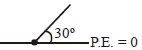
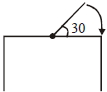
From mechanical energy conservation,\(\mathrm{U}_{\mathrm{i}}+\mathrm{K}_{\mathrm{i}}=\mathrm{U}_{\mathrm{f}}+\mathrm{K}_{\mathrm{r}}\)
\(\Rightarrow \mathrm{mg} \frac{\ell}{2} \sin 30^{\circ}+0=0+\frac{1}{2} \mathrm{I} \omega^{2}\)
\(\Rightarrow \operatorname{mg} \times \frac{1}{2} \times \frac{1}{2}+0=0+\frac{1}{2} \times \frac{\mathrm{m}(1)^{2}}{3} \omega^{2}\)
\(\Rightarrow \omega^{2}=\frac{3 \mathrm{g}}{2} \Rightarrow \omega=\sqrt{15}\)
\(\therefore n=15\)
-
- (A) \(10\)
- (B) \(13\)
- (C) \(15\)
- (D) \(18\)
જવાબ અને ઉકેલ જુઓ
સાચો જવાબ: (C)
From mechanical energy conservation,\(\mathrm{U}_{\mathrm{i}}+\mathrm{K}_{\mathrm{i}}=\mathrm{U}_{\mathrm{f}}+\mathrm{K}_{\mathrm{r}}\)
\(\Rightarrow \mathrm{mg} \frac{\ell}{2} \sin 30^{\circ}+0=0+\frac{1}{2} \mathrm{I} \omega^{2}\)
\(\Rightarrow \operatorname{mg} \times \frac{1}{2} \times \frac{1}{2}+0=0+\frac{1}{2} \times \frac{\mathrm{m}(1)^{2}}{3} \omega^{2}\)
\(\Rightarrow \omega^{2}=\frac{3 \mathrm{g}}{2} \Rightarrow \omega=\sqrt{15}\)
\(\therefore n=15\)
-
- (A) \(7\)
- (B) \(20\)
- (C) \(15\)
- (D) \(9\)
જવાબ અને ઉકેલ જુઓ
સાચો જવાબ: (D)
\(L _{ i }= L _{ f }\)\(\left(80 R ^{2}+\frac{200 R ^{2}}{2}\right) \omega=\left(0+\frac{200 R ^{2}}{2}\right) \omega_{1}\)
\(180 \omega_{0}=100 \omega_{1}\)
\(\omega_{1}=1.8 \omega_{0}=1.8 \times 5\)
\(=9 rpm\)
-
- (A) \(7\)
- (B) \(20\)
- (C) \(15\)
- (D) \(9\)
જવાબ અને ઉકેલ જુઓ
સાચો જવાબ: (D)
\(L _{ i }= L _{ f }\)\(\left(80 R ^{2}+\frac{200 R ^{2}}{2}\right) \omega=\left(0+\frac{200 R ^{2}}{2}\right) \omega_{1}\)
\(180 \omega_{0}=100 \omega_{1}\)
\(\omega_{1}=1.8 \omega_{0}=1.8 \times 5\)
\(=9 rpm\)
-
- (A) \(\cos \theta=\frac{g}{2 \ell \omega^{2}}\)
- (B) \(\cos \theta=\frac{3 g}{2 \ell \omega^{2}}\)
- (C) \(\cos \theta=\frac{2 g}{3 \ell \omega^{2}}\)
- (D) \(\cos \theta=\frac{g}{\ell \omega^{2}}\)
જવાબ અને ઉકેલ જુઓ
સાચો જવાબ: (B)
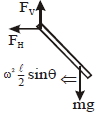
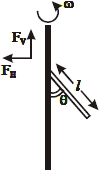
\(F_{V}=m g\)\(F_{H}=m \omega^{2} \frac{\ell}{2} \sin \theta\)
\(mg \frac{\ell}{2} \sin \theta- m \omega^{2} \frac{\ell}{2} \sin \theta \frac{\ell}{2} \cos \theta=\frac{ m \ell^{2}}{12} \omega^{2} \sin \theta \cos \theta\)
\(\cos \theta=\frac{3}{2} \frac{g}{\omega^{2} \ell}\) \(....(ii)\)
-
- (A) \(\cos \theta=\frac{g}{2 \ell \omega^{2}}\)
- (B) \(\cos \theta=\frac{3 g}{2 \ell \omega^{2}}\)
- (C) \(\cos \theta=\frac{2 g}{3 \ell \omega^{2}}\)
- (D) \(\cos \theta=\frac{g}{\ell \omega^{2}}\)
જવાબ અને ઉકેલ જુઓ
સાચો જવાબ: (B)
\(F_{V}=m g\)\(F_{H}=m \omega^{2} \frac{\ell}{2} \sin \theta\)
\(mg \frac{\ell}{2} \sin \theta- m \omega^{2} \frac{\ell}{2} \sin \theta \frac{\ell}{2} \cos \theta=\frac{ m \ell^{2}}{12} \omega^{2} \sin \theta \cos \theta\)
\(\cos \theta=\frac{3}{2} \frac{g}{\omega^{2} \ell}\) \(....(ii)\)
-
- (A) \(200\)
- (B) \(195\)
- (C) \(150\)
- (D) \(175\)
જવાબ અને ઉકેલ જુઓ
સાચો જવાબ: (B)
\(\vec{\tau}=\left(\overrightarrow{ r}_{2}-\overrightarrow{ r }_{1}\right) \times \overrightarrow{ F }\)\(=[(4 \hat{ i }+3 \hat{ j }-\hat{ k })-(\hat{ i }+2 \hat{ j }+\hat{ k })] \times \overrightarrow{ F }\)
\(=(3 \hat{i}+\hat{j}-2 \hat{k}) \times(\hat{i}+2 \hat{j}+3 \hat{k})\)
\(\tau=\left|\begin{array}{ccc}\hat{i} & \hat{j} & \hat{k} \\ 3 & 1 & -2 \\ 1 & 2 & 3\end{array}\right|\)
\(=7 \hat{ i }-11 \hat{ j }+5 \hat{ k }\)
\(|\vec{\tau}|=\sqrt{195}\)
- 109. \(8\) સેમી ત્રિજ્યાના અર્ધગોળાનું દ્રવ્યમાન કેન્દ્ર સમતલ સપાટીથી \(x\,cm\) ઊંચાઈ પર હોય તો \(x=......\) 2020 મધ્યમ
- (A) \(5\)
- (B) \(3\)
- (C) \(9\)
- (D) \(10\)
જવાબ અને ઉકેલ જુઓ
સાચો જવાબ: (B)
\(x=\frac{3 R}{8}=3 c m\)\(x=3\)

- 110. \(8\) સેમી ત્રિજ્યાના અર્ધગોળાનું દ્રવ્યમાન કેન્દ્ર સમતલ સપાટીથી \(x\,cm\) ઊંચાઈ પર હોય તો \(x=......\) 2020 મધ્યમ
- (A) \(5\)
- (B) \(3\)
- (C) \(9\)
- (D) \(10\)
જવાબ અને ઉકેલ જુઓ
સાચો જવાબ: (B)
\(x=\frac{3 R}{8}=3 c m\)\(x=3\)
-
- (A) \(80\)
- (B) \(75\)
- (C) \(85\)
- (D) \(82\)
જવાબ અને ઉકેલ જુઓ
સાચો જવાબ: (B)
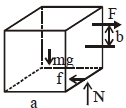
\(\mathrm{F}=\mu \mathrm{m} \mathrm{g}\dots (1)\)\(\mathrm{F}\left(\mathrm{b}+\frac{\mathrm{a}}{2}\right)=\mathrm{mg} \frac{\mathrm{a}}{2}\dots (2)\)
\(\mu m g\left(b+\frac{a}{2}\right)=m g \times \frac{a}{2}\)
\(\left(b+\frac{a}{2}\right) \mu=\frac{a}{2}\)
\(0.4=\mu=\frac{a}{2 b+a}\)
\(0.8 b+0.4 a=a\)
\(0.8 \mathrm{b}=0.6 \mathrm{a}\)
\(\frac{b}{a}=\frac{3}{4}\)
-
- (A) \(80\)
- (B) \(75\)
- (C) \(85\)
- (D) \(82\)
જવાબ અને ઉકેલ જુઓ
સાચો જવાબ: (B)
\(\mathrm{F}=\mu \mathrm{m} \mathrm{g}\dots (1)\)\(\mathrm{F}\left(\mathrm{b}+\frac{\mathrm{a}}{2}\right)=\mathrm{mg} \frac{\mathrm{a}}{2}\dots (2)\)
\(\mu m g\left(b+\frac{a}{2}\right)=m g \times \frac{a}{2}\)
\(\left(b+\frac{a}{2}\right) \mu=\frac{a}{2}\)
\(0.4=\mu=\frac{a}{2 b+a}\)
\(0.8 b+0.4 a=a\)
\(0.8 \mathrm{b}=0.6 \mathrm{a}\)
\(\frac{b}{a}=\frac{3}{4}\)
-
- (A) \(15\)
- (B) \(45\)
- (C) \(30\)
- (D) \(23\)
જવાબ અને ઉકેલ જુઓ
સાચો જવાબ: (D)
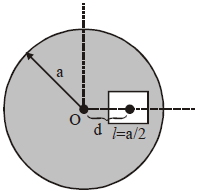
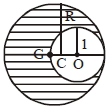
\(X _{ com }=\frac{ m _{1} x _{1}- m _{2} x _{2}}{ m _{1}- m _{2}}\)where
\(m _{1}=\) mass of complete disc
\(m _{2}=\) removed mass
Let \(\sigma=\) surface mass density of disc material
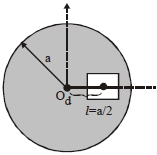
wrt \({ }^{\prime} O ^{\prime}: X_{ com }=\frac{\sigma \pi a ^{2}( O )-\sigma \cdot \frac{ a ^{2}}{4} \cdot d }{\sigma \pi a ^{2}-\sigma \frac{ a ^{2}}{4}}=\frac{-\frac{ a ^{2}}{4} d }{\pi a ^{2}-\frac{ a ^{2}}{4}}\)
\(=\frac{-d}{4 \pi-1}=-\frac{a}{2(4 \pi-1)}\)
So, \(X=2(4 \pi-1)=(8 \pi-2)=23.12\)
So, nearest integer value of \(X=23\)
-
- (A) \(15\)
- (B) \(45\)
- (C) \(30\)
- (D) \(23\)
જવાબ અને ઉકેલ જુઓ
સાચો જવાબ: (D)
\(X _{ com }=\frac{ m _{1} x _{1}- m _{2} x _{2}}{ m _{1}- m _{2}}\)where
\(m _{1}=\) mass of complete disc
\(m _{2}=\) removed mass
Let \(\sigma=\) surface mass density of disc material
wrt \({ }^{\prime} O ^{\prime}: X_{ com }=\frac{\sigma \pi a ^{2}( O )-\sigma \cdot \frac{ a ^{2}}{4} \cdot d }{\sigma \pi a ^{2}-\sigma \frac{ a ^{2}}{4}}=\frac{-\frac{ a ^{2}}{4} d }{\pi a ^{2}-\frac{ a ^{2}}{4}}\)
\(=\frac{-d}{4 \pi-1}=-\frac{a}{2(4 \pi-1)}\)
So, \(X=2(4 \pi-1)=(8 \pi-2)=23.12\)
So, nearest integer value of \(X=23\)
-
- (A) \(25\)
- (B) \(33\)
- (C) \(30\)
- (D) \(39\)
જવાબ અને ઉકેલ જુઓ
સાચો જવાબ: (A)
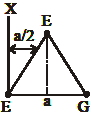
\(I =0+ m \left(\frac{ a }{2}\right)^{2}+ ma ^{2}\)\(=\frac{5}{4} ma ^{2}\)
-
- (A) \(25\)
- (B) \(33\)
- (C) \(30\)
- (D) \(39\)
જવાબ અને ઉકેલ જુઓ
સાચો જવાબ: (A)
\(I =0+ m \left(\frac{ a }{2}\right)^{2}+ ma ^{2}\)\(=\frac{5}{4} ma ^{2}\)
-
- (A) \(2\)
- (B) \(0.5\)
- (C) \(0.75\)
- (D) \(1\)
જવાબ અને ઉકેલ જુઓ
સાચો જવાબ: (D)
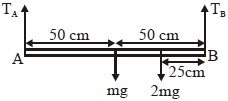
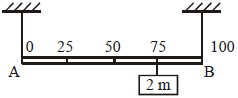
\(\tau_{ B }=0\) (torque about point \(B\) is zero \()\)\(\left(T_{A}\right) \times 100-(m g) \times 50-(2 m g) \times 25=0\)
\(100 T _{ A }=100 mg\)
\(T_{A}=1 mg\)
-
- (A) \(2\)
- (B) \(0.5\)
- (C) \(0.75\)
- (D) \(1\)
જવાબ અને ઉકેલ જુઓ
સાચો જવાબ: (D)
\(\tau_{ B }=0\) (torque about point \(B\) is zero \()\)\(\left(T_{A}\right) \times 100-(m g) \times 50-(2 m g) \times 25=0\)
\(100 T _{ A }=100 mg\)
\(T_{A}=1 mg\)
-
- (A) \(69\)
- (B) \(63\)
- (C) \(55\)
- (D) \(49\)
જવાબ અને ઉકેલ જુઓ
સાચો જવાબ: (B)
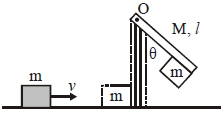
Angular momentum conservation\(mv l=\frac{ Ml ^{2}}{3} \omega+ m l^{2} \omega\)
\(\Rightarrow \omega=\frac{1 \times 6 \times 1}{\frac{2}{3}+1}=\frac{18}{5}\)
Now using energy consevation
\(\frac{1}{2}\left( M \frac{l^{2}}{3}\right) \omega^{2}+\frac{1}{2}\left( m l^{2}\right) \omega^{2}\)
\(=( m + M ) r _{ cm }(1-\cos \theta)\)
\(=( m + M )\left(\frac{ m l+\frac{ M l}{2}}{ m + M }\right) g (1-\cos \theta)\)
\(\frac{5}{6} \times\left(\frac{18}{5}\right)^{2}=20(1-\cos \theta)\)
\(\Rightarrow 1-\cos \theta=\frac{18}{5} \times \frac{3}{20}\)
\(\cos \theta=1-\frac{27}{50}\)
\(\cos \theta=\frac{23}{50} \Rightarrow \theta \simeq 63^{\circ}\)
-
- (A) \(\sqrt{\frac{2 gC }{ ab }}\)
- (B) \(2 \sqrt{2 g C}\)
- (C) \(\sqrt{\frac{2 g}{C}}\)
- (D) \(2 \sqrt{ gC }\)
જવાબ અને ઉકેલ જુઓ
સાચો જવાબ: (B)
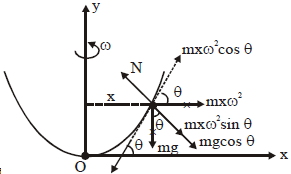
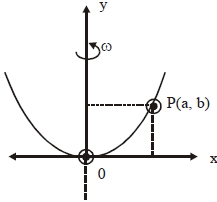
In rotating frame\(mx \omega^{2} \cos \theta= mg \sin \theta\)
\(x \omega^{2}= g \tan \theta\)
\(x \omega^{2}= g \cdot \frac{ dy }{ dx }\)
\(x \omega^{2}= g \cdot(8 cx )\)
\(\omega^{2}=8 gc\)
\(\omega=2 \sqrt{2 gc }\)
-
- (A) \(\sqrt{\frac{2 gC }{ ab }}\)
- (B) \(2 \sqrt{2 g C}\)
- (C) \(\sqrt{\frac{2 g}{C}}\)
- (D) \(2 \sqrt{ gC }\)
જવાબ અને ઉકેલ જુઓ
સાચો જવાબ: (B)
In rotating frame\(mx \omega^{2} \cos \theta= mg \sin \theta\)
\(x \omega^{2}= g \tan \theta\)
\(x \omega^{2}= g \cdot \frac{ dy }{ dx }\)
\(x \omega^{2}= g \cdot(8 cx )\)
\(\omega^{2}=8 gc\)
\(\omega=2 \sqrt{2 gc }\)
-
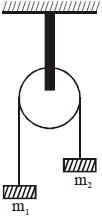
- (A) \(\left[\frac{m_{1}+m_{2}}{\left(m_{1}+m_{2}\right) R^{2}+I}\right]^{\frac{1}{2}} g h\)
- (B) \(\left[\frac{2\left(\mathrm{m}_{1}-\mathrm{m}_{2}\right) \mathrm{gh}}{\left(\mathrm{m}_{1}+\mathrm{m}_{2}\right) \mathrm{R}^{2}+\mathrm{I}}\right]^{\frac{1}{2}}\)
- (C) \(\left[\frac{2\left(\mathrm{m}_{1}+\mathrm{m}_{2}\right) \mathrm{gh}}{\left(\mathrm{m}_{1}+\mathrm{m}_{2}\right) \mathrm{R}^{2}+\mathrm{I}}\right]^{\frac{1}{2}}\)
- (D) \(\left[\frac{\left(\mathrm{m}_{1}-\mathrm{m}_{2}\right)}{\left(\mathrm{m}_{1}+\mathrm{m}_{2}\right) \mathrm{R}^{2}+\mathrm{I}}\right]^{\frac{1}{2}} \mathrm{gh}\)
જવાબ અને ઉકેલ જુઓ
સાચો જવાબ: (B)
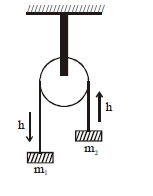
by using work energy theorem\(\mathrm{Wg}=\Delta \mathrm{KE}\)
\(\left(\mathrm{m}_{1}-\mathrm{m}_{2}\right) \mathrm{gh}=\frac{1}{2}\left(\mathrm{m}_{1}+\mathrm{m}_{2}\right) \mathrm{V}^{2}+\frac{1}{2} \mathrm{I} \omega^{2}\)
\(\left(\mathrm{m}_{1}-\mathrm{m}_{2}\right) \mathrm{gh}=\frac{1}{2}\left(\mathrm{m}_{1}+\mathrm{m}_{2}\right)(\omega \mathrm{R})^{2}+\frac{1}{2} \mathrm{I} \omega^{2}\)
\(\left(\mathrm{m}_{1}-\mathrm{m}_{2}\right) \mathrm{gh}=\frac{\omega^{2}}{2}\left[\left(\mathrm{m}_{1}+\mathrm{m}_{2}\right) \mathrm{R}^{2}+\mathrm{I}\right]\)
\(\omega=\sqrt{\frac{2\left(\mathrm{m}_{1}-\mathrm{m}_{2}\right) \mathrm{gh}}{\left(\mathrm{m}_{1}+\mathrm{m}_{2}\right) \mathrm{R}^{2}+\mathrm{I}}}\)
-
- (A) \(\left[\frac{m_{1}+m_{2}}{\left(m_{1}+m_{2}\right) R^{2}+I}\right]^{\frac{1}{2}} g h\)
- (B) \(\left[\frac{2\left(\mathrm{m}_{1}-\mathrm{m}_{2}\right) \mathrm{gh}}{\left(\mathrm{m}_{1}+\mathrm{m}_{2}\right) \mathrm{R}^{2}+\mathrm{I}}\right]^{\frac{1}{2}}\)
- (C) \(\left[\frac{2\left(\mathrm{m}_{1}+\mathrm{m}_{2}\right) \mathrm{gh}}{\left(\mathrm{m}_{1}+\mathrm{m}_{2}\right) \mathrm{R}^{2}+\mathrm{I}}\right]^{\frac{1}{2}}\)
- (D) \(\left[\frac{\left(\mathrm{m}_{1}-\mathrm{m}_{2}\right)}{\left(\mathrm{m}_{1}+\mathrm{m}_{2}\right) \mathrm{R}^{2}+\mathrm{I}}\right]^{\frac{1}{2}} \mathrm{gh}\)
જવાબ અને ઉકેલ જુઓ
સાચો જવાબ: (B)
by using work energy theorem\(\mathrm{Wg}=\Delta \mathrm{KE}\)
\(\left(\mathrm{m}_{1}-\mathrm{m}_{2}\right) \mathrm{gh}=\frac{1}{2}\left(\mathrm{m}_{1}+\mathrm{m}_{2}\right) \mathrm{V}^{2}+\frac{1}{2} \mathrm{I} \omega^{2}\)
\(\left(\mathrm{m}_{1}-\mathrm{m}_{2}\right) \mathrm{gh}=\frac{1}{2}\left(\mathrm{m}_{1}+\mathrm{m}_{2}\right)(\omega \mathrm{R})^{2}+\frac{1}{2} \mathrm{I} \omega^{2}\)
\(\left(\mathrm{m}_{1}-\mathrm{m}_{2}\right) \mathrm{gh}=\frac{\omega^{2}}{2}\left[\left(\mathrm{m}_{1}+\mathrm{m}_{2}\right) \mathrm{R}^{2}+\mathrm{I}\right]\)
\(\omega=\sqrt{\frac{2\left(\mathrm{m}_{1}-\mathrm{m}_{2}\right) \mathrm{gh}}{\left(\mathrm{m}_{1}+\mathrm{m}_{2}\right) \mathrm{R}^{2}+\mathrm{I}}}\)
-
- (A) \(\left(\mathrm{R}^{2}-\mathrm{R}+1\right)(2-\mathrm{R})=1\)
- (B) \(\left(\mathrm{R}^{2}+\mathrm{R}-1\right)(2-\mathrm{R})=1\)
- (C) \(\left(\mathrm{R}^{2}+\mathrm{R}+1\right)(2-\mathrm{R})=1\)
- (D) \(\left(\mathrm{R}^{2}-\mathrm{R}-1\right)(2-\mathrm{R})=1\)
જવાબ અને ઉકેલ જુઓ
સાચો જવાબ: (C)
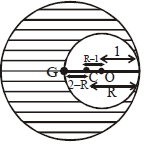
By concept of \(COM\)\(\mathrm{m}_{1} \mathrm{R}_{1}=\mathrm{m}_{2} \mathrm{R}_{2}\)
Remaining mass \(\times(2-\mathrm{R})=\) cavity mass \(\times(\mathrm{R}-1)\)
\(\left(\frac{4}{3} \pi \mathrm{R}^{3} \rho-\frac{4}{3} \pi l^{3} \rho\right)(2-\mathrm{R})=\frac{4}{3} \pi l^{3} \rho \times(\mathrm{R}-1)\)
\(\left(\mathrm{R}^{3}-1\right)(2-\mathrm{R})=\mathrm{R}-1\)
\(\left(\mathrm{R}^{2}+\mathrm{R}+1\right)(2-\mathrm{R})=1\)
-
- (A) \(\left(\mathrm{R}^{2}-\mathrm{R}+1\right)(2-\mathrm{R})=1\)
- (B) \(\left(\mathrm{R}^{2}+\mathrm{R}-1\right)(2-\mathrm{R})=1\)
- (C) \(\left(\mathrm{R}^{2}+\mathrm{R}+1\right)(2-\mathrm{R})=1\)
- (D) \(\left(\mathrm{R}^{2}-\mathrm{R}-1\right)(2-\mathrm{R})=1\)
જવાબ અને ઉકેલ જુઓ
સાચો જવાબ: (C)
By concept of \(COM\)\(\mathrm{m}_{1} \mathrm{R}_{1}=\mathrm{m}_{2} \mathrm{R}_{2}\)
Remaining mass \(\times(2-\mathrm{R})=\) cavity mass \(\times(\mathrm{R}-1)\)
\(\left(\frac{4}{3} \pi \mathrm{R}^{3} \rho-\frac{4}{3} \pi l^{3} \rho\right)(2-\mathrm{R})=\frac{4}{3} \pi l^{3} \rho \times(\mathrm{R}-1)\)
\(\left(\mathrm{R}^{3}-1\right)(2-\mathrm{R})=\mathrm{R}-1\)
\(\left(\mathrm{R}^{2}+\mathrm{R}+1\right)(2-\mathrm{R})=1\)
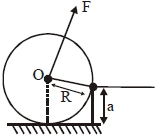
- 127. આકૃતિમાં દર્શાવ્યા પ્રમાણે \(M\) દળ અને \(R\) ત્રિજ્યા ધરાવતો એકસમાન નળાકારને \(a\) (\(a < R\)) ઊંચાઈ પર \(F\) જેટલું બળ at its centre \('O'\)
 2020 અઘરું
- (A) \(Mg \sqrt{1-\frac{ a ^{2}}{ R ^{2}}}\)
- (B) \(Mg \sqrt{\left(\frac{ R }{ R - a }\right)^{2}-1}\)
- (C) \(Mg \frac{ a }{ R }\)
- (D) \(M g \sqrt{1-\left(\frac{R-a}{R}\right)^{2}}\)
જવાબ અને ઉકેલ જુઓ
સાચો જવાબ: (D)
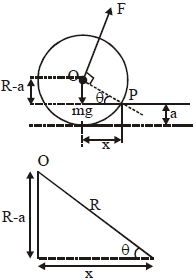
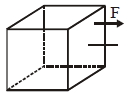
To Step up,\(F \times R \geq M g \times X\)
\(\Rightarrow F_{\min }=\frac{M g}{R} \times \sqrt{R^{2}-(R-a)^{2}}\)
\(\quad\quad\quad\,=M g \sqrt{1-\left(\frac{R-a}{R}\right)^{2}}\)
- 128. આકૃતિમાં દર્શાવ્યા પ્રમાણે \(M\) દળ અને \(R\) ત્રિજ્યા ધરાવતો એકસમાન નળાકારને \(a\) (\(a < R\)) ઊંચાઈ પર \(F\) જેટલું બળ at its centre \('O'\) 2020 અઘરું
- (A) \(Mg \sqrt{1-\frac{ a ^{2}}{ R ^{2}}}\)
- (B) \(Mg \sqrt{\left(\frac{ R }{ R - a }\right)^{2}-1}\)
- (C) \(Mg \frac{ a }{ R }\)
- (D) \(M g \sqrt{1-\left(\frac{R-a}{R}\right)^{2}}\)
જવાબ અને ઉકેલ જુઓ
સાચો જવાબ: (D)
To Step up,\(F \times R \geq M g \times X\)
\(\Rightarrow F_{\min }=\frac{M g}{R} \times \sqrt{R^{2}-(R-a)^{2}}\)
\(\quad\quad\quad\,=M g \sqrt{1-\left(\frac{R-a}{R}\right)^{2}}\)
-
- (A) \(\frac{1}{r} \sqrt{\frac{2 g h}{3}}\)
- (B) \( r \sqrt{\frac{3}{4 g h}}\)
- (C) \( \frac{1}{r} \sqrt{\frac{4 g h}{3}}\)
- (D) \({r} \sqrt{\frac{3}{2 g h}}\)
જવાબ અને ઉકેલ જુઓ
સાચો જવાબ: (C)
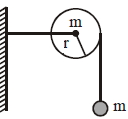
\(\mathrm{mgh}=\frac{1}{2} \mathrm{mv}^{2}+\frac{1}{2} \times \frac{1}{2} \mathrm{mr}^{2} \times \frac{\mathrm{v}^{2}}{\mathrm{r}^{2}}=\frac{3}{4} \mathrm{mv}^{2}\)\(\mathrm{u}=\sqrt{\frac{4}{3} \mathrm{gh}}\)
\(\omega=\frac{V}{r}\)
\(\omega= \frac{1}{r} \sqrt{\frac{4 g h}{3}}\)
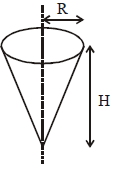
- 131. આકૃતિમાં પોલો આઇસ્ક્રીમ કોન છે ,તેનું દળ \(M,\) ઉપરની ત્રિજ્યા \(R\) અને ઊંચાઈ \(H\) છે,તો આપેલી અક્ષને અનુલક્ષીને જડત્વની ચાક્માત્રા ......
 2020 અઘરું
- (A) \(\frac{ MR ^{2}}{2}\)
- (B) \(\frac{ MH ^{2}}{3}\)
- (C) \(\frac{ MR ^{2}}{3}\)
- (D) \(\frac{ M \left( R ^{2}+ H ^{2}\right)}{4}\)
જવાબ અને ઉકેલ જુઓ
સાચો જવાબ: (A)
સ્પષ્ટીકરણ:
NCERT ધોરણ 11 ભૌતિકવિજ્ઞાન (કણોના તંત્રો અને પરિભ્રમણીય ગતિ પ્રકરણ) ના નિયમો અનુસાર કલનશાસ્ત્ર (calculus) ની મદદથી પોલા શંકુની જડત્વની ચાકમાત્રાની સ્ટેપ-બાય-સ્ટેપ ગણતરી નીચે મુજબ છે:
સ્ટેપ 1: શંકુની ભૂમિતિ સમજવી
ધારો કે શંકુનું શિરોબિંદુ ઊગમબિંદુ પર છે.
- શંકુની ત્રાંસી ઊંચાઈ, \(l = \sqrt{R^2 + H^2}\)
- જો શંકુનો અર્ધ-શિરોકોણ \(\theta\) હોય, તો:
\(\tan\theta = \frac{R}{H}\) અને \(\cos\theta = \frac{H}{\sqrt{R^2+H^2}}\)
આ પોલા શંકુની વક્ર સપાટીનું કુલ ક્ષેત્રફળ \(A = \pi R l = \pi R \sqrt{R^2 + H^2}\) થાય.
તેથી, શંકુની સપાટીની દળ ઘનતા (\(\sigma\)) નીચે મુજબ દર્શાવાય:
\(\sigma = \frac{M}{\pi R \sqrt{R^2 + H^2}}\)
સ્ટેપ 2: વર્તુળાકાર ખંડની પસંદગી
શિરોબિંદુથી અક્ષ પર \(h\) અંતરે આવેલી એક નાની વર્તુળાકાર રીંગ (ખંડ) ધ્યાનમાં લો જેની ત્રિજ્યા \(r\) અને ત્રાંસી પહોળાઈ \(dl\) છે.
ત્રિકોણની ભૂમિતિ પરથી:
\(r = h \tan\theta\)
\(dl = \frac{dh}{\cos\theta}\)
આ નાની રીંગનું ક્ષેત્રફળ (\(dA\)):
\(dA = 2\pi r \cdot dl = 2\pi (h \tan\theta) \frac{dh}{\cos\theta}\)
સ્ટેપ 3: નાની રીંગનું દળ (\(dm\)) મેળવવું
\(dm = \sigma \cdot dA = \left(\frac{M}{\pi R \sqrt{R^2 + H^2}}\right) \cdot \left(2\pi h \frac{\tan\theta}{\cos\theta} dh\right)\)
\(dm = \frac{2M \tan\theta}{R \sqrt{R^2 + H^2} \cos\theta} h dh\)
સ્ટેપ 4: કુલ જડત્વની ચાકમાત્રા (\(I\)) માટે સંકલન કરવું
આ રીંગની પોતાની કેન્દ્રીય અક્ષને અનુલક્ષીને જડત્વની ચાકમાત્રા \(dI = (dm)r^2\) થાય.
અહીં \(r = h \tan\theta\) મુકતા:
\(dI = (dm)(h \tan\theta)^2 = \frac{2M \tan^3\theta}{R \sqrt{R^2 + H^2} \cos\theta} h^3 dh\)
સમગ્ર શંકુ માટે \(h = 0\) થી \(h = H\) ની સીમાઓમાં સંકલન કરતા:
\(I = \int_0^H \frac{2M \tan^3\theta}{R \sqrt{R^2 + H^2} \cos\theta} h^3 dh = \frac{2M \tan^3\theta}{R \sqrt{R^2 + H^2} \cos\theta} \left[ \frac{H^4}{4} \right]\)
સ્ટેપ 5: \(\tan\theta\) અને \(\cos\theta\) ના મૂલ્યો મુકી સાદુંરૂપ આપવું
\(I = \frac{2M \left(\frac{R^3}{H^3}\right)}{R \sqrt{R^2 + H^2} \left(\frac{H}{\sqrt{R^2 + H^2}}\right)} \cdot \frac{H^4}{4}\)
\(I = \frac{2M R^2}{H^4} \cdot \frac{H^4}{4} = \frac{MR^2}{2}\)
આથી, સાચો ઉત્તર વિકલ્પ A છે.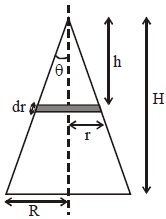
- 132. આકૃતિમાં પોલો આઇસ્ક્રીમ કોન છે ,તેનું દળ \(M,\) ઉપરની ત્રિજ્યા \(R\) અને ઊંચાઈ \(H\) છે,તો આપેલી અક્ષને અનુલક્ષીને જડત્વની ચાક્માત્રા ...... 2020 અઘરું
- (A) \(\frac{ MR ^{2}}{2}\)
- (B) \(\frac{ MH ^{2}}{3}\)
- (C) \(\frac{ MR ^{2}}{3}\)
- (D) \(\frac{ M \left( R ^{2}+ H ^{2}\right)}{4}\)
જવાબ અને ઉકેલ જુઓ
સાચો જવાબ: (A)
Area \(=\pi R \ell=\pi R \left(\sqrt{ H ^{2}+ R ^{2}}\right)\)Area of element \(d A =2 \pi rd \ell==2 \pi r \frac{ dh }{\cos \theta}\)
mass of element \(dm =\frac{ M }{\pi R \sqrt{ H ^{2}+ R ^{2}}} \times \frac{2 \pi rdh }{\cos \theta}\)
\(dm =\frac{2 Mh \tan \theta dh }{ R \sqrt{ H ^{2}+ R ^{2}} \cos \theta} \quad\) (here \(\left. r = h \tan \theta\right)\)
\(I =\int( dm ) r ^{2}=\int \frac{ h ^{2} \tan ^{2} \theta}{\cos \theta}\left(\frac{2 m }{ R } \frac{ h \tan \theta}{\sqrt{ R ^{2}+ H ^{2}}}\right) dh\)
\(=\frac{2 M }{\cos \theta R } \frac{\tan ^{3} \theta}{\sqrt{ R ^{2}+ H ^{2}}}\)
\(\int_{0}^{ H } h ^{3} dh =\frac{ MR ^{2} H ^{4}}{2 RH ^{3} \sqrt{ R ^{2}+ H ^{2}} \cos \theta}\)
\(=\frac{ MR ^{2} H \sqrt{ R ^{2}+ H ^{2}}}{2 \sqrt{ R ^{2}+ H ^{2}} \times H }\)
\(=\frac{ MR ^{2}}{2}\)
- 133. આપેલ ઝંડા આકારની પાતળી તકતીનું દળ \(4\;kg\) છે તો તેના દ્રવ્યમાન કેન્દ્રના યામ શું થશે?
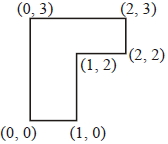 2020 મધ્યમ
- (A) \((1.25\; \mathrm{m}, 1.50\; \mathrm{m})\)
- (B) \((1\; \mathrm{m}, 1.75\; \mathrm{m})\)
- (C) \((0.75\; \mathrm{m}, 0.75\; \mathrm{m})\)
- (D) \((0.75\; \mathrm{m}, 1.75\; \mathrm{m})\)
જવાબ અને ઉકેલ જુઓ
સાચો જવાબ: (D)
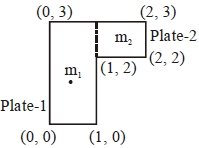
\(\mathrm{m}_{1}=3 \mathrm{kg}\)\(\mathrm{m}_{2}=1 \mathrm{kg}\)
Mass of plate- 1 is assumed to be concentrated at \((0.5,1.5)\)
Mass of plate- 2 is assumed to be concentrated at \((1.5,2.5)\)
\(\mathrm{x}_{\mathrm{cm}}=\frac{\mathrm{m}_{1} \mathrm{x}_{1}+\mathrm{m}_{2} \mathrm{x}_{2}}{\mathrm{m}_{1}+\mathrm{m}_{2}}=\frac{3 \times 0.5+1 \times 1.5}{4}=0.75\)
\(\mathrm{y}_{\mathrm{cm}}=\frac{\mathrm{m}_{1} \mathrm{y}_{1}+\mathrm{m}_{2} \mathrm{y}_{2}}{\mathrm{m}_{1}+\mathrm{m}_{2}}=\frac{3 \times 1.5+1 \times 2.5}{4}=1.75\)
- 134. આપેલ ઝંડા આકારની પાતળી તકતીનું દળ \(4\;kg\) છે તો તેના દ્રવ્યમાન કેન્દ્રના યામ શું થશે? 2020 મધ્યમ
- (A) \((1.25\; \mathrm{m}, 1.50\; \mathrm{m})\)
- (B) \((1\; \mathrm{m}, 1.75\; \mathrm{m})\)
- (C) \((0.75\; \mathrm{m}, 0.75\; \mathrm{m})\)
- (D) \((0.75\; \mathrm{m}, 1.75\; \mathrm{m})\)
જવાબ અને ઉકેલ જુઓ
સાચો જવાબ: (D)
\(\mathrm{m}_{1}=3 \mathrm{kg}\)\(\mathrm{m}_{2}=1 \mathrm{kg}\)
Mass of plate- 1 is assumed to be concentrated at \((0.5,1.5)\)
Mass of plate- 2 is assumed to be concentrated at \((1.5,2.5)\)
\(\mathrm{x}_{\mathrm{cm}}=\frac{\mathrm{m}_{1} \mathrm{x}_{1}+\mathrm{m}_{2} \mathrm{x}_{2}}{\mathrm{m}_{1}+\mathrm{m}_{2}}=\frac{3 \times 0.5+1 \times 1.5}{4}=0.75\)
\(\mathrm{y}_{\mathrm{cm}}=\frac{\mathrm{m}_{1} \mathrm{y}_{1}+\mathrm{m}_{2} \mathrm{y}_{2}}{\mathrm{m}_{1}+\mathrm{m}_{2}}=\frac{3 \times 1.5+1 \times 2.5}{4}=1.75\)
-
- (A) \(15\)
- (B) \(11\)
- (C) \(18\)
- (D) \(20\)
જવાબ અને ઉકેલ જુઓ
સાચો જવાબ: (B)
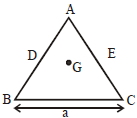
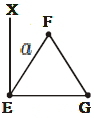
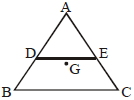
Let side of triangle is a and mass is \(m\)\(MOI\) of plate \(ABC\) about centroid
\(I_{0}=\frac{m}{3}\left(\left(\frac{a}{2 \sqrt{3}}\right)^{2} \times 3\right)=\frac{m a^{2}}{12}\)
triangle \(ADE\) is also an equilateral triangle of side \(a / 2\)
Let moment of inertia of triangular plate \(ADE\) about it's centroid \((G')\) is \(I _{1}\) and \(mass\) is \(m _{1}\)
\(m _{1}=\frac{ m }{\frac{\sqrt{3} a ^{2}}{4}} \times \frac{\sqrt{3}}{4}\left(\frac{ a }{2}\right)^{2}=\frac{ m }{4}\)
\(I _{1}=\frac{ m _{1}}{12}\left(\frac{ a }{2}\right)^{2}=\frac{ m }{4 \times 12} \frac{ a ^{2}}{4}=\frac{ ma ^{2}}{192}\)
distance \(G G^{\prime}=\frac{a}{\sqrt{3}}-\frac{a}{2 \sqrt{3}}=\frac{a}{2 \sqrt{3}}\)
so \(MOI\) of part \(ADE\) about centroid \(G\) is
\(I _{2}= I _{1}+ m _{1}\left(\frac{ a }{2 \sqrt{3}}\right)^{2}=\frac{ ma ^{2}}{192}+\frac{ m }{4} \cdot \frac{ a ^{2}}{12}\)
\(=\frac{5 ma ^{2}}{192}\)
now \(MOI\) of remaining part
\(=\frac{m a^{2}}{12}-\frac{5 m a^{2}}{192}=\frac{11 m a^{2}}{12 \times 16}=\frac{11 I_{0}}{16}\)
\(\Rightarrow \quad N=11\)
-
- (A) \(15\)
- (B) \(11\)
- (C) \(18\)
- (D) \(20\)
જવાબ અને ઉકેલ જુઓ
સાચો જવાબ: (B)
Let side of triangle is a and mass is \(m\)\(MOI\) of plate \(ABC\) about centroid
\(I_{0}=\frac{m}{3}\left(\left(\frac{a}{2 \sqrt{3}}\right)^{2} \times 3\right)=\frac{m a^{2}}{12}\)
triangle \(ADE\) is also an equilateral triangle of side \(a / 2\)
Let moment of inertia of triangular plate \(ADE\) about it's centroid \((G')\) is \(I _{1}\) and \(mass\) is \(m _{1}\)
\(m _{1}=\frac{ m }{\frac{\sqrt{3} a ^{2}}{4}} \times \frac{\sqrt{3}}{4}\left(\frac{ a }{2}\right)^{2}=\frac{ m }{4}\)
\(I _{1}=\frac{ m _{1}}{12}\left(\frac{ a }{2}\right)^{2}=\frac{ m }{4 \times 12} \frac{ a ^{2}}{4}=\frac{ ma ^{2}}{192}\)
distance \(G G^{\prime}=\frac{a}{\sqrt{3}}-\frac{a}{2 \sqrt{3}}=\frac{a}{2 \sqrt{3}}\)
so \(MOI\) of part \(ADE\) about centroid \(G\) is
\(I _{2}= I _{1}+ m _{1}\left(\frac{ a }{2 \sqrt{3}}\right)^{2}=\frac{ ma ^{2}}{192}+\frac{ m }{4} \cdot \frac{ a ^{2}}{12}\)
\(=\frac{5 ma ^{2}}{192}\)
now \(MOI\) of remaining part
\(=\frac{m a^{2}}{12}-\frac{5 m a^{2}}{192}=\frac{11 m a^{2}}{12 \times 16}=\frac{11 I_{0}}{16}\)
\(\Rightarrow \quad N=11\)
-
- (A) \(3.33\)
- (B) \(0.67\)
- (C) \(1.67\)
- (D) \(6.67\)
જવાબ અને ઉકેલ જુઓ
સાચો જવાબ: (D)
Both discs are rotating in same senseAngular momentum conserved for the system
i.e. \(\quad L _{1}+ L _{2}= L _{\text {final }}\)
\(I _{1} \omega_{1}+ I _{2} \omega_{2}=\left( I _{1}+ I _{2}\right) \omega_{ f }\)
\(0.1 \times 10+0.2 \times 5=(0.1+0.2) \times \omega_{f}\)
\(\omega_{ f }=\frac{20}{3}\)
Kinetic energy of combined disc system
\(\Rightarrow \frac{1}{2}\left( I _{1}+ I _{2}\right) \omega_{ f }^{2}\)
\(=\frac{1}{2}(0.1+0.2) \cdot\left(\frac{20}{3}\right)^{2}\)
\(=\frac{0.3}{2} \times \frac{400}{9}=\frac{120}{18}=\frac{20}{3} J\)
-
- (A) \(8.75 \times 10^{-4} \;\mathrm{J}\)
- (B) \(8.75 \times 10^{-3} \;\mathrm{J}\)
- (C) \(6.25 \times 10^{-4} \;\mathrm{J}\)
- (D) \(1.13 \times 10^{-} \;\mathrm{J}\)
જવાબ અને ઉકેલ જુઓ
સાચો જવાબ: (A)
\(\mathrm{m}=0.5 \mathrm{kg}, \mathrm{v}=5 \mathrm{cm} / \mathrm{s}\)\(\mathrm{KE}\) in rolling \(=\frac{1}{2} \mathrm{mv}^{2}+\frac{1}{2} \mathrm{I} \omega^{2}\)
\(=\frac{1}{2} \mathrm{mv}^{2}\left(1+\frac{\mathrm{K}^{2}}{\mathrm{R}^{2}}\right)\)
\(=8.75 \times 10^{-4} \mathrm{J}\)
-
- (A) \(2 \pi \mathrm{a}^{4}\left(\frac{\mathrm{A}}{4}+\frac{\mathrm{aB}}{5}\right)\)
- (B) \( \pi \mathrm{a}^{4}\left(\frac{\mathrm{A}}{4}+\frac{\mathrm{aB}}{5}\right)\)
- (C) \(2 \pi \mathrm{a}^{4}\left(\frac{\mathrm{aA}}{4}+\frac{\mathrm{B}}{5}\right)\)
- (D) \(2 \pi \mathrm{a}^{4}\left(\frac{\mathrm{A}}{4}+\frac{\mathrm{B}}{5}\right)\)
જવાબ અને ઉકેલ જુઓ
સાચો જવાબ: (A)
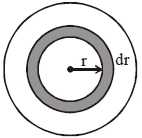
\(\mathrm{dI}=\mathrm{dm}^{2}\)\(\mathrm{dI}=\sigma 2 \pi \mathrm{r}\) dr \(\mathrm{r}^{2}\)
\(\mathrm{dI}=2 \pi(\mathrm{A}+\mathrm{Br}) \mathrm{r}^{3} \mathrm{dr}\)
\(\int \mathrm{dI}=2 \pi \int_{0}^{\mathrm{a}}\left(\mathrm{Ar}^{3}+\mathrm{Br}^{4}\right) \mathrm{dr}\)
\(I=2 \pi a^{4}\left(\frac{A}{4}+\frac{B a}{5}\right)\)
-
- (A) \(2 \pi \mathrm{a}^{4}\left(\frac{\mathrm{A}}{4}+\frac{\mathrm{aB}}{5}\right)\)
- (B) \( \pi \mathrm{a}^{4}\left(\frac{\mathrm{A}}{4}+\frac{\mathrm{aB}}{5}\right)\)
- (C) \(2 \pi \mathrm{a}^{4}\left(\frac{\mathrm{aA}}{4}+\frac{\mathrm{B}}{5}\right)\)
- (D) \(2 \pi \mathrm{a}^{4}\left(\frac{\mathrm{A}}{4}+\frac{\mathrm{B}}{5}\right)\)
જવાબ અને ઉકેલ જુઓ
સાચો જવાબ: (A)
\(\mathrm{dI}=\mathrm{dm}^{2}\)\(\mathrm{dI}=\sigma 2 \pi \mathrm{r}\) dr \(\mathrm{r}^{2}\)
\(\mathrm{dI}=2 \pi(\mathrm{A}+\mathrm{Br}) \mathrm{r}^{3} \mathrm{dr}\)
\(\int \mathrm{dI}=2 \pi \int_{0}^{\mathrm{a}}\left(\mathrm{Ar}^{3}+\mathrm{Br}^{4}\right) \mathrm{dr}\)
\(I=2 \pi a^{4}\left(\frac{A}{4}+\frac{B a}{5}\right)\)
-
- (A) \(0\)
- (B) \(\frac{1}{4}\)
- (C) \(\frac{3}{4}\)
- (D) \(\frac{5}{6}\)
જવાબ અને ઉકેલ જુઓ
સાચો જવાબ: (C)
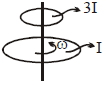
By anglar momentum conservation\(\omega I+3 I \times 0=4 I \omega^{\prime} \Rightarrow \omega^{\prime}=\frac{\omega}{4}\)
\(( KE )_{ i }=\frac{1}{2} I \omega^{2}\)
\(( KE )_{ f }=\frac{1}{2} \times(4 I ) \times\left(\frac{\omega}{4}\right)^{2}=\frac{ I \omega^{2}}{8}\)
\(\Delta KE =\frac{3}{8} I \omega^{2}\)
fractional loss \(=\frac{\Delta KE }{ KE _{1}}=\frac{\frac{3}{8} I \omega^{2}}{\frac{1}{2} I \omega^{2}}=\frac{3}{4}\)
-
- (A) \(0\)
- (B) \(\frac{1}{4}\)
- (C) \(\frac{3}{4}\)
- (D) \(\frac{5}{6}\)
જવાબ અને ઉકેલ જુઓ
સાચો જવાબ: (C)
By anglar momentum conservation\(\omega I+3 I \times 0=4 I \omega^{\prime} \Rightarrow \omega^{\prime}=\frac{\omega}{4}\)
\(( KE )_{ i }=\frac{1}{2} I \omega^{2}\)
\(( KE )_{ f }=\frac{1}{2} \times(4 I ) \times\left(\frac{\omega}{4}\right)^{2}=\frac{ I \omega^{2}}{8}\)
\(\Delta KE =\frac{3}{8} I \omega^{2}\)
fractional loss \(=\frac{\Delta KE }{ KE _{1}}=\frac{\frac{3}{8} I \omega^{2}}{\frac{1}{2} I \omega^{2}}=\frac{3}{4}\)
- 145. ઘડિયાળમાં સેકન્ડ કાંટાની લંબાઈ \(0.1\, m\) છે,તેના ટોચ પરના કણનો સરેરાશ પ્રવેગ ........ \(ms ^{-2}\) 2020 મધ્યમ
- (A) \(10^{-3}\)
- (B) \(10^{-2}\)
- (C) \(10^{-4}\)
- (D) \(10^{-1}\)
જવાબ અને ઉકેલ જુઓ
સાચો જવાબ: (A)
\(R=0.1 m\)\(\omega=\frac{2 \pi}{ T }=\frac{2 \pi}{60}=0.105 rad / sec\)
\(a =\omega^{2} R\)
\(=(0.105)^{2}(0.1)\)
\(=0.0011\)
\(=1.1 \times 10^{-3}\)
Average acceleration is of the order of \(10^{-3}\)
- 146. ઘડિયાળમાં સેકન્ડ કાંટાની લંબાઈ \(0.1\, m\) છે,તેના ટોચ પરના કણનો સરેરાશ પ્રવેગ ........ \(ms ^{-2}\) 2020 મધ્યમ
- (A) \(10^{-3}\)
- (B) \(10^{-2}\)
- (C) \(10^{-4}\)
- (D) \(10^{-1}\)
જવાબ અને ઉકેલ જુઓ
સાચો જવાબ: (A)
\(R=0.1 m\)\(\omega=\frac{2 \pi}{ T }=\frac{2 \pi}{60}=0.105 rad / sec\)
\(a =\omega^{2} R\)
\(=(0.105)^{2}(0.1)\)
\(=0.0011\)
\(=1.1 \times 10^{-3}\)
Average acceleration is of the order of \(10^{-3}\)
-
- (A) \(0.416\)
- (B) \(0.428\)
- (C) \(0.4\)
- (D) \(0.388\)
જવાબ અને ઉકેલ જુઓ
સાચો જવાબ: (D)
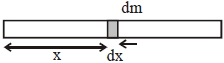
\(I =\int r ^{2} dm =\int x ^{2} \lambda dx\)\(I =\int_{0}^{ L } x ^{2} \lambda_{0}\left(1+\frac{ x }{ L }\right) dx\)
\(I=\lambda_{0} \int_{0}^{L}\left(x^{2}+\frac{x^{3}}{L}\right) d x\)
\(I=\lambda\left[\frac{L^{3}}{3}+\frac{L^{3}}{4}\right]\)
\(I =\frac{7 L ^{3} \lambda_{0}}{12}\) \(...(i)\)
\(M=\int_{0}^{L} \lambda \cdot d x=\int_{0}^{L} \lambda_{0}\left(1+\frac{ x }{ L }\right) dx\)
\(M=\lambda_{0}\left(L+\frac{L}{2}\right)=\lambda_{0} \frac{3 L}{2}\)
\(\frac{2}{3} M =\left(\lambda_{0} L \right)\)\(...(ii)\)
\(From\) \((i)\) \(\&\) \((ii)\)
.\(I=\frac{7}{12}\left(\frac{2}{3} M\right) L^{2}=\frac{7 M L^{2}}{18}\)
-
- (A) \(0.416\)
- (B) \(0.428\)
- (C) \(0.4\)
- (D) \(0.388\)
જવાબ અને ઉકેલ જુઓ
સાચો જવાબ: (D)
\(I =\int r ^{2} dm =\int x ^{2} \lambda dx\)\(I =\int_{0}^{ L } x ^{2} \lambda_{0}\left(1+\frac{ x }{ L }\right) dx\)
\(I=\lambda_{0} \int_{0}^{L}\left(x^{2}+\frac{x^{3}}{L}\right) d x\)
\(I=\lambda\left[\frac{L^{3}}{3}+\frac{L^{3}}{4}\right]\)
\(I =\frac{7 L ^{3} \lambda_{0}}{12}\) \(...(i)\)
\(M=\int_{0}^{L} \lambda \cdot d x=\int_{0}^{L} \lambda_{0}\left(1+\frac{ x }{ L }\right) dx\)
\(M=\lambda_{0}\left(L+\frac{L}{2}\right)=\lambda_{0} \frac{3 L}{2}\)
\(\frac{2}{3} M =\left(\lambda_{0} L \right)\)\(...(ii)\)
\(From\) \((i)\) \(\&\) \((ii)\)
.\(I=\frac{7}{12}\left(\frac{2}{3} M\right) L^{2}=\frac{7 M L^{2}}{18}\)
-
- (A) \(\frac{4}{3}\left(\frac{a+b}{2 a+3 b}\right) L\)
- (B) \(\frac{3}{2}\left(\frac{a+b}{2 a+b}\right) L\)
- (C) \(\frac{3}{2}\left(\frac{2 a+b}{3 a+b}\right) L\)
- (D) \(\frac{3}{4}\left(\frac{2 a+b}{3 a+b}\right) L\)
જવાબ અને ઉકેલ જુઓ
સાચો જવાબ: (D)
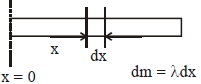
\(\mathrm{x}_{\mathrm{cm}}=\frac{\int \mathrm{xdm}}{\int \mathrm{dm}}=\frac{\int(\lambda \mathrm{dx}) \mathrm{x}}{\int \mathrm{dm}}\)\(=\frac{\int_{0}^{L}\left(a+\frac{b x^{2}}{L^{2}}\right) x d x}{\int_{0}^{L}\left(a+\frac{b x^{2}}{L^{2}}\right) d x}\)
\(=\frac{\frac{a L^{2}}{2}+\frac{b}{L^{2}} \cdot \frac{L^{4}}{4}}{a L+\frac{b}{L^{2}} \cdot \frac{L^{3}}{3}}\)
\(=\frac{\left(\frac{4 a+2 b}{8}\right) L}{\frac{(3 a+b)}{3}}=\frac{3}{4} \frac{(2 a+b) L}{(3 a+b)}\)
-
- (A) \(\frac{4}{3}\left(\frac{a+b}{2 a+3 b}\right) L\)
- (B) \(\frac{3}{2}\left(\frac{a+b}{2 a+b}\right) L\)
- (C) \(\frac{3}{2}\left(\frac{2 a+b}{3 a+b}\right) L\)
- (D) \(\frac{3}{4}\left(\frac{2 a+b}{3 a+b}\right) L\)
જવાબ અને ઉકેલ જુઓ
સાચો જવાબ: (D)
\(\mathrm{x}_{\mathrm{cm}}=\frac{\int \mathrm{xdm}}{\int \mathrm{dm}}=\frac{\int(\lambda \mathrm{dx}) \mathrm{x}}{\int \mathrm{dm}}\)\(=\frac{\int_{0}^{L}\left(a+\frac{b x^{2}}{L^{2}}\right) x d x}{\int_{0}^{L}\left(a+\frac{b x^{2}}{L^{2}}\right) d x}\)
\(=\frac{\frac{a L^{2}}{2}+\frac{b}{L^{2}} \cdot \frac{L^{4}}{4}}{a L+\frac{b}{L^{2}} \cdot \frac{L^{3}}{3}}\)
\(=\frac{\left(\frac{4 a+2 b}{8}\right) L}{\frac{(3 a+b)}{3}}=\frac{3}{4} \frac{(2 a+b) L}{(3 a+b)}\)
આ પેજ પર આ ફિલ્ટર મુજબ કોઈ પ્રશ્ન નથી.