


JEE Mains · Physics · STD 12 - 1. Electric charges and fields
ઉગમબિંદુ \((0,0,0)\) આગળ રહેલ એક વિદ્યુત ડાયપોલની ડાયપોલ મોમેન્ટ \(\overrightarrow{\mathrm{p}}=(-\hat{\mathrm{i}}-3 \hat{\mathrm{j}}+2 \hat{\mathrm{k}}) \times 10^{-29}\; \mathrm{C} \cdot \mathrm{m}\) છે.ડાયપોલને કારણે \(\overrightarrow{\mathrm{r}}=+\hat{\mathrm{i}}+3 \hat{\mathrm{j}}+5 \hat{\mathrm{k}}\) આગળ રહેલ વિદ્યુતક્ષેત્ર કોને સમાંતર હોય? (\(\overrightarrow{\mathrm{r}} \cdot \overrightarrow{\mathrm{p}}=0)\)
- A \((-\hat{i}+3 \hat{j}-2 \hat{k})\)
- B \((+\hat{i}-3 \hat{j}-2 \hat{k})\)
- C \((+\hat{i}+3 \hat{j}-2 \hat{k})\)
- D \((-\hat{i}-3 \hat{j}+2 \hat{k})\)
Answer & Solution
Correct Answer
(C) \((+\hat{i}+3 \hat{j}-2 \hat{k})\)
Step-by-step Solution
Detailed explanation
since \(\overrightarrow{\mathrm{r}}\) and \(\overrightarrow{\mathrm{p}}\) are perpendicular to each other therefore point lies on the equitorial plane. Therefore electric field at the point will be antiparallel to the dipole moment. i.e.…
See the Complete Solution
Get step-by-step explanations for this and 2.5 Lakh+ more JEE, NEET & CET questions.
- Unlock all solutions
- Practice the full chapter
- Track accuracy across PYQs
4.8 rated on Google Play · 14,000+ reviews
More questions from Physics
- ત્રણ સદિશો \(\overrightarrow{\mathrm{OP}}, \overrightarrow{\mathrm{OQ}}\) અને \(\overrightarrow{\mathrm{OR}}\) પ્રત્યેકનું માન \(A\) છે, જે આકૃતિમાં દર્શાવ્યા મુજબ કાર્યરત છે. આ ત્રણ સદિશોનું પરિણામ \(A \sqrt{x}\) છે. \(x\) નું મૂલ્ય _______ છે.
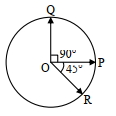 JEE Mains 2024 Hard
 - બંધ પાત્રમાં રહેલ \(2\, L\) પાણીને \(1\,kW\) ની કોઇલ વડે ગરમ કરવામાં આવે છે. જ્યારે પાણી ગરમ થતું હોય ત્યારે પાત્ર \(160\, J/s\) ના દરથી ઉર્જા ગુમાવે છે. પાણીનું તાપમાન \(27\,^oC\) થી \(77\,^oC\) થવા કેટલો સમય લાગે? (પાણીની વિશિષ્ટ ઉષ્મા \(4.2\, kJ/kg\) અને પાત્ર માટે તે અવગણ્ય છે)JEE Mains 2014 Hard
- એક \(16 \Omega\) ના તારને ચોરસ લૂપ બનાવવા માટે વાળવામાં આવે છે. તેની એક બાજુના છેડાઓ વચ્ચે \(1 \Omega\) આંતરિક અવરોધવાળી \(9 V\) ની બેટરીને જોડવામાં આવે છે. જો \(4 \mu F\) નું કેપેસીટર લૂપના વિકર્ણો સાથે જોડવામાં આવે તો કેપેસીટરમાં સંગ્રહીત ઊર્જા \(\frac{x}{2} \mu J\) થાય છે. જ્યાં \(x=\) _________.JEE Mains 2024 Hard
- સૂચિ \(I\) સાથે સૂચિ \(II\)ને જોડો : નીચે આપેલા વિકલ્પોમાંથી સાચો ઉત્તર પસંદ કરોઃ
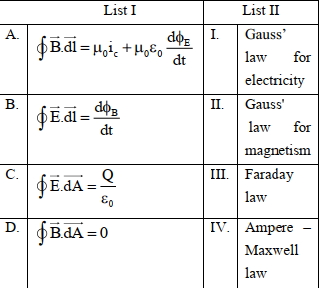 JEE Mains 2024 Hard
 - આપેલ લોઝિક પરિપથના \({A}, {B}\) ના ઈનપુટના મૂલ્યો \((0,0),(0,1),(1,0)\) અને \((1,1)\). તો આઉટપુટ \(Y\) નો ક્રમ કેવો હશે?
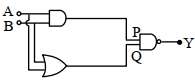 JEE Mains 2021 Medium
 - એક વિદ્યુતચુંબકીય તરંગ ઋણ \(z\) દિશામાં ઊર્જાનું પ્રસરણ કરે છે. ચોક્કસ બિંદુએ અને ચોક્કસ સમયે તરંગનું વિદ્યુતક્ષેત્ર ધન \(y\) દિશામાં છે. તે બિંદુએ અને તે ક્ષણે તરંગનું, ચુંબકીય ક્ષેત્ર કઈ દિશામાં હશે ?JEE Mains 2023 Easy
More PYQs from JEE Mains
- ગણ \(A = \left\{ {x \geq \,:\,{{\tan }^{ - 1}}\,\left( {2x} \right) + {{\tan }^{ - 1}}\,\left( {3x} \right)\, = \frac{\pi }{4}} \right\}\) ની સભ્ય સંખ્યા મેળવો.JEE Mains 2019 Hard
- કેન્દ્રમાંથી પસાર થતી અને લંબાઈને લંબરૂપે રહેલ અક્ષને અનુલક્ષીને એક નળાકારીય સળિયાની ચક્રાવર્તન ત્રિજ્યા \((radius\,of\,gyration) \dots \dots m\) હશે. (સળિયાની લંબાઈ \(10 \sqrt{3} m\) આપેલ છે).JEE Mains 2022 Medium
- \(1000\) નાના પાણીના ટીપાં સંયોજિત થવાથી એક મોટું ટીપું બને છે. પૃષ્ઠ ઊર્જા _______ થશે.JEE Mains 2024 Hard
- ધારો કે \({I_n} = \smallint {\tan ^n}xdx,\left( {n > 1} \right).\) જો \({I_4} + {I_6} = a{\tan ^5}x + b{x^5} + C\), જયાં \(C\) સંકલનનો અચળાંક છે. તો ક્રમયુકત જોડ \(\left( {a,b} \right)\) બરાબર . . . છે.JEE Mains 2017 Medium
- કોઈ \(10\, m\) લાંબો સમક્ષિતિજ તાર કે જે ઉત્તર-પૂર્વથી દક્ષિણ-પશ્ચિમ દિશામાં ખેંચાયેલો હોય અને પૃથ્વીના \(0.3\times 10^{-4}\,Wb/m^2\) ના ચુંબકીય ક્ષેત્રના સમક્ષિતિજ ઘટકને કાટકોણે \(5.0\, ms^{-1}\) ની ઝડપથી પતન કરે છે. પ્રેરિત \(emf\) નું તત્ક્ષણિક મૂલ્ય કેટલું હશે.JEE Mains 2019 Medium
- એક કણને પૃથ્વીની સપાટીથી \(S\) ઊંચાઈએથી મુક્ત કરવામાં આવે છે. કોઈ ચોક્કસ ઊંચાઈએ તેની ગતિઊર્જા તેની સ્થિતિઊર્જા કરતાં ત્રણ ગણી છે. પૃથ્વીની સપાટીથી તે ઊંચાઈ અને તે ક્ષણે કણની ઝડપ અનુક્રમે _______ છે.JEE Mains 2025 Easy