


All JEE Mains 2020 Chemistry questions
25 chaptersShowing 101–150 of 204 questions
-
- (A) \(100\; \mathrm{ml}\) of \(0.1\; \mathrm{N} \;\mathrm{HCl}\)
- (B) \(200\; \mathrm{ml}\) of \(0.4\; \mathrm{N} \;\mathrm{HCl}\)
- (C) \(100\; \mathrm{ml}\) of \(0.2\; \mathrm{N} \;\mathrm{HCl}\)
- (D) \(200\; \mathrm{ml}\) of \(0.2\; \mathrm{N} \;\mathrm{HCl}\)
Show answer and solution
Correct Answer: (C)
\(\mathrm{NH}_{2} \mathrm{CONH}_{2}+2 \mathrm{NaOH} \rightarrow \mathrm{Na}_{2} \mathrm{CO}_{3}+2 \mathrm{NH}_{3}\)\(10\; moles \quad \quad \quad \quad \quad \quad \quad \quad \quad \quad \quad 20 \mathrm{moles}\)
Hence, \(\mathrm{NH}_{3}\) will require \(20 \mathrm{moles}\)
-
- (A) liquid dinitrogen is not used in cryosurgery.
- (B) it can be used as an inert diluent for reactive chemicals.
- (C) it can combine with dioxygen at \(25^{\circ} C\)
- (D) \(N _{2}\) is paramagnetic in nature.
Show answer and solution
Correct Answer: (B)
\((1)\) Liquid nitrogen is used as a refreigerant to preserve biological material food items and in cryosurgery.\((2)\) In iron and chemical Industry inter dilluent for reactive chemicals
- 103. The electron gain enthalpy (in \(kJ/mol\)) of fluorine, chlorine, bromine and iodine, respectively are 2020 Medium
- (A) \(-333, -349, -325\) and \(-296\)
- (B) \(-296, -325, -333\) and \(-349\)
- (C) \(-333, -325, -349\) and \(-296\)
- (D) \(-349, -333, -325\) and \(-296\)
Show answer and solution
Correct Answer: (A)
Order of electron gain enthalpy (magnitude) is \(Cl > F > Br > I\) -
- (A) \(4\) and \(8\)
- (B) \(4\) and \(6\)
- (C) \(8\) and \(8\)
- (D) \(8\) and \(6\)
Show answer and solution
Correct Answer: (C)
\(8\) bonds are present between sulphur and oxygen. (It is best answer in given options) Rhombic sulphur\(8\) bonds are present between sulphur and sulphur atoms.

-
- (A) \(4\)
- (B) \(1\)
- (C) \(2\)
- (D) \(3\)
Show answer and solution
Correct Answer: (B)
\(\mathrm{P}_{4}+3 \mathrm{NaOH}+3 \mathrm{H}_{2} \mathrm{O} \longrightarrow 3 \mathrm{NaH}_{2} \mathrm{PO}_{2} (X)+\mathrm{PH}_{3}\)\(\mathrm{NaH}_{2} \mathrm{PO}_{2}+\mathrm{HCl} \longrightarrow \mathrm{NaCl}+\mathrm{H}_{3} \mathrm{PO}_{2}(Y)\)
\(\mathrm{H}_{3} \mathrm{PO}_{2}\to \) mono basic acid
-
- (A) \(F, Se\) and \(Na\)
- (B) \(F, S\) and \(Li\)
- (C) \(Cl, S\) and \(Li\)
- (D) \(Cl, Se\) and \(Na\)
Show answer and solution
Correct Answer: (C)
(i) Electron affinity of second period \(p-\)block element is less than third period \(p-\)block element due to small size of second period \(p-\)block element.\(E.A.\) order : \(F < Cl\)
(ii) Down the group electron affinity decreases due to size increases.\(EA.\) order : \(S > Se\) \(Li > Na\)
-
- (A) only silver
- (B) only gold
- (C) silver and gold in equal mass proportion
- (D) silver and gold in proportion to their atomic weights
Show answer and solution
Correct Answer: (D)
As voltage is \({ }^{\prime} 2 V ^{\prime}\) so both \(Ag ^{+} \& Au ^{+}\) will reduce and their equal gm equivalent will reduce so\(gmeq\, Ag = gmeq\) of \(Au\)
\(\frac{ Wt _{ Ag }}{ E _{ qw t _{ Ag }}}=\frac{ Wt _{ Au }}{ E _{ qwt_{ Au}} }\)
So \(\frac{ wt _{ Ag }}{ wt _{ Au }}=\)\(\frac{E_{q w t_{Ag}}}{E_{q w t_{A u}}}\)\(=\frac{A t w t_{A g}}{A t w t_{A u}}\)
-
- (A) \(60\)
- (B) \(56\)
- (C) \(64\)
- (D) \(50\)
Show answer and solution
Correct Answer: (A)
Moles of \(e ^{\ominus}=\left(\frac{8 \times 60 \times 2}{96000}\right)\)Using stoichiometry; theoritically
\(\frac{ n _{ e ^{\ominus}} used }{6}=\)\(\frac{ n _{ cr ^{+3}} \text {produced }}{2}\)
\(\Rightarrow n _{ cr ^{+3}}\) produced \(=\frac{2}{6} \times \frac{8 \times 60 \times 2}{96000}\)
\(=\frac{0.02}{6}\)
\(\Rightarrow wt _{ cr ^{+3}}\) theoritically produced
\(=\left(\frac{0.02}{6} \times 52\right) g\)
\(\Rightarrow \%\) efficiency \(=\frac{0.104 g }{\left(\frac{0.02 \times 52}{6}\right) g } \times 100\)
\(=60 \%\)
-
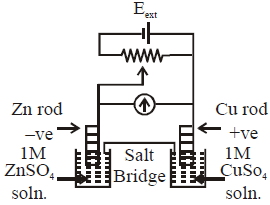
- (A) If \(E _{ ext }>1.1\, V , Zn\) dissolves at \(Zn\) electrode and \(Cu\) deposits at \(Cu\) electrode
- (B) If \(E _{\text {ext }}>1.1\, V , e ^{-}\) flows from \(Cu\) to \(Zn\)
- (C) If \(E _{ ext }=1.1 \,V ,\) no flow of e \(^{-}\) or current occurs
- (D) If \(E _{\text {ext }}<1.1\, V , Zn\) dissolves at anode and \(Cu\) deposits at cathode
Show answer and solution
Correct Answer: (A)
\(E _{\text {cell }}^{\circ}=0.34-(-0.76)\)\(\quad=1.10\) volt
If \(E _{\text {ext }}>1.10\) volt
\(Cu \rightarrow\) Anode
\(Zn \rightarrow\) Cathode
If \(E _{\text {ext }}=1.10\, volt\)
\(Zn \rightarrow\) Anode
\(Cu \rightarrow\) Cathode
-
- (A) \(2.15\)
- (B) \(3.33\)
- (C) \(1.67\)
- (D) \(4.33\)
Show answer and solution
Correct Answer: (A)
Cell reaction is\(\mathrm{Sn}(\mathrm{s})+\mathrm{Pb}^{+2}(\mathrm{aq}) \rightarrow \mathrm{Sn}^{+2}(\mathrm{aq})+\mathrm{Pb}(\mathrm{s})\dots (1)\)
Apply Nernst equation:
\(\mathrm{E}_{\text {cell}}=\mathrm{E}_{\text {cel }}^{0}-\frac{0.06}{2} \log \frac{\left[\mathrm{Sn}^{+2}\right]}{\left[\mathrm{Pb}^{+2}\right]}\)
\(\mathrm{E}_{\mathrm{cell}}^{0}=-0.13+0.14=0.01 \mathrm{V}\)
At equilibrium : \(E_{\text {cell}}=0\)
Substituting in \(( 1)\)
\(0=0.01-\frac{0.06}{2} \log \frac{\left[\mathrm{Sn}^{+2}\right]}{\left[\mathrm{Pb}^{+2}\right]}\)
\(\Rightarrow \quad \frac{1}{3}=\log \frac{\left[\mathrm{Sn}^{+2}\right]}{\left[\mathrm{Pb}^{+2}\right]}\)
\(\Rightarrow\; \frac{\left[\mathrm{Sn}^{+2}\right]}{\left\lceil\mathrm{Pb}^{+2}\right\rceil}=2.15\)
-
- (A) \(140\)
- (B) \(144\)
- (C) \(150\)
- (D) \(156\)
Show answer and solution
Correct Answer: (B)
\(Cu ^{+} \longrightarrow Cu + e ^{-}\)\(Cu ^{+}+ e ^{-} \longrightarrow Cu ( s )\)
__________________________________
\(2 Cu ^{+} \longrightarrow Cu ^{2+}+ Cu\)
\(E_{c e l l}^{o}=E_{C u^{+} / C u}^{0}-E_{C u^{2+} / C u^{+}}^{0}\)
\(=0.52-0.16\)
\(=0.36 V\)
At equilibrium \(\rightarrow E _{\text {cell }}=0\)
\(E_{c e l l}^{o}=\frac{R T}{n F} l n K\)
\(\ln K =\frac{ E _{ eell }^{\circ} \times nF }{ RT }\)
\(\ln K =\frac{0.36 \times 1}{0.025}\)
\(=14.4=144 \times 10^{-1}\)
-
- (A) \(C _{1}=2 C _{2}\)
- (B) \(C_{2}=\frac{C 1} {\sqrt{2}}\)
- (C) \(C _{1}= C _{2}\)
- (D) \(C _{2}=\sqrt{2} C _{1}\)
Show answer and solution
Correct Answer: (D)
\(\Delta G =- n F E _{\text {cell }}\)\(\Delta G\) is negative, if \(E _{\text {cell }}\) is positive
Anode : \(\quad Cu ( s ) \longrightarrow Cu ^{-2}\left( C _{1}\right)+2 e ^{-}: E ^{\circ}\)
\(\frac{\text { Cathode }: Cu ^{+2}\left( C _{2}\right)+2 e ^{-} \longrightarrow Cu ( S ):- E ^{\circ}}{\text { Cell reaction }: Cu ^{+2}\left( C _{2}\right) \longrightarrow Cu ^{+2}\left( C _{1}\right) E _{\text {cell }}^{\circ}=0}\)
\(E _{\text {cell }}= E _{\text {cell }}^{\circ}-\frac{2.303 RT }{ nF } \log Q\)
\(E _{\text {cell }}=0-\frac{2.303 RT }{ nF } \log \left(\frac{ C _{1}}{ C _{2}}\right)\)
\(E _{\text {cell }}>0:\) if \(\frac{ C _{1}}{ C _{2}}<1 \Rightarrow C _{1}< C _{2}\)
-
- (A) \(0.158\; \mathrm{V}\)
- (B) \(0.182\; \mathrm{V}\)
- (C) \(-0.182\; \mathrm{V}\)
- (D) \(-0.158\; \mathrm{V}\)
Show answer and solution
Correct Answer: (A)
\(\quad \quad \quad \quad \quad \quad \quad \quad \quad \quad E^{o}\quad \quad \quad \Delta G^o\)\(\mathrm{Cu}^{2 \mathrm{+}}+2 \mathrm{e}^{-} \longrightarrow \mathrm{Cu} \quad 0.34 \quad=-2 \mathrm{F}(0.34)\)
\(\mathrm{Cu}^{+}+\mathrm{e}^{-} \longrightarrow \mathrm{Cu} \quad \quad 0.522 \quad=-\mathrm{F}(0.522)\)
\(\mathrm{Cu}^{2 \mathrm{+}}+\mathrm{e}^{-} \longrightarrow \mathrm{Cu}^{+}\)
\(\Delta \mathrm{G}^{0}=-2 \mathrm{F}(0.34)-(-\mathrm{F}(0.522))\)\(=-\mathrm{F}(0.68-0.522)=-F(0.158)\)
\(\mathrm{E}^{0}=\frac{-\mathrm{F}(0.158)}{-\mathrm{F}}=0.158 \mathrm{V}\)
-
- (A) \(11\)
- (B) \(8\)
- (C) \(18\)
- (D) \(22\)
Show answer and solution
Correct Answer: (A)
\(\frac{10}{122} \times 6=\frac{2 \times( hr ) \times 3600 \times 60 \%}{96500}\)\(+( hr )=\frac{96500}{122 \times 72}=10.98 hr\)
\(=11\) hours
-
- (A) \(\left(\Lambda_{\mathrm{m}}^{0}\right)_{\mathrm{NaBr}}-\left(\Lambda_{\mathrm{m}}^{0}\right)_{\mathrm{NaI}}=\left(\Lambda_{\mathrm{m}}^{0}\right)_{\mathrm{KBr}}-\left(\Lambda_{\mathrm{m}}^{0}\right)_{\mathrm{NaBr}}\)
- (B) \(\left(\Lambda_{\mathrm{m}}^{0}\right)_{\mathrm{H}_{2} \mathrm{O}}=\left(\Lambda_{\mathrm{m}}^{0}\right)_{\mathrm{HCl}}+\left(\Lambda_{\mathrm{m}}^{0}\right)_{\mathrm{NaOH}}-\left(\Lambda_{\mathrm{m}}^{0}\right)_{\mathrm{NaCl}}\)
- (C) \(\left(\Lambda_{\mathrm{m}}^{0}\right)_{\mathrm{KCl}}-\left(\Lambda_{\mathrm{m}}^{0}\right)_{\mathrm{NaCl}}=\left(\Lambda_{\mathrm{m}}^{0}\right)_{\mathrm{KBr}}-\left(\Lambda_{\mathrm{m}}^{0}\right)_{\mathrm{NaBr}}\)
- (D) \(\left(\Lambda_{\mathrm{m}}^{0}\right)_{\mathrm{NaBr}}-\left(\Lambda_{\mathrm{m}}^{0}\right)_{\mathrm{NaCl}}=\left(\Lambda_{\mathrm{m}}^{0}\right)_{\mathrm{KBr}}-\left(\Lambda_{\mathrm{m}}^{0}\right)_{\mathrm{KCl}}\)
Show answer and solution
Correct Answer: (A)
According to Kohlrausch's law correct expression \(\overline{15}\)\(\left(\Lambda_{\mathrm{m}}^{0}\right)_{\mathrm{KBr}}-\left(\Lambda_{\mathrm{m}}^{0}\right)_{\mathrm{NaI}}=\left(\Lambda_{\mathrm{m}}^{0}\right)_{\mathrm{KBr}}-\left(\Lambda_{\mathrm{m}}^{0}\right)_{\mathrm{KI}}\)
The other statements are correct.
-
- (A) \(96500\)
- (B) \(96455\)
- (C) \(96530\)
- (D) \(96570\)
Show answer and solution
Correct Answer: (A)
\(\Delta G =\Delta G ^{\circ}+ RT \ln \left[\frac{ Sn ^{+2}}{ Cu ^{+2}}\right]\)\(=-2 \times 96500[(-0.16)-0.34]+ RT \ln \left(\frac{1}{1}\right)\)
\(=96500 J\)
-
- (A) \(146\)
- (B) \(150\)
- (C) \(142\)
- (D) \(154\)
Show answer and solution
Correct Answer: (C)
\(\frac{1}{2} H _{2} \rightarrow H ^{+}+ e ^{\ominus}\)\(e ^{\ominus}+ AgCl _{(s)} \rightarrow Ag _{(s)}+ Cl ^{\ominus}\)
_______________________________________________________
\(\frac{1}{2} H _{2}+ AgCl _{(s)} \rightarrow H _{( aq )}^{+}+ Ag _{(s)}+ Cl _{( aq )}^{\ominus}\)
\(E =\varepsilon^{0}-\frac{.06}{1} \log \frac{\left[ H ^{+}\right]\left[ Cl ^{\ominus}\right]}{ P _{ H _{2}}^{\frac{1}{2}}}\)
\(E =0.22-.06 \log \frac{\left(10^{-1}\right)\left(10^{-1}\right)}{1^{\frac{1}{2}}}\)
\(E =0.22+.12=34 volt\)
\(\Rightarrow\) total energy of photon will be (for Na)
\(=2.3+0.34=2.64\,eV\)
\(\Rightarrow\) stopping potential required for \(K\)
\(=2.64-2.25=0.39\) volt
\(E=\varepsilon^{0}-\frac{.06}{1} \log \frac{\left[ H ^{+}\right]\left[ Cl ^{-}\right]}{ P _{ H _{2}}^{\frac{1}{2}}}\)
as \(\left[ H ^{+}\right]=\left[ Cl ^{\ominus}\right]\) so
\(0.39=0.22-.06 \log \frac{\left[ H ^{+}\right]^{2}}{1^{\frac{1}{2}}}\)
\(0.17=+.12 pH\)
\(pH =1.4166 \Rightarrow 1.42\)
-
- (A) \(0.64,-5.71\) and \(-14.29\)
- (B) \(28.4,-7.14\) and \(-5.71\)
- (C) \(28.4,-5.71\) and \(-14.29\)
- (D) \(0.64,-7.14\) and \(-5.71\)
Show answer and solution
Correct Answer: (C)
\(\operatorname{In}\left[\frac{ k _{2}}{ k _{1}}\right]=\frac{\Delta H ^{\circ}}{ R }\left\{\frac{1}{ T _{1}}-\frac{1}{ T _{2}}\right\}\)\(\ln (10)=\frac{\Delta H ^{\circ}}{ R }\left\{\frac{1}{298}-\frac{1}{373}\right\}\)
\(373 \times 298 \times R \times 2.303=\Delta H ^{\circ}=28.37 kJ mol ^{-1}\)
\(\Delta G _{ T _{1}}^{\circ}=- RT _{1} \ln \left( K _{1}\right)=-298 R \ln (10)=-5.71 k mol ^{-1}\)
\(\Delta G _{ T _{2}}^{\circ}=- RT _{2} \ln \left( K _{2}\right)=-373 R \ln (100)\)
\(=-14.283 kJ / mol\)
-
- (A) \(CH _{3} COOH\)
- (B) \(KNO _{3}\)
- (C) \(HCl\)
- (D) \(NaCl\)
Show answer and solution
Correct Answer: (A)
Its a weak electrolyte hence : \(CH _{3} COOH\) -
- (A) \(1.52\)
- (B) \(2.56\)
- (C) \(0.36\)
- (D) \(3.56\)
Show answer and solution
Correct Answer: (A)
\(\mathrm{O}_{2}(\mathrm{g})+4 \mathrm{H}^{+}+4 \mathrm{e}^{-} \rightarrow 2 \mathrm{H}_{2} \mathrm{O}(l) ; \mathrm{E}_{\mathrm{red.}}^{0}=1.23 \mathrm{V}\)From nernst equation
\(\mathrm{E}_{\text {cell }}=\mathrm{E}_{\text {cell }}^{0}-\frac{\mathrm{RT}}{\mathrm{nF}} \ln \mathrm{Q}\)
at \(1\; bar\) and \(298 \mathrm{K}\)
\(\frac{2.303 \mathrm{RT}}{\mathrm{F}}=0.059\)
\(\mathrm{pH}=5 \Rightarrow\left[\mathrm{H}^{+}\right]=10^{-5} \mathrm{M}\)
\(\mathrm{E}_{\text {cell }}=1.23-\frac{0.059}{4} \log \left[\mathrm{H}^{+}\right]^{4}\)
\(\mathrm{E}_{\text {cell }}=1.23-\frac{0.059}{4} \log \left(10^{-5}\right)^{4}\)
\(=1.23+0.295=1.525 \mathrm{V}\)
-
- (A) \(13\)
- (B) \(10\)
- (C) \(8\)
- (D) \(6\)
Show answer and solution
Correct Answer: (B)
\(\mathrm{ppm}=\frac{10.3 \times 10^{-3}}{1030} \times 10^{6}=10\) -
- (A) \(8.33\)
- (B) \(5.67\)
- (C) \(6.33\)
- (D) \(4.67\)
Show answer and solution
Correct Answer: (B)
gm eq. of \(\mathrm{Ag}=\frac{108}{108}=1\)\(\mathrm{gm}\) eq. of \(\mathrm{O}_{2}(\mathrm{g})=1\)
Volume of \(\mathrm{O}_{2}(\mathrm{g})=22.7 \times \frac{1}{4}=5.675\) litre
-
- (A) \(10\)
- (B) \(5\)
- (C) \(8\)
- (D) \(12\)
Show answer and solution
Correct Answer: (A)
Molar mass of \(Na _{2} CO _{3} \cdot xH _{2} O\)\(\Rightarrow 23 \times 2+12+48+18 x\)
\(\Rightarrow 46+12+48+18 x\)
\(\Rightarrow(106+18 x )\)
\(Eqwt =\frac{ M }{2}=(53+9 x )\)
As \(n _{\text {factor }}\) in dissolution will be determined from net cationic or anionic charge; which is \(2\) so
\(Eqwt =\frac{ M }{2}=53+9 x\)
Gmeq \(=\frac{ wt }{ Eqwt }=\frac{1.43}{53+9 x }\)
Normality \(=\frac{ Gmeq }{ V _{\text {litre }}}\)
Normality \(=0.1=\frac{1.43}{\frac{53+9 x }{0.1}}\)
As volume \(=100 ml\)
\(=0.1 Litre\)
So \(\quad 10^{-2}=\frac{1.43}{53+9 x }\)
\(53+9 x =143\)
\(9 x =90\)
\(x =10.00\)
-
- (A) \((A)\)
- (B) \((C)\)
- (C) \((B)\)
- (D) \((A)\) and \((C)\)
Show answer and solution
Correct Answer: (C)
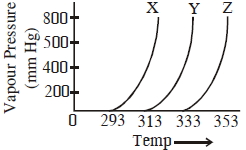
Order of B.P. is : \(Z>Y>X\)Order of vapour pressure \(: Z < Y < X\)
order of intermolecular interaction \(: Z>Y>X\)
-
- (A) \(14\)
- (B) \(22\)
- (C) \(6\)
- (D) \(38\)
Show answer and solution
Correct Answer: (C)
According to Dalton's law of partial pressure\(p _{ i }= x _{ i } \times P _{ T }\)
\(P _{ i }=\) partial pressure of the \(i ^{\text {th }}\) component
\(x _{ i }=\) mole fraction of the \(i ^{\text {th }}\) component
\(p _{ T }=\) total pressure of mixture
\(\Rightarrow 2 atm =\left(\frac{ n _{ H _{2}}}{ n _{ H _{2}}+ n _{ H _{ e }}+ n _{ O _{2}}}\right) \times p _{ T }\)
\(\Rightarrow p _{ T }=2 atm \times \frac{3}{1}=6 atm\)
-
- (A) \(A>B>C\)
- (B) \(A>C>B\)
- (C) \(C>B>A\)
- (D) \(B > C > A\)
Show answer and solution
Correct Answer: (A)
Relative lowering of \(V . P. =\frac{\Delta P }{ P ^{0}}= x _{\text {solute }}\)\(\left(\frac{\Delta P }{ P ^{0}}\right)_{ A }=\frac{\frac{10}{100}}{\frac{10}{100}+\frac{180}{18}}:\left(\frac{\Delta P }{ P ^{0}}\right)_{ B }=\frac{\frac{10}{200}}{\frac{10}{200}+\frac{180}{18}}\)
\(\left(\frac{\Delta P }{ P ^{0}}\right)_{ C }=\frac{\frac{10}{10,000}}{\frac{10}{10,000}+\frac{180}{18}}:\left(\frac{\Delta P }{ P ^{0}}\right)_{ A }>\left(\frac{\Delta P }{ P ^{0}}\right)_{ B }>\left(\frac{\Delta P }{ P ^{0}}\right)_{ C }\)
-
- (A) \(37\)
- (B) \(35\)
- (C) \(40\)
- (D) \(32\)
Show answer and solution
Correct Answer: (A)
\(P _{ CO _{2}}= K _{ H } \times CO _{2}\)\(\frac{3}{30}=\frac{ K _{ H } \cdot n _{ CO _{2}}}{ K _{ H } 1} \Rightarrow n _{ CO _{2}-0.1} mol\)
\(pH =\frac{1}{2}\left( pka _{1}-\log c \right)=\frac{1}{2}(6.4 \times 1)=3.7\)
\(pH =37 \times 10^{-1}\)
-
- (A) \(600\)
- (B) \(620\)
- (C) \(590\)
- (D) \(628\)
Show answer and solution
Correct Answer: (A)
\(550= P _{ A }^{\circ} \times \frac{1}{4}+ P _{ B }^{\circ} \times \frac{3}{4}\)\(2200= P _{ A }^{\circ}+3 P _{ B }^{\circ}\)\(....(i)\)
\(2800= P _{ A }^{\circ}+4 P _{ B }^{\circ}\)\(....(ii)\)
\(560= P _{ A }^{\circ} \times \frac{1}{5}+ P _{ B }^{\circ} \times \frac{4}{5}\)
\(P _{ B }^{\circ}=600, P _{ A }^{\circ}=400\)
-
- (A) heat must be absorbed in order to produce the solution at \(35^oC\)
- (B) Raoult's law is not obeyed by this system
- (C) a mixture of \(100\; mL\; CS_2\) and \(100\; mL\) acetone has a volume \(< 200 \;mL\)
- (D) \(CS_2\) and acetone are less attracted to each other than to themselves
Show answer and solution
Correct Answer: (C)
The vapour pressure of mixture \((=600\; \mathrm{mm} \;\mathrm{Hg}\) ) is greater than the individual vapour pressure of its constituents (Vapour pressure of \(\mathrm{CS}_{2}=512\; \mathrm{mm}\; Hg\), acetone \(=344 \;\mathrm{mm}\; Hg\) ). Hence, the solution formed shows positive deviationfrom Raoult's law.
\(\Rightarrow(1) \Delta_{\mathrm{sol}} \mathrm{H}>0\)
\((2)\) Raoult's law is not obeyed
(3) \(\Delta_{\text {sol. }}\) Volume \(>0\)
(4) \(\mathrm{CS}_{2}\) and Acetone are less attracted to each ether than to themselves.
-
- (A) \(4.97\)
- (B) \(6.63\)
- (C) \(3.52\)
- (D) \(9.47\)
Show answer and solution
Correct Answer: (A)
\(\mathrm{FeSO}_{4} \cdot 7 \mathrm{H}_{2} \mathrm{O}(\mathrm{M}=277.85)\)\(\mathrm{ppm}=\frac{\text { wt. of Fe }}{\text { wt. of wheat }} \times 10^{6}\)
let the wt. of salt be \(=\mathrm{w} \mathrm{gm}\)
moles \(=\frac{\mathrm{w}}{277.85}\)
wt. of \(\mathrm{Fe}=\left(\frac{\mathrm{W}}{277.85} \times 55.85\right) \mathrm{gm}\)
\(10=\frac{\frac{\mathrm{W}}{277.85} \times 55.85}{10^{5}} \times 10^{6}\)
\(W=\frac{277.85}{55.85}=4.97\)
-
- (A) \(2.25\)
- (B) \(2\)
- (C) \(1.75\)
- (D) \(1.5\)
Show answer and solution
Correct Answer: (C)
\(\Delta \mathrm{T}_{\mathrm{f}}=\mathrm{i} \times \mathrm{m} \times \mathrm{K}_{\mathrm{f}}\)\(0.2=2 \times 2 \times \frac{\mathrm{w} / 58.5}{600 / 1000}\)
\(\mathrm{w}=1.755 \mathrm{gm}\)
-
- (A) \(172\)
- (B) \(175\)
- (C) \(180\)
- (D) \(177\)
Show answer and solution
Correct Answer: (D)
Let molar mass of protein \(A=x\) \(g/mol\)Let molar mass of protein \(B = y g / mol\)
\(\pi_{ A }=\) osmotic pressure of protein \(A =\frac{\left(\frac{0.73}{ x }\right)}{0.25} RT\)
\(\pi_{ B }=\) osmotic pressure of protein \(B =\frac{\left(\frac{1.65}{ y }\right)}{1} RT\)
\(\pi_{ A }=\pi_{ B }\)
\(\Rightarrow\left(\frac{0.73}{ x \times 0.25}\right) RT =\left(\frac{1.65}{ y }\right) RT\)
\(\Rightarrow\left(\frac{ x }{ y }\right)=\frac{0.73}{0.25 \times 1.65}=1.769 \cong 1.77\)
-
- (A) \(10\)
- (B) \(5\)
- (C) \(12\)
- (D) \(15\)
Show answer and solution
Correct Answer: (B)
\(\Delta T_{b}=i \times K_{b} \times m\)\(i \times 0.1 \times K_{b}=3 \times 0.05 \times K_{b} \times 2\)
\(i=3\)
\(\left[C r\left(N H_{3}\right)_{5} \cdot C l\right] C l_{2} \rightarrow\left[C r\left(N H_{3}\right)_{5} C l\right]^{+2}+2 C l^{-}\)
\(x=5\)
-
- (A) \(0.37\)
- (B) \(0.67\)
- (C) \(0.87\)
- (D) \(0.63\)
Show answer and solution
Correct Answer: (A)
\(1\; L\) solution requires \(30 \mathrm{m\;mol} \;\mathrm{HCl}\)\(250 \;\mathrm{ml}\) sol. will require \(7.5 \mathrm{m}\; \mathrm{mol} \;\mathrm{HCl}\)
\({\text { or } 3.75 \mathrm{m\;mol}\; \mathrm{H}_{2} \mathrm{SO}_{4}}\)
\({\Rightarrow \frac{3.75 \times 98}{1000} \mathrm{gm} \;\mathrm{H}_{2} \mathrm{SO}_{4}}\)
\({=0.3675 \;\mathrm{gm} \;\mathrm{H}_{2} \mathrm{SO}_{4}}\)
-
- (A) \(150\)
- (B) \(167\)
- (C) \(160\)
- (D) \(159\)
Show answer and solution
Correct Answer: (B)
Osmotic pressure \(=\pi= i \times C \times RT\)For \(NaCl i =2\) so
\(\pi_{ NaCl }= i \times C _{ NaCl } \times RT \quad C _{ NaCl }=\) conc. of \(NaCl\)
\(0.1=2 \times C _{ NaCl } \times RT\)
\(C_{ NaCl }=\frac{0.05}{ RT } \quad C_{\text {glucose }}=\) conc. of glucose
For glucose \(i=1\) so
\(\pi_{\text {Glucose }}= i \times C _{\text {glucose }} \times RT\)
\(0.2=1 \times C _{\text {glucose }} \times RT\)
\(C _{\text {Glucose }}=\frac{0.2}{ RT } \quad \eta_{ NaCl }=\) No. of moles \(NaCl\)
\(\eta_{ NaCl }\) in \(1 L = C _{ NaCl } \times V _{\text {Litre }}\)
\(=\frac{0.05}{ RT } \quad \eta_{ glucose }=\) No. of moles glucose
\(\eta_{\text {glucose }}\) in \(2 L = C _{\text {glucose }} \times V _{\text {Litre }}\)
\(=\frac{0.4}{ RT }\)
\(V _{\text {Total }}=1+2=3 L\)
so Final conc. \(NaCl =\frac{0.05}{3 RT }\)
Final conc. glucose \(=\frac{0.4}{3 RT }\)
\(\pi_{\text {Total }}=\pi_{ NaCl }+\pi_{\text {glucose }}\)
\(=\left[i \times C_{ NaCl }+C_{\text {glucose }}\right] \times RT\)
\(=\left(\frac{2 \times 0.05}{3 RT }+\frac{0.4}{3 RT }\right) \times RT\)
\(=\frac{0.5}{3} atm\)
\(=0.1666 atm\)
\(=166.6 \times 10^{-3} atm\)
\(\Rightarrow 167.00 \times 10^{-3} atm\)
so \(x=167.00\)
-
- (A) The volume of the solution does not change and the volume of the solvent decreases
- (B) The volume of the solution decrease and the volume of the solvent decreases
- (C) The volume of the solution increase and the volume of the solvent decreases
- (D) The volume of the solution and the solvent does not change
Show answer and solution
Correct Answer: (C)
The pure solvent solution will try to maintain higher vapour pressure in the sealed container and in return the solvent vapour molecules will condense in the solution of non-volatile solute as it maintains an equilibrium with lower vapour pressure. (Lowering of vapour pressure is observed when a non volatile solute is mixed in a volatile solvent)This will eventually lead to increase in the volume of solution and decrease in the volume of solvent.
-
- (A) \(20\)
- (B) \(25\)
- (C) \(22\)
- (D) \(18\)
Show answer and solution
Correct Answer: (B)
moles \(=\frac{\text { number of molecules }}{6 \times 10^{23}}=\frac{\text { given mass }}{\text { molar mass }}\)\(\Rightarrow\) molar mas \(=\frac{10 \times 6.023 \times 10^{23}}{6.023 \times 10^{22}}=100 g / mol\)
\(\Rightarrow\) molarity \(=\frac{\text { moles of solute }}{\text { volume of } \operatorname{sol}^{n}(\ell)}=\frac{(5 / 100)}{2}\)
\(=0.025\)
-
- (A) \(90\)
- (B) \(95\)
- (C) \(85\)
- (D) \(80\)
Show answer and solution
Correct Answer: (C)
\(Eq\) of \(H _{2} O _{2}= Eq\) of \(KMnO _{4}\)\(x \times 2=\frac{0.316}{158} \times 5\)
\(x=5 \times 10^{-3} mol\)
\(m _{ H _{2} O _{2}}=5 \times 10^{-3} \times 34=0.17 gm\)
\(\% H _{2} O _{2}=\frac{0.17}{0.2} \times 100=85\)
-
- (A) \(C _{2}=\frac{1000 x _{2}}{ M _{1}+ x _{2}\left( M _{2}- M _{1}\right)}\)
- (B) \(C _{2}=\frac{ d x _{2}}{ M _{2}+ x _{2}\left( M _{2}- M _{1}\right)}\)
- (C) \(C _{2}=\frac{ d x _{1}}{ M _{2}+ x _{2}\left( M _{2}- M _{1}\right)}\)
- (D) \(C _{2}=\frac{1000 dx _{2}}{ M _{1}+ x _{2}\left( M _{2}- M _{1}\right)}\)
Show answer and solution
Correct Answer: (D)
\(C_{2}=\frac{x_{2}}{\left[x_{2} M_{2}+\left(1-x_{2}\right) M_{2}\right] / C l} \times 1000\)\(C_{2}=\frac{1000 d x_{2}}{M_{1}+\left(M_{2}-M_{1}\right) x_{2}}\)
-
- (A) \(4:1\)
- (B) \(1:1\)
- (C) \(2:1\)
- (D) \(3:1\)
Show answer and solution
Correct Answer: (D)
\(\quad \quad{ }^{35} Cl \quad{ }^{37} Cl \quad\) Av. molarlet \(\quad x \quad: \quad 1 \quad\) mass \(=35.5\)
mole ratio
Av. molar mass \(=\frac{ n _{1} M _{1}+ n _{2} M _{2}}{\left( n _{1}+ n _{2}\right)}\)
\(35.5=\frac{x \times 35+1 \times 37}{x+1}\)
\(x=3\)
-
- (A) \(1\) and \(0.5\)
- (B) \(2\) and \(0.5\)
- (C) \(1\) and \(1\)
- (D) \(1\) and \(2\)
Show answer and solution
Correct Answer: (A)
IE values indicate, that the metal belongs to Ist group since second IE is very high ( only one valence electron) Metal hydroxide will be of type, \(MOH\). \(\mathrm{MOH}+\mathrm{HCl} \rightarrow \mathrm{MCl}+\mathrm{H}_{2} \mathrm{O}\)\((1mol)\) \((1 \mathrm{mol})\)
\(\mathrm{MOH}+\frac{1}{2} \mathrm{H}_{2} \mathrm{SO}_{4} \rightarrow \frac{1}{2} \mathrm{M}_{2} \mathrm{SO}_{4}+\mathrm{H}_{2} \mathrm{O}\)
\((1mol) \)\(\left(\frac{1}{2} \mathrm{mol}\right)\)
So one mole of HCl required to react with one mole \(MOH.\)
So \(\frac{1}{2}\) mole of \(\mathrm{H}_{2} \mathrm{SO}_{4}\) required to react with one mole \(MOH.\)
- 142. The mass of ammonia in grams produced when \(2.8\, kg\) of dinitrogen quantitatively reacts with \(1\, kg\) of dihydrogen is............. 2020 Medium
- (A) \(3400\)
- (B) \(3425\)
- (C) \(3390\)
- (D) \(3000\)
Show answer and solution
Correct Answer: (A)
\(N _{2} \quad+\) \(3 H _{2} \rightarrow\) \(2 NH _{3}\) \(\frac{2.8}{28} K mol\) \(\frac{1}{2} K mol\) \(=0.1 K mol\) \(0.5 K mol\) \(-\) \(0\) \(0.2 K mol\) \(0.2 K mol\) mass \(\left( NH _{3}\right)=0.2 \times 17 Kg\)
\(=3.4 Kg\)
\(=3400 gm\)
-
- (A) \(37.84\)
- (B) \(42.67\)
- (C) \(33.33\)
- (D) \(62.16\)
Show answer and solution
Correct Answer: (A)
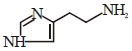
M.F. of Histamine is \(\mathrm{C}_{5} \mathrm{H}_{9} \mathrm{N}_{3}\)Molecular mass of Histamine is 111
Now, mass \(\%\) of nitrogen \(=\left(\frac{42}{111}\right) \times 100\)
\(=37.84 \%\)
-
- (A) \(22\)
- (B) \(19\)
- (C) \(17\)
- (D) \(14\)
Show answer and solution
Correct Answer: (D)
\(100\, \mathrm{gm}\) soln \(\rightarrow 63\, \mathrm{gm} \mathrm{HNO}_{3}\)\(\frac{100}{1.4} \mathrm{mL} \rightarrow 1\) mole \(\mathrm{HNO}_{3}\)
Molarity \(=\frac{1}{\frac{100}{1.4} \times \frac{1}{1000}}=14 \;\mathrm{M}\)
-
- (A) \(8\)
- (B) \(10\)
- (C) \(12\)
- (D) \(5\)
Show answer and solution
Correct Answer: (D)
\(C : H =4: 1\)\(C: O=3: 4\)
Mass ratio
\(C : H : O =12: 3: 16\)
Mole ratio
\(C : H : O =1: 3: 1\)
Empirical formula \(= CH _{3} O\)
Molecular formula \(= C _{2} H _{6} O _{2}\)
(saturated acyclic organic compound)
\(C _{2} H _{6} O _{2}+\frac{5}{2} O _{2} \longrightarrow 2 CO _{2}+3 H _{2} O\)
\(2\, mole\) \(5 \,mol\)
Moles of \(O _{2}\) required \(=5\) moles
- 146. The volume (in \(mL\) ) of \(0.1\, N\) \(NaOH\) required to neutralise \(10\, mL\) of \(0.1\, N\) phosphinic acid is........ 2020 Hard
- (A) \(15\)
- (B) \(18\)
- (C) \(10\)
- (D) \(5\)
Show answer and solution
Correct Answer: (C)
\(H _{3} PO _{2}+ NaOH \rightarrow NaH _{2} PO _{2}+ H _{2} O\)\(\frac{ n _{ H_3 PO _{2}} \text { reacted }}{1}=\frac{ n _{ NaOH } \text { reacted }}{1}\)
\(\Rightarrow \frac{0.1 \times 10}{1}=0.1 \times V _{ NaOH }\)
\(\Rightarrow V _{ NaOH }=10 ml\)
-
- (A) \(32.06\)
- (B) \(38.25\)
- (C) \(26.92\)
- (D) \(24.34\)
Show answer and solution
Correct Answer: (C)
Number of moles of \(\mathrm{Cl}^{-}\) precipitated in \(\left[\mathrm{Co}\left(\mathrm{NH}_{3}\right)_{6}\right] \mathrm{Cl}_{3}\) is equal to number of moles of \(\mathrm{AgNO}_{3}\) used.\(\frac{0.3}{267.46} \times 3=\frac{0.125 \times \mathrm{V}}{1000}\)
where \(\left.\mathrm{V} \text { is volume of } \mathrm{AgNO}_{3} \text { (in } \mathrm{mL}\right)\) \(\mathrm{V}=26.92 \mathrm{mL}\)
-
- (A) \(13\)
- (B) \(15\)
- (C) \(11\)
- (D) \(9\)
Show answer and solution
Correct Answer: (A)
Total \(13\) atom are present in same plane (\(7\) carbon and \(6\) hydrogen atoms.)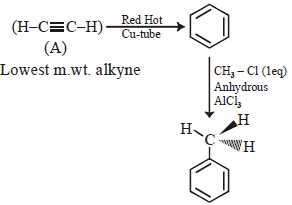
-
- (A) \(4-\)Bromo\(-2-\)methylcyclopentane carboxylic acid
- (B) \(5-\)Bromo\(-3-\)methylcyclopentanoic acid
- (C) \(3-\)Bromo\(-5-\)methylcyclopentane carboxylic acid
- (D) \(3-\)Bromo\(-5-\)methylcyclopentanoic acid
Show answer and solution
Correct Answer: (A)
\(4-\)bromo\(-2-\)methyl cyclopentane carboxylic Acid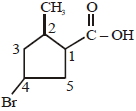
-
- (A) \(24\)
- (B) \(6\)
- (C) \(12\)
- (D) \(18\)
Show answer and solution
Correct Answer: (D)
Each carbon atom is \(sp^{2}\) hybridized Therefore each carbon has \(3 sp^{2}\) hybrid orbitals. Hence total \(\mathrm{sp}^{2}\) hybrid orbitals are \(18 .\)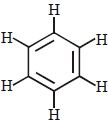

No questions on this page match these filters.