


2017 में पूछे गए अध्याय
20 अध्याय- 2प्रश्न STD 11 7.अपचयोपचय अभिक्रियाएँ
- 3प्रश्न STD 11 साम्यावस्था - 2
- 2प्रश्न STD 12 जैव-अणु
- 1प्रश्न STD 12 ऐमीन
- 1प्रश्न STD 12 ऐल्कोहॉल, फीनॉल एवं ईथर
- 4प्रश्न STD 12 हैलोऐल्केन तथा हैलोऐरीन सबसे ज़्यादा पूछा गया
- 2प्रश्न STD 12 उपसहसंयोजन यौगिक
- 4प्रश्न STD 12 P-ब्लॉक के तत्व - 2
- 2प्रश्न STD 12 रासायनिक बलगतिकी
- 5प्रश्न STD 12 वैद्युत रसायन सबसे ज़्यादा पूछा गया
- 3प्रश्न STD 12 Solution and colligative properties
- 2प्रश्न STD 11 रसायन विज्ञान की कुछ मूल अवधारणाएँ
- 1प्रश्न STD 11 हाइड्रोकार्बन
- 1प्रश्न STD 11 कार्बनिक रसायन शुद्धि और लक्षण वर्णन
- 2प्रश्न STD 11 रासायनिक आबंधन तथा आण्विक संरचना
- 2प्रश्न STD 11 तत्त्वों का वर्गीकरण एवं गुणधर्मों में आवर्तिता
- 1प्रश्न STD 11 साम्यावस्था - 1
- 6प्रश्न STD 11 ऊष्मागतिकी सबसे ज़्यादा पूछा गया
- 1प्रश्न STD 11 P-ब्लॉक तत्त्व
- 3प्रश्न STD 11 परमाणु की संरचना
JEE Mains 2017 Chemistry के सभी प्रश्न
20 अध्याय48 में से 1–48 प्रश्न
-
- (A) \(MnO_4 ^-\) and \(CrO_2Cl_2\)
- (B) \([NiCl_4]^{2-}\) and \([CoCl_4]^{2-}\)
- (C) \([Fe(CN)_6]^{3-}\) and \([Cu(CN)_2]^{2-}\)
- (D) \([FeCl_4]^-\) and \(Co_2O_3\)
उत्तर और हल देखें
सही उत्तर: (A)
\((1)\,Cr\mathop {{O_2}}\limits^{2 - } \mathop {C{l_2}}\limits^{ - 1} \,\,Cr = + 6;\,Mn\mathop {{O_2}}\limits^{2 - } \,\,Mn = + 4\)(Highest oxidation state)
\((2)\,{[Ni\mathop {C{l_4}}\limits^{ - 1} ]^{2 - }}\,\,Ni = + 2;\,{[Co\mathop {C{l_4}}\limits^{ - 1} ]^{2 - }}\,\,Co = + 2\)
\((3)\,{[Fe{(\mathop {CN}\limits^{ - 1} )_6}]^{3 - }}\,\,Fe = + 3;\,{[Cu{(\mathop {CN}\limits^{ - 1} )_4}]^{2 - }}\,\,Cu = + 2\)
\((4)\,{[Fe\mathop {C{l_4}}\limits^{ - 1} ]^ - }\,\,Fe = + 3;\,C{o_2}\mathop {{O_3}}\limits^{ - 2} \,Co = + 3\)
-
- (A) \(XeF_4 + O_2F_2 \rightarrow XeF_6 + O_2\)
- (B) \(XeF_2 + PF_5 \rightarrow [XeF]^+ PF_6^-\)
- (C) \(XeF_6 + H_2O \rightarrow XeOF_4 + 2HF\)
- (D) \(XeF_6 + 2H_2O \rightarrow XeO_2F_2 + 4HF\)
उत्तर और हल देखें
सही उत्तर: (A)
The following reaction is an example of redox reaction as xenon undergoes oxidation from state \(+4\) to \(+6\) and oxygen undergoes reduction from state \(+1\) to \(0 .\)\(\stackrel{+4}{\mathrm{X}} \mathrm{eF}_{4}+\stackrel{+1}{\mathrm{O}_{2}} \mathrm{F}_{2} \rightarrow \stackrel{+6}{\mathrm{Xe}} \mathrm{F}_{6}+\stackrel{0}{\mathrm{O}_{2}}\)
-
- (A) \(3.75\)
- (B) \(4.75\)
- (C) \(8.25\)
- (D) \(9. 25\)
उत्तर और हल देखें
सही उत्तर: (D)
\(N{H_3} + HCl \to N{H_4}Cl\)moles of \(HCl = 0.2\,M \times 25 \times {10^{ - 3}}\,L = 0.005\)
moles \(HCl\) (total consumed)
moles of \(N{H_3} = 0.2\,M \times 50 \times {10^{ - 3}}\,L = 0.01\)
moles \(HCl\)
excess \(N{H_3} = 0.01 - 0.005 = 0.005\) moles
\(1\) mole ammonia \(= 1 \) mole \(N{H_4}Cl\)
\(0.005\,N{H_3} = 0.005\,N{H_4}Cl\)
Total volume
\( = {V_{HCl}} + {V_{N{H_3}}} = 25 + 50\, = 75\,ml\)
\([N{H_3}] = [N{H_4}Cl] = \frac{{0.005\,mole}}{{75 \times {{10}^{ - 3}}\,L}} = 0.066\,M\)
\(pOH = p{K_b} + \log \frac{{[N{H_4}Cl]}}{{[N{H_3}]}}\)
\(pOH = 4.75 + \log \frac{{[0.066]}}{{[0.066]}}\)
\(pOH = 4.75\)
\(pH = 14 - pOH \Rightarrow pH = 9.25\)
-
- (A) \(4: 5\)
- (B) \(1 : 10\)
- (C) \(10 : 1\)
- (D) \(5 : 4\)
उत्तर और हल देखें
सही उत्तर: (C)
\(HA \leftrightarrow {H^ + } + {A^ - }\)(Unionized, weak acid and common ion effect)
\(HA + NaOH \to NaA + {H_2}O\)
\(NaA \to N{a^ + } + {A^ - }\) (ionized)
\({K_a} = \frac{{[{H^ + }][{A^ - }]}}{{[HA]}}\)
Given, \(pH = 6,\,[{H^ + }] = 1 \times {10^{ - 6}}\)
\([{H^ + }] = \frac{{{K_a}[Acid]}}{{[Salt]}}\)
\(\frac{{[Salt]}}{{[Acid]}} = \frac{{{K_a}}}{{[{H^ + }]}} = \frac{{{{10}^{ - 5}}}}{{{{10}^{ - 6}}}} = 10:1\)
-
- (A) \(320\)
- (B) \(325\)
- (C) \(316\)
- (D) \(330\)
उत्तर और हल देखें
सही उत्तर: (C)
\(\frac{{V \times 45}}{{100}} + \frac{{(800 - V) \times 20}}{{100}} = \frac{{800 \times 29.875}}{{100}}\)\( \Rightarrow \frac{{9V}}{{20}} + 160 - \frac{V}{5} = 239\)
\( \Rightarrow V = 136\)
-
- (A) एन्जाइम की सक्रिय सतह पर उत्क्रमणीय संयोजन
- (B) एन्जाइम की बंधनी सतह में संरूपीय परिवर्तन
- (C) एन्जाइम की सक्रिय सतह पर अनुत्क्रमणीय संयोजन
- (D) एन्जाइम की एलोस्टीरिक सतहों पर संयोजन
उत्तर और हल देखें
सही उत्तर: (C)
Enzyme inhibition can be either reversible or irreversible. In case of irreversible inhibition the inhibitor dissociates very slowly from its target enzyme because it has become tightly bound to the enzyme either covalently or non-covalently. Some irreversible inhibitors are important drugs like Penicilline and Aspirin. Thus "drug induced poisoning" may bound irreversibly to the active site of the enzyme -
- (A) ऐलानिन
- (B) वैलीन
- (C) ऐस्पार्टिक अम्ल
- (D) सेरीन
उत्तर और हल देखें
सही उत्तर: (B)
Those amino acids that cannot be synthesized in our body and must be supplied in diet is called esseniial amino acid for ex. valine, Histidine, Isoluecine etc. -
- (A) \((I)\)
- (B) \((II)\)
- (C) \((III)\)
- (D) \((IV)\)
उत्तर और हल देखें
सही उत्तर: (B)
when the given mixture is shaken with \(1\, M HCl\), amine get protonated and becomes cation \(\left( {RNH_2^ \oplus } \right)\) , which does not dissolve in organic solvent but usually dissolve in \(H_2O\) due to its charge. So, shaking with aqueous \(HCl\) will pull amines into the aqueous phase and leave all other compounds in organic layer -
- (A) \((IIl) < (IV) <(II) <(I)\)
- (B) \((IV) < (III) < (I) < (II)\)
- (C) \((II) < (III) < (IV) < (I)\)
- (D) \((III) < (II) < (I) < (IV)\)
उत्तर और हल देखें
सही उत्तर: (A)
\((I)\) \(C_2H_5OH\) Hydrogen bonding Hydrogen bonding \(>\) Dipole -Dipole\((II)\) \(C_2H_5Cl\) Dipole-Dipole \(C_2H_5Cl\) is more polar than \(C_2H_5OCH_3\) so, Dipole-Dipole \(C_2H_5Cl\) \(>\) Dipole-Dipole \(C_2H_5OCH_3\)
\((III)\) \(C_2H_5CH_3\) No hydrogen bonding and dipole- dipole interaction
\((IV)\) \(C_2H_5OCH_3\) Dipole-Dipole
Boiling points order is-
\((III) < (IV) < (II) < (I) \).
-
- (A) \(\begin{array}{*{20}{c}}
{C{H_2} - CH - C{H_3}} \\
{|\,\,\,\,\,\,\,\,\,\,\,\,\,\,\,\,\,\,|\,\,\,\,\,\,\,\,\,\,\,\,\,\,\,\,\,\,\,\,\,\,\,\,\,} \\
{Cl\,\,\,\,\,\,\,\,\,\,\,\,\,Cl\,\,\,\,\,\,\,\,\,\,\,\,\,\,\,\,\,\,\,\,\,\,}
\end{array}\) - (B) \(\begin{array}{*{20}{c}}
{C{H_2} - C{H_2} - C{H_2}\,\,\,\,\,\,\,\,\,\,\,\,\,\,\,\,\,\,\,\,\,\,\,\,\,\,\,\,} \\
{\,|\,\,\,\,\,\,\,\,\,\,\,\,\,\,\,\,\,\,\,\,\,\,\,\,\,\,\,\,\,\,\,\,\,\,\,\,\,\,\,|\,\,\,\,\,\,\,\,\,\,\,\,\,\,\,\,\,\,\,\,\,\,\,\,\,\,\,\,\,\,\,\,\,\,\,} \\
{\,\,\,\,\,\,\,\,\,\,\,\,\,\,\,Cl\,\,\,\,\,\,\,\,\,\,\,\,\,\,\,\,\,\,\,\,\,\,\,\,\,\,\,\,\,\,\,\,\,Cl\,\,\,\,\,\,\,\,\,\,\,\,\,\,\,\,\,\,\,\,\,\,\,\,\,\,\,\,\,\,\,\,\,\,\,\,\,\,\,\,\,\,\,\,\,\,\,\,\,}
\end{array}\) - (C) \(\begin{array}{*{20}{c}}
{CH - CH - C{H_2} - C{H_3}} \\
{\,\,\,|\,\,\,\,\,\,\,\,\,\,\,\,\,\,\,\,\,\,\,\,\,\,\,\,\,\,\,\,\,\,\,} \\
{Cl\,\,\,\,\,\,\,\,\,\,\,\,\,\,\,\,\,\,\,\,\,\,\,\,}
\end{array}\) - (D) \(\begin{array}{*{20}{c}}
{Cl} \\
| \\
{C{H_3} - C - C{H_3}} \\
| \\
{Cl}
\end{array}\)
उत्तर और हल देखें
सही उत्तर: (D)
\(\underset{(I)}{\mathop{\underset{({{C}_{3}}{{H}_{6}}C{{l}_{2}})}{\mathop{\begin{matrix}
\begin{matrix}
\,\,Cl \\
| \\
\end{matrix} \\
{{H}_{3}}C-C-C{{H}_{3}} \\
| \\
\,\,Cl \\
\end{matrix}}}\,}}\,\) \(\xrightarrow[{(aq.)}]{{KOH}}\) \(\mathop {\mathop {\begin{array}{*{20}{c}}
{\begin{array}{*{20}{c}}
{\,\,\,\,OH} \\
|
\end{array}} \\
{C{H_3} - C - C{H_3}} \\
| \\
{\,\,\,\,OH}
\end{array}}\limits_{Unstable} }\limits \xrightarrow{{{H_2}O}}\) \(\mathop {\begin{array}{*{20}{c}}
O \\
{||} \\
{C{H_3} - C - C{H_3}}
\end{array}}\limits_{(II)} \) \(\xrightarrow[{(II)\,{H_2}O\,/\,{H^ \oplus }}]{{(I)\,C{H_3}MgBr}}\) \({\mathop {\begin{array}{*{20}{c}}
{\begin{array}{*{20}{c}}
{\,\,\,\,OH} \\
|
\end{array}} \\
{C{H_3} - C - C{H_3}} \\
| \\
{\,\,\,\,C{H_3}}
\end{array}}\limits_{{3^0}\,alcohol} }\) \(\xrightarrow[{Lucas\,\,\,Test}]{{Anhy.\,ZnC{l_3}\, + \,HCl}}\) Gives turbidity immediately - (A) \(\begin{array}{*{20}{c}}
-
- (A) \(( \pm ){C_6}{H_5}CH({O^t }Bu)C{H_2}{C_6}{H_5}\)
- (B) \(C_6H_5CH=CHC_6H_5\)
- (C) \(( + ){C_6}{H_5}CH({O^t }Bu)C{H_2}{C_6}{H_5}\)
- (D) \(( - ){C_6}{H_5}CH({O^t }Bu)C{H_2}{C_6}{H_5}\)
उत्तर और हल देखें
सही उत्तर: (B)
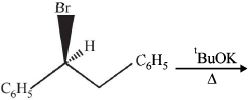
Carrying out dehydrohalogenation with a bulky base such as potassium tert-butoxide ( \(t\) -\(BuOK\) ) in \(1,2\) -diphenyl1-bromoethane \((t-\mathrm{BuOH})\) favors the formation of the alkene via \(E_2\) mechanism. The reaction involved is
-
- (A) \(CH_2 = CHCH_2CH = CHCH_3\)
- (B) \(CH_2= CHCH = CHCH_2CH_3\)
- (C) \(CH_3CH = C = CHCH_2CH_3\)
- (D) \(CH_3CH = CH - CH = CHCH_3\)
उत्तर और हल देखें
सही उत्तर: (D)
\(\,\begin{array}{*{20}{c}}
{C{H_3} - CH - C{H_2} - CH - C{H_2} - C{H_3}}\\
{\,\,\,\,\,\,\,\,\,\,\,\,\,\,\,\,\,\,\,\,\,\,\,\,\,\,\,\,\,\,|\,\,\,\,\,\,\,\,\,\,\,\,\,\,\,\,\,\,\,\,\,\,\,\,\,\,\,\,\,\,\,\,\,\,\,|\,\,\,\,\,\,\,\,\,\,\,\,\,\,\,\,\,\,\,\,\,\,\,\,\,\,\,\,\,\,\,\,\,\,\,\,\,\,\,\,\,\,\,\,\,\,\,\,\,\,\,\,}\\
{\,\,\,\,\,\,\,\,\,Br\,\,\,\,\,\,\,\,\,\,\,\,\,\,\,\,\,\,\,\,\,\,\,\,\,\,\,\,\,\,\,Br\,\,\,\,\,\,\,\,\,\,\,\,\,\,\,\,\,\,\,\,\,\,\,\,\,\,\,\,\,\,}
\end{array}\) \(\xrightarrow[{{E_2}}]{{KOH,\,C{H_3}OH\,\Delta }}\) \(\mathop {C{H_3} - CH = CH - CH = CH - C{H_3}}\limits_{{\text{(Saytzeff product)}}} \) -
- (A) \((III) < (II) < (I)\)
- (B) \((II) < (I) < (III)\)
- (C) \((I) < (III) < (II)\)
- (D) \((II) < (III) < (I)\)
उत्तर और हल देखें
सही उत्तर: (B)
Secondary, tertiary and benzylic halides appear to react by a mechanism that involves the formation of a carbocation and proceeds through \(\mathrm{S}_{\mathrm{N}} 1\) mechanism which takes place in two steps. The first step is the slow step \(-\) it is the rate-determining step. In this step, a molecule of alkyI halide ionizes and becomes an alkyl cation. Therefore, greater the stability of carbocation greater will be its tendency to react via \(S_{N} 1\) mechanism.\(\mathrm{R}-\mathrm{X} \rightleftharpoons \mathrm{R}^{+}+\mathrm{X}^{-}\)
In the second step, the intermediate alkyl cation reacts rapidly with water to produce alcohol.
\(\mathrm{R}^{+}+\mathrm{H}_{2} \mathrm{O} \rightleftharpoons \mathrm{ROH}\)
Hence, the order of reactivity of halides for the \(\mathrm{S}_{\mathrm{N}} 1\) mechanism is \(\mathrm{II}<\mathrm{I}<\mathrm{III}\).
-
- (A) \([Co(H_2O)_4 Cl_2]Cl . 2H_2O\)
- (B) \([Co(H_2O)_3 Cl_3] . 3H_2O\)
- (C) \([Co(H_2O)_6]Cl_3\)
- (D) \([Co(H_2O)_5 Cl]Cl_2 . H_2O\)
उत्तर और हल देखें
सही उत्तर: (D)
\(\text{CoC}{{\text{l}}_{3}}\cdot 6{{\text{H}}_{2}}\text{O}+\text{AgN}{{\text{O}}_{3}}\) \((\text{ excess })\to \text{AgCl}\)\(100\, \mathrm{mL}, 0.1 \,\mathrm{M}\) \(1.2\, \times 10^{22} \text { ion }\)
\(\text {moles }\;\; 0.01 \,\mathrm{mol}\) \(\frac{1.2 \times 10^{22}}{6 \times 10^{23}}=0.02\, \mathrm{mol}\)
since, \(0.01\, \mathrm{mol}\) of \(\mathrm{CoCl}_{3} \cdot 6 \mathrm{H}_{2} \mathrm{O}\) produce \(0.02\,\mathrm{mol}\) of \(\mathrm{AgCl}\)
Therefore, \(1\,mol\) of \(\mathrm{CoCl}_{3} \cdot 6 \mathrm{H}_{2} \mathrm{O}\) will produce \(2\, \mathrm{mol}\) of \(\mathrm{AgCl}\)
Thus, the complex is \(\left[\mathrm{Co}\left(\mathrm{H}_{2} \mathrm{O}\right)_{5} \mathrm{Cl}\right] \mathrm{Cl}_{2} \cdot \mathrm{H}_{2} \mathrm{O}\)
-
- (A) \(NO\)
- (B) \(CO\)
- (C) \(O_2\)
- (D) \(B_2\)
उत्तर और हल देखें
सही उत्तर: (B)
The electronic configuration of the given species is as follows:\(\mathrm{O}_{2}: \sigma 1 s^{2}, \sigma^{*} 1 s^{2}, \sigma 2 s^{2}, \sigma^{*} 2 s^{2}, \sigma 2 p_{x}^{2},\left\{\begin{array}{l}{\pi 2 p_{y}^{2},} \\ {\pi 2 p_{z}^{2},}\end{array}\left\{\begin{array}{l}{\pi^{*} 2 p_{y}^{1}} \\ {\pi^{*} 2 p_{z}^{1}}\end{array}\right.\right.\)
\(\mathrm{B}_{2}: \sigma 1 s^{2}, \sigma^{*} 1 s^{2}, \sigma 2 s^{2}, \sigma^{*} 2 s^{2},\left\{\begin{array}{l}{\pi 2 p_{y}^{1}} \\ {\pi 2 p_{z}^{1}}\end{array}\right.\)
\(\mathrm{NO}: \sigma 1 s^{2}, \sigma^{*} 1 s^{2}, \sigma 2 s^{2}, \sigma^{*} 2 s^{2}, \sigma 2 p_{x}^{2},\left\{\begin{array}{l}{\pi 2 p_{y}^{2}, } \\ {\pi 2 p_{z}^{2},}\end{array}\left\{\begin{array}{l}{\pi^{*} 2 p_{y}^{1}} \\ {\pi^{*} 2 p_{z}^{0}}\end{array}\right.\right.\)
\(CO\): No unpaired electron is present in the molecule, therefore, is not paramagnetic.
- 16. \(H _{2} SO _{3}, H _{2} SO _{4}\) तथा \(H _{2} S _{2} O _{7}\) की संरचना में \(\pi-\) आबन्धों की घटती संख्या का सही क्रम है। 2017 कठिन
- (A) \({H_2}S{O_3}\, > \,{H_2}S{O_4}\, > \,{H_2}{S_2}{O_7}\)
- (B) \({H_2}S{O_4}\, > {H_2}{S_2}{O_7}\, > {H_2}S{O_3}\)
- (C) \({H_2}{S_2}{O_7} > {H_2}S{O_4} > {H_2}S{O_3}\)
- (D) \({H_2}{S_2}{O_7} > {H_2}S{O_3} > {H_2}S{O_4}\)
उत्तर और हल देखें
सही उत्तर: (C)
Number of \(\pi \) - bonds\(H_2S_2O_7\,=\) \(\begin{array}{*{20}{c}}
{\begin{array}{*{20}{c}}
{\,\,O\,\,\,\,\,\,\,\,\,\,\,\,\,\,\,\,O\,} \\
{\,||\,\,\,\,\,\,\,\,\,\,\,\,\,\,\,\,\,||}
\end{array}} \\
{HO - S - O - S - OH} \\
{||\,\,\,\,\,\,\,\,\,\,\,\,\,\,\,\,\,\,||\,} \\
{\,\,\,\,O\,\,\,\,\,\,\,\,\,\,\,\,\,\,\,O\,\,\,\,}
\end{array}\) \(4\)\(H_2SO_4\,=\) \(\begin{array}{*{20}{c}}
{\begin{array}{*{20}{c}}
O \\
{||}
\end{array}} \\
{HO - S - OH} \\
{||} \\
O
\end{array}\) \(2\)\(H_2SO_3\,=\) \(\begin{matrix}
HO-\overset{\centerdot \,\,\centerdot }{\mathop{S}}\,-OH \\
|| \\
O \\
\end{matrix}\) \(1\) -
- (A) \(CH_4, O_3, N_2, SO_2\)
- (B) \(O_3, N_2, CO_2, NO_2\)
- (C) \(O_3, NO_2, SO_2, Cl_2\)
- (D) \(CO_2, CH_4, N_2O, O_3\)
उत्तर और हल देखें
सही उत्तर: (D)
Green house gases are those gases that absorbs and emits radiation within the thermal \(IR\) range. The process is the fundamental cause of the green house effect. These are \(CO_2, CH_4, N_2O\) and \(O_3\) -
- (A) चार तथा चार
- (B) पाँच तथा चार
- (C) पाँच तथा पाँच
- (D) चार तथा पाँच
उत्तर और हल देखें
सही उत्तर: (D)
Oxidation state :Each \(P\) atom is bound to one oxygen \(=-\,1\)
\(2OH=-\,1\times 2\,=\,-\,2\)
\(1\) oxygen \(-\,2\)
Total \(=\,-\,5\)
\(P\,=\,+5\)

-
- (A) \(XeF_2\)
- (B) \(XeF_4\)
- (C) \(XeOF_4\)
- (D) \(XeO_3\)
उत्तर और हल देखें
सही उत्तर: (C)
\(Xe{F_6}\, + \,{H_2}O\, \to \mathop {XeO{F_4}\, + \,2HF}\limits_{(partial\,\,\,hydrolysis)} \)\(Xe{F_6} + 2{H_2}O\, \to Xe{O_2}{F_2}+ \,4HF\)
\(Si{O_2}\, + \,2Xe{F_6}\, \to \mathop {\,2XeO{F_4}\, + \,Si{F_4}}\limits_{(Xenoneoxy\,\,\,tetra\,\,fluoride)} \)
-
- (A) \(9.84\)
- (B) \(4.92\)
- (C) \(2.45\)
- (D) \(19.67\)
उत्तर और हल देखें
सही उत्तर: (B)
In order to calculate the enthalpy change for \(H_2O\) at \(5\,^oC\) to ice at \(-\,5\,^oC\) , we need to calculated the enthalpy change of all the transformation involved in the process.\((a)\) Energy change of \(1\,mol\), \(H_2O\,(l)\), at \(5\,^oC\)
\(\to \,1\,mol\), \(H_2O\,(l)\) , \(0\,^oC\)
\((b)\) Energy change of \(1\,mol\), \(H_2O\,(l)\), at \(0\,^oC\)
\(\to \,1\,mol\), \(H_2O\,(s)\) (ice) , \(0\,^oC\)
\((c)\) Energy change of \(1\,mol\), Ice \((s)\), at \(0\,^oC\)
\(\to \,1\,mol\), Ice \((s)\) , \(-5\,^oC\)
Total \(\Delta H\)
\( = \,{C_P}\,[{H_2}O\,(l)]\,\,\Delta T\,\, + \,\Delta H\) freezing \( + \,\,{C_P}\,[{H_2}O\,(s)]\,\,\Delta T\)
\( = \,(75.3\,\,J\,\,mo{l^{ - 1}}\,{K^{ - 1}})\,( - 5)\,K\, + ( - \,6\, \times \,{10^3}\,\,J\,mo{l^{ - 1}}\,{K^{ - 1}})\) \(+ \,(36.8\,\,J\,mo{l^{ - 1}}\,{K^{ - 1}})\,( - 5)\,K\)
\(\Delta H\,\, = \,\, - \,6.56\,\,kJ\,mo{l^{ - 1}}\) (exothermic process)
So, \(\Delta H\,\, = \,\,6.56\,\,kJ\,mo{l^{ - 1}}\)
\( \Rightarrow \,{T_2}\, = \,304.92\,\,K\)
\({T_1}\, = \,300\,\,K,\,\) \({T_2}\, = 304.92\,\,K\)
\(\Delta T\, = \,\,{T_1}\, - {T_2}\, = 4.92\,\,K\)
-
- (A) \(107.2\)
- (B) \(53.6\)
- (C) \(26.8\)
- (D) \(214.4\)
उत्तर और हल देखें
सही उत्तर: (A)
\(\ln \,\frac{{{K_2}}}{{{K_1}}}\, = \,\frac{{{E_a}}}{R}\,\left( {\frac{1}{{{T_1}}}\, - \,\frac{1}{{{T_2}}}} \right)\)\(\ln \,\,4\, = \,\frac{{{E_a}}}{{8.314}}\left( {\frac{{310 - 300}}{{310 \times 300}}} \right)\)
\(2\,\ln \,2\, = \,\frac{{{E_a}}}{{8.314}}\left( {\frac{{310 - 300}}{{310 \times 300}}} \right)\)
\({E_a} = \frac{{0.693\, \times 2\, \times \,8.314 \times 300 \times 310}}{{10}}\)
\( = 107.2\,\,kJ/mol\)
-
- (A) \(Cr\)
- (B) \(Mn^{2+}\)
- (C) \(Cr^{+3}\)
- (D) \(Cl^-\)
उत्तर और हल देखें
सही उत्तर: (A)
Lower the reduction potential, greater is the tendency of the element to get oxidized, hence, greater is the reducing ability. Since, chromium system has lowest reduction potential; therefore, it is the strongest reducing agent. -
- (A) \(-0.057\)
- (B) \(+0.057\)
- (C) \(+0.30\)
- (D) \(-0.30\)
उत्तर और हल देखें
सही उत्तर: (A)
\(\Delta {G^o}\, = \, - nF{E^o}\)\((i)\,F{e^{2 + }}\, + \,2{e^ - }\, \to \,Fe;\) \({E^o}\, = \, - 0.47\,\,V;\)
\((ii)\,F{e^{3 + }}\, + \,{e^ - }\, \to \,F{e^{2 + }};\) \({E^o}\, = \, + 0.77\,\,V;\)
\((iii)\,F{e^{3 + }}\, + \,3{e^ - }\, \to Fe\)
\((i)\,\Delta {G^o}\, = \, - nF{E^o}\, = \, - \,2\,( - 0.47)F\, = \,0.94\,F\)
\((ii)\,\Delta {G^o}\, = \, - nF{E^o}\, = \, - \,1\,( + 0.77)F\, = \, - 0.77\,F\)
\((iii)\) on adding \(:\,\Delta {G^o}\, = \, + \,0.17\,F\)
\(\Delta {G^o}\, = \, - nF{E^o}\,{E^o}\) for
\((F{e^{3 + }} \to Fe)\, = \,\frac{{\Delta {G^o}}}{{ - nF}}\,\) \( = \,\frac{{0.17F}}{{ - 3F}}\, = \, - \,0.057\,V\)
-
- (A) \(0.38\)
- (B) \(0.32\)
- (C) \(1.28\)
- (D) \(0.66\)
उत्तर और हल देखें
सही उत्तर: (B)
Cell reaction :\(M\, + \,3A{g^ + }(aq)\, \to \,{M^{3 + }}\, + \,3Ag(s)\)
\(E\, = \,{E^o}\, - \,\frac{{0.0591}}{n}\log \,\) \(\frac{{[\operatorname{Re} duction\,\,state]}}{{[Oxidised\,\,\,state]}}\)
\(0.421\, = \,{E^o}\, - \,\frac{{0.0591}}{3}\log \,\frac{{0.001}}{{{{(0.01)}^3}}}\)
\({E^o}\, = \,0.48\)
\({E^o}\, = \,E_{A{g^ + }/Ag}^o\, - \,E_{{M^{3 + }}/M}^o\)
\(E_{{M^{3 + }}/M}^o\, = \,0.8\,V\, - \,0.48\,V\, = \,0.32\,volt\)
- 25. निम्न आयनों में से कौन सा तनु अम्लों से अभिक्रिया करने पर हाइड्रोजन गैस नहीं निकालता ? 2017 कठिन
- (A) \(Ti^{2+}\)
- (B) \(V^{2+}\)
- (C) \(Cr^{2+}\)
- (D) \(Mn^{2+}\)
उत्तर और हल देखें
सही उत्तर: (D)
ions \(E^o\,(V)\)\(Ti^{2+}\) \(-0.37\)
\(V^{2+}\) \(-0.26\)
\(Cr^{2+}\) \(-0.41\)
\(Mn^{2+}\) \(+1.57\)
Negative value of \(E^o\) means these metals librate hydrogen from dilute acid.
\(({M^{2 + }}\, + \,2{H^ + }\, - \,{e^ - }\, \to \,{M^{3 + }}\, + \,{H_2})\)
-
- (A) \(Tl^+\) से \(Al^{3+}\) अधिक स्थिर है।
- (B) \(Al^+\) से \(Al^{3+}\) अधिक स्थिर है।
- (C) \(Tl^+\) से \(Al^+\) अधिक स्थिर है।
- (D) \(Tl^{3+}\) से \(Al^{3+}\) अधिक स्थिर है।
उत्तर और हल देखें
सही उत्तर: (C)
\((i)\,\mathop {A{l^{3 + }}}\limits_{Most\,\,stable} \,\xrightarrow{{{E^o}\, = \, - \,1.66}}Al\,\xleftarrow{{{E^o}\, = \, + \,0.55}}\mathop {A{l^ + }}\limits_{Less\,\,stable} \)\((ii)\mathop {T{l^{3 + }}}\limits_{Less\,\,stable} \,\xrightarrow{{{E^o}\, = \, - + 1.26}}Tl\,\xleftarrow{{{E^o}\, = \, - 0.34}}\mathop {T{l^ + }}\limits_{Most\,\,\,stable} \)
\(Tl^+\) has negative electrode potential \((E^o = - 0.34)\) means, it does not prefer to convert into \(Tl\) but reverse must be preferred that's why it is more stable than \(Tl^{3+}\) \((E^o\,=\,+\,1.26)\) In \(Al\), \(Al^{3+}\) is more stable \(E^o=\,-\,1.66\) than \(Al^+\) \((E^o\,=\,+0.55)\) and also from \(Tl^+\) due to more negative value of \(E^o\). Therefore, by comparison it confirms that \(Tl^+\) is more stable than \(Al^+\).
-
- (A) \(0.162\)
- (B) \(0.675\)
- (C) \(0.325\)
- (D) \(0.486\)
उत्तर और हल देखें
सही उत्तर: (C)
Molar mass of \(CHCl_3\,=\,119.5\,g/mol.\)Molar mass of \(CH_2Cl_2\,=\,85\,g/mol.\)
Molar of \(CHCl_3\,=\,\frac {11.95}{119.5}\,=\,0.1\,mol.\)
Molar of \(CH_2Cl_2\,=\,\frac {8.5}{85}\,=\,0.1\,mol.\)
Mole fraction of \(CHCl_3\,=\,\frac {0.1}{0.2}\,=\,0.5\,mol\)
Mole fraction of \(CH_2Cl_2\,=\,\frac {0.1}{0.2}\,=\,0.5\,mol\)
(Given-
Vapour pressure of \(CHCl_3\,=\,200\,mm\) \(Hg\,=\,0.263\,atm\).
Vapour pressure of \(CH_2Cl_2\,=\,415\,mm\) \(Hg\,=\,0.546\,atm\).)
\((1\,atm\,=\,760\,mm\,Hg)\)
\(\therefore P_{(abovesolution)}\) \(=\) Mole fractiion of \(CHCl_3\times \) (Vapour pressure of \(CHCl_3\) ) \(+\) Mole fractiion of \(CH_2Cl_2\times \) (Vapour pressure of \(CH_2Cl_2\) )
\(=\,0.5\times 0.263\,+\,0.5\times 0.546\,=\,0.4045\)
Mole fraction of \(CHCl_3\) in vapour form
\(=\,\frac {0.1315}{0.4045}\,=\,0.325\)
-
- (A) \(64.6\)
- (B) \(80.4\)
- (C) \(74.6\)
- (D) \(94.6\)
उत्तर और हल देखें
सही उत्तर: (D)
\( \quad \quad \quad \quad 2 \mathrm{CH}_{3} \mathrm{COOH} \rightleftharpoons\left(\mathrm{CH}_{3} \mathrm{COOH}\right)_{2} \)\(Initial\; moles\quad \quad 1 \quad \quad \quad \quad 0\)
\(at\; equilibrium \quad 1-\alpha\quad \quad \alpha / 2\)
Total number of moles at equilibrium \(=1-\alpha+\alpha / 2 \Rightarrow i=1-\alpha / 2(\text { association })\)
\(\Delta T_{\mathrm{r}}=K_{\mathrm{r}} \times m \times i\)
\(0.45=(5.12) \times \frac{(0.2 / 60)}{(20 / 1000)} \times\left(1-\frac{\alpha}{2}\right)\)
\(\left(1-\frac{\alpha}{2}\right)=0.527 \Rightarrow \alpha=0.945\)
So, the percentage of acetic acid that dimerizes \(=94.5 \%\)
-
- (A) \(15\)
- (B) \(25\)
- (C) \(45\)
- (D) \(65\)
उत्तर और हल देखें
सही उत्तर: (C)
Molality (experimental)\( = \,\frac{{\Delta {T_f}}}{{{K_f}}}\, = \,\frac{{3.82}}{{1.86}}\, = \,2.054\,mol/1000\,g\) solvent
Molality (theoretical)
\( = \,\frac{{mole\,\,of\,solute}}{{wt.\,of\,solventing\,(g)}} \times 1000\)
\( = \,\frac{{5\,g\,/\,142\,g\,/\,mole}}{x} \times 1000\)
\(N{a_2}S{O_4}\, \to \,2N{a^ + }\, + \,SO_4^{2 - }\)
Moles before dissociation \(1\) \(0\) \(0\)
Moles after dissociation \(1-x\) \(2x\) \(x\)
Von't Hoff Factor \((i) = \,\frac{{Moles\,after\,\,dissociation}}{{Moles\,before\,\,dissociation}}\)
\( = \frac{{(1 - x)\, + \,2x\, + \,x}}{1}\)
\(Na_2SO_4\) is ionised \(81.5\%\) means \(x\,=\,0.815\)
\( = \frac{{(1 - 0.815)\, + \,2 \times 0.815\, + \,0.815}}{1}\)
\(=\,2.63\)
\(i\, = \,\frac{{Observed\,\,molarrity}}{{Calculated\,\,molarity}}\)
\( \Rightarrow \,2.63\, = \,\frac{{2.054}}{{\frac{{0.0352}}{x} \times 1000}}\, = \,45.07\,g\)
-
- (A) \(0.2\)
- (B) \(0.3\)
- (C) \(0.6\)
- (D) \(1.8\)
उत्तर और हल देखें
सही उत्तर: (A)
\(\underset{\begin{smallmatrix}
\lim iting \\
reagent
\end{smallmatrix}}{\mathop{FeC{{l}_{3}}(aq.)}}\,+\underset{\begin{smallmatrix}
(Excess\,amount) \\
not\,behave\,as
\\
\lim iting\,reagent
\end{smallmatrix}}{\mathop{3NaOH(aq.)}}\,\to \) \(Fe{(OH)_3}(s) + 3NaCl(aq.)\)Moles of \(Fe(OH)_3\) \( = \frac{{weight\,in\,g}}{{M.\,weight\,of\,Fe{{(OH)}_3}}}\)
\( = \frac{{2.14\,g}}{{107\,g/mol}} = 0.02\,mol.\)
\(1.0\) mole of \(Fe(OH)_3\) is obtained from \(= 1.0\) mole of \(FeCl_3\)
\(0.02\) mole of \(Fe(OH)_3\) is obtained from \(0.02\) mole of \(FeCl_3\)
Molarity
\( = \frac{{No.\,of\,moles}}{{Volume\,in\,L}} = \frac{{0.02\,mole}}{{0.1\,L}} = 0.2\,M\)
-
- (A) \(1186\)
- (B) \(84.3\)
- (C) \(118.6\)
- (D) \(11.86\)
उत्तर और हल देखें
सही उत्तर: (B)
\(\mathrm{M}_{2} \mathrm{CO}_{3}+2 \mathrm{HCl} \rightarrow 2 \mathrm{MCl}+\mathrm{H}_{2} \mathrm{O}+\mathrm{CO}_{2}\)\(n=\frac{\text { Mass given }}{\text { Molar mass }}\)
\(0.01186=\frac{1}{M} \Rightarrow M=84.3\, \mathrm{g\,mol}^{-1}\)
-
- (A) \(6\)
- (B) \(0\)
- (C) \(2\)
- (D) \(4\)
उत्तर और हल देखें
सही उत्तर: (D)
When alkenes are treated with \(HBr\) in the presence of peroxides, an anti-Markovnikov addition occurs in the sense that the hydrogen atom becomes attached to the carbon atom with the fewer hydrogen atoms.The product formed has two chirality centres, therefore, four stereoisomers \(\left(2^{2}\right)\) will exist.
\(\begin{array}{*{20}{c}}
{\,\,\,\,\,C{H_3}} \\
| \\
{C{H_3} - C{H_2} - C = CH - C{H_3}}
\end{array}\) \(\xrightarrow[{Peroxide}]{{HBr}}\) \(\mathop {\begin{array}{*{20}{c}}
{\,\begin{array}{*{20}{c}}
{\,\,\,\,\,\,C{H_3}} \\
|
\end{array}} \\
{C{H_3} - C{H_2} - {}_*CH - \mathop {CH}\limits^{*\,} - C{H_3}} \\
{\,\,\,\,\,\,\,\,\,\,\,\,\,\,\,\,\,\,\,\,\,\,\,\,\,\,\,\,\,\,\,\,\,\,\,|} \\
{\,\,\,\,\,\,\,\,\,\,\,\,\,\,\,\,\,\,\,\,\,\,\,\,\,\,\,\,\,\,\,\,\,\,\,\,\,Br}
\end{array}}\limits_{Major\,\,product} \) -
- (A) गतिशील प्रावस्था एक गैस हो सकती है।
- (B) स्थिर प्रावस्था एक बहुत महीन पिसा हुआ ठोस अधिशोषक होता है।
- (C) प्रथक्करण एक गतिशील तथा स्थिर प्रावस्था के बीच विलेय के साम्यन पर निर्भर करता है।
- (D) कागज वर्णलेखन, वितरण वर्णलेखन का एक उदाहरण है।
उत्तर और हल देखें
सही उत्तर: (B)
Partition chromatography is the process of separation where by the component of the mixture get distributed into two phases that may be liquid-liquid, liquid gas but not to solid-gas. -
- (A) \(N{O^ + }\)
- (B) \(CO\)
- (C) \(O_2^{2 - }\)
- (D) \(B_2\)
उत्तर और हल देखें
सही उत्तर: (D)
Total electron\(NO^+\) \(14\)
\(CO\) \(14\)
\(O_2^{2-}\) \(18\)
\(B_2\) \(10\)
\(N{O^ + } \Rightarrow KK.\sigma {(2s)^2}{\sigma ^*}{(2s)^2}.{(\pi 2{p_x})^2}\)
\( = {(\pi 2{p_y})^2}.{(\sigma 2{p_z})^2}\) diamagnetic
\(CO \Rightarrow KK.\sigma {(2s)^2}{\sigma ^*}{(2s)^2}.{(\pi 2{p_x})^2}\)
\( = {(\pi 2{p_y})^2}.{(\sigma 2{p_z})^2}\) diamagnetic
\(O_2^{2 - } \Rightarrow KK.\sigma {(2s)^2}{\sigma ^*}{(2s)^2}.\sigma {(2{p_z})^2}{(\pi 2{p_x})^2}\)
\( = {(\pi 2{p_y})^2}.{\pi ^*}{(2{p_x})^2} = {\pi ^*}{(2{p_y})^2}\) diamagnetic
\({B_2} \Rightarrow KK.\sigma {(2s)^2}{\sigma ^*}{(2s)^2}.\pi {(2{p_x})^1} = \pi {(2{p_y})^1}\) paramagnetic
-
- (A) \(BF_3, NF_3, CO_3^{2 - }\)
- (B) \(CO_3^{2 - } , NO_3^- , SO_3\)
- (C) \(NH_3, SO_3, CO_3^{2 - }\)
- (D) \(NCl_3, BCl_3, SO_3\)
उत्तर और हल देखें
सही उत्तर: (B)
Group Hybridization Shape \((1)\) \(BF_3\)
\(NF_3\)
\(CO_3^{2-}\)
\(sp^2\)
\(sp^3\)
\(sp^2\)
Triangular Planar \((TP)\)
Tetrahedral \((T)\)
\(T.P.\)
\((2)\) \(CO_3^{2-}\)
\(NO_3^-\)
\(SO_3\)
\(sp^2\)
\(sp^2\)
\(sp^2\)
\(\left. \begin{gathered}
T.P. \hfill \\
T.P. \hfill \\
T.P. \hfill \\
\end{gathered} \right\}\) (all have same hybridization)\((3)\) \(NH_3\)
\(SO_3\)
\(CO_3^{2-}\)
\(sp^3\)
\(sp^2\)
\(sp^2\)
\(T\)
\(T.P.\)
\(T.P.\)
\((4)\) \(NCl_3\)
\(BCl_3\)
\(SO_3\)
\(sp^3\)
\(sp^2\)
\(sp^2\)
\(T\)
\(T.P.\)
\(T.P.\)
-
- (A) \([Ne]\, 3s^2\,3p^1\)
- (B) \([Ne]\, 3s^2\,3p^2\)
- (C) \([Ne]\, 3s^2\,3p^3\)
- (D) \([Ar]\, 3d^{10}\,4s^2\,4p^3\)
उत्तर और हल देखें
सही उत्तर: (C)
The smaller the atomic size, larger is the value of \(IP\). Further the atoms having half filled or fully filled orbitals are comparatively more stable, hence more energy required to remove the electron from such atoms. -
- (A) \(O^{-2} , F^-, Na^+, Mg^{2+}\)
- (B) \(O^-, F^-, Na, Mg^+\)
- (C) \(O^{-2} , F^-, Na, Mg^{2+}\)
- (D) \(O^-, F^-, Na^+, Mg^{2+}\)
उत्तर और हल देखें
सही उत्तर: (A)
Isoclectronic species have the same number of electrons. The following ionic species are isoclectronic.\(\begin{array}{lcc}\hline \text { Ions } & {\text { Atomic number }} & {\text { Number of electrons }} \\ \hline 0^{2-} & {8} & {10} \\ {\mathrm{F}^{-}} & {9} & {10} \\ {\mathrm{Na}^{+}} & {11} & {10} \\ {\mathrm{Mg}^{2+}} & {12} & {10} \\ \hline\end{array}\)
-
- (A) \(CO\) को निकाल कर हटा देना
- (B) \(CO _{2}\) को निकाल कर हटा देना
- (C) \(CO _{2}\) को मिला देना
- (D) \(Fe _{2} O _{3}\) को मिला देना
उत्तर और हल देखें
सही उत्तर: (D)
Perturbation Shifts reaction which way?Removal of \(CO\) Left
Removal of \(CO_2\) Right
Addition of \(CO_2\) Left
Addition of \(Fe_2O_3\) No change
(This is a solid compound. Its concentration has no effect on the equilibrium).
-
- (A) \(5.44\)
- (B) \(5.81\)
- (C) \(6.56\)
- (D) \(6\)
उत्तर और हल देखें
सही उत्तर: (C)
In order to calculate the enthalpy change for \(H_2O\) at \(5\,^oC\) to ice at \(-\,5\,^oC\) , we need to calculated the enthalpy change of all the transformation involved in the process.\((a)\) Energy change of \(1\,mol\), \(H_2O\,(l)\), at \(5\,^oC\)
\(\to \,1\,mol\), \(H_2O\,(l)\) , \(0\,^oC\)
\((b)\) Energy change of \(1\,mol\), \(H_2O\,(l)\), at \(0\,^oC\)
\(\to \,1\,mol\), \(H_2O\,(s)\) (ice) , \(0\,^oC\)
\((c)\) Energy change of \(1\,mol\), Ice \((s)\), at \(0\,^oC\)
\(\to \,1\,mol\), Ice \((s)\) , \(-5\,^oC\)
Total \(\Delta H\)
\( = \,{C_P}\,[{H_2}O\,(l)]\,\,\Delta T\,\, + \,\Delta H\) freezing \( + \,\,{C_P}\,[{H_2}O\,(s)]\,\,\Delta T\)
\( = \,(75.3\,\,J\,\,mo{l^{ - 1}}\,{K^{ - 1}})\,( - 5)\,K\, + ( - \,6\, \times \,{10^3}\,\,J\,mo{l^{ - 1}}\,{K^{ - 1}})\) \(+ \,(36.8\,\,J\,mo{l^{ - 1}}\,{K^{ - 1}})\,( - 5)\,K\)
\(\Delta H\,\, = \,\, - \,6.56\,\,kJ\,mo{l^{ - 1}}\) (exothermic process)
So, \(\Delta H\,\, = \,\,6.56\,\,kJ\,mo{l^{ - 1}}\)
-
- (A) \(+ 74.8\)
- (B) \(+ 144.0\)
- (C) \(- 74.8\)
- (D) \(- 144.0\)
उत्तर और हल देखें
सही उत्तर: (C)
\(C(graphite) +\mathrm{O}_{2}(\mathrm{g}) \rightarrow \mathrm{CO}_{2}(\mathrm{g})\) \(\Delta_{r} H^{\circ}=-393.55\,\mathrm{kJ}\, \mathrm{mol}^{-1}\)\(\mathrm{H}_{2}(\mathrm{g})+\frac{1}{2} \mathrm{O}_{2}(\mathrm{g}) \rightarrow \mathrm{H}_{2} \mathrm{O}(\mathrm{l}) ; \)\(\quad \Delta_{r} H^{\circ}=-285.8\, \mathrm{kJ}\, \mathrm{mol}^{-1}\)
\(\mathrm{CO}_{2}(\mathrm{g})+2 \mathrm{H}_{2} \mathrm{O}(\mathrm{l}) \rightarrow \mathrm{CH}_{4}(\mathrm{g})+2 \mathrm{O}_{2}(\mathrm{g}) ;\)\( \Delta_{r} H^{\circ}=+890.3\,\mathrm{kJ}\,\mathrm{mol}^{-1}\)
\(C(graphite) +2 \mathrm{H}_{2}(\mathrm{g}) \rightarrow \mathrm{CH}_{4}(\mathrm{g}) ; \)\(\quad \Delta_{r} H^{\circ}=?\)
Now, Eq. \((4)= \) Eq. \((1)+2 \times\) Eq. \((2)+\) Eq. \(( 3)\)
\(\Delta_{r} H^{\circ}=-393.55+2(-285.8)+890.3\)
\(=-74.8\,\mathrm{kJ} \,\mathrm{mol}^{-1}\)
-
- (A) एन्थैल्पी बढ़ती है परन्तु एन्ट्रॉपी घटती है।
- (B) एन्थैल्पी स्थिर रहती है परन्तु एन्ट्रॉपी बढ़ती है।
- (C) एन्थैल्पी घटती है परन्तु एन्ट्रॉपी बढ़ती है।
- (D) एन्थैल्पी तथा एन्ट्रॉपी दोनों ही स्थिर रहती हैं।
उत्तर और हल देखें
सही उत्तर: (B)
\(\Delta H = n{c_p}\Delta T = 0\) means \(\Delta H\) constant.\(\Delta S = nR\,\ln {\kern 1pt} \left( {\frac{{{v_f}}}{{{v_i}}}} \right) \geqslant 0\) \(\Delta S\) increases.
- 42. एक अभिक्रिया \(A ( g ) \rightarrow A (l)\) के लिए \(\Delta H =-3 \;RT\). इस अभिक्रिया के लिये सही कथन है। 2017 कठिन
- (A) \(\Delta H = \Delta U \ne O\)
- (B) \(\Delta H = \Delta U = O\)
- (C) \(\left| {\Delta H} \right| < \left| {\Delta U} \right|\)
- (D) \(\left| {\Delta H} \right| > \left| {\Delta U} \right|\)
उत्तर और हल देखें
सही उत्तर: (D)
\(A(g) \to A(1)\)\(\Delta H = \Delta U + \Delta {n_g}RT\)
Given, \(\Delta H = - 3RT\)
Here
\(\Delta {n_g} = {n_p} - {n_r} = 0 - 1 = - 1\)
\(\Delta H = \Delta U - RT\)
\( \Rightarrow - 3RT = \Delta U - RT\)
\( \Rightarrow - 3RT + RT = \Delta U\)
\( \Rightarrow - 2RT = \Delta U\)
\(|\Delta H|\, > \,|\Delta U|\)
-
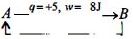
- (A) गैस द्वारा \(10\; J\) कार्य किया जायेगा।
- (B) गैस द्वारा \(6 \;J\) कार्य किया जायेगा।
- (C) गैस पर परिवेश द्वारा किया गया कार्य \(10\; J\) होगा।
- (D) गैस पर परिवेश द्वारा किया गया कार्य \(6\; J\) होगा।
उत्तर और हल देखें
सही उत्तर: (D)
\(\Delta {U_{AB}} = q + w = + 5 + ( - 8) = - 3\)\(q = - 3,\,\Delta {U_{BA}} = + 3\)
\(\Delta {U_{BA}} = q + w\)
\( \Rightarrow 3 = - 3 + w \Rightarrow w = + 6\)
(work done on the system)
-
- (A) रूद्धोष्म कार्य
- (B) समदाबी कार्य
- (C) सम-आयतनिक कार्य
- (D) समतापी कार्य
उत्तर और हल देखें
सही उत्तर: (C)
\(\Delta U = Q +\Delta W\)In adiabatic process no exchange of heat occurs between system and surrounding so \(Q =0\).
Thus, \(\Delta U\) is equal to adiabatic work.
-
- (A) \(KO_2\)
- (B) \(BaO_2\)
- (C) \(SiO_2\)
- (D) \(CsO_2\)
उत्तर और हल देखें
सही उत्तर: (C)
Compound nature\(KO_2\) Superoxide
\(BaO_2\) Peroxide
\(SiO_2\) Oxide
\(CsO_2\) Superoxide
-
- (A) \(15\)
- (B) \(37.5\)
- (C) \(7.5\)
- (D) \(10\)
उत्तर और हल देखें
सही उत्तर: (C)
Mass of hydrogen in human body \(=\frac{10}{100} \times 75=7.5 \,\mathrm{kg}\)If all \(^{1} H\) atoms are replaced by \(^{2} H\) atoms, then, the mass will become \(7.5 \times 2=15\,kg\). Therefore, the weight gain will be \(7.5\, \mathrm{kg}\)
-
- (A) लाइमैन श्रेणी
- (B) बामर श्रेणी
- (C) पाशन श्रेणी
- (D) ब्रेकेट श्रेणी
उत्तर और हल देखें
सही उत्तर: (B)
\(r = 0.529 \times \frac{{{n^2}}}{Z}\)\(r = 211.6\,pm = 2.11\,\mathop A\limits^o \)
\( \Rightarrow 0.529 \times \frac{{{n^2}}}{Z} = 2.11\,\mathop A\limits^o \)
\(n = 2\) (Balmer series)
-
- (A) \(\frac{{5A}}{9}\)
- (B) \(\frac{{9A}}{5}\)
- (C) \(\frac{{36A}}{5}\)
- (D) \(\frac{{36A}}{7}\)
उत्तर और हल देखें
सही उत्तर: (D)
For Lyman series (short wavelength)\({n_1} = 1,\,{n_2} = \infty \)
\(\frac{1}{\lambda } = R{z^2}\left( {\frac{1}{{n_1^2}} - \frac{1}{{n_2^2}}} \right)\)
\( \Rightarrow \frac{1}{A} = {1^2}\,R\left( {\frac{1}{1} - \frac{1}{\infty }} \right) \Rightarrow \frac{1}{A} = R\)
Longest wavelength \(= 1^{st}\) line
\({n_1} = 3,\,{n_2} = 4\)
\(\frac{1}{\lambda } = R{z^2}\left( {\frac{1}{{{3^2}}} - \frac{1}{{{4^2}}}} \right) \Rightarrow \frac{1}{\lambda } = \frac{{R7}}{{36}}\)
\(R = \frac{1}{A}\)
\(\frac{1}{\lambda } = \frac{{\frac{1}{A} \times 7}}{{36}} \Rightarrow \frac{1}{\lambda } = \frac{7}{{36\,A}} \Rightarrow \lambda = \frac{{36\,A}}{7}\)

इस पेज पर इन फ़िल्टर से कोई प्रश्न नहीं मिला।
अन्य वर्ष
अक्सर पूछे जाने वाले प्रश्न
ExamBro पर JEE Mains 2017 Chemistry के कितने प्रश्न हैं?
48 प्रश्न, हर एक सही उत्तर और पूरे हल के साथ।
JEE Mains 2017 Chemistry का कौन-सा अध्याय सबसे ज़्यादा पूछा जाता है?
ऊष्मागतिकी, 6 प्रश्नों के साथ; उसके बाद वैद्युत रसायन, 5 प्रश्नों के साथ।
JEE Mains 2017 Chemistry के प्रश्न कितने कठिन होते हैं?
6% आसान, 15% मध्यम और 79% कठिन।