


પ્રશ્નો
4 પ્રશ્નો4 માંથી 1–4 પ્રશ્નો
-
- (A) \(\begin{array}{*{20}{c}}
{C{H_2} - CH - C{H_3}} \\
{|\,\,\,\,\,\,\,\,\,\,\,\,\,\,\,\,\,\,|\,\,\,\,\,\,\,\,\,\,\,\,\,\,\,\,\,\,\,\,\,\,\,\,\,} \\
{Cl\,\,\,\,\,\,\,\,\,\,\,\,\,Cl\,\,\,\,\,\,\,\,\,\,\,\,\,\,\,\,\,\,\,\,\,\,}
\end{array}\) - (B) \(\begin{array}{*{20}{c}}
{C{H_2} - C{H_2} - C{H_2}\,\,\,\,\,\,\,\,\,\,\,\,\,\,\,\,\,\,\,\,\,\,\,\,\,\,\,\,} \\
{\,|\,\,\,\,\,\,\,\,\,\,\,\,\,\,\,\,\,\,\,\,\,\,\,\,\,\,\,\,\,\,\,\,\,\,\,\,\,\,\,|\,\,\,\,\,\,\,\,\,\,\,\,\,\,\,\,\,\,\,\,\,\,\,\,\,\,\,\,\,\,\,\,\,\,\,} \\
{\,\,\,\,\,\,\,\,\,\,\,\,\,\,\,Cl\,\,\,\,\,\,\,\,\,\,\,\,\,\,\,\,\,\,\,\,\,\,\,\,\,\,\,\,\,\,\,\,\,Cl\,\,\,\,\,\,\,\,\,\,\,\,\,\,\,\,\,\,\,\,\,\,\,\,\,\,\,\,\,\,\,\,\,\,\,\,\,\,\,\,\,\,\,\,\,\,\,\,\,}
\end{array}\) - (C) \(\begin{array}{*{20}{c}}
{CH - CH - C{H_2} - C{H_3}} \\
{\,\,\,|\,\,\,\,\,\,\,\,\,\,\,\,\,\,\,\,\,\,\,\,\,\,\,\,\,\,\,\,\,\,\,} \\
{Cl\,\,\,\,\,\,\,\,\,\,\,\,\,\,\,\,\,\,\,\,\,\,\,\,}
\end{array}\) - (D) \(\begin{array}{*{20}{c}} {Cl} \\ | \\ {C{H_3} - C - C{H_3}} \\ | \\ {Cl} \end{array}\)
જવાબ અને ઉકેલ જુઓ
સાચો જવાબ: (D)
\(\underset{(I)}{\mathop{\underset{({{C}_{3}}{{H}_{6}}C{{l}_{2}})}{\mathop{\begin{matrix}
\begin{matrix}
\,\,Cl \\
| \\
\end{matrix} \\
{{H}_{3}}C-C-C{{H}_{3}} \\
| \\
\,\,Cl \\
\end{matrix}}}\,}}\,\) \(\xrightarrow[{(aq.)}]{{KOH}}\) \(\mathop {\mathop {\begin{array}{*{20}{c}}
{\begin{array}{*{20}{c}}
{\,\,\,\,OH} \\
|
\end{array}} \\
{C{H_3} - C - C{H_3}} \\
| \\
{\,\,\,\,OH}
\end{array}}\limits_{Unstable} }\limits \xrightarrow{{{H_2}O}}\) \(\mathop {\begin{array}{*{20}{c}}
O \\
{||} \\
{C{H_3} - C - C{H_3}}
\end{array}}\limits_{(II)} \) \(\xrightarrow[{(II)\,{H_2}O\,/\,{H^ \oplus }}]{{(I)\,C{H_3}MgBr}}\) \({\mathop {\begin{array}{*{20}{c}}
{\begin{array}{*{20}{c}}
{\,\,\,\,OH} \\
|
\end{array}} \\
{C{H_3} - C - C{H_3}} \\
| \\
{\,\,\,\,C{H_3}}
\end{array}}\limits_{{3^0}\,alcohol} }\) \(\xrightarrow[{Lucas\,\,\,Test}]{{Anhy.\,ZnC{l_3}\, + \,HCl}}\) Gives turbidity immediately - (A) \(\begin{array}{*{20}{c}}
-
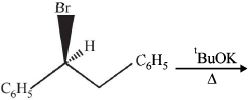
- (A) \(( \pm ){C_6}{H_5}CH({O^t }Bu)C{H_2}{C_6}{H_5}\)
- (B) \(C_6H_5CH=CHC_6H_5\)
- (C) \(( + ){C_6}{H_5}CH({O^t }Bu)C{H_2}{C_6}{H_5}\)
- (D) \(( - ){C_6}{H_5}CH({O^t }Bu)C{H_2}{C_6}{H_5}\)
જવાબ અને ઉકેલ જુઓ
સાચો જવાબ: (B)
Carrying out dehydrohalogenation with a bulky base such as potassium tert-butoxide ( \(t\) -\(BuOK\) ) in \(1,2\) -diphenyl1-bromoethane \((t-\mathrm{BuOH})\) favors the formation of the alkene via \(E_2\) mechanism. The reaction involved is
-
- (A) \(CH_2 = CHCH_2CH = CHCH_3\)
- (B) \(CH_2= CHCH = CHCH_2CH_3\)
- (C) \(CH_3CH = C = CHCH_2CH_3\)
- (D) \(CH_3CH = CH - CH = CHCH_3\)
જવાબ અને ઉકેલ જુઓ
સાચો જવાબ: (D)
\(\,\begin{array}{*{20}{c}}
{C{H_3} - CH - C{H_2} - CH - C{H_2} - C{H_3}}\\
{\,\,\,\,\,\,\,\,\,\,\,\,\,\,\,\,\,\,\,\,\,\,\,\,\,\,\,\,\,\,|\,\,\,\,\,\,\,\,\,\,\,\,\,\,\,\,\,\,\,\,\,\,\,\,\,\,\,\,\,\,\,\,\,\,\,|\,\,\,\,\,\,\,\,\,\,\,\,\,\,\,\,\,\,\,\,\,\,\,\,\,\,\,\,\,\,\,\,\,\,\,\,\,\,\,\,\,\,\,\,\,\,\,\,\,\,\,\,}\\
{\,\,\,\,\,\,\,\,\,Br\,\,\,\,\,\,\,\,\,\,\,\,\,\,\,\,\,\,\,\,\,\,\,\,\,\,\,\,\,\,\,Br\,\,\,\,\,\,\,\,\,\,\,\,\,\,\,\,\,\,\,\,\,\,\,\,\,\,\,\,\,\,}
\end{array}\) \(\xrightarrow[{{E_2}}]{{KOH,\,C{H_3}OH\,\Delta }}\) \(\mathop {C{H_3} - CH = CH - CH = CH - C{H_3}}\limits_{{\text{(Saytzeff product)}}} \) -
- (A) \((III) < (II) < (I)\)
- (B) \((II) < (I) < (III)\)
- (C) \((I) < (III) < (II)\)
- (D) \((II) < (III) < (I)\)
જવાબ અને ઉકેલ જુઓ
સાચો જવાબ: (B)
Secondary, tertiary and benzylic halides appear to react by a mechanism that involves the formation of a carbocation and proceeds through \(\mathrm{S}_{\mathrm{N}} 1\) mechanism which takes place in two steps. The first step is the slow step \(-\) it is the rate-determining step. In this step, a molecule of alkyI halide ionizes and becomes an alkyl cation. Therefore, greater the stability of carbocation greater will be its tendency to react via \(S_{N} 1\) mechanism.\(\mathrm{R}-\mathrm{X} \rightleftharpoons \mathrm{R}^{+}+\mathrm{X}^{-}\)
In the second step, the intermediate alkyl cation reacts rapidly with water to produce alcohol.
\(\mathrm{R}^{+}+\mathrm{H}_{2} \mathrm{O} \rightleftharpoons \mathrm{ROH}\)
Hence, the order of reactivity of halides for the \(\mathrm{S}_{\mathrm{N}} 1\) mechanism is \(\mathrm{II}<\mathrm{I}<\mathrm{III}\).
આ પેજ પર આ ફિલ્ટર મુજબ કોઈ પ્રશ્ન નથી.