


Chapters asked in 2017
20 chapters- 1Qs STD 11 Organic chemistry purification and characterization
- 2Qs STD 11 Redox reactions
- 2Qs STD 12 Biomolecules
- 5Qs STD 11 Equilibrium - II (icon Equilibrium) Most asked
- 3Qs STD 12 Chemical kinetics
- 1Qs STD 12 Amines
- 1Qs STD 12 Alcohol, phenol and ethers
- 4Qs STD 12 Haloalkanes and Haloarenes
- 2Qs STD 12 Co-ordination chemistry
- 5Qs STD 12 P -Block elements - ll Most asked
- 5Qs STD 12 Electrochemistry
- 3Qs STD 12 Solution and colligative properties
- 2Qs STD 11 Some basic concept of chemistry
- 1Qs STD 11 Hydricarbon
- 2Qs STD 11 Chemical bonding and molecular structure
- 2Qs STD 11 Classification of elements and periodicity in properties
- 1Qs STD 11 Equilibrium - 1 (chemical Equilibrium)
- 6Qs STD 11 Thermodynamics and thermochemistry Most asked
- 1Qs STD 11 P-Block elements - I
- 4Qs STD 11 Structure of atom
All JEE Mains 2017 Chemistry questions
20 chaptersShowing 1–50 of 53 questions
-
- (A) Mobile phase can be a gas
- (B) Stationary phase is a finely divided solid adsorbent
- (C) Separation depends upon equilibration of solute between a mobile and a stationary phase
- (D) Paper chromatography is an example of partition chromatography
Show answer and solution
Correct Answer: (B)
Partition chromatography is the process of separation where by the component of the mixture get distributed into two phases that may be liquid-liquid, liquid gas but not to solid-gas. -
- (A) \(MnO_4 ^-\) and \(CrO_2Cl_2\)
- (B) \([NiCl_4]^{2-}\) and \([CoCl_4]^{2-}\)
- (C) \([Fe(CN)_6]^{3-}\) and \([Cu(CN)_2]^{2-}\)
- (D) \([FeCl_4]^-\) and \(Co_2O_3\)
Show answer and solution
Correct Answer: (A)
\((1)\,Cr\mathop {{O_2}}\limits^{2 - } \mathop {C{l_2}}\limits^{ - 1} \,\,Cr = + 6;\,Mn\mathop {{O_2}}\limits^{2 - } \,\,Mn = + 4\)(Highest oxidation state)
\((2)\,{[Ni\mathop {C{l_4}}\limits^{ - 1} ]^{2 - }}\,\,Ni = + 2;\,{[Co\mathop {C{l_4}}\limits^{ - 1} ]^{2 - }}\,\,Co = + 2\)
\((3)\,{[Fe{(\mathop {CN}\limits^{ - 1} )_6}]^{3 - }}\,\,Fe = + 3;\,{[Cu{(\mathop {CN}\limits^{ - 1} )_4}]^{2 - }}\,\,Cu = + 2\)
\((4)\,{[Fe\mathop {C{l_4}}\limits^{ - 1} ]^ - }\,\,Fe = + 3;\,C{o_2}\mathop {{O_3}}\limits^{ - 2} \,Co = + 3\)
-
- (A) \(XeF_4 + O_2F_2 \rightarrow XeF_6 + O_2\)
- (B) \(XeF_2 + PF_5 \rightarrow [XeF]^+ PF_6^-\)
- (C) \(XeF_6 + H_2O \rightarrow XeOF_4 + 2HF\)
- (D) \(XeF_6 + 2H_2O \rightarrow XeO_2F_2 + 4HF\)
Show answer and solution
Correct Answer: (A)
The following reaction is an example of redox reaction as xenon undergoes oxidation from state \(+4\) to \(+6\) and oxygen undergoes reduction from state \(+1\) to \(0 .\)\(\stackrel{+4}{\mathrm{X}} \mathrm{eF}_{4}+\stackrel{+1}{\mathrm{O}_{2}} \mathrm{F}_{2} \rightarrow \stackrel{+6}{\mathrm{Xe}} \mathrm{F}_{6}+\stackrel{0}{\mathrm{O}_{2}}\)
-
- (A) Alanine
- (B) Valine
- (C) Aspartic acid
- (D) Serine
Show answer and solution
Correct Answer: (B)
Those amino acids that cannot be synthesized in our body and must be supplied in diet is called esseniial amino acid for ex. valine, Histidine, Isoluecine etc. -
- (A) Binding reversibly at the active site of the enzyme
- (B) Bringing conformational change in the binding site of enzyme
- (C) Binding irreversibly to the active site of the enzyme
- (D) Binding at the allosteric sites of the enzyme
Show answer and solution
Correct Answer: (C)
Enzyme inhibition can be either reversible or irreversible. In case of irreversible inhibition the inhibitor dissociates very slowly from its target enzyme because it has become tightly bound to the enzyme either covalently or non-covalently. Some irreversible inhibitors are important drugs like Penicilline and Aspirin. Thus "drug induced poisoning" may bound irreversibly to the active site of the enzyme -
- (A) \(3.75\)
- (B) \(4.75\)
- (C) \(8.25\)
- (D) \(9. 25\)
Show answer and solution
Correct Answer: (D)
\(N{H_3} + HCl \to N{H_4}Cl\)moles of \(HCl = 0.2\,M \times 25 \times {10^{ - 3}}\,L = 0.005\)
moles \(HCl\) (total consumed)
moles of \(N{H_3} = 0.2\,M \times 50 \times {10^{ - 3}}\,L = 0.01\)
moles \(HCl\)
excess \(N{H_3} = 0.01 - 0.005 = 0.005\) moles
\(1\) mole ammonia \(= 1 \) mole \(N{H_4}Cl\)
\(0.005\,N{H_3} = 0.005\,N{H_4}Cl\)
Total volume
\( = {V_{HCl}} + {V_{N{H_3}}} = 25 + 50\, = 75\,ml\)
\([N{H_3}] = [N{H_4}Cl] = \frac{{0.005\,mole}}{{75 \times {{10}^{ - 3}}\,L}} = 0.066\,M\)
\(pOH = p{K_b} + \log \frac{{[N{H_4}Cl]}}{{[N{H_3}]}}\)
\(pOH = 4.75 + \log \frac{{[0.066]}}{{[0.066]}}\)
\(pOH = 4.75\)
\(pH = 14 - pOH \Rightarrow pH = 9.25\)
-
- (A) \(4: 5\)
- (B) \(1 : 10\)
- (C) \(10 : 1\)
- (D) \(5 : 4\)
Show answer and solution
Correct Answer: (C)
\(HA \leftrightarrow {H^ + } + {A^ - }\)(Unionized, weak acid and common ion effect)
\(HA + NaOH \to NaA + {H_2}O\)
\(NaA \to N{a^ + } + {A^ - }\) (ionized)
\({K_a} = \frac{{[{H^ + }][{A^ - }]}}{{[HA]}}\)
Given, \(pH = 6,\,[{H^ + }] = 1 \times {10^{ - 6}}\)
\([{H^ + }] = \frac{{{K_a}[Acid]}}{{[Salt]}}\)
\(\frac{{[Salt]}}{{[Acid]}} = \frac{{{K_a}}}{{[{H^ + }]}} = \frac{{{{10}^{ - 5}}}}{{{{10}^{ - 6}}}} = 10:1\)
-
- (A) base and acid
- (B) base and base
- (C) acid and acid
- (D) acid and base
Show answer and solution
Correct Answer: (D)
Zinc oxide is an amphoteric oxide, as indicated by the following reactions:\( {\mathrm{ZnO}+\mathrm{Na}_{2} \mathrm{O} \rightarrow \mathrm{Na}_{2} \mathrm{ZnO}_{2}} \)
\({ { (Acid)\quad (Base) \quad (Salt)}} \)
\({\mathrm{ZnO}+\mathrm{CO}_{2} \rightarrow \mathrm{ZnCO}_{3}} \)
\({ { (Base) } \quad { (Acid) \quad (Salt)}}\)
-
- (A) \(7.2\)
- (B) \(6.9\)
- (C) \(7.0\)
- (D) \(1.0\)
Show answer and solution
Correct Answer: (B)
For the salt of weak acid and weak base, we have\(\mathrm{pH} =7+\frac{1}{2} \mathrm{p} K_{\mathrm{a}}-\frac{1}{2} \mathrm{p} K_{\mathrm{b}} \)
\(=7+\frac{1}{2}(3.2)-\frac{1}{2}(3.4) \)
\(=6.9\)
-
- (A) \(320\)
- (B) \(325\)
- (C) \(316\)
- (D) \(330\)
Show answer and solution
Correct Answer: (C)
\(\frac{{V \times 45}}{{100}} + \frac{{(800 - V) \times 20}}{{100}} = \frac{{800 \times 29.875}}{{100}}\)\( \Rightarrow \frac{{9V}}{{20}} + 160 - \frac{V}{5} = 239\)
\( \Rightarrow V = 136\)
-
- (A) \(9.84\)
- (B) \(4.92\)
- (C) \(2.45\)
- (D) \(19.67\)
Show answer and solution
Correct Answer: (B)
In order to calculate the enthalpy change for \(H_2O\) at \(5\,^oC\) to ice at \(-\,5\,^oC\) , we need to calculated the enthalpy change of all the transformation involved in the process.\((a)\) Energy change of \(1\,mol\), \(H_2O\,(l)\), at \(5\,^oC\)
\(\to \,1\,mol\), \(H_2O\,(l)\) , \(0\,^oC\)
\((b)\) Energy change of \(1\,mol\), \(H_2O\,(l)\), at \(0\,^oC\)
\(\to \,1\,mol\), \(H_2O\,(s)\) (ice) , \(0\,^oC\)
\((c)\) Energy change of \(1\,mol\), Ice \((s)\), at \(0\,^oC\)
\(\to \,1\,mol\), Ice \((s)\) , \(-5\,^oC\)
Total \(\Delta H\)
\( = \,{C_P}\,[{H_2}O\,(l)]\,\,\Delta T\,\, + \,\Delta H\) freezing \( + \,\,{C_P}\,[{H_2}O\,(s)]\,\,\Delta T\)
\( = \,(75.3\,\,J\,\,mo{l^{ - 1}}\,{K^{ - 1}})\,( - 5)\,K\, + ( - \,6\, \times \,{10^3}\,\,J\,mo{l^{ - 1}}\,{K^{ - 1}})\) \(+ \,(36.8\,\,J\,mo{l^{ - 1}}\,{K^{ - 1}})\,( - 5)\,K\)
\(\Delta H\,\, = \,\, - \,6.56\,\,kJ\,mo{l^{ - 1}}\) (exothermic process)
So, \(\Delta H\,\, = \,\,6.56\,\,kJ\,mo{l^{ - 1}}\)
\( \Rightarrow \,{T_2}\, = \,304.92\,\,K\)
\({T_1}\, = \,300\,\,K,\,\) \({T_2}\, = 304.92\,\,K\)
\(\Delta T\, = \,\,{T_1}\, - {T_2}\, = 4.92\,\,K\)
-
- (A) \(107.2\)
- (B) \(53.6\)
- (C) \(26.8\)
- (D) \(214.4\)
Show answer and solution
Correct Answer: (A)
\(\ln \,\frac{{{K_2}}}{{{K_1}}}\, = \,\frac{{{E_a}}}{R}\,\left( {\frac{1}{{{T_1}}}\, - \,\frac{1}{{{T_2}}}} \right)\)\(\ln \,\,4\, = \,\frac{{{E_a}}}{{8.314}}\left( {\frac{{310 - 300}}{{310 \times 300}}} \right)\)
\(2\,\ln \,2\, = \,\frac{{{E_a}}}{{8.314}}\left( {\frac{{310 - 300}}{{310 \times 300}}} \right)\)
\({E_a} = \frac{{0.693\, \times 2\, \times \,8.314 \times 300 \times 310}}{{10}}\)
\( = 107.2\,\,kJ/mol\)
-
- (A) \(8\)
- (B) \(12\)
- (C) \(6\)
- (D) \(4\)
Show answer and solution
Correct Answer: (D)
According to Arrhenius equation\( k=A e^{-E_{2} / R T} \)
\( k_{1} =A e^{-E_{\mathrm{A} 1} / R T} \quad (1)\)
\(k_{2} =A e^{-E_{22} / R T} \quad (2)\)
Dividing Eq. \(( 2 )\) by Eq. \(( 1 )\), we get
\(\frac{k_{2}}{k_{1}}=e^{\left(\frac{E_{21}-E_{22}}{R T}\right)}\)
Taking natural logarithm of both sides, we get
\(\ln \left(\frac{k_{2}}{k_{1}}\right) =\frac{E_{\mathrm{al}}-E_{\mathrm{a} 2}}{R T} \)
\(=\frac{10,000}{8.314 \times 300}=4\)
-
- (A) \((I)\)
- (B) \((II)\)
- (C) \((III)\)
- (D) \((IV)\)
Show answer and solution
Correct Answer: (B)
when the given mixture is shaken with \(1\, M HCl\), amine get protonated and becomes cation \(\left( {RNH_2^ \oplus } \right)\) , which does not dissolve in organic solvent but usually dissolve in \(H_2O\) due to its charge. So, shaking with aqueous \(HCl\) will pull amines into the aqueous phase and leave all other compounds in organic layer -
- (A) \((IIl) < (IV) <(II) <(I)\)
- (B) \((IV) < (III) < (I) < (II)\)
- (C) \((II) < (III) < (IV) < (I)\)
- (D) \((III) < (II) < (I) < (IV)\)
Show answer and solution
Correct Answer: (A)
\((I)\) \(C_2H_5OH\) Hydrogen bonding Hydrogen bonding \(>\) Dipole -Dipole\((II)\) \(C_2H_5Cl\) Dipole-Dipole \(C_2H_5Cl\) is more polar than \(C_2H_5OCH_3\) so, Dipole-Dipole \(C_2H_5Cl\) \(>\) Dipole-Dipole \(C_2H_5OCH_3\)
\((III)\) \(C_2H_5CH_3\) No hydrogen bonding and dipole- dipole interaction
\((IV)\) \(C_2H_5OCH_3\) Dipole-Dipole
Boiling points order is-
\((III) < (IV) < (II) < (I) \).
-
- (A) \(\begin{array}{*{20}{c}}
{C{H_2} - CH - C{H_3}} \\
{|\,\,\,\,\,\,\,\,\,\,\,\,\,\,\,\,\,\,|\,\,\,\,\,\,\,\,\,\,\,\,\,\,\,\,\,\,\,\,\,\,\,\,\,} \\
{Cl\,\,\,\,\,\,\,\,\,\,\,\,\,Cl\,\,\,\,\,\,\,\,\,\,\,\,\,\,\,\,\,\,\,\,\,\,}
\end{array}\) - (B) \(\begin{array}{*{20}{c}}
{C{H_2} - C{H_2} - C{H_2}\,\,\,\,\,\,\,\,\,\,\,\,\,\,\,\,\,\,\,\,\,\,\,\,\,\,\,\,} \\
{\,|\,\,\,\,\,\,\,\,\,\,\,\,\,\,\,\,\,\,\,\,\,\,\,\,\,\,\,\,\,\,\,\,\,\,\,\,\,\,\,|\,\,\,\,\,\,\,\,\,\,\,\,\,\,\,\,\,\,\,\,\,\,\,\,\,\,\,\,\,\,\,\,\,\,\,} \\
{\,\,\,\,\,\,\,\,\,\,\,\,\,\,\,Cl\,\,\,\,\,\,\,\,\,\,\,\,\,\,\,\,\,\,\,\,\,\,\,\,\,\,\,\,\,\,\,\,\,Cl\,\,\,\,\,\,\,\,\,\,\,\,\,\,\,\,\,\,\,\,\,\,\,\,\,\,\,\,\,\,\,\,\,\,\,\,\,\,\,\,\,\,\,\,\,\,\,\,\,}
\end{array}\) - (C) \(\begin{array}{*{20}{c}}
{CH - CH - C{H_2} - C{H_3}} \\
{\,\,\,|\,\,\,\,\,\,\,\,\,\,\,\,\,\,\,\,\,\,\,\,\,\,\,\,\,\,\,\,\,\,\,} \\
{Cl\,\,\,\,\,\,\,\,\,\,\,\,\,\,\,\,\,\,\,\,\,\,\,\,}
\end{array}\) - (D) \(\begin{array}{*{20}{c}}
{Cl} \\
| \\
{C{H_3} - C - C{H_3}} \\
| \\
{Cl}
\end{array}\)
Show answer and solution
Correct Answer: (D)
\(\underset{(I)}{\mathop{\underset{({{C}_{3}}{{H}_{6}}C{{l}_{2}})}{\mathop{\begin{matrix}
\begin{matrix}
\,\,Cl \\
| \\
\end{matrix} \\
{{H}_{3}}C-C-C{{H}_{3}} \\
| \\
\,\,Cl \\
\end{matrix}}}\,}}\,\) \(\xrightarrow[{(aq.)}]{{KOH}}\) \(\mathop {\mathop {\begin{array}{*{20}{c}}
{\begin{array}{*{20}{c}}
{\,\,\,\,OH} \\
|
\end{array}} \\
{C{H_3} - C - C{H_3}} \\
| \\
{\,\,\,\,OH}
\end{array}}\limits_{Unstable} }\limits \xrightarrow{{{H_2}O}}\) \(\mathop {\begin{array}{*{20}{c}}
O \\
{||} \\
{C{H_3} - C - C{H_3}}
\end{array}}\limits_{(II)} \) \(\xrightarrow[{(II)\,{H_2}O\,/\,{H^ \oplus }}]{{(I)\,C{H_3}MgBr}}\) \({\mathop {\begin{array}{*{20}{c}}
{\begin{array}{*{20}{c}}
{\,\,\,\,OH} \\
|
\end{array}} \\
{C{H_3} - C - C{H_3}} \\
| \\
{\,\,\,\,C{H_3}}
\end{array}}\limits_{{3^0}\,alcohol} }\) \(\xrightarrow[{Lucas\,\,\,Test}]{{Anhy.\,ZnC{l_3}\, + \,HCl}}\) Gives turbidity immediately - (A) \(\begin{array}{*{20}{c}}
-
- (A) \((III) < (II) < (I)\)
- (B) \((II) < (I) < (III)\)
- (C) \((I) < (III) < (II)\)
- (D) \((II) < (III) < (I)\)
Show answer and solution
Correct Answer: (B)
Secondary, tertiary and benzylic halides appear to react by a mechanism that involves the formation of a carbocation and proceeds through \(\mathrm{S}_{\mathrm{N}} 1\) mechanism which takes place in two steps. The first step is the slow step \(-\) it is the rate-determining step. In this step, a molecule of alkyI halide ionizes and becomes an alkyl cation. Therefore, greater the stability of carbocation greater will be its tendency to react via \(S_{N} 1\) mechanism.\(\mathrm{R}-\mathrm{X} \rightleftharpoons \mathrm{R}^{+}+\mathrm{X}^{-}\)
In the second step, the intermediate alkyl cation reacts rapidly with water to produce alcohol.
\(\mathrm{R}^{+}+\mathrm{H}_{2} \mathrm{O} \rightleftharpoons \mathrm{ROH}\)
Hence, the order of reactivity of halides for the \(\mathrm{S}_{\mathrm{N}} 1\) mechanism is \(\mathrm{II}<\mathrm{I}<\mathrm{III}\).
-
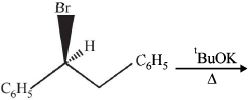
- (A) \(( \pm ){C_6}{H_5}CH({O^t }Bu)C{H_2}{C_6}{H_5}\)
- (B) \(C_6H_5CH=CHC_6H_5\)
- (C) \(( + ){C_6}{H_5}CH({O^t }Bu)C{H_2}{C_6}{H_5}\)
- (D) \(( - ){C_6}{H_5}CH({O^t }Bu)C{H_2}{C_6}{H_5}\)
Show answer and solution
Correct Answer: (B)
Carrying out dehydrohalogenation with a bulky base such as potassium tert-butoxide ( \(t\) -\(BuOK\) ) in \(1,2\) -diphenyl1-bromoethane \((t-\mathrm{BuOH})\) favors the formation of the alkene via \(E_2\) mechanism. The reaction involved is
-
- (A) \(CH_2 = CHCH_2CH = CHCH_3\)
- (B) \(CH_2= CHCH = CHCH_2CH_3\)
- (C) \(CH_3CH = C = CHCH_2CH_3\)
- (D) \(CH_3CH = CH - CH = CHCH_3\)
Show answer and solution
Correct Answer: (D)
\(\,\begin{array}{*{20}{c}}
{C{H_3} - CH - C{H_2} - CH - C{H_2} - C{H_3}}\\
{\,\,\,\,\,\,\,\,\,\,\,\,\,\,\,\,\,\,\,\,\,\,\,\,\,\,\,\,\,\,|\,\,\,\,\,\,\,\,\,\,\,\,\,\,\,\,\,\,\,\,\,\,\,\,\,\,\,\,\,\,\,\,\,\,\,|\,\,\,\,\,\,\,\,\,\,\,\,\,\,\,\,\,\,\,\,\,\,\,\,\,\,\,\,\,\,\,\,\,\,\,\,\,\,\,\,\,\,\,\,\,\,\,\,\,\,\,\,}\\
{\,\,\,\,\,\,\,\,\,Br\,\,\,\,\,\,\,\,\,\,\,\,\,\,\,\,\,\,\,\,\,\,\,\,\,\,\,\,\,\,\,Br\,\,\,\,\,\,\,\,\,\,\,\,\,\,\,\,\,\,\,\,\,\,\,\,\,\,\,\,\,\,}
\end{array}\) \(\xrightarrow[{{E_2}}]{{KOH,\,C{H_3}OH\,\Delta }}\) \(\mathop {C{H_3} - CH = CH - CH = CH - C{H_3}}\limits_{{\text{(Saytzeff product)}}} \) -
- (A) \([Co(H_2O)_4 Cl_2]Cl . 2H_2O\)
- (B) \([Co(H_2O)_3 Cl_3] . 3H_2O\)
- (C) \([Co(H_2O)_6]Cl_3\)
- (D) \([Co(H_2O)_5 Cl]Cl_2 . H_2O\)
Show answer and solution
Correct Answer: (D)
\(\text{CoC}{{\text{l}}_{3}}\cdot 6{{\text{H}}_{2}}\text{O}+\text{AgN}{{\text{O}}_{3}}\) \((\text{ excess })\to \text{AgCl}\)\(100\, \mathrm{mL}, 0.1 \,\mathrm{M}\) \(1.2\, \times 10^{22} \text { ion }\)
\(\text {moles }\;\; 0.01 \,\mathrm{mol}\) \(\frac{1.2 \times 10^{22}}{6 \times 10^{23}}=0.02\, \mathrm{mol}\)
since, \(0.01\, \mathrm{mol}\) of \(\mathrm{CoCl}_{3} \cdot 6 \mathrm{H}_{2} \mathrm{O}\) produce \(0.02\,\mathrm{mol}\) of \(\mathrm{AgCl}\)
Therefore, \(1\,mol\) of \(\mathrm{CoCl}_{3} \cdot 6 \mathrm{H}_{2} \mathrm{O}\) will produce \(2\, \mathrm{mol}\) of \(\mathrm{AgCl}\)
Thus, the complex is \(\left[\mathrm{Co}\left(\mathrm{H}_{2} \mathrm{O}\right)_{5} \mathrm{Cl}\right] \mathrm{Cl}_{2} \cdot \mathrm{H}_{2} \mathrm{O}\)
-
- (A) \(NO\)
- (B) \(CO\)
- (C) \(O_2\)
- (D) \(B_2\)
Show answer and solution
Correct Answer: (B)
The electronic configuration of the given species is as follows:\(\mathrm{O}_{2}: \sigma 1 s^{2}, \sigma^{*} 1 s^{2}, \sigma 2 s^{2}, \sigma^{*} 2 s^{2}, \sigma 2 p_{x}^{2},\left\{\begin{array}{l}{\pi 2 p_{y}^{2},} \\ {\pi 2 p_{z}^{2},}\end{array}\left\{\begin{array}{l}{\pi^{*} 2 p_{y}^{1}} \\ {\pi^{*} 2 p_{z}^{1}}\end{array}\right.\right.\)
\(\mathrm{B}_{2}: \sigma 1 s^{2}, \sigma^{*} 1 s^{2}, \sigma 2 s^{2}, \sigma^{*} 2 s^{2},\left\{\begin{array}{l}{\pi 2 p_{y}^{1}} \\ {\pi 2 p_{z}^{1}}\end{array}\right.\)
\(\mathrm{NO}: \sigma 1 s^{2}, \sigma^{*} 1 s^{2}, \sigma 2 s^{2}, \sigma^{*} 2 s^{2}, \sigma 2 p_{x}^{2},\left\{\begin{array}{l}{\pi 2 p_{y}^{2}, } \\ {\pi 2 p_{z}^{2},}\end{array}\left\{\begin{array}{l}{\pi^{*} 2 p_{y}^{1}} \\ {\pi^{*} 2 p_{z}^{0}}\end{array}\right.\right.\)
\(CO\): No unpaired electron is present in the molecule, therefore, is not paramagnetic.
- 22. The correct sequence of decreasing number of \(\pi -\) bonds in the structures of \(H_2SO_3, H_2SO_4\) and \(H_2S_2O_7\) is 2017 Hard
- (A) \({H_2}S{O_3}\, > \,{H_2}S{O_4}\, > \,{H_2}{S_2}{O_7}\)
- (B) \({H_2}S{O_4}\, > {H_2}{S_2}{O_7}\, > {H_2}S{O_3}\)
- (C) \({H_2}{S_2}{O_7} > {H_2}S{O_4} > {H_2}S{O_3}\)
- (D) \({H_2}{S_2}{O_7} > {H_2}S{O_3} > {H_2}S{O_4}\)
Show answer and solution
Correct Answer: (C)
Number of \(\pi \) - bonds\(H_2S_2O_7\,=\) \(\begin{array}{*{20}{c}}
{\begin{array}{*{20}{c}}
{\,\,O\,\,\,\,\,\,\,\,\,\,\,\,\,\,\,\,O\,} \\
{\,||\,\,\,\,\,\,\,\,\,\,\,\,\,\,\,\,\,||}
\end{array}} \\
{HO - S - O - S - OH} \\
{||\,\,\,\,\,\,\,\,\,\,\,\,\,\,\,\,\,\,||\,} \\
{\,\,\,\,O\,\,\,\,\,\,\,\,\,\,\,\,\,\,\,O\,\,\,\,}
\end{array}\) \(4\)\(H_2SO_4\,=\) \(\begin{array}{*{20}{c}}
{\begin{array}{*{20}{c}}
O \\
{||}
\end{array}} \\
{HO - S - OH} \\
{||} \\
O
\end{array}\) \(2\)\(H_2SO_3\,=\) \(\begin{matrix}
HO-\overset{\centerdot \,\,\centerdot }{\mathop{S}}\,-OH \\
|| \\
O \\
\end{matrix}\) \(1\) -
- (A) four and four
- (B) five and four
- (C) five and five
- (D) four and five
Show answer and solution
Correct Answer: (D)
Oxidation state :Each \(P\) atom is bound to one oxygen \(=-\,1\)
\(2OH=-\,1\times 2\,=\,-\,2\)
\(1\) oxygen \(-\,2\)
Total \(=\,-\,5\)
\(P\,=\,+5\)

- 24. The products obtained when chlorine gas reacts with cold and dilute aqueous \(NaOH\) are : 2017 Medium
- (A) \(ClO^-\) and \(ClO_3^-\)
- (B) \(ClO_2^-\) and \(ClO_3^-\)
- (C) \(Cl^-\) and \(ClO^-\)
- (D) \(Cl^-\) and \(ClO_2^-\)
Show answer and solution
Correct Answer: (C)
Dissolving the halogens in \(NaOH\) can in principle be used to make all the hypohalite ions. The reaction is\(\mathrm{Cl}_{2}+2 \mathrm{NaOH}(\mathrm{cold} / \mathrm{dilute}) \rightarrow \mathrm{NaCl}+\mathrm{NaOCl}+\mathrm{H}_{2} \mathrm{O}\)
-
- (A) \(CH_4, O_3, N_2, SO_2\)
- (B) \(O_3, N_2, CO_2, NO_2\)
- (C) \(O_3, NO_2, SO_2, Cl_2\)
- (D) \(CO_2, CH_4, N_2O, O_3\)
Show answer and solution
Correct Answer: (D)
Green house gases are those gases that absorbs and emits radiation within the thermal \(IR\) range. The process is the fundamental cause of the green house effect. These are \(CO_2, CH_4, N_2O\) and \(O_3\) -
- (A) \(XeF_2\)
- (B) \(XeF_4\)
- (C) \(XeOF_4\)
- (D) \(XeO_3\)
Show answer and solution
Correct Answer: (C)
\(Xe{F_6}\, + \,{H_2}O\, \to \mathop {XeO{F_4}\, + \,2HF}\limits_{(partial\,\,\,hydrolysis)} \)\(Xe{F_6} + 2{H_2}O\, \to Xe{O_2}{F_2}+ \,4HF\)
\(Si{O_2}\, + \,2Xe{F_6}\, \to \mathop {\,2XeO{F_4}\, + \,Si{F_4}}\limits_{(Xenoneoxy\,\,\,tetra\,\,fluoride)} \)
-
- (A) \(Tl^+\) is more stable than \(Al^{3+}\)
- (B) \(Al^+\) is more stable than \(Al^{3+}\)
- (C) \(Tl^+\) is more stable than \(Al^+\)
- (D) \(Tl^{3+}\) is more stable than \(Al^{3+}\)
Show answer and solution
Correct Answer: (C)
\((i)\,\mathop {A{l^{3 + }}}\limits_{Most\,\,stable} \,\xrightarrow{{{E^o}\, = \, - \,1.66}}Al\,\xleftarrow{{{E^o}\, = \, + \,0.55}}\mathop {A{l^ + }}\limits_{Less\,\,stable} \)\((ii)\mathop {T{l^{3 + }}}\limits_{Less\,\,stable} \,\xrightarrow{{{E^o}\, = \, - + 1.26}}Tl\,\xleftarrow{{{E^o}\, = \, - 0.34}}\mathop {T{l^ + }}\limits_{Most\,\,\,stable} \)
\(Tl^+\) has negative electrode potential \((E^o = - 0.34)\) means, it does not prefer to convert into \(Tl\) but reverse must be preferred that's why it is more stable than \(Tl^{3+}\) \((E^o\,=\,+\,1.26)\) In \(Al\), \(Al^{3+}\) is more stable \(E^o=\,-\,1.66\) than \(Al^+\) \((E^o\,=\,+0.55)\) and also from \(Tl^+\) due to more negative value of \(E^o\). Therefore, by comparison it confirms that \(Tl^+\) is more stable than \(Al^+\).
-
- (A) \(Cr\)
- (B) \(Mn^{2+}\)
- (C) \(Cr^{+3}\)
- (D) \(Cl^-\)
Show answer and solution
Correct Answer: (A)
Lower the reduction potential, greater is the tendency of the element to get oxidized, hence, greater is the reducing ability. Since, chromium system has lowest reduction potential; therefore, it is the strongest reducing agent. -
- (A) \(0.38\)
- (B) \(0.32\)
- (C) \(1.28\)
- (D) \(0.66\)
Show answer and solution
Correct Answer: (B)
Cell reaction :\(M\, + \,3A{g^ + }(aq)\, \to \,{M^{3 + }}\, + \,3Ag(s)\)
\(E\, = \,{E^o}\, - \,\frac{{0.0591}}{n}\log \,\) \(\frac{{[\operatorname{Re} duction\,\,state]}}{{[Oxidised\,\,\,state]}}\)
\(0.421\, = \,{E^o}\, - \,\frac{{0.0591}}{3}\log \,\frac{{0.001}}{{{{(0.01)}^3}}}\)
\({E^o}\, = \,0.48\)
\({E^o}\, = \,E_{A{g^ + }/Ag}^o\, - \,E_{{M^{3 + }}/M}^o\)
\(E_{{M^{3 + }}/M}^o\, = \,0.8\,V\, - \,0.48\,V\, = \,0.32\,volt\)
-
- (A) \(-0.057\)
- (B) \(+0.057\)
- (C) \(+0.30\)
- (D) \(-0.30\)
Show answer and solution
Correct Answer: (A)
\(\Delta {G^o}\, = \, - nF{E^o}\)\((i)\,F{e^{2 + }}\, + \,2{e^ - }\, \to \,Fe;\) \({E^o}\, = \, - 0.47\,\,V;\)
\((ii)\,F{e^{3 + }}\, + \,{e^ - }\, \to \,F{e^{2 + }};\) \({E^o}\, = \, + 0.77\,\,V;\)
\((iii)\,F{e^{3 + }}\, + \,3{e^ - }\, \to Fe\)
\((i)\,\Delta {G^o}\, = \, - nF{E^o}\, = \, - \,2\,( - 0.47)F\, = \,0.94\,F\)
\((ii)\,\Delta {G^o}\, = \, - nF{E^o}\, = \, - \,1\,( + 0.77)F\, = \, - 0.77\,F\)
\((iii)\) on adding \(:\,\Delta {G^o}\, = \, + \,0.17\,F\)
\(\Delta {G^o}\, = \, - nF{E^o}\,{E^o}\) for
\((F{e^{3 + }} \to Fe)\, = \,\frac{{\Delta {G^o}}}{{ - nF}}\,\) \( = \,\frac{{0.17F}}{{ - 3F}}\, = \, - \,0.057\,V\)
- 31. Which of the following ions does not liberate hydrogen gas on reaction with dilute acids ? 2017 Hard
- (A) \(Ti^{2+}\)
- (B) \(V^{2+}\)
- (C) \(Cr^{2+}\)
- (D) \(Mn^{2+}\)
Show answer and solution
Correct Answer: (D)
ions \(E^o\,(V)\)\(Ti^{2+}\) \(-0.37\)
\(V^{2+}\) \(-0.26\)
\(Cr^{2+}\) \(-0.41\)
\(Mn^{2+}\) \(+1.57\)
Negative value of \(E^o\) means these metals librate hydrogen from dilute acid.
\(({M^{2 + }}\, + \,2{H^ + }\, - \,{e^ - }\, \to \,{M^{3 + }}\, + \,{H_2})\)
-
- (A) \(15\)
- (B) \(25\)
- (C) \(45\)
- (D) \(65\)
Show answer and solution
Correct Answer: (C)
Molality (experimental)\( = \,\frac{{\Delta {T_f}}}{{{K_f}}}\, = \,\frac{{3.82}}{{1.86}}\, = \,2.054\,mol/1000\,g\) solvent
Molality (theoretical)
\( = \,\frac{{mole\,\,of\,solute}}{{wt.\,of\,solventing\,(g)}} \times 1000\)
\( = \,\frac{{5\,g\,/\,142\,g\,/\,mole}}{x} \times 1000\)
\(N{a_2}S{O_4}\, \to \,2N{a^ + }\, + \,SO_4^{2 - }\)
Moles before dissociation \(1\) \(0\) \(0\)
Moles after dissociation \(1-x\) \(2x\) \(x\)
Von't Hoff Factor \((i) = \,\frac{{Moles\,after\,\,dissociation}}{{Moles\,before\,\,dissociation}}\)
\( = \frac{{(1 - x)\, + \,2x\, + \,x}}{1}\)
\(Na_2SO_4\) is ionised \(81.5\%\) means \(x\,=\,0.815\)
\( = \frac{{(1 - 0.815)\, + \,2 \times 0.815\, + \,0.815}}{1}\)
\(=\,2.63\)
\(i\, = \,\frac{{Observed\,\,molarrity}}{{Calculated\,\,molarity}}\)
\( \Rightarrow \,2.63\, = \,\frac{{2.054}}{{\frac{{0.0352}}{x} \times 1000}}\, = \,45.07\,g\)
-
- (A) \(0.162\)
- (B) \(0.675\)
- (C) \(0.325\)
- (D) \(0.486\)
Show answer and solution
Correct Answer: (C)
Molar mass of \(CHCl_3\,=\,119.5\,g/mol.\)Molar mass of \(CH_2Cl_2\,=\,85\,g/mol.\)
Molar of \(CHCl_3\,=\,\frac {11.95}{119.5}\,=\,0.1\,mol.\)
Molar of \(CH_2Cl_2\,=\,\frac {8.5}{85}\,=\,0.1\,mol.\)
Mole fraction of \(CHCl_3\,=\,\frac {0.1}{0.2}\,=\,0.5\,mol\)
Mole fraction of \(CH_2Cl_2\,=\,\frac {0.1}{0.2}\,=\,0.5\,mol\)
(Given-
Vapour pressure of \(CHCl_3\,=\,200\,mm\) \(Hg\,=\,0.263\,atm\).
Vapour pressure of \(CH_2Cl_2\,=\,415\,mm\) \(Hg\,=\,0.546\,atm\).)
\((1\,atm\,=\,760\,mm\,Hg)\)
\(\therefore P_{(abovesolution)}\) \(=\) Mole fractiion of \(CHCl_3\times \) (Vapour pressure of \(CHCl_3\) ) \(+\) Mole fractiion of \(CH_2Cl_2\times \) (Vapour pressure of \(CH_2Cl_2\) )
\(=\,0.5\times 0.263\,+\,0.5\times 0.546\,=\,0.4045\)
Mole fraction of \(CHCl_3\) in vapour form
\(=\,\frac {0.1315}{0.4045}\,=\,0.325\)
-
- (A) \(64.6\)
- (B) \(80.4\)
- (C) \(74.6\)
- (D) \(94.6\)
Show answer and solution
Correct Answer: (D)
\( \quad \quad \quad \quad 2 \mathrm{CH}_{3} \mathrm{COOH} \rightleftharpoons\left(\mathrm{CH}_{3} \mathrm{COOH}\right)_{2} \)\(Initial\; moles\quad \quad 1 \quad \quad \quad \quad 0\)
\(at\; equilibrium \quad 1-\alpha\quad \quad \alpha / 2\)
Total number of moles at equilibrium \(=1-\alpha+\alpha / 2 \Rightarrow i=1-\alpha / 2(\text { association })\)
\(\Delta T_{\mathrm{r}}=K_{\mathrm{r}} \times m \times i\)
\(0.45=(5.12) \times \frac{(0.2 / 60)}{(20 / 1000)} \times\left(1-\frac{\alpha}{2}\right)\)
\(\left(1-\frac{\alpha}{2}\right)=0.527 \Rightarrow \alpha=0.945\)
So, the percentage of acetic acid that dimerizes \(=94.5 \%\)
-
- (A) \(1186\)
- (B) \(84.3\)
- (C) \(118.6\)
- (D) \(11.86\)
Show answer and solution
Correct Answer: (B)
\(\mathrm{M}_{2} \mathrm{CO}_{3}+2 \mathrm{HCl} \rightarrow 2 \mathrm{MCl}+\mathrm{H}_{2} \mathrm{O}+\mathrm{CO}_{2}\)\(n=\frac{\text { Mass given }}{\text { Molar mass }}\)
\(0.01186=\frac{1}{M} \Rightarrow M=84.3\, \mathrm{g\,mol}^{-1}\)
-
- (A) \(0.2\)
- (B) \(0.3\)
- (C) \(0.6\)
- (D) \(1.8\)
Show answer and solution
Correct Answer: (A)
\(\underset{\begin{smallmatrix}
\lim iting \\
reagent
\end{smallmatrix}}{\mathop{FeC{{l}_{3}}(aq.)}}\,+\underset{\begin{smallmatrix}
(Excess\,amount) \\
not\,behave\,as
\\
\lim iting\,reagent
\end{smallmatrix}}{\mathop{3NaOH(aq.)}}\,\to \) \(Fe{(OH)_3}(s) + 3NaCl(aq.)\)Moles of \(Fe(OH)_3\) \( = \frac{{weight\,in\,g}}{{M.\,weight\,of\,Fe{{(OH)}_3}}}\)
\( = \frac{{2.14\,g}}{{107\,g/mol}} = 0.02\,mol.\)
\(1.0\) mole of \(Fe(OH)_3\) is obtained from \(= 1.0\) mole of \(FeCl_3\)
\(0.02\) mole of \(Fe(OH)_3\) is obtained from \(0.02\) mole of \(FeCl_3\)
Molarity
\( = \frac{{No.\,of\,moles}}{{Volume\,in\,L}} = \frac{{0.02\,mole}}{{0.1\,L}} = 0.2\,M\)
-
- (A) \(6\)
- (B) \(0\)
- (C) \(2\)
- (D) \(4\)
Show answer and solution
Correct Answer: (D)
When alkenes are treated with \(HBr\) in the presence of peroxides, an anti-Markovnikov addition occurs in the sense that the hydrogen atom becomes attached to the carbon atom with the fewer hydrogen atoms.The product formed has two chirality centres, therefore, four stereoisomers \(\left(2^{2}\right)\) will exist.
\(\begin{array}{*{20}{c}}
{\,\,\,\,\,C{H_3}} \\
| \\
{C{H_3} - C{H_2} - C = CH - C{H_3}}
\end{array}\) \(\xrightarrow[{Peroxide}]{{HBr}}\) \(\mathop {\begin{array}{*{20}{c}}
{\,\begin{array}{*{20}{c}}
{\,\,\,\,\,\,C{H_3}} \\
|
\end{array}} \\
{C{H_3} - C{H_2} - {}_*CH - \mathop {CH}\limits^{*\,} - C{H_3}} \\
{\,\,\,\,\,\,\,\,\,\,\,\,\,\,\,\,\,\,\,\,\,\,\,\,\,\,\,\,\,\,\,\,\,\,\,|} \\
{\,\,\,\,\,\,\,\,\,\,\,\,\,\,\,\,\,\,\,\,\,\,\,\,\,\,\,\,\,\,\,\,\,\,\,\,\,Br}
\end{array}}\limits_{Major\,\,product} \) -
- (A) \(BF_3, NF_3, CO_3^{2 - }\)
- (B) \(CO_3^{2 - } , NO_3^- , SO_3\)
- (C) \(NH_3, SO_3, CO_3^{2 - }\)
- (D) \(NCl_3, BCl_3, SO_3\)
Show answer and solution
Correct Answer: (B)
Group Hybridization Shape \((1)\) \(BF_3\)
\(NF_3\)
\(CO_3^{2-}\)
\(sp^2\)
\(sp^3\)
\(sp^2\)
Triangular Planar \((TP)\)
Tetrahedral \((T)\)
\(T.P.\)
\((2)\) \(CO_3^{2-}\)
\(NO_3^-\)
\(SO_3\)
\(sp^2\)
\(sp^2\)
\(sp^2\)
\(\left. \begin{gathered}
T.P. \hfill \\
T.P. \hfill \\
T.P. \hfill \\
\end{gathered} \right\}\) (all have same hybridization)\((3)\) \(NH_3\)
\(SO_3\)
\(CO_3^{2-}\)
\(sp^3\)
\(sp^2\)
\(sp^2\)
\(T\)
\(T.P.\)
\(T.P.\)
\((4)\) \(NCl_3\)
\(BCl_3\)
\(SO_3\)
\(sp^3\)
\(sp^2\)
\(sp^2\)
\(T\)
\(T.P.\)
\(T.P.\)
-
- (A) \(N{O^ + }\)
- (B) \(CO\)
- (C) \(O_2^{2 - }\)
- (D) \(B_2\)
Show answer and solution
Correct Answer: (D)
Total electron\(NO^+\) \(14\)
\(CO\) \(14\)
\(O_2^{2-}\) \(18\)
\(B_2\) \(10\)
\(N{O^ + } \Rightarrow KK.\sigma {(2s)^2}{\sigma ^*}{(2s)^2}.{(\pi 2{p_x})^2}\)
\( = {(\pi 2{p_y})^2}.{(\sigma 2{p_z})^2}\) diamagnetic
\(CO \Rightarrow KK.\sigma {(2s)^2}{\sigma ^*}{(2s)^2}.{(\pi 2{p_x})^2}\)
\( = {(\pi 2{p_y})^2}.{(\sigma 2{p_z})^2}\) diamagnetic
\(O_2^{2 - } \Rightarrow KK.\sigma {(2s)^2}{\sigma ^*}{(2s)^2}.\sigma {(2{p_z})^2}{(\pi 2{p_x})^2}\)
\( = {(\pi 2{p_y})^2}.{\pi ^*}{(2{p_x})^2} = {\pi ^*}{(2{p_y})^2}\) diamagnetic
\({B_2} \Rightarrow KK.\sigma {(2s)^2}{\sigma ^*}{(2s)^2}.\pi {(2{p_x})^1} = \pi {(2{p_y})^1}\) paramagnetic
-
- (A) \([Ne]\, 3s^2\,3p^1\)
- (B) \([Ne]\, 3s^2\,3p^2\)
- (C) \([Ne]\, 3s^2\,3p^3\)
- (D) \([Ar]\, 3d^{10}\,4s^2\,4p^3\)
Show answer and solution
Correct Answer: (C)
The smaller the atomic size, larger is the value of \(IP\). Further the atoms having half filled or fully filled orbitals are comparatively more stable, hence more energy required to remove the electron from such atoms. -
- (A) \(O^{-2} , F^-, Na^+, Mg^{2+}\)
- (B) \(O^-, F^-, Na, Mg^+\)
- (C) \(O^{-2} , F^-, Na, Mg^{2+}\)
- (D) \(O^-, F^-, Na^+, Mg^{2+}\)
Show answer and solution
Correct Answer: (A)
Isoclectronic species have the same number of electrons. The following ionic species are isoclectronic.\(\begin{array}{lcc}\hline \text { Ions } & {\text { Atomic number }} & {\text { Number of electrons }} \\ \hline 0^{2-} & {8} & {10} \\ {\mathrm{F}^{-}} & {9} & {10} \\ {\mathrm{Na}^{+}} & {11} & {10} \\ {\mathrm{Mg}^{2+}} & {12} & {10} \\ \hline\end{array}\)
-
- (A) Removal of \(CO\)
- (B) Removal of \(CO_2\)
- (C) Addition of \(CO_2\)
- (D) Addition of \(Fe_2O_3\)
Show answer and solution
Correct Answer: (D)
Perturbation Shifts reaction which way?Removal of \(CO\) Left
Removal of \(CO_2\) Right
Addition of \(CO_2\) Left
Addition of \(Fe_2O_3\) No change
(This is a solid compound. Its concentration has no effect on the equilibrium).
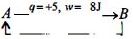
-
- (A) \(10\, J\) of the work will be done by the gas
- (B) \(6\, J\) of the work will be done by the gas
- (C) \(10\, J\) of the work will be done by the surrounding on gas
- (D) \(6\, J\) of the work will be done by the surrounding on gas.
Show answer and solution
Correct Answer: (D)
\(\Delta {U_{AB}} = q + w = + 5 + ( - 8) = - 3\)\(q = - 3,\,\Delta {U_{BA}} = + 3\)
\(\Delta {U_{BA}} = q + w\)
\( \Rightarrow 3 = - 3 + w \Rightarrow w = + 6\)
(work done on the system)
-
- (A) enthalpy increases but entropy decreases
- (B) enthalpy remains constant but entropy increases
- (C) enthalpy decreases but entropy increases.
- (D) Both enthalpy and entropy remain constant.
Show answer and solution
Correct Answer: (B)
\(\Delta H = n{c_p}\Delta T = 0\) means \(\Delta H\) constant.\(\Delta S = nR\,\ln {\kern 1pt} \left( {\frac{{{v_f}}}{{{v_i}}}} \right) \geqslant 0\) \(\Delta S\) increases.
- 45. For a reaction, \(A(g) \to A(l)\); \(\Delta H = - 3RT\). The correct statement for the reaction is 2017 Hard
- (A) \(\Delta H = \Delta U \ne O\)
- (B) \(\Delta H = \Delta U = O\)
- (C) \(\left| {\Delta H} \right| < \left| {\Delta U} \right|\)
- (D) \(\left| {\Delta H} \right| > \left| {\Delta U} \right|\)
Show answer and solution
Correct Answer: (D)
\(A(g) \to A(1)\)\(\Delta H = \Delta U + \Delta {n_g}RT\)
Given, \(\Delta H = - 3RT\)
Here
\(\Delta {n_g} = {n_p} - {n_r} = 0 - 1 = - 1\)
\(\Delta H = \Delta U - RT\)
\( \Rightarrow - 3RT = \Delta U - RT\)
\( \Rightarrow - 3RT + RT = \Delta U\)
\( \Rightarrow - 2RT = \Delta U\)
\(|\Delta H|\, > \,|\Delta U|\)
-
- (A) \(+ 74.8\)
- (B) \(+ 144.0\)
- (C) \(- 74.8\)
- (D) \(- 144.0\)
Show answer and solution
Correct Answer: (C)
\(C(graphite) +\mathrm{O}_{2}(\mathrm{g}) \rightarrow \mathrm{CO}_{2}(\mathrm{g})\) \(\Delta_{r} H^{\circ}=-393.55\,\mathrm{kJ}\, \mathrm{mol}^{-1}\)\(\mathrm{H}_{2}(\mathrm{g})+\frac{1}{2} \mathrm{O}_{2}(\mathrm{g}) \rightarrow \mathrm{H}_{2} \mathrm{O}(\mathrm{l}) ; \)\(\quad \Delta_{r} H^{\circ}=-285.8\, \mathrm{kJ}\, \mathrm{mol}^{-1}\)
\(\mathrm{CO}_{2}(\mathrm{g})+2 \mathrm{H}_{2} \mathrm{O}(\mathrm{l}) \rightarrow \mathrm{CH}_{4}(\mathrm{g})+2 \mathrm{O}_{2}(\mathrm{g}) ;\)\( \Delta_{r} H^{\circ}=+890.3\,\mathrm{kJ}\,\mathrm{mol}^{-1}\)
\(C(graphite) +2 \mathrm{H}_{2}(\mathrm{g}) \rightarrow \mathrm{CH}_{4}(\mathrm{g}) ; \)\(\quad \Delta_{r} H^{\circ}=?\)
Now, Eq. \((4)= \) Eq. \((1)+2 \times\) Eq. \((2)+\) Eq. \(( 3)\)
\(\Delta_{r} H^{\circ}=-393.55+2(-285.8)+890.3\)
\(=-74.8\,\mathrm{kJ} \,\mathrm{mol}^{-1}\)
-
- (A) \(5.44\)
- (B) \(5.81\)
- (C) \(6.56\)
- (D) \(6\)
Show answer and solution
Correct Answer: (C)
In order to calculate the enthalpy change for \(H_2O\) at \(5\,^oC\) to ice at \(-\,5\,^oC\) , we need to calculated the enthalpy change of all the transformation involved in the process.\((a)\) Energy change of \(1\,mol\), \(H_2O\,(l)\), at \(5\,^oC\)
\(\to \,1\,mol\), \(H_2O\,(l)\) , \(0\,^oC\)
\((b)\) Energy change of \(1\,mol\), \(H_2O\,(l)\), at \(0\,^oC\)
\(\to \,1\,mol\), \(H_2O\,(s)\) (ice) , \(0\,^oC\)
\((c)\) Energy change of \(1\,mol\), Ice \((s)\), at \(0\,^oC\)
\(\to \,1\,mol\), Ice \((s)\) , \(-5\,^oC\)
Total \(\Delta H\)
\( = \,{C_P}\,[{H_2}O\,(l)]\,\,\Delta T\,\, + \,\Delta H\) freezing \( + \,\,{C_P}\,[{H_2}O\,(s)]\,\,\Delta T\)
\( = \,(75.3\,\,J\,\,mo{l^{ - 1}}\,{K^{ - 1}})\,( - 5)\,K\, + ( - \,6\, \times \,{10^3}\,\,J\,mo{l^{ - 1}}\,{K^{ - 1}})\) \(+ \,(36.8\,\,J\,mo{l^{ - 1}}\,{K^{ - 1}})\,( - 5)\,K\)
\(\Delta H\,\, = \,\, - \,6.56\,\,kJ\,mo{l^{ - 1}}\) (exothermic process)
So, \(\Delta H\,\, = \,\,6.56\,\,kJ\,mo{l^{ - 1}}\)
-
- (A) lsochoric work
- (B) Isobaric work
- (C) Adiabatic work
- (D) Isothermal work
Show answer and solution
Correct Answer: (C)
\(\Delta U = Q +\Delta W\)In adiabatic process no exchange of heat occurs between system and surrounding so \(Q =0\).
Thus, \(\Delta U\) is equal to adiabatic work.
-
- (A) \(KO_2\)
- (B) \(BaO_2\)
- (C) \(SiO_2\)
- (D) \(CsO_2\)
Show answer and solution
Correct Answer: (C)
Compound nature\(KO_2\) Superoxide
\(BaO_2\) Peroxide
\(SiO_2\) Oxide
\(CsO_2\) Superoxide
-
- (A) \(\frac{{5A}}{9}\)
- (B) \(\frac{{9A}}{5}\)
- (C) \(\frac{{36A}}{5}\)
- (D) \(\frac{{36A}}{7}\)
Show answer and solution
Correct Answer: (D)
For Lyman series (short wavelength)\({n_1} = 1,\,{n_2} = \infty \)
\(\frac{1}{\lambda } = R{z^2}\left( {\frac{1}{{n_1^2}} - \frac{1}{{n_2^2}}} \right)\)
\( \Rightarrow \frac{1}{A} = {1^2}\,R\left( {\frac{1}{1} - \frac{1}{\infty }} \right) \Rightarrow \frac{1}{A} = R\)
Longest wavelength \(= 1^{st}\) line
\({n_1} = 3,\,{n_2} = 4\)
\(\frac{1}{\lambda } = R{z^2}\left( {\frac{1}{{{3^2}}} - \frac{1}{{{4^2}}}} \right) \Rightarrow \frac{1}{\lambda } = \frac{{R7}}{{36}}\)
\(R = \frac{1}{A}\)
\(\frac{1}{\lambda } = \frac{{\frac{1}{A} \times 7}}{{36}} \Rightarrow \frac{1}{\lambda } = \frac{7}{{36\,A}} \Rightarrow \lambda = \frac{{36\,A}}{7}\)

No questions on this page match these filters.
Other years
Frequently asked
How many JEE Mains 2017 Chemistry questions are on ExamBro?
53 questions, each with the correct answer and a full solution.
Which JEE Mains 2017 Chemistry chapter is asked the most?
Thermodynamics and thermochemistry, with 6 questions, followed by Equilibrium - II (icon Equilibrium) with 5.
How difficult are JEE Mains 2017 Chemistry questions?
8% are easy, 19% medium and 74% hard.