


All JEE Mains 2013 Chemistry questions
24 chaptersShowing 51–100 of 100 questions
- 51. Which of the following complex species is not expected to exhibit optical isomerism? (\(en=\) ethylenediamine) 2013 Medium
- (A) \([Co(en)_3]^{3+}\)
- (B) \([Co(en)_2Cl_2]^{+}\)
- (C) \([Co(NH_3)_3Cl_3]\)
- (D) \([Co(en) (NH_3)_2 Cl_2]^+\)
Show answer and solution
Correct Answer: (C)
Optical isomerism is exhibited by only those complexes which lacks elements of symmetry. \(\left[\mathrm{Co}\left(\mathrm{NH}_{3}\right)_{3} \mathrm{Cl}_{3}\right]\) shows facial as well as meridional isomerism. But both the forms contain plane of symmetry. Thus, this complex does not exhibit optical isomerism. -
- (A) \({[Fe{(CN)_6}]^{3 - }}\)
- (B) \({[Co{(C_2O_4)_3}]^{3 - }}\)
- (C) \([FeF_6]^{3-}\)
- (D) \([CoF_6]^{3-}\)
Show answer and solution
Correct Answer: (B)
\([Fe(CN)_6]^{3-}\) has magnetic moment of a single unpaired electron whereas \([FeF_6]^{3-}\) has a magnetic moment of five unpaired electrons. \([CoF_6]^{3-}\) is paramagnetic with four unpaired electrons while \([Co(C_2O_4)_3]^3\) is diamagnetic. This anomaly is explained by valence bond theory in terms of formation of inner and outer orbital coordination entities. \([Co(C_2O_4)_3]^{3-}\) is an inner orbital complexes having \(d^2sp^3\) hybridization . - 53. The order of increasing sizes of atomic radii among the elements \(O , S, Se\) and \(As\) is 2013 Hard
- (A) \(As < S < O < Se\)
- (B) \(Se < S < As < O\)
- (C) \(O < S < Se < As\)
- (D) \(O < S < As < Se\)
Show answer and solution
Correct Answer: (C)
On moving down in a group atomic radii increases due to successive addition of extra shell hence \(O < S < Se\)Further As is in group \(15\) having one less electron in its \(p\) orbital hence have higher atomic radii than group \(16\) elements. \(i.e.,\,\,O < S < Se< As\)
-
- (A) \(XeOF_2\)
- (B) \(XeO_3F_2\)
- (C) \(FXeOSO_2F\)
- (D) \([XeF_8]^{2-}\)
Show answer and solution
Correct Answer: (B)
The hybridization of \(XeO_3F_2\) is \(sp^3d\) and its structure is trigonal bipyramidal in which oxygen atoms are situated on the plane and the fluoride atoms are on the top and bottom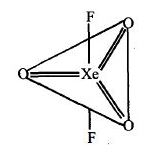
-
- (A) \(0.3892\)
- (B) \(0.2938\)
- (C) \(0.2398\)
- (D) \(0.3928\)
Show answer and solution
Correct Answer: (B)
\(W=Zit\)where \(Z\,=\) Electrochemical equivalent
Eq. wt. of copper \(=\,\frac {63}{2}=31.5\)
\(Z\,=\,\frac {31.5}{96500}\)
\(W\, = \,Zit\, = \,\frac{{31.5}}{{96500}}\, \times \,1.5\, \times 10 \times 60\, = \,0.2938\,g\)
-
- (A) \(Cu^+\)
- (B) \(Fe^{3+}\)
- (C) \(Ag^+\)
- (D) \(I_2\)
Show answer and solution
Correct Answer: (C)
Higher the value of reduction potential stronger will be the oxidising hence based on the given values \(Ag^+\) will be strongest oxidizing agent -
- (A) \(Mn^{2+} < Cl^- < Cr^{3+} < Cr\)
- (B) \(Mn^{2+} < Cl^{3+} < Cl^- < Cr\)
- (C) \(Cr^{3+} < Cl^- < Mn^{2+} < Cr\)
- (D) \(Cr^{3+} < Cl^- < Cr < Mn^{2+}\)
Show answer and solution
Correct Answer: (A)
Lower the value of reduction potential higher will be reducing power hence the correct order will be \(Mn^{2+} < Cl^- < Cr^{3+} < Cr\) -
- (A) \(Cl\)
- (B) \(Cr^{3+}\)
- (C) \(Mn^{2+}\)
- (D) \(MnO_4^-\)
Show answer and solution
Correct Answer: (D)
Higher the value of standard reduction potential stronger will be the oxidising agent, hence \(M n O_{4}^-\) is the strongest oxidising agent. -
- (A) \(4.5\)
- (B) \(3\)
- (C) \(5\)
- (D) \(2.5\)
Show answer and solution
Correct Answer: (B)
In the reaction\(\frac{2}{3}A{l_2}{O_3}\, \to \,\frac{4}{3}Al\, + \,{O_2}\)
For the oxidation half - reaction
\(A{l^{3 + }}\, + \,3{e^ - }\, \to \,Al\)
no. of electron transfered \((n)=3\)
\(\Delta G^o\,=\,-\,nFE^o\)
\(940=3\times 96500 \times E^o\)
\(E^o\,=\,\frac {940\times 10^3\,J}{3\times 96500}\)
\(=\,3.24\,\,\approx\,3\,V\)
-
- (A) \(80\)
- (B) \(60\)
- (C) \(20\)
- (D) \(40\)
Show answer and solution
Correct Answer: (C)
\(\frac{{{P^o}\, - \,{P_s}}}{{{P^o}}}\, = \,\frac{n}{N}\, = \,\frac{w}{m}\, \times \,\frac{M}{W}\)\(0.1\, = \,\frac{{12}}{m}\, \times \,\frac{{18}}{{108}}\)
\(m\, = \,\frac{{12\, \times \,18}}{{0.1\, \times \,108}}\, = \,20\)
-
- (A) \(3\)
- (B) \(5\)
- (C) \(2\)
- (D) \(4\)
Show answer and solution
Correct Answer: (C)
van't Hoff factor \((i)\) and the degree of association are related as below :\(i\, = \,1\, - \,\alpha \,\left( {1 - \,\frac{1}{n}} \right)\)
\(0.9\, = \,1 - \,0.2\,\left( {1 - \frac{1}{n}} \right)\)
On solving,
\(\,\left( {1 - \frac{1}{n}} \right)\, = \,\frac{1}{2}\)
\(\frac{1}{n}\, = \,1\, - \frac{1}{2}\, = \frac{1}{2}\)
\(\therefore \,n = 2\)
-
- (A) \(880.07\)
- (B) \(899.04\)
- (C) \(886.02\)
- (D) \(868.06\)
Show answer and solution
Correct Answer: (D)
\(\Delta {T_f}\, = \,{K_f}m\)where \(m\) \(=\) molality
\(273 - 268\, = \,1.86\, \times \,\frac{w}{{M\, \times \,V}}\)
\(5\, = \,1.86\, \times \,\frac{w}{{32\, \times 10}}\)
\(w\, = \,\frac{{5\, \times 32\, \times \,10}}{{1.86}}\)
\( = \,860.2\, \approx \,868.06\,g\)
-
- (A) \(260\)
- (B) \(2.18\)
- (C) \(2.79\)
- (D) \(3\)
Show answer and solution
Correct Answer: (C)
The relation between molarity \((M)\) and molality \((m)\) is\(d\, = \,M\,\left( {\frac{1}{m}\, + \,\frac{{{M_2}}}{{1000}}} \right)\,,\,{M_2}\, = \) Mol. mass of solute
On putting value
\(1.252\, = \,3\left( {\frac{1}{m}\, + \,\frac{{58.5}}{{1000}}} \right)\)
on solving \(m\,=\,2.79\)
- 64. The molarity of a solution obtained by mixing \(750 \,mL\) of \(0.5(M)\,HCl\) with \(250\,mL\) of \(2(M)\,HCl\) will be .........\(M\) 2013 Medium
- (A) \(0.87\)
- (B) \(1.00\)
- (C) \(1.75\)
- (D) \(0.97\)
Show answer and solution
Correct Answer: (A)
From Molarity equation:\(M_{1} V_{1}+M_{2} V_{2}=M \times V\)
\(M=\frac{M_{1} V_{1}+M_{2} V_{2}}{V}\)
where \(V=\) total volume
\(=\frac{750 \times 0.5+250 \times 2}{1000}=0.875\, M\)
-
- (A) \(0.137\)
- (B) \(0.237\)
- (C) \(0.435\)
- (D) \(0.205\)
Show answer and solution
Correct Answer: (B)
\({P_A}\, = \,P_A^o\, \times \,{x_A}\, = \) total pressure \(\times y_A\)\({P_B}\, = \,P_B^o\, \times {x_B}\, = \) total pressure \(\times y_B\)
where \(x\) and \(y\) represents mole fraction in liquid and vapour phase repsectively.
\(\frac{{P_B^o{x_B}}}{{P_A^o{x_A}}}\, = \,\frac{{{y_B}}}{{{y_A}}};\)
\(\frac{{P_B^o(1 - \,{x_A})}}{{P_A^o\,{x_A}}}\, = \,\frac{{1 - \,{y_A}}}{{{y_A}}}\)
on putting values \(\frac{{119\,(1 - \,0.50)}}{{37\, \times \,0.50}}\, = \,\frac{{1 - \,{y_A}}}{{{y_A}}}\)
on solving \(y_A\,=\,0.237\)
-
- (A) \(0.57\)
- (B) \(5.7\)
- (C) \(11.4\)
- (D) \(1.14\)
Show answer and solution
Correct Answer: (A)
From molarity equation\({M_1}{V_1} + {M_2}{V_2} = M{V_{(total)}}\)
\(2 \times \frac{{10}}{{1000}} + 0.5 \times \frac{{200}}{{1000}} = M \times \frac{{210}}{{1000}}\)
\(120 = M \times 210\)
\(M = \frac{{120}}{{210}} = 0.57\,M\)
-
- (A) Ethene
- (B) \(2-\) Butene
- (C) \(1-\) Butene
- (D) Propene
Show answer and solution
Correct Answer: (B)
\(2-\) Butene -
- (A) \(C_2H_4\)
- (B) \(C_3H_4\)
- (C) \(C_6H_5\)
- (D) \(C_7H_8\)
Show answer and solution
Correct Answer: (D)
\(18 \mathrm{g} \mathrm{H}_{2} \mathrm{O}\) contain \(2 \mathrm{g} \mathrm{H}\)\(\therefore 0.72 \mathrm{g} \mathrm{H}_{2} \mathrm{O}\) contain \(0.08 \mathrm{g} \mathrm{H}\)
\(44 \mathrm{g} \mathrm{CO}_{2}\) contain \(12 \mathrm{g} \mathrm{C}\)
\(\therefore 3.08 \mathrm{g} \mathrm{CO}_{2}\) contain \(0.84 \mathrm{g} \mathrm{C}\)
\(C: H=\frac{0.84}{12}: \frac{0.08}{1}=0.07: 0.08=7: 8\)
\(\therefore\) Empirical formula \(=\mathrm{C}_{7} \mathrm{H}_{8}\)
-
- (A) \(4.0\, g\) of hydrogen
- (B) \(71.0\, g\) of chlorine
- (C) \(127.0\, g\) of iodine
- (D) \(48.0\, g\) of magnesium
Show answer and solution
Correct Answer: (A)
\(4\,g\) of hydrogen \(= 4\) mole of hydrogen\(= 4 \times 6.023 \times 10^{23}\) atoms
\(71.0\,gm\) of chlorine \( = \frac{{71.0}}{{71.0}} = 1\) moles of chlorine
\(= 6.023 \times 10^{23}\) atoms
\(127\,gm\) of iodine \( = \frac{1}{2}\) mole of \(I_2\)
\( = \frac{{127}}{{254}} = 6.023 \times {10^{23}} \times \frac{1}{2}\) atoms
\(48.0\,gm\) of magnesium
\( = \frac{{48.0}}{{24.0}} = 2 \times 6.023 \times {10^{23}}\) atoms
\(\therefore \) \(4.0\,gm\,H_2\) has largest number of atoms
- 70. The addition of \(HI\) in the presence of peroxide catalyst does not follow anti-Markovnikov's rule because 2013 Hard
- (A) \(HI\) is a strong reducing agent
- (B) \(H-I\) bond is too strong to be broken homolytically
- (C) \(I\) atom combines with \(H\) atom to give back \(HI\)
- (D) Iodine atom is not reactive enough to add across a double bond
Show answer and solution
Correct Answer: (D)
\(HI\) does not exhibit peroxide effect. \(HI\) bond although dissociates easily into iodine radicals, they being bigger in size are not much reactive but recombine together to form iodine molecule -
- (A) \(61\)
- (B) \(38\)
- (C) \(35.5\)
- (D) \(41.5\)
Show answer and solution
Correct Answer: (D)
Given \(e = 1.60 \times 10^{-19}\,C\)\(d = 9.17 \times 10^{-11}\,m\)
From \(\mu = e \times d\)
\(\mu = 1.60 \times 10^{-19} \times 9.17 \times 10^{-11}\)
\(= 14.672 \times 10^{-30}\)
\(\%\) ionic character \( = \frac{{Observed\,dipole\,moment}}{{Dipole\,moment\,for\,100\% \,ionic\,bond}}\)
\( = \frac{{6.104 \times {{10}^{ - 30}}}}{{14.672 \times {{10}^{ - 30}}}} \times 100\)
\( = 41.5\% \)
-
- (A) \({H_2} > {B_2} > L{i_2}\)
- (B) \(L{i_2} > {H_2} > {B_2}\)
- (C) \(L{i_2} > {B_2} > {H_2}\)
- (D) None of these
Show answer and solution
Correct Answer: (D)
None of the given option is correct.The molecular orbital configuration of the given molecules is
\(H_2 = \sigma 1s^2\) (no electron anti-bonding)
\(L{i_2} = \sigma 1{s^2}\,{\sigma ^*}1{s^2}\,\sigma 2{s^2}\,\) (two anti - bonding electrons)
\({B_2} = \sigma 1{s^2}\,{\sigma ^*}1{s^2}\,\sigma 2{s^2}\,{\sigma ^*}2{s^2}\)
\(\left\{ {\pi 2p_y^1 = \pi 2p_z^1} \right\}\)
(\(4\) anti-bonding electrons)
Though the bond order of all the specie are same \((B.O=1)\) but stability is different.
This is due to difference in the presence of no. of anti-bonding electron.
Higher the no. of anti-bonding electron lower is the stability hence the correct order is
\(H_2 > Li_2 >B_2\)
- 73. In which of the following pairs of molecules/ions, both the species are not likely to exist? 2013 Medium
- (A) \(H_{2}^+, He_2^{2-}\)
- (B) \(H_{2}^-, He_2^{2-}\)
- (C) \(H_{2}^{+2}, He_2\)
- (D) \(H_{2}^-, He_2^{2+}\)
Show answer and solution
Correct Answer: (C)
Species having zero or negative bond order do not exist.\(\mathrm{H}_{2}^{2+}(1+1-2=0)=\sigma 1 \mathrm{s}^{0}\)
Bond order \(=0\)
\(\mathrm{He}_{2}(2+2=4)=\sigma 1 \mathrm{s}^{2},{ }^{\star} \mathrm{fs}^{2}\)
Bond order \(=\frac{N_{0}-N_{a}}{2}=\frac{2-2}{2}=0\)
\(\mathrm{So}, \mathrm{both} \mathrm{H}_{2}^{2+}\) and \(\mathrm{He}_{2}\) do not exist.
-
- (A) \(CO_2, NO_2, ClO_2, SiO_2\)
- (B) \(PCl_3,Al Cl_3, BCl_3, SbCl_3\)
- (C) \(BF_3, NF_3, PF_3,Al F_3\)
- (D) \(BF_4^- , CCl_4 , NH_4^+ , PCl_4^+\)
Show answer and solution
Correct Answer: (D)
All have tetrahedral structure - 75. Stability of the species \(Li_2, Li_2^-\) and \(Li_2^+\) increases in the order of : 2013 Medium
- (A) \(Li_2 < Li_2^+ < Li_2^-\)
- (B) \(Li_2^- < Li_2^+ < Li_2\)
- (C) \(Li_2 < Li_2^- < Li_2^+\)
- (D) \(Li_2^- < Li_2 < Li_2^+\)
Show answer and solution
Correct Answer: (B)
Correct option(b) \(\mathrm{Li}_{2}-<\mathrm{Li}_{2}^{+}<\mathrm{Li}_{2}\)
Explanation:
\(\mathrm{Li}_{2}(3+3=6)=\sigma 1 \mathrm{s}^{2}, \quad \hat{\sigma} 1 \mathrm{s}^{2}, \sigma 2 \mathrm{s}^{2}\)
Bond order \(=\frac{N_{b}-N_{a}}{2}=\frac{4-2}{2}=1\)
\(\mathrm{Li}_{2}^{+}(3+3-1=5)=\sigma 1 \mathrm{s}^{2}, \dot{\sigma}^{2} 1 s^{2}, \cdot \sigma 2 s^{1}\)
Bond order \(=\frac{3-2}{2}=\frac{1}{2}=0.5\)
Bond order \(=\frac{4-3}{2}=\frac{1}{2}=0.5\)
Stability order is \(\mathrm{Li}_{2}>\mathrm{Li}_{2}^{+}>\mathrm{Li}_{2}^{-}\) (because Li \(_{2}^{-}\) have more number of electrons in antibonding orbitals which destabilises the species).
- 76. The internuclear distances in \(O -O\) bonds for \(O_2^+ ; O_2 , O_2^-\) and \(O_2^{2-}\) respectively are 2013 Medium
- (A) \(1.30\mathop {\,A}\limits^o ,1.49\,\mathop A\limits^o ,1.12\,\mathop A\limits^o ,1.21\,\mathop A\limits^o \)
- (B) \(1.49\mathop {\,A}\limits^o ,1.21\,\mathop A\limits^o ,1.12\,\mathop A\limits^o ,1.30\,\mathop A\limits^o \)
- (C) \(1.21\mathop {\,A}\limits^o ,1.12\,\mathop A\limits^o ,1.49\,\mathop A\limits^o ,1.30\,\mathop A\limits^o \)
- (D) \(1.12\mathop {\,A}\limits^o ,1.21\,\mathop A\limits^o ,1.30\,\mathop A\limits^o ,1.49\,\mathop A\limits^o \)
Show answer and solution
Correct Answer: (D)
The bond length follows the order\(O_2^+ < O_2 < O_2^- < O_2^{2-}\)
According to this the possible values are
\(1.12\mathop {\,A}\limits^o ,1.21\,\mathop A\limits^o ,1.30\,\mathop A\limits^o ,1.49\,\mathop A\limits^o \)
- 77. The structure of which of the following chloro species can be explained on the basis of \(dsp^2\) hybridization ? 2013 Hard
- (A) \(PdCl_4^{2 - }\)
- (B) \(FeCl_4^{2 - }\)
- (C) \(CoCl_4^{2 - }\)
- (D) \(NiCl_4^{2 - }\)
Show answer and solution
Correct Answer: (A)
\([PdCl_4]^{2-}\) is \(dsp^2\) hybridized and square planar in shape. -
- (A) \(ONCl\) and \(ONO^-\) are isoelectronic.
- (B) \(O_3\) molecule is bent
- (C) Ozone is violet-black in solid state
- (D) Ozone is diamagnetic gas.
Show answer and solution
Correct Answer: (A)
(a) Number of electrons in\(\begin{array}{l}\mathrm{ONCl}=3.2 \mathrm{e}^{-} \\\mathrm{ONO}^{-}=24 \mathrm{e}^{-}\end{array}\)
Thus, ONCl and ONO- are not isoelectronic.
(b) \(\mathrm{O}_{3}\) has bent shape structure. Central atom O is \(s p^{2}\) hybridised with 1 lone pair of electrons.
(c) Ozone is violet-black in solid state.
(d) \(O_{3}\) has no unpaired electrons, thus it is diamagnetic.
-
- (A) \(C_2\)
- (B) \(F_2\)
- (C) \(O_2\)
- (D) \(S_2\)
Show answer and solution
Correct Answer: (A)
The molecules expected to exhibit diamagnetic behavior are
A) \(C_2\) and B) \(F_2\).
A molecule is diamagnetic if all its electrons are paired and paramagnetic if it contains one or more unpaired electrons. Based on Molecular Orbital (MO) theory:
A) \(C_2\) (12 electrons): Configuration is \((\sigma 1 s)^2( \left.\sigma^* 1 s\right)^2(\sigma 2 s)^2\left(\sigma^* 2 s\right)^2\left(\pi 2 p_x\right)^2\left(\pi 2 p_y\right)^2\). All electrons are paired. (Diamagnetic)
B) \(F_2\) (18 electrons): Configuration is \(\sigma 1 s^2 \sigma^* 1 s^2 \sigma 2 s^2 \sigma^* 2 s^2 \sigma 2 p_z^2 \pi 2 p_x^2 \pi 2 p_y^2 \pi^* 2 p_x^2 \pi^* 2 p_y^2\). All electrons are paired. (Diamagnetic)
C) \(O _{ 2 }\) (16 electrons): Has two unpaired electrons in the \(\pi^* 2 p_x\) and \(\pi^* 2 p_y\) orbitals. (Paramagnetic)
D) \(S_2\) (32 electrons): Like \(O_2\), it has two unpaired electrons in its highest occupied molecular orbitals ( \(\pi^* 3 p\) ). (Paramagnetic) -
- (A) \(XeF_4\)
- (B) \(IF_5\)
- (C) \(SbF_5\)
- (D) \(CF_4\)
Show answer and solution
Correct Answer: (B)
The geometry of \(IF_5\) is square pyramidal with an unsymmetric charge distribution therefore this molecule is polar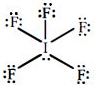
-
- (A) Two \(P\pi - d\pi \) bonds
- (B) One \(P\pi - d\pi \) bonds
- (C) Four \(P\pi - d\pi \) bonds
- (D) Three \(P\pi - d\pi \) bonds
Show answer and solution
Correct Answer: (C)
One \(s\) and three \(p\) orbital undergo \(s p^{3}\) hybridization. Four \(s p^{3}\) hybridorbitals form four \(\sigma\) bonds with oxygen atoms. They are \(\sigma s p^{3}-p .\) Four \(p \pi-d \pi\) bonds are also formed with oxygen atoms by the unpaired electrons.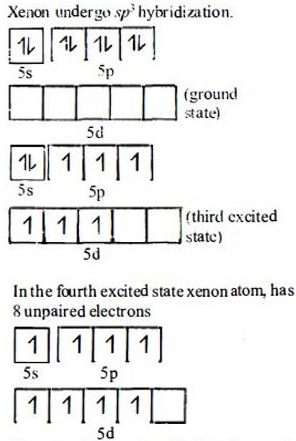
- 82. Electron gain enthalpy with negative sign of fluorine is less than that of chlorine due to 2013 Medium
- (A) High ionization enthalpy of fluorine
- (B) Smaller size of chlorine atom
- (C) Smaller size of fluorine atom
- (D) Bigger size of \(2p\) orbital of fluorine
Show answer and solution
Correct Answer: (C)
The electron gain enthalpy order for halogens is
\(Cl >F>Br>I\)
Due to small size of fluorine the extra electron to be added feels more electron-electron repulsion. Therefore fluorine has less value for electron affinity than chlorine - 83. The element with which of the following outer electron configuration may exhibit the largest number of oxidation states in its compounds 2013 Medium
- (A) \(3d ^5\,4s^2\)
- (B) \(3d ^8\,4s^2\)
- (C) \(3d ^7\,4s^2\)
- (D) \(3d ^6\,4s^2\)
Show answer and solution
Correct Answer: (A)
The element with outer electron configuration \(3d^5\, 4s^2\) is \(Mn\) which exhibits oxidation states from \(+ 2\) to \(+ 7\) -
- (A) \(-2.55\)
- (B) \(-5.1\)
- (C) \(-10.2\)
- (D) \(+2.55\)
Show answer and solution
Correct Answer: (B)
\(\mathrm{Na} \rightarrow \mathrm{Na}^{+}+\mathrm{e}^{-} \quad \mathrm{IE}=5.1 \mathrm{eV} \ldots \ldots\)\(\mathrm{Na}^{+}+\mathrm{e}^{-} \rightarrow \mathrm{Na}\)
Second reaction is inverse of first reaction,
therefore electron goes enthalapy of \(N a^{+}\)
is reverse of ionization energy
\(\therefore \Delta H_{e g}=-5.1 \mathrm{eV}\)
- 85. Which is the correct order of second ionization potential of \(C, N, O\) and \(F\) in the following ? 2013 Medium
- (A) \(O> N > F > C\)
- (B) \(O> F > N > C\)
- (C) \(F > O> N > C\)
- (D) \(C > N > O> F\)
Show answer and solution
Correct Answer: (B)
The second ionization potential means removal of electron from cation\(C^+ = 1s^2\,2s^2\,2p^1,\,N^+ = 1s^2\,2s^2\,2p^2\)
\(O^+ = 1s^2\,2s^2\,2p^3,\,F^+ = 1s^2\,2s^2\,2p^4\)
Therefore \(O > F > N > C\)
- 86. Which of the following represents the correct order of increasing first ionization enthalpy for \(Ca, Ba, S, Se\) and \(Ar\) ? 2013 Hard
- (A) \(Ca < S < Ba < Se < Ar\)
- (B) \(S < Se < Ca < Ba < Ar\)
- (C) \(Ba < Ca < Se < S < Ar\)
- (D) \(Ca < Ba < S < Se < Ar\)
Show answer and solution
Correct Answer: (C)
\(B\)enthalpy increases along the period but decreases down the group.
The IE of an element increases as one moves across a period in the periodic table because the
electrons are held tighter by the higher effective nuclear charge.
The ionization energy of the elements decreases as one moves down the group because the electrons are held in lower-energy orbitals, away from the nucleus and therefore, are less tightly bound.
\(A r\) has higher IE because it is a noble gas and \(B a\) has the lowest IE as it is in 6 periods and more
metallic.
Hence, the correct option is \(\mathrm{C}\)
-
- (A) \(\frac{{{K_1}{K_2}}}{{{K_3}}}\)
- (B) \(\frac{{{K_1}{K_3^2}}}{{{K_2}}}\)
- (C) \({K_1}{K_2}{K_3}\)
- (D) \(\frac{{{K_2}{K_3^3}}}{{{K_1}}}\)
Show answer and solution
Correct Answer: (D)
To calculate the value of \(K_4\) in the given equation we should applyeqn. \((2)\) + eqn. \((3)\times3 \) - eqn. \((1)\)
hence \({K_4} = \frac{{{K_2}{K_3^3}}}{{{K_1}}}\)
-
- (A) \(\frac{1}{{\sqrt {RT} }}\)
- (B) \({\left( {RT} \right)^{1/2}}\)
- (C) \({RT}\)
- (D) \(1\)
Show answer and solution
Correct Answer: (A)
\({K_P} = {K_C}{(RT)^{\Delta {n_g}}}\)For the reaction
\(CO(g) + \frac{1}{2}{O_2}(g) \leftrightarrow C{O_2}(g)\)
\(\Delta {n_g} = 1 - \left( {1 + \frac{1}{2}} \right) = - \frac{1}{2}\)
\(\therefore \,{K_P} = \frac{{{K_C}}}{{\sqrt {RT} }};\,\frac{{{K_P}}}{{{K_C}}} = \frac{1}{{\sqrt {RT} }}\)
-
- (A) \(q = +208\,J, \,w =-208\,J\)
- (B) \(q =-208\,J, w =-208\,J\)
- (C) \(q =-208\,J, w = +208\,J\)
- (D) \(q = +208\,J, w = +208\,J\)
Show answer and solution
Correct Answer: (A)
Solution:-As the heat is absorbed.
\(\therefore q =+208 J\)
Now for reversible isothermal process,
\(q =- W\)
\(\therefore W =- q =-208 J\)
Hence the values of \(q\) and \(W\) for the process will be \(+208 J\) and \(-208 J\) respectively.
-
- (A) \(241.8\)
- (B) \(22\)
- (C) \(44.1\)
- (D) \(527.7\)
Show answer and solution
Correct Answer: (C)
Given\({H_2}(g) + \frac{1}{2}{O_2}(g) \to {H_2}O(l);\)
\(\Delta {H^o} = - 285.9\,kJ\,mo{l^{ - 1}}........(1)\)
\({H_2}(g) + \frac{1}{2}{O_2}(g) \to {H_2}O(g);\)
\(\Delta {H^o}= - 241.8\,kJ\,mo{l^{ - 1}}........(2)\)
We have to calculate
\({H_2}O(l) \to {H_2}O(g);\,\Delta {H^o} = ?\)
On substracting eqn. \((2)\) from eqn. \((1)\) we get
\({H_2}O(l) \to {H_2}O(g);\)
\(\Delta {H^o} = - 241.8 - ( - 285.9)\)
\( = 44.1\,kJ\,mo{l^{ - 1}}\)
-
- (A) \(-300\)
- (B) \(-350\)
- (C) \(-328\)
- (D) \(-228\)
Show answer and solution
Correct Answer: (C)
Applying Hess's Law\({\Delta _f}{H^o} = {\Delta _{sub}}H + \frac{1}{2}{\Delta _{diss}}H + I.E. + E.A + {\Delta _{lattice}}H\)
\({\Delta _f}{H^o} = {\Delta _{sub}}H + \frac{1}{2}{\Delta _{diss}}H + I.E. + E.A + {\Delta _{lattice}}H\)
\(E.A. = - 617 + 286 = - 328\,kJ\,mo{l^{ - 1}}\)
\(\therefore \) electron affinity of fluorine
\( = - 328\,kJ\,mo{l^{ - 1}}\)
-
- (A) \(-88\)
- (B) \(-66\)
- (C) \(-62\)
- (D) \(-44\)
Show answer and solution
Correct Answer: (A)
\({N_2}(g) + \frac{1}{2}{O_2} \to {N_2}O(g)\)\(N\equiv N(g)+\frac{1}{2}(O=O\to )\overset{-}{\mathop{\underset{\centerdot \,\centerdot }{\overset{\centerdot \,\centerdot }{\mathop{N}}}\,}}\,=\overset{+}{\mathop{N}}\,=\underset{\centerdot \,\centerdot }{\overset{\centerdot \,\centerdot }{\mathop{O}}}\,(g)\)
\(\Delta H_f^o = \) [Energy required for breaking of bonds] - [Energy released for forming of bonds]
\(=(\Delta {{H}_{N=N}}+\frac{1}{2}\Delta {{H}_{O=O}}-(\Delta {{H}_{N=N}}+\Delta {{H}_{N=O}})\)
\( = (946 + \frac{1}{2} \times 468) - (418 + 607) = 170\,kJ\,mo{l^{ - 1}}\)
Resonance energy \( = 170 - 82 = 88\,kJ\,mo{l^{ - 1}}\)
-
- (A) \(280\)
- (B) \(285\)
- (C) \(270\)
- (D) \(15\)
Show answer and solution
Correct Answer: (B)
\(X \to Y;\,\Delta H = - 135\,kJ/mol,\)\({E_a} = 150\,kJ/mol\)
For an exothermic reaction
\({{E}_{a(F.R.)}}=\Delta H+E_{a(B.R.)}'\)
\(150 = - 135 + E_{a(B.R.)}'\)
\(E_{a(B.R.)}' = 285\,kJ/mol\)
- 94. Which of the following statements/ relationships is not correct in thermodynamic changes ? 2013 Hard
- (A) \(\Delta U\, = 0\) (isothermal reversible expansion of a gas)
- (B) \(w = - nRT\,\ln \frac{{{V_2}}}{{{V_1}}}\) ( isothermal reversible expansion of an ideal gas)
- (C) \(w = nRT\,\ln \frac{{{V_2}}}{{{V_1}}}\) (isothermal reversible expansion of an ideal gas)
- (D) For a system of constant volume heat involved directly changes to internal energy.
Show answer and solution
Correct Answer: (C)
For isothermal reversible expansion \(w = - nRT\,\ln \frac{{{V_2}}}{{{V_1}}}\) -
- (A) In \((Si_3O_9)^{6-}\), tetrahedral \(SiO_4\) units share two oxygen atoms
- (B) Trialkylchlorosilane on hydrolysis gives \(R_3SiOH\).
- (C) \(SiCl_4\) undergoes hydrolysis to give \(H_4SiO_4\)
- (D) \((Si_3O_9)^{6-}\) has cyclic structure.
Show answer and solution
Correct Answer: (B)
The hydrolysis of Trialkylchlorosilane \(R_3SiCl\) yields dimer :\(\begin{matrix}
\,\,\,R\,\,\,\,\,\,\,\,\,\,\,\,\,\,\,\,\,R\, \\
\,|\,\,\,\,\,\,\,\,\,\,\,\,\,\,\,\,\,\,\,\,|\, \\
R-Si-O-Si-R \\
|\,\,\,\,\,\,\,\,\,\,\,\,\,\,\,\,\,\,\,\,\,| \\
R\,\,\,\,\,\,\,\,\,\,\,\,\,\,\,\,\,R \\
\end{matrix}\) -
- (A) \(1.214 \times 10^{-7} \,m\)
- (B) \(2.816 \times 10^{-7}\, m\)
- (C) \(6.500 \times 10^{-7}\, m\)
- (D) \(8.500 \times 10^{-7}\, m\)
Show answer and solution
Correct Answer: (A)
Let \(\lambda\) is the wavelength of that photon then\(h c / \lambda=E_{2}-E_{1}\)
and using value of given E, \(E=\frac{h c}{\lambda}=2.178 \times 10^{-18} \times z^{2}\left[\frac{1}{1^{2}}-\frac{1}{2^{2}}\right](z=1)\)
\(\therefore \lambda=\frac{6.62 \times 10^{-34} \times 3 \times 10^{8}}{2.178 \times 10^{-18}} \times \frac{4}{3}=1.214 \times 10^{-7} \mathrm{m}\)
-
- (A) \(25\) and \(1\)
- (B) \(8\) and \(1\)
- (C) \(2\) and \(4\)
- (D) \(4\) and \(1\)
Show answer and solution
Correct Answer: (B)
\((i)\) \(n=5\) means \(l=0,1,2,3,4\)since \(m= +1\)
hence total no. of electrons will be \(= 0\) (from \(s\)) \(+ 2\) (from \(p\)) \(+ 2\) (fron \(d\)) \(+ 2\) (from \(f\)) \(+ 2\) (from \(g\))
\(=0+2+2+2+2=8\)
\((ii)\) \(n=2,\,l=1,\,m_l=-1,\,m_s=-1/2\) represent \(2p\) orbital with one electron
- 98. In an atom how many orbital \((s)\) will have the quantum numbers; \(n = 3, l = 2\) and \(m_l = + 2\) ? 2013 Medium
- (A) \(5\)
- (B) \(3\)
- (C) \(1\)
- (D) \(7\)
Show answer and solution
Correct Answer: (C)
\(n=3,\,l=2\) means \(3d\) orbitali.e. in an atom only one orbital can have the value \(m_l = +2\)
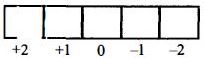
- 99. The de Broglie wavelength of a car of mass \(1000\, kg\) and velocity \(36\, km/hr\) is 2013 Medium
- (A) \(6.626\times10^{-34}\, m\)
- (B) \(6.626\times10^{-38}\, m\)
- (C) \(6.626\times10^{-31}\, m\)
- (D) \(6.626\times10^{-30}\, m\)
Show answer and solution
Correct Answer: (B)
\(\lambda = \frac{h}{{mv}}\)\(h = 6.6 \times {10^{ - 34}}\,J - s\)
\(m = 1000\,kg\)
\(v = 36\,km/hr = \frac{{36 \times {{10}^3}}}{{60 \times 60}}\,m/\sec = 10\,m/\sec \)
\(\lambda = \frac{{6.6 \times {{10}^{ - 34}}}}{{{{10}^3} \times 10}} = 6.6 \times {10^{ - 38}}\,m\)
- 100. The wave number of the first emission line in the Balmer series of \(H-\) Spectrum is ( \(R =\) Rydberg constant) 2013 Medium
- (A) \(\frac {5}{36}\,\,R\)
- (B) \(\frac {9}{400}\,\,R\)
- (C) \(\frac {7}{6}\,\,R\)
- (D) \(\frac {3}{4}\,\,R\)
Show answer and solution
Correct Answer: (A)
\(\bar v = R{Z^2}\left( {\frac{1}{{{2^2}}} - \frac{1}{{{3^2}}}} \right)\)\( = R\left( {\frac{1}{4} - \frac{1}{9}} \right)\)
\( = \frac{{5R}}{{36}}\)
No questions on this page match these filters.