


All JEE Mains 2021 Chemistry questions
26 chaptersShowing 251–300 of 420 questions
-
- (A) \(260\)
- (B) \(39\)
- (C) \(26\)
- (D) \(13\)
Show answer and solution
Correct Answer: (C)
\(\mathrm{k}=1.07 \times 10^{6}\, \mathrm{Sm}^{-1}, \quad \mathrm{R}=0.243\, \Omega\)\(\mathrm{G}=\frac{1}{\mathrm{R}}=\frac{1}{0.243}\, \Omega^{-1}\)
\(\mathrm{k}=\mathrm{G} \times \mathrm{G}^{*}\)
\(\mathrm{G}^{*}=\frac{\mathrm{k}}{\mathrm{G}}=\frac{1.07 \times 10^{6}}{\frac{1}{0.243}} \simeq 26 \times 10^{4}\, \mathrm{~m}^{-1}\)
-
- (A) \((\mathrm{a})-(\mathrm{iii}),(\mathrm{b})-(\mathrm{i}),(\mathrm{c})-(\mathrm{iv}),(\mathrm{d})-(\mathrm{ii})\)
- (B) \((\mathrm{a})-(\mathrm{iii}),(\mathrm{b})-(\mathrm{i}),(\mathrm{c})-(\mathrm{ii}),(\mathrm{d})-(\mathrm{iv})\)
- (C) \((a)-(i), (b)-(iv), (c)-(iii), (d)-(ii)\)
- (D) \((a)-(ii), (b)-(i), (c)-(iii), (d)-(iv)\)
Show answer and solution
Correct Answer: (A)
Cell constant \(=\left(\frac{\ell}{\mathrm{A}}\right) \Rightarrow\) Units \(=\mathrm{m}^{-1}\)Molar conductivity \(\left(\Lambda_{m}\right) \Rightarrow\) Units \(=\mathrm{Sm}^{2} \,\mathrm{~mole}^{-1}\)
Conductivity \((\mathrm{K}) \Rightarrow\) Units \(=\mathrm{S}\, \mathrm{m}^{-1}\)
Degree of dissociation \((\alpha) \rightarrow\) Dimensionless
\(\therefore\) \((a) - (iii)\)
\(\quad(b) - (i)\)
\(\quad(c) - (iv)\)
\(\quad(d) - (ii)\)
-
- (A) \(1\)
- (B) \(2\)
- (C) \(3\)
- (D) \(4\)
Show answer and solution
Correct Answer: (A)
Given balanced equation is\(6 \mathrm{OH}^{-}+\mathrm{Cl} ^{-}\rightarrow \mathrm{ClO}_{3}^{-}+3 \mathrm{H}_{2} \mathrm{O}+6 \mathrm{e}^{-}\)
\(\rightarrow 10\, \mathrm{~g}\, \mathrm{KClO}_{3} \Rightarrow \frac{10}{122.6} \,\mathrm{~mol} \,\mathrm{KCO} 3\) in obtained
\(\rightarrow\) From the above reaction, it is concluded that by \(6\, \mathrm{~F}\) charge \(1\, \mathrm{~mol} \,\mathrm{KClO}_{3}\) is obtained.
\(\rightarrow\) By the passage of \(6\, \mathrm{~F}\) charge \(=1\, \mathrm{~mol} \,\mathrm{KClO}_{3}\)
\(\therefore\) By the passage of \(\frac{x \times 10 \times 60 \times 60}{96500}\, \mathrm{~F}\) charge
\(=\frac{1}{6} \times \frac{x \times 10 \times 60 \times 60}{96500}\)
Now \(\frac{x \times 10 \times 60 \times 60}{6 \times 96500}=\frac{10}{122.6}\)
\(\Rightarrow x=\frac{10 \times 965}{60 \times 122.6}=\frac{965}{735.6}=1.311 \simeq 1\)
OR
\(W=\frac{E}{F} \times I \times t\)
\(10=\frac{122.6}{96500 \times 6} \times x \times 10 \times 3600\)
\(X=1.311\)
-
- (A) \(18\)
- (B) \(12\)
- (C) \(61\)
- (D) \(14\)
Show answer and solution
Correct Answer: (B)
\(\wedge_{\mathrm{m}}=1000 \times \frac{\kappa}{\mathrm{M}}\)\(=1000 \times \frac{2 \times 10^{-5}}{0.001}=20 \mathrm{~S} \mathrm{~cm}^{2} \mathrm{~mol}^{-1}\)
\(\Rightarrow \alpha=\frac{\wedge_{\mathrm{m}}}{\wedge_{\mathrm{m}}^{\infty}}=\frac{20}{190}=\left(\frac{2}{19}\right)\)
\(\mathrm{HA} \rightleftharpoons \mathrm{H}^{+}+\mathrm{A}^{-}\)
\(0.001(1-\alpha) \,\,0.001 \alpha \,\,0.001 \alpha\)
\(\Rightarrow \quad \mathrm{k}_{\mathrm{a}}=0.001\left(\frac{\alpha^{2}}{1-\alpha}\right)=\frac{0.001 \times\left(\frac{2}{19}\right)^{2}}{1-\left(\frac{2}{19}\right)}\)
\(=12.3 \times 10^{-6}\)
-
- (A) \(3776\)
- (B) \(3800\)
- (C) \(4276\)
- (D) \(1552\)
Show answer and solution
Correct Answer: (A)
Eqn is-\(MnO _{4}^{-}+ H ^{\oplus}+5 e ^{-} \rightarrow Mn ^{+2}+4 H _{2} O\)
Nernst equation:
\(E _{\text {cell }}= E _{ Cell }^{0}-\frac{0.059}{5} \log \frac{\left[ Mn ^{+2}\right]}{\left[ MnO _{4}^{-}\right]}\left[\frac{1}{ H ^{+}}\right]^{8}\)
\((I)\) Given \(\left[ H ^{\oplus}\right]=1\, M\)
\(E _{1}= E ^{0}-\frac{0.059}{5} \log \frac{\left[ Mn ^{+2}\right]}{\left[ MnO _{4}^{-}\right]}\)
\((II)\) Now : \(\left[ H ^{\oplus}\right]=10^{-4}\, M\)
\(E _{2}= E ^{0}-\frac{0.059}{5} \log \frac{\left[ Mn ^{+2}\right]}{\left[ MnO _{4}^{-}\right]} \times \frac{1}{\left(10^{-4}\right)^{8}}\)
\(= E ^{0}-\frac{0.059}{5} \log \frac{ Mn ^{+2}}{\left[ MnO _{4}^{-}\right]}+\frac{0.059}{5} \log 10^{-32}\)
therefore : \(\left| E _{1}- E _{2}\right|=\frac{0.059}{5} \times 32\)
\(=0.3776\, V =3776 \times 10^{-4}\)
\(x =3776\)
-
- (A) \(102\)
- (B) \(328\)
- (C) \(488\)
- (D) \(288\)
Show answer and solution
Correct Answer: (D)
From Kohlrausch's law\(\Lambda_{ m }^{\infty}\left( BaSO _{4}\right)=\lambda_{ m }^{\infty}\left( Ba ^{2+}\right)+\lambda_{ m }^{\infty}\left( SO _{4}^{2-}\right)\)
\(\Lambda_{ m }^{\infty}\left( BaSO _{4}\right)=\Lambda_{ m }^{\infty}\left( BaCl _{2}\right)+\Lambda_{ m }^{\infty}\left( H _{2} SO _{4}\right)-2\Lambda_{ m }^{\infty}\left( HCl\right)\)
\(=280+860-2(426)\)
\(=288 \,Scm ^{2} mol ^{-1}\)
- 257. The nature of charge on resulting colloidal particles when \(FeCl _{3}\) is added to excess of hot water is : 2021 Easy
- (A) Positive
- (B) Sometimes positive and sometimes negative
- (C) Neutral
- (D) Negative
Show answer and solution
Correct Answer: (A)
If \(FeCl _{3}\) is added to hot water, a positively charged sol, hydrated ferric oxide is formed
due to adsorption of \(Fe ^{3+}\) ions.\(Fe _{2} O _{3} . xH _{2} O / Fe ^{3+}\)
Positively charged.
- 258. The product obtained from the electrolytic oxidation of acidified sulphate solution, is: 2021 Medium
- (A) \(\mathrm{HO}_{2} \mathrm{SOSO}_{2} \mathrm{H}\)
- (B) \(\mathrm{HO}_{3} \mathrm{SOOSO}_{3} \mathrm{H}\)
- (C) \(\mathrm{HSO}_{4}^{-}\)
- (D) \(\mathrm{HO}_{3} \mathrm{SOSO}_{3} \mathrm{H}\)
Show answer and solution
Correct Answer: (B)
anode: \(2 \mathrm{SO}_{4}^{-2}(\mathrm{aq}) \rightarrow\left(\mathrm{S}_{2} \mathrm{O}_{8}\right)^{-2}+2 \mathrm{e}^{-}\)Cathode : \(2 \mathrm{H}^{2}+2 \mathrm{e}^{-} \rightarrow \mathrm{H}_{2}(\mathrm{~g})\)
Electrolysis of concentrated solution of acidified sulphate solution yields \(\mathrm{H}_{2} \mathrm{~S}_{2} \mathrm{O}_{8}\).
-
- (A) \(760\)
- (B) \(76\)
- (C) \(7.6\)
- (D) \(141\)
Show answer and solution
Correct Answer: (A)
\(\mathrm{K}=\frac{1}{\mathrm{R}} \times \ell / \mathrm{A}=\left(\left(\frac{1}{1500}\right) \times 1.14\right)\, \mathrm{S}\, \mathrm{cm}^{-1}\)\(\Rightarrow \wedge_{\mathrm{m}}=1000 \times \frac{\left(\frac{1.14}{1500}\right)}{0.001}\, \mathrm{~S}\, \mathrm{~cm}^{2} \,\mathrm{~mol}^{-1}\)
\(=760 \mathrm{~S}\, \mathrm{~cm}^{2} \,\mathrm{~mol}^{-1}\)
\(\Rightarrow 760\)
-
- (A) \(12\)
- (B) \(13\)
- (C) \(10\)
- (D) \(11\)
Show answer and solution
Correct Answer: (B)
With benzene as solvent\(\Delta \mathrm{T}_{b}=\mathrm{i} \mathrm{K}_{\mathrm{b}} \mathrm{m}\)
\(\Delta \mathrm{T}_{\mathrm{b}}=\frac{1}{2} \times 2.6 \times \frac{1.22 / \mathrm{M}_{\mathrm{w}}}{100 / 1000}...(1)\)
With Acetone as solvent
\(\Delta \mathrm{T}_{\mathrm{b}}=\mathrm{i} \mathrm{K}_{6} \mathrm{~m}\)
\(0.17=1 \times 1.7 \times \frac{1.22 / \mathrm{M}_{\mathrm{w}}}{100 / 1000}...(2)\)
\((1) /(2)\)
\(\frac{\Delta \mathrm{T}_{\mathrm{b}}}{0.17}=\frac{\frac{1}{2} \times 2.6+\frac{1.22 / \mathrm{M}_{\mathrm{w}}}{100 / 1000}}{1 \times 1.7 \times \frac{1.22 / \mathrm{M}_{\mathrm{w}}}{100 / 1000}}\)
\(\Delta \mathrm{T}_{\mathrm{b}}=\frac{0.26}{2}\)
\(\Delta \mathrm{T}_{\mathrm{b}}=13 \times 10^{-2}\)
\(\Rightarrow \mathrm{x}=13\)
-
- (A) \(7\)
- (B) \(5\)
- (C) \(91\)
- (D) \(15\)
Show answer and solution
Correct Answer: (D)
\(\pi=\mathrm{CRT}\)\(; \pi=\) osmotic pressure
\(\mathrm{C}=\) molarity
\(T=\) Temperature of solution
let the molar mass be \(\mathrm{M}\, \mathrm{gm} / \mathrm{mol}\)
\(2.42 \times 10^{-3}\, \mathrm{bar}=\frac{\left(\frac{1.46\, \mathrm{~g}}{\mathrm{M\,gm} / \mathrm{mol}}\right)}{0.1\, \ell} \times\left(\frac{0.083\, \ell-\mathrm{bar}}{\mathrm{mol}-\mathrm{K}}\right) \times(300\, \mathrm{~K})\)
\(\Rightarrow \quad \mathrm{M}=15.02 \times 10^{4}\, \mathrm{~g} / \mathrm{mol}\)
-
- (A) \(342\)
- (B) \(841\)
- (C) \(518\)
- (D) \(277\)
Show answer and solution
Correct Answer: (C)
Let mass of water initially present \(=\mathrm{x\,gm}\)\(\Rightarrow \text { Mass of sucrose }=(1000-\mathrm{x})\, \mathrm{gm}\)
\(\Rightarrow \text { moles of sucrose }=\left(\frac{1000-\mathrm{x}}{342}\right)\)
\(\Rightarrow 0.75=\frac{\left(\frac{1000-\mathrm{x}}{342}\right)}{\left(\frac{\mathrm{x}}{1000}\right)} \Rightarrow \frac{\mathrm{x}}{1000}=\frac{1000-\mathrm{x}}{342 \times 0.75}\)
\(\Rightarrow 256.5 \mathrm{x}=10^{6}-1000 \mathrm{x}\)
\(\Rightarrow \mathrm{x}=795.86\, \mathrm{gm}\)
\(\Rightarrow \text { moles of sucrose }=0.5969\)
New mass of \(\mathrm{H}_{2} \mathrm{O}=\mathrm{a}\, \mathrm{kg}\)
\(\Rightarrow 4=\frac{0.5969}{\mathrm{a}} \times 1.86 \Rightarrow \mathrm{a}=0.2775\, \mathrm{~kg}\)
\(\Rightarrow \text { ice separated }=(795.86-277.5)=518.3 \,\mathrm{gm}\)
-
- (A) \(370\)
- (B) \(380\)
- (C) \(375\)
- (D) \(385\)
Show answer and solution
Correct Answer: (C)
\(\Delta T _{ b }= iK _{ b } m\)\(=(1+4 \alpha) \times 0.52 \times 1\)
\(=3.4 \times 0.52 \times 1=1.768\)
\(T _{ b }=1.768+313.15=374.918 K\)
\(=375 K\)
-
- (A) \(95\)
- (B) \(85\)
- (C) \(105\)
- (D) \(26\)
Show answer and solution
Correct Answer: (B)
\(\quad \quad \quad \quad \quad K _{4} Fe ( CN )_{6} \rightleftharpoons 4 K ^{+}+ Fe ( CN )_{6}^{4-}\)Initial conc. \(1\, m\quad \quad \quad \quad \quad \quad 0\quad \quad \quad \quad 0\)
Final conc. \((1-0.4) \,m \quad \quad 4 \times 0.4 \quad \quad 0.4\, m\)
\(\quad \quad \quad \quad \quad \quad =0.6\,m \quad \quad \quad =1.6\,m\)
Effective molality \(=0.6+1.6+0.4=2.6 \,m\)
For same boiling point, the molality of another solution should also be \(2.6\, m\).
Now,\(18.1\) weight percent solution means \(18.1\, gm\) solute is present in \(100\, gm\) solution and hence, \((100-18.1=) 81.9 \,gm\) water.
\(\text { Now, } \quad 2.6=\frac{18.1 / M }{81.9 / 1000}\)
\(\therefore\) Molar mass of solute, \(M =85\)
-
- (A) \(50\)
- (B) \(60\)
- (C) \(55\)
- (D) \(65\)
Show answer and solution
Correct Answer: (A)
\(\Delta T _{ f }=(1+\alpha) K _{ f } m\)\(\alpha=0.05=50 \times 10^{-3}\)
-
- (A) \(50\)
- (B) \(12\)
- (C) \(67\)
- (D) \(89\)
Show answer and solution
Correct Answer: (B)
\(SO _{2}+ NaOH \rightarrow NaHSO _{3}\)\(9.2\quad \quad \quad 10\quad \quad \quad \quad -\)
\(- \quad \quad \quad 0.8 \quad \quad \quad \quad \quad 9.2\)
\(\Delta P = P ^{0} \cdot X _{\text {solute }}\)
\(=24 \times \frac{(1.6+18.4)}{2020}\)
\(=0.2376=23.76 \times 10^{-2}\)
-
- (A) \(1\)
- (B) \(2\)
- (C) \(3\)
- (D) \(4\)
Show answer and solution
Correct Answer: (A)
Total mass \(=4\, \mathrm{~g}\)Now
\(\mathrm{NaOH}: \mathrm{a} \,\mathrm{mol}\quad\quad\quad \mathrm{W}_{\mathrm{NaOH}}+\mathrm{W}_{\mathrm{Na}_{2} \mathrm{co}_{3}}=4\)
\(\mathrm{Na}_{2} \mathrm{CO}_{3}: \mathrm{'} \mathrm{a}^{\prime} \mathrm{mol} \quad\quad \Rightarrow 40 \mathrm{a}+106 \mathrm{a}=4\)
\(\quad\quad\quad\quad\quad\quad\quad\quad\quad \Rightarrow \mathrm{a}=\frac{4}{146} \,\mathrm{~mol}\)
\(\Rightarrow\) therefore mass of \(\mathrm{NaOH}\) is : \(\frac{4}{146} \times 40\, \mathrm{~g}\) \(=1.095 \approx 1\)
-
- (A) \(271\)
- (B) \(370\)
- (C) \(71\)
- (D) \(521\)
Show answer and solution
Correct Answer: (A)
\(\text { molality }=\frac{\left(\frac{40}{180}\right) \,{\text {mol }}}{0.2 \,\mathrm{Kg}}=\left(\frac{10}{9}\right) \,\text { molal }\)\(\Rightarrow \Delta \mathrm{T}_{\mathrm{f}}=\mathrm{T}_{\mathrm{f}}-\mathrm{T}_{\mathrm{f}}^{\prime}=1.86 \times \frac{10}{9}\)
\(\Rightarrow \mathrm{T}_{\mathrm{f}}^{\prime}=273.15-1.86 \times \frac{10}{9}\)
\(=271.08\, \mathrm{~K}\)
\(\simeq 271 \,\mathrm{~K}\) (nearest-integer)
-
- (A) \(369\)
- (B) \(269\)
- (C) \(209\)
- (D) \(296\)
Show answer and solution
Correct Answer: (B)
\(\mathrm{k}_{\mathrm{f}}=1.86\, \mathrm{k} \cdot\, \mathrm{kg} / \mathrm{mol}\)\(\mathrm{T}_{\mathrm{f}}^{\circ}=273\, \mathrm{k}\)
solvent \(: \mathrm{H}_{2} \mathrm{O}(625\, \mathrm{~g})\)
Solute : \(83\, \mathrm{~g}\) \(\mathrm{CH}_{2}OH-\mathrm{CH}_{2}OH \Rightarrow\) Non dissociative
solute
\(\Rightarrow \Delta \mathrm{T}_{\mathrm{f}}=\mathrm{k}_{\mathrm{f}} \times \mathrm{m}\)
\(\Rightarrow\left(\mathrm{T}_{\mathrm{f}}^{\circ}-\mathrm{T}_{\mathrm{f}}^{1}\right)=1.86 \times \frac{83 / 62}{624 / 1000}\)
\(\Rightarrow 273-\mathrm{T}_{\mathrm{f}}^{1}=\frac{1.86 \times 83 \times 1000}{62 \times 625}=\frac{154380}{38750}\)
\(\Rightarrow 273-\mathrm{T}_{\mathrm{f}}^{1}=4\)
\(\Rightarrow \mathrm{T}_{\mathrm{f}}^{1}=259\,\mathrm{~K}\)
-
- (A) \(201\)
- (B) \(105\)
- (C) \(102\)
- (D) \(106\)
Show answer and solution
Correct Answer: (D)
\(AB _{2} \rightarrow A ^{2+}+2 B ^{-}\)\(\begin{array}{llll} t =0 a 0 0\end{array}\)
\(\begin{array}{llll} t = t a - a \alpha a \alpha 2 a \alpha\end{array}\)
\(n _{ T }= a - a \alpha+ a \alpha+2 a \alpha\)
\(= a (1+2 \alpha)\)
so \(i =1+2 \alpha\)
Now \(\Delta T _{ b }= i \times m \times K _{ b }\)
\(\Delta T _{ b }=(1+2 \alpha) \times m \times K _{ b }\)
\(\alpha=0.1 \quad m =10 \quad K _{ b }=0.5\)
\(\Delta T _{ b }=1.2 \times 10 \times 0.5\)
\(=6\)
So boiling point \(=106\)
-
- (A) \(71\)
- (B) \(87\)
- (C) \(95\)
- (D) \(78\)
Show answer and solution
Correct Answer: (D)
\(P_{B}^{\circ}=70 \quad P_{T}^{0}=20 \quad X_{B}=0.5=X_{M}\)Now. \(y_{B}=\frac{X_{B} P_{B}^{\circ}}{X_{B} P_{B}^{\circ}+X_{M} P_{M}^{0}}\)
\(=\frac{70 \times 0.5}{70 \times 0.5+20 \times 0.5}\)
\(=0.777 \Rightarrow 77.7 \times 10^{-2} \Rightarrow 78 \times 10^{-2}\)
-
- (A) \(19\)
- (B) \(21\)
- (C) \(25\)
- (D) \(36\)
Show answer and solution
Correct Answer: (A)
Given \(P _{ A }^{0}=21\, kPa \quad \Rightarrow P _{ B }^{0}=18\, kPa\)\(\rightarrow\) An Ideal solution is prepared by mixing \(1\, mol\) \(A\) and \(2 \,mol\, B\).
\(\rightarrow X_{A}=\frac{1}{3}\) and \(X_{B}=\frac{2}{3}\)
\(\rightarrow\) Acc to Raoult's low
\(P _{ T }= X _{ A } P _{ A }^{0}+ X _{ B } P _{ B }^{0}\)
\(P _{ T }=\left(\frac{1}{3} \times 21\right)+\left(\frac{2}{3} \times 18\right)\)
\(P _{ T }=7+12=19\, KPa\)
-
- (A) \(3\)
- (B) \(1\)
- (C) \(5\)
- (D) \(9\)
Show answer and solution
Correct Answer: (B)
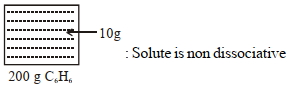
Pure Solvent : \(C _{6} H _{6}(\ell)\)Given : \(T _{ f }^{\circ}=5.5^{\circ} C\)
\(K _{ f }=5.12^{\circ}\,C / m\)
\(\because \Delta T _{ f }= k _{ f } \times m\)
\(\Rightarrow\left( T _{ f }^{0}- T _{ f }^{\prime}\right)=5.12 \times \frac{\left(\frac{10}{58}\right)}{\left(\frac{200}{1000}\right) \,kg } \,mol\)
\(\Rightarrow 5.5- T _{ f }^{\prime}=\frac{5.12 \times 5 \times 10}{58}\)
\(\Rightarrow T _{ f }^{\prime}=1.086^{\circ} C \simeq 1^{\circ} C\)
-
- (A) \(50\)
- (B) \(25\)
- (C) \(55\)
- (D) \(35\)
Show answer and solution
Correct Answer: (B)
From Henry's Law\(0.835=1.67 \times 10^{3} \times \frac{\mathrm{n}\left(\mathrm{CO}_{2}\right)}{\frac{0.9 \times 1000}{18}}\)
\(\mathrm{n}\left(\mathrm{CO}_{2}\right)=0.025\)
Millimoles of \(\mathrm{CO}_{2}=0.025 \times 1000=25\)
-
- (A) \(49\)
- (B) \(80\)
- (C) \(64\)
- (D) \(17\)
Show answer and solution
Correct Answer: (C)
Moles of \(\mathrm{CuSO}_{4} \cdot 5 \mathrm{H}_{2} \mathrm{O}=\frac{80}{249.54}\)Molarity \(=\frac{80}{\frac{249.54}{5}}=64.117 \times 10^{-3}\)
Nearest integer, \(\mathrm{x}=64\)
-
- (A) \(4\)
- (B) \(3\)
- (C) \(6\)
- (D) \(5\)
Show answer and solution
Correct Answer: (B)
\(\alpha=0.75, n =2\)\(i =1-\alpha+ n \alpha=1-0.75+2 \times 0.75=1.75\)
\(\Delta T _{ b }= ik _{ b } m\)
or, \(2.5=1.75 \times 0.52 \times m\)
or, \(m =\frac{2.5}{1.75 \times 0.52}=2.74\)
\(\therefore\) nearest integer answer will be \(3\)
-
- (A) \(150\)
- (B) \(125\)
- (C) \(175\)
- (D) \(850\)
Show answer and solution
Correct Answer: (B)
\(\quad\quad\quad\quad\quad\quad2 \mathrm{HA} \rightleftharpoons \mathrm{H}_{2} \mathrm{~A}_{2} \quad \mathrm{HA} \rightleftharpoons \mathrm{H}^{+}+\mathrm{A}\)\(\text { Initial moles } \mathrm{a} \times \frac{50}{100} \quad\quad 0 \quad \mathrm{a} \times \frac{50}{100} \quad0 \quad\quad 0\)
\(\text { Final moles }\quad 0 \quad 0.25 \mathrm{a} \quad\quad\quad0 \quad\quad 0.5 \mathrm{a} \quad\quad 0.5 \mathrm{a}\)
Now, \(i=\frac{\text { final moles }}{\text { initial moles }}=\frac{0.25 a+0.5 a+0.5 a}{0.5 a+0.5 a}\)
\(=1.25=125 \times 10^{-2}\)
-
- (A) \(4\)
- (B) \(3\)
- (C) \(1\)
- (D) \(2\)
Show answer and solution
Correct Answer: (A)
As \(0.1 \,\mathrm{M} \mathrm{C}_{2} \mathrm{H}_{5} \mathrm{OH}\) is non-dissociative and rest all salt given are electrolyte so in each case effective molarity \(>\,0.1\) so each will have lower freezing point. -
- (A) \(20\)
- (B) \(15\)
- (C) \(30\)
- (D) \(25\)
Show answer and solution
Correct Answer: (D)
\(P = K _{ H } \cdot x\)or, \(20 \times 10^{3}=\left(8 \times 10^{4} \times 10^{3}\right) \times \frac{ n _{ O _{2}}}{ n _{ O _{2}}+ n _{\text {water }}}\)
or \(, \frac{1}{4000}=\frac{ n _{ O _{2}}}{ n _{ O _{2}}+ n _{\text {water }}}=\frac{ n _{ O _{2}}}{ n _{\text {water }}}\)
Means 1 mole water \((=18 gm =18 ml )\) dissolves
\(\frac{1}{4000}\) moles \(O _{2} .\) Hence, molar solubility
\(=\frac{\left(\frac{1}{4000}\right)}{18} \times 1000=\frac{1}{72} mol dm ^{-3}\)
\(=1388.89 \times 10^{-5} mol \,dm ^{-3} \approx 1389 mol\, dm ^{-3}\)
-
- (A) \(1\)
- (B) \(2\)
- (C) \(3\)
- (D) \(4\)
Show answer and solution
Correct Answer: (A)
Given \(\mathrm{P}_{\mathrm{A}}^{\circ}=90\, \mathrm{~mm}\, \mathrm{Hg}\), at \(25^{\circ} \mathrm{C}\)\(\mathrm{P}_{\mathrm{B}}^{\circ}=15\, \mathrm{~mm} \,\mathrm{Hg}\)
\(\text { and }\mathrm{X}_{\mathrm{A}}=0.6,\mathrm{X}_{\mathrm{B}}=0.4\)
\(\mathrm{P}_{\mathrm{T}}=\mathrm{X}_{\mathrm{A}} \mathrm{T}_{\mathrm{A}}^{\circ}+\mathrm{X}_{\mathrm{B}} \mathrm{P}_{\mathrm{B}}^{\circ}\)
\(=(0.6 \times 90)+(0.4 \times 15)\)
\(=54+6=60\, \mathrm{~mm}\)
Now mol fraction of \(B\) in the vapour phase
i.e. \(Y_{B}=\frac{P_{B}}{P_{T}}=\frac{X_{B} P_{B}^{\circ}}{60}=0.1=1 \times 10^{-1}\)
Therefore: \(x=1\)
-
- (A) \(94\)
- (B) \(152\)
- (C) \(316\)
- (D) \(656\)
Show answer and solution
Correct Answer: (C)
\(\text { Let molarity of } \mathrm{KMnO}_{4}=\mathrm{x}\)\(\mathrm{KMnO}_{4}+\mathrm{FeSO}_{4} \rightarrow \mathrm{Fe}_{2}\left(\mathrm{SO}_{4}\right)_{3}+\mathrm{Mn}^{2+}\)
\(\mathrm{n}=5 \quad \mathrm{n}=1\)
(Equivalents of \(\mathrm{KMnO}_{4}\) reacted \()=\) (Equivalents of \(\mathrm{FeSO}_{4}\) reacted \()\)
\(\Rightarrow(5 \times x \times 10\, \mathrm{ml})=1 \times 0.1 \times 10\, \mathrm{ml}\)
\(\Rightarrow \mathrm{x}=0.02\, \mathrm{M}\)
Molar mass of \(\mathrm{KMnO}_{4}=158\, \mathrm{gm} / \mathrm{mol}\)
\(\Rightarrow \text { Strength }=(\mathrm{x} \times 158)=3.16\, \mathrm{~g} / \ell\)
-
- (A) \(38\)
- (B) \(42\)
- (C) \(36\)
- (D) \(44\)
Show answer and solution
Correct Answer: (C)
\(ClCH _{2} COOH \rightleftharpoons ClCH _{2} COO ^{\ominus}+ H ^{+}\)\(i =1+(2-1) \alpha\)
\(i =1+\alpha\)
\(\Delta T _{ f }= ik _{ f } m\)
\(0.5=(1+\alpha)(1.86)\left(\frac{\left(\frac{9.45}{94.5}\right)}{\left(\frac{500}{1000}\right)}\right)\)
\(\frac{5}{3.72}=1+\alpha \quad \Rightarrow \alpha=\frac{1.28}{3.72}\)
\(\alpha=\frac{32}{93}\)
\(\begin{array}{*{20}{c}} {ClC{H_2}COOH \rightleftharpoons ClC{H_2}CO{O^ \ominus } + {H^ + }} \\ {\,\,\,\,\,\,\,\,\,C - C\alpha \,\,\,\,\,\,\,\,\,\,\,\,\,\,\,\,\,\,\,\,\,\,\,\,\,\,\,\,C\alpha \,\,\,\,\,\,\,\,\,\,\,\,\,\,\,\,\,\,\,\,\,\,\,\,\,\,\,\,\,\,\,C\alpha \,\,\,\,\,\,\,\,\,\,\,\,\,} \end{array}\)
\(=0.036\)
\(K _{ a }=36 \times 10^{-3}\)
- 283. Which one of the following \(0.06\, \mathrm{M}\) aqueous solutions has lowest freezing point? 2021 Medium
- (A) \(\mathrm{C}_{6} \mathrm{H}_{12} \mathrm{O}_{6}\).
- (B) \(\mathrm{K}_{2} \mathrm{SO}_{4}\)
- (C) \(KI\)
- (D) \(\mathrm{Al}_{2}\left(\mathrm{SO}_{4}\right)_{3}\)
Show answer and solution
Correct Answer: (D)
\(\Delta \mathrm{T}_{\mathrm{f}}=\mathrm{i} \mathrm{k}_{\mathrm{f}} \times \mathrm{m}\)\(\Delta \mathrm{T}_{\mathrm{f}} \alpha\) \(i\) but \(F.P\) \(\alpha 1 / \mathrm{i}\)
- 284. Which one of the following \(0.10\, \mathrm{M}\) aqueous solutions will exhibit the largest freezing point depression? 2021 Medium
- (A) hydrazine
- (B) glucose
- (C) glycine
- (D) \(\mathrm{KHSO}_{4}\)
Show answer and solution
Correct Answer: (D)
\(\because\) Van't Hoff factor is highest for \(\mathrm{KHSO}_{4}\)\(\therefore\) colligative property \(\left(\Delta \mathrm{T}_{\mathrm{f}}\right)\) will be highest for \(\mathrm{KHSO}_{4}\)
-
- (A) \(1782\)
- (B) \(2152\)
- (C) \(1203\)
- (D) \(1575\)
Show answer and solution
Correct Answer: (D)
\(\mathrm{n}_{\mathrm{eq}} \mathrm{KMnO}_{4}=\mathrm{n}_{\text {eq }}=\mathrm{H}_{2} \mathrm{C}_{2} \mathrm{O}_{4} \cdot 2 \mathrm{H}_{2} \mathrm{O}\)or, \(\frac{10 \times 0.05}{1000} \times 5=\frac{10 \times \mathrm{M}}{1000} \times 2\)
\(\therefore\) Conc. of oxalic acid solution \(=0.125 \,\mathrm{M}\)
\(=0.125 \times 126\, \mathrm{~g} / \mathrm{L}=15.75 \,\mathrm{~g} / \mathrm{L}\)
\(=1575 \times 10^{-2}\, \mathrm{~g} / \mathrm{L}\)
-
- (A) \(19\)
- (B) \(1900\)
- (C) \(190\)
- (D) \(1.9\)
Show answer and solution
Correct Answer: (A)
\(\mathrm{C}_{3} \mathrm{H}_{8(\mathrm{~s})}+5 \mathrm{O}_{2(\mathrm{~g})} \longrightarrow 3 \mathrm{CO}_{2(\mathrm{~g})}+4 \mathrm{H}_{2} \mathrm{O}_{(b)}\)\(\mathrm{t}=0\quad 2.27\, \mathrm{~mole} \quad 31.25\, \mathrm{~mol}\)
\(\mathrm{t}=\infty \quad 0 \quad\quad\quad\quad 19.9 \,\mathrm{~mol} \quad 6.81\, \mathrm{~mol} \quad 9.08\, \mathrm{~mol}\)
mole fraction of \(\mathrm{CO}_{2}\) in the final reaction mixture (heterogenous)
\(\mathrm{X}_{\mathrm{CO}_{2}}=\frac{6.81}{19.9+6.81+9.08}\)
\(=0.1902=19.02 \times 10^{-2}\)
\(\Rightarrow 19\)
-
- (A) \(500\)
- (B) \(50\)
- (C) \(5\)
- (D) \(0.50\)
Show answer and solution
Correct Answer: (B)
\(\mathrm{Na}_{3} \mathrm{PO}_{4} \longrightarrow \quad3 \mathrm{Na}\)\(\frac{1}{3} \times \frac{3.45}{23} \mathrm{~mol} \quad\) \(3.45 \mathrm{~g}\)
\(\quad\quad\quad\quad\quad\quad\quad\frac{3.45}{23} \mathrm{~mol}\)
therefore molarity of \(\mathrm{Na}_{3} \mathrm{PO}_{4}\) Solution =
\(\frac{\mathrm{n}_{\mathrm{Na}_{3} \mathrm{PO}_{4}}}{\text { volume of solution in } \mathrm{L}}\)
\(=\frac{\frac{1}{3} \times \frac{3.45}{23}\, \mathrm{~mol}}{0.1\, \mathrm{~L}}\)
\(=0.5=50\, \times 10^{-2}\)
-
- (A) \(32\)
- (B) \(20\)
- (C) \(24\)
- (D) \(42\)
Show answer and solution
Correct Answer: (C)
\(n _{ eq } Fe ^{2+}= n _{ eq } Cr _{2} O _{7}^{2-}\)or, \(\left(\frac{15 \times M _{ Fe ^{2+}}}{1000}\right) \times 1=\left(\frac{20 \times 0.03}{1000}\right) \times 6\)
\(\therefore M _{ Fe ^{2+}}=0.24 M =24 \times 10^{-2} M\)
-
- (A) \(226\)
- (B) \(235\)
- (C) \(462\)
- (D) \(521\)
Show answer and solution
Correct Answer: (A)
We known that no. of moles \(=\text { Vlitre } \times \text { Molarity and No. of millimoles }\) \(=V_{m l} \times \text { Molarity }\)\(\text { so millimoles of } \mathrm{NaOH}=250 \times 0.5=125\)
\(\text { Millimoles of } \mathrm{HCl}=500 \times 1=500\)
\(\text { Now reaction is }\)
\(\mathrm{NaOH}+\mathrm{HCL} \rightarrow \mathrm{NaCl}+\mathrm{H}_{2} \mathrm{O}\)
\(\mathrm{t}=0 \quad 125\quad 500 \quad 0 \quad 0\)
\(\mathrm{t}=0 \quad 0 375 \quad 125 \quad 125\)
\(\text { so millimoles of } \mathrm{HCl} \text { left }=375\)
\(\text { Moles of } \mathrm{HCl}=375 \times 10^{-3}\)
\(\text { No. of } \mathrm{HCl} \text { molecules }\)\(=6.022 \times 10^{23} \times 375 \times 10^{-3}\)
\(=225.8 \times 10^{21}\)
\(\approx 226 \times 10^{21}=226\)
-
- (A) \(1\)
- (B) \(2\)
- (C) \(3\)
- (D) \(4\)
Show answer and solution
Correct Answer: (B)
Explanation:
1. Calculate the number of moles of compound A:
\( \text{Moles of solute} = \frac{\text{Given mass}}{\text{Molar mass}} = \frac{4.5 \text{ g}}{90 \text{ g/mol}} = 0.05 \text{ mol} \)
2. Convert the volume of the solution into liters:
\( \text{Volume of solution} = \frac{250 \text{ mL}}{1000} = 0.25 \text{ L} \)
3. Calculate the Molarity (M):
\( \text{Molarity} = \frac{\text{Moles of solute}}{\text{Volume of solution in Liters}} = \frac{0.05 \text{ mol}}{0.25 \text{ L}} = 0.2 \text{ M} \)
4. Determine the value of \( x \):
According to the question, the molarity is written as \( x \times 10^{-1} \text{ M} \):
\( 0.2 = 2 \times 10^{-1} \)
Comparing both sides gives \( x = 2 \).
Hence, Option B is the correct choice. -
- (A) \(3\)
- (B) \(4\)
- (C) \(9\)
- (D) \(7\)
Show answer and solution
Correct Answer: (C)
\(6.5\) molal \(KOH =1000\, gm\) solvent has \(6.5\) moles \(KOH\)so wt of solute \(=6.5 \times 56\)
\(=364\, gm\)
wt of solution \(=1000+364=1364\)
Volume of solution \(=\frac{1364}{1.89} m \ell\)
Molarity \(=\frac{\text { mole of solute }}{ V _{\text {solution }} \text { in Litre }}\)
\(=\frac{6.5 \times 1.89 \times 1000}{1364}\)
\(=9.00\)
-
- (A) \(3\)
- (B) \(2\)
- (C) \(1\)
- (D) \(4\)
Show answer and solution
Correct Answer: (A)
\(1000\, \mathrm{~kg}\) solvent has \(3.3\) \(moles\) of \(\mathrm{KCl}\)\(1000\, \mathrm{~kg} \text { solvent } \longrightarrow 3.3 \times 74.5\, \mathrm{gm} \mathrm{KCl}\)
\(\quad\quad\quad\quad\quad\quad\quad \longrightarrow 245.85\)
Weight of solution \(=1245.85\, \mathrm{gm}\)
Volume of solution \(=\frac{1245.85}{1.2}\, \mathrm{ml}\)
So molarity \(=\frac{3.3 \times 1.2}{1245.85} \times 1000=3.17\)
-
- (A) \(51.63\)
- (B) \(63.53\)
- (C) \(53.33\)
- (D) \(50.33\)
Show answer and solution
Correct Answer: (C)
\(n _{ c }= n _{ co _{2}}=\frac{2.64}{44}=0.06\)\(n _{ H }=2 \times n _{ H _{2} O }=\frac{1.08}{18} \times 2=0.12\)
\(m _{0}=1.80-12 \times \frac{2.64}{44}-\frac{1.08}{18} \times 2\)
\(=1.80-0.72-0.12=0.96 gm\)
\(\% 0=\frac{0.96}{1.80} \times 100=53.33 \%\)
-
- (A) \(24\)
- (B) \(22\)
- (C) \(20\)
- (D) \(18\)
Show answer and solution
Correct Answer: (D)
moles of ethane \(=\frac{3 \mathrm{~g}}{30 \mathrm{~g} / \mathrm{mol}}=0.1 \mathrm{~mol} \)\(\mathrm{C}_2 \mathrm{H}_6+3.5 \mathrm{O}_2 \rightarrow 2 \mathrm{CO}_2+3 \mathrm{H}_2 \mathrm{O}\)
\(1 \mathrm{~mol}\) of ethane gives \(3 \mathrm{~mol}\) of water
\(0.1 \mathrm{~mol}\) ethane gives \(0.3 \mathrm{~mol}\) of water
Number of molecules in \(0.3 \mathrm{~mol}\) water
\(=0.3 \times 6 \times 10^{23}=18 \times 10^{22}\) molecules
value of \(x\) is 18
-
- (A) \(123\)
- (B) \(742\)
- (C) \(652\)
- (D) \(464\)
Show answer and solution
Correct Answer: (D)
\(\mathrm{C}_{4} \mathrm{H}_{10}+\frac{13}{2} \mathrm{O}_{2} \longrightarrow 4 \mathrm{CO}_{2}+5 \mathrm{H}_{2} \mathrm{O}\)Moles of \(\mathrm{H}_{2} \mathrm{O}=\frac{72}{18}=4\)
Moles of \(\mathrm{C}_{4} \mathrm{H}_{10}\) used \(=\frac{1}{5} \times 4\)
Weight of \(\mathrm{C}_{4} \mathrm{H}_{10}\) used \(=\frac{4}{5} \times 58\)
\(=46.4\, \mathrm{gm} \Rightarrow 464 \times 10^{-1}\, \mathrm{gm}\)
-
- (A) \(6\)
- (B) \(16\)
- (C) \(32\)
- (D) \(1\)
Show answer and solution
Correct Answer: (A)
\(V _{ NaOH }=4.4\, ml\)eq. of \(NaOH =\) eq. of \(H _{2} C _{2} O _{4}\)
or, \(M \times 4.4 \times 1=1.25 \times 10 \times 2\)
or, \(M =5.68\, M\)
\(\therefore\) Nearest integer answer is \(6.\)
-
- (A) \(4\)
- (B) \(7\)
- (C) \(9\)
- (D) \(11\)
Show answer and solution
Correct Answer: (A)
molarty \(=\) moles/volume\(=\frac{0.72}{180}=4 \times 10^{-3}=\mathrm{M}\)
-
- (A) \(75\)
- (B) \(78\)
- (C) \(81\)
- (D) \(96\)
Show answer and solution
Correct Answer: (B)
Moles of \(\mathrm{C}_{6} \mathrm{H}_{6}=10 / 78\)moles of toluene \(=10 / 78\)
\(\mathrm{w}_{\mathrm{t}}\) of toluene should be \(=10 / 78 \times 92\)
\(\%\) yield \(=\frac{9.2}{\frac{10}{78} \times 92} \times 100=78\, \%\)
-
- (A) \(62\)
- (B) \(13\)
- (C) \(20\)
- (D) \(10\)
Show answer and solution
Correct Answer: (B)
\(\mathrm{Na}_{2} \mathrm{O}+\mathrm{H}_{2} \mathrm{O} \rightarrow 2 \mathrm{NaOH}\)\(\frac{20}{62} \mathrm{moles}\)
Moles of \(\mathrm{NaOH}\) formed \(=\frac{20}{62} \times 2\)
\([\mathrm{NaOH}]=\frac{\frac{40}{62}}{\frac{500}{1000}}=1.29\, \mathrm{M}=13 \times 10^{-1} \,\mathrm{M}\)
(Nearest integer)
-
- (A) \(6\)
- (B) \(5\)
- (C) \(4\)
- (D) \(1\)
Show answer and solution
Correct Answer: (B)
Consider \(1\, \ell\) solutionmass of solution \(=(1.2 \times 1000)\, \mathrm{g}\)
\(=1200\, \mathrm{gm}\)
Neglecting volume of \(\mathrm{NaOH}\)
Mass of water \(=1000\, \mathrm{gm}\)
\(\Rightarrow\) Mass of \(\mathrm{NaOH}=(1200-1000)\, \mathrm{gm}\)
\(=200\, \mathrm{gm}\)
\(\Rightarrow\) Moles of \(\mathrm{NaOH}=\frac{200\, \mathrm{~g}}{50\, \mathrm{~g} / \mathrm{mol}}=5\, \mathrm{~mol}\)
\(\Rightarrow\) molality \(=\frac{5 \,\mathrm{~mol}}{1\, \mathrm{~kg}}=5\, \mathrm{~m}\)
No questions on this page match these filters.