


JEE Mains · Chemistry · STD 11 - 2. structure of atom
બોહરનાં પરમાણ્વીય વાદ પ્રમાણે : \((A)\) ઈલેક્ટ્રોનની ગતિકીય ઊર્જા \(\propto \frac{ Z ^{2}}{ n ^{2}}\) \((B)\) ઈલેક્ટ્રોનનાં વેગ \((v)\) નો અને મુખ્ય ક્વોન્ટમ આંક \((n)\) નો ગુણાંક (product) \('vn'\) \(\propto Z ^{2}.\) \((C)\) કક્ષામાં ઈલેક્ટ્રૉન નાં પરિભ્રમણ (revolution) ની આવૃત્તિ \(\propto \frac{ Z ^{3}}{ n ^{3}}\) \((D)\) ઈલેક્ટ્રૉન ઉપર લાગતા આકર્ષણનાં કુલંબિક બળો \(\propto \frac{ Z ^{3}}{ n ^{4}}\) નીચે દર્શાવેલ વિકલ્પોમાંથી સૌથી વધુ બંધબેસતો જવાબ પસંદ કરો.
- A ફક્ત \((C)\)
- B ફક્ત \((A)\)
- C ફક્ત \((A), (C)\) અને \((D)\)
- D ફક્ત \((A)\) અને \((D)\)
Answer & Solution
Correct Answer
(D) ફક્ત \((A)\) અને \((D)\)
Step-by-step Solution
Detailed explanation
According to Bohr's theory : \((A)\) \(KE =13.6 \frac{ z ^{2}}{ n ^{2}} \frac{ eV }{\text { atom }} \Rightarrow KE \alpha \frac{ z ^{2}}{ n ^{2}}\) \((B)\) speed of \(e ^{-} \alpha \frac{ z }{ n }\) \(\therefore \quad v \times n \alpha z\) \((C)\) Frequency of revolution of…
See the Complete Solution
Get step-by-step explanations for this and 2.5 Lakh+ more JEE, NEET & CET questions.
- Unlock all solutions
- Practice the full chapter
- Track accuracy across PYQs
4.8 rated on Google Play · 14,000+ reviews
More questions from Chemistry
- લાકડાના એક ટુકડામાં \(\frac{{ }^{14} \mathrm{C}}{{ }^{12} \mathrm{C}}\) નો ગુણોત્તર વાતાવરણના \(\frac{1}{8}\) ભાગ છે. જો \({ }^{14} \mathrm{C}\) નું અર્ધ આયુષ્ય \(5730\) વર્ષ હોય, તો લાકડાના નમૂનાની ઉંમર _______ વર્ષ છે.JEE Mains 2024 Hard
- નીચે બે વિધાનો આપેલા છે :
વિધાન I : ઉર્ધ્વપાતનનો ઉપયોગ નીચા ગલનબિંદુ ધરાવતા સંયોજનોના અલગીકરણ અને શુધ્ધિકરણ માટે થાય છે.
વિધાન II : બાહ્ય દબાણ ઘટતા પ્રવાહીનું ઉત્કલનબિંદુ વધે છે.
ઉપરના વિધાનોના સંદર્ભમાં, નીચે આપેલા વિકલ્પોમાંથી સાચો જવાબ પસંદ કરો :JEE Mains 2026 Medium - હેલોજનના સંશ્લેષણ માટે કેરિયસ પદ્ધતિમાં એક \(0.2\, {~g}\) કાર્બનિક સંયોજન એ \(0.188 \,{~g}\) \({AgBr}\) આપ્યું. સંયોજનમાં બ્રોમિનની ટકાવારી \(......\) છે. (નજીકના પૂર્ણાંકમાં) [આણ્વિય દળ: \({Ag}=108, {Br}=80\) ]JEE Mains 2021 Medium
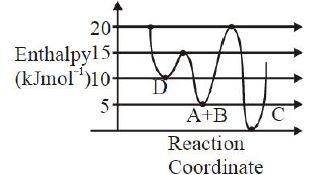
- \(A\) અને \(B\) વચ્ચેની નીચેની પ્રક્રિયાની એન્થાલ્પીનો આપેલ આલેખ ધ્યાનમાં લો. \(A + B \to C + D\) ખોટું વિધાન ઓળખો.
 JEE Mains 2019 Hard
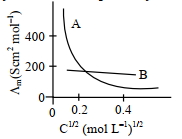
 - વિદ્યુત વિભાજ્યો \(A\) અને \(B\) માટે મોલર વાહકતા \(C^{1 / 2}\) વિરુદ્ધ નીચે દર્શાવ્યા પ્રમાણે આલેખવામાં આવે છે. વિદ્યુત વિભાજ્યો \(A\) અને \(B\) અનુક્રમે _______ છે.
 JEE Mains 2024 Medium
 - \(298\,K\) એ \(0.01\,M\,KCl\) દ્રાવણ ધરાવતા વાહકતા કોષનો અવરોધ \(1750\,\Omega\) છે. \(0.01M\) \(KCl\) દ્રાવણની \(298 K\) એ વાહકતા \(0.152 \times 10^{-3}\,S\,cm ^{-1}\) છે. તો આ વાહકતા કોષની કોષ અચળાંક \(\dots\dots\times 10^{-3} cm ^{-1}\).JEE Mains 2022 Medium
More PYQs from JEE Mains
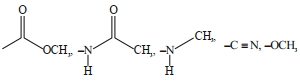
- એરોમેટિક ઇલેક્ટ્રોન અનુરાગી વિસ્થાપન પ્રક્રિયામાં નીચેના પૈકી નિષ્ક્રિયકરણ કરતા સમૂહોની કુલ સંખ્યા _______ છે.
 JEE Mains 2024 Hard
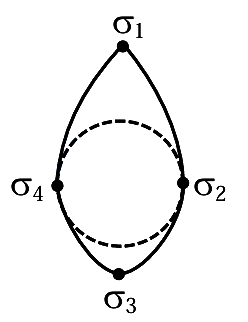
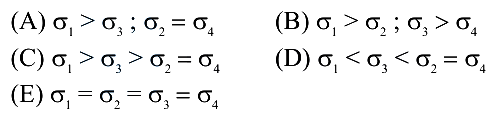
 - આકૃતિમાં દર્શાવ્યા મુજબ અનિયમિત ધાતુની તકતીને વિદ્યુતભાર સ્થાનાંતરિત કરવામાં આવે છે. જો \(\sigma_1, \sigma_2, \sigma_3\) અને \(\sigma_4\) આપેલા બિંદુઓ પર વિદ્યુતભાર ઘનતા હોય, તો નીચે આપેલા વિકલ્પોમાંથી સાચો જવાબ પસંદ કરો:
 JEE Mains 2025 Medium
 - \(\left[ MnBr _4\right]^{2-}( A ),\left[ Cu \left( H _2 O \right)_6\right]^{2+}( B ),\left[ Ni ( CN )_4\right]^{2-}( C )\) અને \(\left[ Ni \left( H _2 O \right)_6\right]^{2+}( D )\) સંકીર્ણ આયનોના સ્પીન-ફક્ત ચુંબકીય ચાકમાત્રા મૂલ્યોનો સાચો ચડતો કમ શોધો.JEE Mains 2026 Medium
- \(t\) થી \((t+1) \mathrm{s}\) સમય અંતરાલમાં, ગતિ કરતા કણ માટે સ્થાનાંતર અને વેગમાં વધારો અનુકમે \(125 \mathrm{~m}\) અને \(50 \mathrm{~m} / \mathrm{s}\) છે. કણ દ્વારા \((t+2)\) માં સેકન્ડમાં કપાતું અંતર _________ \(\mathrm{m}\) છે.JEE Mains 2024 Hard
- પ્રક્રમ જેમાં એન્ટ્રોપીમાં થતો ફેરફાર ઋણ છે.JEE Mains 2019 Hard
- એક સાબુના પરપોટાને ફુલાવીને તેનો વ્યાસ \(7 \mathrm{~cm}\) કરવામાં આવે છે. તેને વધારે ફૂલાવવા માટે કરવા પડતા કાર્ય માટે \(36960\) erg જેટલી ઉર્જા જોઈએ છે. સાબુના દ્રાવણ માટે પૃષ્ઠતાણ \(40\) dyne/cm હોય તો નવી ત્રિજ્યાં _______ \(\mathrm{cm}\) થશે. \(\left(\pi=\frac{22}{7}\right.\)લો).JEE Mains 2024 Hard