


All Structure of atom questions
Newest firstShowing 101–150 of 179 questions
-
- (A) \(3\)
- (B) \(4\)
- (C) \(2\)
- (D) \(1\)
Show answer and solution
Correct Answer: (B)
We can not calculate \(I.E.\) of lithium atom. -
- (A) \(32.1\)
- (B) \(0.624\)
- (C) \(8.58\)
- (D) \(976\)
Show answer and solution
Correct Answer: (C)
\(W = h v\)\(=6.6 \times 10^{-34} \times 1.3 \times 10^{15}\)
\(=8.58 \times 10^{-19} \,J\)
-
- (A) \(548\)
- (B) \(547\)
- (C) \(546\)
- (D) \(545\)
Show answer and solution
Correct Answer: (A)
Heisenberg's uncertainty principle\(\Delta x \times \Delta p _{ x } \geq \frac{ h }{4 \pi}\)
\(\Rightarrow 2 a _{0} \times m \Delta v _{ r }=\frac{ h }{4 \pi}(\text { minimum })\)
\(\Rightarrow \Delta v _{ x}=\frac{ h }{4 \pi} \times \frac{1}{2 a _{0}} \times \frac{1}{ m }\)
\(=\frac{6.63 \times 10^{-34}}{4 \times 3.14 \times 2 \times 52.9 \times 10^{-12} \times 9.1 \times 10^{-31}}\)
\(=548273\; ms ^{-1}\)
\(=548.273\; km\;s ^{-1}\)
\(=548\; km\; s ^{-1}\)
- 104. The number of radial and angular nodes in \(4 d\) orbital are, respectively ........ . 2022 Easy
- (A) \(1\) and \(2\)
- (B) \(3\) and \(2\)
- (C) \(1\) and \(0\)
- (D) \(2\) and \(1\)
Show answer and solution
Correct Answer: (A)
Radial node \(= n - l -1\)\(=4-2-1\)
\(=1\)
Angular node \((l)=2\)
-
- (A) \(Br ^{-}\)and \(Be ^{2+}\)
- (B) \(Cl ^{-}\)and \(Li ^{+}\)
- (C) \(S ^{2-}\) and \(K ^{+}\)
- (D) \(O ^{2-}\) and \(Mg ^{2+}\)
Show answer and solution
Correct Answer: (D)
Isoelectronic species have same no. of electrons \(Al ^{+3}, O ^{2-}, Mg ^{+2}\) all have \(10\) electrons. -
- (A) \(1757\)
- (B) \(1758\)
- (C) \(1756\)
- (D) \(1755\)
Show answer and solution
Correct Answer: (B)
\(v_{e}=x v_{N}\)\(\lambda_{ e }=\lambda_{ N }\)
\(\Rightarrow \frac{ h }{ m _{ e } v _{ c }}=\frac{ h }{ m _{ N } v_{ N }}\)
\(v_{ e }=\frac{ m _{ N }}{ m _{ e }} \cdot v _{ N }\)
\(=\frac{1.6 \times 10^{-27}}{9.1 \times 10^{-31}} v_{ N }\)
\(v_{ e }=1758.24 \times v_{ N }\)
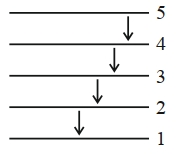
- 107. When the excited electron of a \(H\) atom from \(n =5\) drops to the ground state, the maximum number of emission lines observed are\(.......\) 2022 Medium
- (A) \(15\)
- (B) \(16\)
- (C) \(10\)
- (D) \(8\)
Show answer and solution
Correct Answer: (C)
Maximum number of emission lines from \(\mathrm{n}^{\text {th }}\) energy state to ground state is given by:\(=\frac{\mathrm{n}(\mathrm{n}-1)}{2}=\frac{5(5-1)}{2}=\frac{20}{2}=10 \text { lines. }\)
-
- (A) \(Sm ^{2+}\) and \(Er ^{3+}\)
- (B) \(Yb ^{2+}\) and \(Lu ^{3+}\)
- (C) \(Tb ^{2+}\) and \(Tm ^{4+}\)
- (D) both \((A)\) and \((C)\) are true
Show answer and solution
Correct Answer: (D)
\(Sm ^{2+} \rightarrow\) electron \(=60\)\(Er ^{3+} \rightarrow\) electron \(=65\)
\(Tb ^{2+} \rightarrow\) electron \(=63\)
\(Tm ^{4+} \rightarrow\) electron \(=65\)
all are \((not\,isoelectronic)\)
-
- (A) \(n=3,1=2, m_{1}=0, s=+\frac{1}{2}\)
- (B) \(n=3,1=2, m_{1}=-2, s=+\frac{1}{2}\)
- (C) \(n=3,1=3, m_{1}=-3, s=-\frac{1}{2}\)
- (D) \(n =3,1=0, m _{1}=0, s =-\frac{1}{2}\)
Show answer and solution
Correct Answer: (C)
\(1=0,1,2 \ldots(n-1)\)\(\therefore\) for \(n=3\)
\(1=0,1,2\)
\(1=3 \text {, }\)
not possible for \(n=3\)
-
- (A) \(1\)
- (B) \(4\)
- (C) \(2\)
- (D) \(3\)
Show answer and solution
Correct Answer: (C)
Total energy per sec. \(=50\, \mathrm{~J}\)\(50=\frac{\mathrm{n} \times 6.63 \times 10^{-34} \times 3 \times 10^{8}}{795 \times 10^{-9}}\)
\(\mathrm{n}=1998.49 \times 10^{17}[\mathrm{n}=\mathrm{no} .\) of photons per second \(]\)
\(=1.998 \times 10^{20}\)
\(\simeq 2 \times 10^{20}\)
\(=\mathrm{x} \times 10^{20}\)
\(\mathrm{x}=2\)
- 111. A certain orbital has \(n =4\) and \(m _{ L }=-3\). The number of radial nodes in this orbital is .......... (Round off to the Nearest Integer). 2021 Medium
- (A) \(1\)
- (B) \(0\)
- (C) \(3\)
- (D) \(5\)
Show answer and solution
Correct Answer: (B)
\(n =4\) and \(m _{\ell}=-3\)Hence, \(\ell\) value must be \(3\).
Now, number of radial nodes \(= n -\ell-1\)
\(=4-3-1=0\)
-
- (A) \(2\, s\)
- (B) \(3\, s\)
- (C) \(3\, p\)
- (D) \(2\, p\)
Show answer and solution
Correct Answer: (B)
\(1=0 \Rightarrow\) \('s'\) orbital\(n-l-1=2\)
\(n-1=2\)
\(n =3\)
-
- (A) \(7\)
- (B) \(5\)
- (C) \(1\)
- (D) \(500\)
Show answer and solution
Correct Answer: (B)
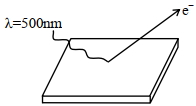
\(v:\) speed of electron having max. K.E.\(\Rightarrow\) from Einstein equation : \(\mathrm{E}=\phi+\mathrm{K} \cdot \mathrm{E}_{\cdot \max }\)
\(\Rightarrow \frac{\mathrm{hc}}{\lambda}=\mathrm{h} v_{0}+\frac{1}{2} \mathrm{mv}^{2}\)
\(\Rightarrow \frac{6.63 \times 10^{-34} \times 3 \times 10^{8}}{500 \times 10^{-9}}=6.63 \times 10^{-34} \times 4.3 \times 10^{14}\)\(+\frac{1}{2} \mathrm{mv}^{2}\)
\(\Rightarrow \frac{6.63 \times 30 \times 10^{-20}}{5}=6.63 \times 4.3 \times 10^{-20}+\frac{1}{2} \mathrm{mv}^{2}\)
\(\Rightarrow 11.271 \times 10^{-20} \mathrm{~J}=\frac{1}{2} \times 9 \times 10^{-31} \times \mathrm{v}^{2}\)
\(\Rightarrow \mathrm{v}=5 \times 10^{5} \,\mathrm{~m} / \mathrm{sec}\)
-
- (A) \(1\)
- (B) \(2\)
- (C) \(3\)
- (D) \(4\)
Show answer and solution
Correct Answer: (B)
\(\lambda=\frac{ h }{\sqrt{2 mqV }}\)\(\frac{\lambda_{ Li }}{\lambda_{ p }}=\sqrt{\frac{ m _{ p }( e ) V }{ m _{ Li }(3 e )( V )}} \quad m _{ Li }=8.3 m _{ p }\)
\(\frac{\lambda_{ Li }}{\lambda_{ p }}=\sqrt{\frac{1}{8.3 \times 3}}=\frac{1}{5}=0.2=2 \times 10^{-1}\)
-
- (A) \(2\)
- (B) \(4\)
- (C) \(6\)
- (D) \(8\)
Show answer and solution
Correct Answer: (A)
Total energy provided bySource per second \(=\frac{1000}{10}=100 \,\mathrm{~J}\)
Energy required to eject electron \(=\frac{h c}{\lambda}\)
\(=\frac{6.626 \times 10^{-34}}{400 \times 10^{-9}} \times 3 \times 10^{8}\)
Number of electrons ejected
\(=\frac{\frac{100}{6.626 \times 10^{-34} \times 3 \times 10^{8}}}{400 \times 10^{-9}}\)
\(=\frac{400 \times 10^{-7} \times 10^{26}}{6.626 \times 3}\)
\(=\frac{40 \times 10^{-20}}{6.626 \times 3}\)
\(=2.01 \times 10^{20}\)
-
- (A) \((C)\) Only
- (B) \((A)\) Only
- (C) \((A), (C)\) and \((D)\) only
- (D) \((A)\) and \((D)\) only
Show answer and solution
Correct Answer: (D)
According to Bohr's theory :\((A)\) \(KE =13.6 \frac{ z ^{2}}{ n ^{2}} \frac{ eV }{\text { atom }} \Rightarrow KE \alpha \frac{ z ^{2}}{ n ^{2}}\)
\((B)\) speed of \(e ^{-} \alpha \frac{ z }{ n }\)
\(\therefore \quad v \times n \alpha z\)
\((C)\) Frequency of revolution of \(e ^{-}=\frac{ v }{2 \pi r }\)
\(\therefore\) frequency \(\alpha \frac{z^{2}}{n^{3}}\)
\((D)\) \(F =\frac{ kq _{1} q _{2}}{ r ^{2}}=\frac{ kze ^{2}}{ r ^{2}} \quad\left\{ r \alpha \frac{ n ^{2}}{ z }\right.\)
\(\Rightarrow F \alpha \frac{ Z }{\left(\frac{ n ^{2}}{ Z }\right)^{2}}\)
\(\Rightarrow F \alpha \frac{ z ^{3}}{ n ^{4}}\)
-
- (A) \(12\)
- (B) \(36\)
- (C) \(58\)
- (D) \(72\)
Show answer and solution
Correct Answer: (C)
\(\Delta v=\frac{0.02}{100} \times 5 \times 10^{6}=10^{3} \,\mathrm{~m} / \mathrm{s}\)According to Heisenberg uncertainty principle
\(\Delta \mathrm{X} \cdot \Delta \mathrm{v}=\frac{\mathrm{h}}{4 \pi \,\mathrm{m}}\)
\(\mathrm{x} \times 10^{-9} \times 10^{3}=\frac{6.63 \times 10^{-34}}{4 \times 3.14 \times 9.1 \times 10^{-31}}\)
\(\mathrm{X} \times 10^{-9} \times 10^{3}=0.058 \times 10^{-3}\)
\(\mathrm{x}=\frac{0.058 \times 10^{-6}}{10^{-9}}=58\)
-
- (A) \(145\)
- (B) \(90\)
- (C) \(40\)
- (D) \(180\)
Show answer and solution
Correct Answer: (D)
\(E=\frac{ hc }{\lambda} \times \frac{ N _{ A }}{1000}\)\(=\frac{6.63 \times 10^{-34} \times 3 \times 10^{8} \times 6.02 \times 10^{23}}{663 \times 10^{-9} \times 1000}\)
\(=3 \times 6.02 \times 10\, kJ\)
\(=180.6\, kJ\)
-
- (A) Both Statement \(I\) and Statement \(II\) are false
- (B) Both Statement \(I\) and Statement \(II\) are true
- (C) Statement \(I\) is false but Statement \(II\) is true
- (D) Statement \(I\) is true but Statement \(II\) is false
Show answer and solution
Correct Answer: (C)
Velocity of electron in Bohr's atom is given by\(\mathrm{V} \propto \frac{\mathrm{Z}}{\mathrm{n}}\)
\(Z=\) atomic number of atom, corresponds to \(+v e\) charge so as \(Z\) increase velocity increases so statement\(-I\) is wrong.
and as \('n'\) decreases velocity increases so statement\(-II\) is correct.
-
- (A) Both statement \(I\) and statement \(II\) are true.
- (B) Statement \(I\) is false but statement \(II\) is true.
- (C) Both statement \(I\) and statement \(II\) are false.
- (D) Statement \(I\) is true but statement \(II\) is false.
Show answer and solution
Correct Answer: (B)
Statement\(-I\) is false since Bohr's theory accounts for the stability and spectrum of single electronic species \(\left( eg : He ^{+}, Li ^{2+}\right.\) etc \()\)Statement\(-II\) is true.
-
- (A) Statement \(\mathrm{I}\) is false but statement \(II\) is true.
- (B) Both statement \(I\) and statement \(II\) are false.
- (C) Statement \(\mathrm{I}\) is true but statement \(II\) is false.
- (D) Both statement \(\mathrm{I}\) and statement \(II\) are true.
Show answer and solution
Correct Answer: (D)
Rutherford's gold foil experiment only proved that electrons are held towards nucleus by electrostatic forces of attraction and move in circular orbits with very high speeds.Bohr's model gave exact formula for simultaneous calculation of speed \(\&\) distance of electron from the nucleus, something which was deemed impossible according to Heisenberg.
- 122. If the Thomson model of the atom was correct, then the result of Rutherford's gold foil experiment would have been: 2021 Medium
- (A) \(\alpha\)-Particles pass through the gold foil deflected by small angles and with reduced speed.
- (B) All \(\alpha\)-particles get bounced back by \(180^{\circ}\).
- (C) \(\alpha\)-Particles are deflected over a wide range of angles.
- (D) All of the \(\alpha\)-particles pass through the gold foil without decrease in speed
Show answer and solution
Correct Answer: (A)
As in Thomson model, protons are diffused (charge is not centered) \(\alpha\)-particles deviate by small angles and due to repulsion from protons, their speeddecreases. - 123. The characteristics of elements \(X, Y\) and \(Z\) with atomic numbers, respectively, \(33,53\) and \(83\) are : 2021 Medium
- (A) \(X\) and \(Y\) are metalloids and \(Z\) is a metal.
- (B) \(X\) is a metalloid, \(Y\) is a non-metal and \(Z\) is a metal.
- (C) \(X , Y\) and \(Z\) are metals.
- (D) \(X\) and \(Z\) are non-metals and \(Y\) is a metalloid
Show answer and solution
Correct Answer: (B)
\(X ={ }_{33} As \rightarrow\) Metalloid\(Y ={ }_{53} I \rightarrow\) Nonmetal
\(Z ={ }_{83} Bi \rightarrow\) Metal
-
- (A) \(1010\)
- (B) \(6135\)
- (C) \(3155\)
- (D) \(3845\)
Show answer and solution
Correct Answer: (C)
\(\operatorname{mvr}=\frac{\mathrm{nh}}{2 \pi}\)\(\text { K.E. }=\frac{\mathrm{n}^{2} \mathrm{~h}^{2}}{8 \pi^{2} \mathrm{mr}^{2}} \quad=\frac{4 \mathrm{~h}^{2}}{8 \pi^{2} \mathrm{~m}\left(4 \mathrm{a}_{0}\right)^{2}}\)
\(\quad\quad\quad\quad\quad\quad\quad\quad=\left(\frac{4}{8 \pi^{2} \times 16}\right) \frac{\mathrm{h}^{2}}{\mathrm{ma}_{0}^{2}}\)
\(\Rightarrow \mathrm{x}=315.507\)
\(\Rightarrow 10 \mathrm{x}=3155 \text { (nearest integer) }\)
- 125. The number of orbitals with \(n =5, m _{l}=+2\) is ...... . (Round off to the Nearest Integer) 2021 Medium
- (A) \(3\)
- (B) \(2\)
- (C) \(1\)
- (D) \(0\)
Show answer and solution
Correct Answer: (A)
For, \(n =5\)\(\ell=(0,1,2,3,4)\)
If \(\ell=0, m =0\)
\(\ell=1, m =\{-1,0,+1\}\)
\(\ell=2, m =\{-2,-1,0,+1,+2\}\)
\(\ell=3, m =\{-3,-2,-1,0,+1,+2,+3\}\)
\(\ell=4, m =\{-4,-3,-2,-1,0,+1,+2,+3,+4\}\)
\(5 d , 5 f\) and \(5 g\) subshell contain one-one orbital having \(m _{\ell}=+2\)
-
- (A) \(50\)
- (B) \(500\)
- (C) \(5\)
- (D) \(663\)
Show answer and solution
Correct Answer: (A)
Energy emitted in \(0.1\, \mathrm{sec}\).\(=0.1\, \mathrm{sec} \cdot \times 10^{-3} \,\frac{\mathrm{J}}{\mathrm{s}}\)
\(=10^{-4}\, \mathrm{~J}\)
If \('n'\) photons of \(\lambda=1000\, \mathrm{~nm}\) are emitted,
\(\text { then ; } 10^{-4}=\mathrm{n} \times \frac{\mathrm{hc}}{\lambda}\)
\(\Rightarrow 10^{-4}=\frac{\mathrm{n} \times 6.63 \times 10^{-34} \times 3 \times 10^{8}}{1000 \times 10^{-9}}\)
\(\Rightarrow \mathrm{n}=5.02 \times 10^{14}=50.2 \times 10^{13}\)
\(\Rightarrow 50\) (nearest integer)
-
- (A) \(3 p\)
- (B) \(4 f\)
- (C) \(4 d\)
- (D) \(5 d\)
Show answer and solution
Correct Answer: (D)
\(n-l-1=2\)\(1=2\)
\(n-2-1=2\)
\(n=5\)
-
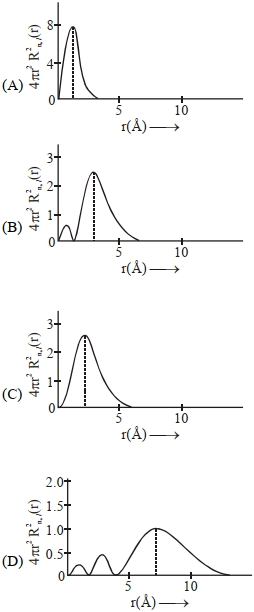
- (A) \((B)\)
- (B) \((A)\)
- (C) \((D)\)
- (D) \((C)\)
Show answer and solution
Correct Answer: (C)
Number of radial nodes \(= n -\ell-1\)\(=3-0-1=2\)
Therefor corresponding graph is \((D)\)
Hence answer is (3)
- 129. The value of magnetic quantum number of the outermost electron of \(\mathrm{Zn}^{+}\)ion is ..... . 2021 Medium
- (A) \(1\)
- (B) \(0\)
- (C) \(3\)
- (D) \(2\)
Show answer and solution
Correct Answer: (B)
\(\mathrm{Zn}^{+} \rightarrow 1 \mathrm{~s}^{2} 2 \mathrm{~s}^{2} 2 \mathrm{p}^{6} 3 \mathrm{~s}^{2} 3 \mathrm{p}^{6} 3 \mathrm{~d}^{10} 4 \mathrm{~s}^{1}\)Outermost electron is in \(4 \,\mathrm{~s}\) subshell \(\mathrm{m}=0\)
-
- (A) \(9\)
- (B) \(4\)
- (C) \(5\)
- (D) \(6\)
Show answer and solution
Correct Answer: (D)
De-broglie-wave length of electron:\(\lambda_{c}=\frac{h}{\sqrt{2 m(\mathrm{KE})}}\)
\(\because \mathrm{e}^{-}\,{\text {is accelerated }}{\text { from rest }}{\Rightarrow \mathrm{KE}=\mathrm{q} \times \mathrm{V}}\)
\(\lambda=\frac{\mathrm{h}}{\sqrt{2 \mathrm{mqv}}}\)
\(=\frac{6.63 \times 10^{-34}}{\sqrt{2 \times 1.6 \times 10^{-19} \times 9.1 \times 10^{-31} \times 40 \times 10^{3}}}\)
\(=0.614 \times 10^{-11} \,\mathrm{~m}\)
\(=6.16 \times 10^{-12} \,\mathrm{~m}\)
Nearest integer \(=6\)
OR
\(=\frac{12.3}{\sqrt{V}} \,\mathring A\)
\(=\frac{12.3}{200}=6.15 \times 10^{-12}\, \mathrm{~m}\)
-
- (A) \(7\)
- (B) \(9\)
- (C) \(12\)
- (D) \(18\)
Show answer and solution
Correct Answer: (B)
Energy incident \(=\frac{ hc }{\lambda}\)\(=\frac{6.63 \times 10^{-34} \times 3.0 \times 10^{8}}{248 \times 10^{-9} \times 1.6 \times 10^{-19}} eV\)
\(=\frac{6.63 \times 3 \times 100}{248 \times 1.6}\)
\(=0.05 eV \times 100=5 eV\)
Now using \(E =\phi+ K . E\)
\(5=3+ K . E\)
\(K . E .=2 eV =3.2 \times 10^{-19} J\)
for debroglie wavelength \(\lambda=\frac{ h }{ mv }\)
\(K . E =\frac{1}{2} mv ^{2}\)
so \(v =\sqrt{\frac{2 KE }{ m }}\)
hence \(\lambda=\frac{ h }{\sqrt{2 KE \times m }}\)
\(=\frac{6.63 \times 10^{-34}}{\sqrt{2 \times 3.2 \times 10^{-19} \times 9.1 \times 10^{-31}}}\)
\(=\frac{6.63}{7.6} \times \frac{10^{-34}}{10^{-25}}=\frac{66.3 \times 10^{-10} m }{7.6}\)
\(=8.72 \times 10^{-10} m\)
\(\approx 9 \times 10^{-10} m\)
\(=9 ^o\)
-
- (A) \(13\) has a half\(-\)filled valence subshell
- (B) \(9\) is the first alkali metal
- (C) \(8\) is the first noble gas
- (D) \(6\) has a \(2 p-\) valence subshell
Show answer and solution
Correct Answer: (A)
\(l=0\) to \(( n +1)\)\(n =1 \quad n =2\)
\(l=0,1,2 \quad l=0,1,2,3\)
\((n+l) \Rightarrow \frac{1 s}{1} \frac{1 p}{2} \frac{1 d}{3} \quad \frac{2 s}{2} \frac{2 p}{3} \frac{2 d}{4} \frac{2 f}{5}\)
\(n=3\)
\(l=0,1,2,3,4\)
\(\frac{3 s }{3} \frac{3 p }{4} \frac{3 d }{5} \frac{3 f }{6} \frac{3 g }{7}\)
Now, in order to write electronic configuration, we need to apply \(( n +l)\) rule
Energy order : \(1 s <1 p <2 s <1 d <2 p <3 s <2 d\)
Option 1) \(13: 1 s^{2} 1 p^{6} 2 s^{2} 1 d^{3}\) is not half filled
Option 2) \(9: \quad 1 s^{2} 1 p^{6} 2 s^{1}\) is the first alkali metal because after losing one electron, it will achieve first noble gas configuration
Option \(3)\) \(8: \quad 1 s^{2} 1 p^{6}\) is the first noble gas because after \(1 p ^{6} e ^{-}\) will
Option \(4)\) \(6: \quad 1 s ^{2} 1 p ^{4}\) has \(1 p\) valence subshell.
-
- (A) \((II), (III), (IV)\)
- (B) \((I), (II), (III)\)
- (C) \((I), (III), (IV)\)
- (D) \((I), (II), (IV)\)
Show answer and solution
Correct Answer: (B)
For balmer : \(\mathrm{n}_{1}=2, \mathrm{n}_{2}=3,4,5, \ldots \infty\)\(\bar{v}=\frac{1}{\lambda}=R_{H}\left[\frac{1}{2^{2}}-\frac{1}{n_{2}^{2}}\right]\)
\(\frac{1}{\lambda_{\text {longest }}}=\mathrm{R}_{\mathrm{H}}\left[\frac{1}{2^{2}}-\frac{1}{3^{2}}\right]\)
-
- (A) \(6 s, 5 f, 6 d, 6 p\)
- (B) \(6 s, 6 p, 6 d, 6 f\)
- (C) \(6 s, 5 d, 5 f, 6 p\)
- (D) \(6 s, 4 f, 5 d, 6 p\)
Show answer and solution
Correct Answer: (D)
As per \(( n +\ell)\) rule in \(6^{th}\) period, order of orbitals filling is \(6 s, 4 f, 5 d, 6 p\) -
- (A) \(8 \pi a_{0}\)
- (B) \(2 \pi a_{0}\)
- (C) \(4 \pi a_{0}\)
- (D) \(6 \pi a_{0}\)
Show answer and solution
Correct Answer: (A)
\(2 \pi r=n \lambda\)for \(\quad \mathrm{n}=1, \mathrm{r}=\mathrm{a}_{0}\)
\(\mathrm{n}=4, \mathrm{r}=16 \mathrm{a}_{0}\)
So, \(\quad 2 \pi \times 16 \mathrm{a}_{0}=4 \times \lambda\)
\(\lambda=8 \pi \mathrm{a}_{0}\)
-
- (A) \(8:3\)
- (B) \(3:2\)
- (C) \(3:8\)
- (D) \(2:3\)
Show answer and solution
Correct Answer: (D)
\(\frac{\Delta R _{1}}{\Delta R _{2}}=\frac{\left( r _{4}- r _{3}\right)_{4^{2+}}}{\left( r _{4}- r _{3}\right)_{ He ^{+}}}=\frac{\frac{4^{2}}{3}-\frac{3^{2}}{3}}{\frac{4^{2}}{2}-\frac{3^{2}}{2}}=\frac{7 / 3}{7 / 2}=\frac{2}{3}\) -
- (A) \(11\)
- (B) \(25\)
- (C) \(15\)
- (D) \(50\)
Show answer and solution
Correct Answer: (B)
No. of orbitals \(=n^{2}=5^{2}=25\)For \(n=5,\) no. of orbitals \(=n^{2}=25\)
Total number of orbitals is equal to no. of electrons having \(\mathrm{m}_{\mathrm{s}}=\frac{1}{2}\)
-
- (A) \(4\)
- (B) \(8\)
- (C) \(16\)
- (D) \(2\)
Show answer and solution
Correct Answer: (D)
For \(n=4\)
\(\ell=0,1,2,3\)
\(\therefore 4 d \& 4 f\) subshell associated with \(n =4, m =-2\)

-
- (A) Visible
- (B) Microwave
- (C) Ultraviolet
- (D) Infrared
Show answer and solution
Correct Answer: (A)
Balmer series give visible lines For \(H\)\(-\)atom -
- (A) \(\frac{5 \lambda_{1}}{9}\)
- (B) \(\frac{27 \lambda_{1}}{5}\)
- (C) \(\frac{9 \lambda_{1}}{5}\)
- (D) \(\frac{36 \lambda_{1}}{5}\)
Show answer and solution
Correct Answer: (C)
As we know \(\Delta E=\frac{h c}{\lambda}\)So \(\quad \lambda=\frac{ hc }{\Delta E } \quad\) for \(\lambda\) minimum i.e.
shortest; \(\Delta E=\) maximum
for Lyman series \(n=1 \&\) for \(\Delta E_{\text {max }}\)
Transition must be form \(n=\infty\) to \(n=1\)
So \(\quad \frac{1}{\lambda}= R _{ H } Z^{2}\left(\frac{1}{ n _{1}^{2}}-\frac{1}{ n _{2}^{2}}\right)\)3
\(\frac{1}{\lambda}= R _{ H } Z^{2}(1-0)\)
\(\frac{1}{\lambda}= R \times(1)^{2} \Rightarrow \lambda_{1}=\frac{1}{ R }\)
For longest wavelength \(\Delta E =\) minimum for Balmer series \(n =3\) to \(n =2\) will have \(\Delta E\) minimum
for \(He ^{+} Z =2\)
So \(\frac{1}{\lambda_{2}}= R _{ H } \times Z^{2}\left(\frac{1}{ n _{1}^{2}}-\frac{1}{ n _{2}^{2}}\right)\)
\(\frac{1}{\lambda_{2}}= R _{ H } \times 4\left(\frac{1}{4}-\frac{1}{9}\right)\)
\(\frac{1}{\lambda_{2}}= R _{ H } \times \frac{5}{9}\)
\(\lambda_{2}=\lambda_{1} \times \frac{9}{5}\)
-
- (A) \(K\)
- (B) \(Na\)
- (C) \(H\)
- (D) \(Li\)
Show answer and solution
Correct Answer: (A)
Greater the nuclear charge, stronger will be the attraction, hence lower will be energy of \(2s\) -
- (A) \(5:4\)
- (B) \(4:1\)
- (C) \(9:4\)
- (D) \(27:5\)
Show answer and solution
Correct Answer: (C)
\(\Delta {{\bar V}_{Lymann}} = \frac{{{R_H}}}{4}\)\(\Delta {{\bar V}_{Balmer}} = \frac{{{R_H}}}{9}\)
\( \Rightarrow \frac{{\Delta {{\bar V}_{Lymann}}}}{{\Delta {{\bar V}_{Balmer}}}} = \frac{9}{4}\)
Formula
\(\bar V = {R_H}\left[ {\frac{1}{{n_1^2}} - \frac{1}{{n_2^{2}}}} \right]\)
-
- (A) Linear with intercept \(- R_H\)
- (B) Non linear
- (C) Linear with slope \(R_H\)
- (D) Linear with slope \(-R_H\)
Show answer and solution
Correct Answer: (D)
For emission line \(n_f < n_i\)\(\therefore \,\bar v = R{Z^2}\left[ {\frac{1}{{n_i^2}} - \frac{1}{{n_f^2}}} \right] = R\left[ {\frac{1}{{{8^2}}} - \frac{1}{{{n^2}}}} \right]\)
or, \(\bar v = {R_H}\left( {\frac{1}{{64}} - \frac{1}{{{n^2}}}} \right)\)
\( = \frac{{{R_H}}}{{64}} - \frac{{{R_H}}}{{{n^2}}}\)
\(\bar v = - {R_H}\left( {\frac{1}{n^2}} \right) + \frac{{{R_H}}}{{64}}\)
\(\therefore \,y = mx + c\)
Slope \(= -R_H\)
-
- (A) Paschen, \(\infty \, \to \,3\)
- (B) Paschen, \(5 \to 3\)
- (C) Balmer, \(\infty \, \to \,2\)
- (D) Lyman, \(\infty \, \to \,1\)
Show answer and solution
Correct Answer: (A)
\([i]\,\,900\,nm = 9000\,\mathop A\limits^o \)
It is in far infra red region hence paschen. -
- (A) \(\frac{3}{4}\lambda \)
- (B) \(\frac{1}{2}\lambda \)
- (C) \(\frac{4}{9}\lambda \)
- (D) \(\frac{2}{3}\lambda \)
Show answer and solution
Correct Answer: (C)
\(K.E = \frac{1}{2}m{u^2} = \frac{1}{2}\frac{{{m^2}{u^2}}}{m} = \frac{1}{2}\frac{{{P^2}}}{m}\)\(\frac{{hc}}{{{\lambda _1}}} = Wo + {(K.E)_1} = Wo + \frac{1}{2}\frac{{{P^2}}}{m}\)
\(\frac{{hc}}{{{\lambda _2}}} = Wo + {(K.E)_2} = Wo + \frac{1}{2}\frac{{{{(1.5P)}^2}}}{m}\)
On solving
\({\lambda _2} = \frac{4}{9}{\lambda _1}\)
Since the \(K.E\) is very high is comparison to work function, then we can assume that \(K.E+Wo = K.E\)
-
- (A) \(0.40\)
- (B) \(1.50\)
- (C) \(1.0\)
- (D) \(0.75\)
Show answer and solution
Correct Answer: (D)
\(2\pi r = n\lambda \)\(\lambda = \frac{{2\pi r}}{n} = \frac{{2\pi {n^2}{a_0}}}{{n \times Z}} = 2\pi \frac{n}{Z}{a_0}\)
\(\lambda = 1.5\pi {a_0}\)
\(\therefore \,2\pi \frac{n}{Z}{a_0} = 1.5\pi {a_0}\)
\(\therefore \frac{n}{Z} = \frac{{1.5}}{2} = 0.75\)
-
- (A) \(\lambda \propto \frac{1}{{\left( {v - {v_0}} \right)}}\)
- (B) \(\lambda \propto \frac{1}{{{{\left( {v - {v_0}} \right)}^{\frac{1}{4}}}}}\)
- (C) \(\lambda \propto \frac{1}{{{{\left( {v - {v_0}} \right)}^{\frac{3}{2}}}}}\)
- (D) \(\lambda \propto \frac{1}{{{{\left( {v - {v_0}} \right)}^{\frac{1}{2}}}}}\)
Show answer and solution
Correct Answer: (D)
\(\lambda = \frac{h}{{mv}}\)According to Einstein's theory of photoelectric effect:
\(hv = h{v_0} + KE\)
\(hv = h{v_0} + \frac{1}{2}m{v^2}\)
\(2h(v - {v_0}) = m{v^2}\)
\(\frac{{2h(v - {v_0})}}{m} = {v^2}\)
\(v \propto {(v - {v_0})^{\frac{1}{2}}}\)
\(\lambda \propto \frac{h}{{m{{(v - {v_0})}^{\frac{1}{2}}}}}\)
\(\lambda \propto \frac{1}{{{{(v - {v_0})}^{\frac{1}{2}}}}}\)
-
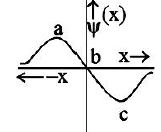
- (A) in the region \(a\) and \(b\)
- (B) in the region \(a\) and \(c\)
- (C) only in the region \(a\)
- (D) only in the region \(c\)
Show answer and solution
Correct Answer: (B)
At \(a\) & \(c\), probability of finding electron is maximum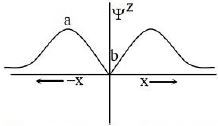
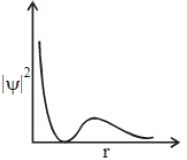
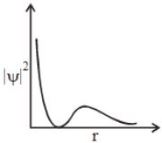
- 149. The graph between \({\left| \psi \right|^2}\) and \(r\)(radial distance) is shown below. This represents
 2019 Medium
- (A) \(1s\) orbital
- (B) \(3s\) orbital
- (C) \(2s\) orbital
- (D) \(2p\) orbital
Show answer and solution
Correct Answer: (C)
As we know that for \(s-\) orbital graph start from top and no. of radial node \(= n-l-1\) For \(2s\) orbital it will \(= 2-0-1=1\)\(\therefore \) The graph is of \(2s\)
- 150. The ground state energy of hydrogen atom is \(-13.6\, eV\). The energy of second excited state of \(He^+\) ion in \(eV\) is 2019 Medium
- (A) \(-54.4\)
- (B) \(-3.4\)
- (C) \(-6.04\)
- (D) \(-27.2\)
Show answer and solution
Correct Answer: (C)
\(E = - 13.6\frac{{{z^2}}}{{{n^2}}}\,eV\)\(E_{He}^ + = - 13.6\frac{4}{9}\)
No questions on this page match these filters.