


JEE Mains 2014 Physics ના બધા પ્રશ્નો
29 પ્રકરણ134 માંથી 101–134 પ્રશ્નો
- 101. એલ્યુમિનિયમ અને કોપર જેવા દ્રવ્યો માટે સ્થિતિસ્થાપક અંકનો સાચો ક્રમ નીચેનામાથી કયો છે? 2014 મધ્યમ
- (A) યંગ મોડ્યુલસ \(<\) આકાર સ્થિતિસ્થાપક અંક \(<\) બલ્ક મોડ્યુલસ
- (B) બલ્ક મોડ્યુલસ \(<\) આકાર સ્થિતિસ્થાપક અંક \(<\) યંગ મોડ્યુલસ
- (C) આકાર સ્થિતિસ્થાપક અંક \(<\) યંગ મોડ્યુલસ \(<\) બલ્ક મોડ્યુલસ
- (D) બલ્ક મોડ્યુલસ \(<\) યંગ મોડ્યુલસ \(<\) આકાર સ્થિતિસ્થાપક અંક
જવાબ અને ઉકેલ જુઓ
સાચો જવાબ: (C)
Poisson's ratio,\(\sigma = \frac{{Iateral\,strain\left( \beta \right)}}{{longitudinal\,strain\left( \alpha \right)}}\)
For material like copper, \(\sigma = 0.33\)
\(And,\,y = 3k\left( {1 - 2\sigma } \right)\)
\(Also,\frac{9}{y} = \frac{1}{k} + \frac{3}{n}\)
\(y = 2n\left( {1 + \sigma } \right)\)
\(Hence,n < y < k\)
-
- (A) ઇથેનોલ \(>\) પાણી \(>\) પારો
- (B) પાણી \(>\) ઇથેનોલ \(>\) પારો
- (C) પારો \(>\) ઇથેનોલ \(>\) પાણી
- (D) ઇથેનોલ \(>\) પારો \(>\) પાણી
જવાબ અને ઉકેલ જુઓ
સાચો જવાબ: (A)
\(Compressibility = \frac{1}{{Bulk\,modulus}}\)As bulk modulus is least for ethanol \((0.9)\) and maximum for mercury \((25)\) among ehtanol, mercury and water. Hence
compression in volume \(\frac{{\Delta V}}{V}\)
\(Ethanol>Water>Mercury\)
-
- (A) \(1.4\,\times 10^4\,N\)
- (B) \(2.7\,\times 10^4\,N\)
- (C) \(3.3\,\times 10^4\,N\)
- (D) \(1.1\,\times 10^4\,N\)
જવાબ અને ઉકેલ જુઓ
સાચો જવાબ: (C)
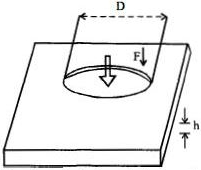
Shearing strain is created along the side surface of the punched disk. Note that the forces exerted on the disk are exerted alongthe circum ference of the disk, and the total force exerted on its center only.
Letus assume that the shearing stress along the side surface of the disk is uniform, then
\(F > \int\limits_{Surface} {d{F_{\max }} = \int\limits_{surface} {{\sigma _{\max }}dA = {\sigma _{\max }}} \int\limits_{surface} {dA} } \)
\( = \int {{\sigma _{\max }}} .A = {\sigma _{\max }}.2\pi \left( {\frac{D}{2}} \right)h\)
\( = 3.5 \times {10^8} \times \left( {\frac{1}{2} \times {{10}^{ - 2}}} \right) \times 0.3 \times {10^{ - 2}} \times 2\pi \)
\( = 3.297 \times {10^4} = 3.3 \times {10^4}N\)
-
- (A) \(0.1\)
- (B) \(0.15\)
- (C) \(0.20\)
- (D) \(0.25\)
જવાબ અને ઉકેલ જુઓ
સાચો જવાબ: (A)
Given: Radius of air bubble,\(r = 0.1\,cm = {10^{ - 3}}m\)
Surface tension of liquid,
\(S = 0.06\,N/m = 6 \times {10^{ - 2}}\,N/m\)
Density of liquid, \(\rho = {10^3}\,kg/{m^3}\)
Excess pressure inside the bubble,
\({\rho _{exe}} = 1100N{m^{ - 2}}\)
Depth of bubble below the liquid surface,
\(h=?\)
As we know,
\({\rho _{Excess}} = h\rho g + \frac{{2s}}{r}\)
\( \Rightarrow 1100 = h \times {10^3} \times 9.8 + \frac{{2 \times 6 \times {{10}^{ - 2}}}}{{{{10}^{ - 3}}}}\)
\( \Rightarrow 1100 - 9800h + 120\)
\( \Rightarrow 9800h = 1100 - 120\)
\( \Rightarrow h = \frac{{980}}{{9800}} = 0.1\,m\)
-
- (A) \(4PV+3ST = 0\)
- (B) \(3PV+4ST = 0\)
- (C) \(2PV+3ST = 0\)
- (D) \(3PV+2ST = 0\)
જવાબ અને ઉકેલ જુઓ
સાચો જવાબ: (B)
Let \(P_i\) and \(R_i\) be the inside pressure and radius of the ith soap bubble respectively.\(\therefore {P_1} = P + \frac{{4T}}{{{R_1}}}.\,\,\,{P_2} = P + \frac{{4T}}{{{R_2}}}\,\,and\,\,{P_3} = P + \frac{{4T}}{{{R_3}}}\)
\(Also\,{P_1}{V_1} + {P_2}{V_2} = {P_3}{V_3}\)
\(\therefore \left( {P + \frac{{4T}}{{{R_1}}}} \right)\frac{{4\pi }}{3}R_1^3 + \left( {P + \frac{{4T}}{{{R_2}}}} \right)\frac{{4\pi }}{3}R_2^3\)
\( = \left( {p + \frac{{4T}}{{{R_3}}}} \right)\frac{{4\pi }}{3}R_3^3\)
\(P\left( {\frac{{4\pi }}{3}R_1^3 + \frac{{4\pi }}{3}R_2^3 - \frac{{4\pi }}{3}R_3^2} \right)\)
\( + \frac{{4T}}{3}\left( {4\pi R_1^2 + 4\pi R_2^2 - 4\pi R_3^2} \right) = 0\)
\(P\left( {{V_1} + {V_2} - {V_3}} \right) + \frac{{4T}}{3}\left( {{S_1} - {S_2} - {S_3}} \right) = 0\)
\(PV + \frac{{4T}}{3}S = 0\,\,\,\,\,\,\, \Rightarrow \,\,\,\,3PV + 4ST = 0\)
-
- (A) \(\left( {1 - \frac{d}{R}} \right)\)
- (B) \(\left( {1 - \frac{2d}{R}} \right)\)
- (C) \(\left( {\frac{{R - d}}{{R + d}}} \right)\)
- (D) \(\left( {\frac{{R + d}}{{R - d}}} \right)\)
જવાબ અને ઉકેલ જુઓ
સાચો જવાબ: (A)
Acceleration due to gravity changes with the depth,\(g' = g\left( {1 - \frac{d}{R}} \right)\)
\(pressure,\,P = \rho gh\)
\(Hence\,ratio,\frac{x}{y}is\left( {1 - \frac{d}{R}} \right)\)
-
- (A) \(R^{2} \sqrt{\frac{\rho_{w} g}{T}}\)
- (B) \(R^{2} \sqrt{\frac{2 \rho_{w} g}{3 T}}\)
- (C) \(R^{2} \sqrt{\frac{3 \rho_{w} g}{T}}\)
- (D) \(R^{2} \sqrt{\frac{\rho_{w} g}{6 T}}\)
જવાબ અને ઉકેલ જુઓ
સાચો જવાબ: (B)
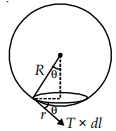
When the bubble gets detached,Buoyant force = force due to surface tension
\(\int T \times d l \sin \theta=\frac{4}{3} \pi R^{3} \rho_{w} g\)
\(\Rightarrow T \times 2 \pi r \times \frac{r}{R}=\frac{4}{3} \pi R^{3} \rho_{w} g\)
\(\Rightarrow r^{2}=\frac{2 R^{4} \rho_{w g} g}{3}\)
\(\Rightarrow r=R^{2} \sqrt{\frac{2 \rho_{w D g}}{3 T}}\)
-
- (A) \(\frac{{2A}}{{\pi {a^2}}}\sqrt {\frac{h}{g}} \)
- (B) \(\frac{{\sqrt 2A }}{{\pi {a^2}}}\sqrt {\frac{h}{g}} \)
- (C) \(\frac{{2\sqrt 2A }}{{\pi {a^2}}}\sqrt {\frac{h}{g}} \)
- (D) \(\frac{A}{{\sqrt 2 \pi {a^2}}}\sqrt {\frac{h}{g}} \)
જવાબ અને ઉકેલ જુઓ
સાચો જવાબ: (B)
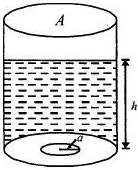
Let the rate of falling water level be \( - \frac{{dh}}{{dt}}\)Initially at \(t = 0\,;\,h = h\)
\(t = t\,;h = 0\)
\(Then,\,A\left( { - \frac{{dh}}{{dt}}} \right) = \pi {a^2}.v\)
\(\left[ {Velocity\,of\,efflux\,of\,liquid\,v = \sqrt {2gh} } \right]\)
Integrating both sides
\(\int\limits_0^t {dt = - \frac{A}{{\sqrt {2g} \pi {a^2}}}{{\int\limits_h^0 h }^{ - 1/2}}dh} \)
\(\left[ t \right]_0^t = - \frac{A}{{\sqrt {2g} \pi {a^2}}} \cdot \left[ {\frac{{{h^{1/2}}}}{{1/2}}} \right]_h^0\)
\(t = \frac{{\sqrt 2 A}}{{\pi {a^2}}}\sqrt {\frac{h}{g}} \)
-
- (A) \(7.5\)
- (B) \(8.0\)
- (C) \(10.0\)
- (D) \(12.5\)
જવાબ અને ઉકેલ જુઓ
સાચો જવાબ: (A)
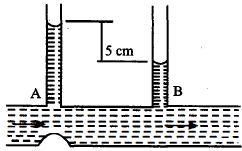
According to \(Bernoulli's\) theorem,\({p_1} + \frac{1}{2}\rho v_1^2 = {P_2} + \frac{1}{2}\rho v_2^2\)
\(\therefore v_2^2 - v_1^2 = 2gh\) \(...\left( 1 \right)\)
According to the equation of continuty
\({A_1}{v_1} = {A_2}{v_2}\) \(...(2)\)
\(\frac{{{A_1}}}{{{A_2}}} = \frac{{6\,m{m^2}}}{{10\,m{m^2}}}\)
\(From\,equation\,\left( 2 \right),\frac{{{A_1}}}{{{A_2}}} = \frac{{{v_2}}}{{{v_1}}} = \frac{6}{{16}}\)
\(or,\,\,{v_2} = \frac{6}{{10}}{v_1}\)
Putting this value of \(v_2\) in equation \((1)\)
\({\left( {\frac{6}{{10}}{v_1}} \right)^2} - {\left( {{v_1}} \right)^2} = 2 \times {10^3} \times 5\)
\(\left[ \begin{array}{l}
g = 10m/{s^2} = {10^3}cm/{s^2}\\
and\,h = 5\,cm
\end{array} \right]\)\(Solving\,we\,get\,{v_1} = \frac{{10}}{8}\)
Therefore the rate at which water flows through the tube
\( = {A_1}{v_1} = {A_2}{v_2} = \frac{{6 \times 10}}{8} = 7.5cc/s\)
-
- (A) \(22\)
- (B) \(38\)
- (C) \(6 \)
- (D) \(16 \)
જવાબ અને ઉકેલ જુઓ
સાચો જવાબ: (D)
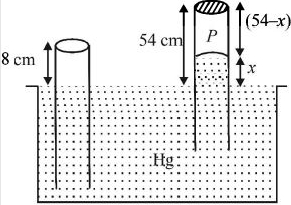
Length of the air column above mercury in the tube is,\(p + x = {P_0}\)
\( \Rightarrow p = \left( {76 - x} \right)\)
\( \Rightarrow 8 \times A \times 76 = \left( {76 - x} \right) \times A \times \left( {54 - x} \right)\)
\(\therefore \,x = 38\)
Thus, lenght of air column \(=54-38=16\,cm.\)
-
- (A) \(\frac{{1 + cos\alpha }}{{1 - cos\alpha }}\)
- (B) \(\;\frac{{1 + tan\alpha }}{{1 - tan\alpha }}\)
- (C) \(\;\frac{{1 + sin\alpha }}{{1 - cos\alpha }}\)
- (D) \(\;\frac{{1 + sin\alpha }}{{1 - sin\alpha }}\)
જવાબ અને ઉકેલ જુઓ
સાચો જવાબ: (B)
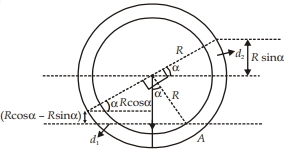
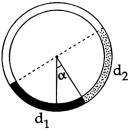
Equating pressure at \(A\)\(\left( {R\cos \alpha + R\sin \alpha } \right){d_2}g = \left( {R\cos \alpha - R\sin \alpha } \right){d_1}g\)
\( \Rightarrow \frac{{{d_1}}}{{{d_2}}} = \frac{{\cos \alpha + \sin \alpha }}{{\cos \alpha - \sin \alpha }} = \frac{{1 + \tan \alpha }}{{1 - \tan \alpha }}\)
-
- (A) \(10^{-1}\,N/m^2\)
- (B) \(10^{-2}\,N/m^2\)
- (C) \(10^{-3}\,N/m^2\)
- (D) \(10^{-4}\,N/m^2\)
જવાબ અને ઉકેલ જુઓ
સાચો જવાબ: (B)
\(\eta = {10^{ - 2}}poise\)\(v = 18\,km/h = \frac{{18000}}{{3600}} = 5m/s\)
\(l = 5\,m\)
\(Strain\,rate = \frac{v}{l}\)
Cofficient of viscosity,
\(\eta = \frac{{shearing\,stress}}{{strain\,rate}}\)
\(\therefore \,Shearing\,stress = \eta \times strain\,rate\)
\( = {10^{ - 2}} \times \frac{5}{5} = {10^{ - 2}}N{m^{ - 2}}\)
-
- (A) \(10.7\)
- (B) \(9.6\)
- (C) \(8.5\)
- (D) \(7.6\)
જવાબ અને ઉકેલ જુઓ
સાચો જવાબ: (B)
\({h_1}{\rho _1}g + {h_2}{\rho _2}g = \frac{1}{2}{\rho _1}{v^2}\)\( \Rightarrow 1000 \times 10 \times 3 + 800 \times 10 \times 2\)
\( = \frac{1}{2} \times 1000 \times {v^2}\)
\( \Rightarrow {v^2} = 2 \times \frac{{46000}}{{1000}}\)
\( \Rightarrow v = \sqrt {92} = 9.6\,m/s\)
-
- (A) \(3.5\times10^5\, J\)
- (B) \(4.05\times10^4\, J\)
- (C) \(3.0\times10^5\, J\)
- (D) \(9.0\times10^4\, J\)
જવાબ અને ઉકેલ જુઓ
સાચો જવાબ: (B)
Total volume of rain drops, recrived \(100\,cm\) in a year by area \(1\,m^2\)\( = 1{m^2} \times \frac{{100}}{{100}}m = 1\,{m^3}\)
As we know, density of water,
\(d = {10^3}\,kg/{m^3}\)
Therefore, mass of this volume of water,
\(M = d \times v = {10^3} \times 1 = {10^3}\,kg\)
Average terminal velocity of rain drop
\(v = 9\,m/s\,\left( {given} \right)\)
Therefore, energy transferred by rain,
\(E = \frac{1}{2}m{v^2}\)
\( = \frac{1}{2} \times {10^3} \times {\left( 9 \right)^2}\)
\( = \frac{1}{2} \times {10^3} \times 81 = 4.05 \times {10^4}J\)
-
- (A) \(22.5\)
- (B) \(15\)
- (C) \(33.7\)
- (D) \(45\)
જવાબ અને ઉકેલ જુઓ
સાચો જવાબ: (A)
\(F=v \frac{d m}{d t}\)\(=v A \rho v\)
\(=v^{2} A \rho\)
\(=(1.5)^{2} \times 10^{-2} \times 10^{3}\)
\(=2.25 \times 10=22.5 N\)
-
- (A) \(\left( { - 3\hat i + 4\hat j\,} \right)\,N\)
- (B) \(\left( { - \frac{3}{5}\hat i + \frac{4}{5}\hat j\,} \right)\,N\)
- (C) \(\left( {3\hat i - 4\hat j\,} \right)\,N\)
- (D) \(\left( {\frac{3}{5}\hat i - \frac{4}{5}\hat j\,} \right)\,N\)
જવાબ અને ઉકેલ જુઓ
સાચો જવાબ: (A)
\(\begin{array}{l}
From\,question,\\
Mass\,of\,body,\,m = 5\,kg\\
Vleocity\,at\,t = 0,\\
u = \,\left( {6\hat i - 2\hat j} \right)\,m/s\\
Velocity\,at\,t = 10s,\\
v = + 6\,\hat j\,m/s\\
Force,\,F = ?
\end{array}\)\(\begin{array}{l}
Acceleration,\,a = \frac{{v - u}}{t}\\
= \frac{{6\hat j - \left( {6\hat i - 2\hat j} \right)}}{{10}} = - 3\hat i + 4\hat j\,m/{s^2}\\
Force,\,F = ma\\
= 5 \times \frac{{\left( {3\hat i + 4\hat j} \right)}}{5} = \left( { - 3\hat i + 4\hat j} \right)\,N
\end{array}\) -
- (A) \(v_1 = v_2\)
- (B) \(\begin{array}{l} {v_1}{\mkern 1mu} = {\mkern 1mu} {m_2}{\mkern 1mu} \sqrt {\frac{{2G}}{{d({m_1} + {m_2})}}} \\ {v_2}{\mkern 1mu} = {\mkern 1mu} {m_1}{\mkern 1mu} \sqrt {\frac{{2G}}{{d({m_1} + {m_2})}}} \end{array}\)
- (C) \(\begin{array}{l} {v_1}{\mkern 1mu} = {\mkern 1mu} {m_1}{\mkern 1mu} \sqrt {\frac{{2G}}{{d({m_1} + {m_2})}}} \\ {v_2}{\mkern 1mu} = {\mkern 1mu} {m_2}{\mkern 1mu} \sqrt {\frac{{2G}}{{d({m_1} + {m_2})}}} \end{array}\)
- (D) \(\begin{array}{l} {v_1}\, = \,{m_2}\,\sqrt {\frac{{2G}}{{{m_1}}}} \\ {v_2}\, = \,{m_2}\,\sqrt {\frac{{2G}}{{{m_2}}}} \end{array}\)
જવાબ અને ઉકેલ જુઓ
સાચો જવાબ: (B)
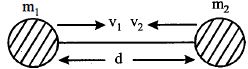
We choose reference point, infinity, where total energy of the system is zero.So initial energy of the system \(=0\)
Final energy
\( = \frac{1}{2}{m_1}v_1^2 + \frac{1}{2}{m_2}v_2^2=\frac{{G{m_1}{m_2}}}{d}\)
From conservation of energy,
\(Initial\, energy=Final\, energy\)
\(\therefore 0 = \frac{1}{2}{m_1}v_1^2 + \frac{1}{2}{m_2}v_2^2 = \frac{{G{m_1}{m_2}}}{d}\)
\(or\,\frac{1}{2}{m_1}v_1^2 + \frac{1}{2}{m_1}v_2^2 = \frac{{G{m_1}{m_2}}}{d}\,\,...\left( i \right)\)
By conservation of linear momentum
\({m_1}{v_1} + {m_2}{v_2} = 0\)
\(or\,\frac{{{v_1}}}{{{v_2}}} = \frac{{{m_2}}}{{{m_1}}} \Rightarrow {v_2} = - \frac{{{m_1}}}{{{m_2}}}{v_1}\)
Putting value of \(v_2\) in equation \((1)\), we get
\({m_1}v_1^2 + {m_2}{\left( { - \frac{{{m_1}{v_1}}}{{{m_2}}}} \right)^2} = \frac{{2G{m_1}{m_2}}}{d}\)
\(\frac{{{m_1}{m_2}v_1^2 + m_1^2v_1^2}}{{{m_2}}} = \frac{{2G{m_1}{m_2}}}{d}\)
\({v_1} = \sqrt {\frac{{2Gm_2^2}}{{d\left( {{m_1} + {m_2}} \right)}}} = {m_2}\sqrt {\frac{{2G}}{{d\left( {{m_1} + {m_2}} \right)}}} \)
\(Similarly\,{v_2} = {m_1}\sqrt {\frac{{2G}}{{d\left( {{m_1} + {m_2}} \right)}}} \)
-
- (A) \(500\)
- (B) \(320\)
- (C) \(260\)
- (D) \(220\)
જવાબ અને ઉકેલ જુઓ
સાચો જવાબ: (C)
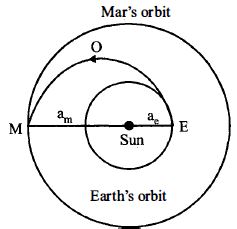
semi major axis of mangalyan\({a_{Mn}} = \frac{{{a_c} + {a_m}}}{2}\)
\( = 1.89 \times {10^{11}}m\)
From kepler's law
\({T^2} \propto {R^3}\)
\(\therefore \,{\left( {\frac{{{T_{mn}}}}{{Te}}} \right)^2} = {\left( {\frac{{{R_M}}}{{{\operatorname{R} _e}}}} \right)^3}\)
\(\therefore {T_{Mn}} = 518\,days\)
\(\therefore \operatorname{Re} duired\,time\, = \frac{{518}}{2} = 260\,days\)
-
- (A) \(71\)
- (B) \(13\sqrt {58}\)
- (C) \(-71\)
- (D) \(1\)
જવાબ અને ઉકેલ જુઓ
સાચો જવાબ: (D)
Gravitational field, \(I = \left( {5\hat i + 12\hat j} \right)\,N/kg\)\(I = - \frac{{dv}}{{dr}}\)
\(v = - \left[ {\int\limits_0^x {{I_x}dx + \int\limits_0^y {{I_y}dy} } } \right]\)
\( = - \left[ {{I_x}.x + {I_y}.y} \right]\)
\( = - \left[ {5\left( {7 - 0} \right) + 12\left( { - 3 - 0} \right)} \right]\)
\( = - \left[ {35 + \left( { - 36} \right)} \right] = 1J/kg\)
i.e., change in gravitational potential \(1J/kg\)
Hence change in gravitational potential energy \(1J\)
-
- (A) \(\frac{{41G{M^2}}}{{3600{R^2}}}\)
- (B) \(\frac{{41G{M^2}}}{{450{R^2}}}\)
- (C) \(\frac{{59G{M^2}}}{{450{R^2}}}\)
- (D) \(\frac{{G{M^2}}}{{225{R^2}}}\)
જવાબ અને ઉકેલ જુઓ
સાચો જવાબ: (A)
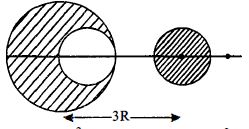
Volume of removed sphere\({V_{remo}} = \frac{4}{3}\pi {\left( {\frac{R}{2}} \right)^3} = \frac{4}{3}\pi {R^3}\left( {\frac{1}{8}} \right)\)
Volume of the sphere (remaining)
\({V_{remain}} = \frac{4}{3}\pi {R^3} - \frac{4}{3}\pi {R^3}\left( {\frac{1}{8}} \right)\)
\( = \frac{4}{3}\pi {R^3}\left( {\frac{7}{8}} \right)\)
Therefore mass of sphere carved and remaining sphere are at respectively \(\frac{1}{8}\,M\,and\,\frac{7}{8}\,M.\)
Therefore, gravitational force between these two sphere
\(F = \frac{{GMm}}{{{r^2}}}\)
\( = \frac{{G\frac{{7M}}{8} \times \frac{1}{8}M}}{{{{\left( {3R} \right)}^2}}} = \frac{7}{{64 \times 9}}\frac{{G{M^2}}}{{{R^2}}}\)
\( = \frac{{41}}{{3600}}\frac{{G{M^2}}}{{{R^2}}}\)
-
- (A) \(\sqrt {2\sqrt 2 \frac{{GM}}{R}} \;\;\;\;\;\;\;\;\;\;\;\;\;\;\)
- (B) \(\;\sqrt {\frac{{GM}}{R}\left( {1 + 2\sqrt 2 } \right)} \)
- (C) \(\frac{1}{2}\sqrt {\frac{{GM}}{R}\left( {1 + 2\sqrt 2 } \right)} \)
- (D) \(\;\sqrt {\frac{{GM}}{R}} \)
જવાબ અને ઉકેલ જુઓ
સાચો જવાબ: (C)
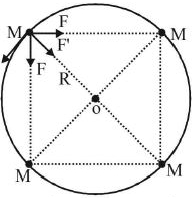
\(2F\cos {45^{ \circ}} + F' = \frac{{M{v^2}}}{R}\,\,\,\,\left( {From\,figure} \right)\)\(where\,F = \frac{{G{M^2}}}{{{{\left( {\sqrt 2 R} \right)}^2}}}\,and\,F' = \frac{{G{M^2}}}{{4{R^2}}}\)
\( \Rightarrow \frac{{2 \times G{M^2}}}{{\sqrt 2 {{\left( {R\sqrt 2 } \right)}^2}}} + \frac{{G{M^2}}}{{4{R^2}}} = \frac{{M{v^2}}}{R}\)
\( \Rightarrow \frac{{G{M^2}}}{R}\left[ {\frac{1}{4} + \frac{1}{{\sqrt 2 }}} \right] = M{v^2}\)
\(\therefore \,v = \sqrt {\frac{{Gm}}{R}\left( {\frac{{\sqrt 2 + 4}}{{4\sqrt 2 }}} \right)} = \frac{1}{2}\sqrt {\frac{{Gm}}{R}\left( {1 + 2\sqrt 2 } \right)} \)
-
- (A) \(\frac{u}{{12}}\left( {\hat i\, + \,\sqrt 3 \hat j} \right)\)
- (B) \(\frac{u}{{12}}\left( {\hat i\, - \,\sqrt 3 \hat j} \right)\)
- (C) \(\frac{u}{{12}}\left( {-\hat i\, + \,\sqrt 3 \hat j} \right)\)
- (D) \(\frac{u}{{12}}\left( {-\hat i\, - \,\sqrt 3 \hat j} \right)\)
જવાબ અને ઉકેલ જુઓ
સાચો જવાબ: (D)
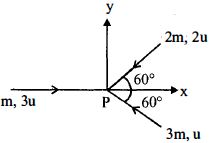
From the law of consevation of momentum we know that,\(\begin{array}{l}
{m_1}{u_1} + {m_2}{u_2} + ...... = {m_1}{v_1} + {m_2}{v_2} + ....\\
Given\,{m_1}\, = \,m,{m_2} = 2m\,and\,{m_3} = 3m\\
and\,{u_1} = 3u,\,{u_2} = 2u\,and\,{u_3} = u
\end{array}\)Let the velocity when the stick \(= \overrightarrow v \)
Then, according to question,
\(\begin{array}{l}
m \times 3u\left( i \right) + 2m \times 2u\left( { - \hat i\cos {{60}^ \circ } - \hat j\sin {{60}^ \circ }} \right)\\
+ 3\,m \times u\left( { - \hat i\cos {{60}^ \circ } + \hat j\sin {{60}^ \circ }} \right)\\
= \left( {m + 2m + 3m} \right)\,\overrightarrow v \\
\Rightarrow \,3mu\hat i - 4mu\frac{{\hat i}}{2} - 4mu\left( {\frac{{\sqrt 3 }}{2}\hat j} \right) - 3mu\frac{{\hat i}}{2}\\
\,\,\,\,\,\,\,\,\,\,\,\,\,\,\,\,\,\,\,\,\,\,\,\,\,\,\,\,\,\,\,\,\,\,\,\,\,\, + 3mu\left( {\frac{{\sqrt 3 }}{2}\hat j} \right) = 6m\,\overrightarrow v \\
\Rightarrow \,mu\hat i\, - \frac{3}{2}mu\hat i - \frac{{\sqrt 3 }}{2}mu\hat j = 6m\,\overrightarrow v \\
\Rightarrow \frac{1}{2}mu\hat i - \frac{{\sqrt 3 }}{2}mu\hat j = 6m\,\overrightarrow v \\
\Rightarrow \,\overrightarrow v = \frac{u}{{12}}\,\left( { - \hat i - \sqrt 3 \hat j} \right)
\end{array}\)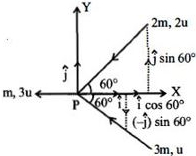
-
- (A) \(\frac{{{n^2}}}{{2n - 1}}\)
- (B) \(\frac{{2{n^2}}}{{n - 1}}\)
- (C) અનંત
- (D) \(n\)
જવાબ અને ઉકેલ જુઓ
સાચો જવાબ: (A)
\(\begin{array}{l}
\left( a \right)\,\,\,\,\,\,Let\,u\,be\,the\,initial\,velocity\,of\,the\,bullet\,of\,\\
\,\,\,\,\,\,\,\,\,\,\,\,mass\,m.\\
\,\,\,\,\,\,\,\,\,\,\,\,After{\rm{ passing}}\,through\,a\,plank\,of\,width\,x,\\
\,\,\,\,\,\,\,\,\,\,\,\,its\,velocity\,decreases\,to\,v.\\
\,\,\,\,\,\,\,\,\,\,\,\,\therefore \,u - v = \frac{4}{n}\,{\kern 1pt} or,\,v = u - \frac{4}{n} = \frac{{u\left( {n - 1} \right)}}{n}\\
\,\,\,\,\,\,\,\,\,\,\,\,\,IfF\,be\,the\,retarding\,force\,applied\,d\,by\,each\,\\
\,\,\,\,\,\,\,\,\,\,\,\,\,plank,\,then\,{\rm{ using}}\,work\, - \,energy\,theorem,\\
Fx = \frac{1}{2}m{u^2} - \frac{1}{2}m{v^2} = \frac{1}{2}m{u^2} - \frac{1}{2}m{u^2}\frac{{\left( {n - {1^2}} \right)}}{{{n^2}}}\\
\,\,\,\,\,\,\,\,\,\,\,\,\,\,\, = \frac{1}{2}m{u^2}\left[ {\frac{{1 - \left( {n - {1^2}} \right)}}{{{n^2}}}} \right]
\end{array}\)\(\begin{array}{l}
Fx = \frac{1}{2}m{u^2}\left( {\frac{{2n - 1}}{{{n^2}}}} \right)\\
Let\,P\,be\,the\,number\,of\,planks\,required\,to\,\\
stope\,the\,bullet.\\
Total\,{\rm{distance}}\,travelled\,by\,the\,bullet\,be\,fore\\
{\rm{ coming}}\,torest = Px\\
{\rm{Using}}\,{\rm{work - energy}}\,{\rm{theorem}}\,{\rm{aging,}}\\
F\left( {Px} \right) = \frac{1}{2}m{u^2} - 0\\
or,\,P\left( {Fx} \right) = P\left[ {\frac{1}{2}m{u^2}\frac{{\left( {2n - 1} \right)}}{{{n^2}}}} \right] = \frac{1}{2}m{u^2}\\
\therefore \,P = \,\frac{{{n^2}}}{{2n - 1}}\,
\end{array}\) -
- (A) \(\frac {1}{2}\,mv^2\)
- (B) \(mv^2\)
- (C) \(\frac {1}{3}\,mv^2\)
- (D) \(\frac {1}{6}\,mv^2\)
જવાબ અને ઉકેલ જુઓ
સાચો જવાબ: (D)
We can find the effective mass of the spring by finding its kinetic energy. This requires adding all the length elements' kinetic energy, and requires the following integral:\(T=\int_{m} \frac{1}{2} u^{2} d m\)
since the spring is uniform, \(d m=\left(\frac{d y}{L}\right) m,\) where \(L\) is the length of the spring. Hence,
\(T =\int_{0}^{L} \frac{1}{2} u^{2}\left(\frac{d y}{L}\right) m\)
\(=\frac{1}{2} \frac{m}{L} \int_{0}^{L} u^{2} d y\)
The velocity of each mass element of the spring is directly proportional to its length, i.e.
\(u=\frac{v y}{L},\) from which it follows\(:\)
\({T=\frac{1}{2} \frac{m}{L} \int_{0}^{L}\left(\frac{v y}{L}\right)^{2} d y}\)
\({=\frac{1}{2} \frac{m}{L^{3}} v^{2} \int_{0}^{L} y^{2} d y}\)
\({=\frac{1}{2} \frac{m}{L^{3}} v^{2}\left[\frac{y^{3}}{3}\right]_{0}^{L}}\)
\({=\frac{1}{2} \frac{m}{3} v^{2}}\)
-
- (A) \(\frac{1}{2}\left( {a{L^2} + b{L^3}} \right)\)
- (B) \(\;\frac{{a{L^2}}}{2} + \frac{{b{L^3}}}{3}\)
- (C) \(\;\frac{1}{2}\) \(\left( {\frac{{a{L^2}}}{2} + \frac{{b{L^3}}}{3}} \right)\)
- (D) \(\;a{L^2} + b{L^3}\)
જવાબ અને ઉકેલ જુઓ
સાચો જવાબ: (B)
Work done in stretching the \(rubber-band\) by a distance \(dx\) is\(dW =F dx =\) \(\left( {ax + b{x^2}} \right)dx\)
Integrating both sides,
\(W = \int\limits_0^L {axdx} \, + \,\int\limits_0^L {b{x^2}\,dx = \frac{{a{L^2}}}{2}} + \frac{{b{L^3}}}{3}\)
-
- (A) \(1.73\)
- (B) \(3.0\)
- (C) \(3.46\)
- (D) \(6.0\)
જવાબ અને ઉકેલ જુઓ
સાચો જવાબ: (B)
\(\begin{array}{l}
Given\,:\,m = 0.160kg\\
\theta = {60^ \circ }\\
V = 10\,m/s\\
Angular\,momentu\,m\,L = \vec r \times m\,\vec V\\
= H\,mv\,\cos \theta \\
= \,mv\frac{{{V^2}{{\sin }^2}\theta }}{{2g}}\cos \theta \,\,\,\left[ {H = \frac{{{V^2}{{\sin }^2}\theta }}{{2g}}} \right]\\
= \frac{{{{10}^2} \times {{\sin }^2}{{60}^ \circ } \times \cos {{60}^ \circ }}}{{2 \times 10}} \times \left( {0.16 \times 10} \right)\\
= 3\,kg\,{m^2}/s
\end{array}\) -
- (A) \(\sin \,\phi = \,\cos \,\phi \)
- (B) \(\sin \,\phi = \frac{1}{2}\,\cos \,\theta \)
- (C) \(\sin \,\phi = \frac{2}{3}\,\cos \,\theta \)
- (D) \(\sin \,\phi = \frac{3}{4}\,\cos \,\theta \)
જવાબ અને ઉકેલ જુઓ
સાચો જવાબ: (C)
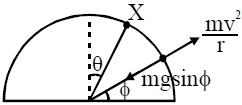
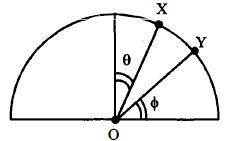
\(\frac{\mathrm{mv}^{2}}{\mathrm{r}}=\mathrm{mg} \sin \phi\) \(...(i)\)\(\mathrm{mg} \mathrm{r} \cos \theta=\frac{1}{2} \mathrm{mv}^{2}+\mathrm{rg} \sin \phi\)
\(\frac{\mathrm{v}^{2}}{\mathrm{rg}}=2 \cos \theta-2 \sin \phi \ldots \ldots(\mathrm{ii})\)
\(\sin \phi=2 \cos \theta-2 \sin \phi\)
\(3 \sin \phi=2 \cos \theta\)
\(\sin \phi=\frac{2}{3} \cos \phi\)
-
- (A) \(1.0\)
- (B) \(4.2\)
- (C) \(6.1\)
- (D) \(9.8\)
જવાબ અને ઉકેલ જુઓ
સાચો જવાબ: (C)
\(\begin{array}{l}
Let\,'t'\,be\,the\,\,time\,taken\,by\,the\,bullet\,\,to\,hit\,the\,{\rm{target}}{\rm{.}}\\
\therefore \,{\rm{700 = }}\,{\rm{m = 63}}{{\rm{0}}^{ - 1}}t\\
\Rightarrow t = \frac{{700m}}{{630m{s^{ - 1}}}} = \frac{{10}}{9}\sec \\
For\,velrtical\,motion,\\
Here,\,u = 0\\
\therefore \,h = \frac{1}{2}g{t^2}
\end{array}\)\(\begin{array}{l}
= \frac{1}{2} \times 10 \times {\left( {\frac{{10}}{9}} \right)^2}\\
= \frac{{500}}{{81}}m = 6.17\,m\\
Therefore,\,the\,rifle\,must\,be\,{\rm{aimed}}\,{\rm{6}}{\rm{.17}}\,{\rm{m}}\,{\rm{above}}\,{\rm{the}}\,{\rm{center}}\,{\rm{of}}\,{\rm{the}}\,\\
{\rm{target}}\,{\rm{to}}\,{\rm{hit}}\,{\rm{the}}\,{\rm{target}}{\rm{.}}\,
\end{array}\) -
- (A) \({\tan ^{ - 1}}\frac{2}{3}\)
- (B) \({\tan ^{ - 1}}\frac{3}{2}\)
- (C) \({\tan ^{ - 1}}\frac{7}{4}\)
- (D) \({\tan ^{ - 1}}\frac{4}{5}\)
જવાબ અને ઉકેલ જુઓ
સાચો જવાબ: (C)
\(\begin{array}{l}
\,\,\,\,\,\,\,\,\,From\,question,\\
\,\,\,\,\,\,\,\,\,Horizontal\,velocity\,\left( {initial} \right),\\
\,\,\,\,\,\,\,\,\,{u_x} = \frac{{40}}{2} = 20m/s\\
\,\,\,\,\,\,\,\,\,Vertical\,velocity\,\left( {initial} \right),\\
\,\,\,\,\,\,\,\,\,\,50 = {u_y}t + \frac{1}{2}g{t^2}\\
\Rightarrow \,{u_y} \times 2 + \frac{1}{2}\left( { - 10} \right) \times 4\\
or,\,50 = 2{u_y} - 20
\end{array}\)\(\begin{array}{l}
or,\,\,{u_y} = \frac{{70}}{2} = 35m/s\\
\therefore \,\tan \,\theta = \frac{{{u_y}}}{{{u_x}}} = \frac{{35}}{{20}} = \frac{7}{4}\\
\Rightarrow \,\,Angle\,\theta {\tan ^{ - 1}}\frac{7}{4}
\end{array}\) -
- (A) \(gH=(n-2)^2u^2\)
- (B) \(2gH=nu^2(n-2)\)
- (C) \(gH=(n-2)u^2\)
- (D) \(2gH=n^2u^2\)
જવાબ અને ઉકેલ જુઓ
સાચો જવાબ: (B)
\(\begin{array}{l}
Speed\,on\,reaching\,ground\,v = \sqrt {{u^2} + 2gh} \\
Now,\,v = u + at\\
\Rightarrow \,\,\,\,\sqrt {{u^2} + 2gh} = - u + gt\\
Time\,taken\,to\,reach\,highest\,{\rm{point}}\,is\,t = \frac{u}{g},\\
\Rightarrow t = \frac{{u + \sqrt {{u^2} + 2gH} }}{g} = \frac{{nu}}{g}\left( {from\,question} \right)\\
\Rightarrow 2gH = n\left( {n - 2} \right){u^2}
\end{array}\)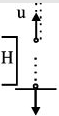
-
- (A) \(3.75\)
- (B) \(8.6\)
- (C) \(9.6\)
- (D) \(6.5\)
જવાબ અને ઉકેલ જુઓ
સાચો જવાબ: (B)
From \(Newton's\,law\) of cooling,\(t = \frac{1}{k}{\log _e}\left( {\frac{{{\theta _2} - {\theta _0}}}{{{\theta _1} - {\theta _0}}}} \right)\)
From question and above equation,
\(5 = \frac{1}{k}{\log _e}\frac{{\left( {40 - 30} \right)}}{{\left( {80 - 130} \right)}}\,\,\,\,\,\,\,\,\,\,\,\,\,\,...\left( 1 \right)\)
\(And,t = \frac{1}{k}{\log _e}\frac{{\left( {32 - 30} \right)}}{{\left( {62 - 30} \right)}}\,\,\,\,\,\,\,\,\,\,\,\,\,\,\,\,...\left( 2 \right)\)
Dividing equation \((2)\) by \((1)\),
\(\frac{t}{5} = \frac{{\frac{1}{k}{{\log }_e}\frac{{\left( {32 - 30} \right)}}{{\left( {62 - 30} \right)}}}}{{\frac{1}{k}{{\log }_e}\frac{{\left( {40 - 30} \right)}}{{\left( {80 - 30} \right)}}}}\)
On solving we get, time taken to cool down from \({62^ \circ }C\,to\,{32^ \circ }C,\)
\(t=8.6\,minutes.\)
-
- (A) \(25\)
- (B) \(10\)
- (C) \(15\)
- (D) \(20\)
જવાબ અને ઉકેલ જુઓ
સાચો જવાબ: (B)
By \(Newton's\,law\) of cooling
\(\frac{{{\theta _1} - {\theta _2}}}{t} = - K\left[ {\frac{{{\theta _1} + {\theta _2}}}{2} - {\theta _0}} \right]\)
where \({\theta _0}\) is the temperature of surrounding. Now, hot water cools from \({60^ \circ }C\,to\,{50^ \circ }C\) in \(10\,minutes,\)
\(\frac{{60 - 50}}{{10}} = - K\left[ {\frac{{60 + 50}}{2}{\theta _0}} \right]\,\,\,\,\,\,\,\,\,\,...\left( i \right)\)
Agian, it cools from \({50^ \circ }C\,to\,{42^ \circ }C\) in next \(10\,minutes.\)
\(\frac{{50 - 42}}{{10}} = - K\left[ {\frac{{50 + 42}}{2} - {\theta _0}} \right]\,\,\,\,\,\,\,\,\,\,...\left( {ii} \right)\)
Dividing equations \((i)\) by \((ii)\) we get
\(\frac{1}{{0.8}} = \frac{{55 - {\theta _0}}}{{46 - {\theta _0}}}\)
\(\frac{{10}}{8} = \frac{{55 - {\theta _0}}}{{46 - {\theta _0}}}\)
\(460 - 10{\theta _0} = 440 - 8{\theta _0}\)
\(2{\theta _0} = 20\)
\({\theta _0} = {10^ \circ }c\)
-
- (A) \(2.4\)
- (B) \(4.8 \)
- (C) \(6.0\)
- (D) \(1.2\)
જવાબ અને ઉકેલ જુઓ
સાચો જવાબ: (B)
Rate of heat flow is given by,\(Q = \frac{{KA\left( {{\theta _1} - {\theta _2}} \right)}}{l}\)
Where, \(K=coefficient\,of\,thermal\,conductivity\)
\(l=length\,of\,rod\,and\,A=Area\,of\,cross-section\,of\,rod\)
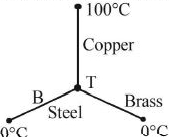
If the junction temperature is \(T\), then
\({Q_{Copper}} = {Q_{Brass}} + {Q_{Steel}}\)
\(\frac{{0.92 \times 4\left( {100 - T} \right)}}{{46}} = \frac{{0.26 \times 4 \times \left( {T - 0} \right)}}{{13}} + \)
\(\frac{{0.12 \times4\times \left( {T - 0} \right)}}{{12}}\)
\( \Rightarrow 200 - 2T = 2T + T\)
\( \Rightarrow T = {40^ \circ }C\)
\(\therefore \,\,{Q_{Copper}} = \frac{{0.92 \times 4 \times 60}}{{46}} = 4.8\,cal/s\)
-
- (A) \(\frac{{M\alpha }}{{4\pi {R^2}\sigma }}\,\ln \left( {\frac{3}{2}} \right)\)
- (B) \(\frac{{M\alpha }}{{4\pi {R^2}\sigma }}\,\ln \left( {\frac{16}{3}} \right)\)
- (C) \(\frac{{M\alpha }}{{16\pi {R^2}\sigma }}\,\ln \left( {\frac{16}{3}} \right)\)
- (D) \(\frac{{M\alpha }}{{16\pi {R^2}\sigma }}\,\ln \left( {\frac{3}{2}} \right)\)
જવાબ અને ઉકેલ જુઓ
સાચો જવાબ: (C)
In the given problem, fall in temperature of sphere,\(dT = \left( {3{T_0} - 2{T_0}} \right) = {T_0}\)
Tmperature of surrounding, \({T_{surr}} = {T_0}\)
Initial temperature of sphere, \({T_{initial}} = 3{T_0}\)
Specific heat of the material of the sphere varies as,
\(c = \alpha {T^3}\,per\,unit\,mass\,\left( {\alpha = a\,constant} \right)\)
Applying formula,
\(\frac{{dT}}{{dt}} = \frac{{\sigma A}}{{McJ}}\left( {{T^4} - T_{surr}^4} \right)\)
\( \Rightarrow \frac{{{T_0}}}{{dt}} = \frac{{\sigma 4\pi {R^2}}}{{M\alpha {{\left( {3{T_0}} \right)}^3}\,J}}\left[ {{{\left( {3{T_0}} \right)}^4} - {{\left( {{T_0}} \right)}^4}} \right]\)
\( \Rightarrow dt = \frac{{M\alpha 27T_0^4J}}{{\alpha 4\pi {R^2} \times 80T_0^4}}\)
Solving we get,
Time taken for the sphere to cool down temperature \(2{T_{{0^,}}}\)
\(t = \frac{{M\alpha }}{{16\pi {R^2}\sigma }}In\left( {\frac{{16}}{3}} \right)\)
આ પેજ પર આ ફિલ્ટર મુજબ કોઈ પ્રશ્ન નથી.