


પ્રશ્નો
9 પ્રશ્નો9 માંથી 1–9 પ્રશ્નો
-
- (A) \(\frac{16}{9}\)
- (B) \(\frac{4}{3}\)
- (C) \(\frac{7}{1}\)
- (D) \(\frac{49}{1}\)
જવાબ અને ઉકેલ જુઓ
સાચો જવાબ: (D)
Intensity \(\propto\) (amplitude) \(^{2}\)\(\frac{I_{1}}{I_{2}}=\frac{16}{9}=\frac{a_{1}^{2}}{a_{2}^{2}}\)
\(\Rightarrow a_{1}=4 ; a_{2}=3\)
Therefore the ratio of intensities of bright and dark parts
\(\frac{{{I_{{\text{Bright }}}}}}{{{I_{{\text{Dark }}}}}} = \frac{{{{\left( {{a_1} + {a_2}} \right)}^2}}}{{{{\left( {{a_1} - {a_2}} \right)}^2}}}\) \( = \frac{{{{(4 + 3)}^2}}}{{{{(4 - 3)}^2}}} = \frac{{49}}{1}\)
-
- (A) \(I\, = \,\frac{{2n\lambda }}{{\sqrt 3 - 1}}\)
- (B) \(I\, = \,\frac{{(2n - 1)\lambda }}{{2(\sqrt 3 - 1)}}\)
- (C) \(I\, = \,\frac{{(2n - 1\,\lambda )\sqrt 3 }}{{4(2 - \sqrt 3 )}}\)
- (D) \(I\, = \,\frac{{(2n - 1)\lambda }}{{\sqrt 3 - 1}}\)
જવાબ અને ઉકેલ જુઓ
સાચો જવાબ: (C)
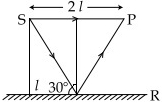
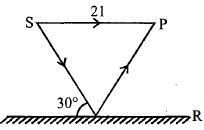
From the figure straight path \(\mathrm{SP}=2 l\)Reflected path \(\mathrm{SP}=2 l\) sec \(30^{\circ}\)
So path difference is \(2 l\left(\sec 30^{\circ}-1\right)\)
Also the ray, when reflected by the mirror, suffers a phase change of \(\pi\)
So the total difference in phase is \(2 l\left(\sec 30^{\circ}-1\right) \times \frac{2 \pi}{\lambda}+\pi\)
For constructive interference
\(2 l\left(\sec 30^{\circ}-1\right) \times \frac{2 \pi}{\lambda}+\pi=2 n \pi\)
Solving this, we get \(l=\frac{(2 n-1) \lambda \sqrt{3}}{4(2-\sqrt{3})}\)
-
- (A) \(0.2\)
- (B) \(0.4\)
- (C) \(0.8\)
- (D) \(0.9\)
જવાબ અને ઉકેલ જુઓ
સાચો જવાબ: (C)
Here, \(\sin \theta_{i c} / \sin \theta_{i B}=1.28\)As we know,
\(\mu=\frac{\sin \theta_{\mathrm{iB}}}{\sin \left(\frac{\pi}{2}-\theta_{\mathrm{iB}}\right)}\)
where, \(\theta_{\mathrm{iB}}\) is Brewster's angle of incidence,
And, \(\mu=\frac{1}{\sin \theta_{\text {ic }}}\)
Onsolving we get, relative refractive index of the two media.
-
- (A) \(( 1 )-(i), (2)-(ii), (3)-(iii), ( 4 )-(iv)\)
- (B) \((1 )-(ii), (2)-(i), (3)-(iv), ( 4)-(iii)\)
- (C) \((1)-(i), (2)-(ii), (3)-(iv), (4)-(iii)\)
- (D) \((1 )-(ii), (2)-(i), (3)-(iii), (4)-(iv)\)
જવાબ અને ઉકેલ જુઓ
સાચો જવાબ: (A)
Rotation period of earth is about \(24\) hrs \(=\) \(10^{5} \mathrm{s}\)Revolution period of earth is about \(365\) days \(=10^{7} \mathrm{s}\)
Speed of light wave \(\mathrm{C}=3 \times 10^{8} \mathrm{m} / \mathrm{s}\)
Wavelength of visible light of spectrum \(\lambda\) \( = 4000 - 7800\,\,\mathop {\text{A}}\limits^o \)
\(\mathrm{C}=\mathrm{f} \lambda\left(\text { and } \mathrm{T}=\frac{1}{\mathrm{f}}\right)\)
Therefore period of light wave is \(10^{-15} \,\mathrm{s}\) (approx)
-
- (A) \(n\) ના ઘટતા મૂલ્ય સાથે વધે
- (B) \(\beta \) ના ઘટતા મૂલ્ય સાથે વધે
- (C) \(n\, sin\, 2\beta \) ના વધતા મૂલ્ય સાથે વધે
- (D) \(\frac{1}{{n\,\sin \,2\beta }}\) ના વધતા મૂલ્ય સાથે વધે
જવાબ અને ઉકેલ જુઓ
સાચો જવાબ: (C)
Resolving power of microscope,\(\mathrm{R.P.}=\frac{2 \mathrm{n} \sin \theta}{\lambda}\)
\(\lambda=\) Wavelength of light used to illuminate the object
\(\mathrm{n}=\) Refractiveindex of the medium between object and objective
\(\theta=\) Angle
-
- (A) \(\;\frac{3}{2}\)
- (B) \(1\)
- (C) \(\;\frac{1}{3}\)
- (D) \(3\)
જવાબ અને ઉકેલ જુઓ
સાચો જવાબ: (C)
According to malus law, intensity of emerging beam is given by,\(I=I_{0} \cos ^{2} \theta\)
Now, \(I_{A^{\prime}}=I_{A} \cos ^{2} 30^o\)
\(I_{B^{\prime}}=I_{B} \cos ^{2} 60^o\)
As \(I_{A^{\prime}}=I_{B^{\prime}}\)
\(\Rightarrow \quad I_{A} \times \frac{3}{4}=I_{B} \times \frac{1}{4}\) \(\therefore \quad \frac{I_{A}}{I_{B}}=\frac{1}{3}\)
-
- (A) \(3300\)
- (B) \(4400\)
- (C) \(5500\)
- (D) \(6600\)
જવાબ અને ઉકેલ જુઓ
સાચો જવાબ: (B)
In a single slit experiment, For diffraction maxima,\(a\sin \theta = \left( {2n + 1\frac{\lambda }{2}} \right)\)
and for diffraction minima,
\(a \sin \theta=n \lambda\)
According to question,
\(\left(2 \times 1+1 \frac{\lambda}{2}\right)=1 \times 6600\)
\(\left( {\because {\lambda _{\text{R}}} = 6600\,\,\mathop {\text{A}}\limits^o } \right)\)
\({\lambda = \frac{{6600 \times 2}}{3}}\)
\(\,\lambda = 4400\,\mathop {\text{A}}\limits^o \)
-
- (A) \(3\)
- (B) \(6\)
- (C) \(12\)
- (D) \(24\)
જવાબ અને ઉકેલ જુઓ
સાચો જવાબ: (C)
In diffraction, angular width of central maxima is \(\frac{2 \lambda}{b}\)where \(b\) is slit width.
In Young's double slit experiment, angular width of each fringe is \(\frac{\lambda}{d}\)
where \(d\) is the distance between the two slits.
Given: \(d=6.1 b\) So, number of maximas observed in central maxima of diffraction pattern \(n=\frac{2 \lambda}{\frac{b}{\lambda}}\)
\(\therefore n=\frac{2 d}{b}=2 \times 6.1=12.2\)
Thus 12 maximas are observed.
-
- (A) \(520\)
- (B) \(540\)
- (C) \(560\)
- (D) \(580\)
જવાબ અને ઉકેલ જુઓ
સાચો જવાબ: (B)
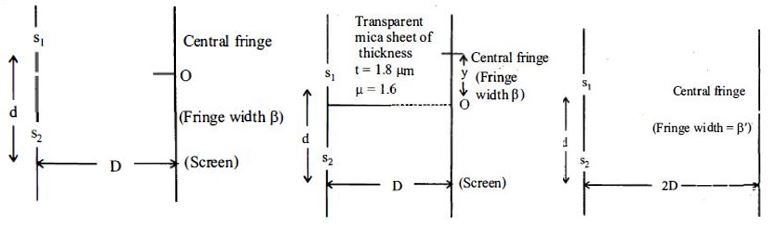
Given \(t=1.8 \times 10^{-6} \mathrm{m}\)\(\mu=1.6\)
\(\mathrm{n}=2(\text { from figure })\)
Applying formula \((\mu-1) \mathrm{t}=\mathrm{n} \lambda\)
\((1.6-1) \times 1.8 \times 10^{-6}=2 \lambda\)
or, \({\lambda = \frac{{1.8 \times {{10}^{ - 6}} \times 0.6}}{2}}\)
\(=\,540 \,\mathrm{nm}\)
આ પેજ પર આ ફિલ્ટર મુજબ કોઈ પ્રશ્ન નથી.