


Chapters asked in 2014
30 chapters- 4Qs STD 11 Units, dimensions and measurement
- 5Qs STD 12 Semicondutor electronics
- 4Qs STD 12 Nuclei
- 4Qs STD 12 Atoms
- 3Qs STD 12 Dual nature of radiation and matter
- 6Qs STD 12 Electromagnetic waves
- 9Qs STD 12 Wave optics Most asked
- 6Qs STD 12 Ray optics and optical instruments
- 2Qs STD 12 Alternating current
- 12Qs STD 11 System of particles and rotational motion Most asked
- 5Qs STD 12 Moving charges and magnetism
- 3Qs STD 12 Electromagnetic induction
- 5Qs STD 12 Magnetism and matter
- 6Qs STD 12 Current electricity
- 5Qs STD 12 Electric potential and capacitance
- 4Qs STD 12 Electric charges and fields
- 4Qs STD 11 Waves and sound
- 6Qs STD 11 Oscillations
- 4Qs STD 11 Kinetic theory of gases
- 5Qs STD 11 Thermodynamics
- 1Qs STD 11 10.1, thermonetry, thermal expansion and calorimetry
- 3Qs STD 11 Mechanical properties of solids
- 4Qs STD 11 Surface tension
- 7Qs STD 11 Fluid mechanics Most asked
- 2Qs STD 11 Newtons laws of motion
- 5Qs STD 11 Gravitation
- 4Qs STD 11 Work, energy, power and collision
- 4Qs STD 11 Motion in plane
- 1Qs STD 11 Motion in straight line
- 4Qs STD 11 Transmission of heat
All JEE Mains 2014 Physics questions
30 chaptersShowing 1–50 of 137 questions
- 1. A student measured the length of a rod and wrote it as \(3.50\;cm\). Which instrument did he use to measure it? 2014 Medium
- (A) A vernier calliper where the \(10\) divisions in vernier scale matches with \(9\) division in main scale and main scale has \(10\) divisions in \(1\; cm\).
- (B) A screw gauge having \(100\) divisions in the circular scale and pitch as \(1\; mm.\)
- (C) A screw gauge having \(50\) divisions in the circular scale and pitch as \(1\; mm.\)
- (D) A meter scale.
Show answer and solution
Correct Answer: (A)
If student measures \(3.50 \mathrm{cm},\) it means that there is an uncertainly of order \(0.01 \mathrm{cm} .\)For vernier scale with \(1 \mathrm{MSD}=\frac{1}{10} \mathrm{cm}\) and \(9 \mathrm{MSD}=10 \mathrm{VSD}\)
\(LC\) of vernier calliper \(=1 \mathrm{MSD}-1 \mathrm{VSD}\)
\(=\frac{1}{10}\left(1-\frac{9}{10}\right)=\frac{1}{100} \mathrm{cm}=0.01 \mathrm{cm}\)
-
- (A) \(1.7\)
- (B) \(2.7\)
- (C) \(4.4\)
- (D) \(2.27\)
Show answer and solution
Correct Answer: (B)
Here, \(T=2 \pi \sqrt{\frac{L}{g}}\) or \(T^{2}=4 \pi^{2}(L / g)\)So, \(g=\frac{4 \pi^{2} L}{T^{2}}\)
Thus, \(\frac{\Delta g}{g}=\frac{\Delta L}{L}+2 \frac{\Delta T}{T}\)
% error in \(g=\frac{\Delta g}{g} \times 100\)
\(=\left(\frac{\Delta L}{L}+2 \frac{\Delta T}{T}\right) \times 100\)
\(=\left(\frac{(1 / 10)}{20}+2 \times \frac{1}{90}\right) \times 100=2.72 \%\)
-
- (A) \(\frac{{ch}}{{2\pi \varepsilon _0^2}}\)
- (B) \(\frac{{{e^2}}}{{2\pi {\varepsilon _0}Gm_e^2}}\)
- (C) \(\frac{{{\mu _0}{\varepsilon _0}G}}{{{c^2}h{e^2}}}\)
- (D) \(\frac{{2\pi \sqrt {{\mu _0}{\varepsilon _0}} h}}{{c{e^2}G}}\)
Show answer and solution
Correct Answer: (B)
\(\begin{array}{l}
The\,{\rm{Dimensional}}\,{\rm{formulae}}\,{\rm{of}}\\
{\rm{e}}\,{\rm{ = }}\left[ {{M^0}{L^0}{T^1}{A^1}} \right]\\
{\varepsilon _0} = \left[ {{M^{ - 1}}{L^{-3}}{T^4}{A^2}} \right]\\
G = \left[ {{M^{ - 1}}{L^3}{T^{ - 2}}} \right]\\
and\,{m_e} = \left[ {{M^1}{L^0}{T^0}} \right]\\
Now,\frac{{{e^2}}}{{2\pi {\varepsilon _0}Gm_e^2}}
\end{array}\)\(\begin{array}{l}
= \frac{{{{\left[ {{M^0}{L^0}{T^1}{A^1}} \right]}^2}}}{{2\pi \left[ {{M^{ - 1}}{L^{ - 3}}{T^4}{A^2}} \right]\left[ {{M^{ - 1}}{L^3}{T^{ - 2}}} \right]{{\left[ {{M^1}{L^0}{T^o}} \right]}^2}}}\\
= \frac{{\left[ {{T^2}{A^2}} \right]}}{{2\pi \left[ {{M^{ - 1 - 1 + 2}}{L^{ - 3 + 3}}{T^{4 - 2}}{A^2}} \right]}}\\
= \frac{{\left[ {{T^2}{A^2}} \right]}}{{2\pi \left[ {{M^0}{L^0}{T^2}{A^2}} \right]}} = \frac{1}{{2\pi }}
\end{array}\)\(\begin{array}{l}
\frac{1}{{2\pi }}\,is\,{\rm{Dimensionl}}ess\,thus\,the\,combination\\
\frac{{{e^2}}}{{2\pi {\varepsilon _0}Gm_e^2}}\end{array}\)would d have the same value in diffierent systems of units
-
- (A) \(\left[ {R{T^{ - 2}}} \right]\)
- (B) \(\left[ {{R^2}{T^{ - 1}}} \right]\)
- (C) \(\left[ {{R^2}} \right]\)
- (D) \(\left[ {{R^2}{T^2}} \right]\)
Show answer and solution
Correct Answer: (C)
\(\begin{array}{l}
{\rm{dimensions of}}\,\mu = \left[ {ML{T^{ - 2}}{A^{ - 2}}} \right]\\
{\rm{dimensions of}}\, \in \, = \,\left[ {{M^{ - 1}}{L^{ - 3}}{T^4}{A^2}} \right]\\
{\rm{dimensions of}}\,R\, = \left[ {M{L^2}{T^{ - 3}}{A^{ - 2}}} \right]\\
\therefore \frac{{{\rm{dimensions of}}\,\mu }}{{{\rm{dimensions of}}\, \in }} = \left[ {\frac{{ML{T^{ - 2}}{A^{ - 2}}}}{{{M^{ - 1}}{L^{ - 3}}{T^4}{A^2}}}} \right]\\
= \left[ {{M^2}{L^4}{T^{-6}}{A^{ - 4}}} \right] = \left[ {{R^2}} \right]
\end{array}\) -
- (A) \(15\,mA, 5\,mA, 10\, mA\)
- (B) \(15\,mA, 7.5\,mA, 7.5\, mA\)
- (C) \(12.5\,mA, 5\,mA, 7.5\, mA\)
- (D) \(12.5\,mA, 7.5\,mA, 5\, mA\)
Show answer and solution
Correct Answer: (D)
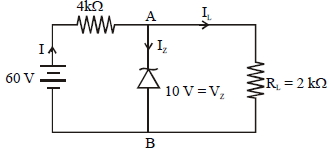
Here, \(R=4 \mathrm{k} \Omega=4 \times 10^{3} \Omega\)\(V_{i}=60 \mathrm{V}\)
Zener voltage \(V_{z}=10 \mathrm{V}\) \(R_{L}=2 \mathrm{k} \Omega=2 \times 10^{3} \Omega\)
Load current, \(I_{\mathrm{L}}=\frac{V_{Z}}{R_{L}}=\frac{10}{2 \times 10^{3}}=5 \mathrm{\,mA}\)
Current through \(R, I=\frac{V_{i}-V_{Z}}{R}\)
\(=\frac{60-10}{4 \times 10^{3}}=\frac{50}{4 \times 10^{3}}=12.5 \mathrm{\,mA}\)
Fom circuit diagram,
\(I=I_{z}+I_{L}\)
\(\Rightarrow 12.5=I_{z}+5\)
\(\Rightarrow I_Z\,=\,12.5-5\,=\,7.5\,mA\)
-
- (A) Emitter, base and collector
- (B) Base, emitter and collector
- (C) Base, collector and emitter
- (D) Collector, emitter and base
Show answer and solution
Correct Answer: (C)
In the given question, \(A\), \(B\) and \(C\) refer base, collector and emitter respectively -
- (A) \(AND\) Gate
- (B) \(OR\) Gate
- (C) \(XOR\) Gate
- (D) \(NOR\) Gate
Show answer and solution
Correct Answer: (A)
\(AND\) Gate -
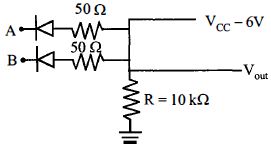
- (A) \(AND\, (A = 1, B = 1, Y = 1)\)
- (B) \(OR\,(A = 1 , B = 1, Y = 0)\)
- (C) \(NOT\, (A = 1, B= 1 , Y = 1)\)
- (D) \(XOR\, (A= 0, B = 0, Y = 0)\)
Show answer and solution
Correct Answer: (A)
\(Y\,=\,\overline{AB}.\overline{AB}=\,\overline{\overline{AB}}\,+\,\overline{\overline{AB}\,}=\,AB\,+\,AB\,=\,AB\)In this case output \(Y\) is equivalent to \(AND\) gate.

-
- (A) \(0.02\)
- (B) \(0.5\)
- (C) \(0.05\)
- (D) \(0.2\)
Show answer and solution
Correct Answer: (D)
The current voltage relation of diode is\(I=\left(e^{1000 V / T}-1\right) \mathrm{mA}(\text { given })\)
When, \(I=5 m A, e^{1000 V / T}=6 m A\)
Also, \(d I=\left(e^{1000\, v / T}\right) \times \frac{1000}{T}\)
(By exponential function)
\(=(6\, m A) \times \frac{1000}{300} \times(0.01)\)
\(=0.2\, \mathrm{mA}\)
-
- (A) \(1672\)
- (B) \(2391\)
- (C) \(3291\)
- (D) \(4453\)
Show answer and solution
Correct Answer: (B)
Given, for \(^{14} \mathrm{C}\)\(A_{0}=16\) dis \(\min ^{-1} g^{-1}\)
\(A=12\) dis \(\min ^{-1} g^{-1}\)
\(\mathrm{t}_{1 / 2}=5760\) years
Now, \(\lambda = \frac{{0.693}}{{{t_{1/2}}}}\)
\(\lambda=\frac{0.693}{5760}\) per year
Then, from, \(t=\frac{2.303}{\lambda} \log _{10} \frac{\mathrm{A}_{0}}{\mathrm{A}}\)
\(=\frac{2.303 \times 5760}{0.693} \log _{10} \frac{16}{12}\)
\( = \frac{{2.303 \times 5760}}{{0.693}}{\log _{10}}1.333\)
\( = \frac{{2.303 \times 5760 \times 0.1249}}{{0.693}}\)
\(=2390.81 \approx 2391\) years
-
- (A) \(10439\)
- (B) \(13094\)
- (C) \(19039\)
- (D) \(39049\)
Show answer and solution
Correct Answer: (C)
Given: \(\frac{\mathrm{d} \mathrm{N}_{0}}{\mathrm{dt}}=20\) decays \(/ \mathrm{mir}\)\(\frac{\mathrm{d} \mathrm{N}}{\mathrm{dt}}=2\) decays/min
\(\mathrm{T}_{1 / 2}=5730 \mathrm{years}\)
As we know,
\(\mathrm{N}=\mathrm{N}_{0} \mathrm{e}^{-\lambda t}\)
\(\log \frac{N_{0}}{N}=\lambda t\)
\(\therefore \mathrm{t}=\frac{1}{\lambda} \log \frac{\mathrm{N}_{0}}{\mathrm{N}}\)
\( = \frac{{2.303 \times {{\text{T}}_{1/2}}}}{{0.693}} \times {\text{Lo}}{{\text{g}}_{10}}\frac{{{{\text{N}}_0}}}{{\text{N}}}\)
But \(\frac{\frac{d N_{0}}{d t}}{\frac{d N}{d t}}=\frac{N_{0}}{N}=\frac{20}{2}=10\)
\(\therefore \,\,t = \frac{{2.303 \times 5730}}{{0.693}} \times 1\)
\(=19039\) years
-
- (A) \(1\,s\)
- (B) \(2\ln \left( {\frac{4}{3}} \right)s\)
- (C) \(ln\, 2\, s\)
- (D) \(\ln \left( {\frac{4}{3}} \right)s\)
Show answer and solution
Correct Answer: (B)
Let \(N\) be the number of nucleiat any time \(t\) then,\(\frac{d N}{d t}=100-\lambda N\)
or \(\int_0^N {\frac{{dN}}{{(100 - \lambda N)}}} = \int_0^t d t\)
\(-\frac{1}{\lambda}[\log (100-\lambda N)]_{0}^{N}=t\)
\(\log (100-\lambda N)-\log 100=-\lambda t\)
\(\log \frac{100-\lambda N}{100}=-\lambda t\)
\(\frac{100-\lambda N}{100}=e^{-\lambda t}\)
\(1 - \frac{{\lambda N}}{{100}} = {e^{ - \lambda t}}\)
\(N=\frac{100}{\lambda}\left(1-e^{-\lambda} t\right)\)
As, \(N=50\) and \(\lambda=0.5\,/sec\)
\(\therefore 50=\frac{100}{0.5}\left(1-e^{-0.5}\right)\)
Solving we get,
\(t=2 \ln \left(\frac{4}{3}\right) \sec\)
-
- (A) \((1)-(iv), (2)-(iii), (3)-(ii), ( 4)-(i)\)
- (B) \((1)-(iii), (2)-(iv), (3)-(i), (4)-(ii)\)
- (C) \((1)-(ii), (2)-(ii i), (3)-(iv), (4)-(i)\)
- (D) \((1)-(i), (2)-(ii), (3)-(iii), (4)-(iv)\)
Show answer and solution
Correct Answer: (D)
Vibration of atoms and molecules \(700\, nm\) to \(1\,nm\) Radioactive decay of the nucleus \( < 10^{-3}\, nm\) Magnetron valve \(1\, nm\) to \(0.1\, m\) - 14. For \(LED's\) to emit light in visible region of electromagnetic light, it should have energy band gap in the range of 2014 Medium
- (A) \(0.1\, eV\) to \(0.4\,eV\)
- (B) \(0.5\, eV\) to \(0.8\,eV\)
- (C) \(0.9\, eV\) to \(1.6\,eV\)
- (D) \(1.7\, eV\) to \(3.0\,eV\)
Show answer and solution
Correct Answer: (D)
Energy band gap range is given by,\(E_{g}=\frac{h c}{\lambda}\)
For visible region
\(\lambda=\left(4 \times 10^{-7}-7 \times 10^{-7}\right) \mathrm{m}\)
\({{E_g} = \frac{{6.6 \times {{10}^{ - 34}} \times 3 \times {{10}^8}}}{{7 \times {{10}^{ - 7}}}}}\)
\(=\frac{19.8 \times 10^{-26}}{7 \times 10^{-7}}\)
\(=\frac{2.8 \times 10^{-19}}{1.6 \times 10^{-19}}\)
\(E_{g}=1.75 \mathrm{eV}\)
-
- (A) \(λ_1 =2λ_2 =2λ_3 =λ_4\)
- (B) \(λ_1 =λ_2 =4λ_3 =9λ_4\)
- (C) \(λ_1 =2λ_2 =3λ_3 =4λ_4\)
- (D) \(4λ_1 =2λ_2 =2λ_3 =λ_4\)
Show answer and solution
Correct Answer: (B)
Wave number \(\frac{1}{\lambda}=R Z^{2}\left[\frac{1}{n_{1}^{2}}-\frac{1}{n^{2}}\right]\)\(\Rightarrow \quad \lambda \propto \frac{1}{Z^{2}}\)
By question \(n=1\) and \(n_{1}=2\)
Then, \(\lambda_{1}=\lambda_{2}=4 \lambda_{3}=9 \lambda_{4}\)
-
- (A) \((1 )-(i), (2)-(ii), (3)-(iii), (4)-(iv)\)
- (B) \((1 )-(i), (2)-(ii), (3)-(iv), ( 4)-(iii)\)
- (C) \((1)-(iii), (2)-(iv), (3)-(i), (4)-(ii)\)
- (D) \((1 )-(iv), (2-(iii), (3)-(ii), (4 )-(i)\)
Show answer and solution
Correct Answer: (B)
\((1)\) Davisson and Gemner experiment-wave nature of electrons.
\((2)\) Millikan's oil drop experiment - charge of an electron.
\((3)\) Rutherford experiment - Existance of nucleus.
\((4)\) Frank-Hertz experiment - Quantisation of energy levels. -
- (A) \(1.1\)
- (B) \(0.8\)
- (C) \(1.6 \)
- (D) \(1.8\)
Show answer and solution
Correct Answer: (A)
Radius of circular path followed by electron is given by,\(r=\frac{m v}{q B}=\frac{\sqrt{2 m e V}}{e B}=\frac{1}{B} \sqrt{\frac{2 m}{e} V}\)
\(\Rightarrow \quad V=\frac{B^{2} r^{2} e}{2 m}=0.8 \mathrm{V}\)
For transition between \(3\) to \(2\) .
\(E=13.6\left(\frac{1}{4}-\frac{1}{9}\right)=\frac{13.6 \times 5}{36}=1.88 \,eV\)
Work function \(=1.88 \mathrm{eV}-0.8 \mathrm{eV} \)
\(=1.08 \mathrm{eV} \approx 1.1 \mathrm{eV}\)
-
- (A) \(6\,\times 10^{11}\)
- (B) \(9\,\times 10^{11}\)
- (C) \(11\,\times 10^{11}\)
- (D) \(15\,\times 10^{11}\)
Show answer and solution
Correct Answer: (B)
Given, \({\lambda _1} = 4972\,\mathop {\text{A}}\limits^o \)and \({\lambda _2} = 6216\,\mathop {\text{A}}\limits^o \)
and \(I=3.6 \times 10^{-3}\, \mathrm{Wm}^{-2}\)
Intensity associated with each wavelength
\(=\frac{3.6 \times 10^{-3}}{2}=1.8 \times 10^{-3} \,\mathrm{Wm}^{-2}\)
Work function \(\phi=h v=\frac{h c}{\lambda}\)
\( = \frac{{\left( {6.62 \times {{10}^{ - 34}}} \right)\left( {3 \times {{10}^8}} \right)}}{\lambda }\)
\(=\frac{12.4 \times 10^{3}}{\lambda} \mathrm{ev}\)
for different wavelengths
\({{\phi _1} = \frac{{12.4 \times {{10}^3}}}{{{\lambda _1}}}\, = \,}\) \({\frac{{12.4 \times {{10}^3}}}{{4972}} = 2.493\,\,{\text{eV}}}\)
\(=3.984 \times 10^{-19}\, \mathrm{J}\)
\({\phi _2} = \frac{{12.4 \times {{10}^3}}}{{{\lambda _2}}}\) \({ = \,\,\frac{{12.4 \times {{10}^3}}}{{6216}} = 1.994\,\,{\text{eV}}}\)
\(=3.184 \times 10^{-19}\, \mathrm{J}\)
Work function for metallic surface \(\phi=2.3\,eV\) (given)
\(\phi_{2}<\phi\)
Therefore, \(\phi_{2}\) will not contribute in this process.
Now, no. of electrons per \(\mathrm{m}^{2}-\mathrm{s}=\) no of photons per \(m^{2}-s\)
no. of electrons per \(m^{2}-s\)
\(=\frac{1.8 \times 10^{-3}}{3.984 \times 10^{-19} \times 10^{-4}}\)
\(\left(\because 1 \mathrm{cm}^{2}=10^{-4} \mathrm{m}^{2}\right)=0.45 \times 10^{12}\)
So, the number of photo electrons liberated in \(2\) sec.
\(=0.45 \times 10^{12} \times 2\)
\(=9 \times 10^{11}\)
-
- (A) \(0.16\)
- (B) \(0.25\)
- (C) \(0.22\)
- (D) \(0.22\)
Show answer and solution
Correct Answer: (B)
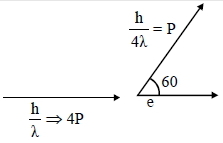
\(\Delta P{\text{ }} = (P\,\,\cos \,\,60\hat i + P\sin \,\,60\hat j) - 4P\hat i\)\( = - \frac{{7P}}{2}\hat i + \frac{{\sqrt 3 P}}{2}\hat j \Rightarrow \) \(\tan \phi = \frac{{\sqrt 3 }}{7},\,\,\tan \phi = 0.25\)
- 20. For which of the following particles will it be most difficult to experimentally verify the deBroglie relationship? 2014 Easy
- (A) an electron
- (B) a proton
- (C) an \(\alpha -\) particle
- (D) a dust particle
Show answer and solution
Correct Answer: (D)
Among the given particles most difficult to experimentally verify the de-broglie relationship is for a dust particle -
- (A) \(1.34\)
- (B) \(2.68\)
- (C) \(4.02\)
- (D) \(5.36 \)
Show answer and solution
Correct Answer: (B)
Wavelength of monochromatic green light \(=5.5 \times 10^{-5} \mathrm{cm}\)Intensity \(I\,=\,\frac{\text { Power }}{\text { Area }}\)
\( = \frac{{100 \times (3/100)}}{{4\pi {{(5)}^2}}}\)
\(=\frac{3}{100 \pi} \mathrm{Wm}^{-2}\)
Now, half of this intensity ( \(\mathrm{I}\) ) belongs to electric field and half of that to magnetic field, therefore,
\(\frac{1}{2}=\frac{1}{4} \varepsilon_{0} E_{0}^{2} C\)
or \(\mathrm{E}_{0}=\sqrt{\frac{2 \mathrm{I}}{\varepsilon_{0} \mathrm{C}}}\)
\( = \sqrt {\frac{{2 \times \left( {\frac{3}{{100}}\pi } \right)}}{{\left( {\frac{1}{{4\pi \times 9 \times {{10}^9}}}} \right) \times \left( {3 \times {{10}^8}} \right)}}} \)
\(=\sqrt{\frac{6}{25} \times 30}=\sqrt{7.2}\)
\(\therefore \mathrm{E}_{0}=2.68 \mathrm{V} / \mathrm{m}\)
-
- (A) \(35 .2\times10^{-10}\, J/m^3\)
- (B) \(35 .2\times10^{-11}\, J/m^3\)
- (C) \(35 .2\times10^{-12}\, J/m^3\)
- (D) \(35 .2\times10^{-13}\, J/m^3\)
Show answer and solution
Correct Answer: (C)
Given: Amplitude of electric field,\(E_{0}=4\,\mathrm{v} / \mathrm{m}\)
Absolute per mitivity,
\(\varepsilon_{0}=8.8 \times 10^{-12}\, \mathrm{c}^{2}\, / \mathrm{N}-\mathrm{m}^{2}\)
Average energy density \(u_{E}=?\)
Applying formula,
Average energy density \(u_{E}=\frac{1}{4} \varepsilon_{0} E^{2}\)
\(\Rightarrow u_{E}=\frac{1}{4} \times 8.8 \times 10^{-12} \times(4)^{2}\)
\(=35.2 \times 10^{-12} \,\mathrm{J} / \mathrm{m}^{3}\)
-
- (A) Electric energy density is half of the magnetic energy density
- (B) Electric energy density is equal to the magnetic energy density
- (C) Both electric and magnetic energy densities are zero
- (D) Electric energy density is double of the magnetic energy density
Show answer and solution
Correct Answer: (B)
\(E_{0}=\mathrm{CB}_{0}\) and \(C=\frac{1}{\sqrt{\mu_{0} \varepsilon_{0}}}\)Electric energy density \(=\frac{1}{2} \varepsilon_{0} E_{0}^{2}=\mu_{E}\)
Magnetic energy density \(=\frac{1}{2} \frac{B o^{2}}{\mu_{0}}=\mu_{B}\)
Thus, \(\mu_{\mathrm{E}}=\mu_{B}\)
Energy is equally divided between electric and magnetic field
-
- (A) \(R, M, I, V, U, X\) and \(G\)
- (B) \(M, R, V, X, U, G\) and \(I\)
- (C) \(G, X, U, V, I, M\) and \(R\)
- (D) \(I, M, R, U, V, X\) and \(G\)
Show answer and solution
Correct Answer: (C)
Gamma rays \(< X-\) rays \(<\) Ultra violet \(<\) Visible rays \(<\) Infrared rays \(<\) Microwaves \(<\) Radio waves -
- (A) \(i\) \(ii\) \(iv\) \(iii\)
- (B) \(iii\) \(ii\) \(i\) \(iv\)
- (C) \(i\) \(ii\) \(iii\) \(iv\)
- (D) \(iv\) \(iii\) \(ii\) \(i\)
Show answer and solution
Correct Answer: (C)
\((1)\) Infrared rays are used to treat muscular strain because these are heat rays.\((2)\) Radio waves are used for broadcasting because these waves have very long wavelength ranging from few centimetres to few hundred kilometers
\((3)\) \(X-\) rays are used to detect fracture of bones because they have high penetrating power but they can't penetrate through denser medium like bones.
\((4)\) Ultraviolet rays are absorbed by ozone of the atmosphere.
-
- (A) \((I)-(A), (II)-(B), (III)-(B), (IV)-(C)\)
- (B) \((I)-(A), (II)-(B), (III)-(C ), (IV)-(C)\)
- (C) \((I)-(B), (II)-(A), (III)-(D), (IV)-(A)\)
- (D) \((I)-(D), (II)-(C), (III)-(A), (IV)-(B)\)
Show answer and solution
Correct Answer: (B)
The sodium spectrum is dominated by the bright doublet, which are known as the sodium \(D\) lines. The wavelength of these lines are around the range \(588.9\; n m\) and \(589.5 \;n m\). Now the wavelength of these sodium \(D\) lines falls under the wavelength range of the X rays in the spectrum. So we can say that the doublet of sodium belongs to the X rays.Most of the hydrogen gas in the interstellar medium is in cold atomic form or in the molecular form. They emit a wavelength due to a slight energy change in the hydrogen atoms. This wavelength is \(21.1 cm\) and so it is called the \(21\;cm\) line radiation. This wavelength lies in the spectrum of the visible light. Hence the wavelength emitted by atomic hydrogen in interstellar space belongs to the visible light spectrum.
The difference in the energy of two close energy levels in a hydrogen atom is called lamb shift. The wavelength
corresponding to this difference in energy is around \(30 \;cm\). This is in the range of the microwaves.
-
- (A) \(0.2\)
- (B) \(0.4\)
- (C) \(0.8\)
- (D) \(0.9\)
Show answer and solution
Correct Answer: (C)
Here, \(\sin \theta_{i c} / \sin \theta_{i B}=1.28\)As we know,
\(\mu=\frac{\sin \theta_{\mathrm{iB}}}{\sin \left(\frac{\pi}{2}-\theta_{\mathrm{iB}}\right)}\)
where, \(\theta_{\mathrm{iB}}\) is Brewster's angle of incidence,
And, \(\mu=\frac{1}{\sin \theta_{\text {ic }}}\)
Onsolving we get, relative refractive index of the two media.
-
- (A) \(3\)
- (B) \(6\)
- (C) \(12\)
- (D) \(24\)
Show answer and solution
Correct Answer: (C)
In diffraction, angular width of central maxima is \(\frac{2 \lambda}{b}\)where \(b\) is slit width.
In Young's double slit experiment, angular width of each fringe is \(\frac{\lambda}{d}\)
where \(d\) is the distance between the two slits.
Given: \(d=6.1 b\) So, number of maximas observed in central maxima of diffraction pattern \(n=\frac{2 \lambda}{\frac{b}{\lambda}}\)
\(\therefore n=\frac{2 d}{b}=2 \times 6.1=12.2\)
Thus 12 maximas are observed.
-
- (A) \(3300\)
- (B) \(4400\)
- (C) \(5500\)
- (D) \(6600\)
Show answer and solution
Correct Answer: (B)
In a single slit experiment, For diffraction maxima,\(a\sin \theta = \left( {2n + 1\frac{\lambda }{2}} \right)\)
and for diffraction minima,
\(a \sin \theta=n \lambda\)
According to question,
\(\left(2 \times 1+1 \frac{\lambda}{2}\right)=1 \times 6600\)
\(\left( {\because {\lambda _{\text{R}}} = 6600\,\,\mathop {\text{A}}\limits^o } \right)\)
\({\lambda = \frac{{6600 \times 2}}{3}}\)
\(\,\lambda = 4400\,\mathop {\text{A}}\limits^o \)
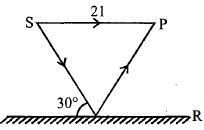
-
- (A) \(I\, = \,\frac{{2n\lambda }}{{\sqrt 3 - 1}}\)
- (B) \(I\, = \,\frac{{(2n - 1)\lambda }}{{2(\sqrt 3 - 1)}}\)
- (C) \(I\, = \,\frac{{(2n - 1\,\lambda )\sqrt 3 }}{{4(2 - \sqrt 3 )}}\)
- (D) \(I\, = \,\frac{{(2n - 1)\lambda }}{{\sqrt 3 - 1}}\)
Show answer and solution
Correct Answer: (C)
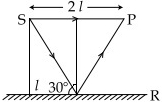
From the figure straight path \(\mathrm{SP}=2 l\)Reflected path \(\mathrm{SP}=2 l\) sec \(30^{\circ}\)
So path difference is \(2 l\left(\sec 30^{\circ}-1\right)\)
Also the ray, when reflected by the mirror, suffers a phase change of \(\pi\)
So the total difference in phase is \(2 l\left(\sec 30^{\circ}-1\right) \times \frac{2 \pi}{\lambda}+\pi\)
For constructive interference
\(2 l\left(\sec 30^{\circ}-1\right) \times \frac{2 \pi}{\lambda}+\pi=2 n \pi\)
Solving this, we get \(l=\frac{(2 n-1) \lambda \sqrt{3}}{4(2-\sqrt{3})}\)
-
- (A) \(( 1 )-(i), (2)-(ii), (3)-(iii), ( 4 )-(iv)\)
- (B) \((1 )-(ii), (2)-(i), (3)-(iv), ( 4)-(iii)\)
- (C) \((1)-(i), (2)-(ii), (3)-(iv), (4)-(iii)\)
- (D) \((1 )-(ii), (2)-(i), (3)-(iii), (4)-(iv)\)
Show answer and solution
Correct Answer: (A)
Rotation period of earth is about \(24\) hrs \(=\) \(10^{5} \mathrm{s}\)Revolution period of earth is about \(365\) days \(=10^{7} \mathrm{s}\)
Speed of light wave \(\mathrm{C}=3 \times 10^{8} \mathrm{m} / \mathrm{s}\)
Wavelength of visible light of spectrum \(\lambda\) \( = 4000 - 7800\,\,\mathop {\text{A}}\limits^o \)
\(\mathrm{C}=\mathrm{f} \lambda\left(\text { and } \mathrm{T}=\frac{1}{\mathrm{f}}\right)\)
Therefore period of light wave is \(10^{-15} \,\mathrm{s}\) (approx)
-
- (A) increases with decreasing value of \(n\)
- (B) increases with decreasing value of \(\beta \)
- (C) increases with increasing value of \(n\, sin\, 2\beta \)
- (D) increases with increasing value of \(\frac{1}{{n\,\sin \,2\beta }}\)
Show answer and solution
Correct Answer: (C)
Resolving power of microscope,\(\mathrm{R.P.}=\frac{2 \mathrm{n} \sin \theta}{\lambda}\)
\(\lambda=\) Wavelength of light used to illuminate the object
\(\mathrm{n}=\) Refractiveindex of the medium between object and objective
\(\theta=\) Angle
-
- (A) \(\;\frac{3}{2}\)
- (B) \(1\)
- (C) \(\;\frac{1}{3}\)
- (D) \(3\)
Show answer and solution
Correct Answer: (C)
According to malus law, intensity of emerging beam is given by,\(I=I_{0} \cos ^{2} \theta\)
Now, \(I_{A^{\prime}}=I_{A} \cos ^{2} 30^o\)
\(I_{B^{\prime}}=I_{B} \cos ^{2} 60^o\)
As \(I_{A^{\prime}}=I_{B^{\prime}}\)
\(\Rightarrow \quad I_{A} \times \frac{3}{4}=I_{B} \times \frac{1}{4}\) \(\therefore \quad \frac{I_{A}}{I_{B}}=\frac{1}{3}\)
-
- (A) \(\frac{16}{9}\)
- (B) \(\frac{4}{3}\)
- (C) \(\frac{7}{1}\)
- (D) \(\frac{49}{1}\)
Show answer and solution
Correct Answer: (D)
Intensity \(\propto\) (amplitude) \(^{2}\)\(\frac{I_{1}}{I_{2}}=\frac{16}{9}=\frac{a_{1}^{2}}{a_{2}^{2}}\)
\(\Rightarrow a_{1}=4 ; a_{2}=3\)
Therefore the ratio of intensities of bright and dark parts
\(\frac{{{I_{{\text{Bright }}}}}}{{{I_{{\text{Dark }}}}}} = \frac{{{{\left( {{a_1} + {a_2}} \right)}^2}}}{{{{\left( {{a_1} - {a_2}} \right)}^2}}}\) \( = \frac{{{{(4 + 3)}^2}}}{{{{(4 - 3)}^2}}} = \frac{{49}}{1}\)
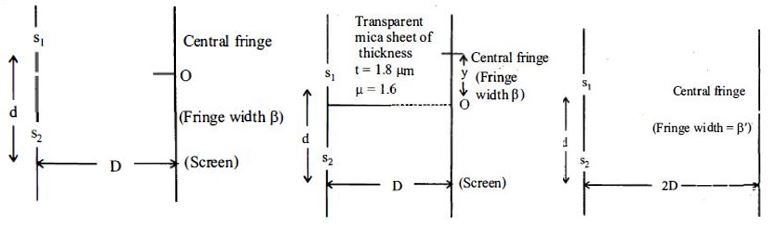
-
- (A) \(520\)
- (B) \(540\)
- (C) \(560\)
- (D) \(580\)
Show answer and solution
Correct Answer: (B)
Given \(t=1.8 \times 10^{-6} \mathrm{m}\)\(\mu=1.6\)
\(\mathrm{n}=2(\text { from figure })\)
Applying formula \((\mu-1) \mathrm{t}=\mathrm{n} \lambda\)
\((1.6-1) \times 1.8 \times 10^{-6}=2 \lambda\)
or, \({\lambda = \frac{{1.8 \times {{10}^{ - 6}} \times 0.6}}{2}}\)
\(=\,540 \,\mathrm{nm}\)
-
- (A) \(15 \times 3 \times \sqrt 5 \,cm\)
- (B) \(15 \times 3\sqrt 7 \,cm\)
- (C) \(\frac{{15 \times \sqrt 7 }}{3}\,\,cm\)
- (D) \(\frac{{15 \times 3}}{{\sqrt 7 }}\,\,cm\)
Show answer and solution
Correct Answer: (D)
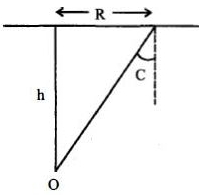
Given, \(\mu \, = \,\frac{4}{3}\)\(h\,=\,15\,cm\)
\(R\,=\,?\)
\(\frac{\sin 90^o}{\sin C}=\mu\)
\(\Rightarrow \quad \sin C=\frac{1}{\mu}=\frac{R}{\sqrt{R^{2}+h^{2}}}=\frac{3}{4}\)
\(\Rightarrow \quad 16 R^{2}=9 R^{2}+9 h^{2}\)
or, \({7{R^2} = 9{h^2}}\)
or, \({R = \frac{3}{{\sqrt 7 }}h = \frac{3}{{\sqrt 7 }} \times 15\,\,{\text{cm}}}\)
-
- (A) The spectrum of visible light whose fre quency is less than that of green light will come out to the air medium
- (B) The spectrum of visible light whose fre quency is more than that of green light will come out to the air medium.
- (C) The entire spectrum of visible light will come out of the water at various angles to the normal.
- (D) The entire spectrum of visible light will come out of the water at an angle of \(90°\) to the normal.
Show answer and solution
Correct Answer: (A)
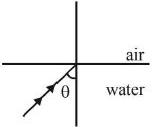
For critical angle \(\theta_{\mathrm{c}}\) ,\(\sin \theta_{c}=\frac{1}{\mu}\)
For greater wavelength or lesser frequency \(\mu\) is less.
So, critical angle would be more. So, they will not suffer reflection and come out at angles less then \(90^o\).
-
- (A) \(f_1 > f \) and \(f_2\) becomes negative
- (B) \(f_2 > f\) and \( f_1\) becomes negative
- (C) \(f_1\) and \(f_2\) both becomes negative
- (D) \(f_1=f_2 < f\)
Show answer and solution
Correct Answer: (A)
By Lens maker's formula for convex lens\(\frac{1}{f}=\left(\frac{\mu}{\mu_{L}}-1\right)\left(\frac{2}{R}\right)\)
for, \(\mu_{L_{1}}=\frac{4}{3}, f_{1}=4 R\)
for \(\mu_{L_{2}}=\frac{5}{3}, f_{2}=-5 R\)
\(\Rightarrow f_{2}=(-) \mathrm{ve}\)
-
- (A) \(124.5\)
- (B) \(144.5\)
- (C) \(65\)
- (D) \(99\)
Show answer and solution
Correct Answer: (D)
Given: Separation of lens for two of its position, \(d=10 \mathrm{cm}\)Ratio of size of the images in two positions
\(\frac{I_{1}}{I_{2}}=\frac{3}{2}\)
Distance of object from the screen, \(D=?\)
Applying formula,
\({\frac{{{I_1}}}{{{I_2}}} = \frac{{{{(D + d)}^2}}}{{{{(D - d)}^2}}}}\)
\({ \Rightarrow \,\,\frac{3}{2} = \frac{{{{(D + 10)}^2}}}{{{{(D - 10)}^2}}}}\)
\({ \Rightarrow \quad \frac{3}{2} = \frac{{{D^2} + 100 + 20D}}{{{D^2} + 100 - 20D}}}\)
\(\Rightarrow 3 D^{2}+300-60 D=2 D^{2}+200+40 D\)
\(\Rightarrow \quad D^{2}-100 D+100=0\)
On solving, we get \(D=99\, \mathrm{cm}\)
Hence the distance between the screen and the object is \(99\, \mathrm{cm} .\)
-
- (A) \(200\)
- (B) \(100\)
- (C) \(400\)
- (D) \(150\)
Show answer and solution
Correct Answer: (A)
Given \(: f_{0}=1.2\, \mathrm{cm} ; f_{\mathrm{e}}=3.0 \,\mathrm{cm}\)\(u_{0}=1.25\, \mathrm{cm} ; M_{\infty}=?\)
From \(\frac{1}{f_{0}}=\frac{1}{v_{0}}-\frac{1}{u_{0}}\)
\(\Rightarrow \frac{1}{1.2}=\frac{1}{v_{0}}-\frac{1}{(-1.25)}\)
\(\Rightarrow \quad \frac{1}{v_{0}}=\frac{1}{1.2}-\frac{1}{1.25}\)
\(\Rightarrow \) \(v_{0}=30\, \mathrm{cm}\)
Magnification at infinity,
\(M_{\infty}=-\frac{v_{0}}{u_{0}} \times \frac{D}{f_{e}}\)
\(=\frac{30}{1.25} \times \frac{25}{3}\) ( \(\because D=25\, \mathrm{cm}\) least distance of distinct vision)
\(=200\)
Hence the magnifying power of the compound microscope is \(200\)
-
- (A) \(+11.2\)
- (B) \(-11.2\)
- (C) \(-8.8\)
- (D) \(+8.8\)
Show answer and solution
Correct Answer: (D)
Given, Focal length of objective, \(f_{0}=30\, \mathrm{cm}\)focal length of eye lens, \(f_{e}=3.0 \,\mathrm{cm}\)
Magnifying power, \(M=?\)
Magnifying power of the Galilean telescope,
\(M_{D}=\frac{f_{0}}{f_{e}}\left(1-\frac{f_{e}}{D}\right)\)
\( = \frac{{30}}{3}\left( {1 - \frac{3}{{25}}} \right)\) \([\because D = 25\,{\text{cm}}]\)
\(=10 \times \frac{22}{25}=8.8\, \mathrm{cm}\)
- 42. A sinusoidal voltage \(V(t) = 100\,sin\,(500t)\) is applied across a pure inductance of \(L = 0.02\,H.\) The current through the coil is 2014 Medium
- (A) \(10\,cos\,(500t)\)
- (B) \(-10\,cos\,(500t)\)
- (C) \(10\,sin\,(500t)\)
- (D) \(-10\,sin\,(500t)\)
Show answer and solution
Correct Answer: (B)
In a pure inductive circuit current alwayslags behind the emf by \(\frac{\pi}{2}\)
If \(v(t)=v_{0} \sin \omega t\)
then \(\mathrm{I}=\mathrm{I}_{0} \sin \left(\omega \mathrm{t}-\frac{\pi}{2}\right)\)
Now, given \(v(t)=100 \sin (500 \,t)\)
and \(\mathrm{I}_{0}=\frac{\mathrm{E}_{0}}{\omega \mathrm{L}}=\frac{100}{500 \times 0.02}[\because \mathrm{L}=0.02 \,\mathrm{H}]\)
\(\mathrm{I}_{0}=10 \sin \left(500 \mathrm{t}-\frac{\pi}{2}\right)\)
\(\mathrm{I}_{0}=-10 \cos (500 \mathrm{t})\)
-
- (A) \(50\)
- (B) \(70\)
- (C) \(90\)
- (D) \(100\)
Show answer and solution
Correct Answer: (C)
Given, \(V_{L}: V_{C}: V_{R}=1: 2: 3\)\(\mathrm{V}=100 \,\mathrm{V}\)
\(\mathrm{V}_{\mathrm{R}}=?\)
As we know,
\(V=\sqrt{V_{R}^{2}+\left(V_{L}-V_{C}\right)^{2}}\)
Solving we get, \(\mathrm{V}_{\mathrm{R}}=90\, \mathrm{V}\)
-
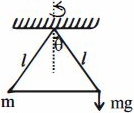
- (A) angular momentum changes in magnitude but not in direction
- (B) angular momentum changes in direction but not in magnitude
- (C) angular momentum changes both in direction and magnitude
- (D) angular momentum is conserved
Show answer and solution
Correct Answer: (B)
Torque working on the bob of mass \(m\) is,\(\tau = mg \times \ell \sin \theta .\,\). (Direction parallel to plane of rotation of particle)
As \(\tau \) is perpendicular to \(\overrightarrow L \), direction of \(L\) changes but magnitude remains same.
-
- (A) angular momentum changes in magnitude but not in direction
- (B) angular momentum changes in direction but not in magnitude
- (C) angular momentum changes both in direction and magnitude
- (D) angular momentum is conserved
Show answer and solution
Correct Answer: (B)
Torque working on the bob of mass \(m\) is,\(\tau = mg \times \ell \sin \theta .\,\). (Direction parallel to plane of rotation of particle)
As \(\tau \) is perpendicular to \(\overrightarrow L \), direction of \(L\) changes but magnitude remains same.
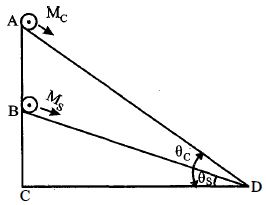
-
- (A) \(\sqrt {\frac{8}{7}} \)
- (B) \(\sqrt {\frac{15}{14}} \)
- (C) \(\frac{8}{7}\)
- (D) \(\frac{15}{14}\)
Show answer and solution
Correct Answer: (D)
As we know,Acceleration, \(a = \frac{{mg\sin \theta }}{{m + \frac{I}{{{r^2}}}}}\)
\(\begin{array}{l}
\,For\,cylinder,\,{a_c} = \frac{{{M_c}g.\sin {\theta _c}}}{{{M_c} + \frac{1}{2}\frac{{{M_c}{R^2}}}{{{R^2}}}}}\\
\,\,\,\,\,\,\,\,\,\,\,\,\,\,\,\,\,\,\,\,\,\,\,\,\,\,\,\,\,\,\,\,\,\,\,\,\,\,\,\,\,\,\, = \frac{{{M_c}g.\sin {\theta _c}}}{{{M_c} + \frac{{{M_c}{R^2}}}{{2{R^2}}}}}
\end{array}\)\(\begin{array}{l}
or,\,\,\,{a_c} = \frac{2}{3}g\sin \,{\theta _c}\\
\,\,\,\,\,\,\,\,For\,sphere,\\
\,\,\,\,\,{a_s} = \frac{{{M_s}g\sin {\theta _s}}}{{{M_s} + \frac{{{I_s}}}{{{r^2}}}}}\\
\,\,\,\,\,\,\,\,\,\,\, = \frac{{{M_s}g\sin {\theta _s}}}{{{M_s} + \frac{2}{5}\frac{{M{R^2}}}{{{R^2}}}}}
\end{array}\)\(\begin{array}{l}
or,\,\,\,\,\,\,\,{a_s} = \frac{5}{7}g\sin {\theta _s}\\
\,\,\,\,\,\,\,\,\,\,\,\,\,given,\,{a_c} = {a_s}\\
i.e.,\,\,\frac{2}{3}g\sin {\theta _c} = \frac{5}{7}g\sin {\theta _s}\\
\therefore \,\,\frac{{\sin {\theta _c}}}{{\sin {\theta _s}}} = \frac{{\frac{5}{7}g}}{{\frac{2}{3}g}} = \frac{{15}}{{14}}
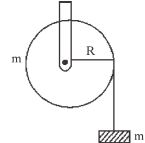
\end{array}\) -
- (A) \(\frac{g}{2}\)
- (B) \(g\)
- (C) \(\;\frac{{5g}}{6}\)
- (D) \(\;\frac{{2g}}{3}\)
Show answer and solution
Correct Answer: (A)
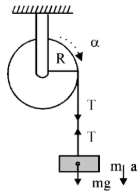
From figure, Acceleration\(a=R\alpha \) . . . (i)
and \(mg-T=ma\) . . .(ii)
From equation (i) and (ii)
\(T \times R = m{R^a} = m{R^2}\left( {\frac{a}{R}} \right)\)
\(T=ma\)
\(mg-ma=ma\)
\(a=g/2\)
-
- (A) \(\frac{g}{2}\)
- (B) \(g\)
- (C) \(\;\frac{{5g}}{6}\)
- (D) \(\;\frac{{2g}}{3}\)
Show answer and solution
Correct Answer: (A)
From figure, Acceleration\(a=R\alpha \) . . . (i)
and \(mg-T=ma\) . . .(ii)
From equation (i) and (ii)
\(T \times R = m{R^a} = m{R^2}\left( {\frac{a}{R}} \right)\)
\(T=ma\)
\(mg-ma=ma\)
\(a=g/2\)
-
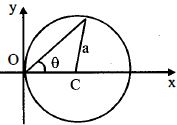
- (A) \(va\,\, ( 1 + cos\,2\theta )\)
- (B) \(va\,\, ( 1 + cos\,\theta )\)
- (C) \(va\,\,cos\,2\theta \)
- (D) \(va\)
Show answer and solution
Correct Answer: (A)
\((v \cos \theta) \times 2\) turns\(2 \cos v a-1=\cos 2 w\)
\(2 \mathrm{rv} \cos ^{2} \mathrm{v}\)
va \((1+\cos 2 \theta)\)

No questions on this page match these filters.
Other years
Frequently asked
How many JEE Mains 2014 Physics questions are on ExamBro?
137 questions, each with the correct answer and a full solution.
Which JEE Mains 2014 Physics chapter is asked the most?
System of particles and rotational motion, with 12 questions, followed by Wave optics with 9.
How difficult are JEE Mains 2014 Physics questions?
6% are easy, 42% medium and 53% hard.