


JEE Mains 2023 Chemistry के सभी प्रश्न
25 अध्याय342 में से 301–342 प्रश्न
- 301. मानक अपचयन विभव \(\mathrm{M}^{+} / \mathrm{M}\) जो कि अपचयन क्षमता की माप होती है निर्भर नहीं करती है 2023 मध्यम
- (A) ठोस धातु परमाणु के आयनन पर
- (B) ठोस धातु के उर्ध्वपातन पर
- (C) गैसीय धातु परमाणु के आयनन पर
- (D) गैसीय धातु आयन के जलयोजन पर
उत्तर और हल देखें
सही उत्तर: (A)
Factual -
- (A) \(3\)
- (B) \(2\)
- (C) \(4\)
- (D) \(1\)
उत्तर और हल देखें
सही उत्तर: (C)
\(A \rightarrow\) Endothermic (Atomisation)\(B \rightarrow\) Endothermic (Atomisation)
\(C \rightarrow\) Endothermic (Vapourisation)
\(D \rightarrow\) Exothermic (Combustion)
\(E \rightarrow\) Endothermic (Dissolution)
-
- (A) \(6\)
- (B) \(3\)
- (C) \(12\)
- (D) \(9\)
उत्तर और हल देखें
सही उत्तर: (A)
\(\because \Delta G ^{\circ}=- RT \ln K _{ eq }\)\(\text { and } K _{ eq }=\frac{ K _{ f }}{ K _{ b }}\)
\(\therefore K _{ eq }=\frac{10^3}{10^2}=10\)
\(\therefore \Delta G =- RT \ln 10\)
\(\Rightarrow-(8.3 \times 300 \times 2.3)=-5.7\,kJ\,mole ^{-1} \approx 6\,kJ\)
\(\text { mole }{ }^{-1}(\text { nearest integer) }\)
\(\text { Ans }=6\)
-
- (A) \(4\)
- (B) \(8\)
- (C) \(2\)
- (D) \(6\)
उत्तर और हल देखें
सही उत्तर: (A)
Extensive \(\Rightarrow\) Mole, Volume, Gibbs free energy.Intensive \(\Rightarrow\) Molar mass, Molar heat capacity, Molarity, \(E ^\theta\) cell.
-
- (A) केवल \(C\) तथा \(D\)
- (B) केवल \(B\) तथा \(C\)
- (C) केवल \(A\) तथा \(B\)
- (D) केवल \(B\) तथा \(D\)
उत्तर और हल देखें
सही उत्तर: (B)
Only \((B)\) and \((C)\) are correct.\((B)\) \(G = H - TS\)
At constant \(T\)
\(\Delta G =\Delta H - T \Delta S\)
(A) First law is given by
\(\Delta U = Q + W\)
If we apply constant \(P\) and reversible work
\(\Delta U = Q - P \Delta V\)
(C)By definition of entropy change
\(dS =\frac{ dq _{ rer }}{ T }\)
At constant \(T\)
\(\Delta S=\frac{q_{\text {rev }}}{T}\)
(D) \(H = U + PV\)
For ideal gas
\(H = U + nRT\)
At constant \(T\)
\(\Delta H =\Delta U +\Delta nRT\)
-
- (A) \(3\)
- (B) \(2\)
- (C) \(5\)
- (D) \(4\)
उत्तर और हल देखें
सही उत्तर: (D)
\(Fe _2 O _3+2 Al \rightarrow Al _2 O _3+2 Fe\)Molar mass \(160\,g \quad 27\,g\)
\(\left(\Delta H _{ f }^0\right)_{\text {reaction }}=\left[\left(\Delta H _{ f }^0\right)_{ Al _2 O _3}+2\left(\Delta H _{ f }^0\right)_{ Fe }\right]- \left[\left(\Delta H _{ f }^0\right)_{ Fe _2 O _3}+2\left(\Delta H _{ f }^0\right)_{ Al }\right]\)
\(=[-1700+0]-[-840+0]\)
\(=-860\,kJ / mol\)
\(\text { Total mass of mixture }= Fe _2 O _3+ Al (1: 2 \text { molar }\)
\(\text { ratio })\)
\(=160+2 \times 27\)
\(=214\,g / mol\)
\(\text { Heat evolved per gram }=\frac{860}{214}=4\,kJ / g\)
-
- (A) \(NaI < NaBr < NaCl < NaF\)
- (B) \(NaF < NaCl < NaBr < NaI\)
- (C) \(NaCl < NaF < NaBr < NaI\)
- (D) \(NaI < NaBr < NaF < NaCl\)
उत्तर और हल देखें
सही उत्तर: (A)
For a given metal \(\Delta_{ f } H ^0\) always becomes less negative from fluoride to iodide. -
- (A) \(Si - Si > C - C > Sn - Sn > Ge - Ge\)
- (B) \(Si - Si > C - C > Ge - Ge > Sn - Sn\)
- (C) \(C - C > Si - Si > Sn - Sn > Ge - Ge\)
- (D) \(C - C > Si - Si > Ge - Ge > Sn - Sn\)
उत्तर और हल देखें
सही उत्तर: (D)
(Bond enthalpy order \(C - C > Si - Si > Ge - Ge > Sn - Sn )\) -
- (A) इसमें इलेक्ट्रॉनिक अतिव्यापन होता हैं।
- (B) इसमें केला बन्ध होते हैं।
- (C) यह जल से अभिक्रिया कर सकती हैं।
- (D) यह चक्रीय यौगिक हैं।
उत्तर और हल देखें
सही उत्तर: (C)
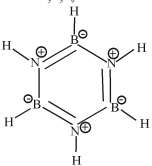
Borazine is \(B _3 N _3 H _8\)\(B _8 N _3 H _6+9 H _2 O \rightarrow 3 NH _3+3 H _8 BO _3+3 H _2\)
-
- (A) \(BBr _3 > BI _3 > BCI _3 > BF _3\)
- (B) \(BCl _3 > BF _3 > BBr _3 > BI _3\)
- (C) \(BF _3 > BCl _3 > BBr _3 > BI _3\)
- (D) \(BI _3 > BBr _3 > BCl _3 > BF _3\)
उत्तर और हल देखें
सही उत्तर: (D)
Extent of back bonding, reduces down the group leading to more Lewis acidic strength \(BF _3 > BCl _3 > BBr _3 > BI _3\) (extent of back bonding) \((2 p-2 p)(2 p-3 p)(2 p-4 p)(2 p-5 p)\)\(BF _3 < BCl _3 < BBr _3 < BI _3\) (lewis acidic nature)
-
- (A) \(Cu _3 B _2\)
- (B) \(Cu\)
- (C) \(Cu \left( BO _2\right)_2\)
- (D) \(CuO\)
उत्तर और हल देखें
सही उत्तर: (C)
Blue green colour is due to formation of \(Cu \left( BO _2\right)_2\)\(CuSO _4 \stackrel{\Delta}{\longrightarrow} CuO + SO _3\)
\(CuO + B _2 O _3 \rightarrow Cu \left( BO _2\right)_2\)
-
- (A) \(3\)
- (B) \(4.5\)
- (C) \(2\)
- (D) \(1.5\)
उत्तर और हल देखें
सही उत्तर: (A)
For good quality cement, the ratio of silica \(\left( SlO _2\right)\) to Alumina \(\left( Al _2 O _3\right)\) should be between \(2.5\) to \(4\). -
- (A) \(\mathrm{Al}\) की अपेक्षा \(\mathrm{Ga}\) अधिक विद्युत ऋणात्मक है और साल्ट \(\mathrm{GaAlCl}_4\) में धनायनिक घटक के रूप में उपस्थित है।
- (B) सॉल्ट \(\mathrm{GaAlCl}_4\) में \(\mathrm{Ga}\) की आक्सीकरण अवस्था +3 है।
- (C) \(\mathrm{GaAlCl}_4\) में \(\mathrm{Cl}, \mathrm{Al}\) तथा \(\mathrm{Ga}\) दोनों से आबन्ध बनाती है।
- (D) \(\mathrm{GaAlCl}_4\) में \(\mathrm{Ga}\) उपसहसंयोजित है \(\mathrm{Cl}\) से।
उत्तर और हल देखें
सही उत्तर: (A)
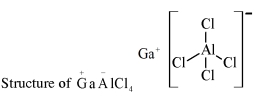
Gallous tetrachloro aluminate \(Ga ^{+} AlCl _4^{-}\)\(2 Ga + Ga ^{+} GaCl _4^{-}+2 Al _2 Cl _6 \stackrel{190^{\circ}}{\longrightarrow} 4 Ga ^{+} AlCl _4^{-}\)
Ga is cationic part of salt \(GaAlCl _4\).
-
- (A) बोरिक अम्ल में प्रबल आयनिक आबन्ध है।
- (B) बोरिक अम्ल प्रबल वान्डर वाल्स अन्योन्य क्रियाएँ है
- (C) बोरिक अम्ल में प्रबल हाइड्रोजन आबन्ध है।
- (D) \(\mathrm{BF}_3\) में प्रबल सहसंयोजी बन्ध है।
उत्तर और हल देखें
सही उत्तर: (C)
Boric acid has strong hydrogen bonding while \(BF _3\) does not. Therefore boric acid is solid. -
- (A) \(\mathrm{A}\) एवं \(\mathrm{R}\) दोनों सही है तथा \(\mathrm{A}\) की सही व्याख्या \(R\) नही है।
- (B) \(\mathrm{A}\) एवं \(\mathrm{R}\) दोनों सही है तथा \(\mathrm{A}\) की सही व्याख्या \(\mathrm{R}\) है
- (C) \(\mathrm{A}\) गलत है परंतु \(\mathrm{R}\) सही है।
- (D) \(\mathrm{A}\) सही है परंतु \(\mathrm{R}\) गलत है।
उत्तर और हल देखें
सही उत्तर: (B)
The oxide which form acid on dissolving in water is acidic oxide. -
- (A) कथन \(I\) तथा \(II\) दोनो सही है।
- (B) कथन \(I\) गलत है परन्तु कथन \(II\) सही है।
- (C) कथन \(I\) तथा \(II\) दोनो गलत है।
- (D) कथन \(I\) सही है परन्तु कथन \(II\) गलत है।
उत्तर और हल देखें
सही उत्तर: (D)
Statement- \(I\) is correct.\(Ni\) is used in Hydrogenation of unsaturated fat to make edible fats.
Statements\(-II\) is false as hydride of Silicon is electron precise and neither electron deficient nor electron rich.
-
- (A) कथन \(I\) गलत है परन्तु कथन \(II\) सही है।
- (B) कथन \(I\) तथा \(II\) दोनो सही है।
- (C) कथन \(I\) सही है परन्तु कथन \(II\) गलत है
- (D) कथन \(I\) तथा \(II\) दोनो गलत है।
उत्तर और हल देखें
सही उत्तर: (B)
The first ionization energies (as in NCERT) are as follows:\(B\) : \(801\,kJ / mol\)
\(Al : 577\,kJ / mol\)
Ga : \(579\,kJ / mol\)
\(Ga :[ Ar ] 3 d ^{10} 4 s ^2 4 p ^1\)
-
- (A) कथन \(I\) गलत है परन्तु कथन \(II\) सही है।
- (B) कथन \(I\) एवं कथन \(II\) दोनों सही है।
- (C) कथन \(I\) सही है परन्तु कथन \(II\) गलत है।
- (D) कथन \(I\) एवं कथन \(II\) दोनों गलत है।
उत्तर और हल देखें
सही उत्तर: (B)
Boron is non- metallic in nature. It is extremely hard and black coloured solid. It exists in many allotropic forms. Due to very strong crystalline lattice, boron has unusually high melting point and boiling point.Element \(B\) \(Al\) \(Ga\) \(In\) \(TI\) Melting point \(2453\) \(933\) \(303\) \(430\) \(576\) Boiling point \(3923\) \(2740\) \(2676\) \(2353\) \(1730\) -
- (A) कथन \(I\) तथा कथन \(II\) सही है।
- (B) कथन \(I\) सही है परन्तु कथन \(II\) गलत है।
- (C) कथन \(I\) तथा कथन \(II\) गलत है।
- (D) कथन \(I\) गलत है परन्तु कथन \(II\) सही है।
उत्तर और हल देखें
सही उत्तर: (C)
(Borax Bead Test)On treatment with metal salt, boric anhydride forms metaborate of the metal which gives different colours in oxidising and reducing flame.
For example, in the case of copper sulphate, following reactions occur.
\(CuSO _4+ B _2 O _3 \longrightarrow Cu \left( BO _2\right)_2+ SO _3\)
Two reactions may take place in reducing flame (Luminous flame)
\((i)\) The blue-green \(Cu \left( BO _2\right)_2\) is reduced to colourless cuprous metaborate as :
\(2 Cu ( BO _2 )_2+2 NaBO _2+ C \underset{\text { flame }}{\stackrel{\text { Luminous }}{\longrightarrow}} 2 CuBO _2+\) \( Na _2 B _4 O _7+ CO\)
\((ii)\) Cupric metaborate may be reduced to metallic copper and bead appears red opaque.
\(2 Cu \left( BO _2\right)_2+4 NaBO _2+2 C \underset{\text { fuminous }}{\stackrel{\text { flame }}{\longrightarrow}} 2 Cu +\) \(2 Na _2 B _4 O _7+2 CO\)
-
- (A) आयनिक साल्ट में \(\mathrm{Be}\) चतुष्फलकीय उपसहसंयोजित होता है।
- (B) अभिक्रिया अम्ल-क्षार उदासीनीकरण अभिक्रिया का एक उदाहरण है।
- (C) दोनों तत्व \(\mathrm{Sr}\) तथा \(\mathrm{Be}\) आयनिक साल्ट में उपस्थित होते है।
- (D) तत्व \(\mathrm{Be}\) आयनिक साल्ट के धनायनिक भाग में उपस्थित होता है।
उत्तर और हल देखें
सही उत्तर: (D)
\(Be ( OH )_2\) is amphoteric in nature.\(Sr ( OH )_2\) is basic in nature.
These two undergo acid - base reaction to form a salt.
\(Be ( OH )_2+ Sr ( OH )_2 \rightarrow Sr \left[ Be ( OH )_4\right]\)
(salt)
-
- (A) \(A-IV, B-I, C-II, D-III\)
- (B) \(A-IV, B-III, C-I, D-II\)
- (C) \(A-II, B-III, C-IV, D-I\)
- (D) \(A-IV, B-III, C-II, D-I\)
उत्तर और हल देखें
सही उत्तर: (D)
Cobalt catalyst \(\rightarrow\) Methanol productionSyn gas \(\rightarrow\) Coal gasification
\(\left( C _{\text {(Redhot coke) }}+ H _2 O ( g ) \rightarrow CO + H _2\right)\)
Nickel catalyst \(\rightarrow\) Water gas production
Brine solution \(\rightarrow\) Production
(aq. \(NaCl ) \quad\left(\begin{array}{l} H _2 \rightarrow \text { Cathode } \\ Cl _2 \rightarrow \text { anode }\end{array}\right)\)
-
- (A) \(796\)
- (B) \(798\)
- (C) \(797\)
- (D) \(785\)
उत्तर और हल देखें
सही उत्तर: (B)
For one photon \(E = hv\)For one mole photon,
\(E=6 \cdot 023 \times 10^{23} \times 6.626 \times 10^{-34} \times 2 \times 10^{12}\)
v
-
- (A) \(r_0=a_0\)
- (B) \(r_0=4 a_0\)
- (C) \(r _0=\frac{ a _0}{2}\)
- (D) \(r_0=2 a_0\)
उत्तर और हल देखें
सही उत्तर: (D)
At node \(\Psi_{2 s }=0\)\(\therefore 2-\frac{ r _0}{ a _0}=0\)
\(\therefore r _0=2 a _0\)
-
- (A) \(6\)
- (B) \(5\)
- (C) \(4\)
- (D) \(7\)
उत्तर और हल देखें
सही उत्तर: (D)
\(\lambda_{ d }=\frac{ h }{ mv }=\frac{ h }{\sqrt{2 mKE }}=\frac{6.6 \times 10^{-34}}{\sqrt{2 \times 9 \times 10^{-31} \times 4.5 \times 10^{-29}}}\)\(=\frac{6.6 \times 10^{-34}}{\sqrt{9^2 \times 10^{-60}}}\)
\(=\frac{6.6 \times 10^{-34}}{9 \times 10^{-30}}=\frac{6.6}{9} \times 10^{-4}\)
\(=7.3 \times 10^{-5}\,m\)
\(\text { Therefore Ans }=7\)
- 325. दिए गए सेट में समइलेक्ट्रॉनिक स्पीशीज की कुल संख्या है:___________ \(O ^{2-}, F ^{-}, Al , Mg ^{2+}, Na ^{+}, O ^{+}, Mg , Al ^{3+}, F\) 2023 मध्यम
- (A) \(5\)
- (B) \(4\)
- (C) \(3\)
- (D) \(2\)
उत्तर और हल देखें
सही उत्तर: (A)
Isoelectronic species \(O ^{2 \Theta}, F ^{\Theta}, Mg ^{2+}, Na ^{\oplus}, Al ^{3+}\) -
- (A) \(170\)
- (B) \(180\)
- (C) \(270\)
- (D) \(250\)
उत्तर और हल देखें
सही उत्तर: (C)
\(r \propto \frac{ n ^2}{ Z }\)\(r _{ He ^{+}} = r _{ H } \times \frac{ n ^2}{ Z }\)
\(r _{ He ^{+}} =0.6 \times \frac{(3)^2}{2}\)
\(=2.7 \mathring A\)
\(r _{ He ^{+}} =270\,pm\)
- 327. हाइड्रोजन परमाणु की प्रथम बोर कक्षा में इलेक्ट्रॉन की ऊर्जा \(-2.18 \times 10^{-18} \mathrm{~J}\) है। तृतीय बोर कक्षा में इसकी ऊर्जा है: 2023 मध्यम
- (A) इस मान का \(\frac{1}{27}\)
- (B) इस मान का एक तिहाई
- (C) इस मान का तीन गुना
- (D) इस मान का \(\frac{1}{9}\)
उत्तर और हल देखें
सही उत्तर: (D)
\(E _{ n }=\frac{-2.18 \times 10^{-18} Z ^2}{ n ^2}\)\(\text { i.e. } E _{ n } \propto \frac{1}{ n ^2}\)
-
- (A) \(n =2\) से \(n =1\)
- (B) \(n =1\) से \(n =3\)
- (C) \(n =1\) से \(n =2\)
- (D) \(n =3\) से \(n =4\)
उत्तर और हल देखें
सही उत्तर: (A)
\(He ^{+}\)ion :\(\frac{1}{\lambda( H )}= R (1)^2\left[\frac{1}{ n _1^2}-\frac{1}{ n _2^2}\right]\)
\(\frac{1}{\lambda\left( He ^{+}\right)}= R (2)^2\left[\frac{1}{2^2}-\frac{1}{4^2}\right]\)
Given \(\lambda( H )=\lambda\left( He ^{+}\right)\)
\(R (1)^2\left[\frac{1}{ n _1^2}-\frac{1}{ n _2^2}\right]= R (4)\left[\frac{1}{2^2}-\frac{1}{4^2}\right]\)
\(\frac{1}{ n _1^2}-\frac{1}{ n _2^2}=\frac{1}{1^2}-\frac{1}{2^2}\)
On comparing \(n _1=1\) and \(n _2=2\)
- 329. किसी इलेक्ट्रॉन का \(3 \mathrm{~s}\) कक्षक में कक्षक कोणीय संवेग \(\frac{\mathrm{xh}}{2 \pi}\) है। \(\mathrm{x}\) का मान_________है। 2023 आसान
- (A) \(1\)
- (B) \(2\)
- (C) \(3\)
- (D) \(0\)
उत्तर और हल देखें
सही उत्तर: (D)
s-कक्षक के लिए \( l = 0 \).
कक्षक कोणीय संवेग \( = \sqrt{l(l+1)} \frac{h}{2 \pi} \)
\( = \sqrt{0(0+1)} \frac{h}{2 \pi} = 0 \frac{h}{2 \pi} \)
दिया गया है, \( \frac{xh}{2 \pi} = 0 \frac{h}{2 \pi} \)
\( x = 0 \)
-
- (A) \(1\)
- (B) \(0\)
- (C) \(2\)
- (D) \(3\)
उत्तर और हल देखें
सही उत्तर: (B)
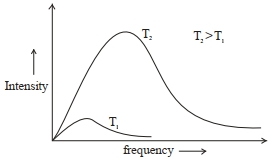
A blackbody can emit and absorb all the wavelengths in electromagnetic spectrum \(\Rightarrow(A)\) is correct\(\Rightarrow(B),(C),(D)\) correct
- 331. लाइमन श्रेणी में हाइड्रोजन परमाणु की लघुत्तम तरंगदैर्ध्य \(\lambda\) है। बामर श्रेणी में \(\mathrm{He}^{+}\)की दीर्घतम तरंगद्धैर्य है:- 2023 कठिन
- (A) \(\frac{5}{9 \lambda}\)
- (B) \(\frac{9 \lambda}{5}\)
- (C) \(\frac{36 \lambda}{5}\)
- (D) \(\frac{5 \lambda}{9}\)
उत्तर और हल देखें
सही उत्तर: (B)
For \(H : \frac{1}{\lambda}= R _{ H } \times 1^2\left(\frac{1}{1^2}-\frac{1}{\infty^2}\right)\)\(\frac{1}{\lambda_{ He ^{+}}}= R _{ H } \times 2^2 \times\left(\frac{1}{4}-\frac{1}{9}\right)\)
From \((1)\) and \((2)\) \(\frac{\lambda_{ He ^{+}}}{\lambda}=\frac{9}{5}\)
\(\lambda_{ He ^{+}}=\lambda \times \frac{9}{5}\)
\(\lambda_{ He ^{+}}=\frac{9 \lambda}{5}\)
-
- (A) \(2\)
- (B) \(3\)
- (C) \(1\)
- (D) \(4\)
उत्तर और हल देखें
सही उत्तर: (C)
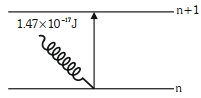
\(\Delta E = R _{ H } Z ^2\left(\frac{1}{ n _1^2}-\frac{1}{ n _2^2}\right)\)\(1.47 \times 10^{-17}=2.18 \times 10^{-15} \times 9\left(\frac{1}{n^2}-\frac{1}{(n+1)^2}\right)\)
\(\frac{1.47}{1.96}=\frac{3}{4}=\frac{1}{n^2}-\frac{1}{(n+1)^2}\)
So, \(n =1\)
- 333. \(\mathrm{Li}^{2+}\) की द्वितीय कक्षा की त्रिज्या \(\mathrm{x}\) है। \(\mathrm{Be}^{3+}\) की तृतीय कक्षा की प्रत्याशित त्रिज्या है। 2023 कठिन
- (A) \(\frac{9}{4} x\)
- (B) \(\frac{4}{9} x\)
- (C) \(\frac{27}{16} x\)
- (D) \(\frac{16}{27} x\)
उत्तर और हल देखें
सही उत्तर: (C)
\(Li ^{2+}\)\(r _2= x = k \times \frac{2^2}{3}=\frac{4 k }{2}\)
\(Be ^{3+}\)
\(r _3= y = k \times \frac{3^2}{4}\)
\(\frac{y}{x}=\frac{9}{4} \times \frac{3}{4}=\frac{27}{16}\)
\(y=\frac{27}{16} x\)
- 334. \(\mathrm{n}=4\) वाले कोश में उपस्थित रह सकने वाले इलेक्ट्रॉनों की अधिकतम संख्या है : 2023 मध्यम
- (A) \(16\)
- (B) \(32\)
- (C) \(50\)
- (D) \(72\)
उत्तर और हल देखें
सही उत्तर: (B)
The number of electrons in the orbitals of sub-shell of \(n=4\) are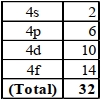
-
- (A) कथन \(I\) एवं कथन \(II\) दोनों सही हैं।
- (B) कथन \(I\) सही है परन्तु कथन \(II\) गलत है।
- (C) कथन \(I\) गलत है परन्तु कथन \(II\) सही है।
- (D) कथन \(I\) एवं कथन \(II\) दोनों गलत हैं।
उत्तर और हल देखें
सही उत्तर: (A)
According to Bohr's model the angular momentum is quantised and equal to \(\frac{ nh }{2 \pi}\).Heisenberg uncertainty principle explains orbital concept, which is based on probability of finding electron.
-
- (A) \(A\) एवं \(R\) दोनों सही हैं तथा \(A\) की सही व्याख्या \(R\) नहीं है।
- (B) \(A\) एवं \(R\) दोनों सही हैं तथा \(A\) की सही व्याख्या \(R\) है।
- (C) \(A\) गलत है परन्तु \(R\) सही है।
- (D) \(A\) सही है परन्तु \(R\) गलत है।
उत्तर और हल देखें
सही उत्तर: (B)
\(5 f\) orbital not buried as \(4 f\) orbitals so \(e ^{-}\) present in \(5 f\) orbital experience less nuclear attraction than \(e ^{-}\)present in \(4 f\) orbital. Hence electrons of 5 f orbital can take part in bonding to a far greater extent. -
- (A) \(A\) तथा \(R\) दोनों सही है परन्तु \(R\) सही व्याख्या नहीं है \(\mathrm{A}\) की
- (B) \(\mathrm{A}\) सही है परन्तु \(\mathrm{R}\) गलत है
- (C) \(\mathrm{A}\) तथा \(\mathrm{R}\) दोनों सही है और \(\mathrm{R}\) सही व्याख्या है \(A\) की
- (D) \(\mathrm{A}\) गलत है परन्तु \(\mathrm{R}\) सही है
उत्तर और हल देखें
सही उत्तर: (B)
There is a characteristic minimum frequency, or "threshold frequency," for each metal below which the photoelectric effect is not seen. The ejected electrons leave with a specific amount of kinetic energy at a frequency \(v > v _0\) with an increase in light frequency of these electron kinetic energies also rise. -
- (A) \(3\)
- (B) \(2\)
- (C) \(1\)
- (D) \(4\)
उत्तर और हल देखें
सही उत्तर: (A)
Radial node \(= n -\ell-1\)\(7 s \Rightarrow R \cdot N =7-0-1=6\)
\(7 p \Rightarrow R \cdot N =7-1-1=5\)
\(6 s \Rightarrow R \cdot N =6-0-1=5\)
\(8 p \Rightarrow R \cdot N =8-1-1=6\)
\(8 d \Rightarrow R \cdot N =8-2-1=5\)
So, Answer is \(3\)
-
- (A) \(Ci ^{+}, Na ^{+}, Mg ^{2+}, Ca ^{2+}\)
- (B) \(\left. Ba ^{2+}, Sr ^{2+}, K +, Ca ^{2+}\right.\)
- (C) \(\left. N ^{3-}, O ^{2-}, F , S ^{2-}\right.\)
- (D) \(\left. K ^{+}, Cl ^{-}, Ca ^{2+}, Sc ^{3+}\right.\)
उत्तर और हल देखें
सही उत्तर: (D)
\(K ^{+} Cl ^1 Ca ^{2+} Sc ^{3+}\)\(\begin{array}{llll}18 & 18 & 18 & 18\end{array}\)
-
- (A) \(B > D > C > A\)
- (B) \(D > B > C > A\)
- (C) \(A > C > B > D\)
- (D) \(D > B > A > C\)
उत्तर और हल देखें
सही उत्तर: (B)
\((A)\) \(n =3 ; 1=0 ; m =0 ; 3 s\) orbital\((B)\) \(n =4 ; 1=0 ; m =0 ; 4 s\) orbital
\((C)\) \(n =3 ; 1=1 ; m =0 ; 3 p\) orbital
\((D)\) \(n =3 ; 1=2 ; m =0 ; 3 d\) orbital
As per Hund's rule energy is given by \(( n +l)\) value.
If value of \(( n +l)\) remains same then energy is given by \(n\) only.
-
- (A) \(2\)
- (B) \(1\)
- (C) \(3\)
- (D) \(0\)
उत्तर और हल देखें
सही उत्तर: (B)
(A) This statement is correct. Line emission spectra (or atomic emission spectra) are indeed used to study the electronic structure of atoms. These spectra are produced when photons are emitted from atoms as excited electrons return to a lower energy level. Each line corresponds to a particular quantum leap between energy levels. (B) This statement is incorrect. The emission spectra of atoms in the gas phase do not show a continuous spread of wavelength from red to violet. Instead, they show distinct lines corresponding to specific electron transitions, hence they are known as line emission spectra. (C) This statement is correct. An absorption spectrum is like the photographic negative of an emission spectrum. In an absorption spectrum, light passes through a cold, dilute gas and atoms in the gas absorb at characteristic frequencies; since the re-emitted light is unlikely to be emitted in the same direction as the absorbed photon, this gives rise to dark lines (absence of light) in the spectrum. (D) This statement is correct. The element helium was indeed discovered in the sun through spectroscopy before it was found on Earth. The name helium comes from Helios, the Greek name for the sun. So, the number of incorrect statements is 1. -
- (A) \(3\)
- (B) \(4\)
- (C) \(2\)
- (D) \(5\)
उत्तर और हल देखें
सही उत्तर: (A)
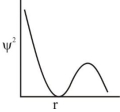
\(A, D\) and \(E\) statements are correct.For \(2 s\) orbital, the probability density first decreases and then increases.
At any distance from nucleus the probability density of finding electron is never zero and it always have some finite value.
इस पेज पर इन फ़िल्टर से कोई प्रश्न नहीं मिला।