


All JEE Mains 2023 Chemistry questions
25 chaptersShowing 301–350 of 366 questions
-
- (A) \(41\)
- (B) \(42\)
- (C) \(43\)
- (D) \(44\)
Show answer and solution
Correct Answer: (D)
\(CO _{( g )}+ H _2 O _{( g )} \rightleftharpoons CO _{2( g )}+ H _{2( g )}\)\(\begin{array}{lllll} t =0 & 1\,mol & 1\,mol & 0 & 0\end{array}\)
at equ. \(1- x \quad 1- x \quad x \quad x\)
at equilibrium \(40 \%\) by mass water reacts with \(CO\)
\(x=0.4 \quad 1-x=0.6\)
\(K _{ C }=\frac{\left[ CO _2\right]\left[ H _2\right]}{[ CO ]\left[ H _2 O \right]}=\frac{0.4 \times 0.4}{0.6 \times 0.6}=0.44\)
\(K _{ C } \times 10^2=44\)
-
- (A) \(2\)
- (B) \(6\)
- (C) \(5\)
- (D) \(3\)
Show answer and solution
Correct Answer: (D)
The yield of \(SO _3\) at equilibrium will be due to:\(B.\) Increasing pressure
\(C.\) Adding more \(SO _2\)
\(D.\) Adding more \(O _2\)
-
- (A) \(2\)
- (B) \(3\)
- (C) \(4\)
- (D) \(1\)
Show answer and solution
Correct Answer: (D)
\(SO _{2( g )}+\frac{1}{2} O _{2( g )} \rightleftharpoons SO _{3( g )}\)\(K _{ P }=2 \times 10^{12} \text { at } 300\,K\)
\(K _{ P }= K _{ C } \times( RT )^{\Delta n _{ g }}\)
\(2 \times 10^{12}= K _{ C } \times(0.082 \times 300)^{-1 / 2}\)
\(K _{ C }=9.92 \times 10^{12}\)
\(K _{ C }=0.992 \times 10^{13}\)
-
- (A) \(2\)
- (B) \(4\)
- (C) \(6\)
- (D) \(8\)
Show answer and solution
Correct Answer: (A)
\(H _2 O ( g ) \rightleftharpoons H _2( g )+\frac{1}{2} O _2( g )\)\(P _0[1-\alpha] \quad P _0 \alpha \quad \frac{ P _0 \alpha}{2} \quad \text { partial pr. at eq }\)
\(P _0\left[1+\frac{\alpha}{2}\right]=1\)
\(K _{ p }=\frac{\left( P _{ H _2}\right)\left( P _{ O _2}\right)^{1 / 2}}{ P _{ H _2 O }}\)
\(\frac{\left( P _0 \alpha\right)\left(\frac{ P _0 \alpha}{2}\right)^{1 / 2}}{ P _0[1-\alpha]}=2 \times 10^{-3}\)
since \(\alpha\) is negligible w.r.t 1 so \(P _0=1\) and \(1-\alpha \approx 1\)
\(\frac{\alpha \sqrt{\alpha}}{\sqrt{2}}=2 \times 10^{-3}\)
\(\alpha^{3 / 2}=2^{3 / 2} \times 10^{-3}\)
\(\alpha=2^{3 / 2 \times 2 / 3} \times 10^{-3 \times 2 / 3}\)
\(\alpha=2 \times 10^{-2} \quad \% \alpha=2 \%\)
-
- (A) \(1005\)
- (B) \(1006\)
- (C) \(1004\)
- (D) \(1003\)
Show answer and solution
Correct Answer: (B)
Bomb calorimeter \(\rightarrow\) const volumeHeat released
By combustion of \(1\) mole
\(C _2 H _6(\Delta U )=-\frac{20 \times 0.5}{0.3} \times 30=-1000\,kJ\)
\(C _2 H _6( g )+7 / 2 O _2( g ) \rightarrow 2 CO _2( g )+3 H _2 O (l)\)
\(\Delta ng =2-(2+7 / 2)=-(7 / 2)\)
\(\Delta H =\Delta U +\Delta nRT\)
\(=-1000-7 / 2 \times 8.3 \times 300\,kJ\)
\(=-1000-6.225\)
\(=-1006\,kJ\)
So heat released \(=1006\,kJ\,mol ^{-1}\)
-
- (A) \(120\)
- (B) \(130\)
- (C) \(140\)
- (D) \(150\)
Show answer and solution
Correct Answer: (D)
\(q =0\)\(\Delta U = w\)
\(1 \times 20 \times\left[ T _2-300\right]=-3000\)
\(T _2-300=-150\)
\(T _2=150\,K\)
-
- (A) \(1070\)
- (B) \(1060\)
- (C) \(1050\)
- (D) \(1040\)
Show answer and solution
Correct Answer: (A)
\(\Delta S =\frac{\Delta H }{ T _{ mp }}\)\(28.4=\frac{30.4 \times 1000}{ T _{ mp }}\)
\(T _{ mp }=1070.422\,K\)
-
- (A) \(600\)
- (B) \(200\)
- (C) \(800\)
- (D) \(500\)
Show answer and solution
Correct Answer: (C)
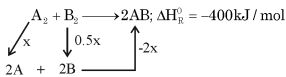
\(A _2+ B _2 \rightarrow 2 AB ; \Delta H _{ r }^0=-200\,kJ\,mol ^{-1}\)\(\Rightarrow \Delta H _{ p }^0( AB )=-200\,kJ\,mol\,m ^{-1}\)
\(\therefore \Delta H _{ R }^0\) for reaction \(A _2+ B _2 \rightarrow 2 AB\) is \(-400\,kJ\,mol ^{-1}\)
Given: Bond Enthalpy of \(A _2, B _2\) and \(AB\) is \(1: 0.5: 1\)
Assuming bond enthalpy of \(A _2\) be \(x\, kJ\, mol { }^{-1}\)
\(\therefore\) Bond enthalpy \(B _2=0.5 \times kJ\, mol ^{-1}\)
\(\therefore\) Bond enthalpy \(AB =( x ) kJ\, mol\, m ^{-1}\)
\(-400= x +0.5 x -2 x\)
\(-400=-0.5 x\)
\(\therefore x =800\,kJ / mol\)
-
- (A) \(180\)
- (B) \(360\)
- (C) \(90\)
- (D) \(45\)
Show answer and solution
Correct Answer: (B)
\(C _6 H _{12} O _6( s )+6 O _2 \rightarrow 6 CO _2( g )+6 H _2 O ( l )\)Extra energy used to convert \(H _2 O (1)\) into \(H _2 O (1)\) into \(H _2 O ( g )\)
\(=\frac{1800}{2}=900\,kJ\)
\(900= n _{ H _2 O } \times 45\)
\(n _{ H _2 O }=\frac{900}{45}=20\,mole\)
\(W _{ H _2 O }=20 \times 18=360\,g\)
-
- (A) \(3\)
- (B) \(6\)
- (C) \(8\)
- (D) \(2\)
Show answer and solution
Correct Answer: (D)
\(B\) and \(D\) options are correct. -
- (A) \(6\)
- (B) \(3\)
- (C) \(12\)
- (D) \(9\)
Show answer and solution
Correct Answer: (A)
\(\because \Delta G ^{\circ}=- RT \ln K _{ eq }\)\(\text { and } K _{ eq }=\frac{ K _{ f }}{ K _{ b }}\)
\(\therefore K _{ eq }=\frac{10^3}{10^2}=10\)
\(\therefore \Delta G =- RT \ln 10\)
\(\Rightarrow-(8.3 \times 300 \times 2.3)=-5.7\,kJ\,mole ^{-1} \approx 6\,kJ\)
\(\text { mole }{ }^{-1}(\text { nearest integer) }\)
\(\text { Ans }=6\)
-
- (A) \(6\)
- (B) \(4\)
- (C) \(8\)
- (D) \(2\)
Show answer and solution
Correct Answer: (D)
For, Spontaneous process \(dG < 0\)For, Equilibrium \(dG =0\)
For, Nonspontaneous process \(dG > 0\)
\(\therefore\) \(A\) Wrong
\(B\) Correct
\(C\) Correct
\(D\) Wrong
-
- (A) \(172\)
- (B) \(174\)
- (C) \(173\)
- (D) \(176\)
Show answer and solution
Correct Answer: (C)
\(\Delta_{ r } H =\sum H _{ p }-\sum H _{ R }\)\(=(-394+4 \times-92)-(-105+(2 \times-242))\)
\(=-173\,kJ / mol\)
-
- (A) \(1411\)
- (B) \(1412\)
- (C) \(1413\)
- (D) \(1414\)
Show answer and solution
Correct Answer: (A)
\(C _2 H _{4( g )}+3 O _{2( g )} \longrightarrow 2 CO _{2( g )}+2 H _2 O_{(l)}\)\(\Delta U =-1406\,KJ\,mol ^{-1}, T =300\,K\)
\(\Delta H =\Delta U +\Delta n _{ g } RT\)
\(\Delta H =-1406+(-2) \times 8.3 \times 300=-1406-4.98\)
\(=-1410.98\,KJ\,mol ^{-1} \approx-1411\)
\(\Delta H = T \Delta S =-1411\,KJ\,mol ^{-1}\)
-
- (A) \(4\)
- (B) \(6\)
- (C) \(2\)
- (D) \(8\)
Show answer and solution
Correct Answer: (C)
\(\Delta G =\Delta H - T \Delta S\)\(A : \Delta G \left( J\,mol ^{-1}\right)=-25 \times 10^3+80 \times 300:- ve\)
\(B : \Delta G \left( J\,mol ^{-1}\right)=-22 \times 10^3-40 \times 300:- ve\)
\(C : \Delta G \left( J\,mol ^{-1}\right)=25 \times 10^3+300 \times 50:+ ve\)
\(D : \Delta G \left( J\,mol ^{-1}\right)=22 \times 10^3-20 \times 300:+ ve\)
Processes \(C\) and \(D\) are non-spontaneous.
-
- (A) \(\frac{x-2 y}{2}\)
- (B) \(\frac{x+2 y}{2}\)
- (C) \(\frac{2 x - y }{2}\)
- (D) \(2 y-x\)
Show answer and solution
Correct Answer: (A)
Target equation\(C \text { (graphite) }+\frac{1}{2} O _{2( g )} \rightarrow CO _{( g )} \ldots \text {.(i) } \Delta H\)
\(C \left(\text { graphite) }+ O _{2( g )} \rightarrow CO _{2( g )} \text {.(ii) } \Delta H _1=- y\,kJ / mole \right.\)
\(CO _{2( g )} \rightarrow CO _{( g )}+\frac{1}{2} O _{2( g )} \ldots \text { (iii) } \Delta H _2=\frac{ x }{2}\,kJ / mole\)
\(\text { eq. (i) }=\text { eq.(ii) }+ \text { eq (iii) }\)
\(\therefore \Delta H =\frac{ x }{2}- y =\frac{ x -2 y }{2}\)
-
- (A) \(NaI < NaBr < NaCl < NaF\)
- (B) \(NaF < NaCl < NaBr < NaI\)
- (C) \(NaCl < NaF < NaBr < NaI\)
- (D) \(NaI < NaBr < NaF < NaCl\)
Show answer and solution
Correct Answer: (A)
For a given metal \(\Delta_{ f } H ^0\) always becomes less negative from fluoride to iodide. -
- (A) \(4\)
- (B) \(3\)
- (C) \(5\)
- (D) \(6\)
Show answer and solution
Correct Answer: (B)
\(\Delta \underset{\text { }}{S}= nR \ell n \left(\frac{ V _2}{ V _1}\right)\)\(=1 \times 8.314 \ell n \left(\frac{3}{2}\right)\)
\(\Delta S_{\text {System }}=3.37\)
\(\Delta S_{\text {Surr. }}=3.37\)
-
- (A) \(620\)
- (B) \(621\)
- (C) \(623\)
- (D) \(624\)
Show answer and solution
Correct Answer: (A)
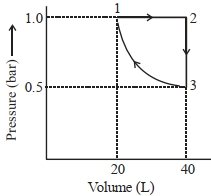
\(1 \rightarrow 2 \Rightarrow \text { Isobaric process }\)\(2 \rightarrow 3 \Rightarrow \text { Isochoric process }\)
\(3 \rightarrow 1 \Rightarrow \text { Isothermal process }\)
\(W = W _{1 \rightarrow 2}+ W _{2 \rightarrow 3}+ W _{3 \rightarrow 1}\)
\(=\left(- P \left( V _2- V _1\right)+0\left[- P _1 V _1 \ln \left(\frac{ V _2}{ V _1}\right)\right]\right)\)
\(=\left[-1 \times(40-20)+0+\left[-1 \times 20 \ln \left(\frac{20}{40}\right)\right]\right]\)
\(=-20+20 \ln 2\)
\(=-20+20 \times 2.3 \times 0.3\)
\(=-6.2 \text { bar } L\)
\(| W |=6.2 \text { bar } 1=620\,J\)
-
- (A) \(3\)
- (B) \(2\)
- (C) \(5\)
- (D) \(4\)
Show answer and solution
Correct Answer: (D)
\(Fe _2 O _3+2 Al \rightarrow Al _2 O _3+2 Fe\)Molar mass \(160\,g \quad 27\,g\)
\(\left(\Delta H _{ f }^0\right)_{\text {reaction }}=\left[\left(\Delta H _{ f }^0\right)_{ Al _2 O _3}+2\left(\Delta H _{ f }^0\right)_{ Fe }\right]\)
\(- \left[\left(\Delta H _{ f }^0\right)_{ Fe _2 O _3}+2\left(\Delta H _{ f }^0\right)_{ Al }\right]\)\(=[-1700+0]-[-840+0]\)
\(=-860\,kJ / mol\)
\(\text { Total mass of mixture }= Fe _2 O _3+ Al (1: 2 \text { molar }\)
\(\text { ratio })\)
\(=160+2 \times 27\)
\(=214\,g / mol\)
\(\text { Heat evolved per gram }=\frac{860}{214}=4\,kJ / g\)
-
- (A) \(600\)
- (B) \(620\)
- (C) \(630\)
- (D) \(610\)
Show answer and solution
Correct Answer: (D)
\(\frac{1}{2} Cl _{2( g )} \rightarrow Cl _{( g )} \rightarrow Cl _{( g )}^{-} \rightarrow Cl _{( aq .)}^{-}\)\(\Delta H ^{\circ}=\frac{1}{2} \times 240+(-350)+(-380)\)
\(=-610 \text { ans. }\)
-
- (A) \(3\)
- (B) \(2\)
- (C) \(4\)
- (D) \(1\)
Show answer and solution
Correct Answer: (C)
\(A \rightarrow\) Endothermic (Atomisation)\(B \rightarrow\) Endothermic (Atomisation)
\(C \rightarrow\) Endothermic (Vapourisation)
\(D \rightarrow\) Exothermic (Combustion)
\(E \rightarrow\) Endothermic (Dissolution)
- 323. The standard electrode potential of \(M ^{+} / M\) in aqueous solution does not depend on 2023 Medium
- (A) Ionisation of a solid metal atom
- (B) Sublimation of a solid metal
- (C) Ionisation of a gaseous metal atom
- (D) Hydration of a gaseous metal ion
Show answer and solution
Correct Answer: (A)
Factual -
- (A) \(4\)
- (B) \(8\)
- (C) \(2\)
- (D) \(6\)
Show answer and solution
Correct Answer: (A)
Extensive \(\Rightarrow\) Mole, Volume, Gibbs free energy.Intensive \(\Rightarrow\) Molar mass, Molar heat capacity, Molarity, \(E ^\theta\) cell.
-
- (A) \(11\)
- (B) \(12\)
- (C) \(14\)
- (D) \(10\)
Show answer and solution
Correct Answer: (D)
\(\Delta G ^0=\Delta H ^0- T \Delta S\)\(\Rightarrow \Delta G ^0=(-54070-10 \times 298)\)
Also, \(\Delta G ^0=(-2.303 RT \log K )\)
\(\Rightarrow(-54070-10 \times 298)\)
\(=(-2.303 \times 8.134 \times 298 \log K )\)
\(\Rightarrow \log K =10 \text { Ans: } 10\)
- 326. What happens when methane undergoes combustion in systems A and B respectively?
2023 MediumSystem \(A\) System \(B\) Temprature rise Temprature remains same - (A)
System \(A\) System \(B\) Adiabatic system Temprature rise - (B)
System \(A\) System \(B\) Temprature falls Diathermic system - (C)
System \(A\) System \(B\) Temprature falls Temprature remains same - (D)
System \(A\) System \(B\) Temprature remains same Temprature rise
Show answer and solution
Correct Answer: (A)
Adiabatic boundary does not allow heat exchange thus heat generated in container can't escape out thereby increasing the temperature.In case of Diathermic container, heat flow can occur to maintain the constant temperature.
- (A)
-
- (A) \(1\)
- (B) \(0\)
- (C) \(2\)
- (D) \(3\)
Show answer and solution
Correct Answer: (B)
For ideal gas \(U = f ( T )\)and for isothermal process, \(\Delta U =0\)
-
- (A) \(1100\)
- (B) \(1200\)
- (C) \(1000\)
- (D) \(1600\)
Show answer and solution
Correct Answer: (B)
Power of heater \(=60\,W\) \(=60\,J / sec\)Total energy emitted \(=60 \times 100=6000\,J\)
Heat capacity \(\times\) temp difference \(=6000\)
Heat capacity \(=\frac{6000}{5}=1200\,JK ^{-1}\)
-
- (A) \(C\) and \(D\) only
- (B) \(B\) and \(C\) only
- (C) \(A\) and \(B\) only
- (D) \(B\) and \(D\) only
Show answer and solution
Correct Answer: (B)
Only \((B)\) and \((C)\) are correct.\((B)\) \(G = H - TS\)
At constant \(T\)
\(\Delta G =\Delta H - T \Delta S\)
(A) First law is given by
\(\Delta U = Q + W\)
If we apply constant \(P\) and reversible work
\(\Delta U = Q - P \Delta V\)
(C)By definition of entropy change
\(dS =\frac{ dq _{ rer }}{ T }\)
At constant \(T\)
\(\Delta S=\frac{q_{\text {rev }}}{T}\)
(D) \(H = U + PV\)
For ideal gas
\(H = U + nRT\)
At constant \(T\)
\(\Delta H =\Delta U +\Delta nRT\)
- 330. \(Be ( OH )_2\) react with \(Sr ( OH )_2\) to yield an ionic salt. Choose the incorrect option related to this reaction from the following: 2023 Medium
- (A) Be is tetrahedrally coordinated in the ionic salt.
- (B) The reaction is an example of acid - base neutralization reaction.
- (C) Both \(Sr\) and \(Be\) elements are present in the ionic salt.
- (D) The elements \(Be\) is present in the cationic part of the ionic salt.
Show answer and solution
Correct Answer: (D)
\(Be ( OH )_2\) is amphoteric in nature.\(Sr ( OH )_2\) is basic in nature.
These two undergo acid - base reaction to form a salt.
\(Be ( OH )_2+ Sr ( OH )_2 \rightarrow Sr \left[ Be ( OH )_4\right]\)
(salt)
-
- (A) Strong ionic bond in Boric acid
- (B) Strong van der Waal's interaction in Boric acid
- (C) Strong hydrogen bond in Boric acid
- (D) Strong covalent bond in \(BF _3\)
Show answer and solution
Correct Answer: (C)
Boric acid has strong hydrogen bonding while \(BF _3\) does not. Therefore boric acid is solid. - 332. During the borax bead test with \(CuSO _4\), a blue green colour of the bead was observed in oxidising flame due to the formation of 2023 Hard
- (A) \(Cu _3 B _2\)
- (B) \(Cu\)
- (C) \(Cu \left( BO _2\right)_2\)
- (D) \(CuO\)
Show answer and solution
Correct Answer: (C)
Blue green colour is due to formation of \(Cu \left( BO _2\right)_2\)\(CuSO _4 \stackrel{\Delta}{\longrightarrow} CuO + SO _3\)
\(CuO + B _2 O _3 \rightarrow Cu \left( BO _2\right)_2\)
-
- (A) \(3\)
- (B) \(4.5\)
- (C) \(2\)
- (D) \(1.5\)
Show answer and solution
Correct Answer: (A)
For good quality cement, the ratio of silica \(\left( SlO _2\right)\) to Alumina \(\left( Al _2 O _3\right)\) should be between \(2.5\) to \(4\). - 334. For compound having the formula \(GaAlCl _4\), the correct option from the following is 2023 Medium
- (A) \(Ga\) is more electronegative than \(Al\) and is present as a cationic part of the salt \(GaAlCl _4\)
- (B) Oxidation state of \(Ga\) in the salt \(GaAlC _4\) is \(+3\).
- (C) \(Cl\) forms bond with both \(Al\) and \(Ga\) in \(GaAlCl _4\)
- (D) \(Ga\) is coordinated with \(Cl\) in \(GaAlCl _4\)
Show answer and solution
Correct Answer: (A)
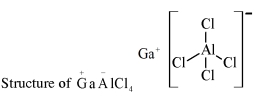
Gallous tetrachloro aluminate \(Ga ^{+} AlCl _4^{-}\)\(2 Ga + Ga ^{+} GaCl _4^{-}+2 Al _2 Cl _6 \stackrel{190^{\circ}}{\longrightarrow} 4 Ga ^{+} AlCl _4^{-}\)
Ga is cationic part of salt \(GaAlCl _4\).
-
- (A) Both \(A\) and \(R\) are correct but \(R\) is NOT the correct explanation of \(A\).
- (B) Both \(A\) and \(R\) are correct and \(R\) is the correct explanation of \(A\).
- (C) \(A\) is not correct but \(R\) is correct.
- (D) \(A\) is correct but \(R\) is not correct.
Show answer and solution
Correct Answer: (B)
The oxide which form acid on dissolving in water is acidic oxide. -
- (A) Statement \(I\) is incorrect but Statement \(II\) is correct
- (B) Both Statement \(I\) and Statement \(II\) is correct
- (C) Statement \(I\) is correct but Statement \(II\) is incorrect
- (D) Both Statement \(I\) and Statement \(II\) is incorrect
Show answer and solution
Correct Answer: (B)
Boron is non- metallic in nature. It is extremely hard and black coloured solid. It exists in many allotropic forms. Due to very strong crystalline lattice, boron has unusually high melting point and boiling point.Element \(B\) \(Al\) \(Ga\) \(In\) \(TI\) Melting point \(2453\) \(933\) \(303\) \(430\) \(576\) Boiling point \(3923\) \(2740\) \(2676\) \(2353\) \(1730\) -
- (A) Both the statements \(I\) and \(II\) are correct
- (B) Statement \(I\) is incorrect but statement \(II\) is correct
- (C) Both the statements \(I\) and \(II\) are incorrect
- (D) Statement \(I\) is correct but statement \(II\) is incorrect
Show answer and solution
Correct Answer: (D)
Statement- \(I\) is correct.\(Ni\) is used in Hydrogenation of unsaturated fat to make edible fats.
Statements\(-II\) is false as hydride of Silicon is electron precise and neither electron deficient nor electron rich.
-
- (A) Statement \(I\) is incorrect but statement \(II\) is correct.
- (B) Both the statements \(I\) and \(II\) are correct
- (C) Statement \(I\) is correct but statement \(II\) is incorrect
- (D) Both the statements \(I\) and \(II\) are incorrect
Show answer and solution
Correct Answer: (B)
The first ionization energies (as in NCERT) are as follows:\(B\) : \(801\,kJ / mol\)
\(Al : 577\,kJ / mol\)
Ga : \(579\,kJ / mol\)
\(Ga :[ Ar ] 3 d ^{10} 4 s ^2 4 p ^1\)
-
- (A) Both Statement \(I\) and Statement \(II\) are true
- (B) Statement \(I\) is true but Statement \(II\) is false
- (C) Both Statement \(I\) and Statement \(II\) are false
- (D) Statement \(I\) is false but Statement \(I\) is true
Show answer and solution
Correct Answer: (C)
(Borax Bead Test)On treatment with metal salt, boric anhydride forms metaborate of the metal which gives different colours in oxidising and reducing flame.
For example, in the case of copper sulphate, following reactions occur.
\(CuSO _4+ B _2 O _3 \longrightarrow Cu \left( BO _2\right)_2+ SO _3\)
Two reactions may take place in reducing flame (Luminous flame)
\((i)\) The blue-green \(Cu \left( BO _2\right)_2\) is reduced to colourless cuprous metaborate as :
\(2 Cu ( BO _2 )_2+2 NaBO _2+ C \underset{\text { flame }}{\stackrel{\text { Luminous }}{\longrightarrow}} 2 CuBO _2+\) \( Na _2 B _4 O _7+ CO\)
\((ii)\) Cupric metaborate may be reduced to metallic copper and bead appears red opaque.
\(2 Cu \left( BO _2\right)_2+4 NaBO _2+2 C \underset{\text { fuminous }}{\stackrel{\text { flame }}{\longrightarrow}} 2 Cu +\) \(2 Na _2 B _4 O _7+2 CO\)
-
- (A) \(A-IV, B-I, C-II, D-III\)
- (B) \(A-IV, B-III, C-I, D-II\)
- (C) \(A-II, B-III, C-IV, D-I\)
- (D) \(A-IV, B-III, C-II, D-I\)
Show answer and solution
Correct Answer: (D)
Cobalt catalyst \(\rightarrow\) Methanol productionSyn gas \(\rightarrow\) Coal gasification
\(\left( C _{\text {(Redhot coke) }}+ H _2 O ( g ) \rightarrow CO + H _2\right)\)
Nickel catalyst \(\rightarrow\) Water gas production
Brine solution \(\rightarrow\) Production
(aq. \(NaCl ) \quad\left(\begin{array}{l} H _2 \rightarrow \text { Cathode } \\ Cl _2 \rightarrow \text { anode }\end{array}\right)\)
-
- (A) \(Si - Si > C - C > Sn - Sn > Ge - Ge\)
- (B) \(Si - Si > C - C > Ge - Ge > Sn - Sn\)
- (C) \(C - C > Si - Si > Sn - Sn > Ge - Ge\)
- (D) \(C - C > Si - Si > Ge - Ge > Sn - Sn\)
Show answer and solution
Correct Answer: (D)
(Bond enthalpy order \(C - C > Si - Si > Ge - Ge > Sn - Sn )\) -
- (A) It has electronic delocalization
- (B) It contains banana bonds.
- (C) It can react with water.
- (D) It is a cyclic compound.
Show answer and solution
Correct Answer: (C)
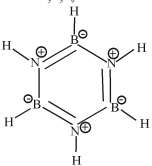
Borazine is \(B _3 N _3 H _8\)\(B _8 N _3 H _6+9 H _2 O \rightarrow 3 NH _3+3 H _8 BO _3+3 H _2\)
-
- (A) \(BBr _3 > BI _3 > BCI _3 > BF _3\)
- (B) \(BCl _3 > BF _3 > BBr _3 > BI _3\)
- (C) \(BF _3 > BCl _3 > BBr _3 > BI _3\)
- (D) \(BI _3 > BBr _3 > BCl _3 > BF _3\)
Show answer and solution
Correct Answer: (D)
Extent of back bonding, reduces down the group leading to more Lewis acidic strength \(BF _3 > BCl _3 > BBr _3 > BI _3\) (extent of back bonding) \((2 p-2 p)(2 p-3 p)(2 p-4 p)(2 p-5 p)\)\(BF _3 < BCl _3 < BBr _3 < BI _3\) (lewis acidic nature)
-
- (A) \(B > D > C > A\)
- (B) \(D > B > C > A\)
- (C) \(A > C > B > D\)
- (D) \(D > B > A > C\)
Show answer and solution
Correct Answer: (B)
\((A)\) \(n =3 ; 1=0 ; m =0 ; 3 s\) orbital\((B)\) \(n =4 ; 1=0 ; m =0 ; 4 s\) orbital
\((C)\) \(n =3 ; 1=1 ; m =0 ; 3 p\) orbital
\((D)\) \(n =3 ; 1=2 ; m =0 ; 3 d\) orbital
As per Hund's rule energy is given by \(( n +l)\) value.
If value of \(( n +l)\) remains same then energy is given by \(n\) only.
-
- (A) \(170\)
- (B) \(180\)
- (C) \(270\)
- (D) \(250\)
Show answer and solution
Correct Answer: (C)
\(r \propto \frac{ n ^2}{ Z }\)\(r _{ He ^{+}} = r _{ H } \times \frac{ n ^2}{ Z }\)
\(r _{ He ^{+}} =0.6 \times \frac{(3)^2}{2}\)
\(=2.7 \mathring A\)
\(r _{ He ^{+}} =270\,pm\)
-
- (A) \(2\)
- (B) \(3\)
- (C) \(1\)
- (D) \(4\)
Show answer and solution
Correct Answer: (A)
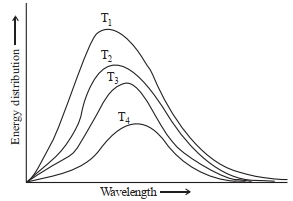
The spectrum of Black body radiation is explained using quantization of energy. With increase in temperature, peak of spectrum shifts to shorter wavelength or higher frequency. For above graph\(\rightarrow T _1 > T _2 > T _3 > T _4 \text {. }\)
-
- (A) Both \(A\) and \(R\) are true but \(R\) is NOT the correct explanation of \(A\)
- (B) Both \(A\) and \(R\) are true and \(R\) is the correct explanation of \(A\)
- (C) \(A\) is false but \(R\) is true
- (D) \(A\) is true but \(R\) is false
Show answer and solution
Correct Answer: (B)
\(5 f\) orbital not buried as \(4 f\) orbitals so \(e ^{-}\) present in \(5 f\) orbital experience less nuclear attraction than \(e ^{-}\)present in \(4 f\) orbital. Hence electrons of 5 f orbital can take part in bonding to a far greater extent. -
- (A) Both \(A\) and \(R\) are correct but \(R\) is NOT the correct explanation of \(A\)
- (B) \(A\) is correct but \(R\) is not correct
- (C) Both \(A\) and \(R\) are correct and \(R\) is the correct explanation of \(A\)
- (D) \(A\) is not correct but \(R\) is correct
Show answer and solution
Correct Answer: (B)
There is a characteristic minimum frequency, or "threshold frequency," for each metal below which the photoelectric effect is not seen. The ejected electrons leave with a specific amount of kinetic energy at a frequency \(v > v _0\) with an increase in light frequency of these electron kinetic energies also rise. -
- (A) Both Statement \(I\) and Statement \(II\) are correct.
- (B) Statement \(I\) is correct but Statement \(II\) is incorrect.
- (C) Statement \(I\) is incorrect but Statement \(II\) is correct
- (D) Both Statement \(I\) and Statement \(II\) are incorrect.
Show answer and solution
Correct Answer: (A)
According to Bohr's model the angular momentum is quantised and equal to \(\frac{ nh }{2 \pi}\).Heisenberg uncertainty principle explains orbital concept, which is based on probability of finding electron.
-
- (A) \(16\)
- (B) \(32\)
- (C) \(50\)
- (D) \(72\)
Show answer and solution
Correct Answer: (B)
The number of electrons in the orbitals of sub-shell of \(n=4\) are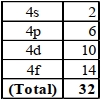
No questions on this page match these filters.