


JEE Mains 2013 Physics ના બધા પ્રશ્નો
27 પ્રકરણ127 માંથી 51–100 પ્રશ્નો
-
- (A) \(16\times10^3\, Wb \,m^{ -2}\)
- (B) \(2\times10^3\, Wb \,m^{ -2}\)
- (C) \(1\times10^3\, Wb \,m^{ -2}\)
- (D) \(4\times10^3\, Wb \,m^{ -2}\)
જવાબ અને ઉકેલ જુઓ
સાચો જવાબ: (C)
Since particle is moving undeflected So, \(qE\, = qvB\) \( \Rightarrow B = \frac{E}{V} = \frac{{{{10}^4}}}{{10}} = {10^3}\,wb/{m^2}\) -
- (A) \(2.5\times10^{- 8}\, T\)
- (B) \(2.0\times10^{- 7}\, T\)
- (C) \(1.63\times10^{- 11}\, T\)
- (D) શૂન્ય
જવાબ અને ઉકેલ જુઓ
સાચો જવાબ: (D)
Magnetic field between the plates in this case is zero. -
- (A) વિધાન \(I\) સાચું છે,વિધાન \(II\) સાચું છે,વિધાન \(-II\) એ વિધાન \(-I\) ની સાચી સમજણ આપે છે.
- (B) વિધાન \(I\) સાચું છે,વિધાન \(II\) સાચું છે,વિધાન \(-II\) એ વિધાન \(-I\) ની સાચી સમજણ આપતું નથી.
- (C) વિધાન \(I\) સાચું છે,વિધાન \( II\) ખોટું છે.
- (D) વિધાન \(I\) ખોટું છે,વિધાન \(II\) સાચું છે.
જવાબ અને ઉકેલ જુઓ
સાચો જવાબ: (D)
Statements \(I\) is false and Statement \(II\) is trueFor ammeter, shunt resistance, \(\mathrm{S}=\frac{\mathrm{IgG}}{\mathrm{I}-\mathrm{Ig}}\)
Therefore for \(I\) to increase, \(S\) should decrease, So additional \(S\) can be connected across it.
-
- (A) બંને ગુચળામાં પ્રવાહ એક જ દિશામાં હશે.
- (B) \(ac\) સ્ત્રોનો ઉપયોગ કરવામાં આવે તો પણ બંન્ને એકબીજા તરફ આકર્ષણ બળ લગાવશે
- (C) બળ \(d^{-1}\) ના સમપ્રમાણમાં હોય
- (D) બળ \(d^{-2}\) ના સમપ્રમાણમાં હોય
જવાબ અને ઉકેલ જુઓ
સાચો જવાબ: (D)
As the force between the two coils is attractive hence currents in the coil must be in the same direction and the force, \(F \propto \frac{{{I_1}{I_2}}}{{2\pi d}}\) where \(I_1\) and \(I_2\) are the currents flowing through the coils. -
- (A) \(T < 2\pi \sqrt {\frac{l}{g}} \) અને હવા કરતાં ઓછો અવમંદિત થાય
- (B) \(T = 2\pi \sqrt {\frac{l}{g}} \) અને હવા કરતાં વધુ અવમંદિત થાય
- (C) \(T > 2\pi \sqrt {\frac{l}{g}}\) અને હવા કરતાં ઓછો અવમંદિત થાય
- (D) \(T < 2\pi \sqrt {\frac{l}{g}} \) અને હવા કરતાં વધુ અવમંદિત થાય
જવાબ અને ઉકેલ જુઓ
સાચો જવાબ: (D)
When the pendulum is oscillating over a current carrying coil , and when the direction of oscillating pendulum bob is opposite to the direction of current. Its instantaneous acceleration increases. Hence time period \(T < 2\pi \sqrt {\frac{\ell }{g}} \) and damping is larger than in air alone due energy dissipation - 56. \(L\) લંબાઈના સીધા વાહકમાંથી \(i\) જેટલો પ્રવાહ વહે છે. તેની અક્ષ પર કેન્દ્રથી \(\frac {L}{4}\) અંતરે ચુંબકીય પ્રેરણ કેટલું મળે? 2013 મધ્યમ
- (A) \(\frac{{4{\mu _0}i}}{{\sqrt 5 \pi L}}\)
- (B) \(\frac{{{\mu _0}i}}{{2\pi L}}\)
- (C) \(\frac{{{\mu _0}i}}{{\sqrt 2 L}}\)
- (D) શૂન્ય
જવાબ અને ઉકેલ જુઓ
સાચો જવાબ: (A)
\(B=\frac{\mu_{0} i}{4 \pi R}\left(\sin \theta_{1}+\sin \theta_{2}\right)\)\(\sin \theta_{2}=\frac{L / 2}{\sqrt{(L / 2)^{2}+(L / 2)^{2}}}=\frac{1}{2(\sqrt{1 / 4+1 / 16})}=\frac{2}{\sqrt{5}}\)
\(\Rightarrow B=\frac{\mu_{0} i}{{4 \pi \frac{L}{4}}}\left(\frac{2 \times 4}{2 \sqrt{5}}\right) B=\frac{4 \mu_{0} i}{\sqrt{5} \pi L}\)
-
- (A) \(6.6 \times 10^{-9}\) \( weber\)
- (B) \(9.1 \times 10^{-11} \) \(weber\)
- (C) \(6.0 \times 10^{-11} \) \(weber\)
- (D) \(3.3 \times 10^{-11} \) \(weber\)
જવાબ અને ઉકેલ જુઓ
સાચો જવાબ: (B)
Aswe know, Magnetic flux, \(\phi=B . A\)\(\frac{\mu_{0}(2)\left(20 \times 10^{-2}\right)^{2}}{2\left[(0.2)^{2}+(0.15)^{2}\right]} \times \pi\left(0.3 \times 10^{-2}\right)^{2}\)
On solving
\(=9.216 \times 10^{-11}=9.2 \times 10^{-11}\) \( weber\)
-
- (A) \(A\)
- (B) \(C\)
- (C) \(B\)
- (D) \(D\)
જવાબ અને ઉકેલ જુઓ
સાચો જવાબ: (A)
Induced emf \(\varepsilon \, \propto \,\frac{{ - di}}{{dt}}\) -
- (A) \(\frac{{2B\omega {l^2}}}{2}\)
- (B) \(\;\frac{{3B\omega {l^2}}}{2}\)
- (C) \(\;\frac{{4B\omega {l^2}}}{2}\)
- (D) \(\;\frac{{5B\omega {l^2}}}{2}\)
જવાબ અને ઉકેલ જુઓ
સાચો જવાબ: (D)
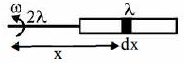
Here, induced \(e.m.f.\)\(e=\int_{2 f}^{3 \ell}(\omega x) B d x=B \omega \frac{\left[(3 \ell)^{2}-(2 \ell)^{2}\right]}{2}=\frac{5 B \ell^{2} \omega}{2}\)
-
- (A) \(3.6 \times 10^{-5} \) \(Wbm^{-2}\)
- (B) \(2.56 \times 10^{-4}\) \( Wbm^{-2}\)
- (C) \(3.50 \times 10^{-4} \) \(Wbm^{-2}\)
- (D) \(5.80 \times 10^{-4}\) \(Wbm^{-2}\)
જવાબ અને ઉકેલ જુઓ
સાચો જવાબ: (B)
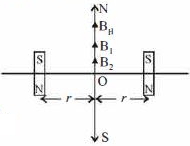
Given \(: M_{1}=1.20 \,A m^{2}\) and \(M_{2}=1.00 \,A m^{2}\)\(r=\frac{20}{2}\, c m=0.1\, \mathrm{m}\)
\(\mathrm{B}_{\mathrm{net}}=\mathrm{B}_{1}+\mathrm{B}_{2}+\mathrm{B}_{\mathrm{H}}\)
\(B_{n e t}=\frac{\mu_{0}}{4 \pi} \frac{\left(M_{1}+M_{2}\right)}{r^{3}}+B_{H}\)
\(=\frac{10^{-7}(1.2+1)}{(0.1)^{3}}+3.6 \times 10^{-5}\)
\(=2.56 \times 10^{-4}\, \mathrm{wb} / \mathrm{m}^{2}\)
-
- (A) \(0.6\)
- (B) \(1.2\)
- (C) \(1.8\)
- (D) \(0.32\)
જવાબ અને ઉકેલ જુઓ
સાચો જવાબ: (A)
Gven \(M=8 \times 10^{22}\, \mathrm{Am}^{2}\)\(\mathrm{d}=\mathrm{R}_{\mathrm{e}}=6.4 \times 10^{6}\, \mathrm{m}\)
Earth's magnetic field, \(\mathrm{B}=\frac{\mu_{0}}{4 \pi} \cdot \frac{2 \mathrm{M}}{\mathrm{d}^{3}}\)
\(=\frac{4 \pi \times 10^{-7}}{4 \pi} \times \frac{2 \times 8 \times 10^{22}}{\left(6.4 \times 10^{6}\right)^{3}}\)
\(\cong 0.6\) \(Gauss\)
-
- (A) \(50\)
- (B) \(10\)
- (C) \(36.7\)
- (D) \(26.7\)
જવાબ અને ઉકેલ જુઓ
સાચો જવાબ: (D)
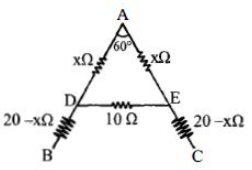
For \(ADE\) \(\frac{1}{\mathrm{R}^{\prime}}=\frac{1}{2 \mathrm{x}}+\frac{1}{10}\)or \(\quad \mathrm{R}^{\prime}=\frac{20 \mathrm{x}}{10+2 \mathrm{x}}\)
\(\mathrm{R}_{\mathrm{BC}}=\frac{20 \mathrm{x}}{10+2 \mathrm{x}}+20-\mathrm{x}+20-\mathrm{x}\) ....\((i)\)
or \(\frac{20 x}{10+2 x}+40=2 x\)
Solving we get
\(x=10\, \Omega\)
Putting the value of \(x=10\, \Omega\) in equation \(( i )\) We get
\( R_{B C} =\frac{20 \times 10}{10+2 \times 10}+20-10+20-10 \)
\(=\frac{80}{3}=26.7\, \Omega \)
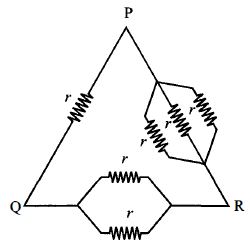
- 63. છ સમાન અવરોધને પરિપથમાં દર્શાવ્યા પ્રમાણે ગોઠવેલા છે. તો કયા બે બિંદુ વચ્ચેનો સમતુલ્ય અવરોધ મહત્તમ હશે?
 2013 અઘરું
- (A) \(P\) અને \(R\)
- (B) \(P\) અને \(Q\)
- (C) \(Q\) અને \(R\)
- (D) કોઈ પણ બે બિંદુ
જવાબ અને ઉકેલ જુઓ
સાચો જવાબ: (B)
Resistance between \(\mathrm{P\,and\,} \mathrm{Q}\)\(r_{P Q}=r_{11}\left(\frac{r}{3}+\frac{r}{2}\right)=\frac{r \times \frac{5}{6} r}{r+\frac{5}{6} r}=\frac{5}{11} r\)
Resistance between \(Q\) and \(R\)
\(\mathrm{r}_{\mathrm{QR}}=\frac{\mathrm{r}}{2} 11\left(\mathrm{r}+\frac{\mathrm{r}}{3}\right)=\frac{\frac{\mathrm{r}}{2} \times \frac{4}{3} \mathrm{r}}{\frac{\mathrm{r}}{2}+\frac{4}{3} \mathrm{r}}=\frac{4}{11} \mathrm{r}\)
Resistance between \(\mathrm{P}\) and \(\mathrm{R}\)
\({{\rm{r}}_{{\rm{PR}}}} = \frac{{\rm{r}}}{3}11\left( {\frac{{\rm{r}}}{2} + {\rm{r}}} \right) = \frac{{\frac{{\rm{r}}}{3} \times \frac{3}{2}{\rm{r}}}}{{\frac{{\rm{r}}}{3} + \frac{3}{2}{\rm{r}}}} = \frac{3}{{11}}{\rm{r}}\)
Hence, it is clear that \(\mathrm{r}_{\mathrm{PQ}}\) is maximum
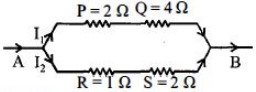
- 64. જ્યારે પ્રવાહ \(A\) થી \(B\) તરફ વહેતો હોય ત્યારે નીચે પૈકી ચાર અવરોધ \(P, Q, R\) અને \(S\) માથી કયો અવરોધ મહત્તમ ઉષ્મા ઉત્પન્ન કરે?
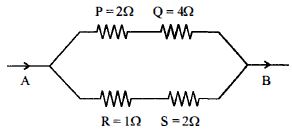 2013 અઘરું
- (A) \(Q\)
- (B) \(S\)
- (C) \(P\)
- (D) \(R\)
જવાબ અને ઉકેલ જુઓ
સાચો જવાબ: (B)
\(\mathrm{R}_{1}=\mathrm{P}+\mathrm{Q}=2 \,\Omega+4\, \Omega=6 \,\Omega\)\(\mathrm{R}_{2}=\mathrm{R}+\mathrm{S}=1 \,\Omega+2 \,\Omega=3\, \Omega\)
\(\mathrm{I}_{1} \mathrm{R}_{1}=\mathrm{I}_{2} \mathrm{R}_{2}\)
\(\mathrm{I}_{1}=\frac{\mathrm{R}_{2}}{\mathrm{R}_{1}} \mathrm{I}_{2}=\frac{3}{6} \mathrm{I}_{2}=\frac{\mathrm{I}_{2}}{2}\)
or \(\mathrm{I}_{2}=2 \mathrm{I}_{1}\)
Heat flow \(\mathrm{H}=\mathrm{I}^{2} \mathrm{Rt}\)
For \(Q, H_{Q}=I_{1}^{2} Q t=\frac{I_{2}^{2}}{4} \times 4 t=I_{2}^{2} t\)
For \(\mathrm{S}, \mathrm{H}_{\mathrm{S}}=\mathrm{I}_{2}^{2} \mathrm{St}=\mathrm{I}_{2}^{2} \cdot 2 \mathrm{t}=2 \mathrm{I}_{2}^{2} \mathrm{t}\)
\(\therefore \) Greatest amount of heat generated by \(S\).
-
- (A) \(80\)
- (B) \(75\)
- (C) \(67\)
- (D) \(50\)
જવાબ અને ઉકેલ જુઓ
સાચો જવાબ: (C)
From question, \(\frac{x}{y}=\frac{40}{100-40}=\frac{2}{3}\)\(\Rightarrow x=\frac{2}{3} y\)
Again, \(\frac{3 x}{y}=\frac{z}{100-z}\)
or \(\frac{3 \times \frac{2 y}{3}}{y}=\frac{z}{100-z}\)
Solving we get \(Z=67\, \mathrm{cm}\)
Therefore new position of null point
\(\cong 67\, \mathrm{cm}\)
-
- (A) \(10.4 \)
- (B) \(0\)
- (C) \(2.9\)
- (D) \(13.3\)
જવાબ અને ઉકેલ જુઓ
સાચો જવાબ: (A)
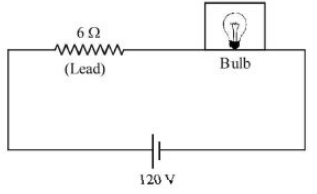
Power of bulb \(=60\, \mathrm{W}\) (given)Resistance of bulb \(=\frac{120 \times 120}{60}=240\, \Omega\left[\because \mathrm{P}=\frac{\mathrm{V}^{2}}{\mathrm{R}}\right]\)
Power of heater \(=240\, \mathrm{W}\) (given)
Resistance of heater \(=\frac{120 \times 120}{240}=60\, \Omega\)
Voltage across bulb before heater is switched on,
\(\mathrm{V}_{1}=\frac{240}{246} \times 120=117.73\, \text { volt }\)
Voltage across bulb after heater is switched on,
\(\mathrm{V}_{2}=\frac{48}{54} \times 120=106.66\, \mathrm{volt}\)
Hence decrease in voltage
\(\mathrm{V}_{1}-\mathrm{V}_{2}=117.073-106.66=10.04\, \mathrm{Volt}\) (approximately)
-
- (A) \(5.5\)
- (B) \(3.5\)
- (C) \(4.5\)
- (D) \(2.5\)
જવાબ અને ઉકેલ જુઓ
સાચો જવાબ: (C)
\(\frac{100}{R+r}=\frac{90}{R}\)\(\Rightarrow \frac{R+r}{R}=\frac{10}{9}\)
\(\Rightarrow \quad 1+\frac{0.5}{\mathrm{R}}=\frac{10}{9}\)
\(\Rightarrow \quad \frac{0.5}{\mathrm{R}}=\frac{1}{9}\)
\(\therefore R=4.5 \,\Omega\)
-
- (A) \(1.8\times 10^5\,V\) અને \(- 5.625 \times 10^6\,V/m\)
- (B) \(0\,V\) અને \(0\,V/m\)
- (C) \(2.25 \times 10^5\,V\) અને \(-5.625 \times 10^6\,V/m\)
- (D) \(2.25 \times 10^5\,V\) અને \(0\,V/m\)
જવાબ અને ઉકેલ જુઓ
સાચો જવાબ: (C)
\(\mathrm{q}=1\, \mu \mathrm{C}=1 \times 10^{-6} \,\mathrm{C}\)\(r=4\, \mathrm{cm}=4 \times 10^{-2}\, \mathrm{m}\)
\( \text { Potential } V =\frac{\mathrm{k} q}{\mathrm{r}} \)
\(=\frac{9 \times 10^{9} \times 10^{-6}}{4 \times 10^{-2}} \)
\(=2.25 \times 10^{5}\, \mathrm{V} \)
Induced electric field \(\mathrm{E}=-\frac{\mathrm{kq}}{\mathrm{r}^{2}}\)
\(=\frac{9 \times 10^{9} \times 1 \times 10^{-6}}{16 \times 10^{-4}}=-5.625\, \times 10^{6}\, \mathrm{V} / \mathrm{m}\)
-
- (A) \(\frac{{Qln2}}{{4\pi {\varepsilon _0}L}}\)
- (B) \(\;\frac{Q}{{8\pi {\varepsilon _0}L}}\)
- (C) \(\;\frac{{3Q}}{{4\pi {\varepsilon _0}L}}\)
- (D) \(\;\frac{{3Q}}{{4\pi {\varepsilon _0}Lln2}}\)
જવાબ અને ઉકેલ જુઓ
સાચો જવાબ: (A)
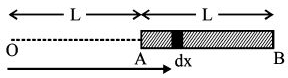
Electric potential is given by,\(V=\int_{L}^{2 L} \frac{k d q}{x}=\int_{L}^{2 L} \frac{1}{4 \pi \varepsilon_{0}} \frac{\left(\frac{q}{L}\right) d x}{x}=\frac{q}{4 \pi \varepsilon_{0} L} \ln (2)\)
-
- (A) \(\frac{1}{{4\pi {\varepsilon _0}}}\frac{{4{p_1}{p_2}}}{{{x^4}}}\)
- (B) \(\frac{1}{{4\pi {\varepsilon _0}}}\frac{{3{p_1}{p_2}}}{{{x^3}}}\)
- (C) \(\frac{1}{{4\pi {\varepsilon _0}}}\frac{{6{p_1}{p_2}}}{{{x^4}}}\)
- (D) \(\frac{1}{{4\pi {\varepsilon _0}}}\frac{{8{p_1}{p_2}}}{{{x^4}}}\)
જવાબ અને ઉકેલ જુઓ
સાચો જવાબ: (B)
Force if interaction\(F = \frac{1}{{4\pi {\varepsilon _0}}}.\frac{{3{p_1}{p_2}}}{{{r^4}}}\)
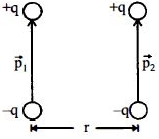
-
- (A) \(9C_1=4C_2\)
- (B) \(5C_1=3C_2\)
- (C) \(3C_1=5C_2\)
- (D) \(3C_1+5C_2=0\)
જવાબ અને ઉકેલ જુઓ
સાચો જવાબ: (C)
For potential to be made zero, after connection\(120 \mathrm{C}_{1}=200 \mathrm{C}_{2} \quad\left[\because C=\frac{q}{v}\right]\)
\(\Rightarrow \quad 3 C_{1}=5 C_{2}\)
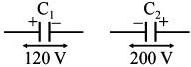
-
- (A) \(2\sqrt {k\,\,mg\,\,\tan \theta } \)
- (B) \(\sqrt {k\,\,mg\,\,\tan \theta } \)
- (C) \(4\sqrt {k\,\,mg/\tan \theta } \)
- (D) \(6\sqrt {k\,\,mg/\tan \theta } \)
જવાબ અને ઉકેલ જુઓ
સાચો જવાબ: (C)
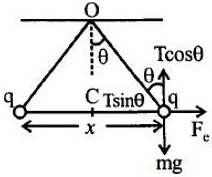
In equilibrium, \(\mathrm{F}_{\mathrm{e}}=\mathrm{T} \sin \theta\)\(\mathrm{mg}=\mathrm{T} \cos \theta\)
\(\tan \theta=\frac{F_{e}}{m g}=\frac{q^{2}}{4 \pi \epsilon_{0} x^{2} \times m g}\)
\(\therefore x = \sqrt {\frac{{{q^2}}}{{4\pi {\varepsilon _0}\,\tan \,\theta \,mg}}} \)
Electric potential at the centre of the line
\(V=\frac{k q}{x / 2}+\frac{k q}{x / 2}=4 \sqrt{k m g / \tan \theta}\)
- 73. ધન વિદ્યુતભારિત વાહકની નજીક વિદ્યુતભાર રહિત વાહક મુક્તા વિદ્યુતભાર રહિત વાહક પાસે વિદ્યુત સ્થિતિમાન 2013 અઘરું
- (A) વિદ્યુતભારિત વાહક ની ઓછું અને અનંત અંતરે વધારે સ્થિતિમાન
- (B) વિદ્યુતભારિત વાહક થી વધારે અને અનંત અંતરે ઓછું સ્થિતિમાન
- (C) વિદ્યુતભારિત વાહકની વધારે અને અનંત અંતરે વધારે સ્થિતિમાન
- (D) વિદ્યુતભારિત વાહકથી ઓછું અને અનંત અંતરે ઓછું સ્થિતિમાન
જવાબ અને ઉકેલ જુઓ
સાચો જવાબ: (A)
The potential of uncharged body is less than that of the charged conductor and more than at infinity -
- (A) \(t= \)\(\frac{\tau }{2}\) સમયે,\(q=CV\) \((1-e^{-1})\)
- (B) બેટરી દ્રારા થતું કાર્ય એ અવરોઘમાં વ્યય થતી ઊર્જાના અડઘા બરાબર છે.
- (C) \(t=\)\(\;\tau \) સમયે,\(q= \) \(\frac{{{\rm{CV}}}}{2}\)
- (D) \(t=\) \(2\tau \) સમયે,\(q=CV \) \((1-e^{-2})\)
જવાબ અને ઉકેલ જુઓ
સાચો જવાબ: (D)
Charge on he capacitor at any time \(t\) is given by\(q=C V\left(1-e^{t / \tau}\right)\)
at \(t=2 \tau\)
\(q=C V\left(1-e^{-2}\right)\)
-
- (A) \(1\)
- (B) \(\frac{4}{3}\)
- (C) \(\frac{2}{3}\)
- (D) \(\frac{1}{3}\)
જવાબ અને ઉકેલ જુઓ
સાચો જવાબ: (B)
\(C_{0}=\frac{k \epsilon_{0} A}{d}\)\(C=\frac{k \epsilon_{0} 2}{3 d}+\frac{2 k \epsilon_{0} A}{3 d}=\frac{4}{3} \frac{k \epsilon_{0} A}{d}\)
\(\therefore\) \(\frac{{\text{c}}}{{{{\text{C}}_0}}} = \frac{{\frac{{4k{\varepsilon _0}A}}{{3d}}}}{{\frac{{k{\varepsilon _0}A}}{d}}} = \frac{4}{3}\)
-
- (A) વિધાન \(-1\) અને વિધાન \(-2\) બંને સાચા છે અને વિધાન \(-2\) વિધાન \(-1\) ની સાચી સમજૂતી આપે છે
- (B) વિધાન \(-1\) અને વિધાન \(-2\) બંને સાચા છે અને વિધાન \(-2\) વિધાન \(-1\) ની સાચી સમજૂતી આપતું નથી
- (C) વિધાન \(-1\) સાચું છે પરંતુ વિધાન \(-2\) ખોટું છે.
- (D) વિધાન \(-1\) ખોટું છે પરંતુ વિધાન \(-2\) સાચું છે.
જવાબ અને ઉકેલ જુઓ
સાચો જવાબ: (C)
The work done is moving a charge along an equipotential surface is always zero. The directIon of electricfield is perpendicular to the equipotential surface or lines -
- (A) \(4.3\times10^{-7}\, m\)
- (B) \(7.8\times10^{-7}\, m\)
- (C) \(0.0078\times10^{-7}\, m\)
- (D) \(3.4\times10^{-7}\, m\)
જવાબ અને ઉકેલ જુઓ
સાચો જવાબ: (B)
\(\mathrm{F}=\mathrm{qE}=\mathrm{mg}\left(\mathrm{q}=6 \mathrm{e}=6 \times 1.6 \times 10^{-19}\right)\)Density \((\mathrm{d})=\frac{\text { mass }}{\text { volume }}=\frac{\mathrm{m}}{\frac{4}{3} \pi r^{3}}\)
or \(r^{3}=\frac{m}{\frac{4}{3} \pi d}\)
Putting the value of \(\mathrm{d}\) and \(\mathrm{m}\left(=\frac{\mathrm{qE}}{\mathrm{g}}\right)\) and
solving we get \(r=7.8 \times 10^{-7} \,\mathrm{m}\)
-
- (A) \(l\)
- (B) \(l^2\)
- (C) \({l^{2/3}}\)
- (D) \({l^{1/3}}\)
જવાબ અને ઉકેલ જુઓ
સાચો જવાબ: (D)
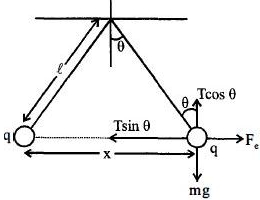
\(\text { In equilibrium, } \mathrm{F}_{\mathrm{e}}=\mathrm{T} \sin \theta\)\(\mathrm{mg}=\mathrm{T} \cos \theta\)
\(\tan \theta = \frac{{{F_e}}}{{mg}} = \frac{{{q^2}}}{{4\pi {_0}\,{x^2}}} \times mg\)
\(\text { also } \tan \theta \approx \sin =\frac{x / 2}{\ell}\)
Hence, \(\frac{x}{2 \ell}=\frac{q^{2}}{4 \pi \epsilon_{0} x^{2} \times m g}\)
\(\Rightarrow x^{3}=\frac{2 q^{2} \ell}{4 \pi \epsilon_{0} m g}\)
\(\therefore x=\left(\frac{q^{2} \ell}{2 \pi \epsilon_{0} m g}\right)^{1 / 3}\)
Therefore \(x \propto \ell^{1 / 3}\)
-
- (A) સીધી રેખામાં
- (B) અતિવલય
- (C) પરવલય
- (D) વરતુળાકાર
જવાબ અને ઉકેલ જુઓ
સાચો જવાબ: (C)
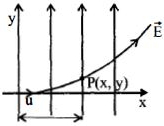
When charged particle enters perpendicularly in an electric field, it describes a parabolic path\(y=\frac{1}{2}\left(\frac{Q E}{m}\right)\left(\frac{x}{4}\right)^{2}\)
This is the equation of parabola.
-
- (A) \(70. 7\%\) ઘટે
- (B) \(29.3\%\) ઘટે
- (C) \(9.7\%\) ઘટે
- (D) \(14.6\%\) ઘટે
જવાબ અને ઉકેલ જુઓ
સાચો જવાબ: (A)
Electric field intensity at the centre of the disc.\(E=\frac{\sigma}{2 \epsilon_{0}} \quad(\text { given })\)
Electric field along the axis at any distance
\(x\) from the centre of the disc
\(E^{\prime}=\frac{\sigma}{2 \epsilon_{0}}\left(1-\frac{x}{\sqrt{x^{2}+R^{2}}}\right)\)
From question, \(x=R(\text { radius of disc })\)
\(\therefore \mathrm{E}^{\prime}=\) \( \frac{\sigma}{2 \epsilon_{0}}\left(1-\frac{\mathrm{R}}{\sqrt{\mathrm{R}^{2}+\mathrm{R}^{2}}}\right) \)
\(= \frac{\sigma}{2 \epsilon_{0}}\left(\frac{\sqrt{2} \mathrm{R}-\mathrm{R}}{\sqrt{2} \mathrm{R}}\right) \)
\(=\frac{4}{14} \mathrm{E}\)
\(\therefore\) \(\%\) reduction in the value of electric field
\(=\frac{\left(\mathrm{E}-\frac{4}{14} \mathrm{E}\right) \times 100}{\mathrm{E}}=\frac{1000}{14} \%=70.7 \%\)
-
- (A) \(y\)
- (B) \(-y\)
- (C) \(\frac{1}{y}\)
- (D) \(-\)\(\;\frac{1}{y}\)
જવાબ અને ઉકેલ જુઓ
સાચો જવાબ: (A)
\(\Rightarrow \mathrm{F}_{\mathrm{net}}=2 \mathrm{F} \cos \theta\)\(F_{n e t}=\frac{2 k q\left(\frac{q}{2}\right)}{(\sqrt{y^{2}+a^{2}})^{2}} \cdot \frac{y}{\sqrt{y^{2}+a^{2}}}\)
\(F_{n e t}=\frac{2 k q\left(\frac{q}{2}\right) y}{\left(y^{2}+a^{2}\right)^{3 / 2}} \Rightarrow \frac{k q^{2} y}{a^{3}}\)
So, \(F \propto y\)

-
- (A) \(770\)
- (B) \(188.5\)
- (C) \(178.2\)
- (D) \(200.5\)
જવાબ અને ઉકેલ જુઓ
સાચો જવાબ: (C)
Fundamental frequency,\(f=\frac{v}{2 \ell}=\frac{1}{2 \ell} \sqrt{\frac{T}{\mu}}=\frac{1}{2 \ell} \sqrt{\frac{T}{A \rho}}\left[\because v=\sqrt{\frac{T}{\mu}} \text { and } \mu=\frac{m}{\ell}\right]\)
Also, \(Y=\frac{T \ell}{A \Delta \ell} \Rightarrow \frac{T}{A}=\frac{Y \Delta \ell}{\ell} \Rightarrow f=\frac{1}{2 \ell} \sqrt{\frac{\gamma \Delta \ell}{\ell \rho}}\) \(...(i)\)
Putting the value of \(\ell, \frac{\Delta \ell}{\ell}, \rho\) and \(\gamma\) in eq \(^{n} .\) \((i)\) we get,
\(f=\sqrt{\frac{2}{7}} \times \frac{10^{3}}{3}\) or, \(f \approx 178.2 \mathrm{Hz}\)
-
- (A) એક બાજુથી \(36\, cm\) અને \(84\, cm\) અંતરે
- (B) એક બાજુથી \(24\, cm\) અને \(72\, cm\) અંતરે
- (C) એક બાજુથી \(48\, cm\) અને \(96\, cm\) અંતરે
- (D) એક બાજુથી \(72\, cm\) અને \(96\, cm\) અંતરે
જવાબ અને ઉકેલ જુઓ
સાચો જવાબ: (D)
Total length of the wire, \(L=114 \mathrm{cm}\)\(\mathrm{n}_{1}: \mathrm{n}_{2}: \mathrm{n}_{3}=1: 3: 4\)
Let \(L_{1}, L_{2}\) and \(L_{3}\) be the lengths of the three parts
As \(n \propto \frac{1}{L}\)
\(\therefore \quad \mathrm{L}_{1}: \mathrm{L}_{2}: \mathrm{L}_{3}=\frac{1}{1}: \frac{1}{3}: \frac{1}{4}=12: 4: 3\)
\(\therefore \quad \mathrm{L}_{1}=72 \mathrm{cm}\left(\frac{12}{12+4+3} \times 114\right)\)
\(\mathrm{L}_{2}=24 \mathrm{cm}\left(\frac{4}{19} \times 114\right)\)
and \(\mathrm{L}_{3}=18 \mathrm{cm}\left(\frac{3}{19} \times 114\right)\)
Hence the bridges should be placed at
\(72 \mathrm{cm}\) and \(72+24=96 \mathrm{cm}\) from oneend
-
- (A) \(500\)
- (B) \(506\)
- (C) \(512\)
- (D) \(494\)
જવાબ અને ઉકેલ જુઓ
સાચો જવાબ: (C)
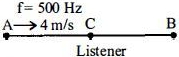
\(Case\, 1:\) When source is moving towards stationary listenerapparent frequency \(\eta^{\prime}=\eta\left(\frac{\mathrm{v}}{\mathrm{v}-\mathrm{v}_{\mathrm{s}}}\right)\)
\(=500\left(\frac{340}{336}\right)=506 \mathrm{Hz}\)
\(Case\, 2:\) When source is moving away from the stationary listener
\(\eta^{\prime \prime}=\eta\left(\frac{v}{v+v_{s}}\right)=500\left(\frac{340}{344}\right)=494 \mathrm{Hz}\)
In case \(1\) rumber of beats heard is \(6\) and in
\(case\, 2\) number of beats heard is \(18\) therefore frequency of the source at \(\mathrm{B}=512 \mathrm{Hz}\)
-
- (A) \(32\)
- (B) \(27.5\)
- (C) \(60\)
- (D) \(30\)
જવાબ અને ઉકેલ જુઓ
સાચો જવાબ: (D)
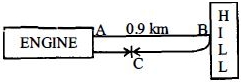
Let after 5 sec engine at point \(C\)\(t=\frac{A B}{330}+\frac{B C}{330}\)
\(5=\frac{0.9 \times 1000}{330}+\frac{\mathrm{BC}}{330}\)
\(\therefore \mathrm{BC}=750 \mathrm{m}\)
Distance travelled by engine in \(5\, sec\)
\(=900 \mathrm{m}-750 \mathrm{m}=150 \mathrm{m}\)
Therefore velocity of engine
\(=\frac{150 \mathrm{m}}{5 \mathrm{sec}}=30 \mathrm{m} / \mathrm{s}\)
-
- (A) \(92\)
- (B) \(200\)
- (C) \(100\)
- (D) \(332\)
જવાબ અને ઉકેલ જુઓ
સાચો જવાબ: (B)
Standard equation\(\mathrm{y}(\mathrm{x}, \mathrm{t})=\mathrm{A} \cos \left(\frac{\omega}{\mathrm{V}} \mathrm{x}-\omega \mathrm{t}\right)\)
From any of the displacement equation Say \(y_1\)
\(\frac{\omega}{V}=0.50 \pi \text { and } \omega=100 \pi\)
\(\therefore \frac{100 \pi}{V}=0.5 \pi\)
\(\therefore \mathrm{V}=\frac{100 \pi}{0.5 \pi}=200 \mathrm{m} / \mathrm{s}\)
-
- (A) \(\frac{{3\pi }}{2}\,cm/s\)
- (B) \(\frac{{5\pi }}{2}\,cm/s\)
- (C) \(\frac{{\pi }}{2}\,cm/s\)
- (D) \(2\pi \,cm/s\)
જવાબ અને ઉકેલ જુઓ
સાચો જવાબ: (B)
Transverse wave equation\(y=a \sin (\omega t+k x)\)
Next crest appears at time interval of \(0.4 \mathrm{s}\)
So, the time period \(T=0.4\)
\(\therefore\) Angular Frequency \(\omega=\frac{2 \pi}{T}=\frac{2 \pi}{0.4}\)
\(\therefore\) Speed of the particle
\(\nu=\frac{d y}{d t}=a \omega \sin (\omega t+k x)\)
\(\nu_{\max }=a \omega\)
\(a=1 / 2 c m\)
\(=\frac{1}{2} \times \frac{2 \pi}{0.4}=\frac{2 \pi}{8} \times 10\)
\(=\frac{5 \pi}{2} \mathrm{cm} / \mathrm{s}\)
-
- (A) \(A\,<\,2.0\,cm\)
- (B) \(A\,=\,2.0\,cm\)
- (C) \(A\,>\,2.0\,cm\)
- (D) \(A\,=\,1.5\,cm\)
જવાબ અને ઉકેલ જુઓ
સાચો જવાબ: (C)
As \(F = -kx\)\(mg=-kx\)
\(1\times 10=500\;A\)
\(A=2\;cm\)
for not gettingdistorted \(A > 2\;cm\)
-
- (A) \(0.6\)
- (B) \(0.7\)
- (C) \(0.81\)
- (D) \(0.73\)
જવાબ અને ઉકેલ જુઓ
સાચો જવાબ: (D)
\(\because A=A_{0} e^{-\frac{b t}{2 m}}\left(\text { where }, A_{0}=\text { maximum amplitude }\right)\)\( According \,to \,the\, questions,\, after\, 5\, second, \)
\(0.9 \mathrm{A}_{0}=\mathrm{A}_{0} \mathrm{e}^{-\frac{\mathrm{b}(5)}{2 \mathrm{m}}}\) \(...(i)\)
\(After\, 10 \,more\, second,\)
\(A=A_{0} \mathrm{e}^{-\frac{\mathrm{b}(15)}{2 \mathrm{m}}}\) \(...(ii)\)
From eq"s \((i)\) and \((ii)\)
\(A=0.729 A_{0} \therefore \alpha=0.729\)
-
- (A) \(\frac{4}{3}\)
- (B) \(\frac{16}{9}\)
- (C) \(\frac{3}{4}\)
- (D) \(\frac{9}{16}\)
જવાબ અને ઉકેલ જુઓ
સાચો જવાબ: (A)
\(\mathrm{k}_{\mathrm{A}}=300 \mathrm{N} / \mathrm{m}, \quad \mathrm{k}_{\mathrm{B}}=400 \mathrm{N} / \mathrm{m}\)Let when the combination of springs is compressed by force \(\mathrm{F}\). Spring \(A\) is compressed by \(x\). Therefore compression in spring \(\mathrm{B}\)
\(x_{B}=(8.75-x) c m\)
\(\mathrm{F}=300 \times x=400(8.75-x)\)
Solving we get, \(x=5 \mathrm{cm}\)
\(x_{B}=8.75-5=3.75 \mathrm{cm}\)
\(\frac{E_{A}}{E_{B}}=\frac{\frac{1}{2} k_{A}\left(x_{A}\right)^{2}}{\frac{1}{2} k_{B}\left(x_{B}\right)^{2}}=\frac{300 \times(5)^{2}}{400 \times(3.75)^{2}}=\frac{4}{3}\)
-
- (A) \(2\)
- (B) \(7\)
- (C) \(5\)
- (D) \(3\)
જવાબ અને ઉકેલ જુઓ
સાચો જવાબ: (A)
Let \(\mathrm{T}_{1}\) and \(\mathrm{T}_{2}\) be the time period of the twopendulums \(T_{1}=2 \pi \sqrt{\frac{1}{g}}\) and \(T_{2}=2 \pi \sqrt{\frac{4}{g}}\)
As \(\ell_{1}<\ell_{2}\) therefore \(\mathrm{T}_{1}<\mathrm{T}_{2}\)
Let at \(t=0\) they start swinging together. since their time periods are different, the swinging will not be in unison always. Only when number of completed oscillations
differ by an integer, the two pendulums will again begin to swing together
Let longer length pendulum complete \(n\) oscillation and shorter length pendulum complete \((\mathrm{n}+1)\) oscillation. For unison swinging
\((n+1) T_{1}=n T_{2}\)
\((n+1) \times 2 \pi \sqrt{\frac{1}{g}}=(n) \times 2 \pi \sqrt{\frac{4}{g}}\)
\(\Rightarrow n=1\)
\(\therefore n+1=1+1=2\)
-
- (A) \(2\pi {\left[ {\frac{M}{{\left( {k + A\sigma g} \right)}}} \right]^{1/2}}\) કરતાં નાનો
- (B) \(2\pi \sqrt {\frac{M}{k}} \)
- (C) \(2\pi {\left[ {\frac{M}{{\left( {k + A\sigma g} \right)}}} \right]^{1/2}}\) કરતાં મોટો
- (D) \(2\pi {\left[ {\frac{M}{{\left( {k + A\sigma g} \right)}}} \right]^{1/2}}\)
જવાબ અને ઉકેલ જુઓ
સાચો જવાબ: (A)
If \(x\) is the displacement then,\(M{\omega ^2}x = \left[ {\rho Ag + k} \right]x\)
\( \Rightarrow \omega = {\left[ {\frac{{\rho Ag + k}}{m}} \right]^{1/2}}\)
\( \Rightarrow T=2\pi {\left[ {\frac{M}{{\left( {k + A\sigma g} \right)}}} \right]^{1/2}}\)
It Should be less than \(2\pi {\left[ {\frac{M}{{\left( {k + A\sigma g} \right)}}} \right]^{1/2}}\)
-
- (A) \(\frac{1}{{2\pi }}\sqrt {\frac{{M{V_0}}}{{A\gamma {P_o}}}} \;\;\;\;\;\;\;\;\;\;\;\;\;\;\;\)
- (B) \(\;\frac{1}{{2\pi }}\sqrt {\frac{{A\gamma {P_o}}}{{{V_0}M}}} \)
- (C) \(\;\frac{1}{{2\pi }}\sqrt {\frac{{{A^2}\gamma {P_o}}}{{M{V_0}}}} \)
- (D) \(\;\frac{1}{{2\pi }}\frac{{{V_o}M{P_o}}}{{{A^2}\gamma }}\)
જવાબ અને ઉકેલ જુઓ
સાચો જવાબ: (C)
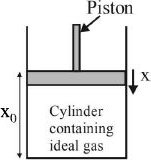
\({\frac{M g}{A}=P_{0}}\) \( {P_{0} V_{0}^{\gamma}=P V^{\gamma}}\)\({\mathrm{Mg}=\mathrm{P}_{0} \mathrm{A}}{\ldots(1)}\) \( {P_{0} A x_{0}^{\gamma}=P A\left(x_{0}-x\right)^{\gamma}}\)
\(P=\frac{P_{0} x_{0}^{\gamma}}{\left(x_{0}-x\right)^{\gamma}}\)
Let piston is displaced by distance \(x\)
\(M g-\left(\frac{P_{0} x_{0}^{\gamma}}{\left(x_{0}-x\right)^{\gamma}}\right) A=F_{\text {restoring }}\)
\(P_{0} A\left(1-\frac{x_{0}^{\gamma}}{\left(x_{0}-x\right)^{\gamma}}\right)=F_{\text {restoring }} \quad\left[x_{0}-x \approx x_{0}\right]\)
\(F=-\frac{\gamma P_{0} A x}{x_{0}}\)
Frequency with which piston executes \(SHM.\)
\(f=\frac{1}{2 \pi} \sqrt{\frac{\gamma P_{0} A}{x_{0} M}}=\frac{1}{2 \pi} \sqrt{\frac{\gamma P_{0} A^{2}}{M V_{0}}}\)
-
- (A) \(398\)
- (B) \(520\)
- (C) \(499\)
- (D) \(532\)
જવાબ અને ઉકેલ જુઓ
સાચો જવાબ: (C)
\({v_{rms}} = \sqrt {\frac{{3PV}}{{{\rm{mass\, of\, the\, gas}}}}} \) -
- (A) \(P, M\) અને \(D\)
- (B) \(M, D\) અને \(P\)
- (C) \(P, D\) અને \(M\)
- (D) \(D, M\) અને \(P\)
જવાબ અને ઉકેલ જુઓ
સાચો જવાબ: (B)
On giving same amount of heat at constant pressure, there is no change in temperature for mono, dia and polyatomic.\((\Delta \mathrm{Q})_{\mathrm{P}}=\mu \mathrm{C}_{\mathrm{p}} \Delta \mathrm{T}\left(\mu=\begin{array}{l}{\text { No. of molecules }} \\ {\text { Avogedro's na }}\end{array}\right)\)
or \(\quad \Delta \mathrm{T} \propto \frac{1}{\text { no of molecules }}\)
-
- (A) વિધાન \(- 1\) એ સાંચું છે, વિધાન \(- 2\) એ સાચું છે; વિધાન \(- 2\) એ વિધાન \(- 1\) ની સાચી સમજુતી છે.
- (B) વિધાન \(- 1 \) એ સાચું છે, વિધાન \(- 2\) એ ખોટું છે.
- (C) વિધાન \(- 1\) એ સાચું છે, વિધાન \(- 2\) એ સાચું છે અને વિધાન \(- 2\) એ વિધાન \(- 1\) ની સાચી સમજુતી નથી.
- (D) વિધાન \(- 1\) એ ખોટું છે, વિધાન \(- 2\) એ સાચું છે.
જવાબ અને ઉકેલ જુઓ
સાચો જવાબ: (C)
Internal energy of a system is the energy possessed by the system due to molecular motion and molecular configuration.Internal energy \(u=u_{k}+u_{p}\)
For an ideal gas there is no molecular attraction \(u_{p}=0\)
\(\therefore\) Internal energy \(\mathrm{u}=\mathrm{u}_{\mathrm{k}}\)
\((i.e.,\, internal\, kinetic\, energy)\)
and \(u=u_{k}=\frac{3}{2} \mu R T\)
At constant pressure \((\Delta \mathrm{Q})_{\mathrm{P}}=\mu \mathrm{C}_{\mathrm{p}} \Delta \mathrm{T}\)
At constant volume \((\Delta \mathrm{Q})_{\mathrm{v}}=\mu \mathrm{C}_{\mathrm{v}} \Delta \mathrm{T}\)
\(\mathrm{AsC}_{\mathrm{P}}>\mathrm{C}_{\mathrm{V}} \quad \therefore \quad(\Delta \mathrm{T})_{\mathrm{P}}<(\Delta \mathrm{T})_{\mathrm{V}}\)
-
- (A) વિધાન \(- 1\) એ ખોટું છે, વિધાન \(- 2\) એ સાચું છે.
- (B) વિધાન \(- 1\) એ સાંચું છે, વિધાન \(- 2\) એ સાચું છે; વિધાન \(- 2\) એ વિધાન \(- 1\) ની સાચી સમજુતી આપે છે.
- (C) વિધાન \(- 1 \) એ સાચું છે, વિધાન \(- 2\) એ ખોટું છે.
- (D) વિધાન \(- 1\) એ સાચું છે, વિધાન \(- 2\) એ સાચું છે અને વિધાન \(- 2\) એ વિધાન \(- 1\) ની સાચી સમજુતી આપતું નથી.
જવાબ અને ઉકેલ જુઓ
સાચો જવાબ: (A)
In ideal gases the molecules are considered as point particles and for point particles, there is no internal excitation, no vibration and no rotation. For an ideal gas the internal energy can only be translational kinetic energy and for real gas both kinetic as well as potential energy -
- (A) \(1.5\)
- (B) \(1.4\)
- (C) \(1.3\)
- (D) \(1.6\)
જવાબ અને ઉકેલ જુઓ
સાચો જવાબ: (B)
Volume of the gas\(v=\frac{m}{d}\) and
using \(P V^{7}=\) constant
\(\frac{P^{\prime}}{P}=\frac{V}{V^{\prime}}=\left(\frac{d^{\prime}}{d}\right)^{\gamma}\)
\(\alpha 128=(32)^{\gamma}\)
\(\gamma=\frac{7}{5}=1.4\)
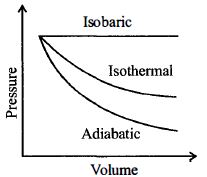
- 99. આપેલ વાયુ નું વિસ્તરણ \(V_1\) થી \(V _2\) અલગ અલગ પ્રક્રિયા દ્વારા કરવામાં આવે તો કઈ પ્રક્રિયામાં સૌથી વધુ કાર્ય થાય?
 2013 મધ્યમ
- (A) બધી પ્રક્રિયામાં સમાન
- (B) સમદાબી પ્રક્રિયા
- (C) સમતાપી પ્રક્રિયા
- (D) સમોષ્મિ પ્રક્રિયા
જવાબ અને ઉકેલ જુઓ
સાચો જવાબ: (B)
Work done \(=\) Area bounded by \(PV\) graph and volume axis Among the three process, bounded area by \(PV\) graph and volume axis is greatest for isobaric process, hence work done is greatest for isobaric process -
- (A) \(4P_0V_0\)
- (B) \(P_0V_0\)
- (C) \(\left( {\frac{{13}}{2}} \right)\) \( P_0V_0\)
- (D) \(\;\left( {\frac{{11}}{2}} \right)\) \( P_0V_0\)
જવાબ અને ઉકેલ જુઓ
સાચો જવાબ: (C)
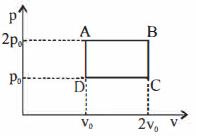
\(Heat\,given\,to\,system = {\left( {n{C_V}\Delta T} \right)_{A \to B}} + {\left( {n{C_P}\Delta T} \right)_{B \to C}}\)\( = {\left[ {\frac{3}{2}\left( {nR\Delta T} \right)} \right]_{A \to B}} + {\left[ {\frac{5}{2}\left( {nR\Delta T} \right)} \right]_{B \to C}}\)
\( = {\left[ {\frac{3}{2} \times {V_0}\Delta P} \right]_{A \to B}} + \left[ {\frac{5}{2} \times 2{P_0} \times {V_0}} \right]\)
\( = \frac{{13}}{2}{P_0}{V_0}\)

આ પેજ પર આ ફિલ્ટર મુજબ કોઈ પ્રશ્ન નથી.