


All JEE Mains 2013 Physics questions
28 chaptersShowing 51–100 of 131 questions
-
- (A) \(\frac{{m\left( {M + 2m} \right)}}{M}\,{\omega ^2}{R^2}\)
- (B) \(\frac{{Mm}}{{\left( {M + m} \right)}}\,{\omega ^2}{R^2}\)
- (C) \(\frac{{Mm}}{{\left( {M + 2m} \right)}}\,{\omega ^2}{R^2}\)
- (D) \(\frac{{\left( {M + m} \right)M}}{{\left( {M + 2m} \right)}}\,{\omega ^2}{R^2}\)
Show answer and solution
Correct Answer: (C)
\(\begin{array}{l}
Kinetic\,energ{y_{\left( {rotational} \right)}}{K_R} = \frac{1}{2}I{\omega ^2}\\
kinetic\,energ{y_{(translational)}}{K_r} = \frac{1}{2}M{v^2}\\
\,\,\,\,\,\,\,\,\,\,\,\,\,\,\,\,\,\,\,\,\,\,\,\,\,\,\,\,\,\,\,\,\,\,\,\,\,\,\,\,\,\,\,\,\,\,\,\,\,\,\,\,\,\,\,\,\,\,\,\,\,\,\left( {v = R\omega } \right)\\
M.{\mathop{\rm I}\nolimits} {._{(initial)}}{I_{ring}} = M{R^2};{\omega _{initial}} = \omega \\
M.I{._{\left( {new} \right)}}I{'_{\left( {system} \right)}} = M{R^2} + 2m{R^2}\\
\omega {'_{\left( {system} \right)}} = \frac{{m\omega }}{{M + 2m}}
\end{array}\)Solving we get loss in \(K.E.\)
\( = \frac{{Mm }}{{\left( {M + 2m} \right)}}{\omega ^2}{R^2}\)
-
- (A) \(1.87\)
- (B) \(2.08\)
- (C) \(1.57\)
- (D) \(1.77\)
Show answer and solution
Correct Answer: (B)
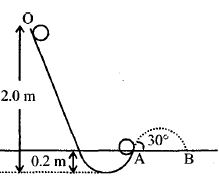
Velocity of the tennis ball on the surface of the earth or ground\(\begin{array}{l}
v = \sqrt {\frac{{2gh}}{{1 + \frac{{{K^2}}}{{{R^2}}}}}} \,\,(where\,k = radius\,of\,gyration\\
of\,spherical\,shell\, = \sqrt {\frac{2}{3}} R)\\
Horizontal\,range\,AB = \frac{{{v^2}\sin 2\theta }}{g}\\
= \frac{{{{\left( {\sqrt {\frac{{2gh}}{{1 + {k^2}/{R^2}}}} } \right)}^2}\sin \left( {2 \times {{30}^ \circ }} \right)}}{g}
\end{array}\) -
- (A) \(\frac{{4{\mu _0}i}}{{\sqrt 5 \pi L}}\)
- (B) \(\frac{{{\mu _0}i}}{{2\pi L}}\)
- (C) \(\frac{{{\mu _0}i}}{{\sqrt 2 L}}\)
- (D) \(Zero\)
Show answer and solution
Correct Answer: (A)
\(B=\frac{\mu_{0} i}{4 \pi R}\left(\sin \theta_{1}+\sin \theta_{2}\right)\)\(\sin \theta_{2}=\frac{L / 2}{\sqrt{(L / 2)^{2}+(L / 2)^{2}}}=\frac{1}{2(\sqrt{1 / 4+1 / 16})}=\frac{2}{\sqrt{5}}\)
\(\Rightarrow B=\frac{\mu_{0} i}{{4 \pi \frac{L}{4}}}\left(\frac{2 \times 4}{2 \sqrt{5}}\right) B=\frac{4 \mu_{0} i}{\sqrt{5} \pi L}\)
-
- (A) \(2.5\times10^{- 8}\, T\)
- (B) \(2.0\times10^{- 7}\, T\)
- (C) \(1.63\times10^{- 11}\, T\)
- (D) Zero
Show answer and solution
Correct Answer: (D)
Magnetic field between the plates in this case is zero. -
- (A) \(16\times10^3\, Wb \,m^{ -2}\)
- (B) \(2\times10^3\, Wb \,m^{ -2}\)
- (C) \(1\times10^3\, Wb \,m^{ -2}\)
- (D) \(4\times10^3\, Wb \,m^{ -2}\)
Show answer and solution
Correct Answer: (C)
Since particle is moving undeflected So, \(qE\, = qvB\)\( \Rightarrow B = \frac{E}{V} = \frac{{{{10}^4}}}{{10}} = {10^3}\,wb/{m^2}\)
-
- (A) \(5.5\)
- (B) \(0.5\)
- (C) \(0.004\)
- (D) \(0.045\)
Show answer and solution
Correct Answer: (D)
The current that will given full scale deflection in the absence of the shunt is nearly equal to the current through the galvanometer when shunt is connected i.e. \(I_g\)\( \text { As } I_{8} =\frac{1 S}{G+S} \)
\(=\frac{5.5 \times 1}{120+1}=0.045 \text { ampere } \)
-
- (A) \(T < 2\pi \sqrt {\frac{l}{g}} \) and damping is smaller than in air alone.
- (B) \(T = 2\pi \sqrt {\frac{l}{g}} \) and damping is larger than in air alone.
- (C) \(T > 2\pi \sqrt {\frac{l}{g}}\) and damping is smaller than in air alone.
- (D) \(T < 2\pi \sqrt {\frac{l}{g}} \) and damping is larger than in air alone
Show answer and solution
Correct Answer: (D)
When the pendulum is oscillating over a current carrying coil , and when the direction of oscillating pendulum bob is opposite to the direction of current. Its instantaneous acceleration increases. Hence time period \(T < 2\pi \sqrt {\frac{\ell }{g}} \) and damping is larger than in air alone due energy dissipation -
- (A) Both the coils carry currents in the same direction
- (B) Coils will attract each other, even if the supply is an ac source
- (C) Force is proportional to \(d^{-1}\)
- (D) Force is proportional to \(d^{-2}\)
Show answer and solution
Correct Answer: (D)
As the force between the two coils is attractive hence currents in the coil must be in the same direction and the force,\(F \propto \frac{{{I_1}{I_2}}}{{2\pi d}}\)
where \(I_1\) and \(I_2\) are the currents flowing through the coils.
-
- (A) Statement\(-I\) is true, Statement\(-II\) is true, Statement\(-II\) is the correct explanation of Statement\(-I.\)
- (B) Statement\(-I\) is true, Statement\(-II\) is true, Statement\(-II\) is not the correct explanation of Statement\(-I.\)
- (C) Statement-\(I\) is true, Statement-\(II\) is false
- (D) Statement-\(I\) is false, Statement-\(II\) is true.
Show answer and solution
Correct Answer: (D)
Statements \(I\) is false and Statement \(II\) is trueFor ammeter, shunt resistance, \(\mathrm{S}=\frac{\mathrm{IgG}}{\mathrm{I}-\mathrm{Ig}}\)
Therefore for \(I\) to increase, \(S\) should decrease, So additional \(S\) can be connected across it.
-
- (A) \(6.6 \times 10^{-9}\) \( weber\)
- (B) \(9.1 \times 10^{-11} \) \(weber\)
- (C) \(6.0 \times 10^{-11} \) \(weber\)
- (D) \(3.3 \times 10^{-11} \) \(weber\)
Show answer and solution
Correct Answer: (B)
Aswe know, Magnetic flux, \(\phi=B . A\)\(\frac{\mu_{0}(2)\left(20 \times 10^{-2}\right)^{2}}{2\left[(0.2)^{2}+(0.15)^{2}\right]} \times \pi\left(0.3 \times 10^{-2}\right)^{2}\)
On solving
\(=9.216 \times 10^{-11}=9.2 \times 10^{-11}\) \( weber\)
-
- (A) \(\frac{{2B\omega {l^2}}}{2}\)
- (B) \(\;\frac{{3B\omega {l^2}}}{2}\)
- (C) \(\;\frac{{4B\omega {l^2}}}{2}\)
- (D) \(\;\frac{{5B\omega {l^2}}}{2}\)
Show answer and solution
Correct Answer: (D)
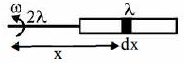
Here, induced \(e.m.f.\)\(e=\int_{2 f}^{3 \ell}(\omega x) B d x=B \omega \frac{\left[(3 \ell)^{2}-(2 \ell)^{2}\right]}{2}=\frac{5 B \ell^{2} \omega}{2}\)
-
- (A) \(A\)
- (B) \(C\)
- (C) \(B\)
- (D) \(D\)
Show answer and solution
Correct Answer: (A)
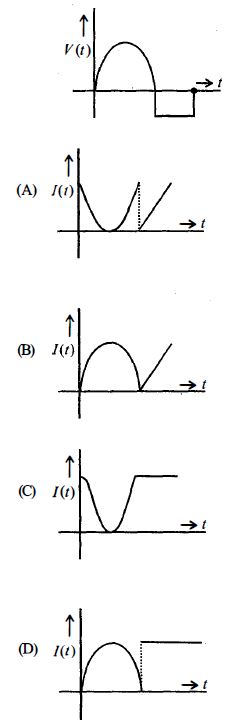
Induced emf\(\varepsilon \, \propto \,\frac{{ - di}}{{dt}}\)
-
- (A) \(0.6\)
- (B) \(1.2\)
- (C) \(1.8\)
- (D) \(0.32\)
Show answer and solution
Correct Answer: (A)
Gven \(M=8 \times 10^{22}\, \mathrm{Am}^{2}\)\(\mathrm{d}=\mathrm{R}_{\mathrm{e}}=6.4 \times 10^{6}\, \mathrm{m}\)
Earth's magnetic field, \(\mathrm{B}=\frac{\mu_{0}}{4 \pi} \cdot \frac{2 \mathrm{M}}{\mathrm{d}^{3}}\)
\(=\frac{4 \pi \times 10^{-7}}{4 \pi} \times \frac{2 \times 8 \times 10^{22}}{\left(6.4 \times 10^{6}\right)^{3}}\)
\(\cong 0.6\) \(Gauss\)
-
- (A) \(3.6 \times 10^{-5} \) \(Wbm^{-2}\)
- (B) \(2.56 \times 10^{-4}\) \( Wbm^{-2}\)
- (C) \(3.50 \times 10^{-4} \) \(Wbm^{-2}\)
- (D) \(5.80 \times 10^{-4}\) \(Wbm^{-2}\)
Show answer and solution
Correct Answer: (B)
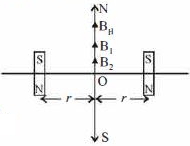
Given \(: M_{1}=1.20 \,A m^{2}\) and \(M_{2}=1.00 \,A m^{2}\)\(r=\frac{20}{2}\, c m=0.1\, \mathrm{m}\)
\(\mathrm{B}_{\mathrm{net}}=\mathrm{B}_{1}+\mathrm{B}_{2}+\mathrm{B}_{\mathrm{H}}\)
\(B_{n e t}=\frac{\mu_{0}}{4 \pi} \frac{\left(M_{1}+M_{2}\right)}{r^{3}}+B_{H}\)
\(=\frac{10^{-7}(1.2+1)}{(0.1)^{3}}+3.6 \times 10^{-5}\)
\(=2.56 \times 10^{-4}\, \mathrm{wb} / \mathrm{m}^{2}\)
-
- (A) \(5.5\)
- (B) \(3.5\)
- (C) \(4.5\)
- (D) \(2.5\)
Show answer and solution
Correct Answer: (C)
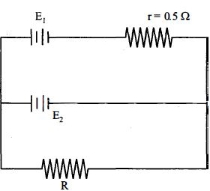
\(\frac{100}{R+r}=\frac{90}{R}\)\(\Rightarrow \frac{R+r}{R}=\frac{10}{9}\)
\(\Rightarrow \quad 1+\frac{0.5}{\mathrm{R}}=\frac{10}{9}\)
\(\Rightarrow \quad \frac{0.5}{\mathrm{R}}=\frac{1}{9}\)
\(\therefore R=4.5 \,\Omega\)
-
- (A) \(50\)
- (B) \(10\)
- (C) \(36.7\)
- (D) \(26.7\)
Show answer and solution
Correct Answer: (D)
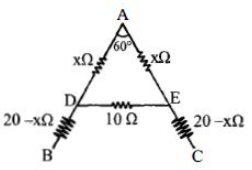
For \(ADE\) \(\frac{1}{\mathrm{R}^{\prime}}=\frac{1}{2 \mathrm{x}}+\frac{1}{10}\)or \(\quad \mathrm{R}^{\prime}=\frac{20 \mathrm{x}}{10+2 \mathrm{x}}\)
\(\mathrm{R}_{\mathrm{BC}}=\frac{20 \mathrm{x}}{10+2 \mathrm{x}}+20-\mathrm{x}+20-\mathrm{x}\) ....\((i)\)
or \(\frac{20 x}{10+2 x}+40=2 x\)
Solving we get
\(x=10\, \Omega\)
Putting the value of \(x=10\, \Omega\) in equation \(( i )\) We get
\( R_{B C} =\frac{20 \times 10}{10+2 \times 10}+20-10+20-10 \)
\(=\frac{80}{3}=26.7\, \Omega \)
-
- (A) \(80\)
- (B) \(75\)
- (C) \(67\)
- (D) \(50\)
Show answer and solution
Correct Answer: (C)
From question, \(\frac{x}{y}=\frac{40}{100-40}=\frac{2}{3}\)\(\Rightarrow x=\frac{2}{3} y\)
Again, \(\frac{3 x}{y}=\frac{z}{100-z}\)
or \(\frac{3 \times \frac{2 y}{3}}{y}=\frac{z}{100-z}\)
Solving we get \(Z=67\, \mathrm{cm}\)
Therefore new position of null point
\(\cong 67\, \mathrm{cm}\)
-
- (A) \(P\) and \(R\)
- (B) \(P\) and \(Q\)
- (C) \(Q\) and \(R\)
- (D) Any two points
Show answer and solution
Correct Answer: (B)
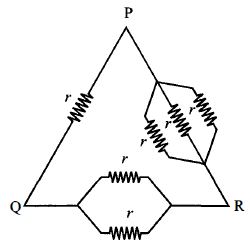
Resistance between \(\mathrm{P\,and} \,\mathrm{Q}\)\(r_{P Q}=r_{11}\left(\frac{r}{3}+\frac{r}{2}\right)=\frac{r \times \frac{5}{6} r}{r+\frac{5}{6} r}=\frac{5}{11} r\)
Resistance between \(Q\) and \(R\)
\(\mathrm{r}_{\mathrm{QR}}=\frac{\mathrm{r}}{2} 11\left(\mathrm{r}+\frac{\mathrm{r}}{3}\right)=\frac{\frac{\mathrm{r}}{2} \times \frac{4}{3} \mathrm{r}}{\frac{\mathrm{r}}{2}+\frac{4}{3} \mathrm{r}}=\frac{4}{11} \mathrm{r}\)
Resistance between \(\mathrm{P}\) and \(\mathrm{R}\)
\({{\rm{r}}_{{\rm{PR}}}} = \frac{{\rm{r}}}{3}11\left( {\frac{{\rm{r}}}{2} + {\rm{r}}} \right) = \frac{{\frac{{\rm{r}}}{3} \times \frac{3}{2}{\rm{r}}}}{{\frac{{\rm{r}}}{3} + \frac{3}{2}{\rm{r}}}} = \frac{3}{{11}}{\rm{r}}\)
Hence, it is clear that \(\mathrm{r}_{\mathrm{PQ}}\) is maximum
-
- (A) \(10.4 \)
- (B) \(0\)
- (C) \(2.9\)
- (D) \(13.3\)
Show answer and solution
Correct Answer: (A)
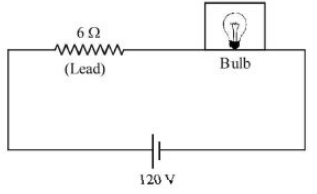
Power of bulb \(=60\, \mathrm{W}\) (given)Resistance of bulb \(=\frac{120 \times 120}{60}=240\, \Omega\left[\because \mathrm{P}=\frac{\mathrm{V}^{2}}{\mathrm{R}}\right]\)
Power of heater \(=240\, \mathrm{W}\) (given)
Resistance of heater \(=\frac{120 \times 120}{240}=60\, \Omega\)
Voltage across bulb before heater is switched on,
\(\mathrm{V}_{1}=\frac{240}{246} \times 120=117.73\, \text { volt }\)
Voltage across bulb after heater is switched on,
\(\mathrm{V}_{2}=\frac{48}{54} \times 120=106.66\, \mathrm{volt}\)
Hence decrease in voltage
\(\mathrm{V}_{1}-\mathrm{V}_{2}=117.073-106.66=10.04\, \mathrm{Volt}\) (approximately)
-
- (A) \(Q\)
- (B) \(S\)
- (C) \(P\)
- (D) \(R\)
Show answer and solution
Correct Answer: (B)
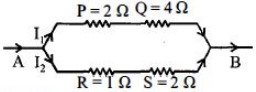
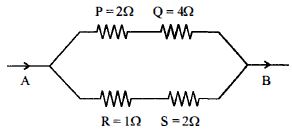
\(\mathrm{R}_{1}=\mathrm{P}+\mathrm{Q}=2\, \Omega+4 \,\Omega=6\, \Omega\)\(\mathrm{R}_{2}=\mathrm{R}+\mathrm{S}=1 \,\Omega+2 \,\Omega=3 \,\Omega\)
\(\mathrm{I}_{1} \mathrm{R}_{1}=\mathrm{I}_{2} \mathrm{R}_{2}\)
\(\mathrm{I}_{1}=\frac{\mathrm{R}_{2}}{\mathrm{R}_{1}} \mathrm{I}_{2}=\frac{3}{6} \mathrm{I}_{2}=\frac{\mathrm{I}_{2}}{2}\)
or \(\mathrm{I}_{2}=2 \mathrm{I}_{1}\)
Heat flow \(\mathrm{H}=\mathrm{I}^{2} \mathrm{Rt}\)
For \(Q, H_{Q}=I_{1}^{2} Q t=\frac{I_{2}^{2}}{4} \times 4 t=I_{2}^{2} t\)
For \(\mathrm{S}, \mathrm{H}_{\mathrm{S}}=\mathrm{I}_{2}^{2} \mathrm{St}=\mathrm{I}_{2}^{2} \cdot 2 \mathrm{t}=2 \mathrm{I}_{2}^{2} \mathrm{t}\)
\(\therefore \) Greatest amount of heat generated by \(S\).
-
- (A) \(1\)
- (B) \(\frac{4}{3}\)
- (C) \(\frac{2}{3}\)
- (D) \(\frac{1}{3}\)
Show answer and solution
Correct Answer: (B)
\(C_{0}=\frac{k \epsilon_{0} A}{d}\)\(C=\frac{k \epsilon_{0} 2}{3 d}+\frac{2 k \epsilon_{0} A}{3 d}=\frac{4}{3} \frac{k \epsilon_{0} A}{d}\)
\(\therefore\) \(\frac{{\text{c}}}{{{{\text{C}}_0}}} = \frac{{\frac{{4k{\varepsilon _0}A}}{{3d}}}}{{\frac{{k{\varepsilon _0}A}}{d}}} = \frac{4}{3}\)
-
- (A) \(1.8\times 10^5\,V\) and \(- 5.625 \times 10^6\,V/m\)
- (B) \(0\,V\) and \(0\,V/m\)
- (C) \(2.25 \times 10^5\,V\) and \(-5.625 \times 10^6\,V/m\)
- (D) \(2.25 \times 10^5\,V\) and \(0\,V/m\)
Show answer and solution
Correct Answer: (C)
\(\mathrm{q}=1\, \mu \mathrm{C}=1 \times 10^{-6} \,\mathrm{C}\)\(r=4\, \mathrm{cm}=4 \times 10^{-2}\, \mathrm{m}\)
\( \text { Potential } V =\frac{\mathrm{k} q}{\mathrm{r}} \)
\(=\frac{9 \times 10^{9} \times 10^{-6}}{4 \times 10^{-2}} \)
\(=2.25 \times 10^{5}\, \mathrm{V} \)
Induced electric field \(\mathrm{E}=-\frac{\mathrm{kq}}{\mathrm{r}^{2}}\)
\(=\frac{9 \times 10^{9} \times 1 \times 10^{-6}}{16 \times 10^{-4}}=-5.625\, \times 10^{6}\, \mathrm{V} / \mathrm{m}\)
-
- (A) \(\frac{{Qln2}}{{4\pi {\varepsilon _0}L}}\)
- (B) \(\;\frac{Q}{{8\pi {\varepsilon _0}L}}\)
- (C) \(\;\frac{{3Q}}{{4\pi {\varepsilon _0}L}}\)
- (D) \(\;\frac{{3Q}}{{4\pi {\varepsilon _0}Lln2}}\)
Show answer and solution
Correct Answer: (A)
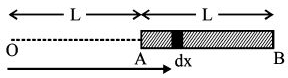
Electric potential is given by,\(V=\int_{L}^{2 L} \frac{k d q}{x}=\int_{L}^{2 L} \frac{1}{4 \pi \varepsilon_{0}} \frac{\left(\frac{q}{L}\right) d x}{x}=\frac{q}{4 \pi \varepsilon_{0} L} \ln (2)\)
-
- (A) less than the charged conductor and more than at infinity
- (B) more than the charged conductor and less than at infinity.
- (C) more than the charged conductor and more than at infinity
- (D) less than the charged conductor and less than at infinity.
Show answer and solution
Correct Answer: (A)
The potential of uncharged body is less than that of the charged conductor and more than at infinity -
- (A) At \(t=\frac{\tau}{2}\),\(q=C V\) \((1-e^{-1})\)
- (B) Work done by the battery is half of the energy dissipated in the resistor
- (C) At \(t=\)\(\;\tau \) ,\(q= \) \(\frac{{{\rm{CV}}}}{2}\)
- (D) At \(t= \)\({2 \tau }\) ,\(q=CV\) \((1-e^{-2})\)
Show answer and solution
Correct Answer: (D)
Charge on he capacitor at any time \(t\) is given by\(q=C V\left(1-e^{t / \tau}\right)\)
at \(t=2 \tau\)
\(q=C V\left(1-e^{-2}\right)\)
-
- (A) Statement \(1\) is true, Statement \(2\) is true,
Statement \(2\) is the correct explanation of Statement \(1\) - (B) Statement \(1\) is true, Statement \(2\) is true,
Statement \(2\) is not the correct explanation of Statement \(1\) - (C) Statement \(1\) is true, Statement \(2\) is false
- (D) Statement \(1\) is false, Statement \(2\) is true
Show answer and solution
Correct Answer: (C)
The work done is moving a charge along an equipotential surface is always zero. The directIon of electricfield is perpendicular to the equipotential surface or lines - (A) Statement \(1\) is true, Statement \(2\) is true,
-
- (A) \(9C_1=4C_2\)
- (B) \(5C_1=3C_2\)
- (C) \(3C_1=5C_2\)
- (D) \(3C_1+5C_2=0\)
Show answer and solution
Correct Answer: (C)
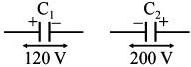
For potential to be made zero, after connection\(120 \mathrm{C}_{1}=200 \mathrm{C}_{2} \quad\left[\because C=\frac{q}{v}\right]\)
\(\Rightarrow \quad 3 C_{1}=5 C_{2}\)
-
- (A) \(\frac{1}{{4\pi {\varepsilon _0}}}\frac{{4{p_1}{p_2}}}{{{x^4}}}\)
- (B) \(\frac{1}{{4\pi {\varepsilon _0}}}\frac{{3{p_1}{p_2}}}{{{x^3}}}\)
- (C) \(\frac{1}{{4\pi {\varepsilon _0}}}\frac{{6{p_1}{p_2}}}{{{x^4}}}\)
- (D) \(\frac{1}{{4\pi {\varepsilon _0}}}\frac{{8{p_1}{p_2}}}{{{x^4}}}\)
Show answer and solution
Correct Answer: (B)
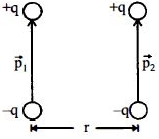
Force if interaction\(F = \frac{1}{{4\pi {\varepsilon _0}}}.\frac{{3{p_1}{p_2}}}{{{r^4}}}\)
-
- (A) \(2\sqrt {k\,\,mg\,\,\tan \theta } \)
- (B) \(\sqrt {k\,\,mg\,\,\tan \theta } \)
- (C) \(4\sqrt {k\,\,mg/\tan \theta } \)
- (D) \(6\sqrt {k\,\,mg/\tan \theta } \)
Show answer and solution
Correct Answer: (C)
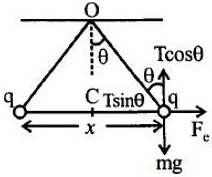
In equilibrium, \(\mathrm{F}_{\mathrm{e}}=\mathrm{T} \sin \theta\)\(\mathrm{mg}=\mathrm{T} \cos \theta\)
\(\tan \theta=\frac{F_{e}}{m g}=\frac{q^{2}}{4 \pi \epsilon_{0} x^{2} \times m g}\)
\(\therefore x = \sqrt {\frac{{{q^2}}}{{4\pi {\varepsilon _0}\,\tan \,\theta \,mg}}} \)
Electric potential at the centre of the line
\(V=\frac{k q}{x / 2}+\frac{k q}{x / 2}=4 \sqrt{k m g / \tan \theta}\)
-
- (A) \(4.3\times10^{-7}\, m\)
- (B) \(7.8\times10^{-7}\, m\)
- (C) \(0.0078\times10^{-7}\, m\)
- (D) \(3.4\times10^{-7}\, m\)
Show answer and solution
Correct Answer: (B)
\(\mathrm{F}=\mathrm{qE}=\mathrm{mg}\left(\mathrm{q}=6 \mathrm{e}=6 \times 1.6 \times 10^{-19}\right)\)Density \((\mathrm{d})=\frac{\text { mass }}{\text { volume }}=\frac{\mathrm{m}}{\frac{4}{3} \pi r^{3}}\)
or \(r^{3}=\frac{m}{\frac{4}{3} \pi d}\)
Putting the value of \(\mathrm{d}\) and \(\mathrm{m}\left(=\frac{\mathrm{qE}}{\mathrm{g}}\right)\) and
solving we get \(r=7.8 \times 10^{-7} \,\mathrm{m}\)
-
- (A) straight line
- (B) hyperbola
- (C) parabola
- (D) circle
Show answer and solution
Correct Answer: (C)
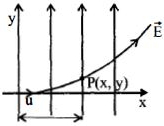
When charged particle enters perpendicularly in an electric field, it describes a parabolic path\(y=\frac{1}{2}\left(\frac{Q E}{m}\right)\left(\frac{x}{4}\right)^{2}\)
This is the equation of parabola.
-
- (A) reduces by \(70. 7\%\)
- (B) reduces by \(29.3\%\)
- (C) reduces by \(9.7\%\)
- (D) reduces by \(14.6\%\)
Show answer and solution
Correct Answer: (A)
Electric field intensity at the centre of the disc.\(E=\frac{\sigma}{2 \epsilon_{0}} \quad(\text { given })\)
Electric field along the axis at any distance
\(x\) from the centre of the disc
\(E^{\prime}=\frac{\sigma}{2 \epsilon_{0}}\left(1-\frac{x}{\sqrt{x^{2}+R^{2}}}\right)\)
From question, \(x=R(\text { radius of disc })\)
\(\therefore \mathrm{E}^{\prime}=\) \( \frac{\sigma}{2 \epsilon_{0}}\left(1-\frac{\mathrm{R}}{\sqrt{\mathrm{R}^{2}+\mathrm{R}^{2}}}\right) \)
\(= \frac{\sigma}{2 \epsilon_{0}}\left(\frac{\sqrt{2} \mathrm{R}-\mathrm{R}}{\sqrt{2} \mathrm{R}}\right) \)
\(=\frac{4}{14} \mathrm{E}\)
\(\therefore\) \(\%\) reduction in the value of electric field
\(=\frac{\left(\mathrm{E}-\frac{4}{14} \mathrm{E}\right) \times 100}{\mathrm{E}}=\frac{1000}{14} \%=70.7 \%\)
-
- (A) \(l\)
- (B) \(l^2\)
- (C) \({l^{2/3}}\)
- (D) \({l^{1/3}}\)
Show answer and solution
Correct Answer: (D)
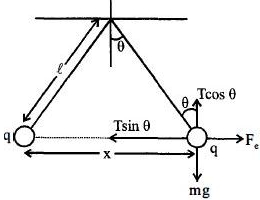
\(\text { In equilibrium, } \mathrm{F}_{\mathrm{e}}=\mathrm{T} \sin \theta\)\(\mathrm{mg}=\mathrm{T} \cos \theta\)
\(\tan \theta = \frac{{{F_e}}}{{mg}} = \frac{{{q^2}}}{{4\pi {_0}\,{x^2}}} \times mg\)
\(\text { also } \tan \theta \approx \sin =\frac{x / 2}{\ell}\)
Hence, \(\frac{x}{2 \ell}=\frac{q^{2}}{4 \pi \epsilon_{0} x^{2} \times m g}\)
\(\Rightarrow x^{3}=\frac{2 q^{2} \ell}{4 \pi \epsilon_{0} m g}\)
\(\therefore x=\left(\frac{q^{2} \ell}{2 \pi \epsilon_{0} m g}\right)^{1 / 3}\)
Therefore \(x \propto \ell^{1 / 3}\)
-
- (A) \(y\)
- (B) \(-y\)
- (C) \(\frac{1}{y}\)
- (D) \(-\)\(\;\frac{1}{y}\)
Show answer and solution
Correct Answer: (A)
\(\Rightarrow \mathrm{F}_{\mathrm{net}}=2 \mathrm{F} \cos \theta\)\(F_{n e t}=\frac{2 k q\left(\frac{q}{2}\right)}{(\sqrt{y^{2}+a^{2}})^{2}} \cdot \frac{y}{\sqrt{y^{2}+a^{2}}}\)
\(F_{n e t}=\frac{2 k q\left(\frac{q}{2}\right) y}{\left(y^{2}+a^{2}\right)^{3 / 2}} \Rightarrow \frac{k q^{2} y}{a^{3}}\)
So, \(F \propto y\)

-
- (A) \(500\)
- (B) \(506\)
- (C) \(512\)
- (D) \(494\)
Show answer and solution
Correct Answer: (C)
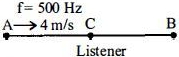
\(Case\, 1:\) When source is moving towards stationary listenerapparent frequency \(\eta^{\prime}=\eta\left(\frac{\mathrm{v}}{\mathrm{v}-\mathrm{v}_{\mathrm{s}}}\right)\)
\(=500\left(\frac{340}{336}\right)=506 \mathrm{Hz}\)
\(Case\, 2:\) When source is moving away from the stationary listener
\(\eta^{\prime \prime}=\eta\left(\frac{v}{v+v_{s}}\right)=500\left(\frac{340}{344}\right)=494 \mathrm{Hz}\)
In case \(1\) rumber of beats heard is \(6\) and in
\(case\, 2\) number of beats heard is \(18\) therefore frequency of the source at \(\mathrm{B}=512 \mathrm{Hz}\)
-
- (A) At \(36\, cm\) and \(84\, cm\) from one end
- (B) At \(24\, cm\) and \(72\, cm\) from one end
- (C) At \(48\, cm\) and \(96\, cm\) from one end
- (D) At \(72\, cm\) and \(96\, cm\) from one end
Show answer and solution
Correct Answer: (D)
Total length of the wire, \(L=114 \mathrm{cm}\)\(\mathrm{n}_{1}: \mathrm{n}_{2}: \mathrm{n}_{3}=1: 3: 4\)
Let \(L_{1}, L_{2}\) and \(L_{3}\) be the lengths of the three parts
As \(n \propto \frac{1}{L}\)
\(\therefore \quad \mathrm{L}_{1}: \mathrm{L}_{2}: \mathrm{L}_{3}=\frac{1}{1}: \frac{1}{3}: \frac{1}{4}=12: 4: 3\)
\(\therefore \quad \mathrm{L}_{1}=72 \mathrm{cm}\left(\frac{12}{12+4+3} \times 114\right)\)
\(\mathrm{L}_{2}=24 \mathrm{cm}\left(\frac{4}{19} \times 114\right)\)
and \(\mathrm{L}_{3}=18 \mathrm{cm}\left(\frac{3}{19} \times 114\right)\)
Hence the bridges should be placed at
\(72 \mathrm{cm}\) and \(72+24=96 \mathrm{cm}\) from oneend
-
- (A) \(770\)
- (B) \(188.5\)
- (C) \(178.2\)
- (D) \(200.5\)
Show answer and solution
Correct Answer: (C)
Fundamental frequency,\(f=\frac{v}{2 \ell}=\frac{1}{2 \ell} \sqrt{\frac{T}{\mu}}=\frac{1}{2 \ell} \sqrt{\frac{T}{A \rho}}\left[\because v=\sqrt{\frac{T}{\mu}} \text { and } \mu=\frac{m}{\ell}\right]\)
Also, \(Y=\frac{T \ell}{A \Delta \ell} \Rightarrow \frac{T}{A}=\frac{Y \Delta \ell}{\ell} \Rightarrow f=\frac{1}{2 \ell} \sqrt{\frac{\gamma \Delta \ell}{\ell \rho}}\) \(...(i)\)
Putting the value of \(\ell, \frac{\Delta \ell}{\ell}, \rho\) and \(\gamma\) in eq \(^{n} .\) \((i)\) we get,
\(f=\sqrt{\frac{2}{7}} \times \frac{10^{3}}{3}\) or, \(f \approx 178.2 \mathrm{Hz}\)
-
- (A) \(32\)
- (B) \(27.5\)
- (C) \(60\)
- (D) \(30\)
Show answer and solution
Correct Answer: (D)
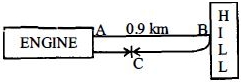
Let after 5 sec engine at point \(C\)\(t=\frac{A B}{330}+\frac{B C}{330}\)
\(5=\frac{0.9 \times 1000}{330}+\frac{\mathrm{BC}}{330}\)
\(\therefore \mathrm{BC}=750 \mathrm{m}\)
Distance travelled by engine in \(5\, sec\)
\(=900 \mathrm{m}-750 \mathrm{m}=150 \mathrm{m}\)
Therefore velocity of engine
\(=\frac{150 \mathrm{m}}{5 \mathrm{sec}}=30 \mathrm{m} / \mathrm{s}\)
-
- (A) \(\frac{{3\pi }}{2}\,cm/s\)
- (B) \(\frac{{5\pi }}{2}\,cm/s\)
- (C) \(\frac{{\pi }}{2}\,cm/s\)
- (D) \(2\pi \,cm/s\)
Show answer and solution
Correct Answer: (B)
Transverse wave equation\(y=a \sin (\omega t+k x)\)
Next crest appears at time interval of \(0.4 \mathrm{s}\)
So, the time period \(T=0.4\)
\(\therefore\) Angular Frequency \(\omega=\frac{2 \pi}{T}=\frac{2 \pi}{0.4}\)
\(\therefore\) Speed of the particle
\(\nu=\frac{d y}{d t}=a \omega \sin (\omega t+k x)\)
\(\nu_{\max }=a \omega\)
\(a=1 / 2 c m\)
\(=\frac{1}{2} \times \frac{2 \pi}{0.4}=\frac{2 \pi}{8} \times 10\)
\(=\frac{5 \pi}{2} \mathrm{cm} / \mathrm{s}\)
-
- (A) \(92\)
- (B) \(200\)
- (C) \(100\)
- (D) \(332\)
Show answer and solution
Correct Answer: (B)
Standard equation\(\mathrm{y}(\mathrm{x}, \mathrm{t})=\mathrm{A} \cos \left(\frac{\omega}{\mathrm{V}} \mathrm{x}-\omega \mathrm{t}\right)\)
From any of the displacement equation Say \(y_1\)
\(\frac{\omega}{V}=0.50 \pi \text { and } \omega=100 \pi\)
\(\therefore \frac{100 \pi}{V}=0.5 \pi\)
\(\therefore \mathrm{V}=\frac{100 \pi}{0.5 \pi}=200 \mathrm{m} / \mathrm{s}\)
-
- (A) \(A\,<\,2.0\,cm\)
- (B) \(A\,=\,2.0\,cm\)
- (C) \(A\,>\,2.0\,cm\)
- (D) \(A\,=\,1.5\,cm\)
Show answer and solution
Correct Answer: (C)
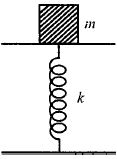
As \(F = -kx\)\(mg=-kx\)
\(1\times 10=500\;A\)
\(A=2\;cm\)
for not gettingdistorted \(A > 2\;cm\)
-
- (A) Smaller than \(2\pi {\left[ {\frac{M}{{\left( {k + A\sigma g} \right)}}} \right]^{1/2}}\)
- (B) \(2\pi \sqrt {\frac{M}{k}} \)
- (C) Larger than \(2\pi {\left[ {\frac{M}{{\left( {k + A\sigma g} \right)}}} \right]^{1/2}}\)
- (D) \(2\pi {\left[ {\frac{M}{{\left( {k + A\sigma g} \right)}}} \right]^{1/2}}\)
Show answer and solution
Correct Answer: (A)
If \(x\) is the displacement then,\(M{\omega ^2}x = \left[ {\rho Ag + k} \right]x\)
\( \Rightarrow \omega = {\left[ {\frac{{\rho Ag + k}}{m}} \right]^{1/2}}\)
\( \Rightarrow T=2\pi {\left[ {\frac{M}{{\left( {k + A\sigma g} \right)}}} \right]^{1/2}}\)
It Should be less than \(2\pi {\left[ {\frac{M}{{\left( {k + A\sigma g} \right)}}} \right]^{1/2}}\)
-
- (A) \(\frac{1}{{2\pi }}\sqrt {\frac{{M{V_0}}}{{A\gamma {P_o}}}} \;\;\;\;\;\;\;\;\;\;\;\;\;\;\;\)
- (B) \(\;\frac{1}{{2\pi }}\sqrt {\frac{{A\gamma {P_o}}}{{{V_0}M}}} \)
- (C) \(\;\frac{1}{{2\pi }}\sqrt {\frac{{{A^2}\gamma {P_o}}}{{M{V_0}}}} \)
- (D) \(\;\frac{1}{{2\pi }}\frac{{{V_o}M{P_o}}}{{{A^2}\gamma }}\)
Show answer and solution
Correct Answer: (C)
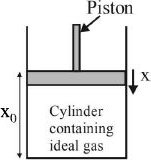
\({\frac{M g}{A}=P_{0}}\) \( {P_{0} V_{0}^{\gamma}=P V^{\gamma}}\)\({\mathrm{Mg}=\mathrm{P}_{0} \mathrm{A}}{\ldots(1)}\) \( {P_{0} A x_{0}^{\gamma}=P A\left(x_{0}-x\right)^{\gamma}}\)
\(P=\frac{P_{0} x_{0}^{\gamma}}{\left(x_{0}-x\right)^{\gamma}}\)
Let piston is displaced by distance \(x\)
\(M g-\left(\frac{P_{0} x_{0}^{\gamma}}{\left(x_{0}-x\right)^{\gamma}}\right) A=F_{\text {restoring }}\)
\(P_{0} A\left(1-\frac{x_{0}^{\gamma}}{\left(x_{0}-x\right)^{\gamma}}\right)=F_{\text {restoring }} \quad\left[x_{0}-x \approx x_{0}\right]\)
\(F=-\frac{\gamma P_{0} A x}{x_{0}}\)
Frequency with which piston executes \(SHM.\)
\(f=\frac{1}{2 \pi} \sqrt{\frac{\gamma P_{0} A}{x_{0} M}}=\frac{1}{2 \pi} \sqrt{\frac{\gamma P_{0} A^{2}}{M V_{0}}}\)
-
- (A) \(0.6\)
- (B) \(0.7\)
- (C) \(0.81\)
- (D) \(0.73\)
Show answer and solution
Correct Answer: (D)
\(\because A=A_{0} e^{-\frac{b t}{2 m}}\left(\text { where }, A_{0}=\text { maximum amplitude }\right)\)\( According \,to \,the\, questions,\, after\, 5\, second, \)
\(0.9 \mathrm{A}_{0}=\mathrm{A}_{0} \mathrm{e}^{-\frac{\mathrm{b}(5)}{2 \mathrm{m}}}\) \(...(i)\)
\(After\, 10 \,more\, second,\)
\(A=A_{0} \mathrm{e}^{-\frac{\mathrm{b}(15)}{2 \mathrm{m}}}\) \(...(ii)\)
From eq"s \((i)\) and \((ii)\)
\(A=0.729 A_{0} \therefore \alpha=0.729\)
-
- (A) \(2\)
- (B) \(7\)
- (C) \(5\)
- (D) \(3\)
Show answer and solution
Correct Answer: (A)
Let \(\mathrm{T}_{1}\) and \(\mathrm{T}_{2}\) be the time period of the twopendulums \(T_{1}=2 \pi \sqrt{\frac{1}{g}}\) and \(T_{2}=2 \pi \sqrt{\frac{4}{g}}\)
As \(\ell_{1}<\ell_{2}\) therefore \(\mathrm{T}_{1}<\mathrm{T}_{2}\)
Let at \(t=0\) they start swinging together. since their time periods are different, the swinging will not be in unison always. Only when number of completed oscillations
differ by an integer, the two pendulums will again begin to swing together
Let longer length pendulum complete \(n\) oscillation and shorter length pendulum complete \((\mathrm{n}+1)\) oscillation. For unison swinging
\((n+1) T_{1}=n T_{2}\)
\((n+1) \times 2 \pi \sqrt{\frac{1}{g}}=(n) \times 2 \pi \sqrt{\frac{4}{g}}\)
\(\Rightarrow n=1\)
\(\therefore n+1=1+1=2\)
-
- (A) \(\frac{4}{3}\)
- (B) \(\frac{16}{9}\)
- (C) \(\frac{3}{4}\)
- (D) \(\frac{9}{16}\)
Show answer and solution
Correct Answer: (A)
\(\mathrm{k}_{\mathrm{A}}=300 \mathrm{N} / \mathrm{m}, \quad \mathrm{k}_{\mathrm{B}}=400 \mathrm{N} / \mathrm{m}\)Let when the combination of springs is compressed by force \(\mathrm{F}\). Spring \(A\) is compressed by \(x\). Therefore compression in spring \(\mathrm{B}\)
\(x_{B}=(8.75-x) c m\)
\(\mathrm{F}=300 \times x=400(8.75-x)\)
Solving we get, \(x=5 \mathrm{cm}\)
\(x_{B}=8.75-5=3.75 \mathrm{cm}\)
\(\frac{E_{A}}{E_{B}}=\frac{\frac{1}{2} k_{A}\left(x_{A}\right)^{2}}{\frac{1}{2} k_{B}\left(x_{B}\right)^{2}}=\frac{300 \times(5)^{2}}{400 \times(3.75)^{2}}=\frac{4}{3}\)
-
- (A) \(P, M\) and \(D\)
- (B) \(M, D\) and \(P\)
- (C) \(P, D\) and \(M\)
- (D) \(D, M\) and \(P\)
Show answer and solution
Correct Answer: (B)
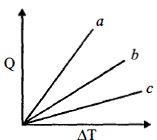
On giving same amount of heat at constant pressure, there is no change in temperature for mono, dia and polyatomic.\((\Delta \mathrm{Q})_{\mathrm{P}}=\mu \mathrm{C}_{\mathrm{p}} \Delta \mathrm{T}\left(\mu=\begin{array}{l}{\text { No. of molecules }} \\ {\text { Avogedro's na }}\end{array}\right)\)
or \(\quad \Delta \mathrm{T} \propto \frac{1}{\text { no of molecules }}\)
-
- (A) \(398\)
- (B) \(520\)
- (C) \(499\)
- (D) \(532\)
Show answer and solution
Correct Answer: (C)
\({v_{rms}} = \sqrt {\frac{{3PV}}{{{\rm{mass\, of\, the\, gas}}}}} \) -
- (A) Statement \(-1\) is false and Statement \(-2\) is true
- (B) Statement \(-1\) and Statement \(-2\) both are true. Statement \(-2\) is the correct explanation of Statement \(-1\)
- (C) Statement \(-1\) is true and Statemcnt \(-2\) is false
- (D) Statement \(-1\) and Statement \(-2\) both are true. Statement \(-2\) is not correct explanation of Statement \(- 1\)
Show answer and solution
Correct Answer: (A)
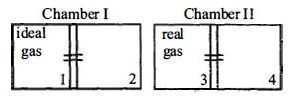
In ideal gases the molecules are considered as point particles and for point particles, there is no internal excitation, no vibration and no rotation. For an ideal gas the internal energy can only be translational kinetic energy and for real gas both kinetic as well as potential energy

No questions on this page match these filters.