


enEnglishguગુજરાતી
JEE Mains · Physics · STD 11 - દોલનો
- JEE Mains 2013
- અઘરું
- સંખ્યાત્મક
બે સાદા લોલક જેની લંબાઈ અનુક્રમે \(1\;m\) અને \(4\;m\) છે તેને કોઈ સમાન સમયે સમાન દિશામાં થોડુક દોલન કરવવામાં આવે છે.કેટલા દોલનો પૂર્ણ કર્યા પછી તે સમાન સ્થિતિમાં પાછા આવશે?
જવાબ ચકાસવા માટે એક વિકલ્પ પસંદ કરો.
જવાબ અને ઉકેલ
સાચો જવાબ
(A) \(2\)
પગલાવાર ઉકેલ
વિગતવાર સમજૂતી
Let \(\mathrm{T}_{1}\) and \(\mathrm{T}_{2}\) be the time period of the two
pendulums \(T_{1}=2 \pi \sqrt{\frac{1}{g}}\) and \(T_{2}=2 \pi \sqrt{\frac{4}{g}}\)
As \(\ell_{1}<\ell_{2}\) therefore \(\mathrm{T}_{1}<\mathrm{T}_{2}\)
Let at \(t=0\) they start swinging together. since their time periods are different, the swinging will not be in unison always. Only when number of completed oscillations
differ by an integer, the two pendulums will again begin to swing together
Let longer length pendulum complete \(n\) oscillation and shorter length pendulum complete \((\mathrm{n}+1)\) oscillation. For unison swinging
\((n+1) T_{1}=n T_{2}\)
\((n+1) \times 2 \pi \sqrt{\frac{1}{g}}=(n) \times 2 \pi \sqrt{\frac{4}{g}}\)
\(\Rightarrow n=1\)
\(\therefore n+1=1+1=2\)
Physics ના વધુ પ્રશ્નો
- બાલટીમાં રહેલ પાણીમાં તરતા એક લાકડાના બ્લોકનું \(\frac{4}{5}\) ભાગનું કદ પાણીમાં ડૂબેલું છે.જ્યારે બાલટીમાં થોડુક ઓઇલ નાખવામાં આવે ત્યારે બ્લોકનું અડધું કદ પાણીમાં અને અડધું ઓઇલમાં દેખાય છે તો ઓઇલની સાપેક્ષ ઘનતા કેટલી હશે?JEE Mains 2019 અઘરું
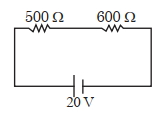
- આકૃતિમાં દર્શાવ્યા મુજબ બે અવરોધોને બેટરી સાથે શ્રેણીમાં જોડવામાં આવ્યા છે. જો \(2000 \,\Omega\) અવરોધ ધરાવતું વોલ્ટમીટર \(500 \,\Omega\) અવરોધને સમાંતર સ્થિતિમાનનો તફાવત માપવા માટે ઉપયોગમાં લેવામાં આવે તો વોલ્ટમીટરમાં ........ \(V\)નું અવલોકન (રિડિંગ) મળશે.
 JEE Mains 2022 મધ્યમ
- પાણીના નમૂનાના કદમાં \(0.2 \%\) ઘટાડો કરવા માટે જરૂરી દબાણમાં થતો વધારો \(\mathrm{P} \times 10^5 \mathrm{Nm}^{-2}\) છે. પાણીનો કદ-સ્થિતિસ્થાપકતા ગુણાંક \(2.15 \times 10^9 \mathrm{Nm}^{-2}\) છે. P નું મૂલ્ય _______ છે.JEE Mains 2025 મધ્યમ
- List-I ને List-II સાથે જોડો.
સૂચિ - I સૂચિ - II (A) ત્રિ-પરિમાણીય જડ વાયુ (I) \(\frac{C_P}{C_V} = \frac{5}{3}\) (B) દ્વિ-પરિમાણીય અજડ વાયુ (II) \(\frac{C_P}{C_V} = \frac{7}{5}\) (C) એક-પરિમાણીય વાયુ (III) \(\frac{C_P}{C_V} = \frac{4}{3}\) (D) દ્વિ-પરિમાણીય જડ વાયુ (IV) \(\frac{C_P}{C_V} = \frac{9}{7}\)
નીચે આપેલા વિકલ્પોમાંથી યોગ્ય ઉત્તર પસંદ કરો :JEE Mains 2025 મધ્યમ - એક \(1\text{ kg}\) દળના પદાર્થને સમક્ષિતિજ સમતલ સાથે \(30°\) ના નમનકોણ ધરાવતી ઢળતી સપાટી પર રાખેલ છે અને તે પ્રારંભમાં સ્થિર છે. પછી આખી ગોઠવણીને \(4\text{ m/s}\) ના અચળ વેગથી ઉપરની તરફ ગતિ કરાવવામાં આવે છે. \(2\text{ s}\) સમયમાં ઘર્ષણ બળ દ્વારા થયેલું કાર્ય _______ J છે. (\(g = 10\text{ m/s}^2\) લો)JEE Mains 2026 મધ્યમ
- વજન \(W\) અને ત્રિજ્યા \(5\, cm\) ધરાવતા એક નિયમિત ગોલકને એક દોરી સાથે આકૃતિ માં બતાવ્યા મુજબ બાંધેલો છે. તો દોરીમાં તણાવ કેટલું હશે?
 JEE Mains 2013 અઘરું
JEE Mains ના વધુ PYQ
- એક પ્રયોગશાળામાં ધાતુના તારની ત્રિજ્યા \((r)\), લંબાઈ \((l)\) અને અવરોધ \((R)\) મુજબ માપવામાં આવે છે. \(\mathrm{r}=(0.35 \pm 0.05) \mathrm{cm}\) \(\mathrm{R}=(100 \pm 10) \mathrm{ohm}\) \(l=(15 \pm 0.2) \mathrm{cm}\) તારના દ્રવ્યની અવરોધકતાની પ્રતિશત ત્રુટિ _______ છે.JEE Mains 2024 અઘરું
- \(X\) અને \(Y\) ને સમાંતર એક \(5\, V\) ની બેટરી જોડવામાં આવેલ છે. \(D_1\) અને \(D_2\) એક સામાન્ય સિલિકોન ડાયોડ છે તેમ ધારો. જે બેટરીનો ધન છેડો બિંદૂ \(X\) સાથે જોડેલો હોય તો બેટરી દ્વારા પૂરો પડાતો વિધુતપ્રવાહ ..........\(A\)
 JEE Mains 2021 મધ્યમ
- જમીન થી \(45^o\) ના ખૂણે એક દડાને ફેંકતા તે સામે રહેલી દીવાલ ને ટપી જાય છે. જો પ્રક્ષેપન સ્થાન દીવાલ ના નીચલા ભાગ થી \(4\,m\) દૂર હોય અને દડો દીવાલ ની સામેની બાજુ એ \(6\,m\) દૂર જમીન પર અથડાય તો દીવાલની ઊંચાઈ ........ \(m\) હશે.JEE Mains 2013 અઘરું
- આપેલ વિદ્યુતચુંબકીય તરંગ \(E_y=600 \sin (\omega t-k x) \mathrm{Vm}^{-1}\) માં, સંકળાયેલ પ્રકાશ કિરણની તીવ્રતા કેટલી છે? ( \(\mathrm{W} / \mathrm{m}^2\) માં); (આપેલ છે કે \(\epsilon_0=\) \(\left.9 \times 10^{-12} \mathrm{C}^{-2} \mathrm{~N}^{-1} \mathrm{~m}^{-2}\right)\)JEE Mains 2024 અઘરું
- ઈલેકટ્રોન,\(\alpha\)-કણ અને પ્રોટોનની ગતિઊર્જા અનુક્રમે \(4K,2K\) અને \(K\) છે. ઈલેકટ્રોન \((\lambda e),\alpha -\) કણ \((\lambda \alpha)\) અને પ્રોટોન \((\lambda p)\) સાથે સંકળાયેલી ડી-બ્રોગ્લીની તરંગલંબાઈ વચ્ચેનો સંબંધ નીચે પ્રમાણે છે :JEE Mains 2023 મધ્યમ
- વર્નિયર કેલિપર્સની મુખ્ય સ્કેલની લઘુત્તમ માપશક્તિ \(1\, mm\) છે. વર્નિયર સ્કેલનો \(10\) મો કાંપો મુખ્ય સ્કેલના \(9\) માં કાંપા સાથે બંધ બેસે છે. જ્યારે વર્નિયર કેલિપર્સ સંપૂર્ણ બંધ હોય ત્યારે વર્નિયર સ્કેલનો \(7\) મો કાંપો મુખ્ય સ્કેલના શૂન્ય સાથે બંધ બેસે છે અને વર્નિયર સ્કેલનો શૂન્ય કાંપો મુખ્ય સ્કેલના શૂન્ય કાંપાની જમણી બાજુ છે. જ્યારે વર્નિયર સ્કેલનો ઉપયોગ નળાકારની લંબાઈ માપવામાં થાય ત્યારે વર્નિયર સ્કેલનો શૂન્ય કાંપો \(3.1\, cm\) અને \(3.2\, cm\) વચ્ચે અને તેનો ચોથો \(VSD\) મુખ્ય સ્કેલ સાથે બંધ બેસે છે. તો નળાકારની લંબાઈ કેટલા \(cm\) હશે? (\(VSD\) વર્નિયર સ્કેલ વિભાગ)JEE Mains 2020 મધ્યમ