


JEE Mains 2013 Physics ના બધા પ્રશ્નો
27 પ્રકરણ127 માંથી 101–127 પ્રશ્નો
-
- (A) \(580\)
- (B) \(590\)
- (C) \(600\)
- (D) \(610\)
જવાબ અને ઉકેલ જુઓ
સાચો જવાબ: (B)
As \(1\, g\) of steam at \(100\,^oC\) melts \(8\,g\) of ice at \(0\,^oC\). \(10\, g\) of steam will melt \(8\times10\, g\) of ice at \(0\,^oC\) Water in calorimeter \(\,= 500 + 80 + 10\,g\, = 590\,g\) -
- (A) \(2.0\)
- (B) \(7\)
- (C) \(3\)
- (D) \(0.5\)
જવાબ અને ઉકેલ જુઓ
સાચો જવાબ: (D)
As the surrounding is identical, vessel is identical time taken to cool both water and liquid\(\left( {from\,{{30}^ \circ }C\,to\,{{25}^ \circ }C} \right)\) is same \(2\,minutes,\) therefore\({\left( {\frac{{dQ}}{{dt}}} \right)_{water}} = {\left( {\frac{{dQ}}{{dt}}} \right)_{liquid}}\)
\(or,\frac{{\left( {{m_w}{C_w} + W} \right)\Delta T}}{t} = \frac{{\left( {{m_\ell }{C_\ell } + W} \right)\Delta T}}{t}\)
\(\left( {W = water\,equivalent\,of\,the\,vessel} \right)\)
\(or,\,\,{m_w}{C_w} = {m_\ell }{C_\ell }\)
\(\therefore Specific\,heat\,of\,liquid,\,{C_\ell } = \frac{{{m_W}{C_W}}}{{{m_\ell }}}\)
\( = \frac{{50 \times 1}}{{100}} = 0.5\,kcal/kg\)
-
- (A) \(2 : 5\)
- (B) \(1:4\)
- (C) \(1 : 64\)
- (D) \(1 : 8\)
જવાબ અને ઉકેલ જુઓ
સાચો જવાબ: (B)
When there is no charge in liquid level in vessel then \(\gamma {'_{real}} = y{'_{vessel}}\)Change in volume in liquid relative to vessel
\(\Delta {V_{app}} = V\gamma {'_{app}}\Delta \theta = V\left( {\gamma {'_{real}} - \gamma {'_{vessel}}} \right)\)
-
- (A) \(-73.7\)
- (B) \(-233.7\)
- (C) \(-86.3\)
- (D) \(-106.3\)
જવાબ અને ઉકેલ જુઓ
સાચો જવાબ: (C)
\(Reading\,on\,any\,scale-LFP\)\(UFP-LFP\)
\(=constant\,for\,all\,scales\)
\(\frac{{340 - 273}}{{373\left| { - 273} \right.}} = \frac{{^ \circ y - \left( { - 160} \right)}}{{ - 50 - \left( { - 160} \right)}}\)
\( \Rightarrow \frac{{67}}{{100}} = \frac{{y + 160}}{{110}}\)
\(\therefore \,\,\,y = - {86.3^ \circ }\,y\)
-
- (A) \(\frac{{2mg}}{{3A}}\)
- (B) \(\frac{{4mg}}{{3A}}\)
- (C) \(\frac{{mg}}{{A}}\)
- (D) \(\frac{{3mg}}{{4A}}\)
જવાબ અને ઉકેલ જુઓ
સાચો જવાબ: (B)
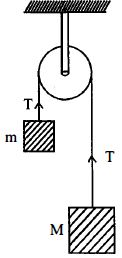
Tension in the wire, \(T = \left( {\frac{{2mM}}{{m + M}}} \right)g.\)\(Stress = \frac{{Force/Tension}}{{Area}} = \frac{{2mM}}{{A\left( {m + M} \right)}}g\)
\( = \frac{{2\left( {m \times 2m} \right)g}}{{A\left( {m + 2m} \right)}}\left( {M = 2m\,given} \right)\)
\( = \frac{{4{m^2}}}{{3mA}}g = \frac{{4mg}}{{3A}}\)
-
- (A) \(1.0\times 10^{-4}\)
- (B) \(1.5\times 10^{-4}\)
- (C) \(0.25\times 10^{-4}\)
- (D) \(5\times 10^{-4}\)
જવાબ અને ઉકેલ જુઓ
સાચો જવાબ: (C)
\(Given,\,y = 2 \times {10^{11}}N{m^{ - 2}}\)\(Stress\left( {\frac{F}{A}} \right) = 5 \times {10^7}N{m^{ - 2}}\)
\(\Delta V = 0.02\% = 2 \times {10^{ - 4}}{m^3}\)
\(\frac{{\Delta r}}{r} = ?\)
\(\gamma = \frac{{stress}}{{strain}} \Rightarrow strain\left( {\frac{{\Delta \ell }}{{{\ell _0}}}} \right) = \frac{\gamma }{{stress}}\,\,...\left( i \right)\)
\(\Delta V = 2\pi {\ell _0}\Delta r - \pi {r^2}\Delta \ell \) \(...\left( {ii} \right)\)
From eqns \((i)\) and \((ii)\) putting the value of
\(\Delta \ell ,{\ell _0}\,and\,\Delta V\,and\,solving\,we\,get\)
\(\frac{{\Delta r}}{r} = 0.25 \times {10^{ - 4}}\)
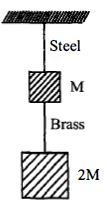
- 107. સ્ટીલ અને બ્રાસ માટે લંબાઈ ,ત્રિજ્યા અને યંગ મોડયુલસનો ગુણોત્તર \(a, b\) અને \(c\) છે તો તેમની લંબાઈમાં થતાં વધારાનો ગુણોત્તર કેટલો થાય?
 2013 અઘરું
- (A) \(\frac{{3c}}{{2a{b^2}}}\)
- (B) \(\frac{{2{a^2}c}}{b}\)
- (C) \(\frac{{3a}}{{2{b^2}c}}\)
- (D) \(\frac{{2ac}}{{{b^2}}}\)
જવાબ અને ઉકેલ જુઓ
સાચો જવાબ: (C)
According to questions,\(\frac{{{\ell _s}}}{{{\ell _b}}} = a,\frac{{{r_s}}}{{{r_b}}} = b,\frac{{{y_s}}}{{{y_b}}} = c,\frac{{\Delta \ell s}}{{\Delta {\ell _b}}} = ?\)
\(As,y = \frac{{F\ell }}{{A\Delta \ell }} \Rightarrow \Delta \ell = \frac{{F\ell }}{{Ay}}\)
\(\Delta {\ell _s} = \frac{{3mg{\ell _s}}}{{\pi _s^2.{y_s}}}\left[ {{F_s} = \left( {M + 2M} \right)g} \right]\)
\(\Delta {\ell _b} = \frac{{2Mg{\ell _b}}}{{\pi r_b^2{y_b}}}\left[ {{F_b} = 2Mg} \right]\)
\(\therefore \frac{{\Delta {\ell _s}}}{{\Delta {\ell _b}}} = \frac{{\frac{{3Mg{\ell _s}}}{{\pi r_s^2.{y_s}}}}}{{\frac{{2Mg.{\ell _b}}}{{\pi {b^2}.{y_b}}}}} = \frac{{3a}}{{2{b^2}C}}\)
-
- (A) \(1.75\)
- (B) \(2\)
- (C) \(1.50\)
- (D) \(1.25\)
જવાબ અને ઉકેલ જુઓ
સાચો જવાબ: (D)
\({Y_c} \times \left( {\Delta {L_c}/{L_c}} \right) = {Y_s} \times \left( {\Delta {L_s}/{L_s}} \right)\)\( \Rightarrow 1 \times {10^{11}} \times \left( {\frac{{1 \times {{10}^{ - 3}}}}{1}} \right) = 2 \times {10^{11}} \times \left( {\frac{{\Delta {L_s}}}{{0.5}}} \right)\)
\(\therefore \Delta {L_s} = \frac{{0.5 \times {{10}^{ - 3}}}}{2} = 0.25\,mm\)
Therefore, total extension of the composite
\(wire = \Delta {L_c} + \Delta {L_s}\)
\( = 1\,mm + 0.25\,m = 1.25\,m\)
-
- (A) \(\frac{{2T}}{{\rho L}}\;\)
- (B) \(\;\frac{{\rho L}}{T}\)
- (C) \(\sqrt {\;\frac{T}{{\rho L}}} \)
- (D) \(\;\frac{T}{{\rho L}}\)
જવાબ અને ઉકેલ જુઓ
સાચો જવાબ: (A)
When radius is decrease by \(\Delta R,\)\(4\pi {R^2}\Delta R\rho L = 4\pi T\left[ {{R^2} - {{\left( {R - \Delta R} \right)}^2}} \right]\)
\( \Rightarrow \rho {R^2}\Delta RL = T\left[ {{R^2} - {R^2} + 2R\Delta R - \Delta {R^2}} \right]\)
\( \Rightarrow \rho {R^2}\Delta RL = T2R\Delta R\,\,\left[ {\Delta R\,is\,very\,small} \right]\)
\( \Rightarrow R = \frac{{2T}}{{\rho L}}\)
-
- (A) \(\theta \) વધે અને \(h\) પણ વધે
- (B) \(\theta \) ઘટે અને \(h\) પણ ઘટે
- (C) \(\theta \) વધે અને \(h\) ઘટે
- (D) \(\theta \) ઘટે અને \(h\) વધે
જવાબ અને ઉકેલ જુઓ
સાચો જવાબ: (C)
Angle of contact \(\theta \)\(\cos \theta = \frac{{{T_{SA}} - {T_{SL}}}}{{{T_{LA}}}}\)
when water is on a waxy or oily surface
\({T_{SA}} < {T_{SL}}\cos \theta \,is\,negative\,i.e.,\)
\({90^ \circ } < \theta < {180^ \circ }\)
\(i.e.,\,angle\,of\,contact\,\theta \,increases\)
\(And\,for\,\theta > {90^ \circ }\,liquid\,level\,in\,capillary\,tube\)
\(fall.\,i.e.,\,h\,decreases\)
-
- (A) વિધાન \(-1\) અને વિધાન \(-2\) બંને સાચા છે અને વિધાન \(-2\) વિધાન \(-1\) ની સાચી સમજૂતી આપતું નથી
- (B) વિધાન \(-1\) ખોટું છે પરંતુ વિધાન \(-2\) સાચું છે.
- (C) વિધાન \(-1\) સાચું છે પરંતુ વિધાન \(-2\) ખોટું છે.
- (D) વિધાન \(-1\) અને વિધાન \(-2\) બંને સાચા છે અને વિધાન \(-2\) વિધાન \(-1\) ની સાચી સમજૂતી આપે છે
જવાબ અને ઉકેલ જુઓ
સાચો જવાબ: (B)
Surface tension of a liquid decreases with the rise in temperture. At the boiling point of liquid, surface tension is zero.\(Capillary\,rise\,h = \frac{{2T\cos \theta }}{{rdg}}\)
As surface tension \(T\) decreases with rise in temperature hence capillary rise also decreases.
-
- (A) \(60\)
- (B) \(180\)
- (C) \(7500\)
- (D) \(12500\)
જવાબ અને ઉકેલ જુઓ
સાચો જવાબ: (C)
Pressure difference\({P_2} - {P_1} = \frac{1}{2}\rho \left( {v_2^2 - v_1^2} \right)\)
\( = \frac{1}{2} \times 1.2\left( {{{\left( {150} \right)}^2} - {{\left( {100} \right)}^2}} \right)\)
\( = \frac{1}{2} \times 1.2\left( {22500 - 10000} \right)\)
\( = 7500\,N{m^{ - 2}}\)
-
- (A) \(2.95\)
- (B) \(5.18\)
- (C) \(8.65\)
- (D) \(0.0\)
જવાબ અને ઉકેલ જુઓ
સાચો જવાબ: (B)
Lengths of \(M\) and \(N\) are \((40-y)\) and \((40+y)\) respecively.\(P_1=\) Preessure of par \(M\)
\(P_2=\) Pressure of part \(N\)
As temperature is constant
Therefore, we can write \(PV =\) constant
For \(M : P_0(40 A)=P_1(40-y) A\)
\(\Rightarrow P_1=\frac{P_0(40)}{(40-y)} \ldots \ldots .(\text { i })\)
For \(N : P_0(40 A)=P_2(40+y) A\)
\(\Rightarrow P_2=\frac{P_0 40}{(40+y)}\)
Here \(A=\) area of cross section of tube
Pressure at lower face \(\left(P_1\right)=\) Pressure at upper face \(\left(P_2\right)+\) Pressure due to mercury column of height \(20 cm\).
\(P_1=P_2=20 pg\)
Use (i) and (ii) in (iii)
\(P_0 \frac{40}{(40-y)}=\frac{P_0 40}{(40+y)}+20 p g\)
\(\frac{40 P_0}{(40-y)}-\frac{40 P_0}{(40+y)}=20 p g\)
\(40 \times 76 p g\left[\frac{2 y}{1600-y^2}\right]=20 p g\)
\((52)(2 y)=1600-y^2\)
\(304 y=1600-y^2\)
\(y^2+304 y-1600=0\)
Solving for \(y\), we get \(y=5.18\; cm\)
-
- (A) \(5\)
- (B) \(0\)
- (C) \(10\)
- (D) \(20\)
જવાબ અને ઉકેલ જુઓ
સાચો જવાબ: (C)
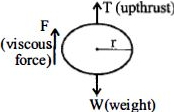
Weight of the body\(W = mg = \frac{4}{3}\pi {r^3}\rho g\)
\(T = \frac{4}{3}\pi {r^3}\sigma g\)
\(and\,F = 6\pi \eta vr\)
When the body attains terminal velocity net force acting on the body is zero \(i.e.,\)
\(W - T - F = 0\)
And terminal velocity \(v = \frac{2}{9}\frac{{{r^2}\left( {\rho - \sigma } \right)}}{\eta }g\)
As in case of upward motion upward force is twice its effective weight, therefore, it will move with same speed \(10cm/s\)
-
- (A) \(\frac{{Mg}}{k}\)
- (B) \(\;\frac{{Mg}}{k}\left( {1 - \frac{{LA\sigma }}{M}} \right)\)
- (C) \(\;\frac{{Mg}}{k}\left( {1 - \frac{{LA\sigma }}{{2M}}} \right)\)
- (D) \(\;\frac{{Mg}}{k}\left( {1 + \frac{{LA\sigma }}{M}} \right)\)
જવાબ અને ઉકેલ જુઓ
સાચો જવાબ: (C)
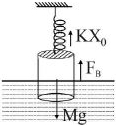
From figure, \(k{x_0} + {F_B} = Mg\)\(k{x_0} + \sigma \frac{L}{2}Ag = Mg\)
\(\left[ {mass = density \times volume} \right]\)
\( \Rightarrow k{x_0} = Mg - \sigma \frac{L}{2}Ag\)
\( \Rightarrow {x_0} = \frac{{Mg - \frac{{\sigma LAg}}{2}}}{k} = \frac{{Mg}}{k}\left( {1 - \frac{{LA\sigma }}{{2M}}} \right)\)
-
- (A) \(144\)
- (B) \(96\)
- (C) \(240\)
- (D) \(192\)
જવાબ અને ઉકેલ જુઓ
સાચો જવાબ: (D)
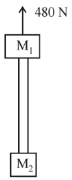
\(\begin{array}{l}
Acceleration\,produced\,in\,upward\,direction\\
a = \frac{F}{{{M_1} + {M_2} + Mass\,of\,metal\,rod}}\\
= \frac{{480}}{{20 + 12 + 8}} = 12\,m{s^{ - 2}}\\
Tension\,at\,the\,mid\,{\rm{point}}\,\\
T = \left( {{M_2} + \frac{{Mass\,of\,rod}}{2}} \right)a\\
\,\,\,\, = \left( {12 + 4} \right) \times 12 = 192N
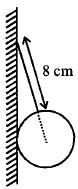
\end{array}\) - 117. વજન \(W\) અને ત્રિજ્યા \(5\, cm\) ધરાવતા એક નિયમિત ગોલકને એક દોરી સાથે આકૃતિ માં બતાવ્યા મુજબ બાંધેલો છે. તો દોરીમાં તણાવ કેટલું હશે?
 2013 અઘરું
- (A) \(\frac{12}{5}\,W\)
- (B) \(\frac{5}{12}\,W\)
- (C) \(\frac{13}{5}\,W\)
- (D) \(\frac{13}{12}\,W\)
જવાબ અને ઉકેલ જુઓ
સાચો જવાબ: (D)
\(\begin{array}{l}
PQ = \sqrt {O{P^2} + O{Q^2}} \\
= \sqrt {{{13}^2} + {5^2}} = 12\\
Tension\,in\,the\,string\,T,\,so,\,T\cos \theta = w\\
\Rightarrow T = \frac{w}{{\cos \theta }} = \frac{{13}}{{12}}W
\end{array}\)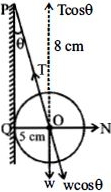
- 118. આપેલ ગોળામાં દર્શાવેલ ભાગ કાપી નાખ્યા પછી વધેલા ભાગનું દૂર રહેલા બિંદુ \(P\) આગળ ગુરુત્વાકર્ષીક્ષેત્ર કેટલું મળશે?
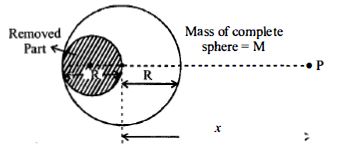 2013 અઘરું
- (A) \(\frac{5}{6}\,\frac{{GM}}{{{x^2}}}\)
- (B) \(\frac{8}{9}\,\frac{{GM}}{{{x^2}}}\)
- (C) \(\frac{7}{8}\,\frac{{GM}}{{{x^2}}}\)
- (D) \(\frac{6}{7}\,\frac{{GM}}{{{x^2}}}\)
જવાબ અને ઉકેલ જુઓ
સાચો જવાબ: (C)
Let mass of smaller sphere (which has to be removed) is m\(Radius = \frac{R}{2}\left( {from\,figure} \right)\)
\(\frac{M}{{\frac{4}{3}\pi {R^3}}} = \frac{m}{{\frac{4}{3}\pi {{\left( {\frac{R}{2}} \right)}^3}}}\)
\( \Rightarrow m = \frac{M}{8}\)
Mass of the left over part of the sphere
\(M' = M - \frac{M}{8} = \frac{7}{8}M\)
Therefore gravitational filed due to the left over part of the sphere
\( = \frac{{GM'}}{{{x^2}}} = \frac{7}{8}\frac{{GM}}{{{x^2}}}\)
-
- (A) \(6.73\times 10^{-5}\,m/s^2\)
- (B) \(6.73\times 10^{-3}\,m/s^2\)
- (C) \(6.73\times 10^{-2}\,m/s^2\)
- (D) \(6.73\times 10^{-4}\,m/s^2\)
જવાબ અને ઉકેલ જુઓ
સાચો જવાબ: (A)
During solar eclipse, the sun and moon will be on the same side of the earth and during lunar eclipse, the moon and the sun will be exactly on the earth’s opposite sides.So the gravitational force acting on earth due to sun will add up with the gravitational force acting on earth due to moon during solar eclipse and the gravitational forces will subtract with each other during lunar eclipse.
Let \(F_S\) be the gravitational force between earth and sun and \(F_L\) be the gravitational force between earth and moon.
Also, the acceleration of earth during solar and lunar eclipse can be derived from Newton’s second law,
\(F=ma\)........(1)
During solar eclipse, eqn (1) will be
\(m.{a_s} = {F_s} + {F_L} \to \left( 2 \right)\)
During lunar ecllpse, eqn \((1)\) will be
\(m.{a_L} = {F_s} - {F_L} \to \left( 3 \right)\)
Here, \(a_s\) and \(a_L\) are the acceleration of earth towards sun during solar and lunar ecllpse respectlvely and \(m\) is the mass of earth.
So the change in acceleration of earth toward sun from solar to lunar ecllpse perlod, can be found, can be found by subtracting eqn \((2)\) from eqn \((3)\)
\(m\left( {{a_s} - {a_L}} \right) = {F_s} + {F_L} - {F_s} + {F_L}\)
\(\therefore m\left( {{a_s} - {a_L}} \right) = 2{F_L} \to \left( 4 \right)\)
Here,
\({F_L} = G\frac{{m.{M_L}}}{{{D^2}}}\)
Where \(G\) is the gravltational constant, \(m\) is the mass of earth, \(ML\) is the mass of moon, and \(D\) is the distance between moon and earth.
\(D\) is equal to the orbital radlus of moon.
So the eqn \((4)\) becomes,
\(\left( {{a_s} - {a_L}} \right) = 2G\frac{{{M_L}}}{{{D^2}}} \to \left( 5 \right)\)
Now, substitute the glven values in eqn \((5)\),
\({M_L} = 7.36 \times {10^{22}}\,kg\)
\(D = 3.8 \times {10^8}\,m\)
Gravltational constant value, \(G = 6.67 \times {10^{ - 11}}N.{m^2}.k{g^{ - 2}}\)
\(\left( {{a_s} - {a_L}} \right) = 2 \times 6.67 \times {10^{ - 11}} \times \frac{{7.36 \times {{10}^{22}}}}{{{{\left( {3.8 \times {{10}^8}} \right)}^2}}}\)
\(\left( {{a_s} - {a_L}} \right) = 6.799 \times {10^{ = 11 + 22 - 16}}\)
\(\left( {{a_s} - {a_L}} \right) = 6.799 \times {10^{ - 5}}m/{s^2}\)
-
- (A) શૂન્ય
- (B) \(1\)
- (C) \(\frac{{144}}{{25}}\)
- (D) \(\frac{{25}}{{144}}\)
જવાબ અને ઉકેલ જુઓ
સાચો જવાબ: (B)
From question,\({E_x} = 5\,N/kg\,and\,{E_y} = 12\,N/kg\)
Gravitational potential
\(=Gravitational\, field\times\,distance\)
\(\therefore {V_{\left( {12m,0} \right)}} = {E_x} \times 12\,J/kg\)
\(and\,{V_{\left( {0.5m} \right)}} = {E_y} \times 5\,\,J/kg\)
\(\left( {Give\,:\,potential\,at\,the\,origin\,is\,zero} \right)\)
\(\therefore \frac{{{V_{\left( {12\,m,0} \right)}}}}{{{V_{\left( {0,5m} \right)}}}} = \frac{{{E_x} \times 12}}{{{E_y} \times 5}} = \frac{{5 \times 12}}{{12 \times 5}} = 1\)
-
- (A) \(\frac{{GmM}}{{3R}}\;\;\;\;\;\;\;\;\;\;\;\;\;\;\;\;\;\;\;\;\;\;\;\;\)
- (B) \(\;\frac{{5GmM}}{{6R}}\)
- (C) \(\;\frac{{2GmM}}{{3R}}\)
- (D) \(\;\frac{{GmM}}{{2R}}\)
જવાબ અને ઉકેલ જુઓ
સાચો જવાબ: (B)
Applying energy conservation\(k + \left( { - \frac{{GMm}}{R}} \right) = \frac{1}{2}mv_0^2 + \left( { - \frac{{GMm}}{{R + h}}} \right)\)
\(k - \frac{{GMm}}{R} = \frac{1}{2}m\left( {\frac{{Gm}}{{R + 2R}}} \right) - \frac{{GMm}}{{R + 2R}}\)
\(\therefore k = \frac{{5GMm}}{{6R}}\)
-
- (A) વિધાન \(I\) સાચું છે,વિધાન \(II\) સાચું છે,વિધાન \(-II\) એ વિધાન \(-I\) ની સાચી સમજણ આપે છે.
- (B) વિધાન \( I\) સાચું છે,વિધાન \(II\) સાચું છે,વિધાન \(-II\) એ વિધાન \(-I\) ની સાચી સમજણ આપતું નથી.
- (C) વિધાન \(I \) ખોટું છે,વિધાન \( II \) સાચું છે.
- (D) વિધાન \( I \) સાચું છે,વિધાન \(II\) ખોટું છે.
જવાબ અને ઉકેલ જુઓ
સાચો જવાબ: (C)
Maximum energy loss \(=\frac{{{P^2}}}{{2m}} - \frac{{{P^2}}}{{2\left( {m + M} \right)}}\)\(\left[ {\because \,K.E. = \frac{{{P^2}}}{{2m}} = \frac{1}{2}m{v^2}} \right]\)
\( = \frac{{2{P^2}}}{{2m}}\left[ {\frac{M}{{\left( {m + M} \right)}}} \right] = \frac{1}{2}m{v^2}\left\{ {\frac{M}{{m + M}}} \right\}\)
Statement II is a case of 12.Perfectly Inelastic Collision.By comparing the equation given in statement I with abpve equation, we get
\(f = \left( {\frac{M}{{m + M}}} \right)\,instead\,of\,\left( {\frac{m}{{M + m}}} \right)\)
Hence statement \(I\) is wrong and statement \(II\) is correct.
-
- (A) \(v^4\)
- (B) \(v^2\)
- (C) \(v\)
- (D) \(v^3\)
જવાબ અને ઉકેલ જુઓ
સાચો જવાબ: (D)
10.Power \(=\mathrm{F} \bullet \mathrm{v}=\mathrm{Fv} F=v\left(\frac{d m}{d t}\right)=v\left\{\frac{d(\rho \times \text {volume})}{d t}\right\}\)\(=\rho v\left\{\frac{d(v o l u m e)}{d t}\right\}=\rho v(A v)=\rho A v^{2} \therefore\) 10.Power \(P=\rho A v^{3} \quad\) or \(P=v^{3}\)
-
- (A) \(16\)
- (B) \(1\)
- (C) \(10\)
- (D) \(2\)
જવાબ અને ઉકેલ જુઓ
સાચો જવાબ: (C)
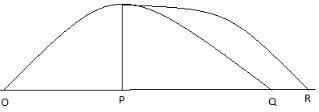
\(OQ=4\;km\)\(QR=x\;km\)
The centre of mass will hit the ground at point \(Q\). As the haviour mass comes to rest after bracking
\({x_{cm}} = \frac{{{m_1}{x_1} + {m_2}{x_2}}}{{{m_1} + {m_2}}}\)
\(\;Here\;{m_{1\;}} = \frac{{3M}}{4},{m_{2\;}} = \frac{M}{4},\;\)\(\;{x_{1\;}} = OP = 2,\;{x_{2\;}} = OR\; = \;4 + x\)
So,
\(4 = \frac{{\frac{{3M}}{4} \times 2 + \frac{M}{4} \times \left( {4 + x} \right)}}{M}\)
\(4M = \frac{{3M}}{2} + M\left( {1 + \frac{x}{4}} \right)1 + \frac{x}{4} \)\(= \frac{5}{2}\frac{x}{4} = \frac{3}{2}x = 6\;km\)
Hence horizontal range of lighter particle is
\(OR = OQ + QR = 4+6 = 10\; km\)
-
- (A) \(y= x- 5x^2\)
- (B) \(y= 2x- 5x^2\)
- (C) \(4y= 2x- 5x^2\)
- (D) \(4y= 2x- 25x^2\)
જવાબ અને ઉકેલ જુઓ
સાચો જવાબ: (B)
\(\begin{array}{l}
\vec u = \hat i + 2\hat j = {u_x}\hat i + {u_y}\hat j \Rightarrow u\cos \theta = 1,\\
u\sin \theta = 2\\
y = x\tan \theta - \frac{1}{2}\frac{{g{x^2}}}{{u_x^2}}\\
\therefore \,y = 2x - \frac{1}{2}g{x^2} = 2x - 5{x^2}
\end{array}\) -
- (A) \(30\)
- (B) \(60\)
- (C) \(75\)
- (D) \(45\)
જવાબ અને ઉકેલ જુઓ
સાચો જવાબ: (B)
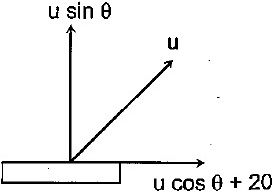
\(\frac{u^{2}}{g}=100\)\(\Rightarrow u=20 \mathrm{m} / \mathrm{s}\)
\(t=\frac{2 u \sin \theta}{g}\)
and \(R=(u \cos \theta+20)\left(\frac{2 u \sin \theta}{g}\right)\)
Put \(\frac{d R}{d \theta}=0\)
\(\Rightarrow \cos \theta=1 / 2\)
\(\Rightarrow \theta=60^{\circ}\)
-
- (A) \(4.4\)
- (B) \(2.4\)
- (C) \(3.6\)
- (D) \(1.6\)
જવાબ અને ઉકેલ જુઓ
સાચો જવાબ: (B)
\(\begin{array}{l}
As\,ball\,is\,projected\,at\,an\,angle\,{45^{ \circ \,}}to\,the\\
horizontal\,therefore\,Rang = 4H\\
or\,\,\,\,10 = 4H \Rightarrow H\frac{{10}}{4} = 2.5m\\
\left( {Range\, = 4m\, + 6\,m = 10m} \right)\\
Maximum\,height,\,H = \frac{{{u^2}{{\sin }^2}\theta }}{{2g}}\\
\therefore \,{u^2} = \frac{{H \times 2g}}{{{{\sin }^2}\theta }} = \frac{{2.5 \times 2 \times 10}}{{{{\left( {\frac{1}{{\sqrt 2 }}} \right)}^2}}} = 100
\end{array}\)\(\begin{array}{l}
or,\,u = \sqrt {100} = 10\,m{s^{ - 1}}\\
Height\,of\,wall\,PA\\
= OA\,\tan \,\theta - \frac{{1\,g{{\left( {OA} \right)}^2}}}{{2\,{u^2}\,{{\cos }^2}\theta }}\\
= 4 = \frac{1}{2} \times \frac{{10 \times 16}}{{10 \times 10 \times \frac{1}{{\sqrt 2 }} \times \frac{1}{{\sqrt 2 }}}} = 2.4m
\end{array}\)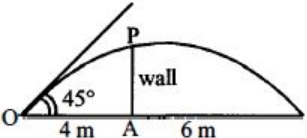
આ પેજ પર આ ફિલ્ટર મુજબ કોઈ પ્રશ્ન નથી.