


JEE Mains 2014 Chemistry ના બધા પ્રશ્નો
24 પ્રકરણ103 માંથી 51–100 પ્રશ્નો
-
- (A) \(\lambda _C =\lambda _{\infty} +(B)C\)
- (B) \(\lambda _C =\lambda _{\infty} - (B)C\)
- (C) \(\lambda _C =\lambda _{\infty} -(B) \sqrt{C}\)
- (D) \(\lambda _C =\lambda _{\infty} +(B) \sqrt{C}\)
જવાબ અને ઉકેલ જુઓ
સાચો જવાબ: (C)
According to Debye Huckle onsager equation,\(\lambda_{C}=\lambda_{\infty}-B \sqrt{C}\)
-
- (A) \(A, C, B, D\)
- (B) \(B, D, C, A\)
- (C) \(C, B, D, A\)
- (D) \(D, A, B, C\)
જવાબ અને ઉકેલ જુઓ
સાચો જવાબ: (C)
As the value of reduction potential decreases the reducing power increases i.e. \(\mathop C\limits_{(0.85)} < \mathop B\limits_{(0.6)} < \mathop D\limits_{( - 0.76)} < \mathop A\limits_{( - 1.2)} \) -
- (A) \(1+\)
- (B) \(2+\)
- (C) \(3+\)
- (D) \(4+\)
જવાબ અને ઉકેલ જુઓ
સાચો જવાબ: (C)
According to Faraday's first law of electrolysis\(W\,=\,\frac {E\times i\times t}{96500}\)
Where \(E\,=\) equivqlent weight
\(=\,\frac {mol.\,mass\,of\,metal\,(M)}{oxidation\,state\,of\,metal(x)}\)
Substituting the value in the formula
\(W\,=\,\frac {M}{x}\) \(\times \) \(\frac {i\times t}{96500}\)
or \(x=\frac {M}{W}\) \(\times \) \(\frac {i\times t}{96500}\) \( = \,\frac{{10\, \times \,2 \times 60 \times 60\,}}{{96500\, \times 0.250}} = 3\)
[Given :no . of moles \(=\frac {M}{W}\,=\,0.250\) ]
Hence oxidation state of metals is \((+3)\)
-
- (A) \(Fe^{2+} < Al < Br^-\)
- (B) \(Br^- < Fe^{2+} < Al\)
- (C) \(Al < Br^- < Fe^{2+}\)
- (D) \(Al < Fe^{2+} < Br^-\)
જવાબ અને ઉકેલ જુઓ
સાચો જવાબ: (D)
A negative \(E^o\) means that the redox couple is a stronger reducing agent. Hence, we can say that Aluminium is strongest reducing agent.Reducing character decreases down the series. Hence the correct order is \(Al < Fe^{2+} < Br^-\)
-
- (A) \(\frac{{{N_A}}}{{20}}\)
- (B) \(\frac{{{N_A}}}{{10}}\)
- (C) \(\frac{{{N_A}}}{{5}}\)
- (D) \(\frac{{{N_A}}}{{2}}\)
જવાબ અને ઉકેલ જુઓ
સાચો જવાબ: (C)
\(Cu\, \to \,C{u^{ + + }}\, + \,2{e^ - }\)i.e., to deposit \(1\,mole\) of \(Cu\) at cathode from \(Cu^{2+}\) \(SO_4^{2-}\) solution \(=\,2\,\,mole\) of electrons are required
i.e., To deposit
\(6.35\,g\, = \,\frac{{6.35}}{{63.5}}\, \times 2\, = \,\frac{2}{{10}}\, = \,\frac{1}{5}\,moles\)
Thus total no. of elecrtrons required \(=\,\frac {N_A}{5}\)
-
- (A) \(-2.69\, V;\) પ્રક્રિયા થશે નહીં
- (B) \(-2.69\,V; \) પ્રક્રિયા થશે
- (C) \(-0.33\, V;\) પ્રક્રિયા થશે નહીં
- (D) \(-0.33 V;\) પ્રક્રિયા થશે
જવાબ અને ઉકેલ જુઓ
સાચો જવાબ: (A)
(a) \(\quad M n^{2+}+2 e^{-} \rightarrow M n ; \quad E^{\circ}=-1.18 V ; \ldots(i)\)(b) \(\quad M n^{3+}+e \rightarrow M n^{2+} ; \quad E^{\circ}=-1.51 V ; \ldots(i i)\)
Now multiplying equation \((i i)\) by two and subtracting from equation \((i)\)
\(3 M n^{2+} \rightarrow M n^{+}+2 M n^{3+}\)
\(E^{\circ}=E_{O_{X}}+E_{\mathrm{Red} .}=-1.18+(-1.51)=-2.69 \mathrm{V}\)
\([-\text { ve value of } E M F(\text { i.e., } \Delta G=+v e)\)\( \text { shows that the reaction is non-spontaneous }]\)
-
- (A) \(5 \times 10^{-4}\)
- (B) \(5 \times 10^{-3}\)
- (C) \(5 \times 10^{3}\)
- (D) \(5 \times 10^{2}\)
જવાબ અને ઉકેલ જુઓ
સાચો જવાબ: (A)
Given for \(0.2 \mathrm{M}\) solution\(R=50 \Omega\)
\(\kappa=1.45 S m^{-1}=1.4 \times 10^{-2} S \mathrm{cm}^{-1}\)
Now, \(R=\rho {\frac{\ell}{a}}=\frac{1}{\kappa} \times \frac{\ell}{a}\)
\(\Rightarrow \frac{\ell}{a}=R \times \kappa=50 \times 1.4 \times 10^{-2}\)
For \(0.5 M\) solution
\(R=280 \Omega ; \kappa=?\)
\(\frac{\ell}{a}=50 \times 1.4 \times 10^{-2}\)
\(\Rightarrow R=\rho \frac{\ell}{a}=\frac{1}{\kappa} \times \frac{\ell}{a}\)
\(\Rightarrow \quad \kappa=\frac{1}{280} \times 50 \times 1.4 \times 10^{-2}\)
\(=\frac{1}{280} \times 70 \times 10^{-2}=2.5 \times 10^{-3} S c m^{-1}\)
Now, \(\Lambda_{m}=\frac{\kappa \times 1000}{M}=\frac{2.5 \times 10^{-3} \times 1000}{0.5}\)
\(=5 S c m^{2} m o l^{-1}=5 \times 10^{-4} S m^{2} m o l^{-1}\)
-
- (A) \(1\)
- (B) \(2\)
- (C) \(2.50\)
- (D) \(4\)
જવાબ અને ઉકેલ જુઓ
સાચો જવાબ: (B)
Givenmass of solute \((w)\,=\,120\,g\)
mass of solvent \((w)\,=\,1000\,g\)
Mol. mass of solute \(=60\,g\)
density of solution \(=\,1.12\,g/ml\)
From the given data,
Mass of solution \(=\,1000+120=1120\,g\)
\(d=\frac {Mol.mass}{V}\) or \(V=\frac {Mol.mass}{d}\)
Volume of solution \(V\,=\,\frac {1120}{1.12}\,=\,1000\,ml\) or
\(=\,1\,litre\)
Now molarity \((M)\) \(=\,\frac {W}{Mol.\,mass\times V(lit)}\) \(=\,\frac {120}{60\times 1}\) \(=\,2\,M\)
-
- (A) તે બધાનુ અભિસરણ દબાણ સમાન છે
- (B) \(0.100\, M\, Mg_3(PO_4)_2\,(aq)\) નુ અભિસરણ દબાણ સૌથી વધુ છે
- (C) \(0.125\, M\, Na_3PO_4\,(aq)\) નુ અભિસરણ દબાણ સૌથી વધુ છે
- (D) \(0.500\, M\, C_2H_5OH\,(aq)\) નું અભિસરણ દબાણ સૌથી વધુ છે
જવાબ અને ઉકેલ જુઓ
સાચો જવાબ: (A)
\(\pi=i C R T\)\(^{\pi} C_{2} H_{3} O H\) \(=1 \times 0.500 \times R \times T=0.5 R T\)
\(^{\pi} M g_{3}\left(P O_{4}\right)_{2}\) \(=5 \times 0.100 \times R \times T=0.5 R T\)
\(^{\pi} K B r=2 \times 0.250 \times R \times T=0.5 R T\)
\(^{\pi} N a_{3} P O_{4}=4 \times 0.125 \times R T=0.5 R T\)
since the osmotic pressure of all the given solutions is equal.
Hence all are isotonic solution.
-
- (A) \(5\) અને \(4.42\)
- (B) \(4\) અને \(4.00\)
- (C) \(5\) અને \(3.42\)
- (D) \(3\) અને \(5.42\)
જવાબ અને ઉકેલ જુઓ
સાચો જવાબ: (A)
Given \({\pi _{ob}}\, = \,10.8\,atm\)\({\pi _{nor}}\, = \,CST\, = \,0.10\, \times \,0.0821\, \times \,298\, = \,2.446\)
now experimntal value of \((i)\)
\(=\,\frac {Observed\,osmotic\,pressure}{Normal\,osmotic\,pressure}\)
\(=\,\frac {10.8}{2.446}\,=\,4.42\)
-
- (A) \(11.65\)
- (B) \(23.3\)
- (C) \(30.6\)
- (D) \(33.2\)
જવાબ અને ઉકેલ જુઓ
સાચો જવાબ: (A)
સ્પષ્ટીકરણ:
સીમિત પ્રક્રિયકના સિદ્ધાંતના આધારે ઉત્પન્ન થતા અવક્ષેપના વજનની સ્ટેપ-બાય-સ્ટેપ ગણતરી નીચે મુજબ છે:
1. \(\text{BaCl}_2\) નું દળ અને મોલ શોધવા:
- \(\text{BaCl}_2\) નું આણ્વીય દળ \(= 208\text{ g mol}^{-1}\)
- \(100\text{ mL}\) ના \(20.8\%\) દ્રાવણમાં \(\text{BaCl}_2\) નું દળ \(= \frac{20.8}{100} \times 100 = 20.8\text{ g}\)
- \(\text{BaCl}_2\) ના મોલ \(= \frac{20.8}{208} = 0.1\text{ mol}\)
2. \(\text{H}_2\text{SO}_4\) નું દળ અને મોલ શોધવા:
- \(\text{H}_2\text{SO}_4\) નું આણ્વીય દળ \(= 98\text{ g mol}^{-1}\)
- \(50\text{ mL}\) ના \(9.8\%\) દ્રાવણમાં \(\text{H}_2\text{SO}_4\) નું દળ \(= \frac{9.8}{100} \times 50 = 4.9\text{ g}\)
- \(\text{H}_2\text{SO}_4\) ના મોલ \(= \frac{4.9}{98} = 0.05\text{ mol}\)
3. સીમિત પ્રક્રિયક (Limiting Reagent) ની ઓળખ:
પ્રક્રિયાનું સંતુલિત સમીકરણ નીચે મુજબ છે:
\(\text{BaCl}_2 + \text{H}_2\text{SO}_4 \rightarrow \text{BaSO}_4 \downarrow + 2\text{HCl}\)
તત્વયોગમિતિય ગુણોત્તર મુજબ, \(1\text{ મોલ}\) \(\text{BaCl}_2\) સંપૂર્ણ પ્રક્રિયા માટે \(1\text{ મોલ}\) \(\text{H}_2\text{SO}_4\) ની જરૂર પડે છે.
અહીં આપણી પાસે \(0.1\text{ મોલ}\) \(\text{BaCl}_2\) ની સાપેક્ષમાં માત્ર \(0.05\text{ મોલ}\) \(\text{H}_2\text{SO}_4\) હાજર હોવાથી, \(\text{H}_2\text{SO}_4\) સીમિત પ્રક્રિયક બને છે અને નીપજનો જથ્થો તેના આધારે નક્કી થશે.
4. ઉત્પન્ન થતા \(\text{BaSO}_4\) ના દળની ગણતરી:
- \(\text{BaSO}_4\) નું આણ્વીય દળ \(= 233\text{ g mol}^{-1}\)
- ઉત્પન્ન થતા \(\text{BaSO}_4\) ના મોલ = સીમિત પ્રક્રિયકના મોલ \(= 0.05\text{ mol}\)
- \(\text{BaSO}_4\) નું વજન \(= 0.05 \times 233 = 11.65\text{ g}\)
આથી, સાચો ઉત્તર વિકલ્પ A છે. -
- (A) \(115.2\)
- (B) \(57.6\)
- (C) \(28.8\)
- (D) \(18.4\)
જવાબ અને ઉકેલ જુઓ
સાચો જવાબ: (B)
\(1\, mole\) of water contains \(= 16\, gm\) of \(O_2\) \(\therefore \) \(3 .6\, mole\) of water contains \(=16\times 3.6=57.6\,g\) -
- (A) \(NH_2\)
- (B) \(N_3H\)
- (C) \(NH_3\)
- (D) \(N_2H_4\)
જવાબ અને ઉકેલ જુઓ
સાચો જવાબ: (D)
In an unknown compounds containing \(N\) and \(H\)given \(\%\) of \(H\) \(= 12.5\%\)
\(\therefore \) \(\%\) of \(N\) \(= 100-12.5 = 87.5\%\)
Element Percentage Atomic ratio Simple ratio \(H\) \(12.5\%\) \(\frac{12.5}{1}=12.5\) \(\frac{12.5}{6.25}=2\) \(N\) \(87.5\%\) \(\frac{87.5}{14}=6.25\) \(\frac{6.25}{6.25}=1\) \(2 \times\) vapour density \(=\) Mol. wt \(= 16 \times 2 = 32.\)
Molecular formula \(= n \times\) empirical formula mass
\(n = \frac{{32}}{{16}} = 2\)
\(\therefore \) Molecular formula of the compound will be \(= (NH_2)_2\)
\(= N_2H_4\)
-
- (A) \(1-\) બ્રોમો\(-2-\) મિથાઇલબ્યુટેન
- (B) \(1-\) બ્રોમો\(-3-\) મિથાઇલબ્યુટેન
- (C) \(2-\) બ્રોમો\(-3-\) મિથાઇલબ્યુટેન
- (D) \(2-\) બ્રોમો\(-2-\) મિથાઇલબ્યુટેન
જવાબ અને ઉકેલ જુઓ
સાચો જવાબ: (D)
The order of substituion in different alkanes is\(3^o > 2^o > 1^o\)
Thus the bromination of \(2-\) methyl butane mainly gives \(2-\) Bromo \(-2-\) methyl butane
\(\mathop {\begin{array}{*{20}{c}}
{\,\,\,\,\,\,\,\,\,\,\,\,\,\,\,C{H_3}} \\
{\,\,\,\,\,\,\,\,\,\,\,\,\,\,|\,\,\,\,} \\
{C{H_3} - C{H_2} - CH - C{H_3}}
\end{array}}\limits_{2 - methyl\,bu\tan e} \xrightarrow{{B{r_2}}}\)\(\mathop {\mathop {\begin{array}{*{20}{c}}
{\,\,\,\,\,\,\,\,\,\,C{H_3}} \\
{\,\,\,\,\,|} \\
{C{H_3} - C{H_2} - CH - C{H_2}Br}
\end{array}}\limits_{1 - Bromo - 2\,methyl\,bu\tan e} }\limits_{(\min or)} \) \(+\) \(\underset{\begin{smallmatrix}
2-Bromo-2-methyl\,bu\tan e \\
\,\,\,\,\,\,\,\,\,\,\,\,\,\,\,\,\,\,\,\,\,\,\,\,\,\,\,(major)
\end{smallmatrix}}{\mathop{\begin{matrix}
\,\,\,\,\,\,\,\,\,\,\,\,\,\,\,\,\,\,\,C{{H}_{3}} \\
\,\,\,\,\,\,\,\,\,\,\,\,\,\,\,| \\
C{{H}_{3}}-C{{H}_{2}}-C-C{{H}_{3}} \\
\,\,\,\,\,\,\,\,\,\,\,\,\,\,\,| \\
\,\,\,\,\,\,\,\,\,\,\,\,\,\,\,\,Br \\
\end{matrix}}}\,\) -
- (A) પોલી-આઇન
- (B) પોલી-ઇન
- (C) પોલી-એસ્ટર
- (D) પોલી-એમાઇન
જવાબ અને ઉકેલ જુઓ
સાચો જવાબ: (B)
Poly-ene. e.g\(\mathop {3CH \equiv CH}\limits_{acetylene} \to \mathop {{C_6}{H_6}}\limits_{Benzene} \)
\(\mathop {3C{H_3} - C \equiv CH}\limits_{\Pr opyne} \to \) (figure)
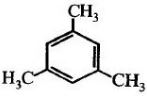
- 66. પેરોક્સાઇડની હાજરીમાં, \(HCl\) અને \(HI\) એ આલ્કીન સાથે પ્રતિમાર્કોનિકોવ નિયમ મુજબ યોગશીલ પ્રક્રિયા આપતા તથી, કારણ કે ......... 2014 અઘરું
- (A) \(HCl\) અને \(HI\) માં એક તબક્કો ઉષ્માશોષક છે
- (B) \(HCl\) અને \(HI\) બંને પ્રબળ એસિડ છે
- (C) \(HCl\) ઓક્સિડેશનકર્તા છે અને \(HI\) રીડકશનકર્તા છે
- (D) \(HCl\) અને \(HI\) માં બધા તબકકા ઉમાક્ષેપક છે.
જવાબ અને ઉકેલ જુઓ
સાચો જવાબ: (A)
Anti-Markownikoff addition is possible only in case of \(HBr\) and not in \(HCl\) and \(HI\) . In \(HBr\) both the chain initiation and propagation steps are exothermic, while in \(HCl,\) first step is exothermic, and second step is endothermic and in \(HI,\) no step is exothermic. Hence \(HCl\) and \(HI\) do not undergo anti-Markownikoff's addition. -
- (A) ઉદ્દીપકીય હાઇડ્રોજીનેશન
- (B) \(H_2/\) લિન્ડલરનો ઉદ્દીપક
- (C) \(Li/NH_3\)
- (D) \(LiAlH_4\)
જવાબ અને ઉકેલ જુઓ
સાચો જવાબ: (C)
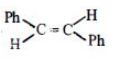
With Lithium in liquid ammonia, trans-alkene is almost an exclusive product.\(Ph-C\equiv C-Ph\xrightarrow[Brich\,reduction]{Li\,in\,liq.N{{H}_{3}}}\begin{matrix}
^{Ph} \\
_{H} \\
\end{matrix}\begin{matrix}
\text{ }\!\!\backslash\!\!\text{ } \\
/ \\
\end{matrix}C=C\begin{matrix}
/ \\
\text{ }\!\!\backslash\!\!\text{ } \\
\end{matrix}_{Ph}^{H}\) -
- (A) \(sp\) અને \(sp^3\)
- (B) \(sp^2\) અને \(sp\)
- (C) ફકત \(sp^2\)
- (D) \(sp^2\) અને \(sp^3\)
જવાબ અને ઉકેલ જુઓ
સાચો જવાબ: (B)
\(\,\begin{matrix}
^{H} \\
_{H} \\
\end{matrix}\begin{matrix}
\text{ }\!\!\backslash\!\!\text{ } \\
/ \\
\end{matrix}\overset{s{{p}^{2}}}{\mathop{C}}\,=\overset{s{{p}^{2}}}{\mathop{C}}\,=\overset{s{{p}^{2}}}{\mathop{C}}\,\begin{matrix}
/ \\
\text{ }\!\!\backslash\!\!\text{ } \\
\end{matrix}_{H}^{H}\) -
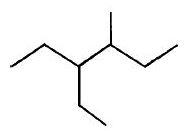
- (A) \(4 -\) મિથાઇલ \(- 3 -\) ઇથાઇલહેકઝેન
- (B) \(3 -\) ઇથાઇલ \(- 4 -\) મિથાઇલહેકઝેન
- (C) \(3, 4 -\) ઇથાઇલમિથાઇલહેકઝેન
- (D) \(4 -\) ઇથાઇલ\(- 3 -\) મિથાઇલહેકઝેન
જવાબ અને ઉકેલ જુઓ
સાચો જવાબ: (B)
\(\mathop {\begin{array}{*{20}{c}} {\,\,\,\,\,\,\,\,\,\,\,\,\,\,\,\,\,\,\,C{H_3}} \\ {\,\,\,\,\,\,\,\,\,\,\,\,\,|} \\ {C{H_3}C{H_2} - CH - CH - C{H_2}C{H_3}} \\ {|\,\,\,\,\,\,\,\,\,\,\,\,\,\,\,\,\,\,} \\ {\,\,\,\,\,\,C{H_2}\,\,\,\,\,\,\,\,\,\,\,\,\,\,} \\ {|\,\,\,\,\,\,\,\,\,\,\,\,\,\,} \\ {\,\,\,\,\,\,\,C{H_3}\,\,\,\,\,\,\,\,\,\,\,\,\,\,\,} \end{array}}\limits_{3 - ethyl - 4 - methyl\,hexane} \) -
- (A) \(6\)
- (B) \(10\)
- (C) \(3\)
- (D) \(5\)
જવાબ અને ઉકેલ જુઓ
સાચો જવાબ: (B)
\(\%\) of \(N=\frac{1.4 \times \text { meq.of acid }}{\text { mass of organic compound }}\)meq. of \(H_{2} S O_{4}=60 \times \frac{M}{10} \times 2=12\)
meq. of \(N a O H=20 \times \frac{M}{10}=2\)
meq. of acid consumed \(=12-2=10\)
\(\therefore \% \quad N=\frac{1.4 \times 10}{1.4}=10 \%\)
- 71. એક કાર્બનિક સંયોજન \(A\), \(C_5H_8O\); નીચે વર્ણવ્યા મુજબ \(H_2O\), \(NH_3\) અને \(CH_3COOH\) સાથે પ્રક્રિયા આપે છે તો \(A\) હશે ?
 2014 અઘરું
- (A) \(\begin{array}{*{20}{c}}
{C{H_3}CH = C - CHO} \\
{\,\,\,\,\,\,|} \\
{\,\,\,\,\,\,\,\,\,\,\,\,\,C{H_3}}
\end{array}\) - (B) \(\begin{array}{*{20}{c}}
{C{H_2} = CHCH - CHO} \\
{\,\,\,\,\,\,|\,\,\,} \\
{\,\,\,\,\,\,\,\,\,\,\,\,\,C{H_3}\,\,\,\,}
\end{array}\) - (C) \(\begin{array}{*{20}{c}}
{C{H_3} - C{H_2} - C = C = O} \\
{\,\,\,\,\,\,\,\,\,\,\,\,\,\,\,|\,\,\,} \\
{\,\,\,\,\,\,\,\,\,\,\,\,\,\,\,\,\,\,\,\,\,\,\,C{H_3}\,\,\,\,}
\end{array}\) - (D) \(\begin{array}{*{20}{c}}
{C{H_3} - C{H_2} - C - C = O} \\
{\,\,\,\,\,\,\,\,\,\,\,\,\,\,\,\,\,\,\,\,\,\,\,||\,\,\,\,\,\,\,\,\,|} \\
{\,\,\,\,\,\,\,\,\,\,\,\,\,\,\,\,\,\,\,\,\,\,\,\,\,\,\,\,\,\,C{H_2}\,H\,\,\,\,}
\end{array}\)
જવાબ અને ઉકેલ જુઓ
સાચો જવાબ: (C)
Given compound \(A\) is\(\begin{matrix}
C{{H}_{3}}-C{{H}_{2}}-C=C=O \\
\,\,\,\,\,\,\,\,\,\,\,\,| \\
\,\,\,\,\,\,\,\,\,\,\,\,\,\,\,\,\,\,C{{H}_{3}} \\
\end{matrix}\)Reactions given are as following:
\(\begin{array}{*{20}{c}}
{C{H_3} - C{H_2} - C = C = O\xrightarrow{{N{H_3}}}} \\
{{\mkern 1mu} {\mkern 1mu} {\mkern 1mu} {\mkern 1mu} {\mkern 1mu} {\mkern 1mu} {\mkern 1mu} {\mkern 1mu} \,\,\,\,\,\,\,\,\,\,\,\,\,\,\,\,{\mkern 1mu} {\mkern 1mu} {\mkern 1mu} |{\mkern 1mu} \,\,{\mkern 1mu} \,\,\,\,\,\,\,\,\,\,\,\,\,\,\,\,\,{\mkern 1mu} } \\
{{\mkern 1mu} {\mkern 1mu} {\mkern 1mu} {\mkern 1mu} {\mkern 1mu} {\mkern 1mu} {\mkern 1mu} {\mkern 1mu} {\mkern 1mu} {\mkern 1mu} {\mkern 1mu} {\mkern 1mu} {\mkern 1mu} {\mkern 1mu} \,\,\,\,\,\,\,\,\,\,\,\,\,\,\,\,\,\,\,\,C{H_{3\,}}\,\,\,\,\,\,\,\,\,\,\,\,\,\,\,\,\,\,\,\,}
\end{array}\) \(\left[ \begin{matrix}
C{{H}_{3}}-C{{H}_{2}}-C=\overset{+}{\mathop{C}}\,-{{O}^{-}} \\
\,\,\,\,\,\,\,\,\,\,\,\,| \\
\,\,\,\,\,\,\,\,\,\,\,\,\,\,\,\,\,\,C{{H}_{3}} \\
\end{matrix} \right]\)\(\updownarrow \)
\(\left[ \begin{matrix}
C{{H}_{3}}-C{{H}_{2}}-C=C-OH \\
\,\,\,\,\,\,\,\,\,\,\,\,\,\,\,\,\,\,\,\,\,\,\,|\,\,\,\,\,\,\,\,\,\,| \\
\,\,\,\,\,\,\,\,\,\,\,\,\,\,\,\,\,\,\,\,\,\,\,\,\,\,\,\,\,\,\,C{{H}_{3}}\,\,N{{H}_{2}}\,\, \\
\end{matrix} \right]\)\(\downarrow \)
\(\begin{matrix}
\,\,\,\,\,\,\,\,\,\,\,\,\,\,\,\,\,\,\,\,\begin{matrix}
\,\,\,\,\,\,\,\,\,\,\,\,\,\,\,\,\,\,\,\,\,\,\,\,\,\,\,\,O\,\, \\
\,\,\,\,\,\,\,\,\,\,\,\,\,\,\,\,\,\,\,\,\,\,\,\,\,|| \\
\end{matrix}\,\,\,\,\,\,\,\,\, \\
C{{H}_{3}}-C{{H}_{2}}-CH-C-N{{H}_{2}} \\
| \\
\,\,\,\,\,\,\,\,C{{H}_{3}} \\
\end{matrix}\)\(\begin{matrix}
C{{H}_{3}}-C{{H}_{2}}-C=C=O\xrightarrow{{{H}_{2}}O} \\
\,\,\,\,\,\,\,\,\,\,\,|\,\,\,\,\, \,\,\,\, \\
\,\,\,\,\,\,\,\,\,\,\,\,\,\,C{{H}_{3}}\,\,\,\,\,\,\,\,\, \\
\end{matrix}\) \(\begin{matrix}
C{{H}_{3}}-C{{H}_{2}}-CH-COOH \\
\,\,\,\,\,\,\,\,\,\,\,\,\,\,\,\,\,\,\,\,\,\,\,\,\,\,\,|\,\,\,\,\,\,\,\,\,\,\,\,\,\,\,\,\,\,\,\, \\
\,\,\,\,\,\,\,\,\,\,\,\,\,\,\,\,\,\,\,\,\,\,\,\,\,\,\,\,\,\,\,\,C{{H}_{3}}\,\,\,\,\,\,\,\,\,\,\,\,\,\,\,\,\,\, \\
\end{matrix}\)\(\begin{matrix}
C{{H}_{3}}-C{{H}_{2}}-C=C=O\xrightarrow{C{{H}_{3}}COOH} \\
\,\,\,\,\,\,\,\,\,|\,\,\,\,\,\,\,\,\,\,\,\,\,\,\,\,\,\,\,\,\,\,\,\, \\
\,\,\,\,\,\,\,\,\,\,C{{H}_{3}}\,\,\,\,\,\,\,\,\,\,\,\,\,\,\,\,\,\,\,\,\, \\
\end{matrix}\) \(\begin{matrix}
\,\,\,\,\,\,\,\,\,\,\,\,\,\,\,\,\,\,\,\,\,\,\,\,\,\,\,\,\,\,\,\,\,\,\,\,\,\,\begin{matrix}
O\,\,\,\,\,\,\,\,\,\,\,\,\,\,\,\,O \\
||\,\,\,\,\,\,\,\,\,\,\,\,\,\,\,\,\,\,\,|| \\
\end{matrix} \\
C{{H}_{3}}-C{{H}_{2}}-CH-C-O-C-C{{H}_{3}} \\
|\,\,\,\,\,\,\,\,\,\,\,\,\,\,\,\,\,\,\,\,\, \\
C{{H}_{3}}\,\,\,\,\,\,\,\,\,\,\,\,\,\,\, \\
\end{matrix}\,\) - (A) \(\begin{array}{*{20}{c}}
- 72. જ્યારે એસિટોન આયોડિન અને પોટેશિયમ હાઇડ્રોક્સાઇડથી ગરમ થાય છે ત્યારે તે કઈ મુખ્ય નીપજની રચના કરે છે ? 2014 અઘરું
- (A) આયોડોએસીટોન
- (B) એસીટીક ઍસિડ
- (C) આયોડોફોર્મ
- (D) એસીટોફીનોન
જવાબ અને ઉકેલ જુઓ
સાચો જવાબ: (C)
\(CH_3COCH_3 + 3I_2 + 4KOH\) \( \longrightarrow\) \(CHI_3 + CH_3COOK + 3HI + 3H_2O\) -
- (A) રિમર-ટીમાન પ્રકિયા
- (B) ફ્રીડલ-ક્રાફ્ટ એસાઈલેશન
- (C) વુર્ત્જ પ્રકિયા
- (D) કેનીઝારો પ્રકિયા
જવાબ અને ઉકેલ જુઓ
સાચો જવાબ: (D)
Canizzaro's reaction is a disproportionation reaction of aldehyde in which one molecule of aldehyde reduces to alcohol whereas other reduces to salt of carboxylic acid \(C_6H_5CHO+ KOH \longrightarrow C_6H_5CH_2OH + C_6H_5COOK\) -
- (A) પરકીન પ્રકિયા
- (B) ગેટરમેન કોચ ફોરમાઈલેશન
- (C) કોલ્બે પ્રકિયા
- (D) ગેટરમેન પ્રકિયા
જવાબ અને ઉકેલ જુઓ
સાચો જવાબ: (D)
The given reaction is known as Gattermann reaction.In this reaction, aromatic compound such as benzene or phenol is treated with a mixture of \(HCN\) and dry \(HCl\) gas under pressure and in the presence of anhydrous aluminum chloride or zinc chloride to introduce a formyl group in the aromatic nucleus. -
- (A) આલ્ડોલ સંઘનન
- (B) ક્લેસન સંઘનન
- (C) કેનીઝારો પ્રકિયા
- (D) પિનાકોલ-પિનાકોલન પ્રકિયા
જવાબ અને ઉકેલ જુઓ
સાચો જવાબ: (C)
Tishchenko reaction is a modifivation of canizzaro's reaction. This reaction involves disproportionation of an aldehyde lacking a hydrogen atom in the alpha position in the presence of an alkoxide. The rection product is an ester. catalysts are aluminium alkoxide or sodium alkoxide.In cannizzaro's reaction the base is sodium hydroxide and the oxidation product is a carboxylic acid and the reduction product is an alcohol.

-
- (A) લેકિટક એસિડ
- (B) ટાર્ટરિક એસિડ
- (C) મેલેઈક એસિડ
- (D) \(\alpha -\) એમીનો એસિડ્સ
જવાબ અને ઉકેલ જુઓ
સાચો જવાબ: (C)
Optical isomers contain an asymmetric (chiral) carbon atom (a carbon atomattached to four different atoms or groups). Therefore all except maleic acid exhibit optical isomerism. -
- (A) એક \(\sigma \) અને એક \(\pi\) બંધ
- (B) એક \(\sigma \) અને બે \(\pi\) બંધ
- (C) બે \(\sigma \) અને બે \(\pi \) બંધ
- (D) બે \(\sigma \) અને એક \(\pi \) બંધ
જવાબ અને ઉકેલ જુઓ
સાચો જવાબ: (B)
The structure of \(CaC_2\) is \(Ca^{2+}\) \([: C \equiv C :]^{2-}\) i.e, one \(\sigma \) and two \(\pi \) bonds - 78. \(LiCl, RbCl, BeCl_2\) અને \(MgCl_2\) પૈકી સૌથી વધુ અને સૌથી ઓછુ આયનીય લક્ષણ ધરાવતા સંયોજનો અનુક્રમે જણાવો. 2014 અઘરું
- (A) \(LiCl\) and \(RbCl\)
- (B) \(RbCl\) અને \(BeCl_2\)
- (C) \(MgCl_2\) અને \(BeCl_2\)
- (D) \(RbCl\) અને \(MgCl_2\)
જવાબ અને ઉકેલ જુઓ
સાચો જવાબ: (B)
According to Fajan's rules smaller, highly charged cation has greatest covalent character while large anion with smaller charge has greatest ionic character -
- (A) \(N_2 > O_2^- > O_2\)
- (B) \(O_2^- > O_2 > N_2\)
- (C) \(N_2 > O_2 > O_2^-\)
- (D) \(O_2 > O_2^- > N_2\)
જવાબ અને ઉકેલ જુઓ
સાચો જવાબ: (C)
The bond order of \(N_2,\) \(O_2,\) and \(O_2^-\) are respectively \(3,2\) and \(1.5\)Since higher bond order implies higher bond dissociation energy hence the correct orde will be
\(N_2 > O_2 > O_2^-\)
-
- (A) \(N_2\)
- (B) \(NO\)
- (C) \(CO\)
- (D) \(O_3\)
જવાબ અને ઉકેલ જુઓ
સાચો જવાબ: (B)
The molecular orbital configuration of the molecules given isTotal no. of electrons in \(NO\)
\(=7(N)+8(O)=15\)
Hence \(E.C.\) of \(NO\)
\(KK{[\sigma 2s]^2}{[{\sigma ^*}(2s)]^2}{[\sigma 2{p_z}]^2}\)
\({[\pi (2{p_x})]^2}[\pi {(2{p_y})^2}]{[{\pi ^*}(2{p_x})]^1}\)
Due to presence of one unpaired electron
\(NO\) is paramagnetic.
Except \(NO\) all are diamagnetic dur to absence of unpaired electrons.
-
- (A) \((CH_3)_3N\)
- (B) \((SiH_3)_3 N\)
- (C) \(P(CH_3)_3\)
- (D) \(P(SiH_3)_3\)
જવાબ અને ઉકેલ જુઓ
સાચો જવાબ: (B)
In case of \(N(SiH_3)_3\, N\) atom is \(sp^2\) hybridised, the lone pair is present in \(2p\) orbital and it is transferred to empty \(d\) orbital of \(Si\) forming \(d\pi -p\pi \) bond . Hence nitrogen with \(sp^2\) hybridization has trigonal planar shape. -
- (A) \(N_2\)
- (B) \(O_2^ - \)
- (C) \(N_2^{2 + }\)
- (D) \(O_2^{2 - }\)
જવાબ અને ઉકેલ જુઓ
સાચો જવાબ: (B)
\(O_2^ - (17) = KK{(\sigma 2s)^2}({\sigma ^*}2{s^2}){(\sigma 2{p_x})^2}\)\({(\pi 2{p_y})^2}{(\pi 2{p_z})^2}{({\pi ^*}2{p_y})^2}{({\pi ^*}2{p_z})^1}\)
one unpaired electron - Paramagnetic
- 83. આપેલા ઘટકો \(O^{2-}, S^{2-}, N^{3-}, P^{3-}\) માટે નીચેના પૈકી કઈ ગોઠવણી વધતી (ઓછાથી વધુ ) આયનીકરણ ત્રિજ્યાનો ક્રમ રજૂ કરે છે ? 2014 અઘરું
- (A) \({O^{2 - }}\, < \,{N^{3 - }}\, < \,\,{S^{2 - }}\, < \,\,{P^{3 - }}\)
- (B) \({O^{2 - }}\, < \,{P^{3 - }}\, < \,\,{N^{3 - }}\, < \,{S^{2 - }}\)
- (C) \({N^3}\, < \,{O^{2 - }}\, < \,\,{P^{3 - }}\, < \,{S^{2 - }}\)
- (D) \({N^{3 - }}\, < \,{S^{2 - }}\, < \,\,{O^{2 - }}\, < \,{P^{3 - }}\)
જવાબ અને ઉકેલ જુઓ
સાચો જવાબ: (A)
For isoelectronic species ionic radii decreases as the charge on ion decreases. Further on moving down in a group ionic radii increases. Hence the correct order is \({O^{2 - }}\, < \,{N^{3 - }}\, < \,\,{S^{2 - }}\, < \,\,{P^{3 - }}\) - 84. આવર્તકોષ્ટકના કોઈ એક સમૂહમાં તત્વોના પરમાણુઓના રસાયણિક ગુણધર્મોમાં સૌથી વધુ કોની સાથે સંકળાયેલ છે ? 2014 સરળ
- (A) પરમાણ્વિય ક્રમાંક
- (B) પરમાણ્વિય દળ
- (C) મુખ્ય ઊર્જાસ્તરની સંખ્યા
- (D) સંયોજકતા ઇલેક્ટ્રોનની સંખ્યા
જવાબ અને ઉકેલ જુઓ
સાચો જવાબ: (A)
If elements are arranged in order of their increasing atomic numbers, element coming at intervals of \(2, 8, 8, 1 8, 1 8, 32\) and \(32\) will have similar physical and chemical properties and thus grouped in one particular group. -
- (A) \(O_2^{2 - }\)
- (B) \(Li^+\)
- (C) \(B^{3+}\)
- (D) \(F^-\)
જવાબ અને ઉકેલ જુઓ
સાચો જવાબ: (A)
On moving along a period ionic radii decreases due to increase in effective nuclear charge - 86. નીચેના પૈકી કઈ શ્રેણી \(X\) થી \(Y\) તરફનો તત્વો વચ્ચેનો સાચો સંબંધ રજૂ કરે છે ? \(X \to Y\) 2014 મધ્યમ
- (A) \(_3Li \to \,_{19}K\) આયનીકરણ એન્થાલ્પી વધે છે
- (B) \(_9F \to \,_{35}Br\) ઇલેક્ટ્રોન પ્રાપ્તિ એન્થાલ્પી (ઋણ નિશાની) વધે છે
- (C) \(_6C \to \,_{32}Ge\) પરમાણ્વિય ત્રિજ્યા વધે છે
- (D) \(_{18}Ar \to \,_{54}Xe\) ઉમદા લાક્ષણિકતા વધે છે
જવાબ અને ઉકેલ જુઓ
સાચો જવાબ: (C)
On moving down a group atomic radii increases -
- (A) \(NO^+\) એ \(O_2\) સાથે સમઇલેક્ટ્રોનીય છે
- (B) \(B\) તેના સંયોજનોમાં હંમેશા સહસંયોજક હોય છે.
- (C) જલીય દ્રાવણમાં, \(Ti^+\) એ \(Ti (III)\) કરતા ધણો વધુ સ્થાયી છે.
- (D) \(LiAlH_4\) એ વિવિધ કાર્બનિક સંશ્લેષણમાં રિડક્શનકર્તા છે.
જવાબ અને ઉકેલ જુઓ
સાચો જવાબ: (A)
\((a)\, NO^+\, =7+8-1\,=14\,e^-\). \(O_2\, = 16\,e^-\). i.e. not isoelectronic \((b)\) Boron forms only covalent compounds. This is due to its extremely high ionisation energy. \((c)\) Compounds of \(Ti^+\) are much more stable than those of \(Ti^{3+}\). \((d)\, LiAlH_4\) is a versatile reducing agent in organic synthesis - 88. ચોક્કસ તાપમાન પર, સંતુલને ફક્ત \(50\%\) \(HI\) એ \(H_2\) \(I_2\) માં વિયોજન પામે છે. તો સંતુલન અચળાંક જણાવો 2014 અઘરું
- (A) \(0.25\)
- (B) \(3\)
- (C) \(0.5\)
- (D) \(1\)
જવાબ અને ઉકેલ જુઓ
સાચો જવાબ: (A)
\(\begin{array}{l}2 HI \quad\quad\rightleftharpoons\quad H _2\quad+\quad I _2 \\ a\quad\quad\quad\quad\quad\quad0\quad\quad\quad\quad0 \\ a (1-0.5) \quad\quad0.25 a \quad\quad0.25 a \end{array}\)\(K =\frac{(0.25 a )(0.25 a )}{(0.5 a )^2}\)
\(K =0.25\)
-
- (A) વધુ નીપજ ઉત્પન્ન થશે
- (B) ઓછી નીપજ ઉત્પન્ન થશે
- (C) વધુ પ્રક્રિયક ઉત્પન્ન થશે
- (D) સંતુલન બદલાયા વગરનું રહેશે
જવાબ અને ઉકેલ જુઓ
સાચો જવાબ: (D)
On adding inert gas at constant volume the total pressure of the system is increased, but the partial pressure of each reactant and product remains the same. Hence no effect on the state of equilibrium. -
- (A) \(1.94\)
- (B) \(5.82\)
- (C) \(7.66\)
- (D) \(38.8\)
જવાબ અને ઉકેલ જુઓ
સાચો જવાબ: (B)
\(N{H_2}COON{H_4}(s) \leftrightarrow 2N{H_3}(g) + C{O_2}(g)\)\({K_P} = \frac{{{{({P_{N{H_3}}})}^2} \times ({P_{C{O_2}}})}}{{{P_{N{H_2}COON{H_4}(s)}}}}\)
\( = {({P_{N{H_3}}})^2} \times ({P_{C{O_2}}})\)
As evident by the reaction, \(NH_3\) and \(CO_2\) are formed in molar ratio of \(2:1\). Thus if \(P\) is the total pressure of the system at equilibrium, then
\({P_{N{H_3}}} = \frac{{2 \times P}}{3}\) \({P_{C{O_2}}} = \frac{{1 \times P}}{3}\)
\({K_P} = {\left( {\frac{{2P}}{3}} \right)^2} \times \frac{P}{3} = \frac{{4{P^3}}}{{27}}\)
Given \({K_P} = 2.9 \times {10^{ - 5}}\)
\(\therefore \,2.9 \times {10^{ - 5}} = \frac{{4{P^3}}}{{27}}\)
\({P^3} = \frac{{2.9 \times {{10}^{ - 5}} \times 27}}{4}\)
\(P = {\left( {\frac{{2.9 \times {{10}^{ - 5}} \times 27}}{4}} \right)^{1/3}} = 5.82 \times {10^{ - 2}}\,atm\)
-
- (A) \(-1\)
- (B) \(-0.5\)
- (C) \(0.5\)
- (D) \(1\)
જવાબ અને ઉકેલ જુઓ
સાચો જવાબ: (B)
\(S O_{2}(g)+\frac{1}{2} O_{2}(g) \rightleftharpoons S O_{3}(g)\)\(K_{p}=K_{C}(R T)^{x}\)
where \(x=\Delta n_{g}=\) number of gaseous moles in product - number of gaseous moles in reactant
\(=1-\left(1+\frac{1}{2}\right)\)
\(=1-\frac{3}{2}=-\frac{1}{2}\)
-
- (A) \(23.03\)
- (B) \(-23.03\)
- (C) \(2.303\)
- (D) \(-2.303\)
જવાબ અને ઉકેલ જુઓ
સાચો જવાબ: (B)
Given, \(C_p = 10\) cals at \(1000\,K\)\(T_t = 1000 K.\) \(T_2 = 100\,K\)
\(m = 32\,g\)
\(\Delta S = ?\)
at constant pressure
\(\Delta S = {C_p}\,\ln \,\frac{{{T_2}}}{{{T_1}}}\)
\( = 2.303 \times {C_p}\,\log \,\frac{{{T_2}}}{{{T_1}}}\)
\( = 2.303 \times 10\,\log \,\frac{{100}}{{1000}}\)
\( = - 23.03\,cal\,{\deg ^{ - 1}}\)
-
- (A) \( \Delta H_{mixing} < 0\) (શૂન્ય)
- (B) \( \Delta H_{mixing} > 0\) (શૂન્ય)
- (C) \(A - B\) આંતરક્રિયા એ \(A - A\) અને \(B - B\) આંતરક્રિયા કરતા પ્રબળ છે
- (D) \(A- A, B - B\) અને \(A - B\) આંતરકિયા સમાન છે.
જવાબ અને ઉકેલ જુઓ
સાચો જવાબ: (D)
Solutions in which solute - solute and solvent-solvent interactions are almost similar to solute solvent interactions are known as ideal solution -
- (A) \(- 1366. 95\)
- (B) \(- 1361.95\)
- (C) \(- 1460.95\)
- (D) \(- 1350. 50 \)
જવાબ અને ઉકેલ જુઓ
સાચો જવાબ: (A)
\(C _{2} H _{5} OH ( l )+3 O _{2}( g ) \rightarrow 2 CO _{2}( g )+3 H _{2} O ( l )\)\(\Delta E =-1364.47 kJ mol ^{-1}\)
\(\Delta H =?\)
\(T =298 K\)
\(\Delta n _{ g }=-1 \because\) complete combution
\(R =8.314 J mol ^{-1}=\frac{8.314}{1000} kJ mol ^{-1}\)
\(\because \Delta H =\Delta E + P \Delta V\)
but, \(P \Delta V =\Delta n _{ g } RT\)
\(\because \Delta H =\Delta E +\Delta n _{ g } RT\)
\(\Delta H =-1364.47+\left((-1) \times \frac{8.314}{1000} \times 298\right)\)
\(\Delta H =-1366.95 kJ mol ^{-1}\)
-
- (A) હાઈડ્રોજન પરમાણુ \(H_2\), ની વિયોજન ઉર્જા
- (B) કાર્બનની પ્રથમ ચાર આયનીકરણ ઊર્જાઓ.
- (C) હાઈડ્રોજન પરમાણુ \(H_2\), ની વિયોજન ઉર્જા અને કાર્બન (ગ્રેફાઇટ)નું ઊધર્વપતન.
- (D) કાર્બન અને હાઇડ્રોજનની ઇલેક્ટ્રોન આકર્ષવાની પ્રથમ ચાર આયનીકરણ ઊર્જાઓ.
જવાબ અને ઉકેલ જુઓ
સાચો જવાબ: (A)
To calculate average enthalpy of \(C-H\) bond in methane following informations are needed\((i)\) dissociation energy of \(H_2\) i.e.
\(\frac{1}{2}{H_2}(g) \to H(g);\Delta H = x\) (suppose)
\((ii)\) Sublimation enegry of \(C\) (graphite) to \(C(g)\)
\(C(graphite) \to C(g);\Delta H = y\) (Suppose)
Given
\(C(graphite) + 2{H_2}(g) \to C{H_4}(g);\Delta H = 75\,kJ\,mo{l^{ - 1}}\)
-
- (A) \(- 1102\)
- (B) \(- 964\)
- (C) \(+352\)
- (D) \(+1056\)
જવાબ અને ઉકેલ જુઓ
સાચો જવાબ: (B)
Given \(\frac{1}{2}{N_2} + \frac{3}{2}{H_2} \leftrightarrow N{H_3};\)\(\Delta {H_f} = - 46.0\,kJ/mol\)
\(H + H \leftrightarrow {H_2};\,\Delta {H_f} = - 436\,kJ/mol\)
\(N + N \leftrightarrow {N_2};\,\Delta {H_f} = - 712\,kJ/mol\)
\(\Delta {H_f}(N{H_3}) = \frac{1}{2}\Delta {H_{N - N}} + \frac{3}{2}\Delta {H_{H - H}} - \Delta {H_{N - H}}\)
\( - 46 = \frac{1}{2}( - 712) + \frac{3}{2}( - 436) - \Delta {H_{N - H}}\)
On calculation
\(\Delta {H_{N - H}} = - 964\,kJ/mol\)
-
- (A) \(-312.5\)
- (B) \(-242.8\)
- (C) \(-108.1\)
- (D) \(-37.6\)
જવાબ અને ઉકેલ જુઓ
સાચો જવાબ: (B)
\(\Delta {S^o} = S_{_{C{O_2}}}^o + 2 \times S_{_{{H_2}O}}^o - (S_{_{C{H_4}}}^o + 2 \times S_{{O_2}}^o)\)\( = (213.6 + 2 \times 69.9) - (186.2 + 2 \times 205.2)\)
\( = - 242.8\,J\,{K^{ - 1}}\,mo{l^{ - 1}}\,\)
-
- (A) \(10^{-33}\,m\)
- (B) \(10^{-35}\,m\)
- (C) \(10^{-31}\,m\)
- (D) \(10^{-25}\,m\)
જવાબ અને ઉકેલ જુઓ
સાચો જવાબ: (A)
De Broglie wavelength \(\left( \lambda \right) = \frac{h}{{mv}}\) \(\frac{{6.63 \times {{10}^{ - 34}}}}{{6.63 \times {{10}^{ - 3}} \times 100}} = {10^{ - 33}}\,m\) -
- (A) \(1.325\times10^{-7}\, m\)
- (B) \(1.325\times10^{-10}\, m\)
- (C) \(2.650\times10^{-7}\, m\)
- (D) \(5.300\times10^{-10}\, m\)
જવાબ અને ઉકેલ જુઓ
સાચો જવાબ: (A)
\(\Delta E = - 2.0 \times {10^{ - 18}} \times \left( {\frac{1}{{{2^2}}} - \frac{1}{{{1^2}}}} \right)\)\( = - 2.0 \times {10^{ - 18}} \times \frac{{ - 3}}{4}\)
\( = 1.5 \times {10^{ - 18}}\)
\(\Delta E = \frac{{hc}}{\lambda }\)
\(\lambda = \frac{{hc}}{{\Delta E}} = \frac{{6.6 \times {{10}^{ - 34}} \times 3 \times {{10}^8}}}{{1.5 \times {{10}^{ - 18}}}}\)
\( = 1.325 \times {10^{ - 7}}\,m\)
-
- (A) \(\sqrt {\frac{{2h}}{m}\left( {{\lambda _0} - \lambda } \right)} \)
- (B) \(\sqrt {\frac{{2hc}}{m}\left( {{\lambda _0} - \lambda } \right)} \)
- (C) \(\sqrt {\frac{{2hc}}{m}\left( {\frac{{{\lambda _0} - \lambda }}{{\lambda {\lambda _0}}}} \right)} \)
- (D) \(\sqrt {\frac{{2h}}{m}\left( {\frac{1}{{{\lambda _0}}} - \frac{1}{\lambda }} \right)} \)
જવાબ અને ઉકેલ જુઓ
સાચો જવાબ: (C)
The kinetic enegry of the ejected electron is given by the equation\(hv = h{v_0} + \frac{1}{2}m{v^2}\,\,\,\because \,v = \frac{c}{\lambda }\)
or \(\frac{{hc}}{\lambda } = \frac{{hc}}{{{\lambda _0}}} + \frac{1}{2}m{v^2}\)
\(\frac{1}{2}m{v^2} = \frac{{hc}}{\lambda } - \frac{{hc}}{{{\lambda _0}}}\)
\( = hc\left( {\frac{{{\lambda _0} - \lambda }}{{\lambda {\lambda _0}}}} \right)\)
\(\therefore \,\,{v^2} = \frac{{2hc}}{m}\left( {\frac{{{\lambda _0} - \lambda }}{{\lambda {\lambda _0}}}} \right)\)
or \(v = \sqrt {\frac{{2hc}}{m}\left( {\frac{{{\lambda _0} - \lambda }}{{\lambda {\lambda _0}}}} \right)} \)

આ પેજ પર આ ફિલ્ટર મુજબ કોઈ પ્રશ્ન નથી.