


JEE Mains 2014 Chemistry के सभी प्रश्न
25 अध्याय106 में से 51–100 प्रश्न
-
- (A) \(A, C, B, D\)
- (B) \(B, D, C, A\)
- (C) \(C, B, D, A\)
- (D) \(D, A, B, C\)
उत्तर और हल देखें
सही उत्तर: (C)
As the value of reduction potential decreases the reducing power increases i.e. \(\mathop C\limits_{(0.85)} < \mathop B\limits_{(0.6)} < \mathop D\limits_{( - 0.76)} < \mathop A\limits_{( - 1.2)} \) -
- (A) \(1+\)
- (B) \(2+\)
- (C) \(3+\)
- (D) \(4+\)
उत्तर और हल देखें
सही उत्तर: (C)
According to Faraday's first law of electrolysis\(W\,=\,\frac {E\times i\times t}{96500}\)
Where \(E\,=\) equivqlent weight
\(=\,\frac {mol.\,mass\,of\,metal\,(M)}{oxidation\,state\,of\,metal(x)}\)
Substituting the value in the formula
\(W\,=\,\frac {M}{x}\) \(\times \) \(\frac {i\times t}{96500}\)
or \(x=\frac {M}{W}\) \(\times \) \(\frac {i\times t}{96500}\) \( = \,\frac{{10\, \times \,2 \times 60 \times 60\,}}{{96500\, \times 0.250}} = 3\)
[Given :no . of moles \(=\frac {M}{W}\,=\,0.250\) ]
Hence oxidation state of metals is \((+3)\)
-
- (A) \(Fe^{2+} < Al < Br^-\)
- (B) \(Br^- < Fe^{2+} < Al\)
- (C) \(Al < Br^- < Fe^{2+}\)
- (D) \(Al < Fe^{2+} < Br^-\)
उत्तर और हल देखें
सही उत्तर: (D)
A negative \(E^o\) means that the redox couple is a stronger reducing agent. Hence, we can say that Aluminium is strongest reducing agent.Reducing character decreases down the series. Hence the correct order is \(Al < Fe^{2+} < Br^-\)
-
- (A) \(5 \times 10^{-4}\)
- (B) \(5 \times 10^{-3}\)
- (C) \(5 \times 10^{3}\)
- (D) \(5 \times 10^{2}\)
उत्तर और हल देखें
सही उत्तर: (A)
Given for \(0.2 \mathrm{M}\) solution\(R=50 \Omega\)
\(\kappa=1.45 S m^{-1}=1.4 \times 10^{-2} S \mathrm{cm}^{-1}\)
Now, \(R=\rho {\frac{\ell}{a}}=\frac{1}{\kappa} \times \frac{\ell}{a}\)
\(\Rightarrow \frac{\ell}{a}=R \times \kappa=50 \times 1.4 \times 10^{-2}\)
For \(0.5 M\) solution
\(R=280 \Omega ; \kappa=?\)
\(\frac{\ell}{a}=50 \times 1.4 \times 10^{-2}\)
\(\Rightarrow R=\rho \frac{\ell}{a}=\frac{1}{\kappa} \times \frac{\ell}{a}\)
\(\Rightarrow \quad \kappa=\frac{1}{280} \times 50 \times 1.4 \times 10^{-2}\)
\(=\frac{1}{280} \times 70 \times 10^{-2}=2.5 \times 10^{-3} S c m^{-1}\)
Now, \(\Lambda_{m}=\frac{\kappa \times 1000}{M}=\frac{2.5 \times 10^{-3} \times 1000}{0.5}\)
\(=5 S c m^{2} m o l^{-1}=5 \times 10^{-4} S m^{2} m o l^{-1}\)
-
- (A) \(\frac{{{N_A}}}{{20}}\)
- (B) \(\frac{{{N_A}}}{{10}}\)
- (C) \(\frac{{{N_A}}}{{5}}\)
- (D) \(\frac{{{N_A}}}{{2}}\)
उत्तर और हल देखें
सही उत्तर: (C)
\(Cu\, \to \,C{u^{ + + }}\, + \,2{e^ - }\)i.e., to deposit \(1\,mole\) of \(Cu\) at cathode from \(Cu^{2+}\) \(SO_4^{2-}\) solution \(=\,2\,\,mole\) of electrons are required
i.e., To deposit
\(6.35\,g\, = \,\frac{{6.35}}{{63.5}}\, \times 2\, = \,\frac{2}{{10}}\, = \,\frac{1}{5}\,moles\)
Thus total no. of elecrtrons required \(=\,\frac {N_A}{5}\)
-
- (A) \(-2.69\, V;\) अभिक्रिया नहीं होगी।
- (B) \(-2.69\,V; \) अभिक्रिया होगी।
- (C) \(-0.33\, V;\) अभिक्रिया नहीं होगी।
- (D) \(-0.33 V;\) अभिक्रिया होगी।
उत्तर और हल देखें
सही उत्तर: (A)
(a) \(\quad M n^{2+}+2 e^{-} \rightarrow M n ; \quad E^{\circ}=-1.18 V ; \ldots(i)\)(b) \(\quad M n^{3+}+e \rightarrow M n^{2+} ; \quad E^{\circ}=-1.51 V ; \ldots(i i)\)
Now multiplying equation \((i i)\) by two and subtracting from equation \((i)\)
\(3 M n^{2+} \rightarrow M n^{+}+2 M n^{3+}\)
\(E^{\circ}=E_{O_{X}}+E_{\mathrm{Red} .}=-1.18+(-1.51)=-2.69 \mathrm{V}\)
\([-\text { ve value of } E M F(\text { i.e., } \Delta G=+v e)\)\( \text { shows that the reaction is non-spontaneous }]\)
-
- (A) \(\lambda _C =\lambda _{\infty} +(B)C\)
- (B) \(\lambda _C =\lambda _{\infty} - (B)C\)
- (C) \(\lambda _C =\lambda _{\infty} -(B) \sqrt{C}\)
- (D) \(\lambda _C =\lambda _{\infty} +(B) \sqrt{C}\)
उत्तर और हल देखें
सही उत्तर: (C)
According to Debye Huckle onsager equation,\(\lambda_{C}=\lambda_{\infty}-B \sqrt{C}\)
-
- (A) इन सब के लिये अससाटक दाब के मान समान होगा।
- (B) \(0.100\, M\, Mg _{3}\left( PO _{4}\right)_{2}\) (जलीय) का आसमाटिक दाब उच्चतम होगा।
- (C) \(0.125\, M\, Na _{3} PO _{4}\) ( जलीय) का आसमाटिक दाब उच्चतम होगा।
- (D) \(0.500\, M\, C _{2} H _{5} OH\) ( जलीय) का आसमाटिक दाब उच्चतम होगा।
उत्तर और हल देखें
सही उत्तर: (A)
\(\pi=i C R T\)\(^{\pi} C_{2} H_{3} O H\) \(=1 \times 0.500 \times R \times T=0.5 R T\)
\(^{\pi} M g_{3}\left(P O_{4}\right)_{2}\) \(=5 \times 0.100 \times R \times T=0.5 R T\)
\(^{\pi} K B r=2 \times 0.250 \times R \times T=0.5 R T\)
\(^{\pi} N a_{3} P O_{4}=4 \times 0.125 \times R T=0.5 R T\)
since the osmotic pressure of all the given solutions is equal.
Hence all are isotonic solution.
-
- (A) \(5\) और \(4.42\)
- (B) \(4\) और \(4.00\)
- (C) \(5\) और \(3.42\)
- (D) \(3\) और \(5.42\)
उत्तर और हल देखें
सही उत्तर: (A)
Given \({\pi _{ob}}\, = \,10.8\,atm\)\({\pi _{nor}}\, = \,CST\, = \,0.10\, \times \,0.0821\, \times \,298\, = \,2.446\)
now experimntal value of \((i)\)
\(=\,\frac {Observed\,osmotic\,pressure}{Normal\,osmotic\,pressure}\)
\(=\,\frac {10.8}{2.446}\,=\,4.42\)
-
- (A) \(1\)
- (B) \(2\)
- (C) \(2.50\)
- (D) \(4\)
उत्तर और हल देखें
सही उत्तर: (B)
Givenmass of solute \((w)\,=\,120\,g\)
mass of solvent \((w)\,=\,1000\,g\)
Mol. mass of solute \(=60\,g\)
density of solution \(=\,1.12\,g/ml\)
From the given data,
Mass of solution \(=\,1000+120=1120\,g\)
\(d=\frac {Mol.mass}{V}\) or \(V=\frac {Mol.mass}{d}\)
Volume of solution \(V\,=\,\frac {1120}{1.12}\,=\,1000\,ml\) or
\(=\,1\,litre\)
Now molarity \((M)\) \(=\,\frac {W}{Mol.\,mass\times V(lit)}\) \(=\,\frac {120}{60\times 1}\) \(=\,2\,M\)
-
- (A) \(115.2\)
- (B) \(57.6\)
- (C) \(28.8\)
- (D) \(18.4\)
उत्तर और हल देखें
सही उत्तर: (B)
\(1\, mole\) of water contains \(= 16\, gm\) of \(O_2\)
\(\therefore \) \(3 .6\, mole\) of water contains
\(=16\times 3.6=57.6\,g\) -
- (A) \(11.65\)
- (B) \(23.3\)
- (C) \(30.6\)
- (D) \(33.2\)
उत्तर और हल देखें
सही उत्तर: (A)
स्पष्टीकरण:
आइए सीमांत अभिकर्मक (limiting reagent) की अवधारणा का उपयोग करके अवक्षेप के द्रव्यमान की गणना चरण-दर-चरण करें:
1. \(\text{BaCl}_2\) के द्रव्यमान और मोल की गणना:
- \(\text{BaCl}_2\) का मोलर द्रव्यमान \(= 208\text{ g mol}^{-1}\)
- \(100\text{ mL}\) के \(20.8\%\) विलयन में \(\text{BaCl}_2\) का द्रव्यमान \(= \frac{20.8}{100} \times 100 = 20.8\text{ g}\)
- \(\text{BaCl}_2\) के मोल \(= \frac{20.8}{208} = 0.1\text{ मोल}\)
2. \(\text{H}_2\text{SO}_4\) के द्रव्यमान और मोल की गणना:
- \(\text{H}_2\text{SO}_4\) का मोलर द्रव्यमान \(= 98\text{ g mol}^{-1}\)
- \(50\text{ mL}\) के \(9.8\%\) विलयन में \(\text{H}_2\text{SO}_4\) का द्रव्यमान \(= \frac{9.8}{100} \times 50 = 4.9\text{ g}\)
- \(\text{H}_2\text{SO}_4\) के मोल \(= \frac{4.9}{98} = 0.05\text{ मोल}\)
3. सीमांत अभिकर्मक की पहचान:
संतुलित रासायनिक समीकरण इस प्रकार है:
\(\text{BaCl}_2 + \text{H}_2\text{SO}_4 \rightarrow \text{BaSO}_4 \downarrow + 2\text{HCl}\)
स्टोइशियोमेट्री के अनुसार, \(1\text{ मोल}\) \(\text{BaCl}_2\) पूरी तरह से \(1\text{ मोल}\) \(\text{H}_2\text{SO}_4\) के साथ अभिक्रिया करता है।
चूँकि हमारे पास \(0.1\text{ मोल}\) \(\text{BaCl}_2\) है और केवल \(0.05\text{ मोल}\) \(\text{H}_2\text{SO}_4\) है, इसलिए \(\text{H}_2\text{SO}_4\) सीमांत अभिकर्मक है और उत्पाद की मात्रा इसी पर निर्भर करेगी।
4. बनने वाले \(\text{BaSO}_4\) के द्रव्यमान की गणना:
- \(\text{BaSO}_4\) का मोलर द्रव्यमान \(= 233\text{ g mol}^{-1}\)
- बनने वाले \(\text{BaSO}_4\) के मोल = सीमांत अभिकर्मक के मोल \(= 0.05\text{ मोल}\)
- \(\text{BaSO}_4\) का द्रव्यमान \(= 0.05 \times 233 = 11.65\text{ g}\)
अतः विकल्प A सही उत्तर है। -
- (A) \(NH_2\)
- (B) \(N_3H\)
- (C) \(NH_3\)
- (D) \(N_2H_4\)
उत्तर और हल देखें
सही उत्तर: (D)
In an unknown compounds containing \(N\) and \(H\)given \(\%\) of \(H\) \(= 12.5\%\)
\(\therefore \) \(\%\) of \(N\) \(= 100-12.5 = 87.5\%\)
Element Percentage Atomic ratio Simple ratio \(H\) \(12.5\%\) \(\frac{12.5}{1}=12.5\) \(\frac{12.5}{6.25}=2\) \(N\) \(87.5\%\) \(\frac{87.5}{14}=6.25\) \(\frac{6.25}{6.25}=1\) \(2 \times\) vapour density \(=\) Mol. wt \(= 16 \times 2 = 32.\)
Molecular formula \(= n \times\) empirical formula mass
\(n = \frac{{32}}{{16}} = 2\)
\(\therefore \) Molecular formula of the compound will be \(= (NH_2)_2\)
\(= N_2H_4\)
-
- (A) \(1-\) ब्रोमो \(-2-\) मेथिलब्युटेन
- (B) \(1-\) ब्रोमो \(-3-\) मेथिलब्युटेन
- (C) \(2-\) ब्रोमो \(-3-\) मेथिलब्युटेन
- (D) \(2-\) ब्रोमो \(-2-\) मेथिलब्युटेन
उत्तर और हल देखें
सही उत्तर: (D)
The order of substituion in different alkanes is\(3^o > 2^o > 1^o\)
Thus the bromination of \(2-\) methyl butane mainly gives \(2-\) Bromo \(-2-\) methyl butane
\(\mathop {\begin{array}{*{20}{c}}
{\,\,\,\,\,\,\,\,\,\,\,\,\,\,\,C{H_3}} \\
{\,\,\,\,\,\,\,\,\,\,\,\,\,\,|\,\,\,\,} \\
{C{H_3} - C{H_2} - CH - C{H_3}}
\end{array}}\limits_{2 - methyl\,bu\tan e} \xrightarrow{{B{r_2}}}\)\(\mathop {\mathop {\begin{array}{*{20}{c}}
{\,\,\,\,\,\,\,\,\,\,C{H_3}} \\
{\,\,\,\,\,|} \\
{C{H_3} - C{H_2} - CH - C{H_2}Br}
\end{array}}\limits_{1 - Bromo - 2\,methyl\,bu\tan e} }\limits_{(\min or)} \) \(+\) \(\underset{\begin{smallmatrix}
2-Bromo-2-methyl\,bu\tan e \\
\,\,\,\,\,\,\,\,\,\,\,\,\,\,\,\,\,\,\,\,\,\,\,\,\,\,\,(major)
\end{smallmatrix}}{\mathop{\begin{matrix}
\,\,\,\,\,\,\,\,\,\,\,\,\,\,\,\,\,\,\,C{{H}_{3}} \\
\,\,\,\,\,\,\,\,\,\,\,\,\,\,\,| \\
C{{H}_{3}}-C{{H}_{2}}-C-C{{H}_{3}} \\
\,\,\,\,\,\,\,\,\,\,\,\,\,\,\,| \\
\,\,\,\,\,\,\,\,\,\,\,\,\,\,\,\,Br \\
\end{matrix}}}\,\) -
- (A) पॉली-आइन
- (B) पॉली-ईन
- (C) पॉली-ऐस्टर
- (D) पॉली-एमाइड
उत्तर और हल देखें
सही उत्तर: (B)
Poly-ene. e.g\(\mathop {3CH \equiv CH}\limits_{acetylene} \to \mathop {{C_6}{H_6}}\limits_{Benzene} \)
\(\mathop {3C{H_3} - C \equiv CH}\limits_{\Pr opyne} \to \) (figure)
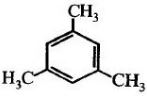
-
- (A) कैट. हाइड्रोजिनेशन
- (B) \(H_2/\) लिंडलर कैट.
- (C) \(Li/NH_3\)
- (D) \(LiAlH_4\)
उत्तर और हल देखें
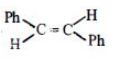
सही उत्तर: (C)
With Lithium in liquid ammonia, trans-alkene is almost an exclusive product.\(Ph-C\equiv C-Ph\xrightarrow[Brich\,reduction]{Li\,in\,liq.N{{H}_{3}}}\begin{matrix}
^{Ph} \\
_{H} \\
\end{matrix}\begin{matrix}
\text{ }\!\!\backslash\!\!\text{ } \\
/ \\
\end{matrix}C=C\begin{matrix}
/ \\
\text{ }\!\!\backslash\!\!\text{ } \\
\end{matrix}_{Ph}^{H}\) - 67. परऑक्साइड की उपस्थिति में ऐल्कीनों को \(HCl\) और \(HI\) ऐन्टीमारकोनीकाफ योग नहीं देते क्यों कि। 2014 कठिन
- (A) \(HCl\) और \(HI\) के सम्बन्ध में एक चरण ऊष्माशोषी है।
- (B) \(HCl\) और \(HI\) दोनों, प्रबल अम्ल हैं।
- (C) \(HCl\) उपचायक और \(HI\) अपचायक है।
- (D) \(HCl\) और \(HI\) के सम्बन्धों में सभी चरण ऊष्माप्रद हैं।
उत्तर और हल देखें
सही उत्तर: (A)
Anti-Markownikoff addition is possible only in case of \(HBr\) and not in \(HCl\) and \(HI\). In \(HBr\) both the chain initiation and propagation steps are exothermic, while in \(HCl,\) first step is Exothermic, and second step is endothermic and in \(HI,\) no step is exothermic. Hence \(HCl\) and \(HI\) do not undergo anti-Markownikoff's addition. -
- (A) \(sp\) और \(sp^3\)
- (B) \(sp^2\) और \(sp\)
- (C) केवल \(sp^2\)
- (D) \(sp^2\) और \(sp^3\)
उत्तर और हल देखें
सही उत्तर: (B)
\(\,\begin{matrix}
^{H} \\
_{H} \\
\end{matrix}\begin{matrix}
\text{ }\!\!\backslash\!\!\text{ } \\
/ \\
\end{matrix}\overset{s{{p}^{2}}}{\mathop{C}}\,=\overset{s{{p}^{2}}}{\mathop{C}}\,=\overset{s{{p}^{2}}}{\mathop{C}}\,\begin{matrix}
/ \\
\text{ }\!\!\backslash\!\!\text{ } \\
\end{matrix}_{H}^{H}\) -
- (A) \(4- \)मेथिल \(- 3 -\) एथिलहैक्सेन
- (B) \(3 -\) एथिल \(-4 -\) मेथिलहैक्सेन
- (C) \(3, 4-\)एथिलमेथिलहैक्सेन
- (D) \(4-\)एथिल \(-3 -\) मेथिलहैक्सेन
उत्तर और हल देखें
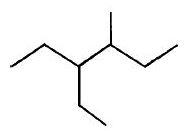
सही उत्तर: (B)
\(\mathop {\begin{array}{*{20}{c}}
{\,\,\,\,\,\,\,\,\,\,\,\,\,\,\,\,\,\,\,C{H_3}} \\
{\,\,\,\,\,\,\,\,\,\,\,\,\,|} \\
{C{H_3}C{H_2} - CH - CH - C{H_2}C{H_3}} \\
{|\,\,\,\,\,\,\,\,\,\,\,\,\,\,\,\,\,\,} \\
{\,\,\,\,\,\,C{H_2}\,\,\,\,\,\,\,\,\,\,\,\,\,\,} \\
{|\,\,\,\,\,\,\,\,\,\,\,\,\,\,} \\
{\,\,\,\,\,\,\,C{H_3}\,\,\,\,\,\,\,\,\,\,\,\,\,\,\,}
\end{array}}\limits_{3 - ethyl - 4 - methyl\,hexane} \) -
- (A) \(6\)
- (B) \(10\)
- (C) \(3\)
- (D) \(5\)
उत्तर और हल देखें
सही उत्तर: (B)
\(\%\) of \(N=\frac{1.4 \times \text { meq.of acid }}{\text { mass of organic compound }}\)meq. of \(H_{2} S O_{4}=60 \times \frac{M}{10} \times 2=12\)
meq. of \(N a O H=20 \times \frac{M}{10}=2\)
meq. of acid consumed \(=12-2=10\)
\(\therefore \% \quad N=\frac{1.4 \times 10}{1.4}=10 \%\)
-
- (A) परकिन अभिक्रिया
- (B) गैटरमन - कॉच फ़रमीलेशन
- (C) कोलबे की अभिक्रिया
- (D) गैटरमन अभिक्रिया
उत्तर और हल देखें
सही उत्तर: (D)
The given reaction is known as Gattermann reaction.In this reaction, aromatic compound such as benzene or phenol is treated with a mixture of \(HCN\) and dry \(HCl\) gas under pressure and in the presence of anhydrous aluminum chloride or zinc chloride to introduce a formyl group in the aromatic nucleus. - 72. एक आरगैनिक यौगिक \(A , C _{5} H _{8} O\); निम्न प्रकार \(H _{2} O , NH _{3}\) और \(CH _{3} COOH\) के साथ क्रिया करता है
 2014 कठिन
- (A) \(\begin{array}{*{20}{c}}
{C{H_3}CH = C - CHO} \\
{\,\,\,\,\,\,|} \\
{\,\,\,\,\,\,\,\,\,\,\,\,\,C{H_3}}
\end{array}\) - (B) \(\begin{array}{*{20}{c}}
{C{H_2} = CHCH - CHO} \\
{\,\,\,\,\,\,|\,\,\,} \\
{\,\,\,\,\,\,\,\,\,\,\,\,\,C{H_3}\,\,\,\,}
\end{array}\) - (C) \(\begin{array}{*{20}{c}}
{C{H_3} - C{H_2} - C = C = O} \\
{\,\,\,\,\,\,\,\,\,\,\,\,\,\,\,|\,\,\,} \\
{\,\,\,\,\,\,\,\,\,\,\,\,\,\,\,\,\,\,\,\,\,\,\,C{H_3}\,\,\,\,}
\end{array}\) - (D) \(\begin{array}{*{20}{c}}
{C{H_3} - C{H_2} - C - C = O} \\
{\,\,\,\,\,\,\,\,\,\,\,\,\,\,\,\,\,\,\,\,\,\,\,||\,\,\,\,\,\,\,\,\,|} \\
{\,\,\,\,\,\,\,\,\,\,\,\,\,\,\,\,\,\,\,\,\,\,\,\,\,\,\,\,\,\,C{H_2}\,H\,\,\,\,}
\end{array}\)
उत्तर और हल देखें
सही उत्तर: (C)
Given compound \(A\) is\(\begin{matrix}
C{{H}_{3}}-C{{H}_{2}}-C=C=O \\
\,\,\,\,\,\,\,\,\,\,\,\,| \\
\,\,\,\,\,\,\,\,\,\,\,\,\,\,\,\,\,\,C{{H}_{3}} \\
\end{matrix}\)Reactions given are as following:
\(\begin{array}{*{20}{c}}
{C{H_3} - C{H_2} - C = C = O\xrightarrow{{N{H_3}}}} \\
{{\mkern 1mu} {\mkern 1mu} {\mkern 1mu} {\mkern 1mu} {\mkern 1mu} {\mkern 1mu} {\mkern 1mu} {\mkern 1mu} \,\,\,\,\,\,\,\,\,\,\,\,\,\,\,\,{\mkern 1mu} {\mkern 1mu} {\mkern 1mu} |{\mkern 1mu} \,\,{\mkern 1mu} \,\,\,\,\,\,\,\,\,\,\,\,\,\,\,\,\,{\mkern 1mu} } \\
{{\mkern 1mu} {\mkern 1mu} {\mkern 1mu} {\mkern 1mu} {\mkern 1mu} {\mkern 1mu} {\mkern 1mu} {\mkern 1mu} {\mkern 1mu} {\mkern 1mu} {\mkern 1mu} {\mkern 1mu} {\mkern 1mu} {\mkern 1mu} \,\,\,\,\,\,\,\,\,\,\,\,\,\,\,\,\,\,\,\,C{H_{3\,}}\,\,\,\,\,\,\,\,\,\,\,\,\,\,\,\,\,\,\,\,}
\end{array}\) \(\left[ \begin{matrix}
C{{H}_{3}}-C{{H}_{2}}-C=\overset{+}{\mathop{C}}\,-{{O}^{-}} \\
\,\,\,\,\,\,\,\,\,\,\,\,| \\
\,\,\,\,\,\,\,\,\,\,\,\,\,\,\,\,\,\,C{{H}_{3}} \\
\end{matrix} \right]\)\(\updownarrow \)
\(\left[ \begin{matrix}
C{{H}_{3}}-C{{H}_{2}}-C=C-OH \\
\,\,\,\,\,\,\,\,\,\,\,\,\,\,\,\,\,\,\,\,\,\,\,|\,\,\,\,\,\,\,\,\,\,| \\
\,\,\,\,\,\,\,\,\,\,\,\,\,\,\,\,\,\,\,\,\,\,\,\,\,\,\,\,\,\,\,C{{H}_{3}}\,\,N{{H}_{2}}\,\, \\
\end{matrix} \right]\)\(\downarrow \)
\(\begin{matrix}
\,\,\,\,\,\,\,\,\,\,\,\,\,\,\,\,\,\,\,\,\begin{matrix}
\,\,\,\,\,\,\,\,\,\,\,\,\,\,\,\,\,\,\,\,\,\,\,\,\,\,\,\,O\,\, \\
\,\,\,\,\,\,\,\,\,\,\,\,\,\,\,\,\,\,\,\,\,\,\,\,\,|| \\
\end{matrix}\,\,\,\,\,\,\,\,\, \\
C{{H}_{3}}-C{{H}_{2}}-CH-C-N{{H}_{2}} \\
| \\
\,\,\,\,\,\,\,\,C{{H}_{3}} \\
\end{matrix}\)\(\begin{matrix}
C{{H}_{3}}-C{{H}_{2}}-C=C=O\xrightarrow{{{H}_{2}}O} \\
\,\,\,\,\,\,\,\,\,\,\,|\,\,\,\,\, \,\,\,\, \\
\,\,\,\,\,\,\,\,\,\,\,\,\,\,C{{H}_{3}}\,\,\,\,\,\,\,\,\, \\
\end{matrix}\) \(\begin{matrix}
C{{H}_{3}}-C{{H}_{2}}-CH-COOH \\
\,\,\,\,\,\,\,\,\,\,\,\,\,\,\,\,\,\,\,\,\,\,\,\,\,\,\,|\,\,\,\,\,\,\,\,\,\,\,\,\,\,\,\,\,\,\,\, \\
\,\,\,\,\,\,\,\,\,\,\,\,\,\,\,\,\,\,\,\,\,\,\,\,\,\,\,\,\,\,\,\,C{{H}_{3}}\,\,\,\,\,\,\,\,\,\,\,\,\,\,\,\,\,\, \\
\end{matrix}\)\(\begin{matrix}
C{{H}_{3}}-C{{H}_{2}}-C=C=O\xrightarrow{C{{H}_{3}}COOH} \\
\,\,\,\,\,\,\,\,\,|\,\,\,\,\,\,\,\,\,\,\,\,\,\,\,\,\,\,\,\,\,\,\,\, \\
\,\,\,\,\,\,\,\,\,\,C{{H}_{3}}\,\,\,\,\,\,\,\,\,\,\,\,\,\,\,\,\,\,\,\,\, \\
\end{matrix}\) \(\begin{matrix}
\,\,\,\,\,\,\,\,\,\,\,\,\,\,\,\,\,\,\,\,\,\,\,\,\,\,\,\,\,\,\,\,\,\,\,\,\,\,\begin{matrix}
O\,\,\,\,\,\,\,\,\,\,\,\,\,\,\,\,O \\
||\,\,\,\,\,\,\,\,\,\,\,\,\,\,\,\,\,\,\,|| \\
\end{matrix} \\
C{{H}_{3}}-C{{H}_{2}}-CH-C-O-C-C{{H}_{3}} \\
|\,\,\,\,\,\,\,\,\,\,\,\,\,\,\,\,\,\,\,\,\, \\
C{{H}_{3}}\,\,\,\,\,\,\,\,\,\,\,\,\,\,\, \\
\end{matrix}\,\) - (A) \(\begin{array}{*{20}{c}}
-
- (A) रोमर - टीमन अभिक्रिया।
- (B) फ्रीडल क्राफट ऐसीलेशन।
- (C) वुर्टज अभिक्रिया।
- (D) कैनीज़ेरो अभिक्रिया।
उत्तर और हल देखें
सही उत्तर: (D)
Canizzaro's reaction is a disproportionation reaction of aldehyde in which one molecule of aldehyde reduces to alcohol whereas other reduces to salt of carboxylic acid\(C_6H_5CHO+ KOH \longrightarrow C_6H_5CH_2OH + C_6H_5COOK\)
- 74. कौन सी बड़ी मात्रा में क्रिया फल प्राप्त होता है जब ऐसीटोन को आयोडीन और पोटैशियम हाइड्राक्साइड के साथ गरम किया जाता है ? 2014 कठिन
- (A) आयोडोऐसीटोन
- (B) एसीटिक ऐसिड
- (C) आयोडोफ़ार्म
- (D) ऐसीटो फिनोन
उत्तर और हल देखें
सही उत्तर: (C)
\(CH_3COCH_3 + 3I_2 + 4KOH\) \( \longrightarrow\) \(CHI_3 + CH_3COOK + 3HI + 3H_2O\) -
- (A) ऐल्डोल संघनन का
- (B) क्लेजन संघनन का
- (C) कैनीजारो अभिक्रिया का
- (D) पिनाकोल - पिनाकोलोन अभिक्रिया का
उत्तर और हल देखें
सही उत्तर: (C)
Tishchenko reaction is a modification of canizzaro's reaction.This reaction involves disproportionation of an aldehyde lacking a hydrogen atom in the alpha position in the presence of an alkoxide. The reaction product is an ester. catalysts are aluminium alkoxide or sodium alkoxide.In cannizzaro's reaction the base is sodium hydroxide and the oxidation product is a carboxylic acid and the reduction product is an alcohol.

-
- (A) लैक्टिक ऐसिड
- (B) टारटैरिक एसिड
- (C) मैलीक एसिड
- (D) \(\alpha -\) एमायनों ऐसिड
उत्तर और हल देखें
सही उत्तर: (C)
Optical isomers contain an asymmetric (chiral) carbon atom (a carbon atomattached to four different atoms or groups). Therefore all except maleic acid exhibit optical isomerism. - 77. \(CaC _{2}\) के \(C _{2}^{2-}\) आयन में आबन्धों की संख्या एवं प्रकार निम्न कौनसी है ? 2014 मध्यम
- (A) एक \(\sigma\) आबन्ध और एक \(\pi\) - आबन्ध
- (B) एक \(\sigma\) आबन्ध और दो \(\pi-\) आबन्ध
- (C) दो \(\sigma\) आबन्ध और दो \(\pi-\) आबन्ध
- (D) दो \(\sigma\) आबन्ध और एक \(\pi\)-आबन्ध
उत्तर और हल देखें
सही उत्तर: (B)
The structure of \(CaC_2\) is \(Ca^{2+}\) \([: C \equiv C :]^{2-}\) i.e, one \(\sigma \) and two \(\pi \) bonds -
- (A) \(N_2\)
- (B) \(O_2^ - \)
- (C) \(N_2^{2 + }\)
- (D) \(O_2^{2 - }\)
उत्तर और हल देखें
सही उत्तर: (B)
\(O_2^ - (17) = KK{(\sigma 2s)^2}({\sigma ^*}2{s^2}){(\sigma 2{p_x})^2}\)\({(\pi 2{p_y})^2}{(\pi 2{p_z})^2}{({\pi ^*}2{p_y})^2}{({\pi ^*}2{p_z})^1}\)
one unpaired electron - Paramagnetic
- 79. \(LiCl , RbCl , BeCl _{2}\) और \(MgCl _{2}\) में से अधिकतम और न्यूनतम आयनी विशेषता रखने वाले यौगिक क्रमानुसार हैं। 2014 कठिन
- (A) \(LiCl\) और \(RbCl\)
- (B) \(RbCl\) और \(BeCl_2\)
- (C) \(MgCl_2\) और \(BeCl_2\)
- (D) \(RbCl\) और \(MgCl_2\)
उत्तर और हल देखें
सही उत्तर: (B)
According to Fajan's rules smaller, highly charged cation has greatest covalent character while large anion with smaller charge has greatest ionic character -
- (A) \(N_2\)
- (B) \(NO\)
- (C) \(CO\)
- (D) \(O_3\)
उत्तर और हल देखें
सही उत्तर: (B)
The molecular orbital configuration of the molecules given isTotal no. of electrons in \(NO\)
\(=7(N)+8(O)=15\)
Hence \(E.C.\) of \(NO\)
\(KK{[\sigma 2s]^2}{[{\sigma ^*}(2s)]^2}{[\sigma 2{p_z}]^2}\)
\({[\pi (2{p_x})]^2}[\pi {(2{p_y})^2}]{[{\pi ^*}(2{p_x})]^1}\)
Due to presence of one unpaired electron
\(NO\) is paramagnetic.
Except \(NO\) all are diamagnetic dur to absence of unpaired electrons.
- 81. निम्न व्यवस्थाओं में से किस में \(N _{2}, O _{2}, O _{2}^{-}\)की आबन्ध वियोजन ऊर्जा के सही क्रम को दिखाया गया है ? 2014 मध्यम
- (A) \(N_2 > O_2^- > O_2\)
- (B) \(O_2^- > O_2 > N_2\)
- (C) \(N_2 > O_2 > O_2^-\)
- (D) \(O_2 > O_2^- > N_2\)
उत्तर और हल देखें
सही उत्तर: (C)
The bond order of \(N_2,\) \(O_2,\) and \(O_2^-\) are respectively \(3,2\) and \(1.5\)Since higher bond order implies higher bond dissociation energy hence the correct orde will be
\(N_2 > O_2 > O_2^-\)
-
- (A) \((CH_3)_3N\)
- (B) \((SiH_3)_3 N\)
- (C) \(P(CH_3)_3\)
- (D) \(P(SiH_3)_3\)
उत्तर और हल देखें
सही उत्तर: (B)
In case of \(N(SiH_3)_3\, N\) atom is \(sp^2\) hybridised, the lone pair is present in \(2p\) orbital and it is transferred to empty \(d\) orbital of \(Si\) forming \(d\pi -p\pi \) bond . Hence nitrogen with \(sp^2\) hybridization has trigonal planar shape. - 83. आवर्त सारणी के किसी ग्रुप में तत्व के परमाणुओं के रासायनिक गुणों में अधिकतम समानता के कारण होते हैं। 2014 आसान
- (A) परमाणुक नम्बर
- (B) परमाणुक द्रव्यमान
- (C) बड़े (Principal) ऊर्जा स्तरों की संख्या
- (D) वैलेन्सी इलैक्ट्रॉनों की संख्या
उत्तर और हल देखें
सही उत्तर: (A)
If elements are arranged in order of their increasing atomic numbers, element coming at intervals of \(2, 8, 8, 1 8, 1 8, 32\) and \(32\) will have similar physical and chemical properties and thus grouped in one particular group. -
- (A) \(NO ^{+}\)तथा \(O _{2}\) समइलेक्ट्रानी नहीं हैं।
- (B) बोरान अपने यौगिकों में सदैव सहसंयोजी होता है।
- (C) जलीय विलयन में, \(Tl \;(III)\) की अपेक्षा \(Tl ^{+}\) आयन अत्याधिक स्थायी होता है।
- (D) \(LiAlH _{4}\) कार्बनिक संश्लेषणों में प्रयोग होने वाला एक बहुमुखी अपचायक है।
उत्तर और हल देखें
सही उत्तर: (A)
\((a)\, NO^+\, =7+8-1\,=14\,e^-\). \(O_2\, = 16\,e^-\). i.e. not isoelectronic
\((b)\) Boron forms only covalent compounds. This is due to its extremely high ionisation energy.
\((c)\) Compounds of \(Ti^+\) are much more stable than those of \(Ti^{3+}\).
\((d)\, LiAlH_4\) is a versatile reducing agent in organic synthesis - 85. निम्न से कौन सा सीरीज दो तत्वों \(X\) और \(Y\) के बीच के सम्बन्ध का सही निरूपन करता है ? \(X \rightarrow Y\) 2014 मध्यम
- (A) \({ }_{3} Li \rightarrow{ }_{19} K\) आयनीकरण की ऐन्थैल्पी बढ़ती है
- (B) \({ }_{9} F \rightarrow{ }_{35} Br\) इलैक्ट्रान लाभ की ऐन्थैल्पी ऋणात्मक चिन्ह के साथ बढ़ती है
- (C) \({ }_{6} C \rightarrow{ }_{32} Ge\) परमाणुओं की त्रिज्याएँ बढ़ती हैं
- (D) \({ }_{18} Ar \rightarrow{ }_{54} Xe\) उत्क्रष्ट स्वभाव बढ़ता है
उत्तर और हल देखें
सही उत्तर: (C)
On moving down a group atomic radii increases -
- (A) \({O^{2 - }}\, < \,{N^{3 - }}\, < \,\,{S^{2 - }}\, < \,\,{P^{3 - }}\)
- (B) \({O^{2 - }}\, < \,{P^{3 - }}\, < \,\,{N^{3 - }}\, < \,{S^{2 - }}\)
- (C) \({N^3}\, < \,{O^{2 - }}\, < \,\,{P^{3 - }}\, < \,{S^{2 - }}\)
- (D) \({N^{3 - }}\, < \,{S^{2 - }}\, < \,\,{O^{2 - }}\, < \,{P^{3 - }}\)
उत्तर और हल देखें
सही उत्तर: (A)
For isoelectronic species ionic radii decreases as the charge on ion decreases. Further on moving down in a group ionic radii increases. Hence the correct order is\({O^{2 - }}\, < \,{N^{3 - }}\, < \,\,{S^{2 - }}\, < \,\,{P^{3 - }}\)
-
- (A) \(O_2^{2 - }\)
- (B) \(Li^+\)
- (C) \(B^{3+}\)
- (D) \(F^-\)
उत्तर और हल देखें
सही उत्तर: (A)
On moving along a period ionic radii decreases due to increase in effective nuclear charge -
- (A) \(-1\)
- (B) \(-0.5\)
- (C) \(0.5\)
- (D) \(1\)
उत्तर और हल देखें
सही उत्तर: (B)
\(S O_{2}(g)+\frac{1}{2} O_{2}(g) \rightleftharpoons S O_{3}(g)\)\(K_{p}=K_{C}(R T)^{x}\)
where \(x=\Delta n_{g}=\) number of gaseous moles in product - number of gaseous moles in reactant
\(=1-\left(1+\frac{1}{2}\right)\)
\(=1-\frac{3}{2}=-\frac{1}{2}\)
- 89. एक ताप विशेष साम्यपर केवल \(50 \% \;HI , H _{2}\) और \(I _{2}\) में विभाजित होता है। साम्य स्थिरांक का मान होगा 2014 कठिन
- (A) \(0.25\)
- (B) \(3\)
- (C) \(0.5\)
- (D) \(1\)
उत्तर और हल देखें
सही उत्तर: (A)
\(\begin{array}{l}2 HI \quad\quad\rightleftharpoons\quad H _2\quad+\quad I _2 \\ a\quad\quad\quad\quad\quad\quad0\quad\quad\quad\quad0 \\ a (1-0.5) \quad\quad0.25 a \quad\quad0.25 a \end{array}\)\(K =\frac{(0.25 a )(0.25 a )}{(0.5 a )^2}\)
\(K =0.25\)
-
- (A) \(1.94\)
- (B) \(5.82\)
- (C) \(7.66\)
- (D) \(38.8\)
उत्तर और हल देखें
सही उत्तर: (B)
\(N{H_2}COON{H_4}(s) \leftrightarrow 2N{H_3}(g) + C{O_2}(g)\)\({K_P} = \frac{{{{({P_{N{H_3}}})}^2} \times ({P_{C{O_2}}})}}{{{P_{N{H_2}COON{H_4}(s)}}}}\)
\( = {({P_{N{H_3}}})^2} \times ({P_{C{O_2}}})\)
As evident by the reaction, \(NH_3\) and \(CO_2\) are formed in molar ratio of \(2:1\). Thus if \(P\) is the total pressure of the system at equilibrium, then
\({P_{N{H_3}}} = \frac{{2 \times P}}{3}\) \({P_{C{O_2}}} = \frac{{1 \times P}}{3}\)
\({K_P} = {\left( {\frac{{2P}}{3}} \right)^2} \times \frac{P}{3} = \frac{{4{P^3}}}{{27}}\)
Given \({K_P} = 2.9 \times {10^{ - 5}}\)
\(\therefore \,2.9 \times {10^{ - 5}} = \frac{{4{P^3}}}{{27}}\)
\({P^3} = \frac{{2.9 \times {{10}^{ - 5}} \times 27}}{4}\)
\(P = {\left( {\frac{{2.9 \times {{10}^{ - 5}} \times 27}}{4}} \right)^{1/3}} = 5.82 \times {10^{ - 2}}\,atm\)
- 91. साम्य रखने वाले आयतन को अपरिवर्तित रखने वाली स्थिति में एक अक्रिय गैस डालने पर क्या होगा ? 2014 मध्यम
- (A) अधिक क्रिया फल प्राप्त होगा।
- (B) कम क्रिया फल प्राप्त होगा।
- (C) अधिक अभिक्रिया होगी।
- (D) साम्य अपरिवर्तित रहेगा।
उत्तर और हल देखें
सही उत्तर: (D)
On adding inert gas at constant volume the total pressure of the system is increased, but the partial pressure of each reactant and product remains the same. Hence no effect on the state of equilibrium. -
- (A) \(23.03\)
- (B) \(-23.03\)
- (C) \(2.303\)
- (D) \(-2.303\)
उत्तर और हल देखें
सही उत्तर: (B)
Given, \(C_p = 10\) cals at \(1000\,K\)\(T_t = 1000 K.\) \(T_2 = 100\,K\)
\(m = 32\,g\)
\(\Delta S = ?\)
at constant pressure
\(\Delta S = {C_p}\,\ln \,\frac{{{T_2}}}{{{T_1}}}\)
\( = 2.303 \times {C_p}\,\log \,\frac{{{T_2}}}{{{T_1}}}\)
\( = 2.303 \times 10\,\log \,\frac{{100}}{{1000}}\)
\( = - 23.03\,cal\,{\deg ^{ - 1}}\)
-
- (A) \(\Delta H _{\text {mixing}} < 0\) (zero)
- (B) \(\Delta H _{\text {mixing}} > 0\) (zero)
- (C) \(A - A\) और \(B - B\) की परस्पर प्रभाव से \(A - B\) का परस्पर प्रभाव अधिक प्रबल होगा।
- (D) \(A - A , B - B\) और \(A - B\) सभी परस्पर प्रभाव एक समान हैं।
उत्तर और हल देखें
सही उत्तर: (D)
Solutions in which solute - solute and solvent-solvent interactions are almost similar to solute solvent interactions are known as ideal solution -
- (A) \(- 1366. 95\)
- (B) \(- 1361.95\)
- (C) \(- 1460.95\)
- (D) \(- 1350. 50\)
उत्तर और हल देखें
सही उत्तर: (A)
\(C _{2} H _{5} OH ( l )+3 O _{2}( g ) \rightarrow 2 CO _{2}( g )+3 H _{2} O ( l )\)\(\Delta E =-1364.47 kJ mol ^{-1}\)
\(\Delta H =?\)
\(T =298 K\)
\(\Delta n _{ g }=-1 \because\) complete combution
\(R =8.314 J mol ^{-1}=\frac{8.314}{1000} kJ mol ^{-1}\)
\(\because \Delta H =\Delta E + P \Delta V\)
but, \(P \Delta V =\Delta n _{ g } RT\)
\(\because \Delta H =\Delta E +\Delta n _{ g } RT\)
\(\Delta H =-1364.47+\left((-1) \times \frac{8.314}{1000} \times 298\right)\)
\(\Delta H =-1366.95 kJ mol ^{-1}\)
-
- (A) \(H _{2}\) अणु की वियोजन ऊर्जा।
- (B) कार्बन की पहली चार आयनन ऊर्जाएँ।
- (C) \(H _{2}\) की वियोजन ऊर्जा और कार्बन (ग्रेफ़ाइट) की ऊर्ध्वपातन ऊर्जा।
- (D) कार्बन की प्रथम चार आयनन ऊर्जाएँ और हाइड्रोजन की इलैक्ट्रॉन बन्धुता।
उत्तर और हल देखें
सही उत्तर: (A)
To calculate average enthalpy of \(C-H\) bond in methane following informations are needed\((i)\) dissociation energy of \(H_2\) i.e.
\(\frac{1}{2}{H_2}(g) \to H(g);\Delta H = x\) (suppose)
\((ii)\) Sublimation enegry of \(C\) (graphite) to \(C(g)\)
\(C(graphite) \to C(g);\Delta H = y\) (Suppose)
Given
\(C(graphite) + 2{H_2}(g) \to C{H_4}(g);\Delta H = 75\,kJ\,mo{l^{ - 1}}\)
-
- (A) \(- 1102\)
- (B) \(- 964\)
- (C) \(+352\)
- (D) \(+1056\)
उत्तर और हल देखें
सही उत्तर: (B)
Given \(\frac{1}{2}{N_2} + \frac{3}{2}{H_2} \leftrightarrow N{H_3};\)\(\Delta {H_f} = - 46.0\,kJ/mol\)
\(H + H \leftrightarrow {H_2};\,\Delta {H_f} = - 436\,kJ/mol\)
\(N + N \leftrightarrow {N_2};\,\Delta {H_f} = - 712\,kJ/mol\)
\(\Delta {H_f}(N{H_3}) = \frac{1}{2}\Delta {H_{N - N}} + \frac{3}{2}\Delta {H_{H - H}} - \Delta {H_{N - H}}\)
\( - 46 = \frac{1}{2}( - 712) + \frac{3}{2}( - 436) - \Delta {H_{N - H}}\)
On calculation
\(\Delta {H_{N - H}} = - 964\,kJ/mol\)
-
- (A) \(-312.5\)
- (B) \(-242.8\)
- (C) \(-108.1\)
- (D) \(-37.6\)
उत्तर और हल देखें
सही उत्तर: (B)
\(\Delta {S^o} = S_{_{C{O_2}}}^o + 2 \times S_{_{{H_2}O}}^o - (S_{_{C{H_4}}}^o + 2 \times S_{{O_2}}^o)\)\( = (213.6 + 2 \times 69.9) - (186.2 + 2 \times 205.2)\)
\( = - 242.8\,J\,{K^{ - 1}}\,mo{l^{ - 1}}\,\)
-
- (A) हाइड्रोफ्लोसिलिसिक ऐसिड
- (B) सिलिका जैल
- (C) सिलिसिक ऐसिड
- (D) कैल्शियमफ्लोरोसिलिकेट
उत्तर और हल देखें
सही उत्तर: (D)
\(2CaF_2 + SiO_2 + H_2SO_4\, \longrightarrow\)\(Si{F_4} + {H_2}O + CaS{O_4}\xrightarrow{{hydrolysis}}CaSi{F_6}\)
-
- (A) \(1\) और \(2\)
- (B) \(1\) और \(3\)
- (C) \(2\) और \(4\)
- (D) \(3\) और \(4\)
उत्तर और हल देखें
सही उत्तर: (B)
Aluminium oxide is amphoteric oxide because it shows the properties of the both acidic and basic oxides . It reacts with both acids and bases to form salt and water.\(Al_2O_3 . xH_2O + 2NaOH \longrightarrow NaAlO_2 +H_2O\)
\(Al_2O_3 . xH_2O+HCl \longrightarrow AlCl_3 + H_2O\)
-
- (A) ज़ियोलाइटें
- (B) अल्ट्रामैरीनें
- (C) फेल्डस्पारें
- (D) बेरिलें
उत्तर और हल देखें
सही उत्तर: (C)
The feldspars are most abundant aluminosilicate minerals in the Earth surface. The silicon atoms and aluminium atoms occupy the centres of interlinked tetrahedra of \(SiO_4^{-4}\) and \(AlO_4^{-5}\) . These tetrahedra connect at each corner to other tetrahedra forming an intricate, three dimesional, negatively charged framework. The sodium cations sit within the voids in this structure

इस पेज पर इन फ़िल्टर से कोई प्रश्न नहीं मिला।