


All JEE Mains 2014 Chemistry questions
25 chaptersShowing 51–100 of 107 questions
-
- (A) \(L_4 < L_3 < L_2 < L_1\)
- (B) \(L_1 < L_3 < L_2 < L_4\)
- (C) \(L_3 < L_2 < L_4 < L_1\)
- (D) \(L_1 < L_2 < L_4 < L_3\)
Show answer and solution
Correct Answer: (B)
Ligand field strength \(\propto\) Energy of light absorbed \(\propto \frac{1}{\text { Wavelength of light absorbed }}\)\(\begin{array}{*{20}{c}}
\lambda &{{\lambda _1}}&{{\lambda _2}}&{{\lambda _3}}&{{\lambda _4}} \\
{{\text{Absorbed}}}&{{\text{light}}\,\,{\text{Red}}}&{{\text{Green}}}&{{\text{Yellow}}}&{{\text{Blue}}}
\end{array}\)Wavelength of absorbed light decreases.
\(\therefore\) Increasing order of energy of wavelengths absorbed reflect greater extent of crystal fleld splitting, hence, higher field strength ot the ligand.
\(Energy\; blue \left(L_{4}\right)>\operatorname{green}\left(L_{2}\right)>\operatorname{yellow}\left(L_{3}\right)>r e d\left(L_{1}\right)\)
\(\therefore \quad L_{4}>L_{2}>L_{3}>L_{1}\) in fleld strength of ligands.
-
- (A) \(K_2[Pt(CN)_4]\) \(\to \) Potassium tetracyanoplatinate \((II)\)
- (B) \([Mn(CN)_5]^{2-}\) \(\to \) Pentacyanomagnate \((II)\) ion
- (C) \(K[Cr(NH_3)_2Cl_4]\) \(\to \) Potassium diammine tetrachlorochromate \((III)\)
- (D) \([Co(NH_3)_4(H_2O)I]SO_4\) \(\to \) Magnetron value
Show answer and solution
Correct Answer: (B)
The correct \(IUPAC\) Name of \([Mn(CN)_5]^{2-}\). Pentacyanomangnate \((III)\) . - 53. Which one of the following complexes will most likely absorb visible light?
(At nos. \(Sc = 21 , Ti = 22, V = 23, Zn = 30\)) 2014 Hard- (A) \({[Sc{({H_2}O)_6}]^{3 + }}\)
- (B) \({[Ti{(N{H_3})_6}]^{4 + }}\)
- (C) \({[V{(N{H_3})_6}]^{3 + }}\)
- (D) \({[Zn{(N{H_3})_6}]^{2 + }}\)
Show answer and solution
Correct Answer: (C)
The absorption of visible light and hence coloured nature of the transition metal cation is due to the promotion of one or more unpaired \(-\,d\,-\) electron from a lower to higher will be the number of unpaired electron higher will be the absorption in visible light.The electronic configuration of the given elements is
\(S{c^{3 + }}(18)\, = \,1{s^2}\,2{s^2}\,2{p^6}\,3{s^2}\,3{p^6}\,3{d^0}\,4{s^0}\) no unpaired \(e^-\)
\(T{i^{4 + }}(18)\, = \,1{s^2}\,2{s^2}\,2{p^6}\,3{s^2}\,3{p^6}\,3{d^0}\,4{s^0}\) no unpaired \(e^-\)
\({V^{3 + }}(18)\, = \,1{s^2}\,2{s^2}\,2{p^6}\,3{s^2}\,3{p^6}\,3{d^2}\,4{s^0}\) - Two unpaired \(e^-\).
\(Z{n^{2 + }}(28)\, = \,1{s^2}\,2{s^2}\,2{p^6}\,3{s^2}\,3{p^6}\,3{d^{10}}\,4{s^0}\) no unpaired \(e^-\)
hence \([V(NH_3)_6]^{3+}\) will moost likely absorb visible light.
-
- (A) \(H_2O_2 + 2H^++ 2e^- \rightarrow 2H_2O\)
- (B) \(H_2O_2 +2e^-\rightarrow O_2 +2H^+\)
- (C) \(H_2O_2 +2e^-\rightarrow 2OH^-\)
- (D) \(H_2O_2+2OH^- \, -2e^- \rightarrow O_2+2H_2O\)
Show answer and solution
Correct Answer: (D)
\(\mathrm{H}_{2} \mathrm{O}_{2}+2 \mathrm{OH}^{-}-2 \mathrm{e} \rightarrow \mathrm{O}_{2}+2 \mathrm{H}_{2} \mathrm{O}\) A molecule of \(\mathrm{H}_{2} \mathrm{O}_{2}\) loses hydrogen and is oxidized. - 55. Shapes of certain interhalogen compounds are stated below. Which one of them is not correctly stated? 2014 Hard
- (A) \(IF_7\) : pentagonal bipyramid
- (B) \(BrF_5\) : trigonal bipyramid
- (C) \(BrF_3\) : planar \(T-\) shaped
- (D) \(ICl_3\) : planar dimeric
Show answer and solution
Correct Answer: (B)
The molecular geometry of \(BrF_5\) is square pyramidal with asymmetric charge distribution on the central atom.
-
- (A) It is a covalent molecule.
- (B) It contains \(Cs^+\) and \(I_3^-\) ions.
- (C) It contains \(Cs^{+3}\) and \(I^-\) ions.
- (D) It contains \(Cs^+, I^-\) and lattice \(I_2\) molecule.
Show answer and solution
Correct Answer: (B)
\(C s l_{3}\) dissociates as\(C s l_{3} \rightarrow C s^{+}+I_{3}\)
- 57. Which of the following xenon-oxo compounds may not be obtained by hydrolysis of xenon fluorides? 2014 Hard
- (A) \(Xe{O_2}{F_2}\)
- (B) \(XeO{F_4}\)
- (C) \(XeO_3\)
- (D) \(XeO_4\)
Show answer and solution
Correct Answer: (D)
\(Xe{F_6}\, + \,{H_2}O\,\xrightarrow{{partial}}XeO{F_4}\, + \,2HF\)\(Xe{F_6}\, + \,2{H_2}O\,\xrightarrow{{partial}}Xe{O_2}{F_2}\, + \,4HF\)
\(Xe{F_6}\, + \,3{H_2}O\,\xrightarrow{{compute}}Xe{O_3}\, + \,6HF\)
-
- (A) It is diamagnetic in gaseous state
- (B) It is neutral oxide
- (C) It combines with oxygen to form nitrogen dioxide
- (D) It's bond order is \(2.5\)
Show answer and solution
Correct Answer: (A)
Nittic oxide is paramagnetic in the gaseous state because of the presence of one unpaired electron in its outermost shell.\({\text { The electronic configuration of } N O \text { is }}\)
\({\sigma_{1 s}^{2} \sigma_{1 s}^{* 2} \sigma_{2 s}^{2} \sigma_{2 s}^{o 2} \sigma_{2 p r s}^{2} \pi_{2 p r}^{2}}\)
\(=\pi_{2 p_{y}}^{2} \pi_{2 p_{z}}^{* 1}\)
-
- (A) \(1+\)
- (B) \(2+\)
- (C) \(3+\)
- (D) \(4+\)
Show answer and solution
Correct Answer: (C)
According to Faraday's first law of electrolysis\(W\,=\,\frac {E\times i\times t}{96500}\)
Where \(E\,=\) equivqlent weight
\(=\,\frac {mol.\,mass\,of\,metal\,(M)}{oxidation\,state\,of\,metal(x)}\)
Substituting the value in the formula
\(W\,=\,\frac {M}{x}\) \(\times \) \(\frac {i\times t}{96500}\)
or \(x=\frac {M}{W}\) \(\times \) \(\frac {i\times t}{96500}\) \( = \,\frac{{10\, \times \,2 \times 60 \times 60\,}}{{96500\, \times 0.250}} = 3\)
[Given :no . of moles \(=\frac {M}{W}\,=\,0.250\) ]
Hence oxidation state of metals is \((+3)\)
-
- (A) \(-2.69\, V;\) the reaction will not occur
- (B) \(-2.69\,V; \) the reaction will occur
- (C) \(-0.33\, V;\) the reaction will not occur
- (D) \(-0.33 V;\) the reaction will occur
Show answer and solution
Correct Answer: (A)
(a) \(\quad M n^{2+}+2 e^{-} \rightarrow M n ; \quad E^{\circ}=-1.18 V ; \ldots(i)\)(b) \(\quad M n^{3+}+e \rightarrow M n^{2+} ; \quad E^{\circ}=-1.51 V ; \ldots(i i)\)
Now multiplying equation \((i i)\) by two and subtracting from equation \((i)\)
\(3 M n^{2+} \rightarrow M n^{+}+2 M n^{3+}\)
\(E^{\circ}=E_{O_{X}}+E_{\mathrm{Red} .}=-1.18+(-1.51)=-2.69 \mathrm{V}\)
\([-\text { ve value of } E M F(\text { i.e., } \Delta G=+v e)\)\( \text { shows that the reaction is non-spontaneous }]\)
-
- (A) \(Fe^{2+} < Al < Br^-\)
- (B) \(Br^- < Fe^{2+} < Al\)
- (C) \(Al < Br^- < Fe^{2+}\)
- (D) \(Al < Fe^{2+} < Br^-\)
Show answer and solution
Correct Answer: (D)
A negative \(E^o\) means that the redox couple is a stronger reducing agent. Hence, we can say that Aluminium is strongest reducing agent.Reducing character decreases down the series. Hence the correct order is \(Al < Fe^{2+} < Br^-\)
-
- (A) \(\frac{{{N_A}}}{{20}}\)
- (B) \(\frac{{{N_A}}}{{10}}\)
- (C) \(\frac{{{N_A}}}{{5}}\)
- (D) \(\frac{{{N_A}}}{{2}}\)
Show answer and solution
Correct Answer: (C)
\(Cu\, \to \,C{u^{ + + }}\, + \,2{e^ - }\)i.e., to deposit \(1\,mole\) of \(Cu\) at cathode from \(Cu^{2+}\) \(SO_4^{2-}\) solution \(=\,2\,\,mole\) of electrons are required
i.e., To deposit
\(6.35\,g\, = \,\frac{{6.35}}{{63.5}}\, \times 2\, = \,\frac{2}{{10}}\, = \,\frac{1}{5}\,moles\)
Thus total no. of elecrtrons required \(=\,\frac {N_A}{5}\)
-
- (A) \(5 \times 10^{-4}\)
- (B) \(5 \times 10^{-3}\)
- (C) \(5 \times 10^{3}\)
- (D) \(5 \times 10^{2}\)
Show answer and solution
Correct Answer: (A)
Given for \(0.2 \mathrm{M}\) solution\(R=50 \Omega\)
\(\kappa=1.45 S m^{-1}=1.4 \times 10^{-2} S \mathrm{cm}^{-1}\)
Now, \(R=\rho {\frac{\ell}{a}}=\frac{1}{\kappa} \times \frac{\ell}{a}\)
\(\Rightarrow \frac{\ell}{a}=R \times \kappa=50 \times 1.4 \times 10^{-2}\)
For \(0.5 M\) solution
\(R=280 \Omega ; \kappa=?\)
\(\frac{\ell}{a}=50 \times 1.4 \times 10^{-2}\)
\(\Rightarrow R=\rho \frac{\ell}{a}=\frac{1}{\kappa} \times \frac{\ell}{a}\)
\(\Rightarrow \quad \kappa=\frac{1}{280} \times 50 \times 1.4 \times 10^{-2}\)
\(=\frac{1}{280} \times 70 \times 10^{-2}=2.5 \times 10^{-3} S c m^{-1}\)
Now, \(\Lambda_{m}=\frac{\kappa \times 1000}{M}=\frac{2.5 \times 10^{-3} \times 1000}{0.5}\)
\(=5 S c m^{2} m o l^{-1}=5 \times 10^{-4} S m^{2} m o l^{-1}\)
-
- (A) \(\lambda _C =\lambda _{\infty} +(B)C\)
- (B) \(\lambda _C =\lambda _{\infty} - (B)C\)
- (C) \(\lambda _C =\lambda _{\infty} -(B) \sqrt{C}\)
- (D) \(\lambda _C =\lambda _{\infty} +(B) \sqrt{C}\)
Show answer and solution
Correct Answer: (C)
According to Debye Huckle onsager equation,\(\lambda_{C}=\lambda_{\infty}-B \sqrt{C}\)
-
- (A) \(A, C, B, D\)
- (B) \(B, D, C, A\)
- (C) \(C, B, D, A\)
- (D) \(D, A, B, C\)
Show answer and solution
Correct Answer: (C)
As the value of reduction potential decreases the reducing power increases i.e. \(\mathop C\limits_{(0.85)} < \mathop B\limits_{(0.6)} < \mathop D\limits_{( - 0.76)} < \mathop A\limits_{( - 1.2)} \) -
- (A) They all have the same osmotic pressure.
- (B) \(0.100\, M\, Mg_3(PO_4)_2\,(aq)\) has the highest osmotic pressure.
- (C) \(0.125\, M\, Na_3PO_4\,(aq)\) has the highest osmotic pressure.
- (D) \(0.500\, M\, C_2H_5OH\,(aq)\) has the highest osmotic pressure.
Show answer and solution
Correct Answer: (A)
\(\pi=i C R T\)\(^{\pi} C_{2} H_{3} O H\) \(=1 \times 0.500 \times R \times T=0.5 R T\)
\(^{\pi} M g_{3}\left(P O_{4}\right)_{2}\) \(=5 \times 0.100 \times R \times T=0.5 R T\)
\(^{\pi} K B r=2 \times 0.250 \times R \times T=0.5 R T\)
\(^{\pi} N a_{3} P O_{4}=4 \times 0.125 \times R T=0.5 R T\)
since the osmotic pressure of all the given solutions is equal.
Hence all are isotonic solution.
-
- (A) \(1\)
- (B) \(2\)
- (C) \(2.50\)
- (D) \(4\)
Show answer and solution
Correct Answer: (B)
Givenmass of solute \((w)\,=\,120\,g\)
mass of solvent \((w)\,=\,1000\,g\)
Mol. mass of solute \(=60\,g\)
density of solution \(=\,1.12\,g/ml\)
From the given data,
Mass of solution \(=\,1000+120=1120\,g\)
\(d=\frac {Mol.mass}{V}\) or \(V=\frac {Mol.mass}{d}\)
Volume of solution \(V\,=\,\frac {1120}{1.12}\,=\,1000\,ml\) or
\(=\,1\,litre\)
Now molarity \((M)\) \(=\,\frac {W}{Mol.\,mass\times V(lit)}\) \(=\,\frac {120}{60\times 1}\) \(=\,2\,M\)
-
- (A) \(5\) and \(4.42\)
- (B) \(4\) and \(4.00\)
- (C) \(5\) and \(3.42\)
- (D) \(3\) and \(5.42\)
Show answer and solution
Correct Answer: (A)
Given \({\pi _{ob}}\, = \,10.8\,atm\)\({\pi _{nor}}\, = \,CST\, = \,0.10\, \times \,0.0821\, \times \,298\, = \,2.446\)
now experimntal value of \((i)\)
\(=\,\frac {Observed\,osmotic\,pressure}{Normal\,osmotic\,pressure}\)
\(=\,\frac {10.8}{2.446}\,=\,4.42\)
-
- (A) \(NH_2\)
- (B) \(N_3H\)
- (C) \(NH_3\)
- (D) \(N_2H_4\)
Show answer and solution
Correct Answer: (D)
In an unknown compounds containing \(N\) and \(H\)given \(\%\) of \(H\) \(= 12.5\%\)
\(\therefore \) \(\%\) of \(N\) \(= 100-12.5 = 87.5\%\)
Element Percentage Atomic ratio Simple ratio \(H\) \(12.5\%\) \(\frac{12.5}{1}=12.5\) \(\frac{12.5}{6.25}=2\) \(N\) \(87.5\%\) \(\frac{87.5}{14}=6.25\) \(\frac{6.25}{6.25}=1\) \(2 \times\) vapour density \(=\) Mol. wt \(= 16 \times 2 = 32.\)
Molecular formula \(= n \times\) empirical formula mass
\(n = \frac{{32}}{{16}} = 2\)
\(\therefore \) Molecular formula of the compound will be \(= (NH_2)_2\)
\(= N_2H_4\)
-
- (A) \(11.65\)
- (B) \(23.3\)
- (C) \(30.6\)
- (D) \(33.2\)
Show answer and solution
Correct Answer: (A)
Explanation:
Let us determine the mass of the precipitate formed step-by-step using the concept of limiting reagents:
1. Calculate the mass and moles of \(\text{BaCl}_2\):
- Molar mass of \(\text{BaCl}_2 = 137 + 2(35.5) = 208\text{ g mol}^{-1}\)
- Mass of \(\text{BaCl}_2\) in \(100\text{ mL}\) of \(20.8\%\) solution \(= \frac{20.8}{100} \times 100 = 20.8\text{ g}\)
- Moles of \(\text{BaCl}_2 = \frac{20.8}{208} = 0.1\text{ mol}\)
2. Calculate the mass and moles of \(\text{H}_2\text{SO}_4\):
- Molar mass of \(\text{H}_2\text{SO}_4 = 2(1) + 32 + 4(16) = 98\text{ g mol}^{-1}\)
- Mass of \(\text{H}_2\text{SO}_4\) in \(50\text{ mL}\) of \(9.8\%\) solution \(= \frac{9.8}{100} \times 50 = 4.9\text{ g}\)
- Moles of \(\text{H}_2\text{SO}_4 = \frac{4.9}{98} = 0.05\text{ mol}\)
3. Identify the Limiting Reagent:
The balanced chemical equation for the precipitation reaction is:
\(\text{BaCl}_2 + \text{H}_2\text{SO}_4 \rightarrow \text{BaSO}_4 \downarrow + 2\text{HCl}\)
According to the stoichiometry, \(1\text{ mol}\) of \(\text{BaCl}_2\) reacts completely with \(1\text{ mol}\) of \(\text{H}_2\text{SO}_4\).
Since we have \(0.1\text{ mol}\) of \(\text{BaCl}_2\) and only \(0.05\text{ mol}\) of \(\text{H}_2\text{SO}_4\), \(\text{H}_2\text{SO}_4\) is the limiting reagent and will determine the amount of product formed.
4. Calculate the mass of \(\text{BaSO}_4\) formed:
- Molar mass of \(\text{BaSO}_4 = 137 + 32 + 4(16) = 233\text{ g mol}^{-1}\)
- Moles of \(\text{BaSO}_4\) produced = Moles of limiting reagent \(= 0.05\text{ mol}\)
- Mass of \(\text{BaSO}_4 = 0.05 \times 233 = 11.65\text{ g}\)
Hence, Option A is the correct choice. -
- (A) \(115.2\)
- (B) \(57.6\)
- (C) \(28.8\)
- (D) \(18.4\)
Show answer and solution
Correct Answer: (B)
\(1\, mole\) of water contains \(= 16\, gm\) of \(O_2\)
\(\therefore \) \(3 .6\, mole\) of water contains
\(=16\times 3.6=57.6\,g\) - 72. In the presence of peroxide, \(HCl\) and \(HI\) do not give anti-Markownikoff's addition of alkenes because 2014 Hard
- (A) One of the steps is endothermic in \(HCl\) and \(HI\)
- (B) Both \(HCl\) and \(HI\) are strong acids
- (C) \(HCl\) is oxidizing and the \(HI\) is reducing
- (D) All the steps are exothermic is \(HCl\) and \(HI\)
Show answer and solution
Correct Answer: (A)
Anti-Markownikoff addition is possible only in case of \(HBr\) and not in \(HCl\) and \(HI\). In \(HBr\) both the chain initiation and propagation steps are exothermic, while in \(HCl,\) first step is Exothermic, and second step is endothermic and in \(HI,\) no step is exothermic. Hence \(HCl\) and \(HI\) do not undergo anti-Markownikoff's addition. - 73. The major product obtained in the photo catalysed bromination of \(2-\) methylbutane is 2014 Hard
- (A) \(1-\) bromo \(-2-\) methylbutane
- (B) \(1-\) bromo \(-3-\) methylbutane
- (C) \(2-\) bromo \(-3-\) methylbutane
- (D) \(2-\) bromo \(-2-\) methylbutane
Show answer and solution
Correct Answer: (D)
The order of substituion in different alkanes is\(3^o > 2^o > 1^o\)
Thus the bromination of \(2-\) methyl butane mainly gives \(2-\) Bromo \(-2-\) methyl butane
\(\mathop {\begin{array}{*{20}{c}}
{\,\,\,\,\,\,\,\,\,\,\,\,\,\,\,C{H_3}} \\
{\,\,\,\,\,\,\,\,\,\,\,\,\,\,|\,\,\,\,} \\
{C{H_3} - C{H_2} - CH - C{H_3}}
\end{array}}\limits_{2 - methyl\,bu\tan e} \xrightarrow{{B{r_2}}}\)\(\mathop {\mathop {\begin{array}{*{20}{c}}
{\,\,\,\,\,\,\,\,\,\,C{H_3}} \\
{\,\,\,\,\,|} \\
{C{H_3} - C{H_2} - CH - C{H_2}Br}
\end{array}}\limits_{1 - Bromo - 2\,methyl\,bu\tan e} }\limits_{(\min or)} \) \(+\) \(\underset{\begin{smallmatrix}
2-Bromo-2-methyl\,bu\tan e \\
\,\,\,\,\,\,\,\,\,\,\,\,\,\,\,\,\,\,\,\,\,\,\,\,\,\,\,(major)
\end{smallmatrix}}{\mathop{\begin{matrix}
\,\,\,\,\,\,\,\,\,\,\,\,\,\,\,\,\,\,\,C{{H}_{3}} \\
\,\,\,\,\,\,\,\,\,\,\,\,\,\,\,| \\
C{{H}_{3}}-C{{H}_{2}}-C-C{{H}_{3}} \\
\,\,\,\,\,\,\,\,\,\,\,\,\,\,\,| \\
\,\,\,\,\,\,\,\,\,\,\,\,\,\,\,\,Br \\
\end{matrix}}}\,\) -
- (A) Cat. Hydrogenation
- (B) \(H_2/\) Lindlar Cat.
- (C) \(Li/NH_3\)
- (D) \(LiAlH_4\)
Show answer and solution
Correct Answer: (C)
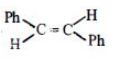
With Lithium in liquid ammonia, trans-alkene is almost an exclusive product.\(Ph-C\equiv C-Ph\xrightarrow[Brich\,reduction]{Li\,in\,liq.N{{H}_{3}}}\begin{matrix}
^{Ph} \\
_{H} \\
\end{matrix}\begin{matrix}
\text{ }\!\!\backslash\!\!\text{ } \\
/ \\
\end{matrix}C=C\begin{matrix}
/ \\
\text{ }\!\!\backslash\!\!\text{ } \\
\end{matrix}_{Ph}^{H}\) - 75. Which one of the following class of compounds is obtained by polymerization of acetylene? 2014 Hard
- (A) Poly-yne
- (B) Poly-ene
- (C) Poly-ester
- (D) Poly-amine
Show answer and solution
Correct Answer: (B)
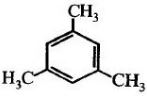
Poly-ene. e.g\(\mathop {3CH \equiv CH}\limits_{acetylene} \to \mathop {{C_6}{H_6}}\limits_{Benzene} \)
\(\mathop {3C{H_3} - C \equiv CH}\limits_{\Pr opyne} \to \) (figure)
-
- (A) \(sp\) and \(sp^3\)
- (B) \(sp^2\) and \(sp\)
- (C) only \(sp^2\)
- (D) \(sp^2\) and \(sp^3\)
Show answer and solution
Correct Answer: (B)
\(\,\begin{matrix}
^{H} \\
_{H} \\
\end{matrix}\begin{matrix}
\text{ }\!\!\backslash\!\!\text{ } \\
/ \\
\end{matrix}\overset{s{{p}^{2}}}{\mathop{C}}\,=\overset{s{{p}^{2}}}{\mathop{C}}\,=\overset{s{{p}^{2}}}{\mathop{C}}\,\begin{matrix}
/ \\
\text{ }\!\!\backslash\!\!\text{ } \\
\end{matrix}_{H}^{H}\) -
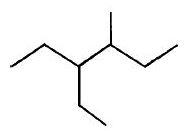
- (A) \(4 -\) methyl \(- 3 -\) ethylhexane
- (B) \(3 -\) ethyl \(- 4 -\) methylhexane
- (C) \(3, 4 -\) ethylmethylhexane
- (D) \(4 -\) ethyl \(- 3 -\) methylhexane
Show answer and solution
Correct Answer: (B)
\(\mathop {\begin{array}{*{20}{c}}
{\,\,\,\,\,\,\,\,\,\,\,\,\,\,\,\,\,\,\,C{H_3}} \\
{\,\,\,\,\,\,\,\,\,\,\,\,\,|} \\
{C{H_3}C{H_2} - CH - CH - C{H_2}C{H_3}} \\
{|\,\,\,\,\,\,\,\,\,\,\,\,\,\,\,\,\,\,} \\
{\,\,\,\,\,\,C{H_2}\,\,\,\,\,\,\,\,\,\,\,\,\,\,} \\
{|\,\,\,\,\,\,\,\,\,\,\,\,\,\,} \\
{\,\,\,\,\,\,\,C{H_3}\,\,\,\,\,\,\,\,\,\,\,\,\,\,\,}
\end{array}}\limits_{3 - ethyl - 4 - methyl\,hexane} \) - 78. Amongst \(LiCl, RbCl, BeCl_2\) and \(MgCl_2\) the compounds with the greatest and the least ionic character, respectively are: 2014 Hard
- (A) \(LiCl\) and \(RbCl\)
- (B) \(RbCl\) and \(BeCl_2\)
- (C) \(MgCl_2\) and \(BeCl_2\)
- (D) \(RbCl\) and \(MgCl_2\)
Show answer and solution
Correct Answer: (B)
According to Fajan's rules smaller, highly charged cation has greatest covalent character while large anion with smaller charge has greatest ionic character - 79. The correct order of bond dissociation energy among \(N_2, O_2, O_2^-\) is shown in which of the following arrangements? 2014 Medium
- (A) \(N_2 > O_2^- > O_2\)
- (B) \(O_2^- > O_2 > N_2\)
- (C) \(N_2 > O_2 > O_2^-\)
- (D) \(O_2 > O_2^- > N_2\)
Show answer and solution
Correct Answer: (C)
The bond order of \(N_2,\) \(O_2,\) and \(O_2^-\) are respectively \(3,2\) and \(1.5\)Since higher bond order implies higher bond dissociation energy hence the correct orde will be
\(N_2 > O_2 > O_2^-\)
-
- (A) One \(\sigma \) bond and one \(\pi - \) bond
- (B) One \(\sigma \) bond and two \(\pi - \) bond
- (C) Two \(\sigma \) bond and two \(\pi - \) bond
- (D) Two \(\sigma \) bond and one \(\pi - \) bond
Show answer and solution
Correct Answer: (B)
The structure of \(CaC_2\) is \(Ca^{2+}\) \([: C \equiv C :]^{2-}\) i.e, one \(\sigma \) and two \(\pi \) bonds -
- (A) \(N_2\)
- (B) \(O_2^ - \)
- (C) \(N_2^{2 + }\)
- (D) \(O_2^{2 - }\)
Show answer and solution
Correct Answer: (B)
\(O_2^ - (17) = KK{(\sigma 2s)^2}({\sigma ^*}2{s^2}){(\sigma 2{p_x})^2}\)\({(\pi 2{p_y})^2}{(\pi 2{p_z})^2}{({\pi ^*}2{p_y})^2}{({\pi ^*}2{p_z})^1}\)
one unpaired electron - Paramagnetic
-
- (A) \((CH_3)_3N\)
- (B) \((SiH_3)_3 N\)
- (C) \(P(CH_3)_3\)
- (D) \(P(SiH_3)_3\)
Show answer and solution
Correct Answer: (B)
In case of \(N(SiH_3)_3\, N\) atom is \(sp^2\) hybridised, the lone pair is present in \(2p\) orbital and it is transferred to empty \(d\) orbital of \(Si\) forming \(d\pi -p\pi \) bond . Hence nitrogen with \(sp^2\) hybridization has trigonal planar shape. -
- (A) \(N_2\)
- (B) \(NO\)
- (C) \(CO\)
- (D) \(O_3\)
Show answer and solution
Correct Answer: (B)
The molecular orbital configuration of the molecules given isTotal no. of electrons in \(NO\)
\(=7(N)+8(O)=15\)
Hence \(E.C.\) of \(NO\)
\(KK{[\sigma 2s]^2}{[{\sigma ^*}(2s)]^2}{[\sigma 2{p_z}]^2}\)
\({[\pi (2{p_x})]^2}[\pi {(2{p_y})^2}]{[{\pi ^*}(2{p_x})]^1}\)
Due to presence of one unpaired electron
\(NO\) is paramagnetic.
Except \(NO\) all are diamagnetic dur to absence of unpaired electrons.
- 84. Similarity in chemical properties of the atoms of elements in a group of the Periodic table is most closely related to 2014 Easy
- (A) atomic numbers
- (B) atomic masses
- (C) number of principal energy levels
- (D) number of valence electrons
Show answer and solution
Correct Answer: (A)
If elements are arranged in order of their increasing atomic numbers, element coming at intervals of \(2, 8, 8, 1 8, 1 8, 32\) and \(32\) will have similar physical and chemical properties and thus grouped in one particular group. -
- (A) \({O^{2 - }}\, < \,{N^{3 - }}\, < \,\,{S^{2 - }}\, < \,\,{P^{3 - }}\)
- (B) \({O^{2 - }}\, < \,{P^{3 - }}\, < \,\,{N^{3 - }}\, < \,{S^{2 - }}\)
- (C) \({N^3}\, < \,{O^{2 - }}\, < \,\,{P^{3 - }}\, < \,{S^{2 - }}\)
- (D) \({N^{3 - }}\, < \,{S^{2 - }}\, < \,\,{O^{2 - }}\, < \,{P^{3 - }}\)
Show answer and solution
Correct Answer: (A)
For isoelectronic species ionic radii decreases as the charge on ion decreases. Further on moving down in a group ionic radii increases. Hence the correct order is\({O^{2 - }}\, < \,{N^{3 - }}\, < \,\,{S^{2 - }}\, < \,\,{P^{3 - }}\)
- 86. Which of the following series correctly represents relations between the elements from \(X\) to \(Y\) ? \(X \to Y\) 2014 Medium
- (A) \(_3Li \to \,_{19}K\) Ionization enthalpy increases
- (B) \(_9F \to \,_{35}Br\) Electron gain enthalpy (negative sign) increases
- (C) \(_6C \to \,_{32}Ge\) Atomic radii increases
- (D) \(_{18}Ar \to \,_{54}Xe\) Noble character increases
Show answer and solution
Correct Answer: (C)
On moving down a group atomic radii increases -
- (A) \(NO^+\) is isoelectronic with \(O_2\)
- (B) \(B\) is always covalent in its compounds
- (C) In aqueous solution, the \(Ti^+\) ion is much more stable than \(Ti (III)\)
- (D) \(LiAlH_4\) is a versatile reducing agent in organic synthesis
Show answer and solution
Correct Answer: (A)
\((a)\, NO^+\, =7+8-1\,=14\,e^-\). \(O_2\, = 16\,e^-\). i.e. not isoelectronic
\((b)\) Boron forms only covalent compounds. This is due to its extremely high ionisation energy.
\((c)\) Compounds of \(Ti^+\) are much more stable than those of \(Ti^{3+}\).
\((d)\, LiAlH_4\) is a versatile reducing agent in organic synthesis -
- (A) \(O_2^{2 - }\)
- (B) \(Li^+\)
- (C) \(B^{3+}\)
- (D) \(F^-\)
Show answer and solution
Correct Answer: (A)
On moving along a period ionic radii decreases due to increase in effective nuclear charge -
- (A) \(0.25\)
- (B) \(3\)
- (C) \(0.5\)
- (D) \(1\)
Show answer and solution
Correct Answer: (A)
\(\begin{array}{l}2 HI \quad\quad\rightleftharpoons\quad H _2\quad+\quad I _2 \\ a\quad\quad\quad\quad\quad\quad0\quad\quad\quad\quad0 \\ a (1-0.5) \quad\quad0.25 a \quad\quad0.25 a \end{array}\)\(K =\frac{(0.25 a )(0.25 a )}{(0.5 a )^2}\)
\(K =0.25\)
-
- (A) \(1.94\)
- (B) \(5.82\)
- (C) \(7.66\)
- (D) \(38.8\)
Show answer and solution
Correct Answer: (B)
\(N{H_2}COON{H_4}(s) \leftrightarrow 2N{H_3}(g) + C{O_2}(g)\)\({K_P} = \frac{{{{({P_{N{H_3}}})}^2} \times ({P_{C{O_2}}})}}{{{P_{N{H_2}COON{H_4}(s)}}}}\)
\( = {({P_{N{H_3}}})^2} \times ({P_{C{O_2}}})\)
As evident by the reaction, \(NH_3\) and \(CO_2\) are formed in molar ratio of \(2:1\). Thus if \(P\) is the total pressure of the system at equilibrium, then
\({P_{N{H_3}}} = \frac{{2 \times P}}{3}\) \({P_{C{O_2}}} = \frac{{1 \times P}}{3}\)
\({K_P} = {\left( {\frac{{2P}}{3}} \right)^2} \times \frac{P}{3} = \frac{{4{P^3}}}{{27}}\)
Given \({K_P} = 2.9 \times {10^{ - 5}}\)
\(\therefore \,2.9 \times {10^{ - 5}} = \frac{{4{P^3}}}{{27}}\)
\({P^3} = \frac{{2.9 \times {{10}^{ - 5}} \times 27}}{4}\)
\(P = {\left( {\frac{{2.9 \times {{10}^{ - 5}} \times 27}}{4}} \right)^{1/3}} = 5.82 \times {10^{ - 2}}\,atm\)
-
- (A) \(-1\)
- (B) \(-0.5\)
- (C) \(0.5\)
- (D) \(1\)
Show answer and solution
Correct Answer: (B)
\(S O_{2}(g)+\frac{1}{2} O_{2}(g) \rightleftharpoons S O_{3}(g)\)\(K_{p}=K_{C}(R T)^{x}\)
where \(x=\Delta n_{g}=\) number of gaseous moles in product - number of gaseous moles in reactant
\(=1-\left(1+\frac{1}{2}\right)\)
\(=1-\frac{3}{2}=-\frac{1}{2}\)
-
- (A) More product will farm
- (B) Less product will form
- (C) More reactant will fonn
- (D) Equilibrium will remain unchanged
Show answer and solution
Correct Answer: (D)
On adding inert gas at constant volume the total pressure of the system is increased, but the partial pressure of each reactant and product remains the same. Hence no effect on the state of equilibrium. - 93. For an ideal solution of two components \(A\) and \(B\), which of the following is true? 2014 Medium
- (A) \( \Delta H_{mixing} < 0\) (zero)
- (B) \( \Delta H_{mixing} > 0\) (zero)
- (C) \(A - B\) interaction is stronger than \(A - A\) and \(B - B\) interactions
- (D) \(A- A, B - B\) and \(A - B\) interactions are identical
Show answer and solution
Correct Answer: (D)
Solutions in which solute - solute and solvent-solvent interactions are almost similar to solute solvent interactions are known as ideal solution -
- (A) \(- 1366. 95\)
- (B) \(- 1361.95\)
- (C) \(- 1460.95\)
- (D) \(- 1350. 50\)
Show answer and solution
Correct Answer: (A)
\(C _{2} H _{5} OH ( l )+3 O _{2}( g ) \rightarrow 2 CO _{2}( g )+3 H _{2} O ( l )\)\(\Delta E =-1364.47 kJ mol ^{-1}\)
\(\Delta H =?\)
\(T =298 K\)
\(\Delta n _{ g }=-1 \because\) complete combution
\(R =8.314 J mol ^{-1}=\frac{8.314}{1000} kJ mol ^{-1}\)
\(\because \Delta H =\Delta E + P \Delta V\)
but, \(P \Delta V =\Delta n _{ g } RT\)
\(\because \Delta H =\Delta E +\Delta n _{ g } RT\)
\(\Delta H =-1364.47+\left((-1) \times \frac{8.314}{1000} \times 298\right)\)
\(\Delta H =-1366.95 kJ mol ^{-1}\)
-
- (A) \(23.03\)
- (B) \(-23.03\)
- (C) \(2.303\)
- (D) \(-2.303\)
Show answer and solution
Correct Answer: (B)
Given, \(C_p = 10\) cals at \(1000\,K\)\(T_t = 1000 K.\) \(T_2 = 100\,K\)
\(m = 32\,g\)
\(\Delta S = ?\)
at constant pressure
\(\Delta S = {C_p}\,\ln \,\frac{{{T_2}}}{{{T_1}}}\)
\( = 2.303 \times {C_p}\,\log \,\frac{{{T_2}}}{{{T_1}}}\)
\( = 2.303 \times 10\,\log \,\frac{{100}}{{1000}}\)
\( = - 23.03\,cal\,{\deg ^{ - 1}}\)
-
- (A) \(-312.5\)
- (B) \(-242.8\)
- (C) \(-108.1\)
- (D) \(-37.6\)
Show answer and solution
Correct Answer: (B)
\(\Delta {S^o} = S_{_{C{O_2}}}^o + 2 \times S_{_{{H_2}O}}^o - (S_{_{C{H_4}}}^o + 2 \times S_{{O_2}}^o)\)\( = (213.6 + 2 \times 69.9) - (186.2 + 2 \times 205.2)\)
\( = - 242.8\,J\,{K^{ - 1}}\,mo{l^{ - 1}}\,\)
-
- (A) The dissociation energy of the hydrogen molecule, \(H_2\)
- (B) The first four ionisation energies of carbon.
- (C) The dissociation energy of \(H_2\) and enthalpy and sublimation of carbon (graphite).
- (D) The first four ionisation energies of carbon and electron affinity of hydrogen.
Show answer and solution
Correct Answer: (A)
To calculate average enthalpy of \(C-H\) bond in methane following informations are needed\((i)\) dissociation energy of \(H_2\) i.e.
\(\frac{1}{2}{H_2}(g) \to H(g);\Delta H = x\) (suppose)
\((ii)\) Sublimation enegry of \(C\) (graphite) to \(C(g)\)
\(C(graphite) \to C(g);\Delta H = y\) (Suppose)
Given
\(C(graphite) + 2{H_2}(g) \to C{H_4}(g);\Delta H = 75\,kJ\,mo{l^{ - 1}}\)
-
- (A) \(- 1102\)
- (B) \(- 964\)
- (C) \(+352\)
- (D) \(+1056\)
Show answer and solution
Correct Answer: (B)
Given \(\frac{1}{2}{N_2} + \frac{3}{2}{H_2} \leftrightarrow N{H_3};\)\(\Delta {H_f} = - 46.0\,kJ/mol\)
\(H + H \leftrightarrow {H_2};\,\Delta {H_f} = - 436\,kJ/mol\)
\(N + N \leftrightarrow {N_2};\,\Delta {H_f} = - 712\,kJ/mol\)
\(\Delta {H_f}(N{H_3}) = \frac{1}{2}\Delta {H_{N - N}} + \frac{3}{2}\Delta {H_{H - H}} - \Delta {H_{N - H}}\)
\( - 46 = \frac{1}{2}( - 712) + \frac{3}{2}( - 436) - \Delta {H_{N - H}}\)
On calculation
\(\Delta {H_{N - H}} = - 964\,kJ/mol\)
-
- (A) Zeolites
- (B) Ultramarines
- (C) Feldspars
- (D) Beryls
Show answer and solution
Correct Answer: (C)
The feldspars are most abundant aluminosilicate minerals in the Earth surface. The silicon atoms and aluminium atoms occupy the centres of interlinked tetrahedra of \(SiO_4^{-4}\) and \(AlO_4^{-5}\) . These tetrahedra connect at each corner to other tetrahedra forming an intricate, three dimesional, negatively charged framework. The sodium cations sit within the voids in this structure -
- (A) \(1\) and \(2\)
- (B) \(1\) and \(3\)
- (C) \(2\) and \(4\)
- (D) \(3\) and \(4\)
Show answer and solution
Correct Answer: (B)
Aluminium oxide is amphoteric oxide because it shows the properties of the both acidic and basic oxides . It reacts with both acids and bases to form salt and water.\(Al_2O_3 . xH_2O + 2NaOH \longrightarrow NaAlO_2 +H_2O\)
\(Al_2O_3 . xH_2O+HCl \longrightarrow AlCl_3 + H_2O\)
No questions on this page match these filters.