


તત્ત્વોનું વર્ગીકરણ અને ગુણધર્મોમાં આવર્તિતા ના બધા પ્રશ્નો
નવા પહેલા135 માંથી 51–100 પ્રશ્નો
-
- (A) ફ્ક્ત \((B), (C)\) અને \((D)\)
- (B) \((A), (B), (C)\) અને \((D)\)
- (C) ફ્ક્ત \((C)\) અને \((D)\)
- (D) ફ્ક્ત \((A), (C)\) અને \((D)\)
જવાબ અને ઉકેલ જુઓ
સાચો જવાબ: (D)
\(\mathrm{O}^{-2} \mathrm{~F}^{-} \mathrm{Na}^{+} \mathrm{Mg}^{+2}\)\(\text { (No. of } \mathrm{e}^{-} \text {) } \ 10 \ 10 \ 10 \ 10\)
(આયનીય ત્રિજ્યા) \(\mathrm{O}^{-2}>\mathrm{F}^{-}>\mathrm{Na}^{+}>\mathrm{Mg}^{+2}\)
\(\text { Zeff } \mathrm{O}^{-2}<\mathrm{F}^{-}<\mathrm{Na}^{+}<\mathrm{Mg}^{-2}\)
-
- (A) \((D)\) અને \((E)\) ફક્ત
- (B) \((A)\) અને \((C)\) ફક્ત
- (C) \((B)\) અને \((E)\) ફક્ત
- (D) \((B)\) અને \((D)\) ફક્ત
જવાબ અને ઉકેલ જુઓ
સાચો જવાબ: (B)
જેમ જેમ વિદ્યુતઋણતા વધે છે તેમ તેમ અધાત્વીય ગુણધર્મ વધે છે.આવર્તમાં આયનીકરણ ઊર્જા વધે છે.
વધુ વિદ્યુતઋણતા તફાવત આયનીય બંધની રચનામાં પરિણમે છે.
ધાતુઓના ઓક્સાઈડ સામાન્ય રીતે બેઝિક હોય છે અને અધાતુઓના ઓક્સાઈડ એસિડિક પ્રકૃતિના હોય છે.
-
- (A) \(\mathrm{Al}>\mathrm{Ga}>\mathrm{Tl}\)
- (B) \(\mathrm{Ga}>\mathrm{Al}>\mathrm{B}\)
- (C) \(\mathrm{B}>\mathrm{Al}>\mathrm{Ga}\)
- (D) \(\mathrm{Tl}>\mathrm{Ga}>\mathrm{Al}\)
જવાબ અને ઉકેલ જુઓ
સાચો જવાબ: (D)
(\(i\)) due to lanthanide contraction \(\mathrm{T} \ell\) has more \(I.E\). as compared to \(\mathrm{Ga}\) and \(\mathrm{A} \ell\)(\(ii\)) due to scandide contraction Ga has more \(I.E\). as compared to \(\mathrm{A} \ell\)
- 54. સમઇલેક્ટ્રોનિક સ્પીસીઝના કિસ્સામાં \(\mathrm{F}^{-}, \mathrm{Ne}\) અને \(\mathrm{Na}^{+}\)નું કદ _______ દ્વારા અસરગ્રસ્ત થાય છે. 2024 અઘરું
- (A) મુખ્ય ક્વોન્ટમ નંબર \((n)\)
- (B) કોઈ પણ પરિબળ નહીં કારણ કે તેમનું કદ સમાન છે
- (C) બાહ્ય કક્ષકોમાં ઇલેક્ટ્રોન-ઇલેક્ટ્રોન પારસ્પરિક ક્રિયા
- (D) ન્યુક્લિયર ચાર્જ \((z)\)
જવાબ અને ઉકેલ જુઓ
સાચો જવાબ: (D)
\(\mathrm{F}^{-}, \mathrm{Ne}, \mathrm{Na}^{+}\)માં બધા \(1 \mathrm{~s}^2, 2 \mathrm{~s}^2, 2 \mathrm{p}^0\) ઇલેક્ટ્રોન રચના ધરાવે છે. ન્યુક્લિયર ચાર્જમાં તફાવતને કારણે તેઓ જુદા જુદા કદ ધરાવે છે. -
- (A) \(\mathrm{Si}\)
- (B) \(\mathrm{Al}\)
- (C) \(\mathrm{N}\)
- (D) \(\mathrm{C}\)
જવાબ અને ઉકેલ જુઓ
સાચો જવાબ: (C)
\(\mathrm{Al}<\mathrm{Si}<\mathrm{C}<\mathrm{N} ; \mathrm{IE}_1\) order. -
- (A) \(A-II, B-III, C-IV, D-I\)
- (B) \(A-III, B-II, C-I, D-IV\)
- (C) \(A-IV, B-III, C-II, D-I\)
- (D) \(A-II, B-I, C-IV, D-III\)
જવાબ અને ઉકેલ જુઓ
સાચો જવાબ: (C)
સૌથી વધુ વિદ્યુતઋણતા ધરાવતા ઘટકો \(\rightarrow \mathrm{F}, \mathrm{O}\)સૌથી મોટી પરમાણુ કદ ધરાવતા ઘટકો \(\rightarrow \mathrm{Fr}, \mathrm{Ra}\)
જે ધાતુ અને અધાતુ બંનેના ગુણધર્મો દર્શાવે છે તે ઘટકો એટલે કે અર્ધ ધાતુઓ \(\rightarrow \mathrm{Ge}\), As
સૌથી વધુ ઋણ ઇલેક્ટ્રોન પ્રાપ્તિ એન્થાલ્પી ધરાવતા ઘટકો \(\rightarrow \mathrm{Cl}, \mathrm{S}\)
-
- (A) (A)-(II), (B)-(IV), (C)-(III), (D)-(I)
- (B) (A)-(I), (B)-(IV), (C)-(III), (D)-(II)
- (C) (A)-(IV), (B)-(II), (C)-(I), (D)-(III)
- (D) (A)-(III), (B)-(I), (C)-(IV), (D)-(II)
જવાબ અને ઉકેલ જુઓ
સાચો જવાબ: (D)
(A)-(III), (B)-(I), (C)-(IV), (D)-(II) -
- (A) \(C > P > At > Br\)
- (B) \(Br > P > At > C\)
- (C) \(P > Br > C > At\)
- (D) \(Br > C > At > P\)
જવાબ અને ઉકેલ જુઓ
સાચો જવાબ: (D)
Atom \(E.N\) \(Br\) \(3.0\) \(C\) \(2.5\) \(At\) \(2.2\) \(P\) \(2.1\) -
- (A) \(Si < Be < Mg < K\)
- (B) \(Be < Si < Mg < K\)
- (C) \(K < Mg < Be < Si\)
- (D) \(Be < Si < K < Mg\)
જવાબ અને ઉકેલ જુઓ
સાચો જવાબ: (A)
Metallic character increases down the group and decreases along the period. - 60. \(B, C, N, Li, Be, O\) અને \(F\) તત્વો માટે, પ્રથમ આયનીકરણ એન્થાલ્પીનો સાચો ક્રમ શોધો. 2023 મધ્યમ
- (A) \(Li < Be < B < C < N < O < F\)
- (B) \(B > Li > Be > C > N > O > F\)
- (C) \(Li < B < Be < C < O < N < F\)
- (D) \(Li < Be < B < C < O < N < F\)
જવાબ અને ઉકેલ જુઓ
સાચો જવાબ: (C)
First I.E.\(F > N > O > C > Be > B > Li\)
\(Li -520\, kJ / mol\)
\(Be -899\, kJ / mol\)
\(B -801 \,kJ / mol\)
\(C -1086 \,kJ / mol\)
\(N -1402 \,kJ / mol\)
\(O -1314\, kJ / mol\)
\(F -1681\,kJ / mol\)
-
- (A) \(Be > Ca > K\)
- (B) \(Ca > K > Be\)
- (C) \(K > Ca > Be\)
- (D) \(K > Be > Ca\)
જવાબ અને ઉકેલ જુઓ
સાચો જવાબ: (C)
On moving from top to bottom metallic character increases while on moving from left to right metallic decreases.\(K > Ca > Be\)
-
- (A) \(Ne\) અને \(F\)
- (B) \(Ne\) અને \(Cl\)
- (C) \(Ar\) અને \(Cl\)
- (D) \(Ar\) અને \(F\)
જવાબ અને ઉકેલ જુઓ
સાચો જવાબ: (B)
\(Cl\) has the most negative \(\Delta H _{\text {eg }}\) among all the elements and \(Ne\) has the most positive \(\Delta H _{ eg }\). -
- (A) ફકત \(A,B,C\) અને \(D\)
- (B) ફકત \(A,C\) અને \(D\)
- (C) ફકત \(B\) અને \(D\)
- (D) ફકત \(A,B\) અને \(D\)
જવાબ અને ઉકેલ જુઓ
સાચો જવાબ: (B)
Electronegativity of an element depends on the atom with which it is attached.\(NO =\text { neutral oxide }\)
\(Al _2 O _3=\text { amphoteric oxide }\)
-
- (A) બંને \(A\) અને \(R\) સાચાં છે,\(R\) એ \(A\) ની સાચી સમજૂતી આપે છે.
- (B) બંને \(A\) અને \(R\) સાચાં છે,\(R\) એ \(A\) ની સાચી સમજૂતી આપતું નથી.
- (C) \(A\) ખોટું છે પણ \(R\) સાચું છે.
- (D) \(A\) સાચું છે પણ \(R\) ખોટું નથી
જવાબ અને ઉકેલ જુઓ
સાચો જવાબ: (A)
From Sc to Mn ionization energy is less than that of \(Mg\).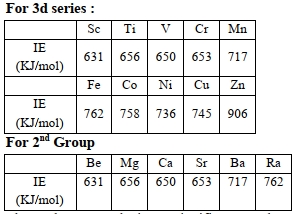
-
- (A) \(A - II, B - IV, C - I, D - III\)
- (B) \(A - I, B - III, C - IV, D - II\)
- (C) \(A - IV, B - III, C - II, D - I\)
- (D) \(A - IV, B - II, C - I, D - III\)
જવાબ અને ઉકેલ જુઓ
સાચો જવાબ: (D)
Atomic number Block \(37\) \((K)\) \(s-\)block \(78\) \((Pt)\) \(d-\)block \(52\) \((Te)\) \(p-\)block \(65\) \((Tb)\) \(f-\)block -
- (A) \(1\)
- (B) \(2\)
- (C) \(0.5\)
- (D) \(3\)
જવાબ અને ઉકેલ જુઓ
સાચો જવાબ: (C)
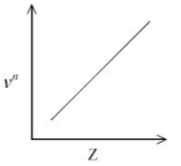
According to Henry Moseley \(\sqrt{v}\,\alpha z - b\)So \(n =\frac{1}{2}\)
- 67. તત્વોની ઈલેક્ટ્રોન પ્રાપ્તિ એન્થાલ્પીઓ માટે \(\Delta_{ eg } H\) તરીકે સૂચિત કરેલ છે.ખોટો વિકલ્પ શોધો. 2023 મધ્યમ
- (A) \(\Delta_{ eg } H ( Cl ) < \Delta_{ eg } H ( F )\)
- (B) \(\Delta_{ eg } H ( Se ) < \Delta_{ eg } H ( S )\)
- (C) \(\Delta_{ eg } H (I) < \Delta_{ eg } H (At)\)
- (D) \(\Delta_{ eg } H ( Te ) < \Delta_{ eg } H\) (Po)
જવાબ અને ઉકેલ જુઓ
સાચો જવાબ: (B)
\((1)\) \(\Delta_{ eg } H ( Cl ) < \Delta_{ eg } H ( F )\)\((-345) (-328)\) Correct
\((2)\) \(\Delta_{ eg } H ( Se ) < \Delta_{ eg } H ( S )\)
\((-195) \quad(-200)\) Incorrect
\((3)\) \(\Delta_{ eg } H (I) < \Delta_{ eg } H ( At )\)
\((-295) (-270)\) Correct
\((4)\) \(\Delta_{ eg } H ( Te ) < \Delta_{ eg } H ( Po )\)
\((-190) (-183)\) Correct
-
- (A) \((A) < (B) < (C) < (D)\)
- (B) \((B) < (A) < (D) < (C)\)
- (C) \(( B )<( D )<( A )<( C )\)
- (D) \(( B ) < ( A ) < ( C ) < (D)\)
જવાબ અને ઉકેલ જુઓ
સાચો જવાબ: (B)
\(3 s ^{2} \rightarrow Mg\)\(3 s ^{2} 3 p ^{1} \rightarrow Al\)
\(3 s ^{2} 3 p ^{3} \rightarrow P\)
\(3 s ^{2} 3 p ^{4} \rightarrow S\)
\(C > D > A > B\)
-
- (A) \(Mg ^{2+}< Na ^{+}< F ^{-}< O ^{2-}< N ^{3-}\)
- (B) \(N ^{3-}< O ^{2-}< F ^{-}< Na ^{+}< Mg ^{2+}\)
- (C) \(F ^{-}< Na ^{+}< O ^{2-}< Mg ^{2+}< N ^{3-}\)
- (D) \(Na ^{+}< F ^{-}< Mg ^{2+}< O ^{2-}< N ^{3-}\)
જવાબ અને ઉકેલ જુઓ
સાચો જવાબ: (A)
\(N ^{-3}> O ^{-2}> F ^{-}> Na ^{+}> Mg ^{+2}(\) Radii \()\)(Isoelectronic species)
-
- (A) \(O \,<\, N\, <\, B \,< \,Be\)
- (B) \(Be\, < \,B \,<\, N\, <\, O\)
- (C) \(B\, <\, Be\, < \,N \,<\, O\)
- (D) \(B \,< \,Be \,< \,O \,<\, N\)
જવાબ અને ઉકેલ જુઓ
સાચો જવાબ: (D)
\(1^{st}\,\,I.E.\) \(\underset{\left(2 p ^{3}\right)}{ N }>\underset{\left(2 p ^{4}\right)}{ O }>\underset{\left(2 s^{2}\right)}{ Be }>\underset{\left(2 p ^{1}\right)}{ B }\) -
- (A) \(F < Cl < Te < Po\)
- (B) \(Cl < F < Te < Po\)
- (C) \(Te < Po < Cl < F\)
- (D) \(Po < Te < F < Cl\)
જવાબ અને ઉકેલ જુઓ
સાચો જવાબ: (D)
As \(Cl\) has maximum electron affinity among all elements.Element \(\quad \Delta _{ eg } H ( k J / m o l )\)
\(F \quad\quad\quad\quad -328\)
\(Cl \quad\quad\quad\quad -349\)
\(Te \quad\quad\quad\quad -190\)
\(Po \quad\quad\quad\quad -174\)
-
- (A) \(Na > Mg > Be > Si > P\)
- (B) \(P > Si > Be > Mg > Na\)
- (C) \(Si > P > Be > Na > Mg\)
- (D) \(Be > Na > Mg > Si > P\)
જવાબ અને ઉકેલ જુઓ
સાચો જવાબ: (A)
Across a period metallic character decreases - 73. ધાતુ કે જેનું ગલનબિંદુ એકદમ નીચું છે અને તેનું આવર્ત સ્થાન અર્ધ ધાતુની નજીક છે તે \(.....\) 2022 સરળ
- (A) \(Al\)
- (B) \(Ga\)
- (C) \(Se\)
- (D) \(In\)
જવાબ અને ઉકેલ જુઓ
સાચો જવાબ: (B)
\(\begin{array}{ll} Al \rightarrow & 933\,K \\ Ga \rightarrow & 303\,K \\ In \rightarrow & 430\,K \\ Se \rightarrow & 490\,K \end{array}\) - 74. એક તત્વ જેનું બાહ્ય ઈલેકટ્રોનીય સંરચના \([Rn] \,5 f ^{14} 6 d ^1 7 s ^2\) છે. તો \(IUPAC\) નામકરણ મુજબ તે \(....\) 2022 મધ્યમ
- (A) \(Unnilbium\)
- (B) \(Unnilunium\)
- (C) \(Unnilquadium\)
- (D) \(Unniltrium\)
જવાબ અને ઉકેલ જુઓ
સાચો જવાબ: (D)
Atomic Number \(103\) -
- (A) \(Be > Mg > Ca > Sr\)
- (B) \(Sr > Ca > Mg > Be\)
- (C) \(Sr > Be > Mg > Ca\)
- (D) \(Be > Sr > Mg > Ca\)
જવાબ અને ઉકેલ જુઓ
સાચો જવાબ: (C)
In \(II'A'\) group density decreases down the group till \(Ca\) and after that it increases.Correct order of density is \(Sr > Be > Mg > Ca\) -
- (A) \(K\) ની પ્રથમ આયનીકરણ એન્થાલ્પી \(Na\) અને \(Li\) કરતા ઓછી છે.
- (B) તેના સમૂહમાં \(Xe\) તેની સૌથી ઓછી પ્રથમ આયનિકરણ એન્થાલ્પી ધરાવતો નથી.
- (C) \(37\) પરમાણુ ક્રમાંક ધરાવતા તત્વની પ્રથમ આયનીકરણ એન્થાલ્પી \(38\) પરમાણુ ક્રમાંક ધરાવતા તત્વ કરતા ઓછી છે.
- (D) \(Ga\) ની પ્રથમ આયનીકરણ એન્થાલ્ધી, \(d\)-વિભાગના પરમાણુ ક્રમાંક \(30\) ધરાવતા તત્વ કરતા વધુ છે.
જવાબ અને ઉકેલ જુઓ
સાચો જવાબ: (D)
Ionization enthalpy order :\(Li > Na > K\)
\(He > Ne > Ar > Kr > Xe > Rn\)
\(Sr > Rb\)
\(Zn > Ga\)
-
- (A) \(Mg^{2+} > Na^+ > F^- > O^{2-} < N^{3-}\)
- (B) \(N^{3-} < F^- > O^{2-} > Na^+ > Mg^{2+}\)
- (C) \(Mg^{2+} < Na^+ < F^- < O^{2-} < N^{3-}\)
- (D) \(N^{3-} > O^{2-} > F^- > Na^+ < Mg^{2+}\)
જવાબ અને ઉકેલ જુઓ
સાચો જવાબ: (C)
Ionic size increases with the addition of electrons and ionic size decreases with the loss of electrons. The nitride ion, has \(10\) electrons in contrast to only \(7\) protons. It has high inter electronic repulsions due to which it has the maximum size. The increasing order of ionic size is \(Mg ^{2+}\,<\, Na ^{+}\,<\,F ^{-}\,< \,O ^{2-}\)They are isoelectronic species with same number of electrons. Higher is the atomic number, higher will be the effective nuclear charge, lower will be the size.
-
- (A) \(487\)
- (B) \(768\)
- (C) \(577\)
- (D) \(856\)
જવાબ અને ઉકેલ જુઓ
સાચો જવાબ: (C)
\(I. E\; : \;Na < Al < Mg < Si\)\(\therefore \quad 496<\operatorname{IE}( Al )<737\)
Option \((C)\), matches the condition.
i.e \(\operatorname{IE}( Al )=577 \;kJmol ^{-1}\)
-
- (A) ફક્ત \((A)\) અને \((B)\)
- (B) ફક્ત \((B)\) અને \((C)\)
- (C) ફક્ત \((A)\) અને \((C)\)
- (D) ફક્ત \((C)\) અને \((D)\)
જવાબ અને ઉકેલ જુઓ
સાચો જવાબ: (C)
\(Rb\) and \(Cs\) have nearly same electron gain enthalpy electron gain enthalpy \(=-46\,kj / ml\)\(Ar\) and \(Kr\) have same \(\Delta H _{ eq }\). Value is \(+96\,kj / ml\)
-
- (A) \(SO _{3}\)
- (B) \(SiO _{2}\)
- (C) \(CaO\)
- (D) \(Al _{2} O _{3}\)
જવાબ અને ઉકેલ જુઓ
સાચો જવાબ: (C)
\(SO _{3}, SiO _{2}=\) Acidic\(CaO =\) Basic
\(Al _{2} O _{3}=\) Amphoteric
-
- (A) બંને \((A)\) અને \((R)\) સાચાં છે, અને \((R)\) એ \((A)\) નું યોગ્ય સ્પષ્ટીકરણ છે.
- (B) બંને \((A)\) અને \((R)\) સાચાં છે, અને \((R)\) એ \((A)\) નું યોગ્ય સ્પષ્ટીકરણ નથી.
- (C) \((A)\) સાચું છે પણ પરંતુ \((R)\) ખોંટુ છે.
- (D) \((A)\) ખોટુ છે પણ પરંતુ \((R)\) સાચું છે.
જવાબ અને ઉકેલ જુઓ
સાચો જવાબ: (D)
Ionic radius of \(O ^{2-}\) is more than that of \(Mg ^{2+}\)Both \(O ^{2-}\) and \(Mg ^{2+}\) are isoelectronic with \(10\) electrons
-
- (A) બંને \(A\) અને \(R\) સાચા છે અને \(R\) એ \(A\) ની સચોટ સમજુતી છે.
- (B) બંને \(A\) અને \(R\) સાચા છે અને \(R\) એ \(A\) ની સાચી સમજૂતી નથી.
- (C) \(A\) સાચું છે, પરંતુ \(R\) ખોટું છે.
- (D) \(A\) ખોટું છે, પરંતુ \(R\) સાચું છે.
જવાબ અને ઉકેલ જુઓ
સાચો જવાબ: (A)
Ionisation energy \(= N > O\).In oxygen atom, \(2\) of the \(42 p\) electrons must occupy the same \(2 p\) orbital resulting in an increased electron electron-repulsion.
-
- (A) \(0\)
- (B) \(1\)
- (C) \(2\)
- (D) \(3\)
જવાબ અને ઉકેલ જુઓ
સાચો જવાબ: (B)
\(Na _{2} O =\) Basic\(N _{2} O =\) Neutral
\(Cl _{2} O _{7}=\) Acidic
\(As _{2} O _{3}=\) Amphoteric
\(NO =\) Neutral
-
- (A) \(( A )-( IV ),( B )-( III ),( C )-( I ),( D )\)\(-( II )\)
- (B) \(( A )-( IV ),( B )-( II ),( C )-( I ),( D )\)\(-( III )\)
- (C) \(( A )-( II ),( B )-( IV ),( C )-( III ),( D )\)\(-( I )\)
- (D) \(( A )-( I ),( B )-( II ),( C )-( III ),( D )\)\(-( IV )\)
જવાબ અને ઉકેલ જુઓ
સાચો જવાબ: (B)
\(Cl _{2} O _{7} \quad\) Acidic\(Na _{2} O \quad\) Basic
\(Al _{2} O _{3} \quad\) Amphoteric
\(N _{2} O \quad\) Neutral
-
- (A) \(3 s ^{2} \cdot 3 p ^{4}\)
- (B) \(3 d ^{10} \cdot 4 s ^{2}, 4 p ^{4}\)
- (C) \(4 d ^{10} \cdot 5 s ^{2}, 5 p ^{4}\)
- (D) \(2 s ^{2}, p 4\)
જવાબ અને ઉકેલ જુઓ
સાચો જવાબ: (A)
\(E \Rightarrow[ Ar ] 3 d ^{10} 4 s ^{2} 4 p ^{4}\)Element above \(E \Rightarrow[ Ne ] 3 s ^{2} 3 p ^{4}\)
- 86. \(+3\) ઓક્સિડેશન અવસ્થામાં ઇલેક્ટ્રોનિક રચના \([{Ar}] 3 {~d}^{5}\) છે તે તત્વને ઓળખો: 2021 મધ્યમ
- (A) \({Ru}\)
- (B) \(Mn\)
- (C) \(Co\)
- (D) \({Fe}\)
જવાબ અને ઉકેલ જુઓ
સાચો જવાબ: (D)
\({Fe}^{3+}[{Ar}] 3 {~d}^{5}\) -
- (A) \(3\)
- (B) \(4\)
- (C) \(5\)
- (D) \(6\)
જવાબ અને ઉકેલ જુઓ
સાચો જવાબ: (A)
Sublimation enthalpy, Ionisation enthalpy and hydration enthalpy affect the reduction potential. -
- (A) તે \({F}^{-}\) અને \({N}\) કરતાં મોટી છે, પરંતુ \({O}^{2-}\) કરતાં નાની છે.
- (B) તે \({O}^{2-}\) અને \({F}^{-}\) કરતાં નાની છે, પરંતુ \({N}\) કરતાં મોટી છે.
- (C) તે \({O}^{2-}\) અને \({F}^{-}\) કરતાં મોટી છે.
- (D) તે \({F}^{-}\) અને \({N}\) કરતાં નાની છે.
જવાબ અને ઉકેલ જુઓ
સાચો જવાબ: (C)
\({F}^{-}, {O}^{2-}\) and \({N}^{3-}\) all are isoelectronic species inwhich \({N}^{3-}\) have least number of protons due to which it's size increases as least nuclear attractionis experienced by the outer shell electrons. Size order \({N}^{3-}>{O}^{2-}>{F}^{-}\) -
- (A) \({Al}^{3+}\,<\,{Mg}^{2+}\,<\,{K}^{+}\,<\,{Na}^{+}\)
- (B) \({K}^{+}\,<\,{Al}^{3+}\,<\,{Mg}^{2+}\,<\,{Na}^{+}\)
- (C) \({Na}^{+}\,<\,{K}^{+}\,<\,{Mg}^{2+}\,<\,{Al}^{3+}\)
- (D) \({Al}^{3+}\,<\,{Mg}^{2+}\,<\,{Na}^{+}\,<\,{K}^{+}\)
જવાબ અને ઉકેલ જુઓ
સાચો જવાબ: (D)
\({Al}^{3+}, {Mg}^{2+}\) and \({Na}^{+}\)are isoelectronic ionic species. For monoatomic ionic isoelectronic species as positive charge increases ionic size decrease.The order of size of \({Na}^{+}\, \& \,{~K}^{+}\)is \({Na}^{+}<{K}^{+}\),
\(\therefore\) order of ionic radii is : \({Al}^{3+}\,<\,{Mg}^{2+}\,<\,{Na}^{+}\,<\,{K}^{+}\)
-
- (A) \( A \) સાચુ નથી પણ \( {R} \) સાચુ છે.
- (B) \( A \) સાચું છે પણ \( {R} \) સાચું નથી.
- (C) \( {A} \) અને \( {R} \) બંને સાચા છે અને \( {R} \) એ \( {A} \) ની સાચી સમજૂતી છે.
- (D) \( {A} \) અને \( {R} \) બંને સાચા છે પણ \( {R} \) એ \( {A} \) ની સાચી સમજૂતી નથી.
જવાબ અને ઉકેલ જુઓ
સાચો જવાબ: (B)
From left to right in periodic table :-Metallic character decreases
Non-metallic character increases
\(\Rightarrow\) It is due to increase in ionization enthalpy and increase in electron gain enthalpy.
- 91. \({P}^{3-}, {S}^{2-}\) \({Ca}^{2+}, {K}^{+}, {Cl}^{-}\) આયનો માટે આયનીય ત્રિજ્યાનો સાચો ક્રમ કયો છે? 2021 સરળ
- (A) \({P}^{3-}>{S}^{2-}>{Cl}^{-}>{K}^{+}>{Ca}^{2+}\)
- (B) \({Cl}^{-}>{S}^{2-}>{P}^{3-}>{Ca}^{2+}>{K}^{+}\)
- (C) \({P}^{3-}>{S}^{2-}>{Cl}^{-}>{Ca}^{2+}>{K}^{+}\)
- (D) \({K}^{+}>{Ca}^{2+}>{P}^{3-}>{S}^{2-}>{Cl}^{-}\)
જવાબ અને ઉકેલ જુઓ
સાચો જવાબ: (A)
\({P}^{3-}>{S}^{2-}>{Cl}^{-}>{K}^{+}>{Ca}^{2+}\)(Correct order of ionic radii)
all the given species are isoelectronic species.
In isoelectronic species size increases with increase of negative charge and size decreases with increase in positive charge.
-
- (A) \({Mg}<{Al}<{S}<{P}\)
- (B) \({Al}<{Mg}<{S}<{P}\)
- (C) \({Mg}<{Al}<{P}<{S}\)
- (D) \({Mg}<{S}<{Al}<{P}\)
જવાબ અને ઉકેલ જુઓ
સાચો જવાબ: (B)
Mg\(\,\)AIPS \(\rightarrow\) I.E. order \(\rightarrow {Al}\,<\,{Mg}\,<\,{S}\,<\,{P}\)\(\quad\quad\quad\quad\quad\quad{Mg}\) \(\quad\quad{Al}\) \(\quad\quad\quad{P}\) \(\quad\quad\quad{S}\)
Valence \(\left[{N}_{{e}}\right]: 3 {~s}^{2}\) \(\quad3 {~s}^{2} 3 {p}^{1}\) \(\quad3 {~s}^{2} 3 {p}^{3} \quad3 {~s}^{2} 3 {p}^{4}\)
\(\quad\quad\quad\quad\quad\quad\uparrow\) \(\quad\quad\quad\quad\quad\quad\uparrow\)
\(\quad\quad\quad\quad\quad\)Full Filled Stable \(\quad\)Half Filled Stable
-
- (A) \((a)-(i), (b)-(ii), (c)-(iii), (d)-(iv)\)
- (B) \((a)-(iii), (b)-(iv), (c)-(ii), (d)-(i)\)
- (C) \((a)-(i), (b)-(iv), (c)-(ii), (d)-(iii)\)
- (D) \((a)-(iv), (b)-(ii), (c)-(iii), (d)-(i)\)
જવાબ અને ઉકેલ જુઓ
સાચો જવાબ: (B)
\({Mn}^{2+} \rightarrow\) \(III\) group\({As}^{3+} \rightarrow\) \(IIB\) group
\({Cu}^{2+} \rightarrow\) \(IIA\) group
\({Al}^{3+} \rightarrow\) \(IV\) group
-
- (A) \(119\)
- (B) \(108\)
- (C) \(102\)
- (D) \(109\)
જવાબ અને ઉકેલ જુઓ
સાચો જવાબ: (D)
સ્પષ્ટીકરણ:
\( Z > 100 \) થી વધુ પરમાણુ ક્રમાંક ધરાવતા તત્વો માટે IUPAC ના પદ્ધતિસરના નામકરણના નિયમ મુજબ, તત્વનું નામ તેના પરમાણુ ક્રમાંકના અંકોના સંખ્યાત્મક મૂળ (numerical roots) ના આધારે નક્કી કરવામાં આવે છે:
- \( 1 = \text{un} \) (અન)
- \( 0 = \text{nil} \) (નિલ)
- \( 9 = \text{enn} \) (એન)
આ મૂળ શબ્દોને ક્રમશઃ પ્રત્યય "-ium" (-ઇયમ) સાથે જોડતાં:
\( \text{un} + \text{nil} + \text{enn} + \text{ium} = \text{unnilennium} \) (અનનિલએનિયમ)
આથી, અનનિલએનિયમ તત્વનો પરમાણુ ક્રમાંક \( 109 \) થાય છે.
આથી, વિકલ્પ D એ સાચો વિકલ્પ છે. -
- (A) \(101\)
- (B) \(95\)
- (C) \(98\)
- (D) \(106\)
જવાબ અને ઉકેલ જુઓ
સાચો જવાબ: (A)
સ્પષ્ટીકરણ:
100 કરતાં વધુ પરમાણ્વીય ક્રમાંક ધરાવતા તત્વો માટે IUPAC દ્વારા નક્કી કરાયેલ સત્તાવાર નામકરણ પદ્ધતિ અનુસાર, તત્વનું નામ તેના પરમાણ્વીય ક્રમાંકના અંકોના મૂળ શબ્દો પરથી બને છે:
1. અંકો માટેના સંખ્યાત્મક મૂળ શબ્દો (Numerical Roots):
- 1 માટે = un
- 0 માટે = nil
- 1 માટે = un
2. નામની બનાવટ:
આ મૂળ શબ્દોને ક્રમમાં જોડીને અંતે "-ium" પ્રત્યય લગાવવામાં આવે છે:
\( \text{un} + \text{nil} + \text{un} + \text{ium} = \text{Unnilunium} \)
3. પરમાણ્વીય ક્રમાંકની ઓળખ:
આ સંયોજન સીધું જ અંકો 1, 0, અને 1 દર્શાવે છે, જે પરમાણ્વીય ક્રમાંક 101 (મેન્ડેલેવિયમ) બને છે. નોંધનીય છે કે પરમાણ્વીય ક્રમાંક 100 માં અંકો 1, 0, 0 હોવાથી તેનું આયોજિત નામ અનનિલનિલિયમ (Unnilnilium) થાય છે. આથી પ્રશ્ન અને આપેલ ઉત્તરવહી બંને સંપૂર્ણપણે સાચા છે.
આથી, સાચો જવાબ વિકલ્પ A છે. -
- (A) \((I), (II)\) અને \((III)\)
- (B) \((II), (III)\) અને \((IV)\)
- (C) \((I), (III)\) અને \((IV)\)
- (D) \((I), (II)\) અને \((IV)\)
જવાબ અને ઉકેલ જુઓ
સાચો જવાબ: (A)
\(\mathrm{Be} \Rightarrow 1 \mathrm{s}^{2} 2 \mathrm{s}^{2}\)\(\mathrm{B} \Rightarrow 1 \mathrm{s}^{2} 2 \mathrm{s}^{2} 2 \mathrm{p}^{1}\)
\(\mathrm{B}\) has a smaller size than \(Be\)
it is easier to remove \(2 \mathrm{p}\) electron than \(2 \mathrm{s}\)
electron due to less pentration effect of \(2 \mathrm{p}\) than \(2 \mathrm{s}\)
\(2 \mathrm{p}\) electron of Boron is more shielded from the nucleus by the inner core of electron than the \(2 \mathrm{s}\) electron of \(\mathrm{Be}\)
\(B\) has a smaller size than \(Be\)
-
- (A) \(\mathrm{MgO}, \mathrm{Cl}_{2} \mathrm{O}, \mathrm{Al}_{2} \mathrm{O}_{3}\)
- (B) \(\mathrm{Cl}_{2} \mathrm{O}, \mathrm{CaO}, \mathrm{P}_{4} \mathrm{O}_{10}\)
- (C) \(\mathrm{Na}_{2} \mathrm{O}, \mathrm{SO}_{3}, \mathrm{Al}_{2} \mathrm{O}_{3}\)
- (D) \(\mathrm{N}_{2} \mathrm{O}_{3}, \mathrm{Li}_{2} \mathrm{O}, \mathrm{Al}_{2} \mathrm{O}_{3}\)
જવાબ અને ઉકેલ જુઓ
સાચો જવાબ: (D)
1. \(MgO\) Basic\(\mathrm{Cl}_{2} \mathrm{O}\) Acidic
\(\mathrm{Al}_{2} \mathrm{O}_{3}\) amphoteric
2. \(\mathrm{Cl}_{2} \mathrm{O}\) Acidic
\(\mathrm{CaO}\) Basic
\(\mathrm{P}_{4} \mathrm{O}_{10}\) Acidic
3. \(\mathrm{Na}_{2} \mathrm{O}\) Basic
\(\mathrm{SO}_{3}\) Acidic
\(\mathrm{Al}_{2} \mathrm{O}_{3}\) amphoteric
4. \(\mathrm{N}_{2} \mathrm{O}_{3}\) Acidic
\(\mathrm{Li}_{2} \mathrm{O}\) Basic
\(\mathrm{Al}_{2} \mathrm{O}_{3}\) amphoteric
-
- (A) \(( I ),( II )\) અને \(( IV )\)
- (B) \(( II ),( III )\) અને \(( IV )\)
- (C) \((I), (II)\) અને \((III)\)
- (D) \((I), (III)\) અને \((IV)\)
જવાબ અને ઉકેલ જુઓ
સાચો જવાબ: (C)
\(I , A _{ N }: Be < Mg\)\(II\, IE : Be > Al\)
\(III\) Charge/radius ratio of \(Be\) \(w\) less than that of \(Al\)
\(IV\) \(Be\), \(Al\) mainly form covalent compounds
-
- (A) \(Fe\)
- (B) \(Ni\)
- (C) \(Co\)
- (D) \(Mn\)
જવાબ અને ઉકેલ જુઓ
સાચો જવાબ: (A)
Electronic configuration of\(\quad \quad \quad \quad _{25} \mathrm{Mn} \quad \quad \quad _{26} \mathrm{Fe} \quad \quad \quad _{27} \mathrm{Co} \quad \quad \quad \quad _{28}Ni\)
\(\mathrm{M}= \quad [\mathrm{Ar}] 3 \mathrm{d}^{3} 4 \mathrm{s}^{2} \quad[\mathrm{Ar}] 3 \mathrm{d}^{6} 4 \mathrm{s}^{2} \quad[\mathrm{Ar}] 3 \mathrm{d}^{7} 4 \mathrm{s}^{2} \quad[\mathrm{Ar}] 3 \mathrm{d}^{2} 4 \mathrm{s}^{2}\)
\(\mathrm{M}^{2+}=[\mathrm{Ar}] 3 \mathrm{d}^{3} 4 \mathrm{s}^{0} \quad[\mathrm{Ar}] 3 \mathrm{d}^{6} 4 \mathrm{s}^{0} \quad[\mathrm{Ar}] 3 \mathrm{d}^{7} 4 \mathrm{s}^{0} \quad[\mathrm{Ar}] 3 \mathrm{d}^{2} 4 \mathrm{s}^{6}\)
So third ionisation energy is minimum for \(Fe\)
- 100. \(Na, \;\mathrm{Mg}, \mathrm{Al}\) અને \(Si\)ની પ્રથમ આયનીકરણ ઉર્જા (\(\mathrm{kJ} / \mathrm{mol}\) માં) અનુક્રમે શું હશે? 2020 મધ્યમ
- (A) \(496,737,577,786\)
- (B) \(786,737,577,496\)
- (C) \(496,577,737,786\)
- (D) \(496,577,786,737\)
જવાબ અને ઉકેલ જુઓ
સાચો જવાબ: (A)
Elecronic configuration of \(\mathrm{Na}=[\mathrm{Ne}] 3 \mathrm{s}^{1}\)\({\mathrm{Mg}=[\mathrm{Ne}] 3 \mathrm{s}^{2}}\)
\({\mathrm{Al}=[\mathrm{Ne}] 3 \mathrm{s}^{2} 3 \mathrm{p}^{1}}\)
So order of first ionisation energy is
\(\mathrm{Na}(496)<\mathrm{Mg}(737)>\mathrm{Al}(577)<\text { Si }{(786)}\)
\(\mathrm{Na}<\mathrm{Al}<\mathrm{Mg}<\mathrm{Si}\left(\mathrm{IE}_{1} \text { order }\right)\)
આ પેજ પર આ ફિલ્ટર મુજબ કોઈ પ્રશ્ન નથી.