


All Classification of elements and periodicity in properties questions
Newest firstShowing 51–100 of 135 questions
-
- (A) \(7\)
- (B) \(5\)
- (C) \(6\)
- (D) \(3\)
Show answer and solution
Correct Answer: (D)
Explanation:
The ability of an element to exhibit a valency equal to its group valency depends on its electronic configuration and the availability of valence orbitals:
1. Concept of Group Valency: The maximum group valency traditionally corresponds to the number of valence electrons present in the outermost shell of the atoms in that group (Group 13 = 3, Group 14 = 4, Group 15 = 5, Group 16 = 6, Group 17 = 7).
2. Anomalous Behavior of Second Period Elements: Elements belonging to the second period, specifically Nitrogen (\( \text{N} \)), Oxygen (\( \text{O} \)), and Fluorine (\( \text{F} \)), possess only \( 2s \) and \( 2p \) valence orbitals. Since there are no vacant \( 2d \) orbitals available in the second principle shell, their maximum covalency is strictly restricted to 4. Consequently, they cannot expand their octet to form stable compounds matching their group valencies of 5, 6, and 7 respectively.
3. Behavior of Other Given Elements:
- Boron (\( \text{B} \)) forms \( \text{BF}_3 \) matching its group valency of 3.
- Carbon (\( \text{C} \)) forms \( \text{CH}_4 \) matching its group valency of 4.
- Sulfur (\( \text{S} \)) and Phosphorus (\( \text{P} \)) belong to the third period and can utilize vacant \( 3d \) orbitals to expand their octets, forming stable compounds like \( \text{SF}_6 \) (valency = 6) and \( \text{PCl}_5 \) (valency = 5).
- Aluminum (\( \text{Al} \)) and Silicon (\( \text{Si} \)) also easily form stable compounds matching their group valencies of 3 and 4.
Therefore, exactly 3 elements (\( \text{N, O, F} \)) cannot form compounds that match their group valencies.
Hence, Option D is the correct choice. -
- (A) \(B \)<\( D \)<\( C \)<\( E \)<\( A\)
- (B) \(E \)<\( C \)<\( A \)<\( B \)<\( D\)
- (C) \(C \)<\( E \)<\( A \)<\( B \)<\( D\)
- (D) \(A \)<\( B \)<\( D \)<\( C \)<\( E\)
Show answer and solution
Correct Answer: (B)
Correct order of \(\mathrm{I}^{\mathrm{st}} \mathrm{IE}\)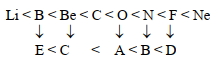
-
- (A) \(\mathrm{Al}>\mathrm{Ga}>\mathrm{Tl}\)
- (B) \(\mathrm{Ga}>\mathrm{Al}>\mathrm{B}\)
- (C) \(\mathrm{B}>\mathrm{Al}>\mathrm{Ga}\)
- (D) \(\mathrm{Tl}>\mathrm{Ga}>\mathrm{Al}\)
Show answer and solution
Correct Answer: (D)
(\(i\)) due to lanthanide contraction \(\mathrm{T} \ell\) has more \(I.E\). as compared to \(\mathrm{Ga}\) and \(\mathrm{A} \ell\)(\(ii\)) due to scandide contraction Ga has more \(I.E\). as compared to \(\mathrm{A} \ell\)
-
- (A) \(C \) > \( B \) > \( D \) > \( A\)
- (B) \(A \) > \( D \) > \( B \) > \( C\)
- (C) \(A \) > \( D \) > \( C \) > \( B\)
- (D) \(D \) > \( C \) > \( B \) > \( A\)
Show answer and solution
Correct Answer: (B)
Element ΔegH (kJ/mol) F −333 S −200 Br −325 Ar +96 -
- (A) \(D\) and \(E\) only
- (B) \(A\), B, \(D\) and E only
- (C) \(A\) and \(D\) only
- (D) \(A\), \(B\) and \(C\) only
Show answer and solution
Correct Answer: (D)
\((A)\) \(\mathrm{Be}+\mathrm{e}^{-} \rightarrow \mathrm{Be}^{-}, \quad\) E.A \(=\)-ive\((B)\) \(\mathrm{N}+\mathrm{e}^{-} \rightarrow \mathrm{N}^{-} \quad\) E.A \(=-\) ive
\((C)\) \(\mathrm{O}+\mathrm{e}^{-} \rightarrow \mathrm{O}^{-}\)
\(\mathrm{O}^{-}+\mathrm{e}^{-} \rightarrow \mathrm{O}^{-2} \quad\) E.A \(=-\) ive
\((D)\) \(\mathrm{Na}+\mathrm{e}^{-} \rightarrow \mathrm{Na}^{-} \quad\) E.A \(=+\) ive
\((E)\) \(\mathrm{A} \ell+\mathrm{e}^{-} \rightarrow \mathrm{A} \ell^{-} \quad\) E.A \(=+\) ive
Ans. \(A,B\) and \(C\) only
-
- (A) \(\mathrm{Si}\)
- (B) \(\mathrm{Al}\)
- (C) \(\mathrm{N}\)
- (D) \(\mathrm{C}\)
Show answer and solution
Correct Answer: (C)
\(\mathrm{Al}<\mathrm{Si}<\mathrm{C}<\mathrm{N} ; \mathrm{IE}_1\) order. -
- (A) \((B), (C)\) and \((D)\) only
- (B) \((A), (B), (C)\) and \((D)\)
- (C) \((C)\) and \((D)\) only
- (D) \((A), (C)\) and \((D)\) only
Show answer and solution
Correct Answer: (D)
\(\mathrm{O}^{-2} \mathrm{~F}^{-} \mathrm{Na}^{+} \mathrm{Mg}^{+2}\)\(\text { (No. of } \mathrm{e}^{-} \text {) } \ 10 \ 10 \ 10 \ 10\)
\(\text { (Ionic radius) } \mathrm{O}^{-2}>\mathrm{F}^{-}>\mathrm{Na}^{+}>\mathrm{Mg}^{+2}\)
\(\text { Zeff } \mathrm{O}^{-2}<\mathrm{F}^{-}<\mathrm{Na}^{+}<\mathrm{Mg}^{-2}\)
- 58. For electron gain enthalpies of the elements denoted as \(\Delta_{ eg } H\), the incorrect option is : 2023 Medium
- (A) \(\Delta_{ eg } H ( Cl ) < \Delta_{ eg } H ( F )\)
- (B) \(\Delta_{ eg } H ( Se ) < \Delta_{ eg } H ( S )\)
- (C) \(\Delta_{ eg } H (I) < \Delta_{ eg } H (At)\)
- (D) \(\Delta_{ eg } H ( Te ) < \Delta_{ eg } H\) (Po)
Show answer and solution
Correct Answer: (B)
\((1)\) \(\Delta_{ eg } H ( Cl ) < \Delta_{ eg } H ( F )\)\((-345) (-328)\) Correct
\((2)\) \(\Delta_{ eg } H ( Se ) < \Delta_{ eg } H ( S )\)
\((-195) \quad(-200)\) Incorrect
\((3)\) \(\Delta_{ eg } H (I) < \Delta_{ eg } H ( At )\)
\((-295) (-270)\) Correct
\((4)\) \(\Delta_{ eg } H ( Te ) < \Delta_{ eg } H ( Po )\)
\((-190) (-183)\) Correct
- 59. For elements \(B , C , N , Li , Be , O\) and \(F\) the correct order of first ionization enthalpy is 2023 Medium
- (A) \(Li < Be < B < C < N < O < F\)
- (B) \(B > Li > Be > C > N > O > F\)
- (C) \(Li < B < Be < C < O < N < F\)
- (D) \(Li < Be < B < C < O < N < F\)
Show answer and solution
Correct Answer: (C)
First I.E.\(F > N > O > C > Be > B > Li\)
\(Li -520\, kJ / mol\)
\(Be -899\, kJ / mol\)
\(B -801 \,kJ / mol\)
\(C -1086 \,kJ / mol\)
\(N -1402 \,kJ / mol\)
\(O -1314\, kJ / mol\)
\(F -1681\,kJ / mol\)
-
- (A) Both \((A)\) and \((R)\) are true and \((R)\) is the correct explanation of \((A)\)
- (B) Both \((A)\) and \((R)\) are true but \((R)\) is not the correct explanation of \((A)\)
- (C) \((A)\) is false but \((R)\) is true
- (D) \((A)\) is true but \((R)\) is false
Show answer and solution
Correct Answer: (A)
From Sc to Mn ionization energy is less than that of \(Mg\).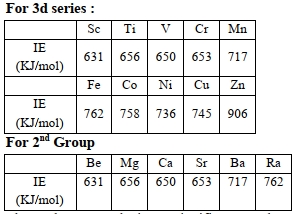
-
- (A) \(1\)
- (B) \(2\)
- (C) \(0.5\)
- (D) \(3\)
Show answer and solution
Correct Answer: (C)
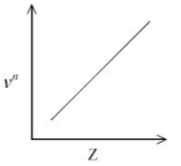
According to Henry Moseley \(\sqrt{v}\,\alpha z - b\)So \(n =\frac{1}{2}\)
-
- (A) \(A - II, B - IV, C - I, D - III\)
- (B) \(A - I, B - III, C - IV, D - II\)
- (C) \(A - IV, B - III, C - II, D - I\)
- (D) \(A - IV, B - II, C - I, D - III\)
Show answer and solution
Correct Answer: (D)
Atomic number Block \(37\) \((K)\) \(s-\)block \(78\) \((Pt)\) \(d-\)block \(52\) \((Te)\) \(p-\)block \(65\) \((Tb)\) \(f-\)block -
- (A) \(C > P > At > Br\)
- (B) \(Br > P > At > C\)
- (C) \(P > Br > C > At\)
- (D) \(Br > C > At > P\)
Show answer and solution
Correct Answer: (D)
Atom \(E.N\) \(Br\) \(3.0\) \(C\) \(2.5\) \(At\) \(2.2\) \(P\) \(2.1\) -
- (A) \(Be > Ca > K\)
- (B) \(Ca > K > Be\)
- (C) \(K > Ca > Be\)
- (D) \(K > Be > Ca\)
Show answer and solution
Correct Answer: (C)
On moving from top to bottom metallic character increases while on moving from left to right metallic decreases.\(K > Ca > Be\)
-
- (A) \(Ne\) and \(F\)
- (B) \(Ne\) and \(Cl\)
- (C) \(Ar\) and \(Cl\)
- (D) \(Ar\) and \(F\)
Show answer and solution
Correct Answer: (B)
\(Cl\) has the most negative \(\Delta H _{\text {eg }}\) among all the elements and \(Ne\) has the most positive \(\Delta H _{ eg }\). - 66. Which of the following represents the correct order of metallic character of the given elements ? 2023 Medium
- (A) \(Si < Be < Mg < K\)
- (B) \(Be < Si < Mg < K\)
- (C) \(K < Mg < Be < Si\)
- (D) \(Be < Si < K < Mg\)
Show answer and solution
Correct Answer: (A)
Metallic character increases down the group and decreases along the period. -
- (A) \(A,B,C\) and \(D\)
- (B) \(A,C\) and \(D\) Only
- (C) \(B\) and \(D\) Only
- (D) \(A,B\) and \(D\) Only
Show answer and solution
Correct Answer: (B)
Electronegativity of an element depends on the atom with which it is attached.\(NO =\text { neutral oxide }\)
\(Al _2 O _3=\text { amphoteric oxide }\)
-
- (A) \(SO _{3}\)
- (B) \(SiO _{2}\)
- (C) \(CaO\)
- (D) \(Al _{2} O _{3}\)
Show answer and solution
Correct Answer: (C)
\(SO _{3}, SiO _{2}=\) Acidic\(CaO =\) Basic
\(Al _{2} O _{3}=\) Amphoteric
-
- (A) \(3 s ^{2} \cdot 3 p ^{4}\)
- (B) \(3 d ^{10} \cdot 4 s ^{2}, 4 p ^{4}\)
- (C) \(4 d ^{10} \cdot 5 s ^{2}, 5 p ^{4}\)
- (D) \(2 s ^{2}, p 4\)
Show answer and solution
Correct Answer: (A)
\(E \Rightarrow[ Ar ] 3 d ^{10} 4 s ^{2} 4 p ^{4}\)Element above \(E \Rightarrow[ Ne ] 3 s ^{2} 3 p ^{4}\)
-
- (A) \(0\)
- (B) \(1\)
- (C) \(2\)
- (D) \(3\)
Show answer and solution
Correct Answer: (B)
\(Na _{2} O =\) Basic\(N _{2} O =\) Neutral
\(Cl _{2} O _{7}=\) Acidic
\(As _{2} O _{3}=\) Amphoteric
\(NO =\) Neutral
-
- (A) Both \((A)\) and \((R)\) are true and \((R)\) is the correct explanation of \(( A )\)
- (B) Both \((A)\) and \((R)\) are true but \((R)\) is not the correct explanation of \((A)\)
- (C) \((A)\) is true but \((R)\) is false
- (D) \((A)\) is false but \((R)\) is true
Show answer and solution
Correct Answer: (D)
Ionic radius of \(O ^{2-}\) is more than that of \(Mg ^{2+}\)Both \(O ^{2-}\) and \(Mg ^{2+}\) are isoelectronic with \(10\) electrons
-
- (A) Both \(A\) and \(R\) are correct and \(R\) is the correct explanation of \(A\).
- (B) Both \(A\) and \(R\) are correct but \(R\) is NOT the correct explanation of \(A\).
- (C) \(A\) is correct but \(R\) is not correct.
- (D) \(A\) is not correct but \(R\) is correct
Show answer and solution
Correct Answer: (A)
Ionisation energy \(= N > O\).In oxygen atom, \(2\) of the \(42 p\) electrons must occupy the same \(2 p\) orbital resulting in an increased electron electron-repulsion.
-
- (A) \((A)\) and \((B)\) only
- (B) \((B)\) and \((C)\) only
- (C) \((A)\) and \((C)\) only
- (D) \((C)\) and \((D)\) only
Show answer and solution
Correct Answer: (C)
\(Rb\) and \(Cs\) have nearly same electron gain enthalpy electron gain enthalpy \(=-46\,kj / ml\)\(Ar\) and \(Kr\) have same \(\Delta H _{ eq }\). Value is \(+96\,kj / ml\)
-
- (A) \(( A )-( IV ),( B )-( III ),( C )-( I ),( D )\)\(-( II )\)
- (B) \(( A )-( IV ),( B )-( II ),( C )-( I ),( D )\)\(-( III )\)
- (C) \(( A )-( II ),( B )-( IV ),( C )-( III ),( D )\)\(-( I )\)
- (D) \(( A )-( I ),( B )-( II ),( C )-( III ),( D )\)\(-( IV )\)
Show answer and solution
Correct Answer: (B)
\(Cl _{2} O _{7} \quad\) Acidic\(Na _{2} O \quad\) Basic
\(Al _{2} O _{3} \quad\) Amphoteric
\(N _{2} O \quad\) Neutral
-
- (A) \((A) < (B) < (C) < (D)\)
- (B) \((B) < (A) < (D) < (C)\)
- (C) \(( B )<( D )<( A )<( C )\)
- (D) \(( B ) < ( A ) < ( C ) < (D)\)
Show answer and solution
Correct Answer: (B)
\(3 s ^{2} \rightarrow Mg\)\(3 s ^{2} 3 p ^{1} \rightarrow Al\)
\(3 s ^{2} 3 p ^{3} \rightarrow P\)
\(3 s ^{2} 3 p ^{4} \rightarrow S\)
\(C > D > A > B\)
-
- (A) \(Na > Mg > Be > Si > P\)
- (B) \(P > Si > Be > Mg > Na\)
- (C) \(Si > P > Be > Na > Mg\)
- (D) \(Be > Na > Mg > Si > P\)
Show answer and solution
Correct Answer: (A)
Across a period metallic character decreases -
- (A) \(Be > Mg > Ca > Sr\)
- (B) \(Sr > Ca > Mg > Be\)
- (C) \(Sr > Be > Mg > Ca\)
- (D) \(Be > Sr > Mg > Ca\)
Show answer and solution
Correct Answer: (C)
In \(II'A'\) group density decreases down the group till \(Ca\) and after that it increases.Correct order of density is \(Sr > Be > Mg > Ca\) - 78. The correct order of electron gain enthalpies of \(Cl\), \(F , Te\) and \(Po\) is ..... 2022 Easy
- (A) \(F < Cl < Te < Po\)
- (B) \(Cl < F < Te < Po\)
- (C) \(Te < Po < Cl < F\)
- (D) \(Po < Te < F < Cl\)
Show answer and solution
Correct Answer: (D)
As \(Cl\) has maximum electron affinity among all elements.Element \(\quad \Delta _{ eg } H ( k J / m o l )\)
\(F \quad\quad\quad\quad -328\)
\(Cl \quad\quad\quad\quad -349\)
\(Te \quad\quad\quad\quad -190\)
\(Po \quad\quad\quad\quad -174\)
-
- (A) \(Mg ^{2+}< Na ^{+}< F ^{-}< O ^{2-}< N ^{3-}\)
- (B) \(N ^{3-}< O ^{2-}< F ^{-}< Na ^{+}< Mg ^{2+}\)
- (C) \(F ^{-}< Na ^{+}< O ^{2-}< Mg ^{2+}< N ^{3-}\)
- (D) \(Na ^{+}< F ^{-}< Mg ^{2+}< O ^{2-}< N ^{3-}\)
Show answer and solution
Correct Answer: (A)
\(N ^{-3}> O ^{-2}> F ^{-}> Na ^{+}> Mg ^{+2}(\) Radii \()\)(Isoelectronic species)
-
- (A) \(Mg^{2+} > Na^+ > F^- > O^{2-} < N^{3-}\)
- (B) \(N^{3-} < F^- > O^{2-} > Na^+ > Mg^{2+}\)
- (C) \(Mg^{2+} < Na^+ < F^- < O^{2-} < N^{3-}\)
- (D) \(N^{3-} > O^{2-} > F^- > Na^+ < Mg^{2+}\)
Show answer and solution
Correct Answer: (C)
Ionic size increases with the addition of electrons and ionic size decreases with the loss of electrons. The nitride ion, has \(10\) electrons in contrast to only \(7\) protons. It has high inter electronic repulsions due to which it has the maximum size. The increasing order of ionic size is \(Mg ^{2+}\,<\, Na ^{+}\,<\,F ^{-}\,< \,O ^{2-}\)They are isoelectronic species with same number of electrons. Higher is the atomic number, higher will be the effective nuclear charge, lower will be the size.
- 81. The first ionization enthalpies of \(Be , B , N\) and \(O\) follow the order\(....\) 2022 Medium
- (A) \(O < N < B < Be\)
- (B) \(Be < B < N < O\)
- (C) \(B < Be < N < O\)
- (D) \(B < Be < O < N\)
Show answer and solution
Correct Answer: (D)
\(1^{st}\,\,I.E.\) \(\underset{\left(2 p ^{3}\right)}{ N }>\underset{\left(2 p ^{4}\right)}{ O }>\underset{\left(2 s^{2}\right)}{ Be }>\underset{\left(2 p ^{1}\right)}{ B }\) -
- (A) \(487\)
- (B) \(768\)
- (C) \(577\)
- (D) \(856\)
Show answer and solution
Correct Answer: (C)
\(I. E\; : \;Na < Al < Mg < Si\)\(\therefore \quad 496<\operatorname{IE}( Al )<737\)
Option \((C)\), matches the condition.
i.e \(\operatorname{IE}( Al )=577 \;kJmol ^{-1}\)
-
- (A) The first ionization enthalpy of \(K\) is less than that of \(Na\) and \(Li\)
- (B) \(Xe\) does not have the lowest first ionization enthalpy in its group
- (C) The first ionization enthalpy of element with atomic number \(37\) is lower than that of the element with atomic number \(38\) .
- (D) The first ionization enthalpy of \(Ga\) is higher than that of the \(d-\)block element with atomic number \(30\).
Show answer and solution
Correct Answer: (D)
Ionization enthalpy order :\(Li > Na > K\)
\(He > Ne > Ar > Kr > Xe > Rn\)
\(Sr > Rb\)
\(Zn > Ga\)
- 84. The \(IUPAC\) nomenclature of an element with electronic configuration \([ Rn ] 5 f ^{14} 6 d ^{1} 7 s ^{2}\) is. 2022 Medium
- (A) \(Unnilbium\)
- (B) \(Unnilunium\)
- (C) \(Unnilquadium\)
- (D) \(Unniltrium\)
Show answer and solution
Correct Answer: (D)
Atomic Number \(103\) - 85. The metal that has very low melting point and its periodic position is closer to a metalloid is. 2022 Easy
- (A) \(Al\)
- (B) \(Ga\)
- (C) \(Se\)
- (D) \(In\)
Show answer and solution
Correct Answer: (B)
\(\begin{array}{ll} Al \rightarrow & 933\,K \\ Ga \rightarrow & 303\,K \\ In \rightarrow & 430\,K \\ Se \rightarrow & 490\,K \end{array}\) -
- (A) \((A)\) is false but \((R)\) is true.
- (B) \((A)\) is true but \((R)\) is false
- (C) Both \((A)\) and \((R)\) are correct and \((R)\) is the correct explanation of \((A)\)
- (D) Both \((A)\) and \((R)\) are correct but \((R)\) is not the correct explanation of \((A)\)
Show answer and solution
Correct Answer: (B)
From left to right in periodic table :-Metallic character decreases
Non-metallic character increases
\(\Rightarrow\) It is due to increase in ionization enthalpy and increase in electron gain enthalpy.
- 87. Identify the element for which electronic configuration in \(+3\) oxidation state is \([\mathrm{Ar}] 3 \mathrm{~d}^{5}\) : 2021 Medium
- (A) \(\mathrm{Ru}\)
- (B) \(Mn\)
- (C) \(Co\)
- (D) \(\mathrm{Fe}\)
Show answer and solution
Correct Answer: (D)
\(\mathrm{Fe}^{3+}[\mathrm{Ar}] 3 \mathrm{~d}^{5}\) -
- (A) \((a)-(i), (b)-(ii), (c)-(iii), (d)-(iv)\)
- (B) \((a)-(iii), (b)-(iv), (c)-(ii), (d)-(i)\)
- (C) \((a)-(i), (b)-(iv), (c)-(ii), (d)-(iii)\)
- (D) \((a)-(iv), (b)-(ii), (c)-(iii), (d)-(i)\)
Show answer and solution
Correct Answer: (B)
\(\mathrm{Mn}^{2+} \rightarrow\) \(III\) group\(\mathrm{As}^{3+} \rightarrow\) \(IIB\) group
\(\mathrm{Cu}^{2+} \rightarrow\) \(IIA\) group
\(\mathrm{Al}^{3+} \rightarrow\) \(IV\) group
-
- (A) \(\mathrm{Mg}<\mathrm{Al}<\mathrm{S}<\mathrm{P}\)
- (B) \(\mathrm{Al}<\mathrm{Mg}<\mathrm{S}<\mathrm{P}\)
- (C) \(\mathrm{Mg}<\mathrm{Al}<\mathrm{P}<\mathrm{S}\)
- (D) \(\mathrm{Mg}<\mathrm{S}<\mathrm{Al}<\mathrm{P}\)
Show answer and solution
Correct Answer: (B)
Mg\(\,\)AIPS \(\rightarrow\) I.E. order \(\rightarrow \mathrm{Al}\,<\,\mathrm{Mg}\,<\,\mathrm{S}\,<\,\mathrm{P}\)\(\quad\quad\quad\quad\quad\quad\mathrm{Mg}\) \(\quad\quad\mathrm{Al}\) \(\quad\quad\quad\mathrm{P}\) \(\quad\quad\quad\mathrm{S}\)
Valence \(\left[\mathrm{N}_{\mathrm{e}}\right]: 3 \mathrm{~s}^{2}\) \(\quad3 \mathrm{~s}^{2} 3 \mathrm{p}^{1}\) \(\quad3 \mathrm{~s}^{2} 3 \mathrm{p}^{3} \quad3 \mathrm{~s}^{2} 3 \mathrm{p}^{4}\)
\(\quad\quad\quad\quad\quad\quad\uparrow\) \(\quad\quad\quad\quad\quad\quad\uparrow\)
\(\quad\quad\quad\quad\quad\)Full Filled Stable \(\quad\)Half Filled Stable
-
- (A) \(\mathrm{P}^{3-}>\mathrm{S}^{2-}>\mathrm{Cl}^{-}>\mathrm{K}^{+}>\mathrm{Ca}^{2+}\)
- (B) \(\mathrm{Cl}^{-}>\mathrm{S}^{2-}>\mathrm{P}^{3-}>\mathrm{Ca}^{2+}>\mathrm{K}^{+}\)
- (C) \(\mathrm{P}^{3-}>\mathrm{S}^{2-}>\mathrm{Cl}^{-}>\mathrm{Ca}^{2+}>\mathrm{K}^{+}\)
- (D) \(\mathrm{K}^{+}>\mathrm{Ca}^{2+}>\mathrm{P}^{3-}>\mathrm{S}^{2-}>\mathrm{Cl}^{-}\)
Show answer and solution
Correct Answer: (A)
\(\mathrm{P}^{3-}>\mathrm{S}^{2-}>\mathrm{Cl}^{-}>\mathrm{K}^{+}>\mathrm{Ca}^{2+}\)(Correct order of ionic radii)
all the given species are isoelectronic species.
In isoelectronic species size increases with increase of negative charge and size decreases with increase in positive charge.
-
- (A) It is bigger than \(\mathrm{F}^{-}\)and \(\mathrm{N}\), but smaller than of \(\mathrm{O}^{2-}\)
- (B) It is smaller than \(\mathrm{O}^{2-}\) and \(\mathrm{F}^{-}\), but bigger than of \(\mathrm{N}\)
- (C) It is bigger than \(\mathrm{O}^{2-}\) and \(\mathrm{F}^{-}\)
- (D) It is smaller than \(\mathrm{F}^{-}\)and \(\mathrm{N}\)
Show answer and solution
Correct Answer: (C)
\(\mathrm{F}^{-}, \mathrm{O}^{2-}\) and \(\mathrm{N}^{3-}\) all are isoelectronic species inwhich \(\mathrm{N}^{3-}\) have least number of protons due to which it's size increases as least nuclear attractionis experienced by the outer shell electrons. Size order \(\mathrm{N}^{3-}>\mathrm{O}^{2-}>\mathrm{F}^{-}\) - 92. The ionic radii of \(\mathrm{K}^{+}, \mathrm{Na}^{+}, \mathrm{Al}^{3+}\) and \(\mathrm{Mg}^{2+}\) are in the order: 2021 Easy
- (A) \(\mathrm{Al}^{3+}\,<\,\mathrm{Mg}^{2+}\,<\,\mathrm{K}^{+}\,<\,\mathrm{Na}^{+}\)
- (B) \(\mathrm{K}^{+}\,<\,\mathrm{Al}^{3+}\,<\,\mathrm{Mg}^{2+}\,<\,\mathrm{Na}^{+}\)
- (C) \(\mathrm{Na}^{+}\,<\,\mathrm{K}^{+}\,<\,\mathrm{Mg}^{2+}\,<\,\mathrm{Al}^{3+}\)
- (D) \(\mathrm{Al}^{3+}\,<\,\mathrm{Mg}^{2+}\,<\,\mathrm{Na}^{+}\,<\,\mathrm{K}^{+}\)
Show answer and solution
Correct Answer: (D)
\(\mathrm{Al}^{3+}, \mathrm{Mg}^{2+}\) and \(\mathrm{Na}^{+}\)are isoelectronic ionic species. For monoatomic ionic isoelectronic species as positive charge increases ionic size decrease.The order of size of \(\mathrm{Na}^{+}\, \& \,\mathrm{~K}^{+}\)is \(\mathrm{Na}^{+}<\mathrm{K}^{+}\),
\(\therefore\) order of ionic radii is : \(\mathrm{Al}^{3+}\,<\,\mathrm{Mg}^{2+}\,<\,\mathrm{Na}^{+}\,<\,\mathrm{K}^{+}\)
-
- (A) \(3\)
- (B) \(4\)
- (C) \(5\)
- (D) \(6\)
Show answer and solution
Correct Answer: (A)
Sublimation enthalpy, Ionisation enthalpy and hydration enthalpy affect the reduction potential. -
- (A) \(( I ),( II )\) and \(( IV )\)
- (B) \(( II ),( III )\) and \(( IV )\)
- (C) \((I), (II)\) and \((III)\)
- (D) \((I), (III)\) and \((IV)\)
Show answer and solution
Correct Answer: (C)
\(I , A _{ N }: Be < Mg\)\(II\, IE : Be > Al\)
\(III\) Charge/radius ratio of \(Be\) \(w\) less than that of \(Al\)
\(IV\) \(Be\), \(Al\) mainly form covalent compounds
-
- (A) \((I), (II)\) and \((III)\)
- (B) \((II), (III)\) and \((IV)\)
- (C) \((I), (III)\) and \((IV)\)
- (D) \((I), (II)\) and \((IV)\)
Show answer and solution
Correct Answer: (A)
\(\mathrm{Be} \Rightarrow 1 \mathrm{s}^{2} 2 \mathrm{s}^{2}\)\(\mathrm{B} \Rightarrow 1 \mathrm{s}^{2} 2 \mathrm{s}^{2} 2 \mathrm{p}^{1}\)
\(\mathrm{B}\) has a smaller size than \(Be\)
it is easier to remove \(2 \mathrm{p}\) electron than \(2 \mathrm{s}\)
electron due to less pentration effect of \(2 \mathrm{p}\) than \(2 \mathrm{s}\)
\(2 \mathrm{p}\) electron of Boron is more shielded from the nucleus by the inner core of electron than the \(2 \mathrm{s}\) electron of \(\mathrm{Be}\)
\(B\) has a smaller size than \(Be\)
- 96. In general, the property (magnitudes only) that shows an opposite trend in comparison to other properties across a period is 2020 Medium
- (A) Electronegativity
- (B) Electron gain enthalpy
- (C) Ionization enthalpy
- (D) Atomic radius
Show answer and solution
Correct Answer: (D)
In general across a period atomic radius decreases while ionisation enthalpy, electron gain enthalpy and electronegativity increases because effective nuclear charge \(\left(Z_{\text {eff }}\right)\) increases. -
- (A) \(\mathrm{MgO}, \mathrm{Cl}_{2} \mathrm{O}, \mathrm{Al}_{2} \mathrm{O}_{3}\)
- (B) \(\mathrm{Cl}_{2} \mathrm{O}, \mathrm{CaO}, \mathrm{P}_{4} \mathrm{O}_{10}\)
- (C) \(\mathrm{Na}_{2} \mathrm{O}, \mathrm{SO}_{3}, \mathrm{Al}_{2} \mathrm{O}_{3}\)
- (D) \(\mathrm{N}_{2} \mathrm{O}_{3}, \mathrm{Li}_{2} \mathrm{O}, \mathrm{Al}_{2} \mathrm{O}_{3}\)
Show answer and solution
Correct Answer: (D)
1. \(MgO\) Basic\(\mathrm{Cl}_{2} \mathrm{O}\) Acidic
\(\mathrm{Al}_{2} \mathrm{O}_{3}\) amphoteric
2. \(\mathrm{Cl}_{2} \mathrm{O}\) Acidic
\(\mathrm{CaO}\) Basic
\(\mathrm{P}_{4} \mathrm{O}_{10}\) Acidic
3. \(\mathrm{Na}_{2} \mathrm{O}\) Basic
\(\mathrm{SO}_{3}\) Acidic
\(\mathrm{Al}_{2} \mathrm{O}_{3}\) amphoteric
4. \(\mathrm{N}_{2} \mathrm{O}_{3}\) Acidic
\(\mathrm{Li}_{2} \mathrm{O}\) Basic
\(\mathrm{Al}_{2} \mathrm{O}_{3}\) amphoteric
-
- (A) \(119\)
- (B) \(108\)
- (C) \(102\)
- (D) \(109\)
Show answer and solution
Correct Answer: (D)
Explanation:
According to the IUPAC systematic nomenclature for elements with atomic numbers \( Z > 100 \), the name is derived directly from the numerical roots of the constituent digits of the atomic number:
- \( 1 = \text{un} \)
- \( 0 = \text{nil} \)
- \( 9 = \text{enn} \)
Combining these roots sequentially along with the standard suffix "-ium", we get:
\( \text{un} + \text{nil} + \text{enn} + \text{ium} = \text{unnilennium} \)
Therefore, the atomic number corresponding to the name unnilennium is \( 109 \).
Hence, Option D is the correct choice. -
- (A) \(101\)
- (B) \(95\)
- (C) \(98\)
- (D) \(106\)
Show answer and solution
Correct Answer: (A)
Explanation:
According to the IUPAC systematic nomenclature rules for elements with atomic numbers greater than 100, the name is derived directly from the numerical roots of the digits composing the atomic number:
1. Numerical Roots for Digits:
- 1 = un
- 0 = nil
- 1 = un
2. Assembling the Name:
The systematic name is formed by combining these roots in sequence and appending the suffix "-ium" at the end:
\( \text{un} + \text{nil} + \text{un} + \text{ium} = \text{Unnilunium} \)
3. Identification:
The digits 1, 0, and 1 construct the atomic number 101 (Mendelevium). Note that atomic number 100 uses the digits 1, 0, 0 and is systematically named Unnilnilium (\( \text{un} + \text{nil} + \text{nil} + \text{ium} \)). Therefore, the question and the original answer key are completely correct.
Hence, Option A is the correct choice. - 100. The correct order of the ionic radii of \(O ^{2-}, N ^{3-}, F ^{-}, Mg ^{2+}, Na ^{+}\) and \(Al ^{3+}\) is 2020 Hard
- (A) \(Al ^{3+}< Na ^{+}< Mg ^{2+}< O ^{2-}< F ^{-}< N ^{3-}\)
- (B) \(N ^{3-}< O ^{2-}< F ^{-}< Na ^{+}< Mg ^{2+}< Al ^{3+}\)
- (C) \(Al ^{3+}< Mg ^{2+}< Na ^{+}< F ^{-}< O ^{2-}< N ^{3-}\)
- (D) \(N ^{3-}< F ^{-}< O ^{2-}< Mg ^{2+}< Na ^{+}< Al ^{3+}\)
Show answer and solution
Correct Answer: (C)
Correct order of size for isoelectronic species.\(Al ^{3+}< Mg ^{2+}< Na ^{+}< F ^{-}< O ^{2-}< N ^{3-}\)
No questions on this page match these filters.