


પ્રશ્નો
4 પ્રશ્નો4 માંથી 1–4 પ્રશ્નો
-
- (A) \(0.17\)
- (B) \(0.15\)
- (C) \(0.34\)
- (D) \(0.25\)
જવાબ અને ઉકેલ જુઓ
સાચો જવાબ: (A)
Given: Capacitance, \(C=0.2\, \mu \mathrm{F}=0.2 \times 10^{-6}\,F\)Inductance \(\mathrm{L}=0.5\, \mathrm{mH}=0.5 \times 10^{-3}\, \mathrm{H}\)
Current \(I=?\)
Using energy conservation
\(\frac{1}{2} C V^{2}=\frac{1}{2} C V_{1}^{2}+\frac{1}{2} L I^{2}\)
\(\frac{1}{2} \times 0.2 \times 10^{-6} \times 10^{2}+0\)
\(=\frac{1}{2} \times 0.2 \times 10^{-6} \times 5^{2}+\frac{1}{2} \times 0.5 \times 10^{-3} I^{2}\)
\(\therefore \quad I=\sqrt{3} \times 10^{-1}\, \mathrm{A}=0.17\, \mathrm{A}\)
-
- (A) \(\frac{{mgR\cos \,\theta }}{{{B^2}{l^2}}}\)
- (B) \(\frac{{mgR\sin \,\theta }}{{{B^2}{l^2}}}\)
- (C) \(\frac{{mgR\tan \,\theta }}{{{B^2}{l^2}}}\)
- (D) \(\frac{{mgR\cot \,\theta }}{{{B^2}{l^2}}}\)
જવાબ અને ઉકેલ જુઓ
સાચો જવાબ: (B)
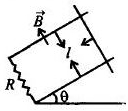
From Faraday's law of electomagnetic induction,\(e=\frac{d \phi}{d t}=\frac{d(B A)}{l t}=\frac{d(B l l)}{d t}\)
\( = \frac{{Bdl \times l}}{{dt}} = BVl\)
Also, \(F=i l B=\left(\frac{B V}{R}\right)\left(l^{2} B\right)=\frac{B^{2} l^{2} V}{R}\)
At equilibrium
\(m g \sin \theta=\frac{B^{2} I V}{R} \Rightarrow V=\frac{m g R \sin \theta}{B^{2} l^{2}}\)
-
- (A) \(nBA\omega \)
- (B) \(\frac{3}{2}\,nBA\omega \)
- (C) \(3\,nBA\omega \)
- (D) \(\frac{1}{2}\,nBA\omega \)
જવાબ અને ઉકેલ જુઓ
સાચો જવાબ: (A)
Induced emf in a coil, \(e\, = \, - \frac{{d\phi }}{{dt}}\, = \,NBA\,\omega \,\sin \,\,\omega t\) Also, \(e = e_0\,\,sin\,\omega t\) \(\therefore \) Maximum \(emf\) induced, \(e_0 = nBA\omega \) -
- (A) \(\frac{{{\mu _0}I}}{{2R}}\,\omega {r^2}\,\sin \,\omega t\)
- (B) \(\frac{{{\mu _0}I}}{{4R}}\,\omega \pi {r^2}\,\sin \,\omega t\)
- (C) \(\frac{{{\mu _0}I}}{{2R}}\,\omega \pi {r^2}\,\sin \,\omega t\)
- (D) \(\frac{{{\mu _0}I}}{{4R}}\,\omega {r^2}\,\sin \,\omega t\)
જવાબ અને ઉકેલ જુઓ
સાચો જવાબ: (C)
According to Faraday's law of electromagnetic induction,\(e=-\frac{d \phi}{d t} \text { and } \phi=B A \cos \omega t=B \pi r^{2} \cos \omega t\)
\(\Rightarrow \quad e=-\frac{d}{d t}\left(\pi r^{2} B \cos \omega t\right)=\pi r^{2} B \sin \omega t(\omega)\)
\(\therefore e=\frac{\mu_{0} I}{2 R} \pi \omega r^{2} \sin \omega t\left(\because B=\frac{\mu_{0} I}{2 R}\right)\)
આ પેજ પર આ ફિલ્ટર મુજબ કોઈ પ્રશ્ન નથી.