


Chapters asked in 2018
29 chapters- 5Qs STD 11 Units, dimensions and measurement
- 4Qs STD 12 Semicondutor electronics
- 3Qs STD 12 Nuclei
- 4Qs STD 12 Atoms
- 2Qs STD 12 Dual nature of radiation and matter
- 4Qs STD 12 Electromagnetic waves
- 5Qs STD 12 Wave optics
- 4Qs STD 12 Ray optics and optical instruments
- 2Qs STD 12 Alternating current
- 12Qs STD 11 System of particles and rotational motion Most asked
- 7Qs STD 12 Moving charges and magnetism Most asked
- 4Qs STD 12 Electromagnetic induction
- 1Qs STD 12 Magnetism and matter
- 8Qs STD 12 Current electricity Most asked
- 5Qs STD 12 Electric potential and capacitance
- 4Qs STD 12 Electric charges and fields
- 5Qs STD 11 Waves and sound
- 4Qs STD 11 Oscillations
- 2Qs STD 11 Kinetic theory of gases
- 5Qs STD 11 Thermodynamics
- 2Qs STD 11 Mechanical properties of solids
- 2Qs STD 11 Surface tension
- 1Qs STD 11 Fluid mechanics
- 1Qs STD 11 Newtons laws of motion
- 4Qs STD 11 Gravitation
- 6Qs STD 11 Work, energy, power and collision
- 3Qs STD 11 Motion in straight line
- 1Qs STD 11 Transmission of heat
- 1Qs STD 11 Vectors
All JEE Mains 2018 Physics questions
29 chaptersShowing 1–50 of 111 questions
-
- (A) \(0.0430\,cm\)
- (B) \(0.3150\,cm\)
- (C) \(0.43 00\,cm\)
- (D) \(0.2150\, cm\)
Show answer and solution
Correct Answer: (D)
In one rotation scale moves \(\frac{0.25}{5}=0.05 cm\)Least count \(=0.05 \times 10^{-2} cm\)
For 4 main scale division \(=4 \times 0.05=0.2 cm\)
For circular scale divosion \(=30 \times 0.05 \times 10^{-2}=1.5 \times 10^{-2} cm\)
Thickness of wire \(=0.2+0.015=0.2150 cm\)
-
- (A) \(G^2hc\)
- (B) \({\left( {\frac{{Gh}}{{{c^3}}}} \right)^{\frac{1}{2}}}\)
- (C) \({G^{\frac{1}{2}}}{h^2}c\)
- (D) \(Gh^2c^3\)
Show answer and solution
Correct Answer: (B)
Plank length is a unit of length\(I_p\,= 1.616229\times10^{-35}\,m\)
\({l_p} = \sqrt {\frac{{hG}}{{{c^3}}}} \)
-
- (A) \(3.5\)
- (B) \(4.5\)
- (C) \(6\)
- (D) \(2.5\)
Show answer and solution
Correct Answer: (B)
\(Density\left( d \right) = \frac{{mass\left( M \right)}}{{volume\left( V \right)}} = \frac{M}{{{L^3}}}\)
\(\therefore Error\,in\,density,\,\frac{{\Delta d}}{d} = \frac{{\Delta M}}{M} + \frac{{3\Delta L}}{L}\)
\( = 1.5\% + 3\left( {1\% } \right) = 4.5\% \)
-
- (A) \(8.5\)
- (B) \(6.0\)
- (C) \(7.5\)
- (D) \(6.5\)
Show answer and solution
Correct Answer: (D)
\(\begin{array}{l}
Maximum\,percentage\,error\,in\,A\\
= 3\left( {\% \,error\,in\,p} \right) + 2\left( {\% \,error\,in\,Q} \right)\\
\,\,\,\,\,\,\,\,\,\,\,\,\,\,\, + \frac{1}{2}\left( {\% \,error\,in\,R} \right) + 1\left( {\% \,error\,in\,S} \right)\\
= 3 \times 0.5 + 2 \times 1 = \frac{1}{2} \times 3 + 1 \times 1.5\\
= 1.5 + 2 + 1.5 + 1.5 = 6.5\%
\end{array}\) -
- (A) \(\frac{2}{3}\alpha \)
- (B) \(\frac{5}{2}\alpha \)
- (C) \(\frac{3}{2}\alpha \)
- (D) \(\alpha \)
Show answer and solution
Correct Answer: (C)
\(\begin{array}{l}
{\mathop{\rm Re}\nolimits} lative\,\,eroor\,\,in\,\,surface\,\,area,\\
\frac{{\Delta s}}{s} = 2 \times \frac{{\Delta r}}{r} = \alpha \,and\,relative\,error\,in\\
volume,\,\frac{{\Delta v}}{v} = 3 \times \frac{{\Delta r}}{r}\\
\therefore \,{\mathop{\rm Re}\nolimits} lative\,\,error\,in\,volume\,w.r.t\,relative\,error\,in\,area,\\
\frac{{\Delta v}}{v} = \frac{3}{2}\alpha
\end{array}\) -
- (A) \(\beta \frac{{{R_L}}}{{{R_{BE}}}},\frac{{\Delta {I_E}}}{{\Delta {I_B}}},{\beta ^2}\frac{{{R_L}}}{{{R_{BE}}}}\)
- (B) \({\beta ^2}\frac{{{R_L}}}{{{R_{BE}}}},\frac{{\Delta {I_C}}}{{\Delta {I_B}}},\beta \frac{{{R_L}}}{{{R_{BE}}}}\)
- (C) \({\beta ^2}\frac{{{R_L}}}{{{R_{BE}}}},\frac{{\Delta {I_C}}}{{\Delta {I_E}}},{\beta ^2}\frac{{{R_L}}}{{{R_{BE}}}}\)
- (D) \(\beta \frac{{{R_L}}}{{{R_{BE}}}},\frac{{\Delta {I_C}}}{{\Delta {I_B}}},{\beta ^2}\frac{{{R_L}}}{{{R_{BE}}}}\)
Show answer and solution
Correct Answer: (D)
Curent gain \(\beta=\frac{\Delta I_{C}}{I_{B}}\)Voltage gain \(\mathrm{A}_{\mathrm{v}}=\) Current gain \(\times\) Resistance
\(\operatorname{gain}=\beta \frac{R_{L}}{R_{B E}}\)
Power gain \(A_{p}=(\text { Current gain })^{2} \times\) Resistance gain
\(=\beta^{2} \frac{R_{L}}{R_{B E}}\)
-
- (A) \(2.5\)
- (B) \(3.3\)
- (C) \(5.5\)
- (D) \(6.7\)
Show answer and solution
Correct Answer: (B)
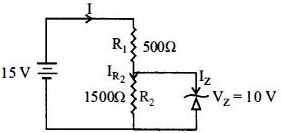
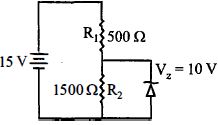
The voltage drop across \(\mathrm{R}_{2}\) is \(\mathrm{V}_{\mathrm{R}_{2}}\) \(=\mathrm{V}_{\mathrm{Z}}=10 \mathrm{V}\)The current through \(\mathrm{R}_{2}\) is
\(\mathrm{I}_{\mathrm{R}_{2}}=\) \(\frac{\mathrm{V}_{\mathrm{R}_{2}}}{\mathrm{R}_{2}}\) \(=\frac{10 \mathrm{V}}{1500 \Omega}\) \(=0.667 \times 10^{-2} \mathrm{A}\)
\(=6.67 \times 10^{-3} \mathrm{A}=6.67 \mathrm{mA}\)
The voltage drop across \(R_{1}\) is
\(\mathrm{V}_{\mathrm{R}_{1}}=15 \mathrm{V}-\mathrm{V}_{\mathrm{R}_{2}}\) \(=15 \mathrm{V}-10 \mathrm{V}=5 \mathrm{V}\)
The current through \(\mathrm{R}_{1}\) is
\(\mathrm{I}_{\mathrm{R}_{1}}=\frac{\mathrm{V}_{\mathrm{R}_{1}}}{\mathrm{R}_{1}}=\frac{5 \mathrm{V}}{500 \Omega}=10^{-2} \mathrm{A}=10 \times 10^{-3} \mathrm{A}=10 \mathrm{mA}\)
The current through the zener diode is
\(\mathrm{I}_{\mathrm{Z}}=\mathrm{I}_{\mathrm{R}_{1}}-\mathrm{I}_{\mathrm{R}_{2}}\) \(=(10-6.67) \mathrm{mA}=3.3 \mathrm{mA}\)
-
- (A) \(15\)
- (B) \(13.5 \)
- (C) \(11.5\)
- (D) \(0\)
Show answer and solution
Correct Answer: (C)
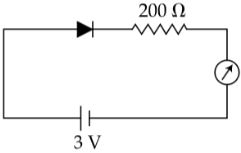
Clearly from fig. given in question, Silicon diode is in forward bias.\(\therefore\) Potential barrier across diode
\(\Delta \mathrm{V}=0.7 \mathrm{volts}\)
Current, \(I=\frac{V-\Delta V}{R}=\frac{3-0.7}{200}\) \(=\frac{2.3}{200}=11.5 \mathrm{mA}\)
-
- (A)
\(x\) \(y\) \(z\) \(0\) \(0\) \(1\) \(0\) \(1\) \(1\) \(1\) \(0\) \(1\) \(1\) \(1\) \(0\) - (B)
\(x\) \(y\) \(z\) \(0\) \(0\) \(0\) \(0\) \(1\) \(0\) \(1\) \(0\) \(0\) \(1\) \(1\) \(1\) - (C)
\(x\) \(y\) \(z\) \(0\) \(0\) \(1\) \(0\) \(1\) \(1\) \(1\) \(0\) \(1\) \(1\) \(1\) \(1\) - (D)
\(x\) \(y\) \(z\) \(0\) \(0\) \(0\) \(0\) \(1\) \(1\) \(1\) \(0\) \(1\) \(1\) \(1\) \(1\)
Show answer and solution
Correct Answer: (C)
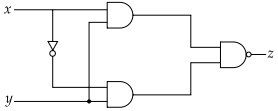
Truth table of the circuit is as follows\(x\) \(y\) \(\bar x\) \(a= x.y\) \(b=\bar x.y\) \(z=\bar {a.b}\) \(0\) \(0\) \(1\) \(0\) \(0\) \(1\) \(0\) \(1\) \(1\) \(0\) \(1\) \(1\) \(1\) \(0\) \(0\) \(0\) \(0\) \(1\) \(1\) \(1\) \(0\) \(1\) \(0\) \(1\) - (A)
-
- (A) \(6\)
- (B) \(7\)
- (C) \(4\)
- (D) \(5\)
Show answer and solution
Correct Answer: (D)
Let initial activity \(=\mathrm{N}_{0}=0.8\, \mu \mathrm{ci}\)\(0.8 \times 3.7 \times 10^{4}\, \mathrm{dps}\)
Activity in \(1\, \mathrm{cm}^{3}\) of blood at \(\mathrm{t}=10\, \mathrm{hr}\)
\(\mathrm{n}=\frac{300}{60} \mathrm{dps}=5 \,\mathrm{dps}\)
\(\mathrm{N}=\) Activity of whole blood at timet \(=10 \,\mathrm{hr}\) Total volume of the blood in the person, \(V\)
\(=\frac{N}{n}\)
\( = \frac{{{N_0}e - \lambda t}}{n} = \) \( \frac{{0.8 \times 3.7 \times {{10}^4} \times 0.7927}}{5} \cong 5\,\,{\mkern 1mu} litre\)
-
- (A) \(8 : 27\)
- (B) \(2 : 3\)
- (C) \(3 : 2\)
- (D) \(4:9\)
Show answer and solution
Correct Answer: (C)
Let heavy nucleus breaks into two nuclei of mass \(m_{1}\) and \(m_{2}\) and move away with velocities \({V}_{1}^1\) and \(V_{2}^2\) respectively.According to question, \(\frac{V_{1}}{V_{2}}=\frac{8}{27}\) \(m_{1} V_{1}=m_{2} V_{2}\) (Law of momentum conservation)
\(\Rightarrow\) \(\frac{{{m_1}}}{{{m_2}}} = \frac{{{V_2}}}{{{V_1}}} = \frac{{27}}{8}\)
\(\rho \times \frac{4}{3}\pi R_1^3\) \(\left( {\because {\text{ density }}\rho = \frac{{{\text{ mass }}}}{{{\text{ volume }}}}} \right)\)
\(\rho \times \frac{4}{3}\pi R_2^3\)
\( \Rightarrow \left( {\frac{{{R_1}}}{{{R_2}}}} \right) = \) \({\left( {\frac{{27}}{8}} \right)^{\frac{1}{3}}} = {\left( {\frac{3}{2}} \right)^{3 \times \frac{1}{3}}}\)
\(\therefore \frac{R_{1}}{R_{2}}=\frac{3}{2}\)
-
- (A) \(10\) years and \(20\) years, respectively
- (B) \(5\) years and \(20\) years, respectively
- (C) \(20\) years and \(10\) years, respectively
- (D) \(20\) years and \(5\) years, respectively
Show answer and solution
Correct Answer: (B)
Given \(: \mathrm{N}_{1}=2 \mathrm{N}_{2}\)Activity of radioactive substance \(=\lambda \mathrm{N}\)
Half life period \(\mathrm{t}=\frac{\ln 2}{\lambda}\) or, \(\lambda=\frac{\ln 2}{\mathrm{t}}\)
\(\lambda_{1} \mathrm{N}_{1}=\frac{\ln 2}{\mathrm{t}_{1}} \times \mathrm{N}_{1}=5 \mu \mathrm{C}_{\mathrm{i}}\) ...... \((i)\)
\(\lambda_{2} \mathrm{N}_{2}=\frac{\ln 2}{\mathrm{t}_{2}} \times \mathrm{N}_{2}=10 \mu \mathrm{C}_{\mathrm{i}}\) ...... \((ii)\)
Dividing equation \((ii)\) by \((i)\)
\(\frac{t_{2}}{t_{1}} \times \frac{N_{1}}{N_{2}}=\frac{1}{2}\)
\(\frac{t_{2}}{t_{1}}=\frac{1}{4} \Rightarrow t_{1}=4 t_{2}\)
i.e., Half life of \(S_{1}\) is four times of sample \(S_{2}\) Hence \(5\) years and \(20\) years.
- 13. If the series limit frequency of the Lyman series is \(v_L\), then the series limit frequency of the \(P\)-fund series is 2018 Medium
- (A) \(16\) \( v_L\)
- (B) \(\frac{{{v_L}}}{{16}}\)
- (C) \(\;\frac{{{v_L}}}{{25}}\)
- (D) \(25\) \( v_L\)
Show answer and solution
Correct Answer: (C)
\(\mathrm{hv}_{\mathrm{L}}=\mathrm{E}_{\infty}-\mathrm{E}_{1}\) ..... \((i)\)\(\mathrm{hv}_{\mathrm{f}}=\mathrm{E}_{\infty}-\mathrm{E}_{5}\) ..... \((ii)\)
\({\text{E}} \propto \frac{{{{\text{z}}^2}}}{{{{\text{n}}^2}}} \Rightarrow \) \(\frac{{{{\text{E}}_5}}}{{{{\text{E}}_1}}} = {\left( {\frac{1}{5}} \right)^2} = \frac{1}{{25}}\)
\(\operatorname{Eqn}(\mathrm{i}) /(\mathrm{ii}) \Rightarrow \frac{\mathrm{h} v_{\mathrm{L}}}{\mathrm{h} v_{\mathrm{f}}}=\frac{\mathrm{E}_{1}}{\mathrm{E}_{5}}\)
\(\Rightarrow \frac{v_{\mathrm{L}}}{v_{\mathrm{f}}}=\frac{25}{1} \Rightarrow v_{\mathrm{f}}=\frac{v_{\mathrm{L}}}{25}\)
-
- (A) \((A), (B), (D)\)
- (B) \((B), (D)\)
- (C) \((C), (D)\)
- (D) \((A), (C), (D)\)
Show answer and solution
Correct Answer: (D)
\((A)\) Radius of muon \({ = \frac{{{\text{Radius of hydrogen}}}}{{200}}}\)Radius of \(H\) atom \(=r=\frac{\epsilon_{0} n^{2} h^{2}}{\pi m e^{2}}\)
Radius of muon \(=r_{\mu}=\frac{\epsilon_{0} n^{2} h^{2}}{\pi \times 200 m e^{2}}\)
\(r_{\mu}=\frac{r}{200}\)\((B)\) Velocityrelation given is wrong
\((C)\) Ionization energy in \(e^-\) \(H\) atom
\(E=\frac{+m e^{4}}{8 \epsilon_{0}^{2} n^{2} h^{2}}\)
\(E_{\mu}=\frac{200 m e^{4}}{8 \epsilon_{0}^{2} n^{2} h^{2}}=200 E\)
\((D)\) Momentum of \(H\) -atom
\(m v r=\frac{n h}{2 \pi}\)
Hence \((A),\,(C),\,(D)\) are correct.
-
- (A) \({\lambda _B}\, = \,{\lambda _{G}}/3\)
- (B) \({\lambda _B}\, = \,{\lambda _{G}}/2\)
- (C) \({\lambda _B}\, = \,{2\lambda _{G}}\)
- (D) \({\lambda _B}\, = \,{3\lambda _{G}}\)
Show answer and solution
Correct Answer: (D)
de-Broglie wavelength, \(\lambda=\frac{h}{P}\)\(\frac{\lambda_{\mathrm{B}}}{\lambda_{\mathrm{G}}}=\frac{\mathrm{P}_{\mathrm{G}}}{\mathrm{P}_{\mathrm{B}}}=\frac{\mathrm{mv}_{\mathrm{G}}}{\mathrm{mv}_{\mathrm{B}}}\)
Speed of electron \(v \propto \frac{z}{n}\)
so \(\frac{\lambda_{B}}{\lambda_{G}}=\frac{n_{B}}{n_{G}}=\frac{3}{1} \Rightarrow \lambda_{B}=3 \lambda_{G}\)
-
- (A) \(20\)
- (B) \(79\)
- (C) \(109\)
- (D) \(34\)
Show answer and solution
Correct Answer: (B)
Energy required to remove e - from singlyionized helium atom \({ = \frac{{(13.6){Z^2}}}{{{1^2}}} = 54.4\,{\text{eV}}}\)
\((\because Z=2)\)
Energy required to remove \(e^-\) from helium atom \(=x\,eV\)
According to question, \(54.4 \mathrm{eV}=2.2 \mathrm{x} \Rightarrow \mathrm{x}\)
\(=24.73 \mathrm{eV}\)
Therefore, energy required to ionize helium atom \(=(54.4+24.73)eV\) \(=79.12 \mathrm{eV}\)
-
- (A) \(10^{-6}\)
- (B) \(10\)
- (C) \(10^{-1}\)
- (D) \(10^{-10}\)
Show answer and solution
Correct Answer: (A)
Energy \(E = \frac {hc}{\lambda };\)\(\frac{{{\lambda _N}}}{{{\lambda _A}}} = \frac{{{E_A}}}{{{E_N}}}\)
where \(E_A\) and \(E_N\) are energies of photons from atom and nucleus respectively. \(E_N\) is of the order of \(MeV = 10^6\,\,eV\) and \(E_A\) in few \(eV.\)
So \(\frac{{{\lambda _N}}}{{{\lambda _A}}}\, = \,{10^{ - 6}}\)
-
- (A) \({\lambda _{CM}} = {\lambda _1} = {\lambda _2}\)
- (B) \(\frac{1}{{{\lambda _1}}} = \frac{1}{{{\lambda _1}}} + \frac{1}{{{\lambda _2}}}\)
- (C) \({\lambda _{CM}} = \frac{{2{\lambda _1}{\lambda _2}}}{{\sqrt {\lambda _1^2 + \lambda _2^2} }}\)
- (D) \({\lambda _{CM}} = \left( {\frac{{{\lambda _1} + {\lambda _2}}}{2}} \right)\)
Show answer and solution
Correct Answer: (C)
Momentum \((p)\) of each electron\(\frac{\mathrm{h}}{\lambda_{1}} \hat{\mathrm{i}}\) and \(\frac{\mathrm{h}}{\lambda_{2}} \hat{\mathrm{j}}\)
Velocity of centre of mass
\({{\text{V}}_{{\text{cm}}}} = \frac{{\text{h}}}{{2{\text{m}}{\lambda _1}}}\widehat {\text{i}} + \) \(\frac{{\text{h}}}{{2{\text{m}}{\lambda _2}}}\widehat {\text{j}}\) \((\because {\text{p}} = {\text{mv}})\)
Velocity of Ist particleabout centre of mass
\(\mathrm{V}_{1 \mathrm{cm}}=\frac{\mathrm{h}}{2 \mathrm{m} \lambda_{1}} \hat{\mathrm{i}}-\frac{\mathrm{h}}{2 \mathrm{m} \lambda_{2}} \hat{\mathrm{j}}\)
\({\lambda _{{\text{cm}}}} = \frac{{\text{h}}}{{\sqrt {\frac{{{{\text{h}}^2}}}{{4\lambda _1^2}} + \frac{{{{\text{h}}^2}}}{{4\lambda _2^2}}} }}\) \( = - \frac{{2{\lambda _1}{\lambda _2}}}{{\sqrt {\lambda _1^2 + \lambda _2^2} }}\left( {\because \lambda = \frac{{\text{h}}}{{\text{p}}}} \right)\)
-
- (A) \(\frac{{{E_0}}}{C}\left( {\frac{{\hat i - \hat j}}{{\sqrt 2 }}} \right)\cos \left[ {{{10}^4}\left( {\frac{{\hat i - \hat j}}{{\sqrt 2 }}} \right)\cdot \vec r - \left( {3 \times {{10}^{12}}} \right)t} \right]\)
- (B) \(\frac{{{E_0}}}{C}\left( {\frac{{\hat i - \hat j}}{{\sqrt 2 }}} \right)\cos \left[ {{{10}^4}\left( {\frac{{\hat i + \hat j}}{{\sqrt 2 }}} \right)\cdot \vec r - \left( {3 \times {{10}^{12}}} \right)t} \right]\)
- (C) \(\frac{{{E_0}}}{C}\hat k\cos \left[ {{{10}^4}\left( {\frac{{\hat i + \hat j}}{{\sqrt 2 }}} \right)\cdot \vec r + \left( {3 \times {{10}^{12}}} \right)t} \right]\)
- (D) \(\frac{{{E_0}}}{C}\frac{{\left( {\hat i + \hat j + \hat k} \right)}}{{\sqrt 3 }}\cos \left[ {{{10}^4}\left( {\frac{{\hat i + \hat j}}{{\sqrt 2 }}} \right)\cdot \vec r + \left( {3 \times {{10}^{12}}} \right)t} \right]\)
Show answer and solution
Correct Answer: (A)
Poynting Vector -\(\vec{s}=\frac{\vec{E} \times \vec{B}}{\mu_{o}}\)
-wherein
It is total energy flowing perpendicularly per second per unit area into the surface in free space.
\(\vec{E} \times \vec{B}\) should give a direction of wave propagation
\(\Rightarrow \vec{E} \times \vec{B} \| \frac{\hat{i}+\hat{j}}{\sqrt{2}}\)
option \((1) \hat{k} \times\left(\frac{\hat{i}+\hat{j}}{\sqrt{2}}\right)=\frac{\hat{j}-\hat{i}}{\sqrt{2}} \| \frac{\hat{i}-\hat{j}}{\sqrt{2}}\)
option \(( 2)\) and \(( 4)\) does not satisfy this wave propagation vector should be
\(\operatorname{along} \frac{\hat{i}+\hat{j}}{\sqrt{2}}\)
-
- (A) \(\vec E\, = \,\sqrt {\frac{I}{{{\varepsilon _0}C}}} \cos \left[ {\frac{{2\pi }}{\lambda }(y - ct)} \right]\,\hat i\,;\,\vec B\, = \,\frac{1}{c}E\hat k\)
- (B) \(\vec E\, = \,\sqrt {\frac{I}{{{\varepsilon _0}C}}} \cos \left[ {\frac{{2\pi }}{\lambda }(y - ct)} \right]\,\hat k\,;\,\vec B\, = - \,\frac{1}{c}E\hat i\)
- (C) \(\vec E\, = \,\sqrt {\frac{{2I}}{{{\varepsilon _0}C}}} \cos \left[ {\frac{{2\pi }}{\lambda }(y - ct)} \right]\,\hat k\,;\,\vec B\, = + \frac{1}{c}E\hat i\)
- (D) \(\vec E\, = \,\sqrt {\frac{{2I}}{{{\varepsilon _0}C}}} \cos \left[ {\frac{{2\pi }}{\lambda }(y + ct)} \right]\,\hat k\,;\,\vec B\, = \frac{1}{c}E\hat i\)
Show answer and solution
Correct Answer: (C)
If \(E_0\) is magnitude of electric field then \(\frac{1}{2}\,{\varepsilon _0}{E_0}^2\, \times \,C\, = \,I\, \Rightarrow {\kern 1pt} {E_0}\, = \sqrt {\frac{{2I}}{{C{\varepsilon _0}}}} \)\({B_0} = {\kern 1pt} \frac{{{E_0}}}{C}\,\)
Direction of \(\vec E \times \vec B\) will be along \( + \hat j.\)
-
- (A) \(\frac{{3 \times {{10}^8}}}{{\left| {{z_2} - {z_1}} \right|}}\)
- (B) \(\frac{{6 \times {{10}^8}}}{{\left| {{z_2} - {z_1}} \right|}}\)
- (C) \(\frac{{1.5 \times {{10}^8}}}{{\left| {{z_2} - {z_1}} \right|}}\)
- (D) \(\frac{1}{{{t_1} + \frac{{\left| {{z_{2 - }}{z_1}} \right|}}{{3 \times {{10}^8}}}}}\)
Show answer and solution
Correct Answer: (A)
Using \(E=E_{0}-e^{j(k z-\omega t)}\)Given, at \(t=t_{1}, z=z_{1}, E=0\)
the next zero that occurs in it's neighborhood is at \(z_{2},\) the frequency of the electromagnetic wave at \(t_{2}\)
\(e^{i\left(k z_{1}-\omega t_{1}\right)}=e^{i\left(k z_{2}-\omega x_{2}\right)}\)
\(k z_{1}-\omega t_{1}=k z_{2}-\omega t_{2}\)
\(\left(t_{2}-t_{1}\right) \omega=k\left(z-z_{1}\right)\)
where \(k=\frac{2 \pi}{\lambda}=2 \pi v\)
\(\left(t_{2}-t_{1}\right)=\frac{2 \pi}{\lambda \times 2 \pi v}\left(z_{2}-z_{1}\right)\)
\(=\frac{1}{x \times v}\left(z_{2}-z_{1}\right)\)
\(\Rightarrow \lambda \times v=\frac{\left(z_{2}-z_{1}\right)}{\left(t_{2}-t_{1}\right)}=C\)
\(\left(t_{2}-t_{1}\right)=\frac{\left(z_{2}-z_{1}\right)}{C}\)
Frequency is \(f \propto \frac{1}{t}\) then \(\frac{1}{\left(t_{2}-t_{1}\right)}=\frac{C}{\left(z_{2}-z_{1}\right)}\)
\(\therefore \text { Frequency, } f=\frac{3 \times 10^{8}}{\left(z_{2}-z_{1}\right)}\)
-
- (A) \(\frac{{{_{{\epsilon r_1}}}}}{{{_{{\epsilon r_2}}}}} = 2\)
- (B) \(\frac{{{_{{\epsilon r_1}}}}}{{{_{{\epsilon r_2}}}}} = \frac{1}{4}\)
- (C) \(\frac{{{_{{\epsilon r_1}}}}}{{{_{{\epsilon r_2}}}}} = \frac{1}{2}\)
- (D) \(\frac{{{_{{\epsilon r_1}}}}}{{{_{{\epsilon r_2}}}}} = 4\)
Show answer and solution
Correct Answer: (B)
Velocity of \(EM\) wave is given by \(\mathrm{v}=\frac{1}{\sqrt{\mu \epsilon}}\)Velocity in air \(=\frac{\omega}{\mathrm{k}}=\mathrm{C}\)
Velocity in medium \(=\frac{\mathrm{C}}{2}\)
Here, \(\mu_{1}=\mu_{2}=1\) as medium is non-magnetic
\(\therefore \frac{\sqrt{\epsilon_{\eta}}}{\frac{1}{\sqrt{\epsilon_{\mathrm{r}_{2}}}}}=\frac{\mathrm{C}}{\left(\frac{\mathrm{C}}{2}\right)}=2 \quad \Rightarrow \quad \frac{\epsilon_{\mathrm{r}_{1}}}{\epsilon_{\mathrm{r}_{2}}}=\frac{1}{4}\)
-
- (A) \(203\)
- (B) \(45\)
- (C) \(98\)
- (D) \(128\)
Show answer and solution
Correct Answer: (A)
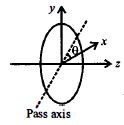
Let the angle between polarization direction and \(x\) -axis be \(\theta^{\prime}\)So angle between polarisation direction and pass axis of polariser is \(\left(\theta^{\prime}-\theta\right)\)
Given \(\theta = {8^o},{88^o},\,{188^o},\,\,{218^o}\)
\(\therefore I=I_{o} \cos ^{2}\,\left(\theta^{\prime}-\theta\right)\)
For \(\theta^{\prime}=203^o\) intensities are same
-
- (A) \(\frac{\pi }{8}\)
- (B) \(\frac{\pi }{12}\)
- (C) \(\frac{\pi }{4}\)
- (D) \(\frac{\pi }{6}\)
Show answer and solution
Correct Answer: (A)
If angular position of \(2^{nd}\) maxima from central maxima is \(\theta\) then\(\sin \theta = \frac{{(2n - 1)\lambda }}{{2a}}\) \( = \frac{{3\lambda }}{{2a}}\) \( = \frac{{3 \times 550 \times {{10}^{ - 9}}}}{{2 \times 22 \times {{10}^{ - 7}}}}\)
\(\therefore \,\,\theta = \frac{\pi }{8}\,\,{\text{rad}}\)
-
- (A) \(50\)
- (B) \(75 \)
- (C) \(100\)
- (D) \(25\)
Show answer and solution
Correct Answer: (D)
Angular width of central maxima \(=\frac{2 \lambda}{\mathrm{d}}\)or, \(\lambda=\frac{\mathrm{d}}{2} ;\) Fringe width, \(\beta=\frac{\lambda \times \mathrm{D}}{\mathrm{d}^{\prime}}\)
\(10^{-2}=\frac{d}{2} \times \frac{50 \times 10^{-2}}{d^{\prime}}=\frac{10^{-6} \times 50 \times 10^{-2}}{2 \times d^{\prime}}\)
Therefore, slit separation distance, \(\mathrm{d}^{\prime}=25 \,\mu \mathrm{m}\)
-
- (A) \(\cos \,\,\theta \, = \,{\left( {\frac{2}{3}} \right)^{1/4}}\)
- (B) \(\cos \,\,\theta \, = \,{\left( {\frac{1}{3}} \right)^{1/4}}\)
- (C) \(\cos \,\,\theta \, = \,{\left( {\frac{1}{3}} \right)^{1/2}}\)
- (D) \(\cos \,\,\theta \, = \,{\left( {\frac{2}{3}} \right)^{1/2}}\)
Show answer and solution
Correct Answer: (A)
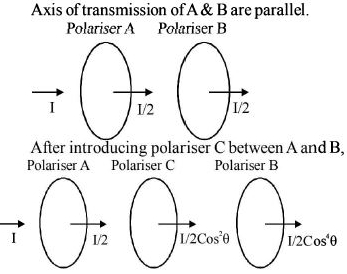
Polariser \(A\) and \(B\) have same alignment of transmission axis. Lets assume polariser \(C\) is introduced at \(\theta \) angle\(\frac{1}{2}{\cos ^2}\,\theta \, \times {\cos ^2}\,\theta \, = \,\frac{1}{3}\)
or, \({\cos ^4}\,\theta \,\, = \,\frac{2}{3}\, \Rightarrow \,\cos \,\theta \, = {\left( {\frac{2}{3}} \right)^{1/4}}\)
-
- (A) \(30\)
- (B) \(45\)
- (C) \(60\)
- (D) \(0\)
Show answer and solution
Correct Answer: (B)
\(\frac{I}{2} \cos ^{4} \theta=\frac{I}{8} \Rightarrow \cos ^{4} \theta=\frac{1}{4}\)\(\Rightarrow \cos \theta=\frac{1}{\sqrt{2}}\) or, \(\theta=45^{\circ}\)
-
- (A) \(18\,cm, 20\,cm\)
- (B) \(10\,cm, 12\,cm\)
- (C) \(12\,cm, 14\,cm\)
- (D) \(16\,cm, 18\,cm\)
Show answer and solution
Correct Answer: (A)
For minimum spherical aberration separation\(d \,= f_1-f_2\, = 2\,cm\)
Resultant focal lenght \(=F\,= 10\,cm\)
Using \(\frac{1}{F} = \frac{1}{{{f_1}}} + \frac{1}{{{f_2}}} - \frac{d}{{{f_1}{f_2}}}\) and solving we get \(f_1\), \(f_2\) \(18\,cm\) and \(20\,cm\) respectively
-
- (A) \((B), (D)\)
- (B) \((B), (C)\)
- (C) \((A), (C), (D)\)
- (D) \((A), (D)\)
Show answer and solution
Correct Answer: (C)
When object is at \(8\,\mathrm{cm}\)Image \(V_{1}=\frac{f \times u}{u-f}=\frac{5 \times 8}{8-5}=-\frac{40}{3}\, \mathrm{cm}\)
When object is at \(12\,\mathrm{cm}\)
Image \(V_{2}=\frac{f \times u}{u-f}=\frac{5 \times 12}{12-5}=-\frac{60}{7}\, \mathrm{cm}\)
Separation \(=\left|\mathrm{V}_{1}-\mathrm{V}_{2}\right|=\frac{40}{3}-\frac{60}{7}=\frac{100}{21} \mathrm{cm}\)
So \(A,\,C\) and \(D\) are correct statements.
-
- (A) \(1.50\)
- (B) \(1.55\)
- (C) \(1.75\)
- (D) \(1.51\)
Show answer and solution
Correct Answer: (B)
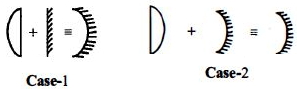
Effective focal length of the combination, \(\frac{1}{F}=\frac{2}{f}+\frac{1}{f_{m}}\)\(f_{m} \Longrightarrow \infty\)
This gives, \(f=56\)
\(f_{m}=\frac{R}{2}\)
Hence,
\(\frac{1}{F}=\frac{2}{f}+\frac{2}{R}\)
This gives, \(R=31.11\)
\(\frac{1}{f}=(\mu-1)\left(\frac{1}{R}\right)\)
\(\mu=1.55\)
-
- (A) \(30\)
- (B) \(0\)
- (C) \(90\)
- (D) \(45\)
Show answer and solution
Correct Answer: (C)
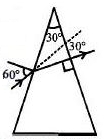
Augle of prism, \(A=30^o,\,\, i=60^o,\)angle of deviation, \(\delta=30^o\)
Using formula, \(\delta=i+e-A\)
\(\Rightarrow e=\delta+A-i\)
\(=30^o+30^o-60^o=0^o\)
Emergent ray will be perpendicular to the face
So it will make angle \(90^o\) with the force through which it emerges.
-
- (A) \(\frac{{{\omega _0}R}}{L}\)
- (B) \(\frac{R}{{\left( {{\omega _0}C} \right)}}\)
- (C) \(\;\frac{{CR}}{{{\omega _0}}}\)
- (D) \(\frac{{{\omega _0}L}}{R}\)
Show answer and solution
Correct Answer: (D)
Quality factor \(Q=\frac{\omega_{0}}{2 \Delta \omega}=\frac{\omega_{0} L}{R}\) -
- (A) \(\frac{{1000}}{{\sqrt 2 }},10\)
- (B) \(\;\frac{{50}}{{\sqrt 2 }},0\)
- (C) \(50,0\)
- (D) \(50,10\)
Show answer and solution
Correct Answer: (A)
As we know, average power \(P_{\text {avg }}=V_{\text {ms }} I_{\text {ms }} \cos \theta\)\(=\left(\frac{V_{0}}{\sqrt{2}}\right)\left(\frac{I_{0}}{\sqrt{2}}\right) \cos \theta=\left(\frac{100}{\sqrt{2}}\right)\left(\frac{20}{\sqrt{2}}\right) \cos 45^{\circ}\left(\because \theta=45^{\circ}\right)\)
\(P_{\text {avg }}=\frac{1000}{\sqrt{2}} \text { watt }\)
Wattless current \(\mathrm{I}=\mathrm{I}_{\mathrm{rms}} \sin \theta\)
\(=\frac{\mathrm{I}_{0}}{\sqrt{2}} \sin \theta=\frac{20}{\sqrt{2}} \sin 45^{\circ}=10\, \mathrm{A}\)
-
- (A) \(\tan \theta = \frac{1}{4}\)
- (B) \(\tan \theta = 2\)
- (C) \(\tan \theta = \frac{1}{2}\)
- (D) \(\tan \theta = 4\)
Show answer and solution
Correct Answer: (C)
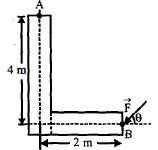
To produce maximum moment of force line of action of force must be perpendicular to line \(AB\).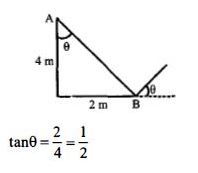
-
- (A) \(\tan \theta = \frac{1}{4}\)
- (B) \(\tan \theta = 2\)
- (C) \(\tan \theta = \frac{1}{2}\)
- (D) \(\tan \theta = 4\)
Show answer and solution
Correct Answer: (C)
To produce maximum moment of force line of action of force must be perpendicular to line \(AB\). -
- (A) \(1:2\)
- (B) \(1:4\)
- (C) \(1:3\)
- (D) \(1:5\)
Show answer and solution
Correct Answer: (C)
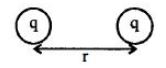
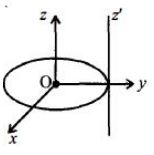
As we know, moment of inertia of a disc about an axis passing through \(C.G.\) and perpendicular to its plane, \({I_z}\, = \frac{{m{R^2}}}{2}\) Moment of inertia of a disc about a tangential axis perpendicular to its own plane,\({I_z}'\, = \frac{3}{{20}}m{R^2}\)
\({I_z}/{I_z}'\, = \frac{{m{R^2}}}{2}/\frac{{3m{R^2}}}{2}\, = 1/3\)
-
- (A) \(1:2\)
- (B) \(1:4\)
- (C) \(1:3\)
- (D) \(1:5\)
Show answer and solution
Correct Answer: (C)
As we know, moment of inertia of a disc about an axis passing through \(C.G.\) and perpendicular to its plane, \({I_z}\, = \frac{{m{R^2}}}{2}\) Moment of inertia of a disc about a tangential axis perpendicular to its own plane,\({I_z}'\, = \frac{3}{{20}}m{R^2}\)
\({I_z}/{I_z}'\, = \frac{{m{R^2}}}{2}/\frac{{3m{R^2}}}{2}\, = 1/3\)
-
- (A) \(\sqrt {\cos \alpha } \)
- (B) \(\cos \alpha \)
- (C) \(\sin \alpha \)
- (D) \(\sqrt {\sin \alpha } \)
Show answer and solution
Correct Answer: (A)
When the rod makes an angle \(\alpha \)Displacement of center of mass \( = \frac{1}{2}\cos \,\alpha \)
\(mg\frac{1}{2}\cos \alpha = \frac{l}{2}I{\omega ^2}\,\)
\(mg\frac{1}{2}\cos \alpha = \frac{{m{l^2}}}{6}{\omega ^2}\) (M.I. of thin uniform rod about an axis passing through its center of mass and perpendicular to the rod \(I = \frac{{m{l^2}}}{{12}}\))
\( \Rightarrow \omega = \sqrt {\frac{{3g\cos \alpha }}{l}} \)
speed of end \( = \omega \times l = \sqrt {3g\cos \alpha l} \)
i.e., Speed of end, \(\omega \, \propto \,\sqrt {\cos \alpha } \)
-
- (A) \(\frac{v}{{6L}}\)
- (B) \(\frac{6v}{{5L}}\)
- (C) \(\frac{3v}{{5L}}\)
- (D) \(\frac{v}{{5L}}\)
Show answer and solution
Correct Answer: (A)
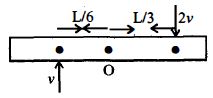
Linear momentum is conserved\(2 m v-2 m v=(2 m+m+M) V_{c m}\)
\(\Rightarrow V_{c m}=0\)
Angular momentum is conserve
\(2 m v \frac{L}{6}+2 m v \times \frac{L}{3}+0=I w\) \(...(i)\)
\(I=\mathrm{M.I.}\) of rod \(+\mathrm{M.I.}\) of mass \(2 \mathrm{m}+\mathrm{M.I}\) of mass \(\mathrm{m}\)
\(=\frac{8 m L^{2}}{12}+2 m\left(\frac{L}{6}\right)^{2}+m\left(\frac{L}{3}\right)^{2}\)
\(=m L^{2}\left(\frac{2}{3}+\frac{1}{18}+\frac{1}{9}\right)=\frac{5}{6} m L^{2}\)
eqn \((1)\) becomes
\(\left(\frac{m v L}{3}+\frac{2}{3} m v L\right)=\frac{5}{6} m L^{2} w\)
\(\frac{m L}{3}(V+2 v)=\frac{5}{6} m L^{2} w\)
\(\frac{6 V}{5 L}=w\)
-
- (A) \(m,\frac{1}{x}\)
- (B) \(m,\frac{1}{x^2}\)
- (C) \(m,x\)
- (D) \(m,x^2\)
Show answer and solution
Correct Answer: (A)
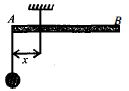
Balancing torque w.r.t point of suspension\(\begin{array}{l}
mg\,x\, = Mg\left( {\frac{{.\ell }}{2} - x} \right)\\
\Rightarrow mx = M\frac{\ell }{2} - Mx\\
m = \left( {M\frac{\ell }{2}} \right)\frac{1}{x} - M\\
y = \alpha \frac{1}{x} - C,\,\,\,\,\,\,\,\,\, straight\,\, line\,\, equation.
\end{array}\)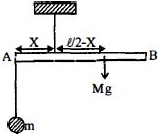
-
- (A) \(m,\frac{1}{x}\)
- (B) \(m,\frac{1}{x^2}\)
- (C) \(m,x\)
- (D) \(m,x^2\)
Show answer and solution
Correct Answer: (A)
Balancing torque w.r.t point of suspension\(\begin{array}{l}
mg\,x\, = Mg\left( {\frac{{.\ell }}{2} - x} \right)\\
\Rightarrow mx = M\frac{\ell }{2} - Mx\\
m = \left( {M\frac{\ell }{2}} \right)\frac{1}{x} - M\\
y = \alpha \frac{1}{x} - C,\,\,\,\,\,\,\,\,\, straight\,\, line\,\, equation.
\end{array}\) -
- (A) \(\frac{{55}}{2}M{R^2}\)
- (B) \(\frac{{73}}{2}M{R^2}\)
- (C) \(\frac{{181}}{2}M{R^2}\)
- (D) \(\;\frac{{19}}{2}M{R^2}\)
Show answer and solution
Correct Answer: (C)
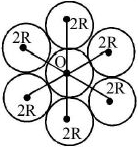
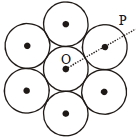
Using parallel axes theorem, moment of inertia about \('O'\)\(\begin{array}{l}
{I_0} = {I_{cm}} + m{d^2}\\
\,\,\,\,\,\,\,\,\,\,\,\,\,\,\,\, = \frac{{7M{R^2}}}{2} + 6\left( {M \times {{\left( {2R} \right)}^2}} \right) = \frac{{55M{R^2}}}{2}
\end{array}\)Again, moment of inertia about point P,\({I_P} = {I_0} + m{d^2}\)
\( = \frac{{55M{R^2}}}{2} + 7M{\left( {3R} \right)^2} = \frac{{181}}{2}M{R^2}\)
-
- (A) \(\frac{{55}}{2}M{R^2}\)
- (B) \(\frac{{73}}{2}M{R^2}\)
- (C) \(\frac{{181}}{2}M{R^2}\)
- (D) \(\;\frac{{19}}{2}M{R^2}\)
Show answer and solution
Correct Answer: (C)
Using parallel axes theorem, moment of inertia about \('O'\)\(\begin{array}{l}
{I_0} = {I_{cm}} + m{d^2}\\
\,\,\,\,\,\,\,\,\,\,\,\,\,\,\,\, = \frac{{7M{R^2}}}{2} + 6\left( {M \times {{\left( {2R} \right)}^2}} \right) = \frac{{55M{R^2}}}{2}
\end{array}\)Again, moment of inertia about point P,\({I_P} = {I_0} + m{d^2}\)
\( = \frac{{55M{R^2}}}{2} + 7M{\left( {3R} \right)^2} = \frac{{181}}{2}M{R^2}\)
-
- (A) \(\frac{1}{2}\,\,q\omega {r^2}\)
- (B) \(\frac{4}{3}\,\,q\omega {r^2}\)
- (C) \(\frac{3}{2}\,\,q\omega {r^2}\)
- (D) \(q\omega {r^2}\)
Show answer and solution
Correct Answer: (A)
Magnetic moment, \(\mu \, = \,IA\, = \,\frac{{qv}}{{2\pi r}}(\pi {r^2})\)or, \(\mu \,\, = \,\,\frac{{qr\omega }}{{2\pi r}}(\pi {r^2})\, = \,\frac{1}{2}\,q{r^2}\omega \)
-
- (A) \(4\times10^{-5}\,Wb/m^2\)
- (B) Zero
- (C) \(2\times10^{-5}\,Wb/m^2\)
- (D) \(8\times10^{-5}\,Wb/m^2\)
Show answer and solution
Correct Answer: (A)
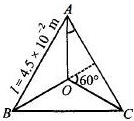
Here, side of the triangle, \(l=4.5 \times 10^{-2} \,\mathrm{m}\) current, \(I =1 \,\mathrm{A}\)magnetic field at the centre of the triangle \('O'B = ?\)
From figure, \(\tan 60^{\circ}=\sqrt{3}=\frac{1}{2 d}\)
\(\Rightarrow d=\frac{l}{2 \sqrt{3}}=\left(\frac{4.5 \times 10^{-2}}{2 \sqrt{3}}\right)\, \mathrm{m}\)
Magnetic field, \(B=\frac{\mu_{0} i}{4 \pi d}\left(\cos \theta_{1}+\cos \theta_{2}\right)\)
Putting value of \(\mu=4 \pi \times 10^{-7}\) and \(\theta_{1}\) and \(\theta_{2}\)
we will get net magenetic field
\(=3 \times B=4 \times 10^{-5} \,\mathrm{Wb} / \mathrm{m}^{2}\)
-
- (A) \(2.5 \times {10^{ - 2}}\,\Omega \)
- (B) \(1.25 \times {10^{ - 3}}\,\Omega \)
- (C) \(2.5 \times {10^{ - 3}}\,\Omega \)
- (D) \(1.25 \times {10^{ - 2}}\,\Omega \)
Show answer and solution
Correct Answer: (D)
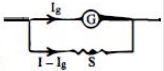
A ccording to question, current through galvanometer, \(\mathrm{I}_{\mathrm{g}}=1\, \mathrm{mA}\)Current through shunt \(\left(I-I_{g}\right)=2\, A\)
Galvanometer resistance \(\mathrm{R}_{\mathrm{g}}=25\, \Omega\)
Resistance of shunt, \(\mathrm{S}=?\)
\(\mathrm{I}_{\mathrm{g}} \mathrm{R}_{\mathrm{g}}=\left(\mathrm{I}-\mathrm{I}_{\mathrm{g}}\right) \mathrm{S}\)
\( \Rightarrow S = \frac{{{{10}^{ - 3}} \times 25}}{2}\)
\(S \simeq 1.25 \times {10^{ - 2}}\,\Omega \)
-
- (A) \(\frac{{4N{\mu _0}I}}{{{5^{3/2}}R}}\)
- (B) \(\frac{{8N{\mu _0}I}}{{{5^{3/2}}R}}\)
- (C) \(\frac{{4N{\mu _0}I}}{{{5^{1/2}}R}}\)
- (D) \(\frac{{8N{\mu _0}I}}{{{5^{1/2}}R}}\)
Show answer and solution
Correct Answer: (B)
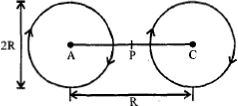
Point \(P\) is situated at the mid-point of the line joining the centres of the circular wires which have same radii \((R)\). The magnetic fields \((\vec{B})\) at \(P\) due to the currents in the wires are in same direction.Magnitude of magnetic fieldat point, \(P\)
\(B = 2\left\{ {\frac{{{\mu _0}NI{R^2}}}{{2{{\left( {{R^2} + \frac{{{R^2}}}{4}} \right)}^{3/2}}}}} \right\}\)
\(=\frac{\mu_{0} N I R^{2}}{\frac{5^{3 / 2}}{8}}=\frac{8 \mu_{0} N I}{5^{3 / 2} R}\)
-
- (A) \(r_e < r_p\) \(=\) \(\;{r_\alpha }\)
- (B) \(r_e < r_p\) \( <\) \(\;{r_\alpha }\)
- (C) \(r_e < \) \(\;{r_\alpha }\) \(< r_p\)
- (D) \(r_e > r_p\) \(=\) \(\;{r_\alpha }\)
Show answer and solution
Correct Answer: (A)
As we know, radius of circular path in magnetic field \(\mathrm{r}=\frac{\sqrt{2 \mathrm{Km}}}{\mathrm{qB}}\)For electron, \(\mathrm{r}_{\mathrm{e}}=\frac{\sqrt{2 \mathrm{Km}_{\mathrm{e}}}}{\mathrm{eB}}.........(i)\)
For proton, \(\mathrm{r}_{\mathrm{p}}=\frac{\sqrt{2 \mathrm{Km}_{\mathrm{p}}}}{\mathrm{eB}}.........(ii)\)
For \(\alpha\) particle,
\(\mathrm{r}_{\alpha}=\frac{\sqrt{2 \mathrm{Km}_{\mathrm{a}}}}{\mathrm{q}_{\alpha} \mathrm{B}}=\frac{\sqrt{2 \mathrm{K} 4 \mathrm{m}_{\mathrm{p}}}}{2 \mathrm{eB}}=\frac{\sqrt{2 \mathrm{Km}_{\mathrm{p}}}}{\mathrm{eB}} .........(iii)\)
\(\mathrm{r}_{\mathrm{e}}<\mathrm{r}_{\mathrm{p}}=\mathrm{r}_{\alpha} \quad\left(\because \mathrm{m}_{\mathrm{e}}<\mathrm{m}_{\mathrm{p}}\right)\)

No questions on this page match these filters.
Other years
Frequently asked
How many JEE Mains 2018 Physics questions are on ExamBro?
111 questions, each with the correct answer and a full solution.
Which JEE Mains 2018 Physics chapter is asked the most?
System of particles and rotational motion, with 12 questions, followed by Current electricity with 8.
How difficult are JEE Mains 2018 Physics questions?
5% are easy, 32% medium and 63% hard.