


Chapters asked in 2017
27 chapters- 3Qs STD 11 Units, dimensions and measurement
- 4Qs STD 12 Semicondutor electronics
- 2Qs STD 12 Nuclei
- 3Qs STD 12 Atoms
- 2Qs STD 12 Dual nature of radiation and matter
- 2Qs STD 12 Electromagnetic waves
- 4Qs STD 12 Wave optics
- 3Qs STD 12 Ray optics and optical instruments
- 1Qs STD 12 Alternating current
- 9Qs STD 11 System of particles and rotational motion Most asked
- 3Qs STD 12 Moving charges and magnetism
- 2Qs STD 12 Electromagnetic induction
- 2Qs STD 12 Magnetism and matter
- 8Qs STD 12 Current electricity Most asked
- 4Qs STD 12 Electric potential and capacitance
- 2Qs STD 12 Electric charges and fields
- 2Qs STD 11 Waves and sound
- 4Qs STD 11 Oscillations
- 4Qs STD 11 Kinetic theory of gases
- 1Qs STD 11 Thermodynamics
- 4Qs STD 11 10.1, thermonetry, thermal expansion and calorimetry
- 2Qs STD 11 Mechanical properties of solids
- 1Qs STD 11 Fluid mechanics
- 1Qs STD 11 Gravitation
- 5Qs STD 11 Work, energy, power and collision Most asked
- 1Qs STD 11 Motion in plane
- 1Qs STD 11 Motion in straight line
All JEE Mains 2017 Physics questions
27 chaptersShowing 1–50 of 80 questions
-
- (A) \(8\)
- (B) \(12\)
- (C) \(32\)
- (D) \(25\)
Show answer and solution
Correct Answer: (C)
\(\begin{array}{l}
Give,\,p = {a^{1/2}}{b^2}{c^3}{d^{ - 4}},\\
Maximum\,relative\,error,\\
\frac{{\Delta p}}{p} = \frac{1}{2}\frac{{\Delta a}}{a} + 2\frac{{\Delta b}}{b} + 3\frac{{\Delta c}}{c} + 4\frac{{\Delta d}}{d}\\
= \frac{1}{2} \times 2 + 2 \times 1 + 3 \times 3 + 4 \times 5\\
= 32\%
\end{array}\) -
- (A) \(0.15 \)
- (B) \(1.5\)
- (C) \(2.4\)
- (D) \(10\)
Show answer and solution
Correct Answer: (B)
\(\mathrm{T}=\frac{\mathrm{rhg}}{2} \times 10^{3} \mathrm{N} / \mathrm{m}\)\(\frac{\Delta \mathrm{T}}{\mathrm{T}}=\left|\frac{\Delta \mathrm{r}}{\mathrm{r}}\right|+\left|\frac{\Delta \mathrm{h}}{\mathrm{h}}\right|=\frac{0.01}{1.25}+\frac{0.01}{1.45}\)
\(\%\) error \(=\frac{\Delta \mathrm{T}}{\mathrm{T}} \times 100=\frac{1}{1.25}+\frac{1}{1.45}=0.8+0.69=1.5 \%\)
-
- (A) \(\left[ M \right] = \left[ {{T^{ - 1}}\,{C^{ - 2}}\,h} \right]\)
- (B) \(\left[ M \right] = \left[ {{T^{ - 1}}\,{C^2}\,h} \right]\)
- (C) \(\left[ M \right] = \left[ {{T^{ - 1}}\,{C^{ - 2}}\,{h^{ - 1}}} \right]\)
- (D) \(\left[ M \right] = \left[ {T\,{C^{ - 2}}\,h} \right]\)
Show answer and solution
Correct Answer: (A)
Let mass related as \(M \propto \,{T^x}{C^y}{h^z}\)
\({M^1}{L^0}{T^0} = {\left( T \right)^x}{\left( {{L^1}{T^{ - 1}}} \right)^y}{\left( {{M^1}{L^2}{T^{ - 1}}} \right)^z}\)
\({M^1}{L^0}{T^0} = {M^z}{L^{y + 2z}} + {T^{x - y - z}}\)
\(z = 1\)
\(y + 2z = 0\) \(x - y - z = 0\)
\(y = - 2\) \(x + 2 - 1 = 0\)
\(M = \left[ {{T^{ - 1}}{C^{ - 2}}{h^1}} \right]\)
-
- (A) \(45\)
- (B) \(90\)
- (C) \(135\)
- (D) \(180\)
Show answer and solution
Correct Answer: (D)
In common emitter configuration for \(n-p-n\) transistor input and output signals are \(180^o\) out of phase i.e., phase difference between output and input voltage is \(180^o\) . - 5. The current gain of a common emitter amplifier is \(69\). If the emitter current is \(7.0\,mA\), collector current is.....\(mA\) 2017 Medium
- (A) \(9.6\)
- (B) \(6.9\)
- (C) \(0.69\)
- (D) \(69\)
Show answer and solution
Correct Answer: (B)
Given, current gain of \(CE\) amplifier \(\beta=69, \mathrm{I}_{\mathrm{E}}\) \(=7 \mathrm{mA}\)or \(\quad \frac{\mathrm{I}_{\mathrm{C}}}{\mathrm{I}_{\mathrm{B}}}=69\)
We know that, \(\alpha=\frac{\beta}{1+\beta}=\frac{69}{70} \cdot \frac{\mathrm{I_C}}{\mathrm{I}_{\mathrm{E}}}\)
\(\mathrm{I}_{\mathrm{C}}=\mathrm{I}_{\mathrm{E}} \times \frac{69}{70}=\frac{\mathrm{69}}{70} \times 7\)
Collector current, \(I_{C}=6.9\, \mathrm{mA}\)
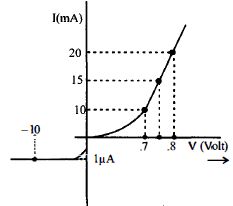
- 6. The \(V-I\) characteristic of a diode is shown in the figure. The ratio of forward to reverse bias resistance is
 2017 Hard
- (A) \(10\)
- (B) \(10^{-6}\)
- (C) \(10^6\)
- (D) \(100\)
Show answer and solution
Correct Answer: (B)
Forward bias resistance\(=\frac{\Delta V}{\Delta I}=\frac{0.1}{10 \times 10^{-3}}=10 \Omega\)
Reverse bias resistance \(=\frac{10}{10^{-6}}=10^{7} \Omega\)
Ratio of resistances
\(=\,\frac {Forward \,\,bias\,\, resistance }{Reverse\,\, bias \,\,resistance}\)
\(=10^{-6}\)
-
- (A) \(1.68\)
- (B) \(1.83\)
- (C) \(0.59\)
- (D) \(1.20\)
Show answer and solution
Correct Answer: (A)
The conductivity of semiconductor\( \sigma =\mathrm{e}\left(\mathrm{n}_{\mathrm{e}} \mu_{\mathrm{e}}+\mathrm{n}_{\mathrm{h}} \mu_{\mathrm{h}}\right)\)
\(=1.6 \times 10^{-19}\left(5 \times 10^{18} \times 2+5 \times 10^{19} \times 0.01\right) \)
\(=1.6 \times 1.05=1.68(\Omega-\mathrm{m})^{-1}\)
-
- (A) \(t = \frac{T}{2}\;\frac{{\log 2}}{{\log 1.3}}\)
- (B) \(t = T\;\frac{{\log 1.3}}{{\log 2}}\)
- (C) \(t=T \log(1.3)\)
- (D) \(t = \frac{T}{{{{log}}\left( {1.3} \right)}}\)
Show answer and solution
Correct Answer: (B)
Let initially there are total \(\mathrm{N}_{0}\) number of nucleiAt time \(\mathrm{t} \frac{N_{B}}{N_{A}}=0.3(\text { given })\)
\(\Rightarrow \quad N_{B}=0.3 N_{A}\)
\(\mathrm{N}_{0}=N_{A}+N_{B}=N_{A}+0.3 N_{A}\)
\(\therefore \quad N_{A}=\frac{\mathrm{N}_{0}}{1.3}\)
As we know \(N_{t}=N_{0} e^{-\lambda t}\)
or, \(\frac{\mathrm{N}_{0}}{1.3}=N_{0} e^{-\lambda t}\)
\(\frac{1}{1.3}=e^{-\lambda t} \Rightarrow \ln (1.3)=\lambda t\)
or, \(t=\frac{\ln (1.3)}{\lambda} \Rightarrow t=\frac{\ln (1.3)}{\frac{\ln (2)}{T}}=\frac{\ln (1.3)}{\ln (2)} T\)
-
- (A) \(0.96\, gm\)
- (B) \(0.8\,gm\)
- (C) \(4\times10^{-2} \,gm\)
- (D) \(6.6\times10^{-5} \,gm\)
Show answer and solution
Correct Answer: (C)
Power level of reactor, \(P=\frac{E}{\Delta t}=\frac{\Delta m c^{2}}{\Delta t}\)mass of the fuel consumed per hour in the reactor,
\(\frac{\Delta m}{\Delta t}=\frac{P}{c^{2}}=\frac{10^{9}}{\left(3 \times 10^{8}\right)^{2}}=4 \times 10^{-2} \mathrm{gm}\)
-
- (A) \(n^{-4}\)
- (B) \(n^{-5}\)
- (C) \(n^{-3}\)
- (D) \(n^{-2}\)
Show answer and solution
Correct Answer: (D)
Magnetic field at the centre of nucleus of \(\mathrm{H}\) -atom,\(\mathrm{B}=\frac{\mu_{0} \mathrm{I}}{2 \mathrm{r}}\) ..... \((i)\)
According to Bohr's model, radius of orbit \(r\, \propto \,{n^2}\) from eq. \((i)\) we can also write as \(B \propto n^{-2}\)
-
- (A) \(r = \frac{4}{3}\)
- (B) \(\;r = \frac{2}{3}\)
- (C) \(\;r = \frac{3}{4}\)
- (D) \(\;r = \frac{1}{3}\)
Show answer and solution
Correct Answer: (D)
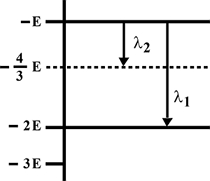
From energy level diagram, using \(\Delta E=\frac{h c}{\lambda}\)For wavelength \(\lambda_{1} \Delta E=-E-(-2 E)=\frac{h c}{\lambda_{1}}\)
\(\therefore \quad \lambda_{1}=\frac{h c}{E}\)
For wavelength \(\lambda_{2} \Delta E=-E-\left(-\frac{4 E}{3}\right)=\frac{h c}{\lambda_{2}}\)
\(\therefore \quad {\lambda _2} = \frac{{hc}}{{\left( {\frac{E}{3}} \right)}}\) \(\therefore r = \frac{{{\lambda _1}}}{{{\lambda _2}}} = \frac{1}{3}\)
- 12. The acceleration of an electron in the first orbit of the hydrogen atom \((z\, = 1)\) is 2017 Hard
- (A) \(\frac{{{h^2}}}{{{\pi ^2}{m^2}{r^3}}}\)
- (B) \(\frac{{{h^2}}}{{8{\pi ^2}{m^2}{r^3}}}\)
- (C) \(\frac{{{h^2}}}{{4{\pi ^2}{m^2}{r^3}}}\)
- (D) \(\frac{{{h^2}}}{{4\pi {m^2}{r^3}}}\)
Show answer and solution
Correct Answer: (C)
Speed of electron in first orbit \((\mathrm{n}=1)\) of hydrogen atom \((z=1)\),\(v = \frac{{{e^2}}}{{2{\varepsilon _0}h}}\)
radius of Bohr's first orbit,
\(r=\frac{h^{2} \varepsilon_{0}}{\pi m e^{2}} \Rightarrow \varepsilon_{0}=\frac{r \pi m \mathrm{e}^{2}}{h^{2}}\) ..... \((i)\)
Acceleration of electron,
\(\frac{v^{2}}{r}=\frac{e^{4}}{4 \varepsilon_{0}^{2} h^{2}} \times \frac{\pi m e^{2}}{h^{2} \varepsilon_{0}}\)
\({ = \frac{{{{\text{e}}^4} \times \pi {\text{m}}{{\text{e}}^2}}}{{4{{\text{h}}^4}\varepsilon _0^3}}}\) ..... \((ii)\)
eliminating \(\varepsilon_{0}\) from eq \((ii)\)
\(=\frac{e^{4} \pi m e^{2} h^{6}}{4 h^{4} r^{3} \pi^{3} m^{3} e^{6}}\) from \(eq^n\) \((i)\)
\(=\frac{h^{2}}{4 \pi^{2} m^{2} r^{3}}\)
-
- (A) \(10^{20}\)
- (B) \(10^{18}\)
- (C) \(10^{22}\)
- (D) \(10^{19}\)
Show answer and solution
Correct Answer: (A)
Given, \(\lambda=660 \mathrm{nm}, \text { Power }=0.5 \mathrm{kW}, \mathrm{t}=60 \mathrm{ms}\)Power \(P=\frac{\text { nhc }}{\lambda t} \Rightarrow n=\frac{p \lambda t}{h c}\)
\(=0.5 \times 10^{3} \times \) \(\frac{{660 \times {{10}^{ - 9}} \times 60 \times {{10}^{ - 3}}}}{{6.6 \times {{10}^{ - 34}} \times 3 \times {{10}^8}}}\)
\(=100 \times 10^{18}=10^{20}\)
-
- (A) less than \(\sqrt 3 v\,\)
- (B) \(v\)
- (C) more thanequal \(\sqrt 3 v\,\)
- (D) equal to \(\sqrt 3 v\,\)
Show answer and solution
Correct Answer: (C)
As the metal surface is same, work function \((\phi)\) is same for both the case.Initially \(\mathrm{KE}_{\max }=\mathrm{nh}-\phi\) ..... \((i)\)
After increase
\(\mathrm{KE}_{\mathrm{max}}^{\prime}=3 \mathrm{nh}-\phi\) ..... \((ii)\)
For work function \(\phi-\) not to be \(-\,ve\) or zero.
\(v^{\prime}>\sqrt{3} v\)
-
- (A) \(\vec E = {B_0}\,c\sin \,\left( {kx + \omega t} \right)\hat k\,V/m\)
- (B) \(\vec E = \frac{{{B_0}}}{c}\,\sin \,\left( {kx + \omega t} \right)\hat k\,V/m\)
- (C) \(\vec E = - {B_0}\,c\sin \,\left( {kx + \omega t} \right)\hat k\,V/m\)
- (D) \(\vec E = {B_0}\,c\sin \,\left( {kx - \omega t} \right)\hat k\,V/m\)
Show answer and solution
Correct Answer: (A)
Speed of \(EM\) wave in force space \(\left( c \right) = \frac{{{E_0}}}{{{B_0}}}\,\)or \(\vec E = c{B_0}{\mkern 1mu} \sin {\mkern 1mu} \left( {kx + \omega t} \right)\hat k\)
-
- (A) \(\frac{{2{E_0}}}{c}\hat j\,\sin\, kz\,\cos\, \omega t\)
- (B) \(-\frac{{2{E_0}}}{c}\hat j\,\sin\, kz\,\sin\, \omega t\)
- (C) \(\frac{{2{E_0}}}{c}\hat j\,\sin\, kz\,\sin\, \omega t\)
- (D) \(\frac{{2{E_0}}}{c}\hat j\,\cos\, kz\,\cos\, \omega t\)
Show answer and solution
Correct Answer: (C)
Given, Electric field component of monochromatic radiation,\((\overrightarrow{\mathrm{E}})=2 \mathrm{E}_{0} \hat{\mathrm{i}} \cos \mathrm{kz} \cos \omega \mathrm{t}\)
We know that, \(\frac{d E}{d z}=-\frac{d B}{d t}\)
\(\frac{\mathrm{dE}}{\mathrm{dz}}=-2 \mathrm{E}_{0} \mathrm{k} \sin \mathrm{kz} \cos \omega \mathrm{t}=-\frac{\mathrm{dB}}{\mathrm{dt}}\)
\(\mathrm{dB}=+2 \mathrm{E}_{0} \mathrm{k} \,\sin \mathrm{kz} \cos\, \omega \mathrm{td}\, \mathrm{t}\) .... \((i)\)
Integrating \(eq^n\). \((i)\), we have
\(B=+2 E_{0} k \sin k z \int \cos \omega t d t\)
Magnetic field is given by,
\(=+2 \mathrm{E}_{0} \frac{\mathrm{k}}{\omega} \sin \mathrm{kz} \sin \,\omega \mathrm{t}\)
We also know that,
\(\frac{E_{0}}{B_{0}}=\frac{\omega}{k}=c\)
Magnetic field vector,
\(\overrightarrow{\mathrm{B}}=\frac{2 \mathrm{E}_{0}}{\mathrm{c}} \hat{\mathrm{j}} \sin \mathrm{kz} \sin \omega \mathrm{t}\)
-
- (A) \(3\)
- (B) \(9\)
- (C) \(4.5\)
- (D) \(1.5\)
Show answer and solution
Correct Answer: (B)
\(\mathrm{a}=0.1\, \mathrm{mm}=10^{-4}\, \mathrm{cm}\)\(\lambda=6000 \times 10^{-10}\, \mathrm{cm}=6 \times 10^{-7} \,\mathrm{cm}, \mathrm{D}=0.5\, \mathrm{m}\)
for \(3^{\text {rd }}\) dark band, \(a\,\sin \theta=3 \lambda\)
or \(\sin \theta=\frac{3 \lambda}{a}=\frac{x}{D}\)
The distance of the third dark band from the central bright band
\(x = \frac{{3\lambda D}}{a}\) \( = \frac{{3 \times 6 \times {{10}^{ - 7}} \times 0.5}}{{{{10}^{ - 4}}}}\) \(=\,9\,mm\)
-
- (A) \(1.5\)
- (B) \(3\)
- (C) \(4.5\)
- (D) \(6\)
Show answer and solution
Correct Answer: (B)
For secondary minima,\(b \sin \theta=n \lambda \Rightarrow \sin \theta=\frac{n \lambda}{b}\)
Distance of \(\mathrm{n}^{\text {th }}\) secondary minima \(\mathrm{x}=\mathrm{D} \sin\, \theta\)
or \(\sin \theta_{1}=\frac{x_{1}}{D}\)
\(\sin \theta_{1}=\frac{2 \lambda}{b}\)
\(n=4\)
\(\sin \theta_{2}=\frac{4 \lambda}{b}=\frac{x_{2}}{D}\)
\(x_{2}-x_{1}=\frac{4 \lambda}{b}-\frac{2 \lambda}{b}=\frac{2 \lambda}{b}\)
\(3=\frac{2 \lambda}{b} \Rightarrow b=\frac{2 \lambda}{3}\) ...... \((i)\)
Width of central maxima \(=\frac{2 \lambda}{b}\)
\(=\frac{2 \lambda}{\frac{2 \lambda}{3}}=3 \mathrm{cm}\) ... from eq. \((i)\)
-
- (A) \(10.1 \)
- (B) \(12.1 \)
- (C) \(17.3\)
- (D) \(15.3\)
Show answer and solution
Correct Answer: (C)
Use relativistic doppler's effect as velocity of observer is not small as compared to light\(f=f_{0} \sqrt{\frac{c+v}{c+v}}\) ; \(V=\) relative speed of approach
\(f_{0}=10\, \mathrm{GHz}\)
\(\therefore f=10 \sqrt{\frac{c+\frac{c}{2}}{c-\frac{c}{2}}}=10 \sqrt{3}=17.3\, \mathrm{GHz}\)
-
- (A) \(1.56\)
- (B) \(7.8\)
- (C) \(9.75\)
- (D) \(15.6\)
Show answer and solution
Correct Answer: (B)
For common maxima, \(n_{1} \lambda_{1}=n_{2} \lambda_{2}\)\(\Rightarrow \quad \frac{n_{1}}{n_{2}}=\frac{\lambda_{2}}{\lambda_{1}}=\frac{520 \times 10^{-9}}{650 \times 10^{-9}}=\frac{4}{5}\)
For \(\lambda_{1}\)
\(y=\frac{n_{1} \lambda_{1} D}{d}, \lambda_{1}=650\, \mathrm{nm}\)
\(y=\frac{4 \times 650 \times 10^{-9} \times 1.5}{0.5 \times 10^{-3}} \quad\) or, \(y=7.8\,\mathrm{mn}\)
-
- (A) real and at a distance of \(40\ cm\) from the divergent lens
- (B) real and at a distance of \(40\ cm\) from convergent lens
- (C) virtual and at a distance of \(40\ cm\) from convergent lens.
- (D) real and at a distance of \(6\ cm\) from the convergent lens
Show answer and solution
Correct Answer: (B)
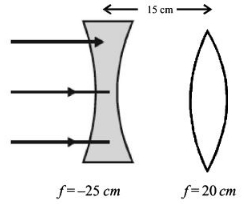
As parallel beam incident on diverging lens will form image at focus.\(\therefore \quad v=-25\, \mathrm{cm}\)
The image formed by diverging lens is used as an object for converging lens,
So for converging lens \(u=-25-15=-40 \,\mathrm{cm}, \quad f=20\, \mathrm{cm}\)
\(\therefore \quad\) Final image formed by converging lens
\(\frac{1}{V}-\frac{1}{-40}=\frac{1}{20}\)
or, \(\quad V=40\, \mathrm{cm}\) from converging lens real and inverted.
-
- (A) \(27.5\)
- (B) \(20\)
- (C) \(25\)
- (D) \(30.5\)
Show answer and solution
Correct Answer: (A)
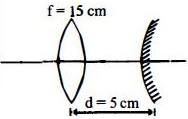
Given, focal kngth of lens \((\mathrm{f})=15 \,\mathrm{cm}\)object is placed at a distance \((u)=-20\, \mathrm{cm}\)
By lens formula,
\(\frac{1}{f} = \frac{1}{v} - \frac{1}{u}\)
\(\frac{1}{v} = \frac{1}{f} + \frac{1}{u}\)
\( = \frac{1}{{15}} - \frac{1}{{20}}\)
\(\frac{1}{v}=\frac{4-3}{60}\)
\({v}=60\, \mathrm{cm}\)
The image \(I\) gets formed at \(60\,\mathrm{cm}\) to the right of the lens and it wil be inverted.
The rays from the image \((I)\) formed further falls on the convex mirror forms another image This image should formed in such a way that it coincide with object at the same point due to reflection takes place by convex mirror.
Distance between lens and mirror will be \(\mathrm{d}\,=\) imagedistance \((\mathrm{v})\,-\) radius of curvature of convex mirror.
\(5=60-2 f\)
\(2 f=60-5\)
\(\mathrm{f}=\frac{55}{2}=27.5\, \mathrm{cm}\) (convex mirror)
-
- (A) \(\frac{1}{{{{\cos }^{ - 1}}\,\left( {\sin {\mkern 1mu} {\theta _C}} \right)}}\)
- (B) \(\frac{1}{{{{\tan }^{ - 1}}\,\left( {\sin {\mkern 1mu} {\theta _C}} \right)}}\)
- (C) \({{{\cos }^{ - 1}}\left( {\sin \,{\theta _C}} \right)}\)
- (D) \({{{\tan }^{ - 1}}\left( {\sin \,{\theta _C}} \right)}\)
Show answer and solution
Correct Answer: (D)
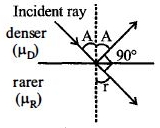
From Snell's law, \(\frac{\mu_{\mathrm{R}}}{\mu_{\mathrm{D}}}=\frac{\sin \mathrm{i}}{\sin \mathrm{r}}\) ..... \((i)\)\(\because \,\angle {\text{i}} = {\text{A}}\) and \(\angle {\text{r}} = \left( {{{90}^o} - {\text{A}}} \right)\)
We also know that, \(\sin \theta_{C}=\frac{\mu_{R}}{\mu_{D}}\)
From \(eq^{n}\,\,(i)\), \(\sin {\theta _C} = \frac{{\sin A}}{{\sin \left( {{{90}^o} - A} \right)}}\)
\(\sin {\theta _{\text{C}}} = \frac{{\sin {\text{A}}}}{{\cos {\text{A}}}}\)
\(\sin {\theta _{\text{C}}} = \tan {\text{A}}\)
\({\text{A}} = {\tan ^{ - 1}}\left( {\sin {\theta _{\text{C}}}} \right)\)
-
- (A) \(10\,\Omega \,\,\) and \(\,\,\,{\tan ^{ - 1}}\left( {\frac{5}{3}} \right)\)
- (B) \(7\,\Omega \,\,\) and \(45^o\)
- (C) \(10\,\Omega \,\,\) and \(\,\,\,{\tan ^{ - 1}}\left( {\frac{8}{3}} \right)\)
- (D) \(7\,\Omega \,\,\) and \(\,\,\,{\tan ^{ - 1}}\left( {\frac{5}{3}} \right)\)
Show answer and solution
Correct Answer: (B)
Given,\(\mathrm{V}_{0}=283 \,\mathrm{volt}, \omega=320,\, \mathrm{R}=5 \,\Omega, \mathrm{L}=25 \,\mathrm{mH}, \mathrm{C} =1000 \,\mu \mathrm{F}\)
\(x_{L}=\omega L=320 \times 25 \times 10^{-3}=8\, \Omega\)
\(x_{C}=\frac{1}{\omega C}=\frac{1}{320 \times 1000 \times 10^{-6}}=3.1 \,\Omega\)
Total impedance of the circuit:
\(z=\sqrt{\mathrm{R}^{2}+\left(\mathrm{X}_{\mathrm{L}}-\mathrm{X}_{\mathrm{C}}\right)^{2}}=\sqrt{25+(4.9)^{2}}=7\, \Omega\)
Phase difference between the voltage and current
\(\tan \phi=\frac{\mathrm{X}_{\mathrm{L}}-\mathrm{X}_{\mathrm{C}}}{\mathrm{R}}\)
\(\tan \phi=\frac{4.9}{5} \approx 1 \Rightarrow \phi=45 \%\)
-
- (A) \(\frac{{219\,M{R^2}}}{{256}}\)
- (B) \(\frac{{237\,M{R^2}}}{{512}}\)
- (C) \(\frac{{19\,M{R^2}}}{{512}}\)
- (D) \(\frac{{197\,M{R^2}}}{{256}}\)
Show answer and solution
Correct Answer: (B)
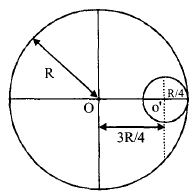
Moment of Inertia of complete disc about\('O'\) point \({I_{total}} = \frac{{M{R^2}}}{2}\)
Radius of removed disc \(= R/4\)
Mass of removed disc \(= M/16\) [As \(M\) \( \propto \) \({{R^2}}\)]
\(M.I.\) of removed disc about its own axis \((O')\)
\( = \frac{1}{2}\frac{M}{{16}}{\left( {\frac{R}{4}} \right)^2} = \frac{{M{R^2}}}{{512}}\)
\(M.I\) of removed disc about \(O\)
\(\begin{array}{l}
{I_{remo\,ved\,disc\,}} = {I_{cm}} + m{x^2}\\
= \frac{{M{R^2}}}{{512}} + \frac{M}{{16}}{\left( {\frac{{3R}}{4}} \right)^2} = \frac{{19\,M{R^2}}}{{512}}
\end{array}\)\(M.I.\) of remaining disc
\({I_{remaining}} = \frac{{M{R^2}}}{2} - \frac{{19}}{{512}}M{R^2} = \frac{{237}}{{512}}M{R^2}\)
-
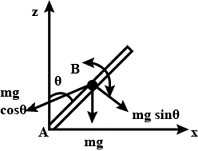
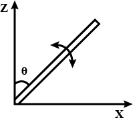
- (A) \(\frac{3 g}{2 l} \sin \theta\)
- (B) \(\frac{2 g}{3 l} \sin \theta\)
- (C) \(\frac{3 g}{2 l} \cos \theta\)
- (D) \(\frac{2 g}{2 l} \sin \theta\)
Show answer and solution
Correct Answer: (A)
Torque at angle \(\theta\)\(\tau=M g \sin \theta\)
\(\tau=l \alpha\)
\(l \alpha=M g \sin \theta \frac{l}{2}\)
\(l=\frac{M l^{2}}{3}\)
\(\frac{M l^{2}}{3} . \alpha=M g \sin \theta \frac{l}{2}\)
\(\frac{l \alpha}{3}=g \frac{\sin \theta}{2}\)
\(\alpha=\frac{3 g \sin \theta}{2 l}\)
-
- (A) \(\frac{{2mg}}{{2m + M}}\)
- (B) \(\frac{{2Mg}}{{2m + M}}\)
- (C) \(\frac{{2mg}}{{2M + m}}\)
- (D) \(\frac{{2Mg}}{{2M + m}}\)
Show answer and solution
Correct Answer: (A)
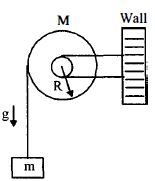
From the codition of equilibrium\(mg - T = ma \) \(....(i)\)
\(RT =\) \(I\alpha \)
\(\begin{array}{l}
\overline a = \overline \alpha \times R\,and\,I = \frac{{M{R^2}}}{2}\\
\,\,\,\,\,\,\,\,\,\,\,RT = \frac{{M{R^2}}}{2}.\frac{a}{R}
\end{array}\)Tension in string,
\(T = \frac{{Ma}}{2}\) From equation \((i)\)
\(mg - \frac{{Ma}}{2} = ma\)
\( \Rightarrow mg = a\left( {\frac{M}{2} + m} \right) \Rightarrow mg = a\left( {\frac{{M + 2m}}{2}} \right)\)
Hence, acceleration of the body,
\(a = \frac{{2mg}}{{M + 2m}}\)
-
- (A) Left arm is longer than the right arm
- (B) Both the arms are of same length
- (C) Left arm is shorter than the right arm
- (D) Every object that is weighed using this balance appears lighter than its actual weight
Show answer and solution
Correct Answer: (C)
According to principle of moments when a system is stable or balance, the anticlockwise moment is equal to clockwise moment.
i.e., load \( \times \) load arm \(=\) effort \( \times \) effort armWhen \(5\, mg\) weight is placed, load arm shifts to left side, hence left arm becomes shorter than right arm
-
- (A) \(\sqrt {\frac{3}{2}} \;\;\;\;\;\;\;\;\;\;\)
- (B) \(\frac{{\sqrt 3 }}{2}\)
- (C) \(1\)
- (D) \(\frac{3}{{\sqrt 2 }}\)
Show answer and solution
Correct Answer: (A)
As we known, moment of inertia of a solid cylinder about an axis which is perpendicular bisector\(\begin{array}{l}
I = \frac{{m{R^2}}}{4} + \frac{{m{l^2}}}{{12}}\\
I = \frac{m}{4}\left[ {{R^2} + \frac{{{l^2}}}{3}} \right]\\
Let\,V\, = Volume\,of\,cylinder\, = \,\pi {R^2}l\\
\,\, = \frac{m}{4}\left[ {\frac{V}{{\pi l}} + \frac{{{l^2}}}{3}} \right] \Rightarrow \frac{{dI}}{{dl}} = \frac{m}{4}\left[ {\frac{{ - V}}{{\pi {l^2}}} + \frac{{2l}}{3}} \right] = 0
\end{array}\)\(\begin{array}{l}
\frac{V}{{\pi {l^2}}} = \frac{{2l}}{3} \Rightarrow V = \frac{{2\pi {l^3}}}{3}\\
\pi {R^2}l = \frac{{2\pi {l^3}}}{3} \Rightarrow \frac{{{l^2}}}{{{R^2}}} = \frac{3}{2}\,or,\,\frac{l}{R} = \sqrt {\frac{3}{2}}
\end{array}\)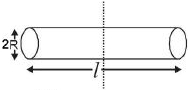
-
- (A) \(\sqrt {\frac{3}{2}} \;\;\;\;\;\;\;\;\;\;\)
- (B) \(\frac{{\sqrt 3 }}{2}\)
- (C) \(1\)
- (D) \(\frac{3}{{\sqrt 2 }}\)
Show answer and solution
Correct Answer: (A)
As we known, moment of inertia of a solid cylinder about an axis which is perpendicular bisector\(\begin{array}{l}
I = \frac{{m{R^2}}}{4} + \frac{{m{l^2}}}{{12}}\\
I = \frac{m}{4}\left[ {{R^2} + \frac{{{l^2}}}{3}} \right]\\
Let\,V\, = Volume\,of\,cylinder\, = \,\pi {R^2}l\\
\,\, = \frac{m}{4}\left[ {\frac{V}{{\pi l}} + \frac{{{l^2}}}{3}} \right] \Rightarrow \frac{{dI}}{{dl}} = \frac{m}{4}\left[ {\frac{{ - V}}{{\pi {l^2}}} + \frac{{2l}}{3}} \right] = 0
\end{array}\)\(\begin{array}{l}
\frac{V}{{\pi {l^2}}} = \frac{{2l}}{3} \Rightarrow V = \frac{{2\pi {l^3}}}{3}\\
\pi {R^2}l = \frac{{2\pi {l^3}}}{3} \Rightarrow \frac{{{l^2}}}{{{R^2}}} = \frac{3}{2}\,or,\,\frac{l}{R} = \sqrt {\frac{3}{2}}
\end{array}\) -
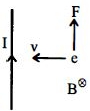
- (A) away from the wire
- (B) towards the wire
- (C) parallel to the wire along the current
- (D) parallel to the wire opposite to the current
Show answer and solution
Correct Answer: (B)
The force is parallel to the direction of current in magnetic field,hence \(\mathrm{F}=\mathrm{q}(\mathrm{v} \times \overrightarrow{\mathrm{B}})\)
According to Fleming's left hand rule,
we have, the direction of motion of charge is towards the wire.
-
- (A) \(\vec E = - {v_0}{B_0}\left( {3\hat i - 2\hat j - 4\hat k} \right)\)
- (B) \(\vec E = - {v_0}{B_0}\left( {\hat i + \hat j + 7\hat k} \right)\)
- (C) \(\vec E = {v_0}{B_0}\left( {14\hat j + 7\hat k} \right)\)
- (D) \(\vec E = - {v_0}{B_0}\left( {14\hat j + 7\hat k} \right)\)
Show answer and solution
Correct Answer: (D)
According to question, as the test charge experiences no net force in that region i.e., sum of electric force \(\left( {{{\text{F}}_{\text{e}}} = {\text{q}}\overrightarrow {\text{E}} } \right)\,\) and magnetic forces \([{{\text{F}}_{\text{m}}} = {\text{q}}(\overline {\text{v}} \times \overline {\text{B}} ]\) will be zero.Hence, \(F_{e}+F_{m}=0\)
\(\mathrm{F}_{\mathrm{e}}=-\mathrm{q}(\overline{\mathrm{v}} \times \overline{\mathrm{B}})\)
\(=-\mathrm{B}_{0} \mathrm{v}_{0}[(3 \hat{\mathrm{i}}-\hat{\mathrm{j}}+2 \hat{\mathrm{k}}) \times(\mathrm{i}+2 \hat{\mathrm{j}}-4 \hat{\mathrm{k}})]\)
\(=-B_{0} v_{0}(14 \hat{j}+7 \hat{k})\)
-
- (A) \(1.985 \times 10^3\) \(Ω\)
- (B) \(2.045 \times 10^3 \) \( Ω\)
- (C) \(2.535 \times 10^3 \) \(Ω\)
- (D) \(4.005 \times10^3\) \( Ω\)
Show answer and solution
Correct Answer: (A)
Given : Current through the galvanometer, \(i_{g}=5 \times 10^{-3} \,A\)Galvanometer resistance, \(G=15\, \Omega\)
Let resistance \(R\) to be put in series with the galvanometer to convert it into a voltmeter.
\(V=i_{g}(R+G)\)
\(10= 5 \times 10^{-3}(R+15) \)
\( \therefore \quad R=2000-15=1985 \)
\(=1.985 \times 10^{3} \,\Omega \)
-
- (A) \(\frac{{\pi {\mu _0}{I_0}}}{2}.\frac{{{a^2}}}{b}\omega \,\sin \,\left( {\omega t} \right)\)
- (B) \(\frac{{\pi {\mu _0}{I_0}}}{2}.\frac{{{a^2}}}{b}\omega \,\cos \,\left( {\omega t} \right)\)
- (C) \(\pi {\mu _0}{I_0}\,\frac{{{a^2}}}{b}\omega \,\sin \,\left( {\omega t} \right)\)
- (D) \(\frac{{\pi {\mu _0}{I_0}{b^2}}}{a}\,\omega \,\cos \,\left( {\omega t} \right)\)
Show answer and solution
Correct Answer: (A)
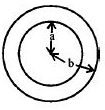
For two concentric circular coil,Mutual Inductance \(M=\frac{\mu_{0} \pi \mathrm{N}_{1} \mathrm{N}_{2} \mathrm{a}^{2}}{2 \mathrm{b}}\)
here, \(\mathrm{N}_{1}=\mathrm{N}_{2}=1\)
Hence, \(M=\frac{\mu_{0} \pi a^{2}}{2 b}.........(i)\)
and given \(I=I_{0} \cos \omega t.........(ii)\)
Now according to Faraday's second law induced \(emf\)
\(\mathrm{e}=-\mathrm{M} \frac{\mathrm{d} \mathrm{I}}{\mathrm{dt}}\)
Fromeq. \((ii)\)
\(\mathrm{e}=\frac{-\mu_{0} \pi \mathrm{a}^{2}}{2 \mathrm{b}} \frac{\mathrm{d}}{\mathrm{dt}}\left(\mathrm{I}_{0} \cos \omega \mathrm{t}\right)\)
\(\mathrm{e}=\frac{\mu_{0} \pi \mathrm{a}^{2}}{2 \mathrm{b}} \mathrm{I}_{0} \sin \omega \mathrm{t}(\omega)\)
\(\mathrm{e}=\frac{\pi \mu_{0} \mathrm{I}_{0}}{2} \cdot \frac{\mathrm{a}^{2}}{\mathrm{b}} \omega \sin \omega \mathrm{t}\)
-
- (A) \(200 \)
- (B) \(225\)
- (C) \(250\)
- (D) \(275\)
Show answer and solution
Correct Answer: (C)
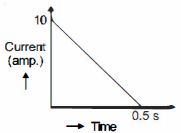
According to Faraday's law of electromagnetic induction, \(\quad \varepsilon=\frac{d \phi}{d t}\)Also, \(\varepsilon=\mathrm{i} \mathrm{R}\)
\(\therefore \quad i R=\frac{d \phi}{d t} \quad \Rightarrow \int d \phi=R \int i d t\)
Magnitude of change in flux \((\mathrm{d} \phi)=R \times\) area under current vs time graph
or, \(\quad d \phi=100 \times \frac{1}{2} \times \frac{1}{2} \times 10=250\, \mathrm{Wb}\)
-
- (A) maximum potential energy when the torque is maximum
- (B) zero potential energy when the torque is minimum
- (C) zero potential energy when the torque is maximum
- (D) minimum potential energy when the torque is maximum.
Show answer and solution
Correct Answer: (C)
Potential energy of dipole,\(U = - pE\,\cos \,\theta \)
Torque experienced by dipole
\(\tau = pE\,\sin \,\theta \)
Torque will be maximum \(({\tau _{\max }})\) when \(\theta = {90^o}\)
then potential energy \(U = 0\)
-
- (A) \(6.65\)
- (B) \(8.89 \)
- (C) \(6.98\)
- (D) \(8.76 \)
Show answer and solution
Correct Answer: (A)
Given : Magnetic moment, \(M=6.7 \times 10^{-2}\, \mathrm{Am}^{2}\)Magnetic field, \(\mathrm{B}=0.01\, \mathrm{T}\)
Moment of inertia, \(I=7.5 \times 10^{-6}\, \mathrm{Kgm}^{2}\)
\(\text { Using, } T =2 \pi \sqrt{\frac{I}{M B}} \)
\(=2 \pi \sqrt{\frac{7.5 \times 10^{-6}}{6.7 \times 10^{-2} \times 0.01}}=\frac{2 \pi}{10} \times 1.06\, s\)
Time taken for \(10\) complete oscillations
\(t=10\, T=2 \pi \times 1.06 \)
\(=6.6568 \approx 6.65\, \mathrm{s}\)
-
- (A) Reading of \(A_1\) is \(2\,A\)
- (B) Reading of \(A_1\) is \(18\, A\)
- (C) Reading of \(V\) is \(9\, V\)
- (D) Reading of \(V\) is \(7\, V\)
Show answer and solution
Correct Answer: (A)
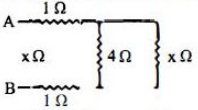
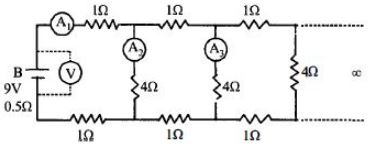
The given circuit can be redrawn as,as \(4\, \Omega\) and \(x \,\Omega\) are parallel
\(x^{\prime}=\frac{1}{4}+\frac{1}{x}=\frac{(4+x)}{4 x} \quad x^{\prime}=\frac{4 x}{4+x}\)
and \( 1 \,\Omega\) and \(1\, \Omega\) are also in series \(x^{\prime \prime}=2\, \Omega\) Now equivalent resistance of circuit
\(x=\frac{4 x}{4+x}+2=\frac{8+6 x}{4+x}\)
\(4 x+x^{2}=8+6 x\)
\(x^{2}-2 x-8=0\)
\(x=\frac{2 \pm \sqrt{4-4(1)(-8)}}{2}=\frac{2 \pm \sqrt{36}}{2}\)
\(=\frac{2 \pm 6}{2}=4\, \Omega\)
Reading of Ammeter \(A_{1}=\frac{V}{(R+r)}\)
\(A_{1}=\frac{9}{4+0.5}=2\) \(Ampere\)
-
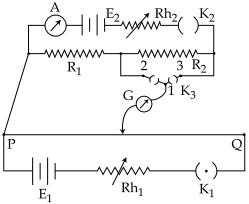
- (A) \(\frac{{{l_1}}}{{{l_1} + {l_2}}}\)
- (B) \(\frac{{{l_2}}}{{{l_2} - {l_1}}}\)
- (C) \(\frac{{{l_1}}}{{{l_1} - {l_2}}}\)
- (D) \(\frac{{{l_1}}}{{{l_2} - {l_1}}}\)
Show answer and solution
Correct Answer: (D)
When key is at point \(( 1)\)\(\mathrm{V}_{1}=\mathrm{i} \mathrm{R}_{1}=\mathrm{x} l_{1}\)
When key is at \(( 3)\)
\({{\rm{v}}_2} = {\rm{i}}\left( {{{\rm{R}}_1} + {{\rm{R}}_2}} \right) = {\rm{x}}{l_2}\)
\(\frac{\mathrm{R}_{1}}{\mathrm{R}_{1}+\mathrm{R}_{2}}=\frac{l_{1}}{l_{2}} \Rightarrow \frac{\mathrm{R}_{1}}{\mathrm{R}_{2}}=\frac{l_{1}}{l_{2}-l_{1}}\)
-
- (A) \(1600\)
- (B) \(400\)
- (C) \(200\)
- (D) \(100\)
Show answer and solution
Correct Answer: (A)
Given, \({R_1} = 100\,\Omega ,{r^\prime } = r/2,{R_2} = ?\)Resistivity of wire, \(\mathrm{R}=\frac{\rho l}{\mathrm{A}}\)
\(\because\) Area \(\times\) length \(=\) volume
Hence, \(R=\frac{\rho V}{A^{2}}\)
since, \(\rho \rightarrow\) constant, \(V \rightarrow\) constant
\(\mathrm{R} \propto \frac{1}{\mathrm{A}^{2}}\)
or \(\quad \mathrm{R} \propto \frac{1}{\mathrm{r}^{4}} \quad \because \quad \mathrm{A}=\pi \mathrm{r}^{2}\)
\(\frac{\mathrm{R}_{2}}{\mathrm{R}_{1}}=16 \Rightarrow \mathrm{R}_{2}=16 \times 100=1600 \,\Omega,\)
Resistance of new wire.
-
- (A) \(\frac{33}{5}\, \Omega \)
- (B) \( 6\,\Omega \)
- (C) \( 7\,\Omega \)
- (D) \(\frac{20}{3}\, \Omega \)
Show answer and solution
Correct Answer: (D)
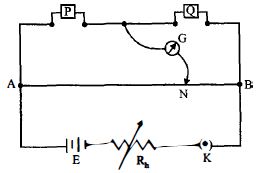
In balance position of bridge, \(\frac{P}{Q}=\frac{l}{(100-l)}\)Initially neutral position is \(60\, \mathrm{cm} .\) from \(\mathrm{A}\),
so
\(\frac{4}{60}=\frac{Q}{40} \Rightarrow Q=\frac{16}{6}=\frac{8}{3}\, \Omega\)
Now, when unknown resistance \(\mathrm{R}\) is connected in series to \(P\), neutral point is \(80 \,cm\) from Athen,
\(\frac{4+R}{80}=\frac{Q}{20}\)
\(\frac{4+R}{80}=\frac{8}{60}\)
\(R=\frac{64}{6}-4=\frac{64-24}{6}=\frac{40}{6} \,\Omega\)
Hence, the value of unknown resistance \(\mathrm{R}\)
is \(=\frac{20}{3} \,\Omega\)
-
- (A) \(1\) \(A\)
- (B) \(0.25\) \( A\)
- (C) \(0.5\) \( A\)
- (D) \(0\) \( A\)
Show answer and solution
Correct Answer: (D)
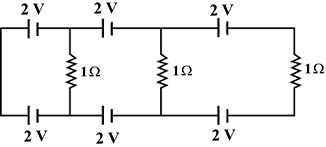
The potential difference in each loop is zero.\(\therefore \) No current will flow or current in each resistance is Zero.
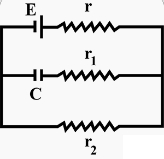
- 46. In the given circuit diagram when the current reaches steady state in the circuit, the charge on the capacitor of capacitance \(C\) will be
 2017 Medium
- (A) \(CE\)
- (B) \(CE\)\(\;\frac{{\;{r_1}}}{{\left( {{r_2} + r} \right)}}\)
- (C) \(CE\)\(\;\frac{{\;{r_2}}}{{\left( {r + {r_2}} \right)}}\)
- (D) \(CE\)\(\;\frac{{\;{r_1}}}{{\left( {{r_1} + r} \right)}}\)
Show answer and solution
Correct Answer: (C)
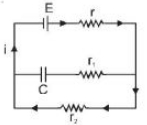
In steady state, flow of current through capacitor will be zero.Current through the circuit,
\(i=\frac{E}{r+r_{2}}\)
Potential difference through capacitor
\(V_{c}=\frac{Q}{C}=E-i r=E-\left(\frac{E}{r+r_{2}}\right) r\)
\(\therefore \quad Q=C E \frac{r_{2}}{r+r_{2}}\)
-
- (A) \(P_1 > P_2 > P_3\)
- (B) \(P_1 > P_3 > P_2\)
- (C) \(P_2 > P_1 > P_3\)
- (D) \(P_3 > P_2 > P_1\)
Show answer and solution
Correct Answer: (C)
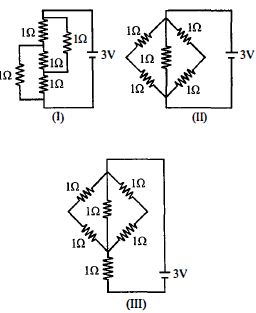
From the given circuit, net resistances \({{\rm{R}}_I} = 1\,\Omega ,{{\rm{R}}_{{\rm{II}}}} = 1/2\,\Omega ,{{\rm{R}}_{{\rm{III}}}} = 3/2\,\Omega \)It is clear that \(\mathrm{R}_{3}>\mathrm{R}_{1}>\mathrm{R}_{2}\)
Hence, \({P_3} < {P_1} < {P_2}\)
As Power \((P)\) \(=\frac{\mathrm{V}^{2}}{\mathrm{R}} \Rightarrow \mathrm{P} \propto \frac{1}{\mathrm{R}}\)
-
- (A) Wheatstone bridge is the most sensitive when all the four resistances are of the same order of magnitude
- (B) In a balanced wheatstone bridge if the cell and the galvanometer are exchanged, the null point is disturbed.
- (C) A rheostat can be used as a potential divider
- (D) Kirchhoff's second law represents energy conservation
Show answer and solution
Correct Answer: (B)
There is no change in null point, if the cell and the galvanometer are exchanged in a balanced wheatstone birdge.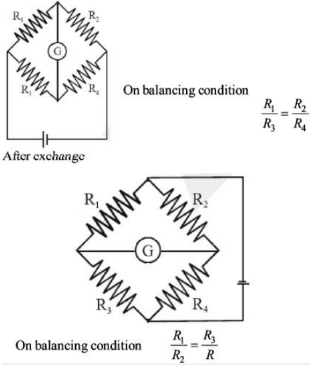
-
- (A) \(1\)
- (B) \(16\)
- (C) \(24\)
- (D) \(32\)
Show answer and solution
Correct Answer: (D)
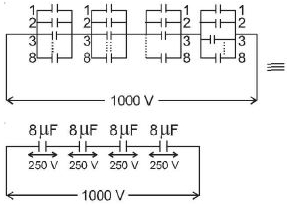
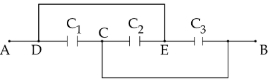
To get a capacitance of \(2\, \mu \mathrm{F}\) arrangement of capacitors of capacitance \(1\, \mu \mathrm{F}\) as shown in figure \(8\) capacitors of \(1\, \mu \mathrm{F}\) in parallel with four such branches in series i.e., \(32\) such capacitors are required.\(\frac{1}{C_{e q}}=\frac{1}{8}+\frac{1}{8}+\frac{1}{8}+\frac{1}{8} \quad \therefore C_{e q}=2\, \mu F\)
-
- (A) \(3\)
- (B) \(4\)
- (C) \(5\)
- (D) \(6\)
Show answer and solution
Correct Answer: (C)
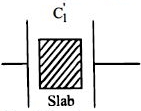
Before introducing a slab capacitance of plates\(C_{1}=\frac{\varepsilon_{0} A}{3}\)
If a slab of dielectric constant \(K\) is introduced between plates then
\(C=\frac{K \varepsilon_{0} A}{d}\) then \(C'_1 = \frac{{{\varepsilon _0}A}}{{2.4}}\)
\(\mathrm{C}_{1}\) and \({C'}_{1}\) are in series hence,
\(\frac{{{\varepsilon _0}A}}{3} = \frac{{{\text{k}}\frac{{{\varepsilon _0}A}}{3} \cdot \frac{{{\varepsilon _0}A}}{{2.4}}}}{{{\text{k}}\frac{{{\varepsilon _0}A}}{3} + \frac{{{\varepsilon _0}{\text{A}}}}{{2.4}}}}\)
\(3\, k=2.4 \,k+3\)
\(0.6\, \mathrm{k}=3\)
Hence, the dielectric constant of slap is given by,
\(k=\frac{30}{6}=5\)
No questions on this page match these filters.
Other years
Frequently asked
How many JEE Mains 2017 Physics questions are on ExamBro?
80 questions, each with the correct answer and a full solution.
Which JEE Mains 2017 Physics chapter is asked the most?
System of particles and rotational motion, with 9 questions, followed by Current electricity with 8.
How difficult are JEE Mains 2017 Physics questions?
5% are easy, 43% medium and 53% hard.