


પ્રશ્નો
4 પ્રશ્નો4 માંથી 1–4 પ્રશ્નો
-
- (A) \(2\)
- (B) \(3.5\)
- (C) \(5\)
- (D) \(7\)
જવાબ અને ઉકેલ જુઓ
સાચો જવાબ: (B)
Since system dissipates its energy gradually, and hence amplitude will also decreases with time according to\(a=a_{0} \mathrm{e}^{-\mathrm{bt/m}}\) \(...(i)\)
Energy of vibration drop to half of its in itial value \(\left(\mathrm{E}_{0}\right),\) as \(\mathrm{E} \propto \mathrm{a}^{2} \Rightarrow \mathrm{a} \propto \sqrt{\mathrm{E}}\)
\(a=\frac{a_{0}}{\sqrt{2}} \Rightarrow \frac{b t}{m}=\frac{10^{-2} t}{0.1}=\frac{t}{10}\)
From \(eq^n(i),\)
\(\frac{a_{0}}{\sqrt{2}}=a_{0} e^{-t / 10}\)
\(\frac{1}{\sqrt{2}}=e^{-t / 10}\) or \(\sqrt{2}=e^{\frac{t}{10}}\)
\(\ln \sqrt{2}=\frac{t}{10} \quad \therefore t=3.5\) seconds
-
- (A) \(0.25\)
- (B) \(0.35\)
- (C) \(0.5\)
- (D) \(2\)
જવાબ અને ઉકેલ જુઓ
સાચો જવાબ: (C)
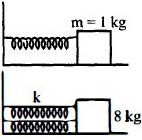
Frequency of spring \((f)=\frac{1}{2 \pi} \sqrt{\frac{k}{m}}=1 \mathrm{Hz}\)\(\Rightarrow 4 \pi^{2}=\frac{\mathrm{k}}{\mathrm{m}}\)
If block of mass \(\mathrm{m}=1 \mathrm{kg}\) is attached then, \(k=4 \pi^{2}\)
Now, identical springs are attached in parallel with mass
\(\mathrm{m}=8 \mathrm{kg}\), Hence, \(k_{e q}=2 k\)
\(f^{\prime}=\frac{1}{2 \pi} \sqrt{\frac{\mathrm{k} \times 2}{8}}=\frac{1}{2} \mathrm{Hz}\)
-
- (A) \(1\)
- (B) \(0.1\)
- (C) \(0.5\)
- (D) \(0.01\)
જવાબ અને ઉકેલ જુઓ
સાચો જવાબ: (B)
As we know, Time-period of simplependulum, T \(\propto \sqrt{l}\)
\(5 \times {10^{ - 4}} = \frac{1}{2}\frac{{{r_1} - {r_2}}}{1}\)
\(\because\) change in length \(\Delta l=r_{1}-r_{2}\)
\(5 \times {10^{ - 4}} = \frac{1}{2}\frac{{{r_1} - {r_2}}}{1}\)
\(r_{1}-r_{2}=10 \times 10^{-4}\)
\(10^{-3} \mathrm{m}=10^{-1} \mathrm{cm}=0.1 \mathrm{cm}\)
-
- (A) \(500\, m/s^2\)
- (B) \(500\,\sqrt 2 \,m/{s^2}\)
- (C) \(750\, m/s^2\)
- (D) \(750\,\sqrt 2 \,m/{s^2}\)
જવાબ અને ઉકેલ જુઓ
સાચો જવાબ: (B)
Maximum velocity in \(\mathrm{SHM}, \mathrm{v}_{\max }=\mathrm{a} \omega\)
Maximum acceleration in \(\mathrm{SHM}, \mathrm{A}_{\max }=\mathrm{a} \omega^{2}\)
where \(a\) and \(\omega\) are maximum amplitude and angular frequency.
Given that, \(\frac{A_{\max }}{v_{\max }}=10\)
i.e., \(\omega=10 \mathrm{s}^{-1}\)
Displacement is given by\(x=a \sin (\omega t+\pi t 4)\)
at \(t=0, x=5\)\(5=a \sin \pi / 4\)
\(5=a \sin 45^{\circ} \Rightarrow a=5 \sqrt{2}\)
Maximum acceleration \(\mathrm{A}_{\mathrm{max}}=\mathrm{a} \omega^{2}\)\(=500\sqrt{2}\,m/s^2\)
આ પેજ પર આ ફિલ્ટર મુજબ કોઈ પ્રશ્ન નથી.