


પ્રશ્નો
2 પ્રશ્નો2 માંથી 1–2 પ્રશ્નો
-
- (A) \({\phi _1} < {\phi _2} = {\phi _3} > {\phi _4}\)
- (B) \({\phi _1} > {\phi _2} > {\phi _3} > {\phi _4}\)
- (C) \({\phi _1} = {\phi _2} = {\phi _3} = {\phi _4}\)
- (D) \({\phi _1} > {\phi _3} ; {\phi _2} < {\phi _4}\)
જવાબ અને ઉકેલ જુઓ
સાચો જવાબ: (C)
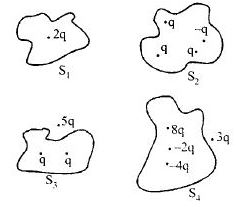
The net fluw linked with closed surfaces \(S_{1}\), \(\mathrm{S}_{2}, \mathrm{S}_{3} \& \mathrm{S}_{4}\) areFor surface \(S_{1}, \phi_{1}=\frac{1}{\varepsilon_{0}}(2 q)\)
For surface
\(\mathrm{S}_{2}, \phi_{2}=\frac{1}{\varepsilon_{0}}(\mathrm{q}+\mathrm{q}+\mathrm{q}-\mathrm{q})=\frac{1}{\varepsilon_{0}} 2 \mathrm{q}\)
For surface \(S_{3}, \phi_{3}=\frac{1}{\varepsilon_{0}}(q+q)=\frac{1}{\varepsilon_{0}}(2 q)\)
For surface
\(S_{4}, \phi_{4}=\frac{1}{\varepsilon_{0}}(8 q-2 q-4 q)=\frac{1}{\varepsilon_{0}}(2 q)\)
Hence, \(\phi_{1}=\phi_{2}=\phi_{3}=\phi_{4}\) i.e. netelectric flux is same for all surfaces.
Keep in mind, the electric field due to a charge outside \(\left(\mathrm{S}_{3} \text { and } \mathrm{S}_{4}\right),\) the Gaussian surface contributes zero net flux through the surface, because as many lines due to that charge enter the surface as leave it.
-
- (A) \(30\)
- (B) \(45\)
- (C) \(60\)
- (D) \(90\)
જવાબ અને ઉકેલ જુઓ
સાચો જવાબ: (C)
\(\mathrm{T}=\mathrm{PE} \sin \theta\) Torque experienced by the dipole in an electric field,\(\quad \vec{T}=\vec{P} \times \vec{E}\)
\(\vec{p}=p \cos \theta \hat{i}+p \sin \theta \hat{j}\)
\(\vec{E}_{1}=\overrightarrow{E i}\)
\(\vec{T}_{1}=\vec{p} \times \vec{E}_{1}=(p \cos \theta \hat{i}+p \sin \theta \hat{j}) \times E(\hat{i})\)
\(\tau \hat{k}=p E \sin \theta(-\hat{k}).........(i)\)
\(\vec{E}_{2}=\sqrt{3} E_{1} \hat{j}\)
\(\left.\vec{T}_{2}=p \cos \theta \hat{i}+p \sin \theta \hat{j}\right) \times \sqrt{3} E_{1} \hat{j}\)
\(\tau \hat{k}=\sqrt{3} p E_{1} \cos \theta \hat{k}.........(ii)\)
From eqns. ( \(i\) ) and \((ii )\)
\(p E \sin \theta=\sqrt{3} p E \cos \theta\)
\(\tan \theta=\sqrt{3} \quad \therefore \quad \theta=60^{\circ}\)
આ પેજ પર આ ફિલ્ટર મુજબ કોઈ પ્રશ્ન નથી.