


JEE Mains 2019 Physics ના બધા પ્રશ્નો
30 પ્રકરણ451 માંથી 51–100 પ્રશ્નો
-
- (A) \(\vec B = 2 \times {10^{ - 7}}\,\sin \,\left( {1.5 \times {{10}^2}x + 0.5 \times {{10}^{11}}t} \right)\hat j\)
- (B) \(\vec B = 60\,\sin \,\left( {0.5 \times {{10}^3}x + 1.5 \times {{10}^{11}}t} \right)\hat k\)
- (C) \(\vec B = 2 \times {10^{ - 7}}\,\sin \,\left( {0.5 \times {{10}^3}z - 1.5 \times {{10}^{11}}t} \right)\hat i\)
- (D) \(\vec B = 2 \times {10^{7}}\,\sin \,\left( {0.5 \times {{10}^3}z + 1.5 \times {{10}^{11}}t} \right)\hat i\)
જવાબ અને ઉકેલ જુઓ
સાચો જવાબ: (C)
Magnetic field when electromagnetic wave propagates in \(+z\) direction.\(\mathrm{B}=\mathrm{B}_{0} \sin (\mathrm{kz}-\omega \mathrm{t})\)
where
\(\mathrm{B}_{0}-\frac{60}{3 \times 10^{8}}=2 \times 10^{-7}\)
\(\mathrm{k}=\frac{2 \pi}{\lambda}=0.5 \times 10^{3}\)
\(\omega=2 \pi \mathrm{f}=1.5 \times 10^{11}\)
-
- (A) \({U_E} = \frac{{{U_B}}}{2}\)
- (B) \(U_E\,>\,U_B\)
- (C) \(U_E\,<\,U_B\)
- (D) \(U_E\,=\,U_B\)
જવાબ અને ઉકેલ જુઓ
સાચો જવાબ: (D)
\(\mathrm{B}=\frac{\mathrm{E}}{\mathrm{C}}\)\(\Rightarrow \mathrm{U}_{\mathrm{E}}=\frac{1}{2} \varepsilon_{\mathrm{o}} \mathrm{E}^{2}\)
\(\mathrm{U}_{\mathrm{B}}=\frac{\mathrm{B}^{2}}{2 \mu_{0}}=\frac{\mathrm{E}^{2}}{2 \mu_{0} \mathrm{C}^{2}}=\frac{\mathrm{E}^{2}}{2 \mu_{0}}\left(\mu_{0} \varepsilon_{0}\right)=\mathrm{U}_{\mathrm{E}}\)
-
- (A) \(\vec B = \frac{{{E_0}}}{C}\hat j\,\sin \,\left( {kz} \right)\,\cos \,\left( {\omega t} \right)\)
- (B) \(\vec B = \frac{{{E_0}}}{C}\hat k\,\sin \,\left( {kz} \right)\,\cos \,\left( {\omega t} \right)\)
- (C) \(\vec B = \frac{{{E_0}}}{C}\hat j\,\cos \,\left( {kz} \right)\,\sin \,\left( {\omega t} \right)\)
- (D) \(\vec B = \frac{{{E_0}}}{C}\hat j\,\sin \,\left( {kz} \right)\,\sin \,\left( {\omega t} \right)\)
જવાબ અને ઉકેલ જુઓ
સાચો જવાબ: (D)
\(\because \overrightarrow{\mathrm{E}} \times \overrightarrow{\mathrm{B}} \| \overrightarrow{\mathrm{v}}\)Given that wave is propagating along positive \(z\) -axis and \(\overrightarrow{\mathrm{E}}\) along positive \(x\) -axis. Hence \(\overrightarrow{\mathrm{B}}\) along \(\mathrm{y}\) -axis.
From Maxwell equation
\(\overrightarrow{\mathrm{V}} \times \overrightarrow{\mathrm{E}}=-\frac{\partial \mathrm{B}}{\partial \mathrm{t}}\)
i.e. \(\frac{\partial E}{\partial Z}=-\frac{\partial B}{d t}\) and \(B_{0}=\frac{E_{0}}{C}\)
-
- (A) \(\hat S = \left( {\frac{{ - 3\hat j + 4\hat k}}{5}} \right)\)
- (B) \(\hat S = \left( {\frac{{ 4\hat j - 3\hat k}}{5}} \right)\)
- (C) \(\hat S = \left( {\frac{{ - 4\hat k + 3\hat j}}{5}} \right)\)
- (D) \(\hat S = \left( {\frac{{ - 3\hat i - 4\hat j}}{5}} \right)\)
જવાબ અને ઉકેલ જુઓ
સાચો જવાબ: (A)
\(\overrightarrow{\mathrm{E}}=\mathrm{E}_{0} \hat{\mathrm{n}} \sin \left(\omega \mathrm{t}+(6 \mathrm{y}-8 \mathrm{z})=\mathrm{E}_{0} \hat{\mathrm{n}} \sin (\omega \mathrm{t}+\overrightarrow{\mathrm{k}} \cdot \overrightarrow{\mathrm{r}})\right.\)where \(\vec{r}=x \hat{i}+y \hat{j}+z \hat{k}\) and \(\vec{k} \cdot \vec{r}=6 y-8 z\)
\(\Rightarrow \overrightarrow{\mathrm{k}}=6 \hat{\mathrm{j}}-8 \hat{\mathrm{k}}\)
\(\text { direction of propagation } \hat{\mathrm{s}} =-\hat{\mathrm{k}}\)
\( =\left(\frac{-3 \hat{\mathrm{j}}+4 \hat{\mathrm{k}}}{5}\right) \)
-
- (A) \(6 \times {10^4}\,N/C\)
- (B) \(3 \times {10^4}\,N/C\)
- (C) \(4 \times {10^4}\,N/C\)
- (D) \(4.5 \times {10^4}\,N/C\)
જવાબ અને ઉકેલ જુઓ
સાચો જવાબ: (B)
\(E_{0}=B_{0} \times C\)\(=100 \times 10^{-6} \times 3 \times 10^{8}\)
\(=3 \times 10^{4} \,N / C\)
-
- (A) \(2 \times {10^{ - 8}}\,T\) ,\(z -\) અક્ષની દિશામાં
- (B) \(6 \times {10^{ - 8}}\,T\) , \(x -\) અક્ષની દિશામાં
- (C) \(6 \times {10^{ - 8}}\,T\) , \(z -\) અક્ષની દિશામાં
- (D) \(2 \times {10^{ - 8}}\,T\) , \(y -\) અક્ષની દિશામાં
જવાબ અને ઉકેલ જુઓ
સાચો જવાબ: (A)
The direction of propagation of an \(EM\) wave is direction of \(\overrightarrow{\mathrm{E}} \times \overrightarrow{\mathrm{B}}\) \(\hat{\mathrm{i}}=\hat{\mathrm{j}} \times \hat{\mathrm{B}}\)\(\Rightarrow \hat{\mathrm{B}}=\hat{\mathrm{k}}\)
\(C=\frac{E}{B} \Rightarrow B=\frac{E}{C}=\frac{6}{3 \times 10^{8}}\)
\(\mathrm{B}=2 \times 10^{-8}\, \mathrm{T}\) along \(\mathrm{z}\) direction.
-
- (A) \(\left( {\frac{1}{{\sqrt n }},\frac{1}{{\sqrt n }}} \right)\)
- (B) \(\left( {\sqrt n ,\sqrt n } \right)\)
- (C) \(\left( {\frac{1}{{\sqrt n }},\sqrt n } \right)\)
- (D) \(\,\left( {\sqrt n ,\frac{1}{{\sqrt n }}} \right)\)
જવાબ અને ઉકેલ જુઓ
સાચો જવાબ: (D)
\(\frac{E_{i}}{B_{i}}=C.........(1)\)\(\frac{E_{f}}{B_{f}}=\frac{c}{n}.........(2)\)
\( \Rightarrow \frac{{{E_i}{B_f}}}{{{E_f}}} = \frac{1}{n}\)
\( \Rightarrow \frac{{{E_i}}}{{{E_f}}} = \frac{1}{n}\frac{{{B_i}}}{{{B_f}}}\)
\(\left( {\because \,n = \frac{1}{{\sqrt {{\mu _0}{e_r}} }}} \right)\)
\(\frac{1}{{\sqrt n }}:\sqrt n \)
-
- (A) \(A -S, B -Q, C -R, D -P\)
- (B) \(A -Q, B -S, C -P, D -R\)
- (C) \(A -R, B -P, C -S, D -Q\)
- (D) \(A -Q, B -S, C -R, D -P\)
જવાબ અને ઉકેલ જુઓ
સાચો જવાબ: (B)
\(Optical\, Fibre\, Communication -Infrared\, light\)For fiber optics with glass fibers, we use light in the infrared region which has wavelengths longer than visible light, typically around \(850,1300\) and \(1550 \mathrm{nm}\). Scattering is caused by light bouncing off atoms or molecules in the glass.
\(Radar -Radiowave\)
Radar is a detection system that uses radio waves to determine the range, angle, or velocity of objects.
\(Sonar -ultrasound\)
Sonar, as used in robotics means having an ultrasonic emitter and ultrasonic receiver. There is also some sonar with a single emitter/receiver. However, they all use ultrasonic sound ways in order to sense the distance to an object.
\(Mobilephones -microwave\)
we use microwaves as a power transmitter to our mobile phones. For this, we require a sensor, a rectenna circuit and a filer on our mobile phone. The microwave is sent with the message by the transmitter using an antenna at frequency \(2.24 \mathrm{GHz}\).
-
- (A) \(1\,T\)
- (B) \(10^2\,T\)
- (C) \(10^{-2}\,T\)
- (D) \(10^{-4}\,T\)
જવાબ અને ઉકેલ જુઓ
સાચો જવાબ: (D)
\(\mathrm{I}=\frac{\mathrm{B}_{\mathrm{o}}^{2}}{2 \mu_{\mathrm{o}}} \times \mathrm{C}\)\(B_{0}^{2}=1 \times 2 \mu_{0} \times C\)
\(B_{0}^{2}=\frac{10^{3} \times 2 \times 4 \pi \times 10^{-7}}{3 \times 10^{8}}\)
\(B_{0} \approx 10^{-4} \,T\)
-
- (A) \(\vec E = 4.8 \times {10^{ 2}}\,\cos \,\left( {2 \times {{10}^7}z + 6 \times {{10}^{15}}t} \right)\left( { - \hat i + 2\hat j} \right)\frac{V}{m}\)
- (B) \(\vec E = 4.8 \times {10^{ 2}}\,\cos \,\left( {2 \times {{10}^7}z + 6 \times {{10}^{15}}t} \right)\left( { - 2\hat j + 2\hat i} \right)\frac{V}{m}\)
- (C) \(\vec E = 4.8 \times {10^{ 2}}\,\cos \,\left( {2 \times {{10}^7}z + 6 \times {{10}^{15}}t} \right)\left( {\hat i + 2\hat j} \right)\frac{V}{m}\)
- (D) \(\vec E = 4.8 \times {10^{ 2}}\,\cos \,\left( {2 \times {{10}^7}z + 6 \times {{10}^{15}}t} \right)\left( {2\hat i + \hat j} \right)\frac{V}{m}\)
જવાબ અને ઉકેલ જુઓ
સાચો જવાબ: (A)
If we use that direction of light propagation will be along \(\overrightarrow{\mathrm{E}} \times \overrightarrow{\mathrm{B}}\). Then \((\mathrm{A})\) option is correct.Magnitude of \(E=C B\)
\(E=3 \times 10^{8} \times 1.6 \times 10^{-6} \times \sqrt{5}\)
\(E=4.8 \times 10^{2} \times \sqrt{5}\)
\(\overrightarrow{\mathrm{E}}\) and \(\overrightarrow{\mathrm{B}}\) are perpendicular to each other \(\Rightarrow \overrightarrow{\mathrm{E}} \cdot \overrightarrow{\mathrm{B}}=0\)
\(\Rightarrow\) Either direction of \(\bar{E}\) is \(\hat{i}-2 \hat{j}\) or \(-\hat{i}+2 \hat{j}\) from given option
Also wave propagation direction is parallel to \(\overrightarrow{\mathrm{E}} \times \overrightarrow{\mathrm{B}}\) which is \(-\overrightarrow{\mathrm{k}}\)
\(\Rightarrow \overrightarrow{\mathrm{E}}\) is along \((-\hat{\mathrm{i}}+2 \hat{\mathrm{j}})\)
-
- (A) \(0.9\,N\)
- (B) \(3\times 10^{-2}\,N\)
- (C) \(0.1\,N\)
- (D) \(0.6\,N\)
જવાબ અને ઉકેલ જુઓ
સાચો જવાબ: (D)
Maximum electric field \(E=(B)(C)\)\(\overrightarrow{\mathrm{E}}_{0}=\left(3 \times 10^{-5}\right) \mathrm{c}(-\hat{\mathrm{j}})\)
\(\overrightarrow{\mathrm{E}}_{1}=\left(2 \times 10^{-6}\right) \mathrm{c}(-\hat{\mathrm{i}})\)
Maximum force
\(\overrightarrow{\mathrm{F}}_{\mathrm{net}}=10^{-4} \times 3 \times 10^{8} \sqrt{\left(3 \times 10^{-5}\right)^{2}+\left(2 \times 10^{-6}\right)^{2}}=0.9\, \mathrm{N}\)
\(\mathrm{F}_{\mathrm{ms}}=\frac{\mathrm{F}_{0}}{\sqrt{2}}=0.6\, \mathrm{N}\) (approx)
-
- (A) \(625\, nm, 500\, nm\)
- (B) \(380\, nm, 525\, nm\)
- (C) \(380\, nm, 500\, nm\)
- (D) \(400\, nm, 500\, nm\)
જવાબ અને ઉકેલ જુઓ
સાચો જવાબ: (A)
For maxima,\(\operatorname{dsin} \theta=n \lambda\)
\(\lambda=\frac{\mathrm{d} \theta}{\mathrm{n}}\) ( \(\because \,\sin \theta \approx \theta \) when \(\theta\) is small )
\(=\frac{2500}{n}\, n m\)
Take \(n=4,5\) for \(\lambda=625\, \mathrm{nm}\) and \(500 \,\mathrm{nm}\)
-
- (A) \(\sqrt {\frac{5}{3}} \)
- (B) \(\frac{3}{{\sqrt 5 }}\)
- (C) \(\frac{5}{{\sqrt 3 }}\)
- (D) \(\frac{4}{3}\)
જવાબ અને ઉકેલ જુઓ
સાચો જવાબ: (B)
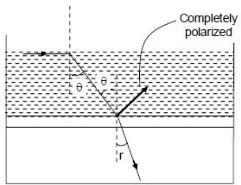
\(\sin 90^{\circ}=\mu \sin \theta\)\(\Rightarrow \quad \sin \theta=\frac{1}{\mu}\)
\({\mu \sin \theta=1.5 \sin r}\)
\({\mu \tan \theta=1.5}\)
\( \Rightarrow \tan \theta = \frac{{1.5}}{\mu }\)
\(\sin \theta = \frac{3}{{\sqrt {9 + 4{\mu ^2}} }} = \frac{1}{\mu }\)
\(9{\mu ^2} = 9 + 4{\mu ^2}\)
\( \Rightarrow \mu = \frac{3}{{\sqrt 5 }}\)
-
- (A) \(457.5\times10^{-9}\) radian
- (B) \(610\times10^{-9}\) radian
- (C) \(305\times10^{-9}\) radian
- (D) \(152.5\times10^{-9}\) radian
જવાબ અને ઉકેલ જુઓ
સાચો જવાબ: (C)
Limit of resolution of telescope \(=\frac{1.22 \lambda}{\mathrm{D}}\)\(\theta = \frac{{1.22 \times 500 \times {{10}^{ - 9}}}}{{200 \times {{10}^{ - 2}}}}\) \( = 305 \times {10^{ - 9}}\,{\text{radian}}\)
-
- (A) \(\frac{\lambda }{{2\left( {\sqrt 5 - 2} \right)}}\)
- (B) \(\frac{\lambda }{{\left( {\sqrt 5 - 2} \right)}}\)
- (C) \(\frac{\lambda }{{2\left( {5 - \sqrt 2 } \right)}}\)
- (D) \(\frac{\lambda }{{\left( {5 - \sqrt 2 } \right)}}\)
જવાબ અને ઉકેલ જુઓ
સાચો જવાબ: (A)
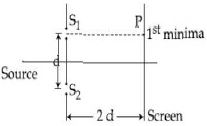
\(\sqrt{(2 d)^{2}+(d)^{2}}-2 d=\frac{\lambda}{2}\)\(\Rightarrow \quad(\sqrt{5}-2) d=\frac{\lambda}{2}\)
\(\Rightarrow \quad d=\frac{\lambda}{2(\sqrt{5}-2)}\)
-
- (A) \(10\)
- (B) \(05\)
- (C) \(04\)
- (D) \(09\)
જવાબ અને ઉકેલ જુઓ
સાચો જવાબ: (B)
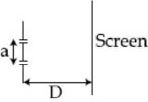
For diffractionLocation of \(1^{\text {st }}\) minima
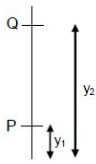
\({y_1} = \frac{{D\lambda }}{a} = 0.2469\,D\lambda \)
Location of \(2^{\text {nd }}\) minima
\({{\text{y}}_2} = \frac{{2{\text{D}}\lambda }}{{\text{a}}} = 0.4938\,{\text{D}}\lambda \)
Now for interference
Path for interference
Path difference at \(P\)
\(\frac{d y}{D}=4.8 \lambda\)
Path difference at \(P\)
\(\frac{d y}{D}=9.6 \lambda\)
So orders of maxima in between \(\mathrm{P}\) and \(\mathrm{Q}\) is
\(5,\,6,\,7,\,8,\,9\)
So \(5\) bright fringes all present between \(\mathrm{P}\) and \(\mathrm{Q}\)
-
- (A) \(16 : 9\)
- (B) \(25 : 9\)
- (C) \(4 : 1\)
- (D) \(5 : 3\)
જવાબ અને ઉકેલ જુઓ
સાચો જવાબ: (B)
\(\left( {\frac{{\sqrt {{I_1}} + \sqrt {{I_2}} }}{{\sqrt {{I_1}} - \sqrt {{I_2}} }}} \right) = \frac{{16}}{1}\) ; \(\frac{\sqrt{I_{1}}+\sqrt{I_{2}}}{\sqrt{I_{1}}-\sqrt{I_{2}}}=\frac{4}{1}\)\( \Rightarrow \quad 3\sqrt {{I_1}} = 5\sqrt {{I_2}} \)
\(\Rightarrow \quad \frac{I_{1}}{I_{2}}=\frac{25}{9}\)
-
- (A) \(0.48\)
- (B) \(0.38\)
- (C) \(0.24\)
- (D) \(0.12\)
જવાબ અને ઉકેલ જુઓ
સાચો જવાબ: (C)
Numerical aperature of the microscope is given as\({\text{NA}} = \frac{{0.61\,\lambda }}{{\text{d}}}\)
Where \(\mathrm{d}=\) minimum sparaton between two points to be seen as distinct
\({\text{d}} = \frac{{0.61\,\,\lambda }}{{{\text{NA}}}} = \) \(\frac{{(0.61) \times \left( {5000 \times 10\,{{\text{m}}^{ - 10}}} \right)}}{{1.25}}\) \( = 2.4 \times {10^{ - 7}}{\text{m}}\)
\( = 0.24\,\mu m\)
-
- (A) \(10.67\)
- (B) \(1.80\)
- (C) \(5.33\)
- (D) \(16\)
જવાબ અને ઉકેલ જુઓ
સાચો જવાબ: (A)
since unpolarised light falls on \(\mathrm{P}_{1}\)\(\Rightarrow\) Intensity of light transmitted from \(P_{1}=\frac{I_{0}}{2}\).
Pass axis of \(\mathrm{P}_{2}\) will be at an angle of \(30^{\circ}\) with \(\mathrm{P}_{1}\)
\(\therefore\) Intensity of light transmitted from
\(P_{2}=\frac{I_{0}}{2} \cos ^{2} 30^{\circ}=\frac{3I_{0}}{8}\)
Pass axis of \(\mathrm{P}_{3}\) is at an angle of \(60^{\circ}\) with \(\mathrm{P}_{2}\)
\(\therefore \) Intensity of light transmitted from
\({P_3} = \frac{{3{I_0}}}{8}{\cos ^2}{60^\circ } = \frac{{3{I_0}}}{{32}}\)
\(\therefore\left(\frac{I_{0}}{I}\right)=\frac{32}{3}=10.67\)
-
- (A) \(1.5 \times {10^{ - 7}}\,rad\)
- (B) \(2.0 \times {10^{ - 7}}\,rad\)
- (C) \(3.0 \times {10^{ - 7}}\,rad\)
- (D) \(4.5 \times {10^{ - 7}}\,rad\)
જવાબ અને ઉકેલ જુઓ
સાચો જવાબ: (C)
Limit of resolution \(=\frac{1.22 \lambda}{\mathrm{d}}\)\(=\frac{1.22 \times 600 \times 10^{-9}}{250 \times 10^{-2}}\)
\(=2.9 \times 10^{-7} \mathrm{rad}\)
-
- (A) \(0.74\)
- (B) \(0.85\)
- (C) \(0.94\)
- (D) \(0.80\)
જવાબ અને ઉકેલ જુઓ
સાચો જવાબ: (B)
\(\Delta x=\frac{\lambda}{8}\)Phase \(|\Delta P|=\frac{2 \pi}{\lambda} \times \frac{\lambda}{8}=\frac{\pi}{4}\)
\(\therefore \) \(\mathrm{I}_{\mathrm{res}}=I+I+2I \cos \left(\frac{\mathrm{R}}{4}\right)\)
\(=\,2I\left(1+\frac{1}{\sqrt{2}}\right)=2I \times 1.7\)
\(\therefore \quad \frac{I_{res }}{I_{\operatorname{man}}}=\frac{2I\times 1.7}{41}=0.85\)
-
- (A) \(640\)
- (B) \(320\)
- (C) \(321\)
- (D) \(641\)
જવાબ અને ઉકેલ જુઓ
સાચો જવાબ: (D)
\(\Delta X_{\max }=d \sin \theta=0.32 \sin 30=0.16\, \mathrm{mm}\)\(\therefore n = \frac{{\Delta {X_{\max }}}}{\lambda }\)
\( = \frac{{0.16 \times {{10}^{ - 3}}}}{{500 \times {{10}^{ - 9}}}}\)
\(=\frac{0.16 \times 10^{6}}{500}=\frac{1600}{5}=320\)
Number of \(\mathrm{BFs}=(2 n+1)=641\)
-
- (A) \({\left( {\sqrt 3 + 1} \right)^4}\,:\,16\)
- (B) \(25\,:\,9\)
- (C) \(9\,:\,1\)
- (D) \(4\,:\,1\)
જવાબ અને ઉકેલ જુઓ
સાચો જવાબ: (C)
\(\frac{{{I_{\max }}}}{{{I_{\min }}}} = \frac{9}{1}\) -
- (A) \(\frac{{2nD\lambda }}{{a\left( {\mu - 1} \right)}}\)
- (B) \(\frac{{nD\lambda }}{{a\left( {\mu - 1} \right)}}\)
- (C) \(\frac{{2D\lambda }}{{a\left( {\mu - 1} \right)}}\)
- (D) \(\frac{{n\lambda }}{{\left( {\mu - 1} \right)}}\)
જવાબ અને ઉકેલ જુઓ
સાચો જવાબ: (D)
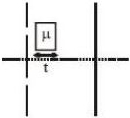
Path difference at central maxima \(\Delta x=(\mu-1)\, t,\) whole pattern will shift by same amount which will be given by\((\mu-1) \,t \frac{D}{d}=n \frac{\lambda D}{d},\) according to eh question \(t=\frac{n \lambda}{(\mu-1)}\)
No option is matching, therefore question should be award bonus.
\(\therefore \) Correct option should be (Bonus)
-
- (A) \(\frac{\lambda }{{2\,\left( {\mu - 1} \right)}}\)
- (B) \(\frac{\lambda }{{\,\left( {\mu - 1} \right)}}\)
- (C) \(\frac{\lambda }{{\,\left( {2\mu - 1} \right)}}\)
- (D) \(\frac{{2\lambda }}{{\,\left( {\mu - 1} \right)}}\)
જવાબ અને ઉકેલ જુઓ
સાચો જવાબ: (B)
\(\Delta x=(\mu-1)\, t=1 \lambda\)for one maximum shift
\(t=\frac{\lambda}{\mu-1}\)
-
- (A) \(2.26\times 10^{-3}\,m/s\) કાચથી દૂર
- (B) \(0.92\times 10^{-3}\,m/s\) કાચથી દૂર
- (C) \(3.22\times 10^{-3}\,m/s\) કાચ તરફ
- (D) \(1.16\times 10^{-3}\,m/s\) કાચ તરફ
જવાબ અને ઉકેલ જુઓ
સાચો જવાબ: (D)
\(\frac{1}{V}-\frac{1}{-20}=\frac{1}{30}\)\( \Rightarrow \frac{1}{V} = \frac{1}{{0.30}} - \frac{1}{{20}} = \) \( + \frac{{200 - 3}}{{60}} = \frac{{197}}{{60}}\)
\( \Rightarrow \quad - \frac{{dV}}{{dt\,\,{V^2}}} + \frac{{du}}{{dt\,{u^2}}} = 0\)
\( \Rightarrow \frac{{dV}}{{dt}} = \frac{{{V^2}}}{{{u^2}}}\frac{{du}}{{dt}}\) \( = {\left( {\frac{3}{{197}}} \right)^2} \times ( - 5)\) \( = - 0.00116\,{\text{m}}/{\text{s}}\)
-
- (A) \(0.16\)
- (B) \(1.60\)
- (C) \(0.24\)
- (D) \(0.32\)
જવાબ અને ઉકેલ જુઓ
સાચો જવાબ: (D)
\(m = \frac{f}{{f - u}}\) \(5 = \frac{{ - 40}}{{ - 40 - u}}\,;\,u\, = \, - 32\,cm\) -
- (A) \({\mu _1} + 2{\mu _2} = 3\)
- (B) \({2\mu _1} + {\mu _2} = 1\)
- (C) \({3\mu _2} + {\mu _1} = 1\)
- (D) \({2\mu _2} + {\mu _1} = 1\)
જવાબ અને ઉકેલ જુઓ
સાચો જવાબ: (A)
\(\frac{1}{{{f_1}}} = \left( {{\mu _1} - 1} \right)\left( {\frac{1}{R} - \frac{1}{\infty }} \right)\) ; \(\frac{1}{{{f_2}}} = \left( {{\mu _2} - 1} \right)\left( {\frac{1}{\infty } - \frac{1}{R}} \right)\)\(\frac{1}{{{f_1}}} = \frac{{(\mu - 1)}}{R}\) ; \(\frac{1}{{{f_2}}} = - \left( {\frac{{{\mu _2} - 1}}{R}} \right)\)
\(\mathrm{f}_{2}=2 \mathrm{f}_{1}\) ; \(\frac{1}{\mathrm{f}_{1}}=\frac{2}{\mathrm{f}_{2}}\)
\(\frac{\mu_{1}-1}{R}=\frac{-2\left(\mu_{2}-1\right)}{R}\)
\(\mu_{1}+2 \mu_{2}=3\)
-
- (A) \(5 : 3\)
- (B) \(2 : 1\)
- (C) \(4 : 3\)
- (D) \(3 : 1\)
જવાબ અને ઉકેલ જુઓ
સાચો જવાબ: (D)
Magnification is \(2\)If image is real, \(x_{1}=\frac{3 f}{2}\)
If image is virtual, \(x_{2}=\frac{f}{2}\)
\(\frac{x_{1}}{x_{2}}=3: 1\)
-
- (A) \(13.4\)
- (B) \(8.8\)
- (C) \(6.7\)
- (D) \(11.7\)
જવાબ અને ઉકેલ જુઓ
સાચો જવાબ: (B)
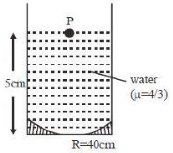
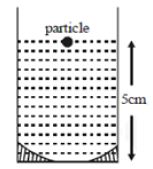
Light incident from particle \(P\) will be reflected at mirror.\({\text{u}} = - 5\,{\text{cm}},\) \({\text{f}} = {\text{m}} - \frac{{\text{R}}}{2}\) \( = - 20\,{\text{cm}}\)
\(\frac{1}{v} + \frac{1}{u} = \frac{1}{f}\) ; \(\boxed{{v_1} = + \frac{{20}}{3}\,\,cm}\)
This image will act as object for light getting refracted at water surface.
So, object distance \(d=5+\frac{20}{3}=\frac{35}{3} \,\mathrm{cm}\)
Below water surface.
After refraction, final image is at
\({d^\prime } = d\left( {\frac{{{\mu _2}}}{{{\mu _1}}}} \right)\) \( = \left( {\frac{{35}}{3}} \right)\left( {\frac{1}{{4/3}}} \right)\)
\(=\frac{35}{4}=8.75 \,\mathrm{cm}\)
\( \approx 8.8\, \mathrm{cm}\)
-
- (A) \(57000\)
- (B) \(45000\)
- (C) \(66000\)
- (D) એક પણ નહિ
જવાબ અને ઉકેલ જુઓ
સાચો જવાબ: (A)
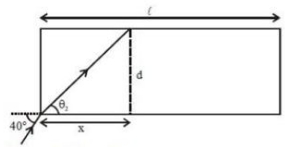
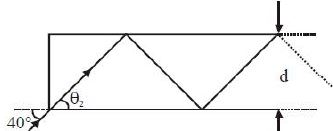
If we approximate the angle \(\theta_{2}\) as \(30^o\) initially then answer will be closer to \(57000\). but if we solve thoroughly, answer will be close to \(55000\) .So both the answers must be awarded. Detailed solution as following.
Exact solution
By Snell's law \(1.\sin {40^o} = (1.31)\sin {\theta _2}\)
\(\sin \theta_{2}=\frac{64}{1.31}=\frac{64}{131} \approx .49\)
Now \(\tan {\theta _2} = \frac{{64}}{{\sqrt {{{(131)}^2} - {{(64)}^2}} }}\) \( = \frac{{64}}{{\sqrt {13065} }} \approx \frac{{64}}{{114.3}} = \frac{{\text{d}}}{x}\)
Now number of reflections
\(=\frac{2 \times 64}{114.3 \times 20 \times 10^{-6}}=\frac{64 \times 10^{5}}{114.3}\)
\(=55991 \approx 55000\)
Approximate solution
By Snell's law \(1 . \sin 40^{\circ}=(1.31) \sin \theta_{2}\)
\({\sin \theta_{2}=\frac{0.64}{1.31}=\frac{64}{131} \approx 0.49}\)
If assume \( \Rightarrow {\theta _2} \approx {30^o}\)
\(\tan {30^o} = \frac{{\text{d}}}{{\text{x}}} \Rightarrow {\text{x}} = \sqrt 3 {\text{d}}\)
Now number of reflections
\(=\frac{\ell}{\sqrt{3} \mathrm{d}}=\frac{2}{\sqrt{3} \times 20 \times 10^{-6}}=\frac{10^{5}}{\sqrt{3}}\)
\(\approx 57735 \approx 57000\)
-
- (A) \(2a + \frac{{2b}}{{\sqrt 3 }}\)
- (B) \(2a + \frac{{2b}}{3}\)
- (C) \(\frac{{2\sqrt 3 }}{a} + 2b\)
- (D) \(2a + 2b\)
જવાબ અને ઉકેલ જુઓ
સાચો જવાબ: (D)
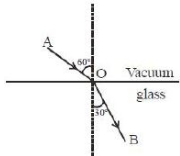
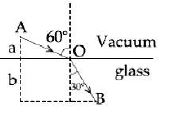
From Snell's law\(1 \sin 60^o=\mu \sin 30^o\)
\(\Rightarrow \mu=\sqrt{3}\)
Optical path \( = {\text{AO}} + \mu ({\text{OB}})\)
\( = \frac{{\text{a}}}{{\cos {{60}^o}}} + \sqrt 3 \frac{{\text{b}}}{{\cos {{30}^o}}}\)
\( = 2{\text{a}} + 2{\text{b}}\)
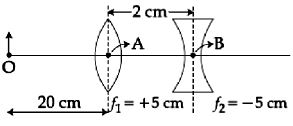
- 83. આકૃતિમાં દર્શાવેલ લેન્સના સંયોજનથી કયા સ્થાન પર અને કેવું પ્રતિબિંબ રચાશે? (\(f_1, f_2\) એ કેન્દ્ર લંબાઈ છે.)
 2019 અઘરું
- (A) બિંદુ \(B\) થી \(70\, cm\) ડાબી બાજુએ, અને આભાસી
- (B) બિંદુ \(B\) થી \(40\, cm\) જમણી બાજુએ, અને વાસ્તવિક
- (C) બિંદુ \(B\) થી \(\frac{20}{3}\, cm\) જમણી બાજુએ, અને વાસ્તવિક
- (D) બિંદુ \(B\) થી \(70\, cm\) જમણી બાજુએ, અને વાસ્તવિક
જવાબ અને ઉકેલ જુઓ
સાચો જવાબ: (D)
Image by convex lens:\(\frac{1}{v} - \frac{1}{u} = \frac{1}{f}\) ; \(\frac{1}{v} + \frac{1}{{20}} = \frac{1}{5}\)
\({v=\frac{20}{3}\, \mathrm{cm}}\)
Image by concave lens:
\(u=\left[\frac{20}{3}-2\right]=\frac{14}{3} \,\mathrm{cm}\)
\(\frac{1}{v}-\frac{1}{u}=\frac{1}{f}\) ; \(\frac{1}{v}-\frac{3}{14}=-\frac{1}{5}\)
\(v=70\, \mathrm{cm}\)
-
- (A) \(1\)
- (B) \(2\)
- (C) \(4\)
- (D) \(3.1\)
જવાબ અને ઉકેલ જુઓ
સાચો જવાબ: (D)
\({\frac{\mu_{2}}{\mathrm{v}}-\frac{\mu_{1}}{\mathrm{u}}=\frac{\mu_{2}-\mu_{1}}{\mathrm{R}}}\)\({\Rightarrow \quad \frac{1.34}{\mathrm{v}}-\frac{1}{-\infty}=\frac{0.34}{7.8}} \)
\( \Rightarrow {\text{v}} = \frac{{1.34 \times 7.8}}{{0.34}}\,\,{\text{nm}}\) \( = 3.074\,{\text{cm}}\)
-
- (A) \(45\)
- (B) \(60\)
- (C) \(75\)
- (D) \(90\)
જવાબ અને ઉકેલ જુઓ
સાચો જવાબ: (B)
\(\theta \,=\,60^o\)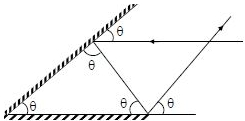
-
- (A) \(20\)
- (B) \(10\)
- (C) \(30\)
- (D) \(40\)
જવાબ અને ઉકેલ જુઓ
સાચો જવાબ: (B)
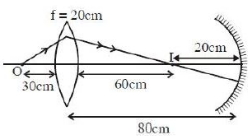
Image formed by lens\(\frac{1}{v}-\frac{1}{u}=\frac{1}{f}\) ; \(\frac{1}{v}+\frac{1}{30}=\frac{1}{20}\)
\(v=+60\, \mathrm{cm}\)
If image position does not change even when mirror is removed it means image formed by lens is formed at centre of curvature of spherical mirror.
Radius of curvature of mirror \(=80-60=20\,{cm}\)
\(\Rightarrow\) Focal length of mirror \(f=10\, \mathrm{cm}\) for virtual image, object is to be kept between focus and pole.
\(\Rightarrow\) Maximum distance of object from spherical mirror for which virtual image is formed, is \(10\,\mathrm{cm} .\)
-
- (A) \(\theta > {\sin ^{ - 1}}\,\frac{{{\mu _1}}}{{{\mu _2}}}\)
- (B) \(\theta > {\sin ^{ - 1}}\,\sqrt {\frac{{\mu _2^2}}{{\mu _1^2}} - 1} \)
- (C) \(\theta < {\sin ^{ - 1}}\,\frac{{{\mu _1}}}{{{\mu _2}}}\)
- (D) \(\theta < {\sin ^{ - 1}}\,\sqrt {\frac{{\mu _2^2}}{{\mu _1^2}} - 1} \)
જવાબ અને ઉકેલ જુઓ
સાચો જવાબ: (D)
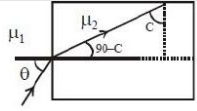
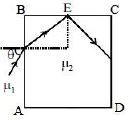
\(\sin \mathrm{c}=\frac{\mu_{1}}{\mu_{2}}\)\(\mu_{1} \sin \theta=\mu_{2} \sin \left(90^o-\mathrm{C}\right)\)
\(\sin \theta=\frac{\mu_{2} \sqrt{1-\frac{\mu_{1}^{2}}{\mu_{2}^{2}}}}{\mu_{1}}\)
\(\theta=\sin ^{-1} \sqrt{\frac{\mu_{1}^{2}-\mu_{2}^{2}}{\mu_{1}^{2}}}\)
For \(TIR\)
\(\theta<\sin ^{-1} \sqrt{\frac{\mathrm{u}_{2}^{2}}{\mu_{1}^{2}}-1}\)
-
- (A) અભિસારી અરીસાથી \(40\, cm\) અંતરે ,વસ્તુના પરિમાણ જેટલું જ
- (B) અભિસારી અરીસાથી \(20\, cm\) અંતરે ,વસ્તુના પરિમાણ જેટલું જ
- (C) અભિસારી લેન્સથી \(40\, cm\) અંતરે ,વસ્તુના પરિમાણ કરતાં બમણું
- (D) એક પણ નહીં
જવાબ અને ઉકેલ જુઓ
સાચો જવાબ: (D)
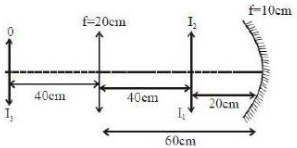
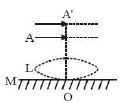
There will be \(3\) phenomenon\((i)\) Refraction from lens
\((ii)\) Reflection from mirror
\((iii)\) Refraction from lens
After these phenomena. Image will be on object and will have same size. None of the option depicts so this question is Bonus.
\(1^{\text {st }}\) refraction \(\mathrm{u}=-40\,\mathrm{cm} ; \mathrm{f}=+20\, \mathrm{cm}\)
\( \Rightarrow {\text{v}} = + 40\,{\text{cm}}\) (image \(I_1\)) and \(m_1\,=\,-\,1\) for reflction
\({\text{u}} = - 20\,{\mkern 1mu} {\text{cm}}\,;{\text{f}} = - 10\,{\mkern 1mu} {\text{cm}}\)
\( \Rightarrow v = - 20{\mkern 1mu} \,{\text{cm}}\) (image \(I_2\)) and \(m_2\,=\,-\,1\) \(2^{\text {nd }}\) refraction
\(\mathrm{u}=-40\, \mathrm{cm}\) ; \(\mathrm{f}=+20\, \mathrm{cm}\)
\( \Rightarrow v = + 40{\mkern 1mu} \,{\text{cm}}\) (image \(I_3\)) and \(m_3=-\,1\)
Total magnification \(=m_{1} \times m_{2} \times m_{3}=-1\) and final image is formed at distance \(40\,\mathrm{cm}\) from convergent lens and is of same size as the object.
-
- (A) પ્રતિબિંબ દેખાશે નહીં
- (B) વિસ્તૃત (મોટું) પ્રતિબિંબ
- (C) સીધુ વાસ્તવિક પ્રતિબિંબ
- (D) કોઈ ફેરફાર નહીં
જવાબ અને ઉકેલ જુઓ
સાચો જવાબ: (A)
If the water is filled focal length will decrease and image will disappear. -
- (A) \(f_1\,-\,f_2\)
- (B) \(\frac{R}{{{\mu _2} - {\mu _1}}}\)
- (C) \(\frac{{2{f_1}{f_2}}}{{{f_1} + {f_2}}}\)
- (D) \({{f_1} + {f_2}}\)
જવાબ અને ઉકેલ જુઓ
સાચો જવાબ: (B)
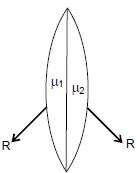
\(\frac{1}{f}=\frac{\left(\mu_{1}-1\right)}{R}+\frac{\left(1-\mu_{2}\right)}{R}\)\(\frac{1}{f}=\frac{\left(\mu_{1}-\mu_{2}\right)}{R}\)
\(\Rightarrow \quad \mathrm{f}=\frac{\mathrm{R}}{\mu_{1}-\mu_{2}}\)
-
- (A) \(\sqrt 2 \)
- (B) \(\frac{4}{3}\)
- (C) \(\sqrt 3 \)
- (D) \(\frac{3}{2}\)
જવાબ અને ઉકેલ જુઓ
સાચો જવાબ: (B)
For image to form at object itself, says must retrace their path back to object. Hence must incident on mirror normally.case \(1\) : Object will be at focus of lens
\(\frac{1}{f}=(\mu-1)\left(\frac{1}{R}-\frac{1}{-R}\right)=\frac{1}{-18}\)
\(\Rightarrow {\mathrm{R}}=18\, \mathrm{cm}\)
case \(2\) : Retraction at \(1^{\text {st }}\) surface:
\(\frac{1}{-27}-\frac{1.5}{V_{1}}=\frac{1-1.5}{R}\) ..... \((i)\)
\(2^{\text {nd }}\) retraction:
\(\frac{1.5}{V_{1}}-\frac{\mu}{\infty}=\frac{1.5-u}{-R}\) ..... \((ii)\)
From \((i)\) and \((ii)\)
\(\mu=\frac{4}{3}\)
- 92. પાતળા લેન્સ માટે મોટવણી \(m\) વિરુદ્ધ પ્રતિબિંબ અંતર \(v\) નો આલેખ આપેલ છે.તો લેન્સની કેન્દ્રલંબાઈ કેટલી હશે?
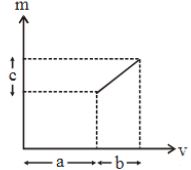 2019 મધ્યમ
- (A) \(\frac {b^2}{ac}\)
- (B) \(\frac {a}{c}\)
- (C) \(\frac {b^2c}{a}\)
- (D) \(\frac {b}{c}\)
જવાબ અને ઉકેલ જુઓ
સાચો જવાબ: (D)
\(f\,=\,\frac {b}{c}\)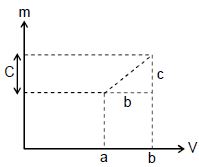
-
- (A) \(\frac{R}{{2\left( {{\mu _1} - {\mu _2}} \right)}}\)
- (B) \(\frac{2R}{{\left( {{\mu _1} - {\mu _2}} \right)}}\)
- (C) \(\frac{R}{{\left( {{\mu _1} - {\mu _2}} \right)}}\)
- (D) \(\frac{R}{{2 - \left( {{\mu _1} - {\mu _2}} \right)}}\)
જવાબ અને ઉકેલ જુઓ
સાચો જવાબ: (C)
For \(1^{\text {st }}\) lens \(\frac{1}{{{f_1}}} = \left( {\frac{{{\mu _1} - 1}}{1}} \right)\) \(\left( {\frac{1}{\infty } - \frac{1}{{ - R}}} \right) = \frac{{{\mu _1} - 1}}{R}\)For \(2^{n d}\) lens \(\frac{1}{{{f_2}}} = \left( {\frac{{{\mu _2} - 1}}{1}} \right)\) \(\left( {\frac{1}{{ - R}} - 0} \right) = - \frac{{{\mu _2} - 1}}{R}\)
\(\frac{1}{f_{e q}}=\frac{1}{f_{1}}+\frac{1}{f_{2}}\)
\(\frac{1}{{{f_{eq}}}} = \frac{{{\mu _1} - 1}}{R} + \frac{{ - \left( {{\mu _2} - 1} \right)}}{R}\) \( \Rightarrow {f_{eq}} = \frac{R}{{{\mu _1} - {\mu _2}}}\)
-
- (A) \(90\)
- (B) \(30\)
- (C) \(60\)
- (D) \(45\)
જવાબ અને ઉકેલ જુઓ
સાચો જવાબ: (C)
\(i=\theta\)\(r_{1}=r_{2}=\frac{A}{2}=30^{\circ}\)
by Snell's law
\(1 \times \sin i = \sqrt 3 \times \frac{1}{2} = \frac{{\sqrt 3 }}{2}\)
\(i=60\)
-
- (A) \(1.1\, cm\) લેન્સથી દૂર
- (B) \(0\)
- (C) \(0.55\, cm\) લેન્સ તરફ
- (D) \(0.55\, cm\) લેન્સથી દૂર
જવાબ અને ઉકેલ જુઓ
સાચો જવાબ: (D)
If \(u=-10 \,\mathrm{cm}\)\(v=+10\, \mathrm{cm}\)
\(\Rightarrow \mathrm{f}=5\,\mathrm{cm}\)
Glass plate shift \(=\mathrm{t}\left(1-\frac{1}{\mu}\right)=1.5\left(1-\frac{2}{3}\right)=0.5\,\mathrm{cm}\)
So, new \(u=10-0.5=9.5\,\mathrm{cm}\)
\(\frac{1}{v}-\frac{1}{u}=\frac{1}{f}\)
\(\frac{1}{v}-\frac{1}{-9.5}=\frac{1}{5}\)
After solving we get,
\(v=\frac{47.5}{4.5}\). Hence, shift \(\frac{47.5}{4.5}-10=\left(\frac{2.5}{4.5}\right)=0.55\, \mathrm{cm}\)
-
- (A) \(2.2\)
- (B) \(3.3\)
- (C) \(5\)
- (D) \(7.2\)
જવાબ અને ઉકેલ જુઓ
સાચો જવાબ: (B)
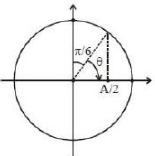
\(V(t)=220 \sin (100 \pi t)\) volt time taken,\(t=\frac{\theta}{\omega}=\frac{\frac{\pi}{3}}{100 \pi}=\frac{1}{300} \,\mathrm{sec}\)
\(=3.3 \,\mathrm{ms}\)
-
- (A) \(\frac{2}{{\ln \,2}}\)
- (B) \(ln\,2\)
- (C) \(\frac{1}{2}\,\ln\,2\)
- (D) \(2\,ln\,2\)
જવાબ અને ઉકેલ જુઓ
સાચો જવાબ: (D)
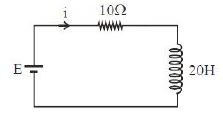
\(L I D I=I^{2} R\)\(L \times \frac{E}{10}\left(-e^{-t / 2}\right) \times \frac{-1}{2}=\frac{E}{10}\left(1-e^{-t / 2}\right) \times 10\)
\(e^{-1 / 2}=1-e^{-1 / 2} \quad ; \quad t=2 \ell n 2\)
-
- (A) \(\frac{{EL}}{{7.3{R^2}}}\)
- (B) \(\frac{{EL}}{{2.7{R^2}}}\)
- (C) \(\frac{{7.3EL}}{{{R^2}}}\)
- (D) \(\frac{{2.7EL}}{{{R^2}}}\)
જવાબ અને ઉકેલ જુઓ
સાચો જવાબ: (B)
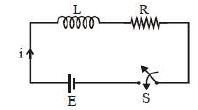
\(q=\int 1 d t\)\(\mathrm{q}=\int_{0}^{\mathrm{L} R} \frac{\mathrm{E}}{\mathrm{R}}\left[1-\mathrm{e}^{\frac{-\mathrm{Rt}}{\mathrm{L}}}\right] \mathrm{dt}\)
\(\mathrm{q}=\frac{\mathrm{EL}}{\mathrm{R}^{2}} \frac{1}{\mathrm{e}} \quad ; \quad \mathrm{q}=\frac{\mathrm{EL}}{2.7 \mathrm{R}^{2}}\)
-
- (A) \(RC\) પરિપથ જેમાં \(R = 1\, k\,\Omega \) અને \(C = 1\, \mu F\)
- (B) \(RL\) પરિપથ જેમાં \(R = 1\, k\,\Omega \) અને \(L = 10\, mH\)
- (C) \(RL\) પરિપથ જેમાં \(R = 1\, k\,\Omega \) અને \(L = 1\, mH\)
- (D) \(RC\) પરિપથ જેમાં \(R = 1\, k\,\Omega \) અને \(C = 10\, \mu F\)
જવાબ અને ઉકેલ જુઓ
સાચો જવાબ: (D)
Given phase difference \(=\frac{\pi}{4}\) and \(\omega=100\) \(rad/s\)\(\Rightarrow\) Reactance \((X)=\) Resistance \((R)\) Now by checking option.
Option \((A)\)
\(\mathrm{R}=1000 \,\Omega\) and \(\mathrm{X}_{\mathrm{c}}=\frac{1}{10^{-6} \times 100}=10^{4} \,\Omega\)
Option \((B)\)
\(\mathrm{R}=10^{3} \,\Omega\) and \(\mathrm{X}_{\mathrm{L}}=10 \times 10^{-3} \times 100=1 \,\Omega\)
Option \((\mathrm{C})\)
\(\mathrm{R}=10^{3} \,\Omega\) and \(\mathrm{X}_{\mathrm{L}}=10^{-3} 100=10^{-1}\, \Omega\)
Option \((D)\)
\(\mathrm{R}=10^{3} \,\Omega\) and \(\mathrm{X}_{\mathrm{c}}=\frac{1}{10 \times 10^{-6} \times 100}=10^{3} \,\Omega\)
-
- (A) \(5.65\times 10^2\,J\)
- (B) \(2.26\times 10^3\,J\)
- (C) \(5.17\times 10^2\,J\)
- (D) \(3.39\times 10^3\,J\)
જવાબ અને ઉકેલ જુઓ
સાચો જવાબ: (C)
\(E = Pt = \frac{{{E^2}}}{{{Z^2}}}Rt = \frac{{{{(24)}^2}}}{{{{60}^2} + {{(8.33\pi - 2\pi )}^2}}}(60)(60) = 518\,\,J\)

આ પેજ પર આ ફિલ્ટર મુજબ કોઈ પ્રશ્ન નથી.