


All JEE Mains 2019 Physics questions
31 chaptersShowing 51–100 of 468 questions
-
- (A) \(\lambda_A\), \(2\lambda_A\)
- (B) \(2\lambda_A\), \(\lambda_A\)
- (C) \(\lambda_A\), \(\frac{\lambda_A}{2}\)
- (D) \(\frac{\lambda_A}{2}\), \(\lambda_A\)
Show answer and solution
Correct Answer: (D)
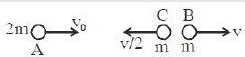
Let mass of \(B\) and \(C\) is \(m\) each. By momentum conservation \(2 m v_{0}=m v-\frac{m v}{2}\)\(\mathrm{v}=4 \mathrm{v}_{0}\)
\({{\text{P}}_{\text{A}}} = 2{\text{m}}{{\text{v}}_0}\) \({{\text{p}}_{\text{B}}} = 4{\text{m}}{{\text{v}}_0}\) \({{\text{p}}_{\text{c}}} = 2{\text{m}}{{\text{v}}_0}\)
De-Broglie wavelength \(\lambda=\frac{h}{p}\)
\(\lambda_{\mathrm{A}}=\frac{\mathrm{h}}{2 \mathrm{mv}_{0}}\) ; \(\lambda_{\mathrm{B}}=\frac{\mathrm{h}}{4 \mathrm{mv}_{0}}\) ; \(\lambda_{\mathrm{C}}=\frac{\mathrm{h}}{2 \mathrm{mv}_{0}}\)
-
- (A) \(10.00\)
- (B) \(0.07\)
- (C) \(14.14\)
- (D) \(4.47\)
Show answer and solution
Correct Answer: (C)
\(\lambda = \frac{{\text{h}}}{{\sqrt {2{\text{mqV}}} }}\)\(\frac{{{\lambda _P}}}{{{\lambda _\alpha }}} = \sqrt {\frac{{4 \times 1 \times 2500}}{{1 \times 1 \times 50}}} \) \( = 10\sqrt 2 = 14.14\)
-
- (A) \(1.1\times 10^6\,m/s\)
- (B) \(1.7\times 10^6\,m/s\)
- (C) \(1.8\times 10^6\,m/s\)
- (D) \(1.45\times 10^6\,m/s\)
Show answer and solution
Correct Answer: (D)
\({\lambda _e} = {\lambda _{{\text{photon }}}} \times {10^{ - 3}}\)\( \Rightarrow \frac{h}{{mv}} = \frac{c}{v} \times {10^{ - 3}}{\text{s}}\)
\( \Rightarrow v = \frac{{hv}}{{mC \times {{10}^{ - 3}}}}\)
\( = \frac{{6.62 \times {{10}^{ - 34}} \times 6 \times {{10}^{14}}}}{{9.1 \times {{10}^{ - 31}} \times 3 \times {{10}^8} \times {{10}^{ - 3}}}}\)
\( = 1.45 \times {10^6}\)
-
- (A) \(1700\)
- (B) \(2020\)
- (C) \(220\)
- (D) \(250\)
Show answer and solution
Correct Answer: (D)
\(5.6\,\,{\text{eV}} - 0.7{\text{eV}} = 4.9\,{\text{eV}}\) \( = \frac{{12410\,\,{\text{eV}} - \mathop {\text{A}}\limits^o }}{\lambda }\)\(\lambda = \frac{{12410\,\,{\text{eV}} - \mathop {\text{A}}\limits^o }}{{4.9\,{\text{eV}}}}\)
\( \approx 250\,{\text{nm}}\)
-
- (A) \(15.1\)
- (B) \(1.5\)
- (C) \(4.5\)
- (D) \(3\)
Show answer and solution
Correct Answer: (B)
\(\mathrm{K}_{\max }=\frac{\mathrm{hc}}{\lambda}-\frac{\mathrm{hc}}{\lambda_{0}}\)\(\Rightarrow K_{\max }=h c\left(\frac{\lambda_{0}-\lambda}{\lambda \lambda_{0}}\right)\)
\(\Rightarrow \mathrm{K}_{\max }=(1237)\left(\frac{380-260}{380 \times 260}\right)\)
\(=1.5 \mathrm{eV}\)
-
- (A) \(0.5\)
- (B) \(1.5\)
- (C) \(1\)
- (D) \(2\)
Show answer and solution
Correct Answer: (C)
\(\frac{\mathrm{hc}}{\lambda_{1}}=\phi+\mathrm{eV}_{1}\) ...... \((i)\)\(\frac{\mathrm{hc}}{\lambda_{2}}=\phi+\mathrm{eV}_{2}\) ...... \((ii)\)
\((i)\) \(-\) \((ii)\)
\(\operatorname{hc}\left(\frac{1}{\lambda_{1}}-\frac{1}{\lambda_{2}}\right)=e\left(V_{1}-V_{2}\right)\)
\( \Rightarrow {V_1} - {V_2} = \frac{{hc}}{e}\left( {\frac{{{\lambda _2} - {\lambda _1}}}{{{\lambda _1} - {\lambda _2}}}} \right)\)
\( = (1240\,\,{\text{nm}}\,\,V)\,\,\frac{{100\,{\text{nm}}}}{{300\,{\text{nm}} \times 400\,{\text{nm}}}}\)
\( = \frac{{12.4}}{{12}} \approx 1{\text{V}}\)
-
- (A) \(500\)
- (B) \(100\)
- (C) \(1\)
- (D) \(25\)
Show answer and solution
Correct Answer: (D)
\(\mathrm{k}=\frac{\mathrm{P}^{2}}{2 \mathrm{m}}=\frac{\mathrm{h}^{2}}{2 \mathrm{m} \lambda^{2}}\)\( = \frac{{{{\left( {6.62 \times {{10}^{ - 34}}} \right)}^2}}}{{2 \times 9.1 \times {{10}^{ - 31}} \times {{\left( {7.5 \times {{10}^{ - 12}}} \right)}^2}}}\) \( \times \frac{1}{{1.6 \times {{10}^{ - 19}}}}{\text{eV}}\)
Alternate method
\(\lambda=\sqrt{\frac{150}{V}}\)
\(\Rightarrow \quad 7.5 \times 10^{-12}=\sqrt{\frac{150}{V}}\)
\(V=\frac{80}{3} \mathrm{kV}\)
Energy \(=\frac{80}{3} \mathrm{keV}=25 \mathrm{keV}\)
-
- (A) \(6.3\times 10^{-4}\,Ns\)
- (B) \(3.5\times 10^{-6}\,Ns\)
- (C) \(5.0\times 10^{-3}\,Ns\)
- (D) \(1.4\times 10^{-6}\,Ns\)
Show answer and solution
Correct Answer: (C)
\(\mathrm{I}=25 \frac{\mathrm{W}}{\mathrm{cm}^{2}}\) \(=25 \times 10^{4} \mathrm{W} / \mathrm{m}^{2}\)\(P = 25 \times 25;\) \(W = 625\,W\)
\(\frac{\mathrm{hc}}{\lambda} \frac{\mathrm{dn}}{\mathrm{dt}}=\mathrm{P}\)
\(F=\frac{h}{\lambda} \frac{d n}{d t}=\frac{P}{C}=\frac{625}{3 \times 10^{8}}\)
Momentum \(=\frac{625 \times 40 \times 60}{3 \times 10^{8}}=5 \times 10^{-3} \mathrm{Ns}\)
-
- (A) \(1.8\)
- (B) \(2.5\)
- (C) \(5.6\)
- (D) \(1.4\)
Show answer and solution
Correct Answer: (A)
\(\frac{1240}{350}-\phi=(\mathrm{KE})_{1}=4 \mathrm{x}\) ..... \((1)\)\(\frac{1240}{540}-\phi=(\mathrm{KE})_{11}=x\) ...... \((2)\)
\((1)\,\,-\,\,(2)\)
\(\frac{1240}{350}-\frac{1240}{540}=3.542-2.296=3 x\)
\(1.246=3 x ; \quad x=0.41\)
\(\phi=2.296-0.41=1.886\)
-
- (A) \(0.48\)
- (B) \(2.48\)
- (C) \(0.72\)
- (D) \(2\)
Show answer and solution
Correct Answer: (A)
\(\omega=6 \times 10^{14} \times 2 \pi\)\(f=6 \times 10^{14}\)
\(\lambda = \frac{C}{f} = \frac{{3 \times {{10}^8}}}{{6 \times {{10}^{14}}}} = 5000\,\,\mathop {\text{A}}\limits^o \)
Energy of photon \(\Rightarrow \frac{12375}{5000}=2.475\, \mathrm{eV}\)
From Einstein's equation
\(\mathrm{KE}_{\max }=\mathrm{E}-\phi\)
\(\mathrm{eV}_{\mathrm{s}}=\mathrm{E}-\phi\)
\(\mathrm{eV}_{\mathrm{s}}=2.475-2\)
\(\mathrm{eV}_{\mathrm{o}}=0.475\, \mathrm{eV}\)
\(\mathrm{V}_{\mathrm{o}}=0.48\, \mathrm{V}\)
-
- (A) \(6.82\)
- (B) \(12.5\)
- (C) \(8.52\)
- (D) \(7.72\)
Show answer and solution
Correct Answer: (D)
\(\mathrm{KE}_{\max } =\mathrm{hv}_{\max }-\phi\)\( = \frac{{(6.6 \times {{10}^{ - 34}})(6.28 \times {{10}^7})(3 \times {{10}^8})}}{{1.6 \times {{10}^{ - 19}} \times 2 \times 3.14}} - 4.7\)
\(=12.37-4.7=7.67 \mathrm{eV}\)
-
- (A) \(1.82\)
- (B) \(1.66\)
- (C) \(2.12\)
- (D) \(1.95\)
Show answer and solution
Correct Answer: (B)
\(\mathrm{hv}=\phi+\mathrm{ev}_{0}\)\(v_{0}=\frac{h v}{e}-\frac{\phi}{e}\)
\(\mathrm{v}_{0}\) is zero for \(v=4 \times 10^{14} \mathrm{Hz}\)
\(0=\frac{h v}{e}-\frac{\phi}{e}\)
\(\Rightarrow \phi=\mathrm{hv}\)
\( = \frac{{6.63 \times {{10}^{ - 34}} \times 4 \times {{10}^{14}}}}{{1.6 \times {{10}^{ - 19}}}}\) \( = 1.66\,\,{\text{eV}}\)
-
- (A) \(\lambda = \sqrt {{\lambda _1}{\lambda _2}} \)
- (B) \(\lambda = \frac{{{\lambda _1} + {\lambda _2}}}{2}\)
- (C) \(\frac{2}{\lambda } = \frac{1}{{{\lambda _1}}} + \frac{1}{{{\lambda _2}}}\)
- (D) \(\frac{1}{{{\lambda ^2}}} = \frac{1}{{\lambda _1^2}} + \frac{1}{{\lambda _2^2}}\)
Show answer and solution
Correct Answer: (D)
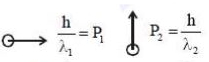
\(\vec{P}_{1}=\frac{h}{\lambda_{1}} \hat{i}\) and \(\vec{P}_{2}=\frac{h}{\lambda_{2}} \hat{j}\)Using momentum conservation
\(\vec{P}=\vec{P}_{1}+\vec{P}_{2}=\frac{h}{\lambda_{1}} \hat{i}+\frac{h}{\lambda_{2}} \hat{j}\)
\(|\vec P| = \sqrt {{{\left( {\frac{h}{{{\lambda _1}}}} \right)}^2} + {{\left( {\frac{h}{{{\lambda _2}}}} \right)}^2}} \)
\(\frac{h}{\lambda}=\sqrt{\left(\frac{h}{\lambda_{1}}\right)^{2}+\left(\frac{h}{\lambda_{2}}\right)^{2}}\)
\(\frac{1}{\lambda^{2}}=\frac{1}{\lambda_{1}^{2}}+\frac{1}{\lambda_{2}^{2}}\)
-
- (A) \(\frac {5v}{3}\)
- (B) \(\frac {4}{3}\,v\)
- (C) \(2\,v\)
- (D) \(\frac {3v}{2}\)
Show answer and solution
Correct Answer: (D)
\({\text{e}}{{\text{V}}_{\text{s}}} = {\text{hv}} - \phi \)\(\left\{ {\frac{{ - e{V_0}}}{2} = hv - \phi } \right\} \times 2\) ..... \((1)\)
\( - e{V_0} = \frac{{hv}}{2} - \phi \) ..... \((2)\)
\(0 = 2hv - 2\phi - \frac{{hv}}{2} + \phi \)
\(\phi = \frac{{3hv}}{2}\) \( \Rightarrow {v_{th}} = \frac{{3v}}{2}\)
-
- (A) \(2\)
- (B) \(0.7\)
- (C) \(1\)
- (D) \(1.4\)
Show answer and solution
Correct Answer: (D)
Intensity of \(EM\) wave is given by\({\mathrm{I}=\frac{\text { Power }}{\text { Area }}=\frac{1}{2} \varepsilon_{0} \mathrm{E}_{0}^{2} \mathrm{C}}\)
\({=\frac{27 \times 10^{-3}}{10 \times 10^{-6}}=\frac{1}{2} \times 9 \times 10^{-2} \times \mathrm{E}^{2} \times 3 \times 10^{8}}\)
\({\mathrm{E}=\sqrt{2} \times 10^{3}\, \mathrm{kV} / \mathrm{m}}\)
\({=1.4\, \mathrm{kV} / \mathrm{m}}\)
-
- (A) \(30\)
- (B) \(10\)
- (C) \(24\)
- (D) \(6\)
Show answer and solution
Correct Answer: (C)
\(I=\frac{1}{2} \varepsilon_{0} E_{0}^{2} C\) ..... \((i)\)\(0.96\, \mathrm{I}=\frac{1}{2} \mathrm{E}_{0}^{2} \mathrm{V}\) ..... \((ii)\)
\(\Rightarrow \quad 0.96=\left(\frac{E_{0}^{\prime}}{E_{0}}\right)^{2} \frac{\varepsilon}{\varepsilon_{0}} \frac{V}{C}\)
\(0.96 = {\left( {\frac{{E_0^\prime }}{{{E_0}}}} \right)^2}\frac{\varepsilon }{{{\varepsilon _0}}}\frac{1}{{1.5}}\)
\({0.96=\left(\frac{E_{0}^{\prime}}{E_{0}}\right)^{2} \varepsilon_{r} \frac{1}{1.5}}\) ..... \((iii)\)
and \({\text{v}} = \frac{1}{{\sqrt {{\mu _{\text{o}}}{\varepsilon _{\text{o}}}{\mu _{\text{r}}}{\varepsilon _{\text{r}}}} }};\) \({\text{v}} = \frac{{\text{C}}}{{\sqrt {{\mu _{\text{r}}}{\varepsilon _{\text{r}}}} }}\)
\(\sqrt {{\mu _r}{\varepsilon _r}} = \frac{C}{v}\) ; \(\sqrt {{\varepsilon _r}} = 1.5\,;\) \({\mu _r} \approx 1\) for transparent medium.
From equation \((iii)\)
\(0.96=\left(\frac{E_{0}^{\prime}}{E_{0}}\right)^{2}(1.5)^{2}\left(\frac{1}{1.5}\right)\)
\(\Rightarrow E_{\circ}^{\prime}=24 \mathrm{V} / \mathrm{m}\)
-
- (A) \(\vec B = 2 \times {10^{ - 7}}\,\sin \,\left( {1.5 \times {{10}^2}x + 0.5 \times {{10}^{11}}t} \right)\hat j\)
- (B) \(\vec B = 60\,\sin \,\left( {0.5 \times {{10}^3}x + 1.5 \times {{10}^{11}}t} \right)\hat k\)
- (C) \(\vec B = 2 \times {10^{ - 7}}\,\sin \,\left( {0.5 \times {{10}^3}z - 1.5 \times {{10}^{11}}t} \right)\hat i\)
- (D) \(\vec B = 2 \times {10^{7}}\,\sin \,\left( {0.5 \times {{10}^3}z + 1.5 \times {{10}^{11}}t} \right)\hat i\)
Show answer and solution
Correct Answer: (C)
Magnetic field when electromagnetic wave propagates in \(+z\) direction.\(\mathrm{B}=\mathrm{B}_{0} \sin (\mathrm{kz}-\omega \mathrm{t})\)
where
\(\mathrm{B}_{0}-\frac{60}{3 \times 10^{8}}=2 \times 10^{-7}\)
\(\mathrm{k}=\frac{2 \pi}{\lambda}=0.5 \times 10^{3}\)
\(\omega=2 \pi \mathrm{f}=1.5 \times 10^{11}\)
-
- (A) \(18.9 \times {10^{ - 8}}\,\hat kT\)
- (B) \(2.1 \times {10^{ - 8}}\,\hat kT\)
- (C) \(6.3 \times {10^{ - 8}}\,\hat kT\)
- (D) \(18.9 \times {10^{ 8}}\,\hat kT\)
Show answer and solution
Correct Answer: (B)
\(\frac{E}{B}=C\)\(B=\frac{E}{C}=\frac{6.3 \times 10^{27}}{3 \times 10^{8}}=2.1 \times 10^{19}\)
-
- (A) \(2 \times {10^{ - 8}}\,T\) along \(z -\) direction
- (B) \(6 \times {10^{ - 8}}\,T\) along \(x -\) direction
- (C) \(6 \times {10^{ - 8}}\,T\) along \(z -\) direction
- (D) \(2 \times {10^{ - 8}}\,T\) along \(y -\) direction
Show answer and solution
Correct Answer: (A)
The direction of propagation of an \(EM\) wave is direction of \(\overrightarrow{\mathrm{E}} \times \overrightarrow{\mathrm{B}}\) \(\hat{\mathrm{i}}=\hat{\mathrm{j}} \times \hat{\mathrm{B}}\)\(\Rightarrow \hat{\mathrm{B}}=\hat{\mathrm{k}}\)
\(C=\frac{E}{B} \Rightarrow B=\frac{E}{C}=\frac{6}{3 \times 10^{8}}\)
\(\mathrm{B}=2 \times 10^{-8}\, \mathrm{T}\) along \(\mathrm{z}\) direction.
-
- (A) \(\hat S = \left( {\frac{{ - 3\hat j + 4\hat k}}{5}} \right)\)
- (B) \(\hat S = \left( {\frac{{ 4\hat j - 3\hat k}}{5}} \right)\)
- (C) \(\hat S = \left( {\frac{{ - 4\hat k + 3\hat j}}{5}} \right)\)
- (D) \(\hat S = \left( {\frac{{ - 3\hat i - 4\hat j}}{5}} \right)\)
Show answer and solution
Correct Answer: (A)
\(\overrightarrow{\mathrm{E}}=\mathrm{E}_{0} \hat{\mathrm{n}} \sin \left(\omega \mathrm{t}+(6 \mathrm{y}-8 \mathrm{z})=\mathrm{E}_{0} \hat{\mathrm{n}} \sin (\omega \mathrm{t}+\overrightarrow{\mathrm{k}} \cdot \overrightarrow{\mathrm{r}})\right.\)where \(\vec{r}=x \hat{i}+y \hat{j}+z \hat{k}\) and \(\vec{k} \cdot \vec{r}=6 y-8 z\)
\(\Rightarrow \overrightarrow{\mathrm{k}}=6 \hat{\mathrm{j}}-8 \hat{\mathrm{k}}\)
\(\text { direction of propagation } \hat{\mathrm{s}} =-\hat{\mathrm{k}}\)
\( =\left(\frac{-3 \hat{\mathrm{j}}+4 \hat{\mathrm{k}}}{5}\right) \)
-
- (A) \(\left( {\frac{1}{{\sqrt n }},\frac{1}{{\sqrt n }}} \right)\)
- (B) \(\left( {\sqrt n ,\sqrt n } \right)\)
- (C) \(\left( {\frac{1}{{\sqrt n }},\sqrt n } \right)\)
- (D) \(\,\left( {\sqrt n ,\frac{1}{{\sqrt n }}} \right)\)
Show answer and solution
Correct Answer: (D)
\(\frac{E_{i}}{B_{i}}=C.........(1)\)\(\frac{E_{f}}{B_{f}}=\frac{c}{n}.........(2)\)
\( \Rightarrow \frac{{{E_i}{B_f}}}{{{E_f}}} = \frac{1}{n}\)
\( \Rightarrow \frac{{{E_i}}}{{{E_f}}} = \frac{1}{n}\frac{{{B_i}}}{{{B_f}}}\)
\(\left( {\because \,n = \frac{1}{{\sqrt {{\mu _0}{e_r}} }}} \right)\)
\(\frac{1}{{\sqrt n }}:\sqrt n \)
-
- (A) \(A -S, B -Q, C -R, D -P\)
- (B) \(A -Q, B -S, C -P, D -R\)
- (C) \(A -R, B -P, C -S, D -Q\)
- (D) \(A -Q, B -S, C -R, D -P\)
Show answer and solution
Correct Answer: (B)
\(Optical\, Fibre\, Communication -Infrared\, light\)For fiber optics with glass fibers, we use light in the infrared region which has wavelengths longer than visible light, typically around \(850,1300\) and \(1550 \mathrm{nm}\). Scattering is caused by light bouncing off atoms or molecules in the glass.
\(Radar -Radiowave\)
Radar is a detection system that uses radio waves to determine the range, angle, or velocity of objects.
\(Sonar -ultrasound\)
Sonar, as used in robotics means having an ultrasonic emitter and ultrasonic receiver. There is also some sonar with a single emitter/receiver. However, they all use ultrasonic sound ways in order to sense the distance to an object.
\(Mobilephones -microwave\)
we use microwaves as a power transmitter to our mobile phones. For this, we require a sensor, a rectenna circuit and a filer on our mobile phone. The microwave is sent with the message by the transmitter using an antenna at frequency \(2.24 \mathrm{GHz}\).
-
- (A) \(6 \times {10^4}\,N/C\)
- (B) \(3 \times {10^4}\,N/C\)
- (C) \(4 \times {10^4}\,N/C\)
- (D) \(4.5 \times {10^4}\,N/C\)
Show answer and solution
Correct Answer: (B)
\(E_{0}=B_{0} \times C\)\(=100 \times 10^{-6} \times 3 \times 10^{8}\)
\(=3 \times 10^{4} \,N / C\)
-
- (A) \(\vec B = \frac{{{E_0}}}{C}\hat j\,\sin \,\left( {kz} \right)\,\cos \,\left( {\omega t} \right)\)
- (B) \(\vec B = \frac{{{E_0}}}{C}\hat k\,\sin \,\left( {kz} \right)\,\cos \,\left( {\omega t} \right)\)
- (C) \(\vec B = \frac{{{E_0}}}{C}\hat j\,\cos \,\left( {kz} \right)\,\sin \,\left( {\omega t} \right)\)
- (D) \(\vec B = \frac{{{E_0}}}{C}\hat j\,\sin \,\left( {kz} \right)\,\sin \,\left( {\omega t} \right)\)
Show answer and solution
Correct Answer: (D)
\(\because \overrightarrow{\mathrm{E}} \times \overrightarrow{\mathrm{B}} \| \overrightarrow{\mathrm{v}}\)Given that wave is propagating along positive \(z\) -axis and \(\overrightarrow{\mathrm{E}}\) along positive \(x\) -axis. Hence \(\overrightarrow{\mathrm{B}}\) along \(\mathrm{y}\) -axis.
From Maxwell equation
\(\overrightarrow{\mathrm{V}} \times \overrightarrow{\mathrm{E}}=-\frac{\partial \mathrm{B}}{\partial \mathrm{t}}\)
i.e. \(\frac{\partial E}{\partial Z}=-\frac{\partial B}{d t}\) and \(B_{0}=\frac{E_{0}}{C}\)
- 75. The energy associated with electric field is \((U_E)\) and with magnetic field is \((U_B)\) for an electromagnetic wave in free space. Then 2019 Medium
- (A) \({U_E} = \frac{{{U_B}}}{2}\)
- (B) \(U_E\,>\,U_B\)
- (C) \(U_E\,<\,U_B\)
- (D) \(U_E\,=\,U_B\)
Show answer and solution
Correct Answer: (D)
\(\mathrm{B}=\frac{\mathrm{E}}{\mathrm{C}}\)\(\Rightarrow \mathrm{U}_{\mathrm{E}}=\frac{1}{2} \varepsilon_{\mathrm{o}} \mathrm{E}^{2}\)
\(\mathrm{U}_{\mathrm{B}}=\frac{\mathrm{B}^{2}}{2 \mu_{0}}=\frac{\mathrm{E}^{2}}{2 \mu_{0} \mathrm{C}^{2}}=\frac{\mathrm{E}^{2}}{2 \mu_{0}}\left(\mu_{0} \varepsilon_{0}\right)=\mathrm{U}_{\mathrm{E}}\)
-
- (A) \(0.9\,N\)
- (B) \(3\times 10^{-2}\,N\)
- (C) \(0.1\,N\)
- (D) \(0.6\,N\)
Show answer and solution
Correct Answer: (D)
Maximum electric field \(E=(B)(C)\)\(\overrightarrow{\mathrm{E}}_{0}=\left(3 \times 10^{-5}\right) \mathrm{c}(-\hat{\mathrm{j}})\)
\(\overrightarrow{\mathrm{E}}_{1}=\left(2 \times 10^{-6}\right) \mathrm{c}(-\hat{\mathrm{i}})\)
Maximum force
\(\overrightarrow{\mathrm{F}}_{\mathrm{net}}=10^{-4} \times 3 \times 10^{8} \sqrt{\left(3 \times 10^{-5}\right)^{2}+\left(2 \times 10^{-6}\right)^{2}}=0.9\, \mathrm{N}\)
\(\mathrm{F}_{\mathrm{ms}}=\frac{\mathrm{F}_{0}}{\sqrt{2}}=0.6\, \mathrm{N}\) (approx)
-
- (A) \(\vec E = 4.8 \times {10^{ 2}}\,\cos \,\left( {2 \times {{10}^7}z + 6 \times {{10}^{15}}t} \right)\left( { - \hat i + 2\hat j} \right)\frac{V}{m}\)
- (B) \(\vec E = 4.8 \times {10^{ 2}}\,\cos \,\left( {2 \times {{10}^7}z + 6 \times {{10}^{15}}t} \right)\left( { - 2\hat j + 2\hat i} \right)\frac{V}{m}\)
- (C) \(\vec E = 4.8 \times {10^{ 2}}\,\cos \,\left( {2 \times {{10}^7}z + 6 \times {{10}^{15}}t} \right)\left( {\hat i + 2\hat j} \right)\frac{V}{m}\)
- (D) \(\vec E = 4.8 \times {10^{ 2}}\,\cos \,\left( {2 \times {{10}^7}z + 6 \times {{10}^{15}}t} \right)\left( {2\hat i + \hat j} \right)\frac{V}{m}\)
Show answer and solution
Correct Answer: (A)
If we use that direction of light propagation will be along \(\overrightarrow{\mathrm{E}} \times \overrightarrow{\mathrm{B}}\). Then \((\mathrm{A})\) option is correct.Magnitude of \(E=C B\)
\(E=3 \times 10^{8} \times 1.6 \times 10^{-6} \times \sqrt{5}\)
\(E=4.8 \times 10^{2} \times \sqrt{5}\)
\(\overrightarrow{\mathrm{E}}\) and \(\overrightarrow{\mathrm{B}}\) are perpendicular to each other \(\Rightarrow \overrightarrow{\mathrm{E}} \cdot \overrightarrow{\mathrm{B}}=0\)
\(\Rightarrow\) Either direction of \(\bar{E}\) is \(\hat{i}-2 \hat{j}\) or \(-\hat{i}+2 \hat{j}\) from given option
Also wave propagation direction is parallel to \(\overrightarrow{\mathrm{E}} \times \overrightarrow{\mathrm{B}}\) which is \(-\overrightarrow{\mathrm{k}}\)
\(\Rightarrow \overrightarrow{\mathrm{E}}\) is along \((-\hat{\mathrm{i}}+2 \hat{\mathrm{j}})\)
-
- (A) \(1\,T\)
- (B) \(10^2\,T\)
- (C) \(10^{-2}\,T\)
- (D) \(10^{-4}\,T\)
Show answer and solution
Correct Answer: (D)
\(\mathrm{I}=\frac{\mathrm{B}_{\mathrm{o}}^{2}}{2 \mu_{\mathrm{o}}} \times \mathrm{C}\)\(B_{0}^{2}=1 \times 2 \mu_{0} \times C\)
\(B_{0}^{2}=\frac{10^{3} \times 2 \times 4 \pi \times 10^{-7}}{3 \times 10^{8}}\)
\(B_{0} \approx 10^{-4} \,T\)
-
- (A) \(10.67\)
- (B) \(1.80\)
- (C) \(5.33\)
- (D) \(16\)
Show answer and solution
Correct Answer: (A)
since unpolarised light falls on \(\mathrm{P}_{1}\)\(\Rightarrow\) Intensity of light transmitted from \(P_{1}=\frac{I_{0}}{2}\).
Pass axis of \(\mathrm{P}_{2}\) will be at an angle of \(30^{\circ}\) with \(\mathrm{P}_{1}\)
\(\therefore\) Intensity of light transmitted from
\(P_{2}=\frac{I_{0}}{2} \cos ^{2} 30^{\circ}=\frac{3I_{0}}{8}\)
Pass axis of \(\mathrm{P}_{3}\) is at an angle of \(60^{\circ}\) with \(\mathrm{P}_{2}\)
\(\therefore \) Intensity of light transmitted from
\({P_3} = \frac{{3{I_0}}}{8}{\cos ^2}{60^\circ } = \frac{{3{I_0}}}{{32}}\)
\(\therefore\left(\frac{I_{0}}{I}\right)=\frac{32}{3}=10.67\)
-
- (A) \(457.5\times10^{-9}\) radian
- (B) \(610\times10^{-9}\) radian
- (C) \(305\times10^{-9}\) radian
- (D) \(152.5\times10^{-9}\) radian
Show answer and solution
Correct Answer: (C)
Limit of resolution of telescope \(=\frac{1.22 \lambda}{\mathrm{D}}\)\(\theta = \frac{{1.22 \times 500 \times {{10}^{ - 9}}}}{{200 \times {{10}^{ - 2}}}}\) \( = 305 \times {10^{ - 9}}\,{\text{radian}}\)
-
- (A) \(\sqrt {\frac{5}{3}} \)
- (B) \(\frac{3}{{\sqrt 5 }}\)
- (C) \(\frac{5}{{\sqrt 3 }}\)
- (D) \(\frac{4}{3}\)
Show answer and solution
Correct Answer: (B)
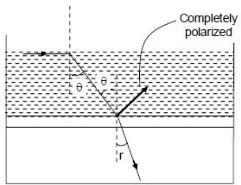
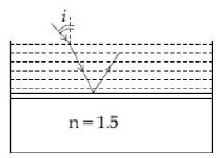
\(\sin 90^{\circ}=\mu \sin \theta\)\(\Rightarrow \quad \sin \theta=\frac{1}{\mu}\)
\({\mu \sin \theta=1.5 \sin r}\)
\({\mu \tan \theta=1.5}\)
\( \Rightarrow \tan \theta = \frac{{1.5}}{\mu }\)
\(\sin \theta = \frac{3}{{\sqrt {9 + 4{\mu ^2}} }} = \frac{1}{\mu }\)
\(9{\mu ^2} = 9 + 4{\mu ^2}\)
\( \Rightarrow \mu = \frac{3}{{\sqrt 5 }}\)
-
- (A) \(\frac{\lambda }{{2\left( {\sqrt 5 - 2} \right)}}\)
- (B) \(\frac{\lambda }{{\left( {\sqrt 5 - 2} \right)}}\)
- (C) \(\frac{\lambda }{{2\left( {5 - \sqrt 2 } \right)}}\)
- (D) \(\frac{\lambda }{{\left( {5 - \sqrt 2 } \right)}}\)
Show answer and solution
Correct Answer: (A)
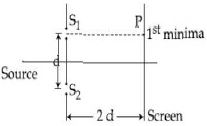
\(\sqrt{(2 d)^{2}+(d)^{2}}-2 d=\frac{\lambda}{2}\)\(\Rightarrow \quad(\sqrt{5}-2) d=\frac{\lambda}{2}\)
\(\Rightarrow \quad d=\frac{\lambda}{2(\sqrt{5}-2)}\)
-
- (A) \(1.5 \times {10^{ - 7}}\,rad\)
- (B) \(2.0 \times {10^{ - 7}}\,rad\)
- (C) \(3.0 \times {10^{ - 7}}\,rad\)
- (D) \(4.5 \times {10^{ - 7}}\,rad\)
Show answer and solution
Correct Answer: (C)
Limit of resolution \(=\frac{1.22 \lambda}{\mathrm{d}}\)\(=\frac{1.22 \times 600 \times 10^{-9}}{250 \times 10^{-2}}\)
\(=2.9 \times 10^{-7} \mathrm{rad}\)
-
- (A) \(10\)
- (B) \(05\)
- (C) \(04\)
- (D) \(09\)
Show answer and solution
Correct Answer: (B)
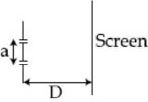
For diffractionLocation of \(1^{\text {st }}\) minima
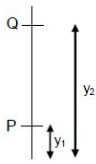
\({y_1} = \frac{{D\lambda }}{a} = 0.2469\,D\lambda \)
Location of \(2^{\text {nd }}\) minima
\({{\text{y}}_2} = \frac{{2{\text{D}}\lambda }}{{\text{a}}} = 0.4938\,{\text{D}}\lambda \)
Now for interference
Path for interference
Path difference at \(P\)
\(\frac{d y}{D}=4.8 \lambda\)
Path difference at \(P\)
\(\frac{d y}{D}=9.6 \lambda\)
So orders of maxima in between \(\mathrm{P}\) and \(\mathrm{Q}\) is
\(5,\,6,\,7,\,8,\,9\)
So \(5\) bright fringes all present between \(\mathrm{P}\) and \(\mathrm{Q}\)
-
- (A) \(\frac{\lambda }{{2\,\left( {\mu - 1} \right)}}\)
- (B) \(\frac{\lambda }{{\,\left( {\mu - 1} \right)}}\)
- (C) \(\frac{\lambda }{{\,\left( {2\mu - 1} \right)}}\)
- (D) \(\frac{{2\lambda }}{{\,\left( {\mu - 1} \right)}}\)
Show answer and solution
Correct Answer: (B)
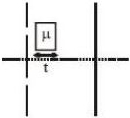
\(\Delta x=(\mu-1)\, t=1 \lambda\)for one maximum shift
\(t=\frac{\lambda}{\mu-1}\)
-
- (A) \(0.74\)
- (B) \(0.85\)
- (C) \(0.94\)
- (D) \(0.80\)
Show answer and solution
Correct Answer: (B)
\(\Delta x=\frac{\lambda}{8}\)Phase \(|\Delta P|=\frac{2 \pi}{\lambda} \times \frac{\lambda}{8}=\frac{\pi}{4}\)
\(\therefore \) \(\mathrm{I}_{\mathrm{res}}=I+I+2I \cos \left(\frac{\mathrm{R}}{4}\right)\)
\(=\,2I\left(1+\frac{1}{\sqrt{2}}\right)=2I \times 1.7\)
\(\therefore \quad \frac{I_{res }}{I_{\operatorname{man}}}=\frac{2I\times 1.7}{41}=0.85\)
-
- (A) \({\left( {\sqrt 3 + 1} \right)^4}\,:\,16\)
- (B) \(25\,:\,9\)
- (C) \(9\,:\,1\)
- (D) \(4\,:\,1\)
Show answer and solution
Correct Answer: (C)
\(\frac{{{I_{\max }}}}{{{I_{\min }}}} = \frac{9}{1}\) -
- (A) \(640\)
- (B) \(320\)
- (C) \(321\)
- (D) \(641\)
Show answer and solution
Correct Answer: (D)
\(\Delta X_{\max }=d \sin \theta=0.32 \sin 30=0.16\, \mathrm{mm}\)\(\therefore n = \frac{{\Delta {X_{\max }}}}{\lambda }\)
\( = \frac{{0.16 \times {{10}^{ - 3}}}}{{500 \times {{10}^{ - 9}}}}\)
\(=\frac{0.16 \times 10^{6}}{500}=\frac{1600}{5}=320\)
Number of \(\mathrm{BFs}=(2 n+1)=641\)
-
- (A) \(625\, nm, 500\, nm\)
- (B) \(380\, nm, 525\, nm\)
- (C) \(380\, nm, 500\, nm\)
- (D) \(400\, nm, 500\, nm\)
Show answer and solution
Correct Answer: (A)
For maxima,\(\operatorname{dsin} \theta=n \lambda\)
\(\lambda=\frac{\mathrm{d} \theta}{\mathrm{n}}\) ( \(\because \,\sin \theta \approx \theta \) when \(\theta\) is small )
\(=\frac{2500}{n}\, n m\)
Take \(n=4,5\) for \(\lambda=625\, \mathrm{nm}\) and \(500 \,\mathrm{nm}\)
-
- (A) \(\frac{{2nD\lambda }}{{a\left( {\mu - 1} \right)}}\)
- (B) \(\frac{{nD\lambda }}{{a\left( {\mu - 1} \right)}}\)
- (C) \(\frac{{2D\lambda }}{{a\left( {\mu - 1} \right)}}\)
- (D) \(\frac{{n\lambda }}{{\left( {\mu - 1} \right)}}\)
Show answer and solution
Correct Answer: (D)
Path difference at central maxima \(\Delta x=(\mu-1)\, t,\) whole pattern will shift by same amount which will be given by\((\mu-1) \,t \frac{D}{d}=n \frac{\lambda D}{d},\) according to eh question \(t=\frac{n \lambda}{(\mu-1)}\)
No option is matching, therefore question should be award bonus.
\(\therefore \) Correct option should be (Bonus)
-
- (A) \(0.48\)
- (B) \(0.38\)
- (C) \(0.24\)
- (D) \(0.12\)
Show answer and solution
Correct Answer: (C)
Numerical aperature of the microscope is given as\({\text{NA}} = \frac{{0.61\,\lambda }}{{\text{d}}}\)
Where \(\mathrm{d}=\) minimum sparaton between two points to be seen as distinct
\({\text{d}} = \frac{{0.61\,\,\lambda }}{{{\text{NA}}}} = \) \(\frac{{(0.61) \times \left( {5000 \times 10\,{{\text{m}}^{ - 10}}} \right)}}{{1.25}}\) \( = 2.4 \times {10^{ - 7}}{\text{m}}\)
\( = 0.24\,\mu m\)
-
- (A) \(16 : 9\)
- (B) \(25 : 9\)
- (C) \(4 : 1\)
- (D) \(5 : 3\)
Show answer and solution
Correct Answer: (B)
\(\left( {\frac{{\sqrt {{I_1}} + \sqrt {{I_2}} }}{{\sqrt {{I_1}} - \sqrt {{I_2}} }}} \right) = \frac{{16}}{1}\) ; \(\frac{\sqrt{I_{1}}+\sqrt{I_{2}}}{\sqrt{I_{1}}-\sqrt{I_{2}}}=\frac{4}{1}\)\( \Rightarrow \quad 3\sqrt {{I_1}} = 5\sqrt {{I_2}} \)
\(\Rightarrow \quad \frac{I_{1}}{I_{2}}=\frac{25}{9}\)
-
- (A) \(0.16\)
- (B) \(1.60\)
- (C) \(0.24\)
- (D) \(0.32\)
Show answer and solution
Correct Answer: (D)
\(m = \frac{f}{{f - u}}\)\(5 = \frac{{ - 40}}{{ - 40 - u}}\,;\,u\, = \, - 32\,cm\)
-
- (A) \(13.4\)
- (B) \(8.8\)
- (C) \(6.7\)
- (D) \(11.7\)
Show answer and solution
Correct Answer: (B)
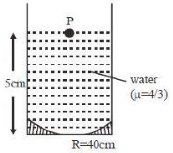
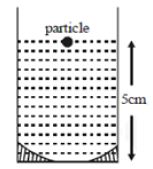
Light incident from particle \(P\) will be reflected at mirror.\({\text{u}} = - 5\,{\text{cm}},\) \({\text{f}} = {\text{m}} - \frac{{\text{R}}}{2}\) \( = - 20\,{\text{cm}}\)
\(\frac{1}{v} + \frac{1}{u} = \frac{1}{f}\) ; \(\boxed{{v_1} = + \frac{{20}}{3}\,\,cm}\)
This image will act as object for light getting refracted at water surface.
So, object distance \(d=5+\frac{20}{3}=\frac{35}{3} \,\mathrm{cm}\)
Below water surface.
After refraction, final image is at
\({d^\prime } = d\left( {\frac{{{\mu _2}}}{{{\mu _1}}}} \right)\) \( = \left( {\frac{{35}}{3}} \right)\left( {\frac{1}{{4/3}}} \right)\)
\(=\frac{35}{4}=8.75 \,\mathrm{cm}\)
\( \approx 8.8\, \mathrm{cm}\)
-
- (A) \(1.1\, cm\) away fro the lens
- (B) \(0\)
- (C) \(0.55\, cm\) towards the lens
- (D) \(0.55\, cm\) away from the lens
Show answer and solution
Correct Answer: (D)
If \(u=-10 \,\mathrm{cm}\)\(v=+10\, \mathrm{cm}\)
\(\Rightarrow \mathrm{f}=5\,\mathrm{cm}\)
Glass plate shift \(=\mathrm{t}\left(1-\frac{1}{\mu}\right)=1.5\left(1-\frac{2}{3}\right)=0.5\,\mathrm{cm}\)
So, new \(u=10-0.5=9.5\,\mathrm{cm}\)
\(\frac{1}{v}-\frac{1}{u}=\frac{1}{f}\)
\(\frac{1}{v}-\frac{1}{-9.5}=\frac{1}{5}\)
After solving we get,
\(v=\frac{47.5}{4.5}\). Hence, shift \(\frac{47.5}{4.5}-10=\left(\frac{2.5}{4.5}\right)=0.55\, \mathrm{cm}\)
-
- (A) \(20\)
- (B) \(10\)
- (C) \(30\)
- (D) \(40\)
Show answer and solution
Correct Answer: (B)
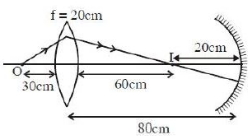
Image formed by lens\(\frac{1}{v}-\frac{1}{u}=\frac{1}{f}\) ; \(\frac{1}{v}+\frac{1}{30}=\frac{1}{20}\)
\(v=+60\, \mathrm{cm}\)
If image position does not change even when mirror is removed it means image formed by lens is formed at centre of curvature of spherical mirror.
Radius of curvature of mirror \(=80-60=20\,{cm}\)
\(\Rightarrow\) Focal length of mirror \(f=10\, \mathrm{cm}\) for virtual image, object is to be kept between focus and pole.
\(\Rightarrow\) Maximum distance of object from spherical mirror for which virtual image is formed, is \(10\,\mathrm{cm} .\)
-
- (A) \(5 : 3\)
- (B) \(2 : 1\)
- (C) \(4 : 3\)
- (D) \(3 : 1\)
Show answer and solution
Correct Answer: (D)
Magnification is \(2\)If image is real, \(x_{1}=\frac{3 f}{2}\)
If image is virtual, \(x_{2}=\frac{f}{2}\)
\(\frac{x_{1}}{x_{2}}=3: 1\)
-
- (A) \(90\)
- (B) \(30\)
- (C) \(60\)
- (D) \(45\)
Show answer and solution
Correct Answer: (C)
\(i=\theta\)\(r_{1}=r_{2}=\frac{A}{2}=30^{\circ}\)
by Snell's law
\(1 \times \sin i = \sqrt 3 \times \frac{1}{2} = \frac{{\sqrt 3 }}{2}\)
\(i=60\)
-
- (A) \(f_1\,-\,f_2\)
- (B) \(\frac{R}{{{\mu _2} - {\mu _1}}}\)
- (C) \(\frac{{2{f_1}{f_2}}}{{{f_1} + {f_2}}}\)
- (D) \({{f_1} + {f_2}}\)
Show answer and solution
Correct Answer: (B)
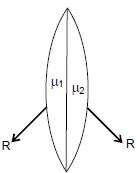
\(\frac{1}{f}=\frac{\left(\mu_{1}-1\right)}{R}+\frac{\left(1-\mu_{2}\right)}{R}\)\(\frac{1}{f}=\frac{\left(\mu_{1}-\mu_{2}\right)}{R}\)
\(\Rightarrow \quad \mathrm{f}=\frac{\mathrm{R}}{\mu_{1}-\mu_{2}}\)
-
- (A) \({\mu _1} +2{\mu _2} = 3\)
- (B) \({2\mu _1} + {\mu _2} = 1\)
- (C) \({3\mu _2} + {\mu _1} = 1\)
- (D) \({2\mu _2} + {\mu _1} = 1\)
Show answer and solution
Correct Answer: (A)
\(\frac{1}{{{f_1}}} = \left( {{\mu _1} - 1} \right)\left( {\frac{1}{R} - \frac{1}{\infty }} \right)\) ; \(\frac{1}{{{f_2}}} = \left( {{\mu _2} - 1} \right)\left( {\frac{1}{\infty } - \frac{1}{R}} \right)\)\(\frac{1}{{{f_1}}} = \frac{{(\mu - 1)}}{R}\) ; \(\frac{1}{{{f_2}}} = - \left( {\frac{{{\mu _2} - 1}}{R}} \right)\)
\(\mathrm{f}_{2}=2 \mathrm{f}_{1}\) ; \(\frac{1}{\mathrm{f}_{1}}=\frac{2}{\mathrm{f}_{2}}\)
\(\frac{\mu_{1}-1}{R}=\frac{-2\left(\mu_{2}-1\right)}{R}\)
\(\mu_{1}+2 \mu_{2}=3\)

No questions on this page match these filters.