


All JEE Mains 2021 Chemistry questions
26 chaptersShowing 51–100 of 420 questions
-
- (A) \(\mathrm{C}_{2} \mathrm{O}_{4}^{2-} \rightarrow 2 \mathrm{CO}_{2}\)
- (B) \(\mathrm{CrO}_{4}^{2-} \rightarrow \mathrm{Cr}^{3+}\)
- (C) \(\mathrm{Cr}_{2} \mathrm{O}_{7}^{2-} \rightarrow 2 \mathrm{Cr}^{3+}\)
- (D) \(\mathrm{MnO}_{4}^{-} \rightarrow \mathrm{Mn}^{2+}\)
Show answer and solution
Correct Answer: (D)
\(\underset{(+7)}{\mathrm{MnO}_{4}^{-}} \rightarrow \underset{(+2)}{\mathrm{Mn}^{2+}} 5 \mathrm{e}^{-}\)change -
- (A) \(29\)
- (B) \(17\)
- (C) \(12\)
- (D) \(22\)
Show answer and solution
Correct Answer: (C)
\(16 e ^{\ominus}+ S _{8} \longrightarrow 8 S ^{2-}\)\(\frac{12 H _{2} O + S _{8} \longrightarrow 4 S _{2} O _{3}^{2-}+24 H ^{+}+16 e ^{\circ}}{2 S _{8}+12 H _{2} O \longrightarrow 8 S ^{2-}+4 S _{2} O _{3}^{2-}+24 H }\)
for balancing in basic medium add equal number of \(OH ^{\ominus}\) that of \(H ^{+}\)
\(2 S _{8}+12 H _{2} O +24 OH ^{\ominus} \longrightarrow 8 S ^{2-}+4 S _{2} O _{8}^{2-}\)
\(+24 H _{2} O\)
\(2 S _{8}+24 OH ^{\ominus} \rightarrow 8 S ^{2-}+4 S _{2} O _{8}^{2-}+12 H _{2} O\)
\(S _{8}+12 OH ^{\ominus} \rightarrow 4 S ^{2-}+2 S _{2} O _{8}^{2-}+6 H _{2} O\)
\(a =12\)
-
- (A) \(\mathrm{BrO}_{2}^{-}\)
- (B) \(\mathrm{BrO}_{4}^{-}\)
- (C) \(\mathrm{BrO}^{-}\)
- (D) \(\mathrm{BrO}_{3}^{-}\)
Show answer and solution
Correct Answer: (B)
In \(\mathrm{BrO}_{4}^{\ominus}, \mathrm{Br}\) is in highest oxidation state \((+7),\) Soit cannot oxidise further it only reduced hence it cannot show disproportionation reaction - 54. A non-reducing sugar \("A"\) hydrolyses to give two reducing mono saccharides. Sugar \(A\) is 2021 Medium
- (A) Fructose
- (B) Galactose
- (C) Glucose
- (D) Sucrose
Show answer and solution
Correct Answer: (D)
Sucrose \(\quad \stackrel{ H _{2} O }{\longrightarrow}\) glucose \(+\) Fructose(Non reducing sugar) \(\quad\) (Re ducing sugar) \(\quad\) (Reducing sugar)
-
- (A) Amylase and Invertase
- (B) Invertase and Amylase
- (C) Invertase and Zymase
- (D) Zymase and Invertase
Show answer and solution
Correct Answer: (C)
Informative\(OR\)
\(C _{12} H _{22} O _{11}+ H _{2} O \stackrel{\text { Invertase }}{\longrightarrow} C _{6} H _{12} O _{6}+ C _{6} H _{12} O _{6}\)
\(\quad \quad\quad\quad\quad\quad\quad\quad\quad\quad\quad\)Glucose \(\quad\quad\) Fructose
\(C _{6} H _{12} O _{6} \stackrel{\text { Zymase }}{\longrightarrow} 2 C _{6} H _{5} OH +2 CO _{2}\)
- 56. Compound \(A\) gives \(D-\)Galactose and \(D-\)Glucose on hydrolysis. The compound \(A\) is: 2021 Medium
- (A) Lactose
- (B) Amylose
- (C) Sucrose
- (D) Maltose
Show answer and solution
Correct Answer: (A)
Lactose : It is a disaccharide of \(\beta\)-D-Galactose and \(\beta\)-D-Glucose with \(\mathrm{C}_{1}\) of galactose and \(\mathrm{C}_{4}\) of glucoselink.Lactose : \(\beta-D-\)Galactose \(+\beta-D-\)Glucose.
-
- (A) Pyranose
- (B) Ketohexose
- (C) Aldohexose
- (D) Heptose
Show answer and solution
Correct Answer: (B)
Fructose is a ketohexose.
-
- (A) Both \((A)\) and \((R)\) are true but \((R)\) is not the true explanation of \((A)\)
- (B) \((A)\) is false but \((R)\) is true.
- (C) \((A)\) is true but \((R)\) is false
- (D) Both \((A)\) and \((R)\) are true and \((R)\) is the true explanation of \((A)\)
Show answer and solution
Correct Answer: (C)
Surcrose is example of disaccharide and non reducing sugarAssertion : correct
Sucrose involves glycosidic linkage between \(\mathrm{C}_{1}\) of \(\alpha-\mathrm{D}\)-glucose \(\mathrm{C}_{2}\) of \(\beta\)-D-fructose
Reason : Incorrect
-
- (A) \(\alpha-\mathrm{D}-(-)\)-Glucose and \(\beta-\mathrm{D}-(-)\)-Fructose
- (B) \(\alpha-\mathrm{D}-(+)\)-Glucose and \(\alpha-\mathrm{D}-(-)\)-Fructose
- (C) \(\alpha-\mathrm{D}-(-)\)-Glucose and \(\alpha-\mathrm{D}-(+)\)-Fructose
- (D) \(\alpha\)-D-(+)-Glucose and \(\beta-D-(-)\)-Fructose
Show answer and solution
Correct Answer: (D)
Sucrose is formed by \(\alpha-\mathrm{D}(+) .\) Glucose \(+\beta-\mathrm{D}(-)\) Fructose.we obtain these monomers on hydrolysis.
-
- (A) Glycogen is called as animal starch
- (B) \(\beta\)-Glycosidic linkage makes cellulose polymer
- (C) Amylose is a branched chain polymer of glucose
- (D) Starch is a polymer of \(\alpha-D\) glucose
Show answer and solution
Correct Answer: (C)
Amylose is a linear chain polymer of \(\alpha-D-\)glucosewhile amylopectine is branched chain polymer of \(\alpha-D-\)glucose. -
- (A) \(( a ) \rightarrow( i ),( b ) \rightarrow( iii ),( c ) \rightarrow( ii )\)
- (B) \(( a ) \rightarrow( iii ),( b ) \rightarrow( i ),( c ) \rightarrow( iii )\)
- (C) \((a) \rightarrow (ii), (b) \rightarrow (i), (c) \rightarrow (iii)\)
- (D) \((a) \rightarrow (iii), (b) \rightarrow (ii), (c) \rightarrow (i)\)
Show answer and solution
Correct Answer: (C)
\((1)\) Sucrose \(\rightarrow \alpha\) -D-Glucose and \(\beta\) -D-Fructose\((2)\) Lactose \(\rightarrow \beta-D\) -Galactose and \(\beta-D\) -Glucose
\((3)\) Maltose \(\rightarrow \alpha\) -D-Glucose and \(\alpha\) -D-Glucose
\(a \rightarrow II\)
\(b \rightarrow I\)
\(c \rightarrow III\)
-
- (A) Ionic bonding
- (B) Hydrogen bonding
- (C) Covalent bonding
- (D) vander Waals forces
Show answer and solution
Correct Answer: (B)
Hydrogen bonding is responsible for the stacking of \(\alpha\) -helix structure of protein. - 63. Seliwanoff test and Xanthoproteic test are used for the identification of \(....\) and \(....\) respectively 2021 Easy
- (A) Aldoses, ketoses
- (B) Proteins, ketoses
- (C) Ketoses, proteins
- (D) Ketoses, aldoses
Show answer and solution
Correct Answer: (C)
Seliwanoff test for ketose and Xenthoprotic test for proteins. -
- (A) Adenine
- (B) Cytosine
- (C) Guanine
- (D) Uracil
Show answer and solution
Correct Answer: (A)
Given structure is Thymine and Thymine being paired with adenine. -
- (A) Peptide bond
- (B) glycosidic bond
- (C) Hydrogen bonding
- (D) van der Waals forces
Show answer and solution
Correct Answer: (C)
The secondary structure of protein includes two type :\((a)\) \(\alpha\) -Helix
\((b)\) \(\beta\) -pleated sheet
In \(\alpha\) -Helix structure, the poly peptide chain is coil around due to presence of Intramolecular H-Bonding.
- 66. The total number of negative charge in the tetrapeptide, \(Gly-Glu-Asp-Tyr,\) at \(\mathrm{pH} 12.5\) will be ...... . 2021 Easy
- (A) \(4\)
- (B) \(3\)
- (C) \(1\)
- (D) \(2\)
Show answer and solution
Correct Answer: (A)
Total negative charge produced \(=4.\)
-
- (A) Fibrin
- (B) Albumin
- (C) Collagen
- (D) Myosin
Show answer and solution
Correct Answer: (B)
Albumin is water soluble. -
- (A) Vitamin \(\mathrm{B}_{2}\) and Vitamin \(E\)
- (B) Vitamin \(\mathrm{B}_{1}\) and Vitamin \(\mathrm{B}_{6}\)
- (C) Vitamin \(\mathrm{B}_{6}\) and Vitamin \(\mathrm{B}_{2}\)
- (D) Vitamin \(E\) and Vitamin \(\mathrm{B}_{2}\)
Show answer and solution
Correct Answer: (B)
Vitamine- \(B_{1}\) is also known as Thiamine while vitamin \(B-6\) is known as Pyridoxine -
- (A) The intermolecular association in primary amines is less than the intermolecular association in secondary amines.
- (B) Primary amines on treating with nitrous acid solution form corresponding alcohols except methyl amine.
- (C) Primary amines are less basic than the secondary amines.
- (D) Primary amines can be prepared by the Gabriel phthalimide synthesis.
Show answer and solution
Correct Answer: (A)
The intermolecular association is more prominent in case of primary amines as compared to secondary, due to the availability of two hydrogen atom. -
- (A) Keratin
- (B) Albumin
- (C) Collagen
- (D) Myosin
Show answer and solution
Correct Answer: (B)
Keratin, collagen and myosin are example of fibrous protein. -
- (A) \(C -1\) of galactose and \(C -4\) of glucose
- (B) \(C -1\) of glucose and \(C -6\) of galactose
- (C) \(C -1\) of glucose and \(C -4\) of galactose
- (D) \(C -1\) of galactose and \(C -6\) of glucose
Show answer and solution
Correct Answer: (A)
In lactose linkage is formed between \(C _{1}\) of galactose and \(C _{4}\) of gluocse.
- 72. Which one among the following chemical tests is used to distinguish monosaccharide from disaccharide? 2021 Easy
- (A) Barfoed test
- (B) Seliwanoff's test
- (C) Tollen's test
- (D) Iodine test
Show answer and solution
Correct Answer: (A)
Barford test is used for distinguish mono-saccharide from disaccharide - 73. Which one of the following compounds contains \(\beta-\mathrm{C}_{1}-\mathrm{C}_{4}\) glycosidic linkage ? 2021 Easy
- (A) Lactose
- (B) Sucrose
- (C) Maltose
- (D) Amylose
Show answer and solution
Correct Answer: (A)
In Lactose it is \(\beta\, \mathrm{C}_{1}-\mathrm{C}_{4}\) glycosidic linkage.In Maltose, Amylose \(\alpha \,\mathrm{C}_{1}-\mathrm{C}_{4}\) glycosidic linkage is present
-
- (A) Enzymes work as catalysts by lowering the activation energy of a biochemical reation.
- (B) The action of enzymes is temperature and \(\mathrm{pH}\) specific.
- (C) Almost all enzymes of proteins.
- (D) Enzymes are non-specific for a reaction and substrate.
Show answer and solution
Correct Answer: (D)
Enzymes are highly specific both in the reactions that they catalyzed and in their choice of reactions, which are called substrates. -
- (A) \(6\)
- (B) \(3\)
- (C) \(2\)
- (D) \(7\)
Show answer and solution
Correct Answer: (C)
\(\,\,\,\,\,\,\,\,\,\,\,\,\,\,\,\,\,\,\quad\quad\quad HA \rightleftharpoons \quad H ^{+}+\quad A ^{-}\)Initial conc. \(\quad0.01 M\quad \, 0.1 M \quad\quad 0\)
Equ. conc. \(\,(0.01- x )\quad(0.1+ x )\quad xM\)
Now, \(K_{a}=\frac{\left[x^{+}\right]\left[A^{-}\right]}{[H A]} \Rightarrow 2 \times 10^{-6}=\frac{0.1 \times x}{0.01}\)
\(\therefore \quad x=2 \times 10^{-7}\)
Now, \(\alpha=\frac{x}{0.01}=\frac{2 \times 10^{-7}}{0.01}=2 \times 10^{-5}\)
-
- (A) \(18\)
- (B) \(150\)
- (C) \(308\)
- (D) \(108\)
Show answer and solution
Correct Answer: (D)
\(\mathrm{A}_{3} \mathrm{~B}_{2}(\mathrm{~s}) \rightleftharpoons 3 \mathrm{~A}_{(\mathrm{xa})}^{+2}+2 \mathrm{~B}_{(4)}^{-3}\)\(\quad\quad\quad\quad\quad\quad3 \mathrm{~s}\quad\quad \quad 2 \mathrm{~s}\)
\(\mathrm{~K}_{\mathrm{sp}}=(3 \mathrm{~s})^{3}(2 \mathrm{~s})^{2}\)
\(\mathrm{~K}_{\mathrm{SP}}=108 \mathrm{~S}^{5} \& \mathrm{~s}=(\mathrm{X} / \mathrm{M})\)
\(\mathrm{K}_{\mathrm{SP}}=108\left(\frac{\mathrm{x}}{\mathrm{m}}\right)^{5}\)
\(\text { given } \mathrm{K}_{\mathrm{SP}}=\mathrm{a}\left(\frac{\mathrm{x}}{\mathrm{m}}\right)^{5}\)
comparing a \(=108\)
-
- (A) \(\mathrm{AgCl}\) will precipitate first as the amount of \(\mathrm{Ag}^{+}\)needed to precipitate is low.
- (B) \(\mathrm{AgCl}\) precipitates first because its \(\mathrm{K}_{\mathrm{sp}}\) is high.
- (C) \(\mathrm{Ag}_{2} \mathrm{CrO}_{4}\) precipitates first because the amount of \(\mathrm{Ag}^{+}\)needed is low.
- (D) \(\mathrm{Ag}_{2} \mathrm{CrO}_{4}\) precipitates first as its \(\mathrm{K}_{\mathrm{sp}}\) is low.
Show answer and solution
Correct Answer: (A)
\((i)\) \(\left[\mathrm{Ag}^{+}\right]\)required to \(\mathrm{ppt} \mathrm{AgCl}(\mathrm{s})\)\(\mathrm{Ksp}=\mathrm{IP}=\left[\mathrm{Ag}^{+}\right]\left[\mathrm{Cl}^{-}\right]=1.7 \times 10^{-10}\) \(\left[\mathrm{Ag}^{+}\right]=1.7 \times 10^{-9}\)
\((ii)\) \(\left[\mathrm{Ag}^{+}\right]\)required to \(\mathrm{ppt} \mathrm{Ag}_{2} \mathrm{CrO}_{4}(\mathrm{~s})\)
\(\mathrm{Ksp}=\mathrm{IP}=\left[\mathrm{Ag}^{+}\right]^{2}\left[\mathrm{CrO}_{4}^{-2}\right]=1.9 \times 10^{-12}\) \(\left[\mathrm{Ag}^{+}\right]=4.3 \times 10^{-5}\)
\(\left[\mathrm{Ag}^{+}\right]\)required to \(\mathrm{ppt} \mathrm{AgCl}\) is low so \(\mathrm{AgCl}\) will \(\mathrm{ppt}\) \(\mathrm{1}^{\mathrm{st}}\).
-
- (A) \(2\)
- (B) \(1\)
- (C) \(3\)
- (D) \(4\)
Show answer and solution
Correct Answer: (B)
\(\mathrm{Ba}(\mathrm{OH})_{2} \rightarrow \mathrm{Ba}^{+2}+2 \mathrm{OH}^{-} \rightarrow 2 \times 0.005=0.01=10^{-2}\)At \(298\, \mathrm{~K}:\) in aq. solution \([H3O^{+}][\mathrm{OH}^{-}]=10^{-14}\)
\({\left[\mathrm{H}_{3} \mathrm{O}^{+}\right]=\frac{10^{-14}}{10^{-2}}=10^{-12}}\)
\({\left[\mathrm{H}_{3} \mathrm{O}^{+}\right]=1 \times 10^{-12}\, \mathrm{M}}\)
-
- (A) Statement \(I\) is false but Statement \(II\) is true
- (B) Statement \(I\) is true but Statement \(II\) is false
- (C) Both Statement \(I\) and Statement \(II\) are true
- (D) Both Statement \(I\) and Statement \(II\) are false
Show answer and solution
Correct Answer: (B)
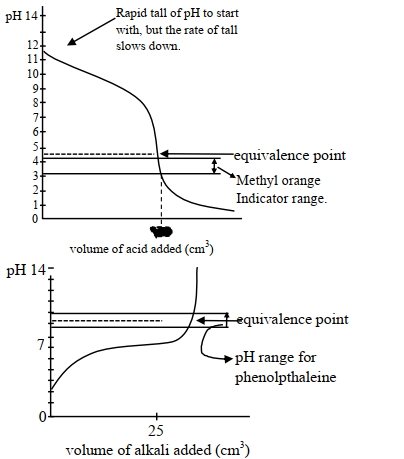
Titration curve for strong acid and weak base initially a buffer of weak base and conjugate acid is:Formed, thus \(\mathrm{pH}\) falls slowly and after equivalence point, so the \(\mathrm{pH}\) falls sharply so methyl arrange, having \(\mathrm{pH}\) range of \(3.2\) to \(4.4\) will weak as indicator. So statement\(-I\) is correct.
Titration curve for weak acid and strong base \((\mathrm{NaOH})\) Initially weak acid will form a buffer so \(\mathrm{pH}\) increases slowly but after equivalence point. it rises sharply covering range of phenolphthalein so it will be suitable indicator so statement\(-II\) is false.
-
- (A) \(5\)
- (B) \(15\)
- (C) \(20\)
- (D) \(10\)
Show answer and solution
Correct Answer: (D)
\(pH = pKa +\log \frac{[ CB ]}{[ WA ]}\)\(5.74=4.74+\log \frac{[ CB ]}{1}\)
\(\Rightarrow[ CB ]=10 M\)
-
- (A) \(2\)
- (B) \(1\)
- (C) \(3\)
- (D) \(4\)
Show answer and solution
Correct Answer: (B)
\(H _{2} SO _{3}\) [Dibasic acid]\(c=0.588 \,M\)
\(\Rightarrow \quad pH\) of solution \(P\) due to First dissociation only
since \(K _{ a },>> Ka _{2}\)
\(\Rightarrow\) First dissociation of \(H _{2} SO _{3}\)
\(H _{2} SO _{3}( aq ) \rightleftharpoons H ^{\oplus}( aq )+ HSO _{3}^{-}( aq ): ka _{1}=1.7 \times 10^{-2}\)
\(t=0\) \(\;\;C\)
\(t\) \(\quad\;\;\;\;C - x\;\; \, x \;\;\, x\)
\(\Rightarrow \quad Ka _{1}=\frac{1.7}{100}=\frac{\left[ H ^{\oplus}\right]\left[ HSO _{3}^{-}\right]}{\left[ H _{2} SO _{3}\right]}\)
\(\Rightarrow \frac{1.7}{100}=\frac{ x ^{2}}{(0.58- x )}\)
\(\Rightarrow 1.7 \times 0.588-1.7 x =100 x ^{2}\)
\(\Rightarrow \quad 100 x^{2}+1.7 x-1=0\)
\(\Rightarrow \quad\left[ H ^{\oplus}\right]= x =\frac{-1.7+\sqrt{(1.7)^{2}+4 \times 100 \times 1}}{2 \times 100}=0.09186\)
Therefore \(pH\) of sol. is \(: pH =-\log \left[ H ^{\oplus}\right]\)
\(\Rightarrow \quad pH =-\log (0.09186)=1.036 \simeq 1\)
-
- (A) \(1\)
- (B) \(3\)
- (C) \(2\)
- (D) \(4\)
Show answer and solution
Correct Answer: (C)
\(\mathrm{Zn}(\mathrm{OH})_{2}(\mathrm{~s}) \rightleftharpoons \mathrm{Zn}^{+2}(\mathrm{aq})+2 \mathrm{OH}^{-}(\mathrm{aq})\)\(\quad\quad\quad\quad\quad\quad\quad S\quad\quad\quad\quad (0.1+2S) \simeq\,0.1\)
\(\mathrm{K}_{\mathrm{sp}}=\mathrm{S}(0.1)^{2}\)
\(2 \times 10^{-20}=\mathrm{s} \times 10^{-2} \Rightarrow \mathrm{S}=2 \times 10^{-18}\)
\(=\mathrm{x} \times 10^{-18}\)
\(\mathrm{x}=2\)
-
- (A) \(3\)
- (B) \(4\)
- (C) \(5\)
- (D) \(6\)
Show answer and solution
Correct Answer: (A)
\(\left[\mathrm{NH}_{4}^{+}\right]=0.0504 \,\&\,\left[\mathrm{NH}_{3}\right]=0.0210\)So \(\mathrm{K}_{b}=\frac{\left[\mathrm{NH}_{4}^{+}\right]\left[\mathrm{HO}^{-}\right]}{\left[\mathrm{NH}_{3}\right]}\)
\(\left[\mathrm{HO}^{-}\right]=\frac{\mathrm{K}_{\mathrm{b}} \times\left[\mathrm{NH}_{3}\right]}{\left[\mathrm{NH}_{4}^{+}\right]} =1.8 \times 10^{-5} \times \frac{2}{5} \times \frac{210}{504}\)
\(=3 \times 10^{-6}\)
-
- (A) \(5021\)
- (B) \(6021\)
- (C) \(2211\)
- (D) \(3211\)
Show answer and solution
Correct Answer: (B)
\(\quad\quad\quad\mathrm{HCl}(\) aq. \()+\mathrm{NaOH}\) (aq.) \(\rightarrow \mathrm{NaCl}(\) aq. \()+\mathrm{H}_{2} \mathrm{O}(\ell)\)\(\quad\quad\quad50\, \mathrm{ml}, 1\, \mathrm{M} \quad 30\, \mathrm{ml}, 1\, \mathrm{M} \quad\quad\quad\quad-\quad\quad\quad\quad\quad-\)
\(\mathrm{t}=0 \,\quad 50 \,\mathrm{~mm} \,\quad\quad 30\, \mathrm{~mm}\)
\(\mathrm{t}=\infty\quad 20\, \mathrm{~mm} \quad\quad\quad\, -\)
\([\mathrm{HCl}]=\frac{20}{80}=\frac{1}{4}\, \mathrm{M}=2.5 \times 10^{-1}\, \mathrm{M}\)
\(\mathrm{pH}=-\log 2.15 \times 10^{-1}=1-0.3979=0.6021\)
\(\mathrm{pH}=6021 \times 10^{-4}\)
-
- (A) \(11\)
- (B) \(9\)
- (C) \(7\)
- (D) \(8\)
Show answer and solution
Correct Answer: (C)
Since \(\left( NH _{4}\right)_{3} PO _{4}\) is salt of weak acid \(\left( H _{3} PO _{4}\right)\) and weak base \(\left( NH _{4} OH \right)\)\(pH =7+\frac{1}{2}( pka - pkb )\)
\(=7+\frac{1}{2}(5.23-4.75)\)
\(=7.24 \approx 7\)
-
- (A) \(0.625 \times 10^{-6}\)
- (B) \(1.9 \times 10^{-5}\)
- (C) \(2.2 \times 10^{-16}\)
- (D) \(1.6 \times 10^{-6}\)
Show answer and solution
Correct Answer: (B)
\(\frac{ K _{ sp }}{ Ka }=\frac{ s ^{2}}{\left( H ^{+}\right)} ; \quad s =\sqrt{\frac{ K _{ sp }}{ K _{ a }}\left( H ^{+}\right)}\)\(s=\sqrt{\frac{2.2 \times 10^{-16}}{6.2 \times 10^{-10}} \times 10^{-3}}\)
\(s =1.9 \times 10^{-5}\)
-
- (A) \(1.77 \times 10^{-6}\)
- (B) \(1.11 \times 10^{-6}\)
- (C) \(1.11 \times 10^{-2}\)
- (D) \(1.77 \times 10^{-2}\)
Show answer and solution
Correct Answer: (C)
\(Ca ( OH )_{2} \rightleftharpoons Ca ^{2+}( aq )+2 OH ^{-}( aq )\)\(\quad \quad \quad \quad \quad \quad \quad \quad s\quad \quad \quad \quad \quad 2s\)
\(k _{ sp }= s (2 s )^{2} \Rightarrow 5.5 \times 10^{-6}=4 s ^{3}\)
\(\Rightarrow s =\left(\frac{5.5}{4}\right)^{\frac{1}{3}} \times 10^{-2}=1.11 \times 10^{-2}\)
-
- (A) \(196\)
- (B) \(169\)
- (C) \(112\)
- (D) \(141\)
Show answer and solution
Correct Answer: (D)
Given : \(\left[ K _{ sp }\right]_{ PbI _{2}}=8 \times 10^{-9}\)To calculate : solubility of \(PbI _{2}\) in \(0.1 \,M\) sol of \(Pb \left( NO _{3}\right)_{2}\)
\((I)\) \(Pb \left( NO _{3}\right)_{2} \rightarrow Pb _{\text {(aq) }}^{+2}+2 NO _{3}^{-}( aq )\)
\(0.1\,M\quad \quad \quad \quad \quad -\quad \quad \quad \quad \quad -\)
\(-\quad \quad \quad \quad \quad \quad \quad 0.1\,M\quad \quad \quad0.2\,M\)
\((II)\) \(PbI _{2}( s ) \rightleftharpoons Pb ^{+2}( aq )+2 I ^{-}( aq )\)
\(\quad \quad \quad \quad \quad \quad \quad \quad s\quad \quad \quad \quad \quad 2s\)
\(= s +0.1\)
\(\simeq 0.1\)
Now : \(K _{ sp }=8 \times 10^{-9}=\left[ Pb ^{+2}\right][ I^- ]^{2}\)
\(\Rightarrow 8 \times 10^{-9}=0.1 \times(2 s )^{2}\)
\(\Rightarrow 8 \times 10^{-8}=4 s ^{2} \Rightarrow s =\sqrt{2} \times 10^{-4}\)
\(\Rightarrow S =141 \times 10^{-6} \,M\)
\(\Rightarrow x =141\)
-
- (A) \(40\)
- (B) \(50\)
- (C) \(45\)
- (D) \(55\)
Show answer and solution
Correct Answer: (B)
For \(A _{2} X\)\(A _{2} X \rightarrow 2 A ^{+}+ X ^{2-}\)
\(2 S _{1} \quad S _{1}\)
\(K _{ sp }=4 S _{1}^{3}=4 \times 10^{-12}\)
\(S _{1}=10^{-4}\)
for \(MX\)
\(MX \rightarrow M ^{+}+ X ^{-}\)
\(\begin{array}{ll} S _{2} S _{2}\end{array}\)
\(K _{ sp }= S _{2}^{2}=4 \times 10^{-12}\)
\(S _{2}=2 \times 10^{-6}\)
so \(\frac{ S _{ A _{2} x }}{ S _{ MX }}=\frac{10^{-4}}{2 \times 10^{-6}}=50\)
-
- (A) \(NF _{3}\)
- (B) \(PCl _{5}\)
- (C) \(SF _{4}\)
- (D) \(ClF _{3}\)
Show answer and solution
Correct Answer: (B)
Lewis base : Chemical species which has capability to donate electron pair.In \(NF _{3}, SF _{4}, ClF _{3}\) central atom (i.e. \(\left. N , S , Cl \right)\) having lone pair therefore act as lewis base.
In \(PCl _{5}\) central atom \((P)\) does not have lone pair therefore does not act as lewis base.
-
- (A) \(1\)
- (B) \(2\)
- (C) \(3\)
- (D) \(4\)
Show answer and solution
Correct Answer: (C)
\(r = k [ NO ]^{ m }\left[ Cl _{2}\right]^{ n }\)\(= k (0.1)^{ m }(0.1)^{ n } \quad \ldots . .(1)\)
\(= k (0.1)^{ m }(0.2)^{ n } \quad \ldots . .(2)\)
\(= k (0.2)^{ m }(0.2)^{ n } \ldots \ldots(3)\)
\(n =1\)
\(m =2\)
\(m + n =3\)
-
- (A) \(110\)
- (B) \(108\)
- (C) \(208\)
- (D) \(136\)
Show answer and solution
Correct Answer: (B)
Given \(t _{2}=54\, min \quad T _{1 / 2}=18 \,min\)\(A\) \(\quad\) \(B\)
\(\Rightarrow \quad\) To calculate \(:\left[ A _{t}\right]=16 \times\left[ B _{ t }\right] \ldots .(1)\) time \(=?\)
\(\Rightarrow \quad\) For \(I\) order kinetic : \(\left[ A _{ t }\right]=\frac{ A _{0}}{(2)^{ n }}\)
\(n \rightarrow\) no of Half lives
\(\Rightarrow \quad\) Now from the relation \((1)\)
\(\left[ A _{ t }\right]=16 \times\left[ B _{ t }\right]\)
\(\Rightarrow \quad \frac{x}{(2)^{n_{1}}}=\frac{x}{(2)^{n_{2}}} \times 16 \Rightarrow(2)^{ n _{2}}=(2)^{n_{1}} \times(2)^{4}\)
\(\Rightarrow \quad n_{2}=n_{1}+4 \quad \Rightarrow \quad \frac{t}{\left(t_{1 / 2}\right)_{2}}=\frac{t}{\left(t_{1 / 2}\right)_{1}}+4\)
\(\Rightarrow \quad t\left(\frac{1}{18}-\frac{1}{54}\right)=4 \Rightarrow t=\frac{4 \times 18 \times 54}{36}\)
\(\Rightarrow \quad t=108\, \min\)
-
- (A) \(4\)
- (B) \(15\)
- (C) \(11\)
- (D) \(10\)
Show answer and solution
Correct Answer: (D)
\(\frac{ t _{99.996}}{ t _{50 \%}}=\frac{\frac{1}{ K } \ln \frac{100}{0.1}}{\frac{1}{ K } \ln 2}\)\(=\frac{\ln 1000}{\ln 2} \times t _{50 \%}\)
\(=\frac{3 \ln 10}{\ln 2} \times 1\)
\(=\frac{3 \times 2.3}{0.69}=10\)
-
- (A) \(20\)
- (B) \(65\)
- (C) \(50\)
- (D) \(45\)
Show answer and solution
Correct Answer: (D)
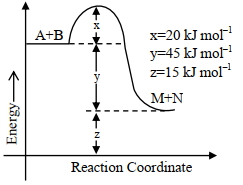
\(\Delta \mathrm{H}=\mathrm{E}_{\mathrm{a}_{\mathrm{f}}}-\mathrm{E}_{\mathrm{a}_{\mathrm{b}}}\)\(=20-65\)
\(=-45\, \mathrm{KJ} / \mathrm{mol}\)
\(|\Delta \mathrm{H}|=45\, \mathrm{KJ} / \mathrm{mol}\)
-
- (A) \(40\)
- (B) \(250\)
- (C) \(50\)
- (D) \(150\)
Show answer and solution
Correct Answer: (C)
\(X \longrightarrow Y\)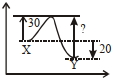
-
- (A) \(2\)
- (B) \(4\)
- (C) \(6\)
- (D) \(8\)
Show answer and solution
Correct Answer: (A)
For \(1^{\text {st }}\) order reaction,\(K =\frac{2.303}{ t } \cdot \log \frac{\left[ A _{0}\right]}{\left[ A _{ t }\right]}=\frac{2.303}{570 sec } \cdot \log \left(\frac{100}{32}\right)\)
\(=1.999 \times 10^{-3} sec ^{-1} \approx 2 \times 10^{-3} sec ^{-1}\)
-
- (A) \(1\)
- (B) \(2\)
- (C) \(3\)
- (D) \(4\)
Show answer and solution
Correct Answer: (D)
\(\mathrm{A} \rightarrow \mathrm{B}\)\(\mathrm{t}=0 \quad\quad\quad\quad 0\)
\(\mathrm{t}=30\, \mathrm{~min}\quad\quad 0.2 \,\mathrm{M}\)
Av. Rate of reaction \(=-\frac{\Delta[\mathrm{A}]}{\Delta \mathrm{t}}=\frac{\Delta[\mathrm{B}]}{\Delta \mathrm{t}}=\frac{(0.2-0)}{\frac{1}{2}}\)
\(=0.4=4 \times 10^{-1} \,\mathrm{~mol} / \mathrm{L} \times \mathrm{hr}\)
-
- (A) \(4\)
- (B) \(1\)
- (C) \(3\)
- (D) \(2\)
Show answer and solution
Correct Answer: (D)
\(\mathrm{k}=\frac{2.303}{\mathrm{t}} \log \frac{\mathrm{a}}{\mathrm{a}-\mathrm{x}}\)\(\frac{2.303}{\mathrm{t}_{50 \%}} \log \frac{100}{100-50}=\frac{2.303}{\mathrm{t}_{75 \%}} \log \frac{100}{100-75}\)
\(\mathrm{t}_{75 \%}=2 \mathrm{t}_{50 \%}\)
-
- (A) \(\mathrm{mol}^{1-\mathrm{n}} \mathrm{L}^{1-\mathrm{n}} \mathrm{s}^{-1}\)
- (B) \(\mathrm{mol}^{1-\mathrm{n}} \mathrm{L}^{\mathrm{n}-1} \mathrm{~s}^{-1}\)
- (C) \(\mathrm{mol}^{1-\mathrm{n}} \mathrm{L}^{1-\mathrm{n}} \mathrm{s}\)
- (D) \(\mathrm{mol}^{1-\mathrm{n}} \mathrm{L}^{2 \mathrm{n}} \mathrm{s}^{-1}\)
Show answer and solution
Correct Answer: (B)
Rate \(=\mathrm{k}[\mathrm{A}]^{\mathrm{n}}\)comparing units
\((\mathrm{mol} / \ell)\) \({\mathrm{sec}}=\mathrm{k}\left(\frac{\mathrm{mol}}{\ell}\right)^{\mathrm{n}}\)
\(\Rightarrow \mathrm{k}=\mathrm{mol}^{(1-\mathrm{n})} \ell^{(\mathrm{n}-1)} \mathrm{s}^{-1}\)
-
- (A) \(450\)
- (B) \(200\)
- (C) \(100\)
- (D) \(700\)
Show answer and solution
Correct Answer: (D)
\(\quad \quad \quad \quad\quad \quad \mathrm{A} \longrightarrow \quad \mathrm{B}\)\(\mathrm{t}=0\quad \quad \quad \quad 1 \text { mole } \quad 0\)
\(\mathrm{t}=100 \mathrm{~min}\quad 1-\mathrm{x} \quad \quad 2 \mathrm{x}\)
\(\quad \quad \quad \quad \quad =0.9 \mathrm{~mol} \quad =0.2 \mathrm{~mol}\)
Now, \(t=\frac{t_{1 / 2}}{\ln 2} \times \frac{\left[A_{0}\right]}{\left[A_{t}\right]}\)
\(100=\frac{\mathrm{t}_{1 / 2}}{\ln 2} \times \ln \frac{1}{0.9} \Rightarrow \mathrm{t}_{1 / 2}=690\, \mathrm{~min} . \quad\) (Taking \(\left.\ln 3=1.11\right)\)
Answer is \(700 .\) (Nearest integer).

No questions on this page match these filters.