


JEE Mains 2021 Physics ના બધા પ્રશ્નો
31 પ્રકરણ656 માંથી 151–200 પ્રશ્નો
-
- (A) \(15\)
- (B) \(20\)
- (C) \(30\)
- (D) \(10\)
જવાબ અને ઉકેલ જુઓ
સાચો જવાબ: (C)
According to lens formula \(\frac{1}{f} = (\mu - 1)\left[ {\frac{1}{{{R_1}}} - \frac{1}{{{R_2}}}} \right]\)The lens is plano-convex i.e., \({R_1} = R\) and \({R_2} = \infty \)
Hence \(\frac{1}{f} = \frac{{\mu - 1}}{R} \Rightarrow f = \frac{R}{{\mu - 1}}\)
Speed of light in medium of lens \(v = 2 \times {10^8}\) \(m/s\)
==> \(\mu = \frac{c}{v} = \frac{{3 \times {{10}^8}}}{{2 \times {{10}^8}}} = \frac{3}{2} = 1.5\)
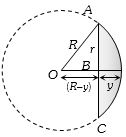
If \(r\) is the radius and \(y\) is the thickness of lens (at the centre), the radius of curvature \(R\) of its curved surface in accordance with the figure is given by
\({R^2} = {r^2} + {(R - y)^2} \Rightarrow {r^2} + {y^2} - 2Ry = 0\)
Neglecting \({y^2};\) we get \(R = \frac{{{r^2}}}{{2y}} = \frac{{{{(6/2)}^2}}}{{2 \times 0.3}} = 15 cm\)
Hence \(f = \frac{{15}}{{1.5 - 1}} = 30 cm\)
-
- (A) \(\overrightarrow{ b }=\overrightarrow{ a }+2 \overrightarrow{ c }\)
- (B) \(\overrightarrow{ b }=2 \overrightarrow{ a }+\overrightarrow{ c }\)
- (C) \(\overrightarrow{ b }=\overrightarrow{ a }-2(\overrightarrow{ a } \cdot \overrightarrow{ c }) \overrightarrow{ c }\)
- (D) \(\overrightarrow{ b }=\overrightarrow{ a }-\overrightarrow{ c }\)
જવાબ અને ઉકેલ જુઓ
સાચો જવાબ: (C)
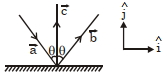
\(\overrightarrow{ a }=\sin \theta \hat{ i }-\cos \hat{ j }\)\(\overrightarrow{ b }=\sin \theta \hat{ i }+\cos \theta \hat{ j }\)
\(\overrightarrow{ c }=\hat{ j }\)
\(\overrightarrow{ a }-2(\overrightarrow{ a } \cdot \overrightarrow{ c }) \overrightarrow{ c }=\sin \theta \hat{ i }+\cos \theta \hat{ j }\)
-
- (A) \(75\)
- (B) \(10\)
- (C) \(20\)
- (D) \(100\)
જવાબ અને ઉકેલ જુઓ
સાચો જવાબ: (A)
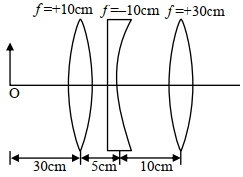
\(\frac{1}{{V}_{1}}+\frac{1}{30}=\frac{1}{10}\)\(\frac{1}{{V}_{1}}=\frac{2}{30} \Rightarrow {V}_{1}=15 \,{cm}\)
\(\frac{1}{{V}_{2}}-\frac{1}{10}=-\frac{1}{10}\)
\(\frac{1}{{V}_{2}}=0 \quad {V}_{2}=\infty\, {V}_{3}=30\, {cm}\)
\({OV}_{3}=75\, {cm}\)
-
- (A) \(3 {a}\)
- (B) \(4.6 {a}\)
- (C) \(2.3 {a}\)
- (D) \(2 \sqrt{10} {a}\)
જવાબ અને ઉકેલ જુઓ
સાચો જવાબ: (B)
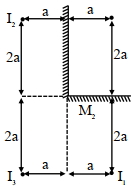
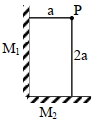
Shortest distance is \(2 {a}\) between \({I}_{1} \& {I}_{3}\)But answer given is for \({I}_{1} \& {I}_{2}\)
\(\sqrt{(4 a)^{2}+(2 a)^{2}}\)
\(a \sqrt{20}\)
\(4.47 {a}\)
-
- (A) \(1\)
- (B) અનંત
- (C) \(\frac{ R _{1} R _{2}}{ R _{1}- R _{2}}\)
- (D) શૂન્ય
જવાબ અને ઉકેલ જુઓ
સાચો જવાબ: (B)
\(\frac{1}{ F }=\left[\frac{\mu_{ L }}{\mu_{ S }}-1\right]\left[\frac{1}{ R _{1}}-\frac{1}{ R _{2}}\right]\)If \(\mu_{ L }=\mu_{ S } \Rightarrow \frac{1}{ F }=0 \Rightarrow F =\infty\)
-
- (A) \(30\)
- (B) \(36\)
- (C) \(25\)
- (D) \(40\)
જવાબ અને ઉકેલ જુઓ
સાચો જવાબ: (A)
\(\lambda_{ m }=\frac{\lambda_{ a }}{\mu} \Rightarrow \mu=\frac{3}{2}\)\(\frac{\mu}{ v }-\frac{1}{ u }=\frac{\mu-1}{ R }\)
\(\frac{3}{2 \times 10}+\frac{1}{15}=\frac{\frac{3}{2}-1}{ R }\)
\(R =\frac{30}{13}\)
\(=30\)
-
- (A) \(A\) સાચું છે પરંતુ \(R\) ખોટું છે.
- (B) બંને \(A\) અને \(R\) સાચાં છે પરંતુ \(A\) નું સાચું સ્પષ્ટીકરણ \(R\)નથી.
- (C) બંને \(A\) અને \(R\) સાચાં છે અને \(A\) માટે\(R\) સાચું સ્પષ્ટીકરણ કરે છે.
- (D) \(A\) ખોટું છે પરંતુ \(R\) સાચું છે.
જવાબ અને ઉકેલ જુઓ
સાચો જવાબ: (C)
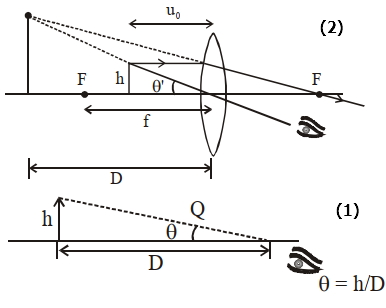
\(\theta^{\prime}=\frac{ h }{ u _{0}} ; \theta^{\prime}\) is same for both object and image\(m =\frac{\theta^{\prime}}{\theta}=\frac{ D }{\mu_{0}}\)
\(u _{0} < D\)
Hence \(m > 1\)
-
- (A) \(0.005\)
- (B) \(500\)
- (C) \(5.173\)
- (D) \(5\)
જવાબ અને ઉકેલ જુઓ
સાચો જવાબ: (D)
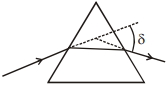
\({i}={A}=60^{\circ}\)\(={\delta}_{\min }=2 {i}-{A}\)
\(=2 \times 60^{\circ}-60^{\circ}=60^{\circ}\)
\(\mu=\frac{\sin ^{-1}\left(\frac{\delta_{\min }+{A}}{2}\right)}{\sin ^{-1}\left(\frac{{A}}{2}\right)}\)
\(=\sqrt{3}\)
\({V}_{\text { prism }}=\frac{3 \times 10^{8}}{\sqrt{3}}\)
\({AP}=10 \times 10^{-2} \times \frac{\sqrt{3}}{2}\)
\(\text { time }=\frac{5 \times 10^{-2}}{3 \times 10^{8}} \times \sqrt{3} \times \sqrt{3}\)
\(=5 \times 10^{-10}\, {sec}\)
\(\text { Ans }=5\)
-
- (A) \(\sin ^{-1} \frac{\sqrt{5}}{3}\)
- (B) \(\sin ^{-1} \frac{\sqrt{7}}{3}\)
- (C) \(\sin ^{-1} \frac{\sqrt{7}}{4}\)
- (D) \(\sin ^{-1} \frac{\sqrt{5}}{4}\)
જવાબ અને ઉકેલ જુઓ
સાચો જવાબ: (B)
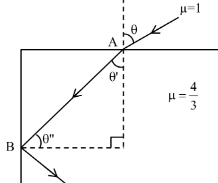
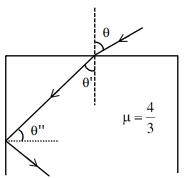
At maximum angle \(\theta\) ray at point \(B\) goes in gazing emergence, at all less values of \(\theta, \operatorname{TIR}\) occurs.At point B
\(\frac{4}{3} \times \sin \theta^{\prime \prime}=1 \times \sin 90^{\circ}\)
\(\theta^{\prime \prime}=\sin ^{-1}\left(\frac{3}{4}\right)\)
\(\theta^{\prime}=\left(\frac{\pi}{2}-\theta^{\prime \prime}\right)\)
At point \(A\)
\(1 \times \sin \theta=\frac{4}{3} \times \sin \theta^{\prime}\)
\(\sin \theta=\frac{4}{3} \times \sin \left(\frac{\pi}{2}-\theta^{\prime \prime}\right)\)
\(\sin \theta=\frac{4}{3} \cos \left[\cos ^{-1} \frac{\sqrt{7}}{4}\right]\)
\(\sin \theta=\frac{4}{3} \times \frac{\sqrt{7}}{4}\)
\(\theta=\sin ^{-1}\left(\frac{\sqrt{7}}{3}\right)\)
-
- (A) \(\frac{2 {d}_{1} {d}_{2}}{{d}_{1}-{d}_{2}}\)
- (B) \(\frac{2 {d}_{1} {d}_{2}}{{d}_{1}+{d}_{2}}\)
- (C) \(\frac{{d}_{1} {d}_{2}}{{d}_{1}+{d}_{2}}\)
- (D) \(\frac{{d}_{1} {d}_{2}}{{d}_{1}-{d}_{2}}\)
જવાબ અને ઉકેલ જુઓ
સાચો જવાબ: (A)
Using Newton"s formula\(\left({f}+{d}_{1}\right)\left({f}-{d}_{2}\right)={f}^{2}\)
\({f}^{2}+{fd}_{1}-{fd}_{2}-{d}_{1} {d}_{2}={f}^{2}\)
\({f}=\frac{{d}_{1} {d}_{2}}{{d}_{1}-{d}_{2}}\)
\(\therefore {R}=\frac{2 {d}_{1} {d}_{2}}{{d}_{1}-{d}_{2}}\)
-
- (A) \(350\)
- (B) \(250\)
- (C) \(50\)
- (D) \(150\)
જવાબ અને ઉકેલ જુઓ
સાચો જવાબ: (C)
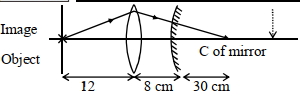
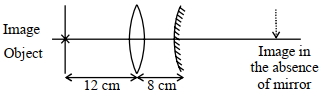
For the object to coincide with image, the light must fall perpendicularly to mirror. Which means that the light will have to converge at \({C}\) of mirror.
Without the mirror also, the light would coverage at \({C}\).So the distance is : \(12+8+30=50 \,{cm}\)
-
- (A) \(1, \infty\)
- (B) ખૂબ મોટું, \(\infty\)
- (C) \(\frac{1}{2}, \frac{f}{2}\)
- (D) \(\frac{1}{4}, \frac{f}{4}\)
જવાબ અને ઉકેલ જુઓ
સાચો જવાબ: (C)
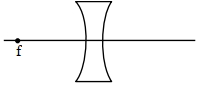
\({U}=-{f}\)\(\frac{1}{{V}}-\frac{1}{{U}}=\frac{1}{-{f}} \Rightarrow \frac{1}{{V}}=-\frac{2}{{f}}\)
\({V}=\frac{-{f}}{2}\)
\({m}=\frac{{V}}{{U}}=\frac{1}{2}\)
distance \(=\frac{{f}}{2}\)
- 163. ગોલીય બહિર્ગોળ અરીસાની કેન્દ્રલંબાઈ \(f\) તેની વક્તાત્રિજ્યા \(R\) સાથે ......... અનુસાર સંબંધ ધરાવે છે. 2021 સરળ
- (A) \(f =+\frac{1}{2} R\)
- (B) \(f =-R\)
- (C) \(f=-\frac{1}{2} R\)
- (D) \(f = R\)
જવાબ અને ઉકેલ જુઓ
સાચો જવાબ: (A)
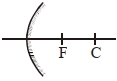
For convex mirror, focus is behind the mirror.\(\Rightarrow f =+\frac{ R }{2}\)
-
- (A) \(15\)
- (B) \(10\)
- (C) \(18\)
- (D) \(12\)
જવાબ અને ઉકેલ જુઓ
સાચો જવાબ: (D)
\(\omega_{1}=0.02 ; \mu_{1}=1.5 ; \quad \omega_{2}=0.03 ; \mu_{2}=1.6\)Achromatic combination
\(\therefore \theta_{\text {net }}=0\)
\(\theta_{1}-\theta_{2}=0\)
\(\theta_{1}=\theta_{2}\)
\(\omega_{1} \delta_{1}=\omega_{2} \delta_{2}\)
\(\&\, \delta_{\text {net }}=\delta_{1}-\delta_{2}=2^{\circ}\)
\(\delta_{1}-\frac{\omega_{1} \delta_{1}}{\omega_{2}}=2^{\circ}\)
\(\delta_{1}\left(1-\frac{\omega_{1}}{\omega_{2}}\right)=2^{\circ}\)
\(\delta_{1}\left(1-\frac{2}{3}\right)=2^{\circ}\)
\(\delta_{1}=6^{\circ}\)
\(\delta_{1}=\left(\mu_{1}-1\right) A_{1}\)
\(6^{\circ}=(1.5-1) A_{1}\)
\(A_{1}=12^{\circ}\)
-
- (A) પ્રતિબિંબ વાસ્તવિક, અંતર્ગોળ અરીસાની એકજ બાજુ
- (B) પ્રતિબિંબ આભાસી, અંતર્ગોળ અરીસાની વિરૂધ્ધ બાજું
- (C) પ્રતિબિંબ વાસ્તવિક, બહિર્ગોળ અરીસાની એકજ બાજું
- (D) પ્રતિબિંબ આભાસી, બહિર્ગોળ અરીસાની વિરૂધ્ધ બાજુ
જવાબ અને ઉકેલ જુઓ
સાચો જવાબ: (D)
Since orientation is same image is virtual. Since image is smaller the mirror has to be convex -
- (A) \(4\)
- (B) \(0.2\)
- (C) \(40\)
- (D) \(0.1\)
જવાબ અને ઉકેલ જુઓ
સાચો જવાબ: (D)
Mirror used is convex mirror (rear-view mirror)\(\therefore \mathrm{V}_{\mathrm{I} / \mathrm{m}}=-\mathrm{m}^{2} \mathrm{~V}_{\mathrm{O} / \mathrm{m}}\)
Given,
\(\mathrm{V}_{\mathrm{O} / \mathrm{m}}=40 \mathrm{~m} / \mathrm{s}\)
\(\mathrm{m}=\frac{\mathrm{f}}{\mathrm{f}-\mathrm{u}}=\frac{10}{10+190}=\frac{10}{200}\)
\(\therefore \mathrm{V}_{\mathrm{L} / \mathrm{m}}=-\frac{1}{400} \times 40=-0.1 \mathrm{~m} / \mathrm{s}\)
\(\therefore\) Car will appear to move with speed \(0.1 \mathrm{~m} / \mathrm{s}\).
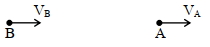
-
- (A) લીલો
- (B) લાલ
- (C) બ્લૂ અને લીલો
- (D) બ્લૂ
જવાબ અને ઉકેલ જુઓ
સાચો જવાબ: (B)
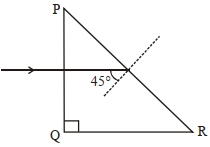
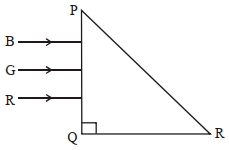
Assuming that the right angled prism is an isoceles prism, so the other angles will be \(45^{\circ}\) each.\(\Rightarrow\) Each incident ray will make an angle of \(45^{\circ}\) with the normal at face \(PR\).
\(\Rightarrow\) The wavelength corresponding to which the incidence angle is less than the critical angle, will pass through \(PR\). \(\Rightarrow \theta_{ C }=\) critical angle
\(\Rightarrow \theta_{c}=\sin ^{-1}\left(\frac{1}{\mu}\right)\)
\(\Rightarrow\) If \(\theta_{ C } \geq 45^{\circ}\)
the light ray will pass
\(\Rightarrow\left(\theta_{ C }\right)_{ Red }=\sin ^{-1}\left(\frac{1}{1.27}\right)=51.94^{\circ}\)
Red will pass.
\(\Rightarrow\left(\theta_{ C }\right)_{ Green }=\sin ^{-1}\left(\frac{1}{1.42}\right)=44.76^{\circ}\)
Green will not pass
\(\Rightarrow\left(\theta_{ C }\right)_{ Blue }=\sin ^{-1}\left(\frac{1}{1.49}\right)=42.15^{\circ}\)
Blue will not pass
\(\Rightarrow\) So only red will pass through \(PR.\)
-
- (A) \(10\)
- (B) \(15\)
- (C) \(20\)
- (D) \(30\)
જવાબ અને ઉકેલ જુઓ
સાચો જવાબ: (B)
\(m =\frac{ f }{ u + f }\)\(+ m =\frac{ f }{-10+ f } \quad \cdots\)
\(- m =\frac{ f }{-20+ f } \ldots\)
(1) / (2)
\(-1=\frac{ f -20}{ f -10}\)
\(10- f = f -20\)
\(30=2 f\)
\(f =15 cm\)
-
- (A) \(500\)
- (B) \(600\)
- (C) \(700\)
- (D) \(800\)
જવાબ અને ઉકેલ જુઓ
સાચો જવાબ: (B)
For no deviation, \(n_{1}=n_{2}\)\(1.2+\frac{10.8 \times 10^{-14}}{\lambda^{2}} =1.45+\frac{1.8 \times 10^{-14}}{\lambda^{2}}\)
\(0.25 =\frac{9 \times 10^{-14}}{\lambda^{2}}\)
\(\lambda^{2} =\frac{9 \times 10^{-14}}{0.25}\)
\(\lambda =\frac{3}{5} \times 10^{-6}\)
\(\lambda =6 \times 10^{-7} m\)
\(\lambda =600 nm\)
-
- (A) \(5.33\)
- (B) \(4.33\)
- (C) \(3.33\)
- (D) \(2.33\)
જવાબ અને ઉકેલ જુઓ
સાચો જવાબ: (C)
\(V=\frac{c}{\sqrt{\mu_{r} \varepsilon_{r}}}\)\(V=3.33 \times 10^{7} \;m / sec\)
-
- (A) \(50\)
- (B) \(80\)
- (C) \(30\)
- (D) \(60\)
જવાબ અને ઉકેલ જુઓ
સાચો જવાબ: (D)
At minimum deviation \(r_{1}=r_{2}=\frac{A}{2}\)Also given \({i}=2 {r}_{1}={A}\)
Now \(1 \sin i =\sqrt{3} \sin r_{1}\)
\(1 \sin A=\sqrt{3} \sin \frac{A}{2}\)
\(2 \sin \frac{A}{2} \cos \frac{A}{2}=\sqrt{3} \sin \frac{A}{2}\)
\(\cos \frac{A}{2}=\frac{\sqrt{3}}{2} \Rightarrow \frac{A}{2}=30^{\circ}\)
\(A=60^{\circ}\)
-
- (A) વિધાન \(( A ),( B )\) અને \(( C )\) સાચા છે.
- (B) માત્ર વિધાન \((D)\) સાચું છે.
- (C) માત્ર વિધાન \(( A )\) અને \(( B )\) સાચા છે.
- (D) વિધાન \((B)\) અને \((C)\) સાચા છે.
જવાબ અને ઉકેલ જુઓ
સાચો જવાબ: (A)
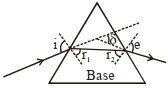
Deviation is minimum in a prism when\(i = e , r _{1}= r _{2}\) and ray \((2)\) is parallel to base of prism.
- 173. પ્રિઝમનો પ્રિઝમકોણ \(A\) અને વક્રીભવનાંક \(\mu\) છે,જો લઘુત્તમ વિચલનકોણ \(A\) હોય,તો પ્રિઝમકોણ કેટલો હશે? 2021 અઘરું
- (A) \({\sin ^{ - 1}}\left( {\frac{\mu }{2}} \right)\)
- (B) \({\sin ^{ - 1}}\sqrt {\frac{{\mu - 1}}{2}} \)
- (C) \(2{\cos ^{ - 1}}\left( {\frac{\mu }{2}} \right)\)
- (D) \({\cos ^{ - 1}}\left( {\frac{\mu }{2}} \right)\)
જવાબ અને ઉકેલ જુઓ
સાચો જવાબ: (C)
(c) Given \({\delta _m} = A,\) as\(\mu = \frac{{\sin \,\left({\frac{{A + {\delta _m}}}{2}} \right)}}{{\sin \,\left({\frac{A}{2}} \right)}}\)
\( \Rightarrow \)\(\mu = \frac{{\sin \left({\frac{{A + A}}{2}} \right)}}{{\sin \left({\frac{A}{2}} \right)}} = 2\cos \frac{A}{2} \)
\(\Rightarrow A = 2{\cos ^{ - 1}}\left({\frac{\mu }{2}} \right)\)
-
- (A) \(75\)
- (B) \(135\)
- (C) \(150\)
- (D) \(210\)
જવાબ અને ઉકેલ જુઓ
સાચો જવાબ: (C)
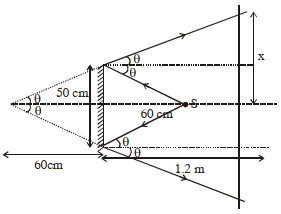
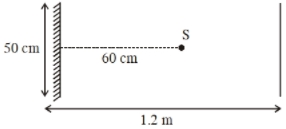
\(\tan \theta=\frac{25}{60}=\frac{ x }{180}\)\(x =75 \,cm\)
so distance between extreme point \(=2 x =2 \times\) \(75=150\, cm\)
-
- (A) \(\frac{1}{\mu_{2}-\mu_{1}}\)
- (B) \(\mu_{1}-\mu_{2}\)
- (C) \(\frac{1}{\mu_{1}-\mu_{2}}\)
- (D) \(\mu_{2}-\mu_{1}\)
જવાબ અને ઉકેલ જુઓ
સાચો જવાબ: (B)
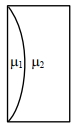
\(\frac{1}{{f}_{1}}=\left(\mu_{1}-1\right)\left(\frac{1}{{R}}\right)\)\(\frac{1}{{f}_{2}}=\left(\mu_{2}-1\right)\left(-\frac{1}{{R}}\right)\)
\(\frac{1}{{f}_{1}}+\frac{1}{{f}_{2}}=\frac{1}{{f}_{{eq}}}=\frac{\left(\mu_{1}-1\right)-\left(\mu_{2}-1\right)}{{R}}\)
\(\frac{1}{f_{e q}}=\frac{\left(\mu_{1}-\mu_{2}\right)}{R}\)
\(\frac{{R}}{{f}_{{eq}}}=\left(\mu_{1}-\mu_{2}\right)\)

- 176. તમારા મિત્રને આંખમાં ખામી છે તે દૂર રહેલી જાળીને ઝાંખી અનિયમિત અને વિકૃત જોઇ શકતા હોય તો તેની કઈ ખામી હોય? 2021 મધ્યમ
- (A) એસ્ટિગ્મેટિઝ્મ
- (B) લઘુદષ્ટિ અને એસ્ટિગ્મેટિઝ્મ
- (C) મોતિયો અને એસ્ટિગ્મેટિઝ્મ
- (D) લઘુદષ્ટિ અને ગુરુદષ્ટિ
જવાબ અને ઉકેલ જુઓ
સાચો જવાબ: (B)
If distant objects are blurry then problem is Myopia.If objects are distorted then problem is Astigmatism
-
- (A) \(55.44\)
- (B) \(9.52\)
- (C) \(37.58\)
- (D) \(18.23\)
જવાબ અને ઉકેલ જુઓ
સાચો જવાબ: (C)
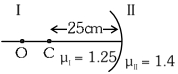
\(\frac{\mu_{2}}{v}-\frac{\mu_{1}}{u}=\frac{\mu_{2}-\mu_{1}}{R}\)\(\frac{1.4}{v}-\frac{1.25}{-40}=\frac{1.4-1.25}{-25}\)
\(\frac{1.4}{v}=-\frac{0.15}{25}-\frac{1.25}{40}\)
\(v=-37.58\, {cm}\)
-
- (A) \(703\)
- (B) \(700\)
- (C) \(730\)
- (D) \(70.3\)
જવાબ અને ઉકેલ જુઓ
સાચો જવાબ: (D)
\(C=0.1\, \mu {F}=10^{-7}\, {F}\)Resonant frequency \(=60\, {Hz}\)
at resonance
\(\omega_{0}=\frac{1}{\sqrt{L C}}\)
\(2 \pi f_{0}=\frac{1}{\sqrt{L C}} \Rightarrow \frac{1}{4 \pi^{2} f_{0}^{2} C}\)
By putting values \({L}=70.3\, {Hz}\)
-
- (A) \(4\)
- (B) \(25\)
- (C) \(400\)
- (D) \(40\)
જવાબ અને ઉકેલ જુઓ
સાચો જવાબ: (A)
For maximum average power\(X_{\mathrm{L}}=\mathrm{X}_{\mathrm{C}}\)
\(250 \pi=\frac{1}{2 \pi(50) \mathrm{C}}\)
\(\mathrm{C}=4 \times 10^{-6}\)
-
- (A) \(2.25\)
- (B) \(3.0\)
- (C) \(3.37\)
- (D) \(9.0\)
જવાબ અને ઉકેલ જુઓ
સાચો જવાબ: (A)
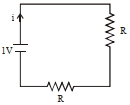
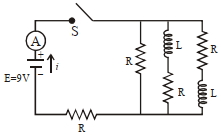
Just after the switch is closed, inductor will behave like infinite resistance (open circuit) so the circuit will look like\(i=\frac{9}{R+R}=\frac{9}{4}=2.25\)
-
- (A) \(1000\)
- (B) \(200\)
- (C) \(500\)
- (D) \(5\)
જવાબ અને ઉકેલ જુઓ
સાચો જવાબ: (C)
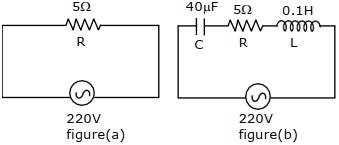
\(P_{\text {avg }}=\frac{v_{\text {rms }}^{2}}{R}\)\(\frac{v_{ rms }^{2}}{Z^{2}} \times R=\frac{v_{r m s}^{2}}{R} \times 1\)
\(R^{2}=Z^{2}\)
\(25=\left(\sqrt{\left(x_{C}-x_{L}\right)^{2}+5^{2}}\right)^{2}\)
\(25=\left(x_{c}-x_{L}\right)^{2}+25\)
\(x_{c}=x_{L} \Rightarrow \frac{1}{\omega C}=\omega L\)
\(\omega^{2}=\frac{1}{L C}=\frac{10^{6}}{0.1 \times 40}\)
\(\omega=500\)
-
- (A) \(5.9\)
- (B) \(3.16\)
- (C) \(0.94\)
- (D) \(6\)
જવાબ અને ઉકેલ જુઓ
સાચો જવાબ: (B)
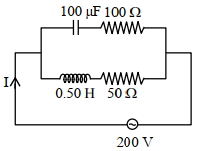
\(Z_{{c}}=\sqrt{\left(\frac{1}{\omega {C}}\right)^{2}+{R}^{2}}\)\(=\sqrt{\left(\frac{1}{100 \times 100 \times 10^{-6}}\right)^{2}+100^{2}}\)
\({Z}_{{C}}=\sqrt{(100)^{2}+(100)^{2}}\)
\(=100 \sqrt{2}\)
\({Z}_{{L}}=\sqrt{(\omega {L})^{2}+{R}^{2}}\)
\(\sqrt{(100 \times 0.5)^{2}+50^{2}}\)
\(=50 \sqrt{2}\)
\({i}_{{C}}=\frac{200}{{z}_{{c}}}=\frac{200}{100 \sqrt{2}}=\sqrt{2}\)
\({i}_{{L}}=\frac{200}{{z}_{{L}}}=\frac{200}{50 \sqrt{2}}=2 \sqrt{2}\)
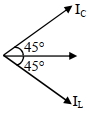
\(\cos \phi_{1}=\frac{100}{10 \sqrt{2}}=\frac{1}{\sqrt{2}} \Rightarrow \phi_{1}=45^{\circ}\)
\(\cos \phi_{2}=\frac{50}{50 \sqrt{2}}=\frac{1}{\sqrt{2}} \Rightarrow \phi_{2}=45^{\circ}\)
\({I}=\sqrt{{I}_{{C}}^{2}+{I}_{{L}}^{2}}\)
\(=\sqrt{2+8}\)
\(=\sqrt{10}\)
\({I}=3.16 \,{A}\)
- 183. \(AC\) પ્રવાહ \(I = I _{1} \sin \omega t + I _{2} \cos \omega t\) મુજબ આપવામાં આવે છે, તો \(AC\) એમીટરનું અવલોકન કેટલું હશે? 2021 અઘરું
- (A) \(\sqrt{\frac{I_{1}^{2}-I_{2}^{2}}{2}}\)
- (B) \(\sqrt{\frac{ I _{1}^{2}+ I _{2}^{2}}{2}}\)
- (C) \(\frac{ I _{1}+ I _{2}}{\sqrt{2}}\)
- (D) \(\frac{ I _{1}+ I _{2}}{2 \sqrt{2}}\)
જવાબ અને ઉકેલ જુઓ
સાચો જવાબ: (B)
\(I=I_{1} \sin \omega t+I_{2} \cos \omega t\)\(\therefore I_{0}=\sqrt{I_{1}^{2}+I_{2}^{2}}\)
\(\therefore I_{ rms }=\frac{I_{0}}{\sqrt{2}}=\sqrt{\frac{I_{1}^{2}+I_{2}^{2}}{2}}\)
-
- (A) \(2\)
- (B) \(1\)
- (C) \(3\)
- (D) \(4\)
જવાબ અને ઉકેલ જુઓ
સાચો જવાબ: (B)
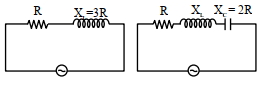
\(\cos \phi=\frac{{R}}{\sqrt{{R}^{2}+3 {R}^{2}}}\)\(=\frac{1}{\sqrt{10}}\)
\(\cos \phi^{\prime}=\frac{{R}}{\sqrt{{R}^{2}+{R}^{2}}}\)
\(=\frac{1}{\sqrt{2}}\)
\(\frac{\cos \phi^{\prime}}{\cos \phi}=\frac{\sqrt{10}}{\sqrt{2}}=\frac{\sqrt{5}}{1}\)
\(\therefore {x}=1\)
-
- (A) \(2000\)
- (B) \(2500\)
- (C) \(1600\)
- (D) \(1800\)
જવાબ અને ઉકેલ જુઓ
સાચો જવાબ: (A)
Given : \(\quad L =2 \times 10^{-4} H\)\(R =6.28 \Omega\)
\(f =10 MHz =10^{7} Hz\)
Since quality factor,
\(Q =\omega_{0} \frac{ L }{ R }=2 \pi f \frac{ L }{ R }\)
\(\therefore Q =2 \pi \times 10^{7} \times \frac{2 \times 10^{-4}}{6.28}\)
\(Q =2 \times 10^{3}=2000\)
\(\therefore\) Ans. is 2000
- 186. અવરોધ પર \(220\, V , 50\, Hz\)નો \(AC\) ઉદગમ લગાવેલ છે,પ્રવાહને મહતમ મૂલ્યથી \(rms\) મૂલ્ય થતાં લાગતો સમય શોધો. 2021 મધ્યમ
- (A) \(2.5\, ms\)
- (B) \(25\, ms\)
- (C) \(2.5\, s\)
- (D) \(0.25\, ms\)
જવાબ અને ઉકેલ જુઓ
સાચો જવાબ: (A)
\(i = i _{0} \cos (\omega t )\)\(i = i _{0}\) at \(t =0\)
\(i =\frac{ i _{0}}{\sqrt{2}}\) at \(\omega t =\frac{\pi}{4}\)
\(t =\frac{\pi}{4 \omega}=\frac{\pi}{4(2 \pi f )}=\frac{1}{8 f }\)
\(t =\frac{1}{400}=2.5 ms\)
-
- (A) \(88\, {A}\) અને \(\tan ^{-1}\left(\frac{11}{6}\right)\)
- (B) \(0.88\, {A}\) અને \(\tan ^{-1}\left(\frac{11}{6}\right)\)
- (C) \(8.8 \,{A}\) અને \(\tan ^{-1}\left(\frac{11}{6}\right)\)
- (D) \(8.8 \,{A}\) અને \(\tan ^{-1}\left(\frac{6}{11}\right)\)
જવાબ અને ઉકેલ જુઓ
સાચો જવાબ: (C)
Inductive reactance, \(X_{L}=\omega L\)\(=100 \pi \times 0.07\)
\(=100 \times \frac{22}{7} \times \frac{7}{100}\)
\(=22 \Omega\)
\(\therefore \quad \text { Impedance, } Z =\sqrt{R^{2}+X_{L}^{2}}\)
\(=\sqrt{12^{2}+22^{2}}\)
\(=\sqrt{144+484}\)
\(=\sqrt{628}\)
\( \approx 25 \Omega\)
\(\therefore \text { Current, } I=\frac{V}{Z}=\frac{220}{25} =8.8 A\)
\(\Rightarrow \quad I=8.8 \Lambda\)
Also, phase angle between current and source voltage can be given as
\(\tan \phi =\left(\frac{X_{L}}{R}\right) \Rightarrow \tan \phi=\frac{22}{12}\)
\(\Rightarrow \quad \phi =\tan ^{-1}\left(\frac{11}{6}\right)\)
-
- (A) \(1\)
- (B) \(2.5\)
- (C) \(1.5\)
- (D) \(2\)
જવાબ અને ઉકેલ જુઓ
સાચો જવાબ: (D)
\(\tan 45^{\circ}=\frac{1}{\omega C R}=\frac{\omega L}{R} \Rightarrow X_{L}=X_{C}\)\(\Rightarrow\) resonance
\(i =\frac{ V }{ R }\)
\(=\frac{220}{110}=2 \,A\)
-
- (A) \(1200\)
- (B) \(600\)
- (C) \(800\)
- (D) \(900\)
જવાબ અને ઉકેલ જુઓ
સાચો જવાબ: (D)
At resonance\(P =\frac{ V ^{2}}{ R }\)
\(R =\frac{ V ^{2}}{ P } =\frac{(120)^{2}}{16}\)
\(=900 \,\Omega\)
-
- (A) \(5\)
- (B) \(15\)
- (C) \(20\)
- (D) \(10\)
જવાબ અને ઉકેલ જુઓ
સાચો જવાબ: (D)
\(\lambda=960 m\)\(C =2.56 \mu F =2.56 \times 10^{-6} F\)
\(c=3 \times 10^{8} m / s\)
\(L =?\)
Now at resonance, \(\omega_{0}=\frac{1}{\sqrt{L C}}\)
[Resoant frequency]
\(2 \pi f _{0}=\frac{1}{\sqrt{ LC }}\)
On substituting \(f _{0}=\frac{ c }{\lambda},\) we have \(2 \pi \frac{ c }{\lambda}=\frac{1}{\sqrt{ LC }}\)
Squaring both sides : \(4 \pi^{2} \frac{ c ^{2}}{\lambda^{2}}=\frac{1}{ LC }\)
\(=\frac{4 \times 10 \times\left(3 \times 10^{8}\right)^{2}}{(960)^{2}}=\frac{1}{ L \times 2.56 \times 10^{-6}}\)
\(\Rightarrow \frac{1}{L}=\frac{4 \times 10 \times 9 \times 10^{16} \times 2.56 \times 10^{-6}}{960 \times 960}\)
\(\Rightarrow L =10 \times 10^{-8} H\)
- 191. એક ઊલટસુલટ પ્રવાહ માટેનું સમીકરણ \(i=i_{1} \sin \omega t+i_{2} \cos \omega t\) આપેલ છે. તેમનો \(rms\) પ્રવાહ ........ હશે. 2021 અઘરું
- (A) \(\frac{1}{\sqrt{2}}\left(i_{1}^{2}+i_{2}^{2}\right)^{\frac{1}{2}}\)
- (B) \(\frac{1}{\sqrt{2}}\left( i _{1}+ i _{2}\right)^{2}\)
- (C) \(\frac{1}{2}\left( i _{1}^{2}+ i _{2}^{2}\right)^{\frac{1}{2}}\)
- (D) \(\frac{1}{\sqrt{2}}\left( i _{1}+ i _{2}\right)\)
જવાબ અને ઉકેલ જુઓ
સાચો જવાબ: (A)
\(i = i _{1} \sin \omega t + i _{2} \sin (\omega t +90)\)\(i_0 =\sqrt{ i _{1}^{2}+ i _{2}^{2}}\)
\(i _{ rms }=\frac{ i _{0}}{\sqrt{2}}=\frac{\sqrt{ i _{1}^{2}+ i _{2}^{2}}}{\sqrt{2}}\)
-
- (A) \(0.2\)
- (B) \(20\)
- (C) \(2.2\)
- (D) \(2\)
જવાબ અને ઉકેલ જુઓ
સાચો જવાબ: (D)
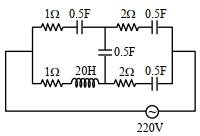
\({X}_{{L}}=2 \pi {fL}\)\({f}\) is very large
\(\therefore {X}_{{L}}\) is very large hence open circuit.
\({X}_{{C}}=\frac{1}{2 \pi {fC}}\)
\({f}\) is very large.
\(\therefore {X}_{{c}}\) is very small, hence short circuit.
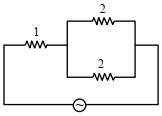
Final circuit
\(Z_{e q}=1+\frac{2 \times 2}{2+2}=2\)
-
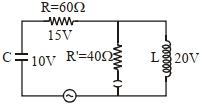
- (A) \(0.8\, H\) અને \(150\, \mu F\)
- (B) \(0.8\, H\) અને \(250\, \mu F\)
- (C) \(1.33\, H\) અને \(250\, \mu F\)
- (D) \(1.33\, H\) અને \(150\, \mu F\)
જવાબ અને ઉકેલ જુઓ
સાચો જવાબ: (B)
Current through \(60 \Omega\) resistance \(=\frac{15}{60}=\frac{1}{4} A\)thus capacitor current \(=\frac{1}{4} A\)
\(\because V _{ C }= I X _{ C }\)
\(10=\frac{1}{4} \times \frac{1}{\omega C}\)
\(\therefore C =\frac{1}{40 \omega}=\frac{1}{4000}=250 \mu F\)
Now,
current through \(40 \Omega\) resistance \(=\frac{20}{40}=\frac{1}{2} A\)
thus current through inductor \(=\frac{1}{2}-\frac{1}{4}=\frac{1}{4} A\)
\(V _{ L }= IX _{ L }=\frac{1}{4} \times \omega L\)
\(20=\frac{1}{4} \times 100 \times L\)
\(\Rightarrow L =0.8 H\)
-
- (A) બેન્ડવીથ વધે
- (B) અનુનાદિત આવૃતિ વધે
- (C) \(Q-\) ફેક્ટર વધે.
- (D) \(Q-\) ફેક્ટર અને આવૃતિ અચળ રહે.
જવાબ અને ઉકેલ જુઓ
સાચો જવાબ: (A)
Bandwidth \(= R / L\)Bandwidth \(\propto R\)
So bandwidth will increase
-
- (A) \(\frac{1}{2}\)
- (B) \(\frac{1}{2 \sqrt{2}}\)
- (C) \(\frac{1}{\sqrt{2}}\)
- (D) \(\frac{\sqrt{3}}{2}\)
જવાબ અને ઉકેલ જુઓ
સાચો જવાબ: (C)
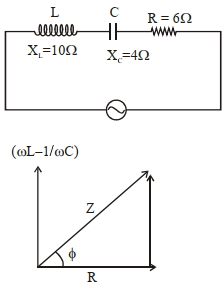
We know that power factor is \(\cos \phi\)\(\cos \phi=\frac{ R }{ Z }\)
\(Z=\sqrt{R^{2}+\left(X_{L}-X_{C}\right)^{2}} \quad \ldots\)
\(\Rightarrow Z =\sqrt{6^{2}+(10-4)^{2}}\)
\(\Rightarrow Z =6 \sqrt{2} \mid \cos \phi=\frac{6}{6 \sqrt{2}}\)
\(\cos \phi=\frac{1}{\sqrt{2}}\)
-
- (A) \(3\)
- (B) \(4\)
- (C) \(5\)
- (D) \(6\)
જવાબ અને ઉકેલ જુઓ
સાચો જવાબ: (B)
At resonance power \((P)\)\(P=\frac{\left(V_{ rms }\right)^{2}}{ R }\)
\(P=\frac{(250 / \sqrt{2})^{2}}{8}=3906.25 W\)
\(\approx 4 kW\)
-
- (A) \(3\)
- (B) \(5\)
- (C) \(7\)
- (D) \(9\)
જવાબ અને ઉકેલ જુઓ
સાચો જવાબ: (A)
\(\tan \phi=\frac{x_{C}-x_{L}}{R}\)\(\tan 45=\frac{x_{C}-x_{L}}{R}\)
\(X_{C}-X_{L}=R\)
\(\frac{1}{\omega C}-\omega L=R\)
\(\frac{1}{\omega C}-300 \times 0.03=1\)
\(\frac{1}{\omega C}=10\)
\(C=\frac{1}{10 \omega}=\frac{1}{10 \times 300}\)
\(C=\frac{1}{3} \times 10^{-3}\)
\(X=3\)
-
- (A) \(\approx 90^{\circ}\), ઇન્ડક્ટિવ પરિપથ
- (B) \(0^{\circ}\), અવરોધ પરિપથ
- (C) \(0^{\circ}\), અનુનાદીય પરિપથ
- (D) \(\approx 90^{\circ}\), કેપેસિટીવ પરિપથ
જવાબ અને ઉકેલ જુઓ
સાચો જવાબ: (D)
\(R=100\, \Omega\)\(X_{L}=\omega L=50 \pi \times 10^{-3}\)
\(X_{c}=\frac{1}{\omega C}=\frac{10^{11}}{100 \pi}\)
\(X_{c} \gg X_{L}\)
\(\&\,\left|X_{c}-X_{L}\right| \gg R\)
-
- (A) \(150\)
- (B) \(125\)
- (C) \(160\)
- (D) \(200\)
જવાબ અને ઉકેલ જુઓ
સાચો જવાબ: (B)
\(X_{L}=X_{c}\) (due to resonance)\(Z=R \text { So } i_{m s}=\frac{V}{Z}=\frac{V}{R}\)
\(\frac{V^{2}}{R}=\frac{250 \times 250}{5}=125 \times 10^{2} \,W\)
-
- (A) \((a) - (iv) ; (b) - (iii) ; (c) - (ii) ; (d) - (i)\)
- (B) \((a) - (iii) ; (b) - (i) ; (c) - (iv) ; (d) - (ii)\)
- (C) \((a) - (ii) ; (b) - (i) ; (c) - (iv) ; (d) - (iii)\)
- (D) \((a) - (ii) ; (b) - (i) ; (c) - (iii) ; (d) - (iv)\)
જવાબ અને ઉકેલ જુઓ
સાચો જવાબ: (C)
\((a)\) For \({x}_{{L}}\,>\,{x}_{{C}}\), voltage leads the current\((ii)\)
\((b)\) For \(x_{L}=x_{C}\), voltage \(\&\) current are in same phase
\((i)\)
\((c)\) For \({x}_{{L}}\, < \,{x}_{{C}}\), current leads the voltage
\((iv)\)
\((d)\) For resonant frequency \({x}_{{L}}={x}_{{C}}\), current is maximum
\((iii)\)
આ પેજ પર આ ફિલ્ટર મુજબ કોઈ પ્રશ્ન નથી.