


JEE Mains 2021 Physics ના બધા પ્રશ્નો
31 પ્રકરણ656 માંથી 651–656 પ્રશ્નો
- 651. સદીશ \(A=\hat{i}+\hat{j}+\hat{k}\) નો સદીશ \(\vec{B}=\hat{i}+\hat{j}\) પરનો પ્રક્ષેપણ શું થાય? 2021 મધ્યમ
- (A) \(\sqrt{2}(\hat{i}+\hat{j})\)
- (B) \((\hat{i}+\hat{j})\)
- (C) \(\sqrt{2}(\hat{i}+\hat{j}+\hat{k})\)
- (D) \(2(\hat{i}+\hat{j}+\hat{k})\)
જવાબ અને ઉકેલ જુઓ
સાચો જવાબ: (B)
Projection of vector \(A\) on vector \(B\)\((A \cos \theta) \hat{B}=A\left(\frac{\bar{A} \cdot \bar{B}}{A B}\right) \hat{B}=\frac{\bar{A} \cdot \bar{B}}{B} \hat{B}\)
\(=\frac{2}{\sqrt{2}}\left(\frac{\hat{i}+\hat{j}}{\sqrt{2}}\right)=\hat{i}+\hat{j}\)
-
- (A) \(-16 \hat{i}-24 \hat{j}+32 \hat{k}\)
- (B) \(16 \hat{i}+24 \hat{j}-32 \hat{k}\)
- (C) \(16 \hat{i}+24 \hat{j}+32 \hat{k}\)
- (D) \(16 \hat{i}-24 \hat{j}+32 \hat{k}\)
જવાબ અને ઉકેલ જુઓ
સાચો જવાબ: (B)
We know,\(\because \overrightarrow{ OA }+\overrightarrow{ OB }+\overrightarrow{ OC }+\overrightarrow{ OD }+\overrightarrow{ OE }+\overrightarrow{ OF }+\overrightarrow{ OG }+\overrightarrow{ OH }=\overrightarrow{0}\)
By triangle law of vector addition, we can write
\(\overrightarrow{ AB }=\overrightarrow{ AO }+\overrightarrow{ OB } ; \overrightarrow{ AC }=\overrightarrow{ AO }+\overrightarrow{ OC }\)
\(\overrightarrow{ AD }=\overrightarrow{ AO }+\overrightarrow{ OD } ; \overrightarrow{ AE }=\overrightarrow{ A O }+\overrightarrow{ OE }\)
\(\overrightarrow{ AF }=\overrightarrow{ AO }+\overrightarrow{ OF } \quad ; \overrightarrow{ AG }=\overrightarrow{ AO }+\overrightarrow{ OG }\)
\(\overrightarrow{ AH }=\overrightarrow{ A O }+\overrightarrow{ OH }\)
Now
\(\overrightarrow{ AB }+\overrightarrow{ AC }+\overrightarrow{ AD }+\overrightarrow{ AE }+\overrightarrow{ AF }+\overrightarrow{ AG }+\overrightarrow{ AH }\)
\(=(7 \overrightarrow{ AO })+\overrightarrow{ OB }+\overrightarrow{ OC }+\overrightarrow{ OD }+\overrightarrow{ OE }+\overrightarrow{ OF }+\overrightarrow{ OG }+\overrightarrow{ OH }\)
\(=(7 \overrightarrow{ AO })+\overrightarrow{0}-\overrightarrow{ OA }\)
\(=(7 \overrightarrow{ AO })+\overrightarrow{ AO }\)
\(=8 \overrightarrow{ A O }=8(2 \hat{ i }+3 \hat{ j }-4 \hat{ k })\)
\(=16 \hat{i}+24 \hat{j}-32 \hat{k}\)
-
- (A) \(11\)
- (B) \(47\)
- (C) \(5\)
- (D) \(3\)
જવાબ અને ઉકેલ જુઓ
સાચો જવાબ: (D)
Direction of \(P=\hat{v}_{1}=\pm \frac{\vec{A} \times \vec{B}}{|\vec{A} \times \vec{B}|}=\pm \frac{\hat{i}-\hat{j}+\hat{k}}{\sqrt{3}}\)Direction of \(Q=\hat{v}_{2}=\pm \frac{\vec{A} \times \vec{C}}{|\vec{A} \times \vec{C}|}=\pm \frac{2 \hat{k}}{2}=\pm \hat{k}\)
Angle between \(\hat{v}_{1}\) and \(\hat{v}_{2}\)
\(\cos \theta = \frac{\hat{v}_{1}, \hat{v}_{2}}{\left|\hat{v}_{1}\right|\left|\hat{v}_{2}\right|}=\frac{\pm 1 / \sqrt{3}}{(1)(1)}=\pm \frac{1}{\sqrt{3}}\)
\(\Rightarrow x=3\)
-
- (A) બંને \(A\) અને \(R\) સાચાં છે અને \(R\) એ \(A\) ની સાચી સમજણ આપે છે.
- (B) \(A\) સાચું નથી પણ \(R\) સાયું છે.
- (C) બંને \(A\) અને \(R\) સાચાં છે પણ \(R\) એ \(A\) ની સાચી સમજણ આપતું નથી.
- (D) \(A\) સાયું છે પણ \(R\) સાયું નથી.
જવાબ અને ઉકેલ જુઓ
સાચો જવાબ: (C)
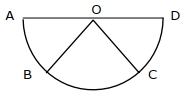
\(|\overrightarrow{A B}|=|\overrightarrow{B C}|=|\overrightarrow{C D}|\)Here, \(O\) is the centre of semi- circle
\(\therefore|\overrightarrow{O A}|=|\overrightarrow{O B}|=|\overrightarrow{O C}|=|\overrightarrow{O D}|\)
Using vector law of addition, we can write,
\(\overrightarrow{ AB }=\overrightarrow{ AO }+\overrightarrow{ OB }\)
\(\overrightarrow{ AC }=\overrightarrow{ AO }+\overrightarrow{ OC }\)
\(\overrightarrow{ AD }=\overrightarrow{ AO }+\overrightarrow{ OD }=2 \overrightarrow{ AO }\)
After adding all, we get,
\(\overrightarrow{A B}+\overrightarrow{A C}+\overrightarrow{A D}=4 \overrightarrow{A O}+\overrightarrow{O B}+\overrightarrow{O C}\)
Reason \(R\) is the direct result of Polygon law of vector addition
Therefore, Polygon law is applicable in both but the equation given in the reason is not useful in explaining the assertion.
-
- (A) વિધાન \(-I\) ખોટું પરંતુ વિધાન \(-II\) સાચું છે
- (B) બંને વિધાન \(-I\) અને વિધાન \(-II\) સાચા છે.
- (C) વિધાન \(-I\) સાચું પરંતુ વિધાન \(-II\) ખોટું છે.
- (D) બંને વિધાન \(-I\) અને વિધાન \(-II\) ખોટા છે.
જવાબ અને ઉકેલ જુઓ
સાચો જવાબ: (B)
\(\overrightarrow{{A}}=\overrightarrow{{P}}+\overrightarrow{{Q}}\)\(\overrightarrow{{B}}=\overrightarrow{{P}}-\overrightarrow{{Q}} \quad \overrightarrow{{P}} \perp \overrightarrow{{Q}}\)
\(|\overrightarrow{{A}}|=|\overrightarrow{{B}}|=\sqrt{{P}^{2}+{Q}^{2}}\)
\(|\overrightarrow{{A}}+\overrightarrow{{B}}|=\sqrt{2\left({P}^{2}+{Q}^{2}\right)(1+\cos \theta)}\)
\(\text { For }|\overrightarrow{{A}}+\overrightarrow{{B}}|=\sqrt{3\left({P}^{2}+{Q}^{2}\right)}\)
\(\theta_{1}=60^{\circ}\)
For \(|\vec{A}+\vec{B}|=\sqrt{2\left(P^{2}+Q^{2}\right)}\)
\(\theta_{2}=90^{\circ}\)
-
- (A) વિધાન \(-I\) ખોટું છે પરંતુ વિધાન \(-II\) સાચું છે
- (B) વિધાન \(-I\) સાચું છે પરંતુ વિધાન \(-II\) ખોટું છે
- (C) બંને વિધાન \(-I\) અને વિધાન \(-II\) ખોટા છે
- (D) બંને વિધાન \(-I\) અને વિધાન \(-II\) સાચાં છે.
જવાબ અને ઉકેલ જુઓ
સાચો જવાબ: (D)
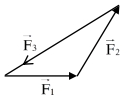
Here \(\overrightarrow{{F}}_{1}+\overrightarrow{{F}}_{2}+\overrightarrow{{F}}_{3}=0\)\(\overrightarrow{{F}}_{1}+\overrightarrow{{F}}_{2}=-\overrightarrow{{F}}_{3}\)
Since \(\overrightarrow{{F}}_{\text {net }}=0\) (equilibrium)
Both statements correct

આ પેજ પર આ ફિલ્ટર મુજબ કોઈ પ્રશ્ન નથી.