


Solution and colligative properties ના બધા પ્રશ્નો
નવા પહેલા186 માંથી 101–150 પ્રશ્નો
-
- (A) \(1\)
- (B) \(0\)
- (C) \(2\)
- (D) \(3\)
જવાબ અને ઉકેલ જુઓ
સાચો જવાબ: (C)
\(Y _{ A }= 0 . 5 \Rightarrow Y _{ B }= 0 . 5\)\(P _{ A }= P _{ B }= 0 . 4 a t m\)
\(P _{ A }= P _{ A }^{0} X _{ A }\)
\(P _{ A }^{0}=2\)
-
- (A) \(45\)
- (B) \(4\)
- (C) \(2\)
- (D) \(9\)
જવાબ અને ઉકેલ જુઓ
સાચો જવાબ: (C)
Given: Molar mass of \(A _{2} B = AB _{3}\)\(\therefore(2 A+B)=(A+3 B)[A \rightarrow \text { Atomic wt. of } A , B \rightarrow \text { Atomic wt. of } B]\)
\(\Rightarrow A=2 B\)
\(\therefore\) atomic wt. of \(A\) is \(2\) times of atomic wt. of \(B\)
Integer answer is \(2\)
-
- (A) \(0\)
- (B) \(1\)
- (C) \(2\)
- (D) \(3\)
જવાબ અને ઉકેલ જુઓ
સાચો જવાબ: (B)
\(\Delta T _{ b }= iK _{ b } m _{1} \quad \Delta T _{ f }= iK _{ f } m _{2}\)\(\frac{\Delta T _{ b }}{\Delta T _{ f }}=\frac{ K _{ b } \times 1}{ K _{ f } \times 2}\) \(\Rightarrow \frac{3}{6}=\frac{1}{2}=\frac{ K _{ b }}{ K _{ f }} \times \frac{1}{2}\)
\(\frac{ K _{ b }}{ K _{ f }}=\frac{1}{1} \Rightarrow x =1\)
-
- (A) \(120\)
- (B) \(330\)
- (C) \(450\)
- (D) \(903\)
જવાબ અને ઉકેલ જુઓ
સાચો જવાબ: (B)
\(\pi= CRT\)\(5.03 \times 10^{-3}= C \times 0.083 \times 300\)
\(C =0.202 \times 10^{-3}\, M\)
Moles of protein \(=0.202 \times 10^{-3} \times 0.5\)
\(=10^{-4} \times 1.01\)
\(1.01 \times 10^{-4}=\frac{2.5}{ M }\)
\(M (\) molar mass of protein \()=24752\)
\(\therefore\) No. of glycine units \(=\frac{24752}{75}=330.03\)
-
- (A) \(0\)
- (B) \(1\)
- (C) \(2\)
- (D) \(3\)
જવાબ અને ઉકેલ જુઓ
સાચો જવાબ: (B)
\(p = K _{ H } \times x\)\(0.920=46.82 \times 10^{3} \text { bar } \times \frac{ mol of O _{2}}{ molof H _{2} O }\)
\(0.920=46.82 \times 10^{3} \times \frac{ mol \text { of } O _{2}}{1000 / 18}\)
\(0.920=46.82 \times n _{ O _{2}}\)
\(p =\frac{0.920}{46.82 \times 18}= n _{0_{2}}\)
\(\Rightarrow 1.09 \times 10^{-3}= n _{0_{2}}\)
\(\Rightarrow m\;mol\;of\;O_{2}=1\)
-
- (A) \(50\)
- (B) \(60\)
- (C) \(70\)
- (D) \(80\)
જવાબ અને ઉકેલ જુઓ
સાચો જવાબ: (D)
\(\Delta T = i \,k _{ f } \times m\)\(0.2= i \times 1.86 \times \frac{0.7}{93} \times \frac{1000}{42}\)
\(i =\frac{0.2 \times 93 \times 6}{1.86 \times 100}\)
\(i =0.60\)
\(2 A \quad \rightleftharpoons A _{2}\)
\(1-\alpha\)
\(i =1-\alpha+\frac{\alpha}{2}\)
\(i =1-\frac{\alpha}{2}\)
\(1-\frac{\alpha}{2}=0.60\)
\(1-0.60=\frac{\alpha}{2}\)
\(\alpha=0.80\)
-
- (A) \(41\)
- (B) \(60\)
- (C) \(80\)
- (D) \(98.5\)
જવાબ અને ઉકેલ જુઓ
સાચો જવાબ: (D)
\(0.5\, \%\) solution of \(KCl\)So \(m =\frac{0.5}{74.6} \times \frac{1}{0.1}\)
\(\Delta T _{ f }= i \times m _{ f }\)
\(0.24=i \cdot \frac{0.5}{74.6} \times \frac{1.80}{0.1}\)
\(i=\frac{0.24 \times 74.6}{0.5 \times 1.80} \times 0.1\)
\(=1.989\)
\(1.989=1+\alpha( n -1)\)
\(1.989=1+\alpha\)
\(\alpha=.989\)
\(\% \alpha=98.9 \%\)
Ans \(99 \,\%\)
If mass of \(H _{2} O =99.5\)
\(m =\frac{0.5}{74.5} \times \frac{1}{.0995}\)
\(i =\frac{0.24 \times 74.6 \times .0995}{.5 \times 1.80}\)
\(=1.979\)
\(1.979=1+\alpha( n -1)\)
\(1.979=1+\alpha\)
\(\alpha=.979\)
\(\% \alpha=97.9\, \%\)
\(98\, \%\)
-
- (A) \(12\)
- (B) \(13\)
- (C) \(10\)
- (D) \(11\)
જવાબ અને ઉકેલ જુઓ
સાચો જવાબ: (B)
With benzene as solvent\(\Delta {T}_{b}={i} {K}_{{b}} {m}\)
\(\Delta {T}_{{b}}=\frac{1}{2} \times 2.6 \times \frac{1.22 / {M}_{{w}}}{100 / 1000}...(1)\)
With Acetone as solvent
\(\Delta {T}_{{b}}={i} {K}_{6} {~m}\)
\(0.17=1 \times 1.7 \times \frac{1.22 / {M}_{{w}}}{100 / 1000}...(2)\)
\((1) /(2)\)
\(\frac{\Delta {T}_{{b}}}{0.17}=\frac{\frac{1}{2} \times 2.6+\frac{1.22 / {M}_{{w}}}{100 / 1000}}{1 \times 1.7 \times \frac{1.22 / {M}_{{w}}}{100 / 1000}}\)
\(\Delta {T}_{{b}}=\frac{0.26}{2}\)
\(\Delta {T}_{{b}}=13 \times 10^{-2}\)
\(\Rightarrow {x}=13\)
-
- (A) \(7\)
- (B) \(5\)
- (C) \(91\)
- (D) \(15\)
જવાબ અને ઉકેલ જુઓ
સાચો જવાબ: (D)
\(\pi={CRT}\)\(; \pi=\) osmotic pressure
\({C}=\) molarity
\(T=\) Temperature of solution
let the molar mass be \({M}\, {gm} / {mol}\)
\(2.42 \times 10^{-3}\, {bar}=\frac{\left(\frac{1.46\, {~g}}{{M\,gm} / {mol}}\right)}{0.1\, \ell} \times\left(\frac{0.083\, \ell-{bar}}{{mol}-{K}}\right) \times(300\, {~K})\)
\(\Rightarrow \quad {M}=15.02 \times 10^{4}\, {~g} / {mol}\)
-
- (A) \(342\)
- (B) \(841\)
- (C) \(518\)
- (D) \(277\)
જવાબ અને ઉકેલ જુઓ
સાચો જવાબ: (C)
Let mass of water initially present \(={x\,gm}\)\(\Rightarrow \text { Mass of sucrose }=(1000-{x})\, {gm}\)
\(\Rightarrow \text { moles of sucrose }=\left(\frac{1000-{x}}{342}\right)\)
\(\Rightarrow 0.75=\frac{\left(\frac{1000-{x}}{342}\right)}{\left(\frac{{x}}{1000}\right)} \Rightarrow \frac{{x}}{1000}=\frac{1000-{x}}{342 \times 0.75}\)
\(\Rightarrow 256.5 {x}=10^{6}-1000 {x}\)
\(\Rightarrow {x}=795.86\, {gm}\)
\(\Rightarrow \text { moles of sucrose }=0.5969\)
New mass of \({H}_{2} {O}={a}\, {kg}\)
\(\Rightarrow 4=\frac{0.5969}{{a}} \times 1.86 \Rightarrow {a}=0.2775\, {~kg}\)
\(\Rightarrow \text { ice separated }=(795.86-277.5)=518.3 \,{gm}\)
-
- (A) \(95\)
- (B) \(85\)
- (C) \(105\)
- (D) \(26\)
જવાબ અને ઉકેલ જુઓ
સાચો જવાબ: (B)
\(\quad \quad \quad \quad \quad K _{4} Fe ( CN )_{6} \rightleftharpoons 4 K ^{+}+ Fe ( CN )_{6}^{4-}\)Initial conc. \(1\, m\quad \quad \quad \quad \quad \quad 0\quad \quad \quad \quad 0\)
Final conc. \((1-0.4) \,m \quad \quad 4 \times 0.4 \quad \quad 0.4\, m\)
\(\quad \quad \quad \quad \quad \quad =0.6\,m \quad \quad \quad =1.6\,m\)
Effective molality \(=0.6+1.6+0.4=2.6 \,m\)
For same boiling point, the molality of another solution should also be \(2.6\, m\).
Now,\(18.1\) weight percent solution means \(18.1\, gm\) solute is present in \(100\, gm\) solution and hence, \((100-18.1=) 81.9 \,gm\) water.
\(\text { Now, } \quad 2.6=\frac{18.1 / M }{81.9 / 1000}\)
\(\therefore\) Molar mass of solute, \(M =85\)
-
- (A) \(71\)
- (B) \(87\)
- (C) \(95\)
- (D) \(78\)
જવાબ અને ઉકેલ જુઓ
સાચો જવાબ: (D)
\(P_{B}^{\circ}=70 \quad P_{T}^{0}=20 \quad X_{B}=0.5=X_{M}\)Now. \(y_{B}=\frac{X_{B} P_{B}^{\circ}}{X_{B} P_{B}^{\circ}+X_{M} P_{M}^{0}}\)
\(=\frac{70 \times 0.5}{70 \times 0.5+20 \times 0.5}\)
\(=0.777 \Rightarrow 77.7 \times 10^{-2} \Rightarrow 78 \times 10^{-2}\)
-
- (A) \(1\)
- (B) \(2\)
- (C) \(3\)
- (D) \(4\)
જવાબ અને ઉકેલ જુઓ
સાચો જવાબ: (A)
Given \({P}_{{A}}^{\circ}=90\, {~mm}\, {Hg}\), at \(25^{\circ} {C}\)\({P}_{{B}}^{\circ}=15\, {~mm} \,{Hg}\)
\(\text { and }{X}_{{A}}=0.6,{X}_{{B}}=0.4\)
\({P}_{{T}}={X}_{{A}} {T}_{{A}}^{\circ}+{X}_{{B}} {P}_{{B}}^{\circ}\)
\(=(0.6 \times 90)+(0.4 \times 15)\)
\(=54+6=60\, {~mm}\)
Now mol fraction of \(B\) in the vapour phase
i.e. \(Y_{B}=\frac{P_{B}}{P_{T}}=\frac{X_{B} P_{B}^{\circ}}{60}=0.1=1 \times 10^{-1}\)
Therefore: \(x=1\)
-
- (A) \(50\)
- (B) \(12\)
- (C) \(67\)
- (D) \(89\)
જવાબ અને ઉકેલ જુઓ
સાચો જવાબ: (B)
\(SO _{2}+ NaOH \rightarrow NaHSO _{3}\)\(9.2\quad \quad \quad 10\quad \quad \quad \quad -\)
\(- \quad \quad \quad 0.8 \quad \quad \quad \quad \quad 9.2\)
\(\Delta P = P ^{0} \cdot X _{\text {solute }}\)
\(=24 \times \frac{(1.6+18.4)}{2020}\)
\(=0.2376=23.76 \times 10^{-2}\)
-
- (A) \(50\)
- (B) \(25\)
- (C) \(55\)
- (D) \(35\)
જવાબ અને ઉકેલ જુઓ
સાચો જવાબ: (B)
From Henry's Law\(0.835=1.67 \times 10^{3} \times \frac{{n}\left({CO}_{2}\right)}{\frac{0.9 \times 1000}{18}}\)
\({n}\left({CO}_{2}\right)=0.025\)
Millimoles of \({CO}_{2}=0.025 \times 1000=25\)
-
- (A) \(19\)
- (B) \(21\)
- (C) \(25\)
- (D) \(36\)
જવાબ અને ઉકેલ જુઓ
સાચો જવાબ: (A)
Given \(P _{ A }^{0}=21\, kPa \quad \Rightarrow P _{ B }^{0}=18\, kPa\)\(\rightarrow\) An Ideal solution is prepared by mixing \(1\, mol\) \(A\) and \(2 \,mol\, B\).
\(\rightarrow X_{A}=\frac{1}{3}\) and \(X_{B}=\frac{2}{3}\)
\(\rightarrow\) Acc to Raoult's low
\(P _{ T }= X _{ A } P _{ A }^{0}+ X _{ B } P _{ B }^{0}\)
\(P _{ T }=\left(\frac{1}{3} \times 21\right)+\left(\frac{2}{3} \times 18\right)\)
\(P _{ T }=7+12=19\, KPa\)
-
- (A) \(1\)
- (B) \(2\)
- (C) \(3\)
- (D) \(4\)
જવાબ અને ઉકેલ જુઓ
સાચો જવાબ: (A)
Total mass \(=4\, {~g}\)Now
\({NaOH}: {a} \,{mol}\quad\quad\quad {W}_{{NaOH}}+{W}_{{Na}_{2} {co}_{3}}=4\)
\({Na}_{2} {CO}_{3}: {'} {a}^{\prime} {mol} \quad\quad \Rightarrow 40 {a}+106 {a}=4\)
\(\quad\quad\quad\quad\quad\quad\quad\quad\quad \Rightarrow {a}=\frac{4}{146} \,{~mol}\)
\(\Rightarrow\) therefore mass of \({NaOH}\) is : \(\frac{4}{146} \times 40\, {~g}\) \(=1.095 \approx 1\)
-
- (A) \(271\)
- (B) \(370\)
- (C) \(71\)
- (D) \(521\)
જવાબ અને ઉકેલ જુઓ
સાચો જવાબ: (A)
\(\text { molality }=\frac{\left(\frac{40}{180}\right) \,{\text {mol }}}{0.2 \,{Kg}}=\left(\frac{10}{9}\right) \,\text { molal }\)\(\Rightarrow \Delta {T}_{{f}}={T}_{{f}}-{T}_{{f}}^{\prime}=1.86 \times \frac{10}{9}\)
\(\Rightarrow {T}_{{f}}^{\prime}=273.15-1.86 \times \frac{10}{9}\)
\(=271.08\, {~K}\)
\(\simeq 271 \,{~K}\) (nearest-integer)
-
- (A) \(3\)
- (B) \(1\)
- (C) \(5\)
- (D) \(9\)
જવાબ અને ઉકેલ જુઓ
સાચો જવાબ: (B)
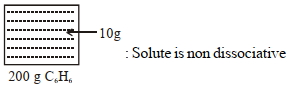
Pure Solvent : \(C _{6} H _{6}(\ell)\)Given : \(T _{ f }^{\circ}=5.5^{\circ} C\)
\(K _{ f }=5.12^{\circ}\,C / m\)
\(\because \Delta T _{ f }= k _{ f } \times m\)
\(\Rightarrow\left( T _{ f }^{0}- T _{ f }^{\prime}\right)=5.12 \times \frac{\left(\frac{10}{58}\right)}{\left(\frac{200}{1000}\right) \,kg } \,mol\)
\(\Rightarrow 5.5- T _{ f }^{\prime}=\frac{5.12 \times 5 \times 10}{58}\)
\(\Rightarrow T _{ f }^{\prime}=1.086^{\circ} C \simeq 1^{\circ} C\)
-
- (A) \(369\)
- (B) \(269\)
- (C) \(209\)
- (D) \(296\)
જવાબ અને ઉકેલ જુઓ
સાચો જવાબ: (B)
\({k}_{{f}}=1.86\, {k} \cdot\, {kg} / {mol}\)\({T}_{{f}}^{\circ}=273\, {k}\)
solvent \(: {H}_{2} {O}(625\, {~g})\)
Solute : \(83\, {~g}\) \({CH}_{2}OH-{CH}_{2}OH \Rightarrow\) Non dissociative
solute
\(\Rightarrow \Delta {T}_{{f}}={k}_{{f}} \times {m}\)
\(\Rightarrow\left({T}_{{f}}^{\circ}-{T}_{{f}}^{1}\right)=1.86 \times \frac{83 / 62}{624 / 1000}\)
\(\Rightarrow 273-{T}_{{f}}^{1}=\frac{1.86 \times 83 \times 1000}{62 \times 625}=\frac{154380}{38750}\)
\(\Rightarrow 273-{T}_{{f}}^{1}=4\)
\(\Rightarrow {T}_{{f}}^{1}=259\,{~K}\)
-
- (A) \(201\)
- (B) \(105\)
- (C) \(102\)
- (D) \(106\)
જવાબ અને ઉકેલ જુઓ
સાચો જવાબ: (D)
\(AB _{2} \rightarrow A ^{2+}+2 B ^{-}\)\(\begin{array}{llll} t =0 a 0 0\end{array}\)
\(\begin{array}{llll} t = t a - a \alpha a \alpha 2 a \alpha\end{array}\)
\(n _{ T }= a - a \alpha+ a \alpha+2 a \alpha\)
\(= a (1+2 \alpha)\)
so \(i =1+2 \alpha\)
Now \(\Delta T _{ b }= i \times m \times K _{ b }\)
\(\Delta T _{ b }=(1+2 \alpha) \times m \times K _{ b }\)
\(\alpha=0.1 \quad m =10 \quad K _{ b }=0.5\)
\(\Delta T _{ b }=1.2 \times 10 \times 0.5\)
\(=6\)
So boiling point \(=106\)
- 122. દ્રાવકમાં \(50\, \%\) એસિડ \(HA\) ડાઇમેરાઇઝ થાય છે અને બાકીનું વિઘટન થાય છે. એસિડનું વોન્ટ હોફ અવયવ \(.....\,\times 10^{-2}\) છે. 2021 અઘરું
- (A) \(150\)
- (B) \(125\)
- (C) \(175\)
- (D) \(850\)
જવાબ અને ઉકેલ જુઓ
સાચો જવાબ: (B)
\(\quad\quad\quad\quad\quad\quad2 {HA} \rightleftharpoons {H}_{2} {~A}_{2} \quad {HA} \rightleftharpoons {H}^{+}+{A}\)\(\text { Initial moles } {a} \times \frac{50}{100} \quad\quad 0 \quad {a} \times \frac{50}{100} \quad0 \quad\quad 0\)
\(\text { Final moles }\quad 0 \quad 0.25 {a} \quad\quad\quad0 \quad\quad 0.5 {a} \quad\quad 0.5 {a}\)
Now, \(i=\frac{\text { final moles }}{\text { initial moles }}=\frac{0.25 a+0.5 a+0.5 a}{0.5 a+0.5 a}\)
\(=1.25=125 \times 10^{-2}\)
-
- (A) \(370\)
- (B) \(380\)
- (C) \(375\)
- (D) \(385\)
જવાબ અને ઉકેલ જુઓ
સાચો જવાબ: (C)
\(\Delta T _{ b }= iK _{ b } m\)\(=(1+4 \alpha) \times 0.52 \times 1\)
\(=3.4 \times 0.52 \times 1=1.768\)
\(T _{ b }=1.768+313.15=374.918 K\)
\(=375 K\)
-
- (A) \(4\)
- (B) \(3\)
- (C) \(6\)
- (D) \(5\)
જવાબ અને ઉકેલ જુઓ
સાચો જવાબ: (B)
\(\alpha=0.75, n =2\)\(i =1-\alpha+ n \alpha=1-0.75+2 \times 0.75=1.75\)
\(\Delta T _{ b }= ik _{ b } m\)
or, \(2.5=1.75 \times 0.52 \times m\)
or, \(m =\frac{2.5}{1.75 \times 0.52}=2.74\)
\(\therefore\) nearest integer answer will be \(3\)
-
- (A) \(94\)
- (B) \(152\)
- (C) \(316\)
- (D) \(656\)
જવાબ અને ઉકેલ જુઓ
સાચો જવાબ: (C)
\(\text { Let molarity of } {KMnO}_{4}={x}\)\({KMnO}_{4}+{FeSO}_{4} \rightarrow {Fe}_{2}\left({SO}_{4}\right)_{3}+{Mn}^{2+}\)
\({n}=5 \quad {n}=1\)
(Equivalents of \({KMnO}_{4}\) reacted \()=\) (Equivalents of \({FeSO}_{4}\) reacted \()\)
\(\Rightarrow(5 \times x \times 10\, {ml})=1 \times 0.1 \times 10\, {ml}\)
\(\Rightarrow {x}=0.02\, {M}\)
Molar mass of \({KMnO}_{4}=158\, {gm} / {mol}\)
\(\Rightarrow \text { Strength }=({x} \times 158)=3.16\, {~g} / \ell\)
-
- (A) \(38\)
- (B) \(42\)
- (C) \(36\)
- (D) \(44\)
જવાબ અને ઉકેલ જુઓ
સાચો જવાબ: (C)
\(ClCH _{2} COOH \rightleftharpoons ClCH _{2} COO ^{\ominus}+ H ^{+}\)\(i =1+(2-1) \alpha\)
\(i =1+\alpha\)
\(\Delta T _{ f }= ik _{ f } m\)
\(0.5=(1+\alpha)(1.86)\left(\frac{\left(\frac{9.45}{94.5}\right)}{\left(\frac{500}{1000}\right)}\right)\)
\(\frac{5}{3.72}=1+\alpha \quad \Rightarrow \alpha=\frac{1.28}{3.72}\)
\(\alpha=\frac{32}{93}\)
\(\begin{array}{*{20}{c}} {ClC{H_2}COOH \rightleftharpoons ClC{H_2}CO{O^ \ominus } + {H^ + }} \\ {\,\,\,\,\,\,\,\,\,C - C\alpha \,\,\,\,\,\,\,\,\,\,\,\,\,\,\,\,\,\,\,\,\,\,\,\,\,\,\,\,C\alpha \,\,\,\,\,\,\,\,\,\,\,\,\,\,\,\,\,\,\,\,\,\,\,\,\,\,\,\,\,\,\,C\alpha \,\,\,\,\,\,\,\,\,\,\,\,\,} \end{array}\)
\(=0.036\)
\(K _{ a }=36 \times 10^{-3}\)
-
- (A) \(49\)
- (B) \(80\)
- (C) \(64\)
- (D) \(17\)
જવાબ અને ઉકેલ જુઓ
સાચો જવાબ: (C)
Moles of \({CuSO}_{4} \cdot 5 {H}_{2} {O}=\frac{80}{249.54}\)Molarity \(=\frac{80}{\frac{249.54}{5}}=64.117 \times 10^{-3}\)
Nearest integer, \({x}=64\)
-
- (A) \(4\)
- (B) \(3\)
- (C) \(1\)
- (D) \(2\)
જવાબ અને ઉકેલ જુઓ
સાચો જવાબ: (A)
As \(0.1 \,{M} {C}_{2} {H}_{5} {OH}\) is non-dissociative and rest all salt given are electrolyte so in each case effective molarity \(>\,0.1\) so each will have lower freezing point. -
- (A) \({C}_{6} {H}_{12} {O}_{6}\).
- (B) \({K}_{2} {SO}_{4}\)
- (C) \(KI\)
- (D) \({Al}_{2}\left({SO}_{4}\right)_{3}\)
જવાબ અને ઉકેલ જુઓ
સાચો જવાબ: (D)
\(\Delta {T}_{{f}}={i} {k}_{{f}} \times {m}\)\(\Delta {T}_{{f}} \alpha\) \(i\) but \(F.P\) \(\alpha 1 / {i}\)
- 130. નીચેનામાંથી કયું \(0.10\, {M}\) જલીય દ્રાવણ સૌથી મોટા ફ્રીઝિંગ પોઇન્ટ ડિપ્રેશનનું પ્રદર્શન કરશે? 2021 મધ્યમ
- (A) હાઈડ્રેઝીન
- (B) ગ્લુકોઝ
- (C) ગ્લાયસીન
- (D) \({KHSO}_{4}\)
જવાબ અને ઉકેલ જુઓ
સાચો જવાબ: (D)
\(\because\) Van't Hoff factor is highest for \({KHSO}_{4}\)\(\therefore\) colligative property \(\left(\Delta {T}_{{f}}\right)\) will be highest for \({KHSO}_{4}\)
-
- (A) \(50\)
- (B) \(60\)
- (C) \(55\)
- (D) \(65\)
જવાબ અને ઉકેલ જુઓ
સાચો જવાબ: (A)
\(\Delta T _{ f }=(1+\alpha) K _{ f } m\)\(\alpha=0.05=50 \times 10^{-3}\)
-
- (A) \(20\)
- (B) \(15\)
- (C) \(30\)
- (D) \(25\)
જવાબ અને ઉકેલ જુઓ
સાચો જવાબ: (D)
\(P = K _{ H } \cdot x\)or, \(20 \times 10^{3}=\left(8 \times 10^{4} \times 10^{3}\right) \times \frac{ n _{ O _{2}}}{ n _{ O _{2}}+ n _{\text {water }}}\)
or \(, \frac{1}{4000}=\frac{ n _{ O _{2}}}{ n _{ O _{2}}+ n _{\text {water }}}=\frac{ n _{ O _{2}}}{ n _{\text {water }}}\)
Means 1 mole water \((=18 gm =18 ml )\) dissolves
\(\frac{1}{4000}\) moles \(O _{2} .\) Hence, molar solubility
\(=\frac{\left(\frac{1}{4000}\right)}{18} \times 1000=\frac{1}{72} mol dm ^{-3}\)
\(=1388.89 \times 10^{-5} mol \,dm ^{-3} \approx 1389 mol\, dm ^{-3}\)
-
- (A) \(10\)
- (B) \(5\)
- (C) \(12\)
- (D) \(15\)
જવાબ અને ઉકેલ જુઓ
સાચો જવાબ: (B)
\(\Delta T_{b}=i \times K_{b} \times m\)\(i \times 0.1 \times K_{b}=3 \times 0.05 \times K_{b} \times 2\)
\(i=3\)
\(\left[C r\left(N H_{3}\right)_{5} \cdot C l\right] C l_{2} \rightarrow\left[C r\left(N H_{3}\right)_{5} C l\right]^{+2}+2 C l^{-}\)
\(x=5\)
-
- (A) \(13\)
- (B) \(10\)
- (C) \(8\)
- (D) \(6\)
જવાબ અને ઉકેલ જુઓ
સાચો જવાબ: (B)
\(\mathrm{ppm}=\frac{10.3 \times 10^{-3}}{1030} \times 10^{6}=10\) -
- (A) \(10\)
- (B) \(5\)
- (C) \(8\)
- (D) \(12\)
જવાબ અને ઉકેલ જુઓ
સાચો જવાબ: (A)
Molar mass of \(Na _{2} CO _{3} \cdot xH _{2} O\)\(\Rightarrow 23 \times 2+12+48+18 x\)
\(\Rightarrow 46+12+48+18 x\)
\(\Rightarrow(106+18 x )\)
\(Eqwt =\frac{ M }{2}=(53+9 x )\)
As \(n _{\text {factor }}\) in dissolution will be determined from net cationic or anionic charge; which is \(2\) so
\(Eqwt =\frac{ M }{2}=53+9 x\)
Gmeq \(=\frac{ wt }{ Eqwt }=\frac{1.43}{53+9 x }\)
Normality \(=\frac{ Gmeq }{ V _{\text {litre }}}\)
Normality \(=0.1=\frac{1.43}{\frac{53+9 x }{0.1}}\)
As volume \(=100 ml\)
\(=0.1 Litre\)
So \(\quad 10^{-2}=\frac{1.43}{53+9 x }\)
\(53+9 x =143\)
\(9 x =90\)
\(x =10.00\)
-
- (A) \(172\)
- (B) \(175\)
- (C) \(180\)
- (D) \(177\)
જવાબ અને ઉકેલ જુઓ
સાચો જવાબ: (D)
Let molar mass of protein \(A=x\) \(g/mol\)Let molar mass of protein \(B = y g / mol\)
\(\pi_{ A }=\) osmotic pressure of protein \(A =\frac{\left(\frac{0.73}{ x }\right)}{0.25} RT\)
\(\pi_{ B }=\) osmotic pressure of protein \(B =\frac{\left(\frac{1.65}{ y }\right)}{1} RT\)
\(\pi_{ A }=\pi_{ B }\)
\(\Rightarrow\left(\frac{0.73}{ x \times 0.25}\right) RT =\left(\frac{1.65}{ y }\right) RT\)
\(\Rightarrow\left(\frac{ x }{ y }\right)=\frac{0.73}{0.25 \times 1.65}=1.769 \cong 1.77\)
-
- (A) \(600\)
- (B) \(620\)
- (C) \(590\)
- (D) \(628\)
જવાબ અને ઉકેલ જુઓ
સાચો જવાબ: (A)
\(550= P _{ A }^{\circ} \times \frac{1}{4}+ P _{ B }^{\circ} \times \frac{3}{4}\)\(2200= P _{ A }^{\circ}+3 P _{ B }^{\circ}\)\(....(i)\)
\(2800= P _{ A }^{\circ}+4 P _{ B }^{\circ}\)\(....(ii)\)
\(560= P _{ A }^{\circ} \times \frac{1}{5}+ P _{ B }^{\circ} \times \frac{4}{5}\)
\(P _{ B }^{\circ}=600, P _{ A }^{\circ}=400\)
-
- (A) \(35^oC\) પર દ્રાવણ બનાવવા ઉષ્મા શોષાવી જોઇએ
- (B) આ પ્રણાલીમાં રાઉલ્ટના નિયમનું પાલન થતુ નથી
- (C) \(100\; mL\; CS_2\) અને \(100\; mL\) એસિટોનના મિશ્રણનું કદ \(< 200 \;mL\) થશે
- (D) તેઓ પોતે સ્વતંત્ર રીતે હોય તેના કરતા \(CS_2\) અને એસિટોન ઓછા જોડાયેલા છે
જવાબ અને ઉકેલ જુઓ
સાચો જવાબ: (C)
The vapour pressure of mixture \((=600\; \mathrm{mm} \;\mathrm{Hg}\) ) is greater than the individual vapour pressure of its constituents (Vapour pressure of \(\mathrm{CS}_{2}=512\; \mathrm{mm}\; Hg\), acetone \(=344 \;\mathrm{mm}\; Hg\) ). Hence, the solution formed shows positive deviationfrom Raoult's law.
\(\Rightarrow(1) \Delta_{\mathrm{sol}} \mathrm{H}>0\)
\((2)\) Raoult's law is not obeyed
(3) \(\Delta_{\text {sol. }}\) Volume \(>0\)
(4) \(\mathrm{CS}_{2}\) and Acetone are less attracted to each ether than to themselves.
-
- (A) \(0.37\)
- (B) \(0.67\)
- (C) \(0.87\)
- (D) \(0.63\)
જવાબ અને ઉકેલ જુઓ
સાચો જવાબ: (A)
\(1\; L\) solution requires \(30 \mathrm{m\;mol} \;\mathrm{HCl}\)\(250 \;\mathrm{ml}\) sol. will require \(7.5 \mathrm{m}\; \mathrm{mol} \;\mathrm{HCl}\)
\({\text { or } 3.75 \mathrm{m\;mol}\; \mathrm{H}_{2} \mathrm{SO}_{4}}\)
\({\Rightarrow \frac{3.75 \times 98}{1000} \mathrm{gm} \;\mathrm{H}_{2} \mathrm{SO}_{4}}\)
\({=0.3675 \;\mathrm{gm} \;\mathrm{H}_{2} \mathrm{SO}_{4}}\)
-
- (A) દ્રાવણનું કદ બદલાતુ અને દ્રાવકનું કદ ઘટે છે
- (B) દ્રાવણનુ કદ ઘટે છે અને દ્રાવકનું કદ ઘટે છે
- (C) દ્રાવણનુ કદ ઘટે છે અને દ્રાવકનું કદ વધે છે
- (D) દ્રાવણ અને દ્રાવકની કટ બદલાતા નથી
જવાબ અને ઉકેલ જુઓ
સાચો જવાબ: (C)
The pure solvent solution will try to maintain higher vapour pressure in the sealed container and in return the solvent vapour molecules will condense in the solution of non-volatile solute as it maintains an equilibrium with lower vapour pressure. (Lowering of vapour pressure is observed when a non volatile solute is mixed in a volatile solvent)This will eventually lead to increase in the volume of solution and decrease in the volume of solvent.
-
- (A) \(8.33\)
- (B) \(5.67\)
- (C) \(6.33\)
- (D) \(4.67\)
જવાબ અને ઉકેલ જુઓ
સાચો જવાબ: (B)
gm eq. of \(\mathrm{Ag}=\frac{108}{108}=1\)\(\mathrm{gm}\) eq. of \(\mathrm{O}_{2}(\mathrm{g})=1\)
Volume of \(\mathrm{O}_{2}(\mathrm{g})=22.7 \times \frac{1}{4}=5.675\) litre
-
- (A) \(A>B>C\)
- (B) \(A>C>B\)
- (C) \(C>B>A\)
- (D) \(B > C > A\)
જવાબ અને ઉકેલ જુઓ
સાચો જવાબ: (A)
Relative lowering of \(V . P. =\frac{\Delta P }{ P ^{0}}= x _{\text {solute }}\)\(\left(\frac{\Delta P }{ P ^{0}}\right)_{ A }=\frac{\frac{10}{100}}{\frac{10}{100}+\frac{180}{18}}:\left(\frac{\Delta P }{ P ^{0}}\right)_{ B }=\frac{\frac{10}{200}}{\frac{10}{200}+\frac{180}{18}}\)
\(\left(\frac{\Delta P }{ P ^{0}}\right)_{ C }=\frac{\frac{10}{10,000}}{\frac{10}{10,000}+\frac{180}{18}}:\left(\frac{\Delta P }{ P ^{0}}\right)_{ A }>\left(\frac{\Delta P }{ P ^{0}}\right)_{ B }>\left(\frac{\Delta P }{ P ^{0}}\right)_{ C }\)
-
- (A) \(14\)
- (B) \(22\)
- (C) \(6\)
- (D) \(38\)
જવાબ અને ઉકેલ જુઓ
સાચો જવાબ: (C)
According to Dalton's law of partial pressure\(p _{ i }= x _{ i } \times P _{ T }\)
\(P _{ i }=\) partial pressure of the \(i ^{\text {th }}\) component
\(x _{ i }=\) mole fraction of the \(i ^{\text {th }}\) component
\(p _{ T }=\) total pressure of mixture
\(\Rightarrow 2 atm =\left(\frac{ n _{ H _{2}}}{ n _{ H _{2}}+ n _{ H _{ e }}+ n _{ O _{2}}}\right) \times p _{ T }\)
\(\Rightarrow p _{ T }=2 atm \times \frac{3}{1}=6 atm\)
-
- (A) \(37\)
- (B) \(35\)
- (C) \(40\)
- (D) \(32\)
જવાબ અને ઉકેલ જુઓ
સાચો જવાબ: (A)
\(P _{ CO _{2}}= K _{ H } \times CO _{2}\)\(\frac{3}{30}=\frac{ K _{ H } \cdot n _{ CO _{2}}}{ K _{ H } 1} \Rightarrow n _{ CO _{2}-0.1} mol\)
\(pH =\frac{1}{2}\left( pka _{1}-\log c \right)=\frac{1}{2}(6.4 \times 1)=3.7\)
\(pH =37 \times 10^{-1}\)
-
- (A) \(150\)
- (B) \(167\)
- (C) \(160\)
- (D) \(159\)
જવાબ અને ઉકેલ જુઓ
સાચો જવાબ: (B)
Osmotic pressure \(=\pi= i \times C \times RT\)For \(NaCl i =2\) so
\(\pi_{ NaCl }= i \times C _{ NaCl } \times RT \quad C _{ NaCl }=\) conc. of \(NaCl\)
\(0.1=2 \times C _{ NaCl } \times RT\)
\(C_{ NaCl }=\frac{0.05}{ RT } \quad C_{\text {glucose }}=\) conc. of glucose
For glucose \(i=1\) so
\(\pi_{\text {Glucose }}= i \times C _{\text {glucose }} \times RT\)
\(0.2=1 \times C _{\text {glucose }} \times RT\)
\(C _{\text {Glucose }}=\frac{0.2}{ RT } \quad \eta_{ NaCl }=\) No. of moles \(NaCl\)
\(\eta_{ NaCl }\) in \(1 L = C _{ NaCl } \times V _{\text {Litre }}\)
\(=\frac{0.05}{ RT } \quad \eta_{ glucose }=\) No. of moles glucose
\(\eta_{\text {glucose }}\) in \(2 L = C _{\text {glucose }} \times V _{\text {Litre }}\)
\(=\frac{0.4}{ RT }\)
\(V _{\text {Total }}=1+2=3 L\)
so Final conc. \(NaCl =\frac{0.05}{3 RT }\)
Final conc. glucose \(=\frac{0.4}{3 RT }\)
\(\pi_{\text {Total }}=\pi_{ NaCl }+\pi_{\text {glucose }}\)
\(=\left[i \times C_{ NaCl }+C_{\text {glucose }}\right] \times RT\)
\(=\left(\frac{2 \times 0.05}{3 RT }+\frac{0.4}{3 RT }\right) \times RT\)
\(=\frac{0.5}{3} atm\)
\(=0.1666 atm\)
\(=166.6 \times 10^{-3} atm\)
\(\Rightarrow 167.00 \times 10^{-3} atm\)
so \(x=167.00\)
-
- (A) \(2.25\)
- (B) \(2\)
- (C) \(1.75\)
- (D) \(1.5\)
જવાબ અને ઉકેલ જુઓ
સાચો જવાબ: (C)
\(\Delta \mathrm{T}_{\mathrm{f}}=\mathrm{i} \times \mathrm{m} \times \mathrm{K}_{\mathrm{f}}\)\(0.2=2 \times 2 \times \frac{\mathrm{w} / 58.5}{600 / 1000}\)
\(\mathrm{w}=1.755 \mathrm{gm}\)
-
- (A) \(4.97\)
- (B) \(6.63\)
- (C) \(3.52\)
- (D) \(9.47\)
જવાબ અને ઉકેલ જુઓ
સાચો જવાબ: (A)
\(\mathrm{FeSO}_{4} \cdot 7 \mathrm{H}_{2} \mathrm{O}(\mathrm{M}=277.85)\)\(\mathrm{ppm}=\frac{\text { wt. of Fe }}{\text { wt. of wheat }} \times 10^{6}\)
let the wt. of salt be \(=\mathrm{w} \mathrm{gm}\)
moles \(=\frac{\mathrm{w}}{277.85}\)
wt. of \(\mathrm{Fe}=\left(\frac{\mathrm{W}}{277.85} \times 55.85\right) \mathrm{gm}\)
\(10=\frac{\frac{\mathrm{W}}{277.85} \times 55.85}{10^{5}} \times 10^{6}\)
\(W=\frac{277.85}{55.85}=4.97\)
-
- (A) \((A)\)
- (B) \((C)\)
- (C) \((B)\)
- (D) \((A)\) અને \((C)\)
જવાબ અને ઉકેલ જુઓ
સાચો જવાબ: (C)
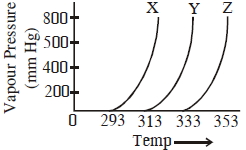
Order of B.P. is : \(Z>Y>X\)Order of vapour pressure \(: Z < Y < X\)
order of intermolecular interaction \(: Z>Y>X\)
-
- (A) \(5:1\)
- (B) \(10:1\)
- (C) \(1:5\)
- (D) \(1:0.2\)
જવાબ અને ઉકેલ જુઓ
સાચો જવાબ: (C)
\(\Delta \,{T_b}\, = \,{K_b}\, \times \,m\)\(\therefore \,\,\frac{{\Delta {T_{b\,(A)}}}}{{\Delta {T_{b\,(B)}}}}\, = \,\frac{{{K_{b(A)}}}}{{{K_{b(B)}}}}\) as \({m_A}\, = \,{m_B}\)
\(\therefore \,\,\frac{{\Delta {T_{b\,(A)}}}}{{\Delta {T_{b\,(B)}}}}\, = \frac{1}{5}\)
-
- (A) \(48\)
- (B) \(32\)
- (C) \(64\)
- (D) \(16\)
જવાબ અને ઉકેલ જુઓ
સાચો જવાબ: (C)
Let moles of \(H_2O\) separated as ice \(=\,x\,gm\)\(\Delta {T_f}\, = \,\,i\,{K_f}m\)
\(10\, = \,1\, \times \,1.86\,\frac{{\frac{{62}}{{62}}}}{{\frac{{250\, - \,x}}{{1000}}}}\)
\(x\, = \,64\,gm\)
આ પેજ પર આ ફિલ્ટર મુજબ કોઈ પ્રશ્ન નથી.