


All Solution and colligative properties questions
Newest firstShowing 101–150 of 188 questions
-
- (A) \(50\)
- (B) \(60\)
- (C) \(70\)
- (D) \(80\)
Show answer and solution
Correct Answer: (D)
\(\Delta T = i \,k _{ f } \times m\)\(0.2= i \times 1.86 \times \frac{0.7}{93} \times \frac{1000}{42}\)
\(i =\frac{0.2 \times 93 \times 6}{1.86 \times 100}\)
\(i =0.60\)
\(2 A \quad \rightleftharpoons A _{2}\)
\(1-\alpha\)
\(i =1-\alpha+\frac{\alpha}{2}\)
\(i =1-\frac{\alpha}{2}\)
\(1-\frac{\alpha}{2}=0.60\)
\(1-0.60=\frac{\alpha}{2}\)
\(\alpha=0.80\)
-
- (A) \(0.8\)
- (B) \(1.1\)
- (C) \(1.9\)
- (D) \(2.4\)
Show answer and solution
Correct Answer: (C)
\([ HCOOH ]=0.5\,ml\,1^{-1}\)\(\Rightarrow\left(0.5 ml \times 1.05\,g\,ml ^{-1}\right) HCOOH\) in \(1 L\)
\(\Rightarrow 0.525\,g\,HCOOH\) in \(1\,L\)
\(m =\frac{(0.525 / 46)}{1\,kg } mol\) [Assuming dilute solution]
\(\therefore \Delta T _{ f }= iK _{ f } m \Rightarrow i =\frac{\Delta T _{ f }}{ k _{ f } m }=\frac{0.0405 \times 46}{1.86 \times 0.525}=1.9\)
-
- (A) \(0\)
- (B) \(1\)
- (C) \(2\)
- (D) \(3\)
Show answer and solution
Correct Answer: (B)
\(\Delta T _{ b }= iK _{ b } m _{1} \quad \Delta T _{ f }= iK _{ f } m _{2}\)\(\frac{\Delta T _{ b }}{\Delta T _{ f }}=\frac{ K _{ b } \times 1}{ K _{ f } \times 2}\) \(\Rightarrow \frac{3}{6}=\frac{1}{2}=\frac{ K _{ b }}{ K _{ f }} \times \frac{1}{2}\)
\(\frac{ K _{ b }}{ K _{ f }}=\frac{1}{1} \Rightarrow x =1\)
-
- (A) \(236\)
- (B) \(654\)
- (C) \(313\)
- (D) \(415\)
Show answer and solution
Correct Answer: (D)
\(\pi= iCRT\)\(=\frac{1 \times 2}{60000 \times 0.2} \times 0.083 \times 300\)
\(=0.00415\) bar \(\quad\left(\because 1\right.\) bar \(\left.=10^{5} Pa \right)\)
So, \(0.00415 \times 10^{5} Pa =415 \,Pa\)
-
- (A) \(11\)
- (B) \(33\)
- (C) \(54\)
- (D) \(44\)
Show answer and solution
Correct Answer: (C)
\(\pi= C.R.T\)\(7.47= C \times 0.083 \times 300\)
\(C =0.3 M\)
\(=0.3 \times 180 gL ^{-1}\)
\(=54 gL ^{-1}\)
-
- (A) \(140\)
- (B) \(89\)
- (C) \(14\)
- (D) \(54\)
Show answer and solution
Correct Answer: (C)
\(\frac{ y _{ B }}{1- y _{ B }}=\frac{ P _{ B }^{\circ}}{ P _{A}^{\circ}}\frac{ X _{ B }}{1- X _{ B }}\)\(\Rightarrow \frac{ y _{ B }}{1- y _{ B }}=\frac{100}{50}[\frac{0.7}{0.3}]=\frac{14}{3}\)
\(\Rightarrow y _{ B }=\frac{14}{17}\)
Ans. \(14\)
-
- (A) \(45\)
- (B) \(4\)
- (C) \(2\)
- (D) \(9\)
Show answer and solution
Correct Answer: (C)
Given: Molar mass of \(A _{2} B = AB _{3}\)\(\therefore(2 A+B)=(A+3 B)[A \rightarrow \text { Atomic wt. of } A , B \rightarrow \text { Atomic wt. of } B]\)
\(\Rightarrow A=2 B\)
\(\therefore\) atomic wt. of \(A\) is \(2\) times of atomic wt. of \(B\)
Integer answer is \(2\)
-
- (A) \(1: 4\)
- (B) \(1: 0.25\)
- (C) \(1: 0.20\)
- (D) \(1: 5\)
Show answer and solution
Correct Answer: (B)
\(\frac{\Delta T _{ ex }}{\Delta T _{ fy }}=\frac{ k _{ f } \cdot m _{ x }}{ k _{ f } \cdot m _{ y }}=\frac{\frac{1 / M _{ x }}{1 / M _{ y }}}{\frac{1}{1}}\)\(\frac{1}{4}=\frac{M_{y}}{M_{x}}\)
\(M _{ x }: M _{ y }=1: 0.25\)
-
- (A) \(2\)
- (B) \(3\) or \(6\)
- (C) \(4\)
- (D) \(5\)
Show answer and solution
Correct Answer: (B)
\(\because\) Diliute solution given:\(\frac{ P ^{0}- P _{ s }}{ P ^{0}} \sim \frac{{ }^{n} \text { solute }}{{ }^{n} \text { solvent }}\)
\(\frac{ P ^{0}- P ^{0} / 2}{ P ^{0}}=\frac{{ }^{n} \text { solute }}{ n _{\text {solvent }}}\)
" solute \(\sim \frac{{ }^{ n } \text { solvent }}{2}=\frac{100}{18 \times 2}=2.78\,mol\)
More accurate approach:
\(\frac{ P ^{0}- P _{ S }}{ P _{ S }}=\frac{{ }^{ n } \text { solute }}{{ }^{n} \text { solvent }}\)
\(\frac{ P ^{0}- P ^{0} / 2}{ P ^{0} / 2}=\frac{{ }^{n} \text { solute }}{{ }^{n} \text { solvent }}\)
\(\text { " solute }={ }^{n} \text { solvent }=\frac{100}{18}=5.55\,mol\)
-
- (A) \(12\)
- (B) \(13\)
- (C) \(10\)
- (D) \(11\)
Show answer and solution
Correct Answer: (B)
With benzene as solvent\(\Delta \mathrm{T}_{b}=\mathrm{i} \mathrm{K}_{\mathrm{b}} \mathrm{m}\)
\(\Delta \mathrm{T}_{\mathrm{b}}=\frac{1}{2} \times 2.6 \times \frac{1.22 / \mathrm{M}_{\mathrm{w}}}{100 / 1000}...(1)\)
With Acetone as solvent
\(\Delta \mathrm{T}_{\mathrm{b}}=\mathrm{i} \mathrm{K}_{6} \mathrm{~m}\)
\(0.17=1 \times 1.7 \times \frac{1.22 / \mathrm{M}_{\mathrm{w}}}{100 / 1000}...(2)\)
\((1) /(2)\)
\(\frac{\Delta \mathrm{T}_{\mathrm{b}}}{0.17}=\frac{\frac{1}{2} \times 2.6+\frac{1.22 / \mathrm{M}_{\mathrm{w}}}{100 / 1000}}{1 \times 1.7 \times \frac{1.22 / \mathrm{M}_{\mathrm{w}}}{100 / 1000}}\)
\(\Delta \mathrm{T}_{\mathrm{b}}=\frac{0.26}{2}\)
\(\Delta \mathrm{T}_{\mathrm{b}}=13 \times 10^{-2}\)
\(\Rightarrow \mathrm{x}=13\)
-
- (A) \(7\)
- (B) \(5\)
- (C) \(91\)
- (D) \(15\)
Show answer and solution
Correct Answer: (D)
\(\pi=\mathrm{CRT}\)\(; \pi=\) osmotic pressure
\(\mathrm{C}=\) molarity
\(T=\) Temperature of solution
let the molar mass be \(\mathrm{M}\, \mathrm{gm} / \mathrm{mol}\)
\(2.42 \times 10^{-3}\, \mathrm{bar}=\frac{\left(\frac{1.46\, \mathrm{~g}}{\mathrm{M\,gm} / \mathrm{mol}}\right)}{0.1\, \ell} \times\left(\frac{0.083\, \ell-\mathrm{bar}}{\mathrm{mol}-\mathrm{K}}\right) \times(300\, \mathrm{~K})\)
\(\Rightarrow \quad \mathrm{M}=15.02 \times 10^{4}\, \mathrm{~g} / \mathrm{mol}\)
-
- (A) \(342\)
- (B) \(841\)
- (C) \(518\)
- (D) \(277\)
Show answer and solution
Correct Answer: (C)
Let mass of water initially present \(=\mathrm{x\,gm}\)\(\Rightarrow \text { Mass of sucrose }=(1000-\mathrm{x})\, \mathrm{gm}\)
\(\Rightarrow \text { moles of sucrose }=\left(\frac{1000-\mathrm{x}}{342}\right)\)
\(\Rightarrow 0.75=\frac{\left(\frac{1000-\mathrm{x}}{342}\right)}{\left(\frac{\mathrm{x}}{1000}\right)} \Rightarrow \frac{\mathrm{x}}{1000}=\frac{1000-\mathrm{x}}{342 \times 0.75}\)
\(\Rightarrow 256.5 \mathrm{x}=10^{6}-1000 \mathrm{x}\)
\(\Rightarrow \mathrm{x}=795.86\, \mathrm{gm}\)
\(\Rightarrow \text { moles of sucrose }=0.5969\)
New mass of \(\mathrm{H}_{2} \mathrm{O}=\mathrm{a}\, \mathrm{kg}\)
\(\Rightarrow 4=\frac{0.5969}{\mathrm{a}} \times 1.86 \Rightarrow \mathrm{a}=0.2775\, \mathrm{~kg}\)
\(\Rightarrow \text { ice separated }=(795.86-277.5)=518.3 \,\mathrm{gm}\)
-
- (A) \(370\)
- (B) \(380\)
- (C) \(375\)
- (D) \(385\)
Show answer and solution
Correct Answer: (C)
\(\Delta T _{ b }= iK _{ b } m\)\(=(1+4 \alpha) \times 0.52 \times 1\)
\(=3.4 \times 0.52 \times 1=1.768\)
\(T _{ b }=1.768+313.15=374.918 K\)
\(=375 K\)
-
- (A) \(95\)
- (B) \(85\)
- (C) \(105\)
- (D) \(26\)
Show answer and solution
Correct Answer: (B)
\(\quad \quad \quad \quad \quad K _{4} Fe ( CN )_{6} \rightleftharpoons 4 K ^{+}+ Fe ( CN )_{6}^{4-}\)Initial conc. \(1\, m\quad \quad \quad \quad \quad \quad 0\quad \quad \quad \quad 0\)
Final conc. \((1-0.4) \,m \quad \quad 4 \times 0.4 \quad \quad 0.4\, m\)
\(\quad \quad \quad \quad \quad \quad =0.6\,m \quad \quad \quad =1.6\,m\)
Effective molality \(=0.6+1.6+0.4=2.6 \,m\)
For same boiling point, the molality of another solution should also be \(2.6\, m\).
Now,\(18.1\) weight percent solution means \(18.1\, gm\) solute is present in \(100\, gm\) solution and hence, \((100-18.1=) 81.9 \,gm\) water.
\(\text { Now, } \quad 2.6=\frac{18.1 / M }{81.9 / 1000}\)
\(\therefore\) Molar mass of solute, \(M =85\)
-
- (A) \(50\)
- (B) \(60\)
- (C) \(55\)
- (D) \(65\)
Show answer and solution
Correct Answer: (A)
\(\Delta T _{ f }=(1+\alpha) K _{ f } m\)\(\alpha=0.05=50 \times 10^{-3}\)
-
- (A) \(50\)
- (B) \(12\)
- (C) \(67\)
- (D) \(89\)
Show answer and solution
Correct Answer: (B)
\(SO _{2}+ NaOH \rightarrow NaHSO _{3}\)\(9.2\quad \quad \quad 10\quad \quad \quad \quad -\)
\(- \quad \quad \quad 0.8 \quad \quad \quad \quad \quad 9.2\)
\(\Delta P = P ^{0} \cdot X _{\text {solute }}\)
\(=24 \times \frac{(1.6+18.4)}{2020}\)
\(=0.2376=23.76 \times 10^{-2}\)
-
- (A) \(1\)
- (B) \(2\)
- (C) \(3\)
- (D) \(4\)
Show answer and solution
Correct Answer: (A)
Total mass \(=4\, \mathrm{~g}\)Now
\(\mathrm{NaOH}: \mathrm{a} \,\mathrm{mol}\quad\quad\quad \mathrm{W}_{\mathrm{NaOH}}+\mathrm{W}_{\mathrm{Na}_{2} \mathrm{co}_{3}}=4\)
\(\mathrm{Na}_{2} \mathrm{CO}_{3}: \mathrm{'} \mathrm{a}^{\prime} \mathrm{mol} \quad\quad \Rightarrow 40 \mathrm{a}+106 \mathrm{a}=4\)
\(\quad\quad\quad\quad\quad\quad\quad\quad\quad \Rightarrow \mathrm{a}=\frac{4}{146} \,\mathrm{~mol}\)
\(\Rightarrow\) therefore mass of \(\mathrm{NaOH}\) is : \(\frac{4}{146} \times 40\, \mathrm{~g}\) \(=1.095 \approx 1\)
-
- (A) \(271\)
- (B) \(370\)
- (C) \(71\)
- (D) \(521\)
Show answer and solution
Correct Answer: (A)
\(\text { molality }=\frac{\left(\frac{40}{180}\right) \,{\text {mol }}}{0.2 \,\mathrm{Kg}}=\left(\frac{10}{9}\right) \,\text { molal }\)\(\Rightarrow \Delta \mathrm{T}_{\mathrm{f}}=\mathrm{T}_{\mathrm{f}}-\mathrm{T}_{\mathrm{f}}^{\prime}=1.86 \times \frac{10}{9}\)
\(\Rightarrow \mathrm{T}_{\mathrm{f}}^{\prime}=273.15-1.86 \times \frac{10}{9}\)
\(=271.08\, \mathrm{~K}\)
\(\simeq 271 \,\mathrm{~K}\) (nearest-integer)
-
- (A) \(369\)
- (B) \(269\)
- (C) \(209\)
- (D) \(296\)
Show answer and solution
Correct Answer: (B)
\(\mathrm{k}_{\mathrm{f}}=1.86\, \mathrm{k} \cdot\, \mathrm{kg} / \mathrm{mol}\)\(\mathrm{T}_{\mathrm{f}}^{\circ}=273\, \mathrm{k}\)
solvent \(: \mathrm{H}_{2} \mathrm{O}(625\, \mathrm{~g})\)
Solute : \(83\, \mathrm{~g}\) \(\mathrm{CH}_{2}OH-\mathrm{CH}_{2}OH \Rightarrow\) Non dissociative
solute
\(\Rightarrow \Delta \mathrm{T}_{\mathrm{f}}=\mathrm{k}_{\mathrm{f}} \times \mathrm{m}\)
\(\Rightarrow\left(\mathrm{T}_{\mathrm{f}}^{\circ}-\mathrm{T}_{\mathrm{f}}^{1}\right)=1.86 \times \frac{83 / 62}{624 / 1000}\)
\(\Rightarrow 273-\mathrm{T}_{\mathrm{f}}^{1}=\frac{1.86 \times 83 \times 1000}{62 \times 625}=\frac{154380}{38750}\)
\(\Rightarrow 273-\mathrm{T}_{\mathrm{f}}^{1}=4\)
\(\Rightarrow \mathrm{T}_{\mathrm{f}}^{1}=259\,\mathrm{~K}\)
-
- (A) \(201\)
- (B) \(105\)
- (C) \(102\)
- (D) \(106\)
Show answer and solution
Correct Answer: (D)
\(AB _{2} \rightarrow A ^{2+}+2 B ^{-}\)\(\begin{array}{llll} t =0 a 0 0\end{array}\)
\(\begin{array}{llll} t = t a - a \alpha a \alpha 2 a \alpha\end{array}\)
\(n _{ T }= a - a \alpha+ a \alpha+2 a \alpha\)
\(= a (1+2 \alpha)\)
so \(i =1+2 \alpha\)
Now \(\Delta T _{ b }= i \times m \times K _{ b }\)
\(\Delta T _{ b }=(1+2 \alpha) \times m \times K _{ b }\)
\(\alpha=0.1 \quad m =10 \quad K _{ b }=0.5\)
\(\Delta T _{ b }=1.2 \times 10 \times 0.5\)
\(=6\)
So boiling point \(=106\)
-
- (A) \(71\)
- (B) \(87\)
- (C) \(95\)
- (D) \(78\)
Show answer and solution
Correct Answer: (D)
\(P_{B}^{\circ}=70 \quad P_{T}^{0}=20 \quad X_{B}=0.5=X_{M}\)Now. \(y_{B}=\frac{X_{B} P_{B}^{\circ}}{X_{B} P_{B}^{\circ}+X_{M} P_{M}^{0}}\)
\(=\frac{70 \times 0.5}{70 \times 0.5+20 \times 0.5}\)
\(=0.777 \Rightarrow 77.7 \times 10^{-2} \Rightarrow 78 \times 10^{-2}\)
-
- (A) \(19\)
- (B) \(21\)
- (C) \(25\)
- (D) \(36\)
Show answer and solution
Correct Answer: (A)
Given \(P _{ A }^{0}=21\, kPa \quad \Rightarrow P _{ B }^{0}=18\, kPa\)\(\rightarrow\) An Ideal solution is prepared by mixing \(1\, mol\) \(A\) and \(2 \,mol\, B\).
\(\rightarrow X_{A}=\frac{1}{3}\) and \(X_{B}=\frac{2}{3}\)
\(\rightarrow\) Acc to Raoult's low
\(P _{ T }= X _{ A } P _{ A }^{0}+ X _{ B } P _{ B }^{0}\)
\(P _{ T }=\left(\frac{1}{3} \times 21\right)+\left(\frac{2}{3} \times 18\right)\)
\(P _{ T }=7+12=19\, KPa\)
-
- (A) \(3\)
- (B) \(1\)
- (C) \(5\)
- (D) \(9\)
Show answer and solution
Correct Answer: (B)
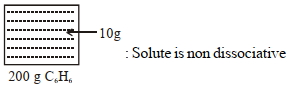
Pure Solvent : \(C _{6} H _{6}(\ell)\)Given : \(T _{ f }^{\circ}=5.5^{\circ} C\)
\(K _{ f }=5.12^{\circ}\,C / m\)
\(\because \Delta T _{ f }= k _{ f } \times m\)
\(\Rightarrow\left( T _{ f }^{0}- T _{ f }^{\prime}\right)=5.12 \times \frac{\left(\frac{10}{58}\right)}{\left(\frac{200}{1000}\right) \,kg } \,mol\)
\(\Rightarrow 5.5- T _{ f }^{\prime}=\frac{5.12 \times 5 \times 10}{58}\)
\(\Rightarrow T _{ f }^{\prime}=1.086^{\circ} C \simeq 1^{\circ} C\)
-
- (A) \(50\)
- (B) \(25\)
- (C) \(55\)
- (D) \(35\)
Show answer and solution
Correct Answer: (B)
From Henry's Law\(0.835=1.67 \times 10^{3} \times \frac{\mathrm{n}\left(\mathrm{CO}_{2}\right)}{\frac{0.9 \times 1000}{18}}\)
\(\mathrm{n}\left(\mathrm{CO}_{2}\right)=0.025\)
Millimoles of \(\mathrm{CO}_{2}=0.025 \times 1000=25\)
-
- (A) \(49\)
- (B) \(80\)
- (C) \(64\)
- (D) \(17\)
Show answer and solution
Correct Answer: (C)
Moles of \(\mathrm{CuSO}_{4} \cdot 5 \mathrm{H}_{2} \mathrm{O}=\frac{80}{249.54}\)Molarity \(=\frac{80}{\frac{249.54}{5}}=64.117 \times 10^{-3}\)
Nearest integer, \(\mathrm{x}=64\)
-
- (A) \(4\)
- (B) \(3\)
- (C) \(6\)
- (D) \(5\)
Show answer and solution
Correct Answer: (B)
\(\alpha=0.75, n =2\)\(i =1-\alpha+ n \alpha=1-0.75+2 \times 0.75=1.75\)
\(\Delta T _{ b }= ik _{ b } m\)
or, \(2.5=1.75 \times 0.52 \times m\)
or, \(m =\frac{2.5}{1.75 \times 0.52}=2.74\)
\(\therefore\) nearest integer answer will be \(3\)
-
- (A) \(150\)
- (B) \(125\)
- (C) \(175\)
- (D) \(850\)
Show answer and solution
Correct Answer: (B)
\(\quad\quad\quad\quad\quad\quad2 \mathrm{HA} \rightleftharpoons \mathrm{H}_{2} \mathrm{~A}_{2} \quad \mathrm{HA} \rightleftharpoons \mathrm{H}^{+}+\mathrm{A}\)\(\text { Initial moles } \mathrm{a} \times \frac{50}{100} \quad\quad 0 \quad \mathrm{a} \times \frac{50}{100} \quad0 \quad\quad 0\)
\(\text { Final moles }\quad 0 \quad 0.25 \mathrm{a} \quad\quad\quad0 \quad\quad 0.5 \mathrm{a} \quad\quad 0.5 \mathrm{a}\)
Now, \(i=\frac{\text { final moles }}{\text { initial moles }}=\frac{0.25 a+0.5 a+0.5 a}{0.5 a+0.5 a}\)
\(=1.25=125 \times 10^{-2}\)
-
- (A) \(4\)
- (B) \(3\)
- (C) \(1\)
- (D) \(2\)
Show answer and solution
Correct Answer: (A)
As \(0.1 \,\mathrm{M} \mathrm{C}_{2} \mathrm{H}_{5} \mathrm{OH}\) is non-dissociative and rest all salt given are electrolyte so in each case effective molarity \(>\,0.1\) so each will have lower freezing point. -
- (A) \(20\)
- (B) \(15\)
- (C) \(30\)
- (D) \(25\)
Show answer and solution
Correct Answer: (D)
\(P = K _{ H } \cdot x\)or, \(20 \times 10^{3}=\left(8 \times 10^{4} \times 10^{3}\right) \times \frac{ n _{ O _{2}}}{ n _{ O _{2}}+ n _{\text {water }}}\)
or \(, \frac{1}{4000}=\frac{ n _{ O _{2}}}{ n _{ O _{2}}+ n _{\text {water }}}=\frac{ n _{ O _{2}}}{ n _{\text {water }}}\)
Means 1 mole water \((=18 gm =18 ml )\) dissolves
\(\frac{1}{4000}\) moles \(O _{2} .\) Hence, molar solubility
\(=\frac{\left(\frac{1}{4000}\right)}{18} \times 1000=\frac{1}{72} mol dm ^{-3}\)
\(=1388.89 \times 10^{-5} mol \,dm ^{-3} \approx 1389 mol\, dm ^{-3}\)
-
- (A) \(1\)
- (B) \(2\)
- (C) \(3\)
- (D) \(4\)
Show answer and solution
Correct Answer: (A)
Given \(\mathrm{P}_{\mathrm{A}}^{\circ}=90\, \mathrm{~mm}\, \mathrm{Hg}\), at \(25^{\circ} \mathrm{C}\)\(\mathrm{P}_{\mathrm{B}}^{\circ}=15\, \mathrm{~mm} \,\mathrm{Hg}\)
\(\text { and }\mathrm{X}_{\mathrm{A}}=0.6,\mathrm{X}_{\mathrm{B}}=0.4\)
\(\mathrm{P}_{\mathrm{T}}=\mathrm{X}_{\mathrm{A}} \mathrm{T}_{\mathrm{A}}^{\circ}+\mathrm{X}_{\mathrm{B}} \mathrm{P}_{\mathrm{B}}^{\circ}\)
\(=(0.6 \times 90)+(0.4 \times 15)\)
\(=54+6=60\, \mathrm{~mm}\)
Now mol fraction of \(B\) in the vapour phase
i.e. \(Y_{B}=\frac{P_{B}}{P_{T}}=\frac{X_{B} P_{B}^{\circ}}{60}=0.1=1 \times 10^{-1}\)
Therefore: \(x=1\)
-
- (A) \(94\)
- (B) \(152\)
- (C) \(316\)
- (D) \(656\)
Show answer and solution
Correct Answer: (C)
\(\text { Let molarity of } \mathrm{KMnO}_{4}=\mathrm{x}\)\(\mathrm{KMnO}_{4}+\mathrm{FeSO}_{4} \rightarrow \mathrm{Fe}_{2}\left(\mathrm{SO}_{4}\right)_{3}+\mathrm{Mn}^{2+}\)
\(\mathrm{n}=5 \quad \mathrm{n}=1\)
(Equivalents of \(\mathrm{KMnO}_{4}\) reacted \()=\) (Equivalents of \(\mathrm{FeSO}_{4}\) reacted \()\)
\(\Rightarrow(5 \times x \times 10\, \mathrm{ml})=1 \times 0.1 \times 10\, \mathrm{ml}\)
\(\Rightarrow \mathrm{x}=0.02\, \mathrm{M}\)
Molar mass of \(\mathrm{KMnO}_{4}=158\, \mathrm{gm} / \mathrm{mol}\)
\(\Rightarrow \text { Strength }=(\mathrm{x} \times 158)=3.16\, \mathrm{~g} / \ell\)
-
- (A) \(38\)
- (B) \(42\)
- (C) \(36\)
- (D) \(44\)
Show answer and solution
Correct Answer: (C)
\(ClCH _{2} COOH \rightleftharpoons ClCH _{2} COO ^{\ominus}+ H ^{+}\)\(i =1+(2-1) \alpha\)
\(i =1+\alpha\)
\(\Delta T _{ f }= ik _{ f } m\)
\(0.5=(1+\alpha)(1.86)\left(\frac{\left(\frac{9.45}{94.5}\right)}{\left(\frac{500}{1000}\right)}\right)\)
\(\frac{5}{3.72}=1+\alpha \quad \Rightarrow \alpha=\frac{1.28}{3.72}\)
\(\alpha=\frac{32}{93}\)
\(\begin{array}{*{20}{c}} {ClC{H_2}COOH \rightleftharpoons ClC{H_2}CO{O^ \ominus } + {H^ + }} \\ {\,\,\,\,\,\,\,\,\,C - C\alpha \,\,\,\,\,\,\,\,\,\,\,\,\,\,\,\,\,\,\,\,\,\,\,\,\,\,\,\,C\alpha \,\,\,\,\,\,\,\,\,\,\,\,\,\,\,\,\,\,\,\,\,\,\,\,\,\,\,\,\,\,\,C\alpha \,\,\,\,\,\,\,\,\,\,\,\,\,} \end{array}\)
\(=0.036\)
\(K _{ a }=36 \times 10^{-3}\)
- 133. Which one of the following \(0.06\, \mathrm{M}\) aqueous solutions has lowest freezing point? 2021 Medium
- (A) \(\mathrm{C}_{6} \mathrm{H}_{12} \mathrm{O}_{6}\).
- (B) \(\mathrm{K}_{2} \mathrm{SO}_{4}\)
- (C) \(KI\)
- (D) \(\mathrm{Al}_{2}\left(\mathrm{SO}_{4}\right)_{3}\)
Show answer and solution
Correct Answer: (D)
\(\Delta \mathrm{T}_{\mathrm{f}}=\mathrm{i} \mathrm{k}_{\mathrm{f}} \times \mathrm{m}\)\(\Delta \mathrm{T}_{\mathrm{f}} \alpha\) \(i\) but \(F.P\) \(\alpha 1 / \mathrm{i}\)
- 134. Which one of the following \(0.10\, \mathrm{M}\) aqueous solutions will exhibit the largest freezing point depression? 2021 Medium
- (A) hydrazine
- (B) glucose
- (C) glycine
- (D) \(\mathrm{KHSO}_{4}\)
Show answer and solution
Correct Answer: (D)
\(\because\) Van't Hoff factor is highest for \(\mathrm{KHSO}_{4}\)\(\therefore\) colligative property \(\left(\Delta \mathrm{T}_{\mathrm{f}}\right)\) will be highest for \(\mathrm{KHSO}_{4}\)
-
- (A) \(13\)
- (B) \(10\)
- (C) \(8\)
- (D) \(6\)
Show answer and solution
Correct Answer: (B)
\(\mathrm{ppm}=\frac{10.3 \times 10^{-3}}{1030} \times 10^{6}=10\) -
- (A) \(8.33\)
- (B) \(5.67\)
- (C) \(6.33\)
- (D) \(4.67\)
Show answer and solution
Correct Answer: (B)
gm eq. of \(\mathrm{Ag}=\frac{108}{108}=1\)\(\mathrm{gm}\) eq. of \(\mathrm{O}_{2}(\mathrm{g})=1\)
Volume of \(\mathrm{O}_{2}(\mathrm{g})=22.7 \times \frac{1}{4}=5.675\) litre
-
- (A) \(10\)
- (B) \(5\)
- (C) \(8\)
- (D) \(12\)
Show answer and solution
Correct Answer: (A)
Molar mass of \(Na _{2} CO _{3} \cdot xH _{2} O\)\(\Rightarrow 23 \times 2+12+48+18 x\)
\(\Rightarrow 46+12+48+18 x\)
\(\Rightarrow(106+18 x )\)
\(Eqwt =\frac{ M }{2}=(53+9 x )\)
As \(n _{\text {factor }}\) in dissolution will be determined from net cationic or anionic charge; which is \(2\) so
\(Eqwt =\frac{ M }{2}=53+9 x\)
Gmeq \(=\frac{ wt }{ Eqwt }=\frac{1.43}{53+9 x }\)
Normality \(=\frac{ Gmeq }{ V _{\text {litre }}}\)
Normality \(=0.1=\frac{1.43}{\frac{53+9 x }{0.1}}\)
As volume \(=100 ml\)
\(=0.1 Litre\)
So \(\quad 10^{-2}=\frac{1.43}{53+9 x }\)
\(53+9 x =143\)
\(9 x =90\)
\(x =10.00\)
-
- (A) \((A)\)
- (B) \((C)\)
- (C) \((B)\)
- (D) \((A)\) and \((C)\)
Show answer and solution
Correct Answer: (C)
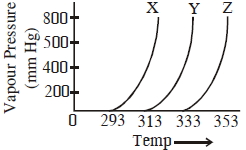
Order of B.P. is : \(Z>Y>X\)Order of vapour pressure \(: Z < Y < X\)
order of intermolecular interaction \(: Z>Y>X\)
-
- (A) \(14\)
- (B) \(22\)
- (C) \(6\)
- (D) \(38\)
Show answer and solution
Correct Answer: (C)
According to Dalton's law of partial pressure\(p _{ i }= x _{ i } \times P _{ T }\)
\(P _{ i }=\) partial pressure of the \(i ^{\text {th }}\) component
\(x _{ i }=\) mole fraction of the \(i ^{\text {th }}\) component
\(p _{ T }=\) total pressure of mixture
\(\Rightarrow 2 atm =\left(\frac{ n _{ H _{2}}}{ n _{ H _{2}}+ n _{ H _{ e }}+ n _{ O _{2}}}\right) \times p _{ T }\)
\(\Rightarrow p _{ T }=2 atm \times \frac{3}{1}=6 atm\)
-
- (A) \(A>B>C\)
- (B) \(A>C>B\)
- (C) \(C>B>A\)
- (D) \(B > C > A\)
Show answer and solution
Correct Answer: (A)
Relative lowering of \(V . P. =\frac{\Delta P }{ P ^{0}}= x _{\text {solute }}\)\(\left(\frac{\Delta P }{ P ^{0}}\right)_{ A }=\frac{\frac{10}{100}}{\frac{10}{100}+\frac{180}{18}}:\left(\frac{\Delta P }{ P ^{0}}\right)_{ B }=\frac{\frac{10}{200}}{\frac{10}{200}+\frac{180}{18}}\)
\(\left(\frac{\Delta P }{ P ^{0}}\right)_{ C }=\frac{\frac{10}{10,000}}{\frac{10}{10,000}+\frac{180}{18}}:\left(\frac{\Delta P }{ P ^{0}}\right)_{ A }>\left(\frac{\Delta P }{ P ^{0}}\right)_{ B }>\left(\frac{\Delta P }{ P ^{0}}\right)_{ C }\)
-
- (A) \(37\)
- (B) \(35\)
- (C) \(40\)
- (D) \(32\)
Show answer and solution
Correct Answer: (A)
\(P _{ CO _{2}}= K _{ H } \times CO _{2}\)\(\frac{3}{30}=\frac{ K _{ H } \cdot n _{ CO _{2}}}{ K _{ H } 1} \Rightarrow n _{ CO _{2}-0.1} mol\)
\(pH =\frac{1}{2}\left( pka _{1}-\log c \right)=\frac{1}{2}(6.4 \times 1)=3.7\)
\(pH =37 \times 10^{-1}\)
-
- (A) \(600\)
- (B) \(620\)
- (C) \(590\)
- (D) \(628\)
Show answer and solution
Correct Answer: (A)
\(550= P _{ A }^{\circ} \times \frac{1}{4}+ P _{ B }^{\circ} \times \frac{3}{4}\)\(2200= P _{ A }^{\circ}+3 P _{ B }^{\circ}\)\(....(i)\)
\(2800= P _{ A }^{\circ}+4 P _{ B }^{\circ}\)\(....(ii)\)
\(560= P _{ A }^{\circ} \times \frac{1}{5}+ P _{ B }^{\circ} \times \frac{4}{5}\)
\(P _{ B }^{\circ}=600, P _{ A }^{\circ}=400\)
-
- (A) heat must be absorbed in order to produce the solution at \(35^oC\)
- (B) Raoult's law is not obeyed by this system
- (C) a mixture of \(100\; mL\; CS_2\) and \(100\; mL\) acetone has a volume \(< 200 \;mL\)
- (D) \(CS_2\) and acetone are less attracted to each other than to themselves
Show answer and solution
Correct Answer: (C)
The vapour pressure of mixture \((=600\; \mathrm{mm} \;\mathrm{Hg}\) ) is greater than the individual vapour pressure of its constituents (Vapour pressure of \(\mathrm{CS}_{2}=512\; \mathrm{mm}\; Hg\), acetone \(=344 \;\mathrm{mm}\; Hg\) ). Hence, the solution formed shows positive deviationfrom Raoult's law.
\(\Rightarrow(1) \Delta_{\mathrm{sol}} \mathrm{H}>0\)
\((2)\) Raoult's law is not obeyed
(3) \(\Delta_{\text {sol. }}\) Volume \(>0\)
(4) \(\mathrm{CS}_{2}\) and Acetone are less attracted to each ether than to themselves.
-
- (A) \(4.97\)
- (B) \(6.63\)
- (C) \(3.52\)
- (D) \(9.47\)
Show answer and solution
Correct Answer: (A)
\(\mathrm{FeSO}_{4} \cdot 7 \mathrm{H}_{2} \mathrm{O}(\mathrm{M}=277.85)\)\(\mathrm{ppm}=\frac{\text { wt. of Fe }}{\text { wt. of wheat }} \times 10^{6}\)
let the wt. of salt be \(=\mathrm{w} \mathrm{gm}\)
moles \(=\frac{\mathrm{w}}{277.85}\)
wt. of \(\mathrm{Fe}=\left(\frac{\mathrm{W}}{277.85} \times 55.85\right) \mathrm{gm}\)
\(10=\frac{\frac{\mathrm{W}}{277.85} \times 55.85}{10^{5}} \times 10^{6}\)
\(W=\frac{277.85}{55.85}=4.97\)
-
- (A) \(2.25\)
- (B) \(2\)
- (C) \(1.75\)
- (D) \(1.5\)
Show answer and solution
Correct Answer: (C)
\(\Delta \mathrm{T}_{\mathrm{f}}=\mathrm{i} \times \mathrm{m} \times \mathrm{K}_{\mathrm{f}}\)\(0.2=2 \times 2 \times \frac{\mathrm{w} / 58.5}{600 / 1000}\)
\(\mathrm{w}=1.755 \mathrm{gm}\)
-
- (A) \(172\)
- (B) \(175\)
- (C) \(180\)
- (D) \(177\)
Show answer and solution
Correct Answer: (D)
Let molar mass of protein \(A=x\) \(g/mol\)Let molar mass of protein \(B = y g / mol\)
\(\pi_{ A }=\) osmotic pressure of protein \(A =\frac{\left(\frac{0.73}{ x }\right)}{0.25} RT\)
\(\pi_{ B }=\) osmotic pressure of protein \(B =\frac{\left(\frac{1.65}{ y }\right)}{1} RT\)
\(\pi_{ A }=\pi_{ B }\)
\(\Rightarrow\left(\frac{0.73}{ x \times 0.25}\right) RT =\left(\frac{1.65}{ y }\right) RT\)
\(\Rightarrow\left(\frac{ x }{ y }\right)=\frac{0.73}{0.25 \times 1.65}=1.769 \cong 1.77\)
-
- (A) \(10\)
- (B) \(5\)
- (C) \(12\)
- (D) \(15\)
Show answer and solution
Correct Answer: (B)
\(\Delta T_{b}=i \times K_{b} \times m\)\(i \times 0.1 \times K_{b}=3 \times 0.05 \times K_{b} \times 2\)
\(i=3\)
\(\left[C r\left(N H_{3}\right)_{5} \cdot C l\right] C l_{2} \rightarrow\left[C r\left(N H_{3}\right)_{5} C l\right]^{+2}+2 C l^{-}\)
\(x=5\)
-
- (A) \(0.37\)
- (B) \(0.67\)
- (C) \(0.87\)
- (D) \(0.63\)
Show answer and solution
Correct Answer: (A)
\(1\; L\) solution requires \(30 \mathrm{m\;mol} \;\mathrm{HCl}\)\(250 \;\mathrm{ml}\) sol. will require \(7.5 \mathrm{m}\; \mathrm{mol} \;\mathrm{HCl}\)
\({\text { or } 3.75 \mathrm{m\;mol}\; \mathrm{H}_{2} \mathrm{SO}_{4}}\)
\({\Rightarrow \frac{3.75 \times 98}{1000} \mathrm{gm} \;\mathrm{H}_{2} \mathrm{SO}_{4}}\)
\({=0.3675 \;\mathrm{gm} \;\mathrm{H}_{2} \mathrm{SO}_{4}}\)
-
- (A) \(150\)
- (B) \(167\)
- (C) \(160\)
- (D) \(159\)
Show answer and solution
Correct Answer: (B)
Osmotic pressure \(=\pi= i \times C \times RT\)For \(NaCl i =2\) so
\(\pi_{ NaCl }= i \times C _{ NaCl } \times RT \quad C _{ NaCl }=\) conc. of \(NaCl\)
\(0.1=2 \times C _{ NaCl } \times RT\)
\(C_{ NaCl }=\frac{0.05}{ RT } \quad C_{\text {glucose }}=\) conc. of glucose
For glucose \(i=1\) so
\(\pi_{\text {Glucose }}= i \times C _{\text {glucose }} \times RT\)
\(0.2=1 \times C _{\text {glucose }} \times RT\)
\(C _{\text {Glucose }}=\frac{0.2}{ RT } \quad \eta_{ NaCl }=\) No. of moles \(NaCl\)
\(\eta_{ NaCl }\) in \(1 L = C _{ NaCl } \times V _{\text {Litre }}\)
\(=\frac{0.05}{ RT } \quad \eta_{ glucose }=\) No. of moles glucose
\(\eta_{\text {glucose }}\) in \(2 L = C _{\text {glucose }} \times V _{\text {Litre }}\)
\(=\frac{0.4}{ RT }\)
\(V _{\text {Total }}=1+2=3 L\)
so Final conc. \(NaCl =\frac{0.05}{3 RT }\)
Final conc. glucose \(=\frac{0.4}{3 RT }\)
\(\pi_{\text {Total }}=\pi_{ NaCl }+\pi_{\text {glucose }}\)
\(=\left[i \times C_{ NaCl }+C_{\text {glucose }}\right] \times RT\)
\(=\left(\frac{2 \times 0.05}{3 RT }+\frac{0.4}{3 RT }\right) \times RT\)
\(=\frac{0.5}{3} atm\)
\(=0.1666 atm\)
\(=166.6 \times 10^{-3} atm\)
\(\Rightarrow 167.00 \times 10^{-3} atm\)
so \(x=167.00\)
-
- (A) The volume of the solution does not change and the volume of the solvent decreases
- (B) The volume of the solution decrease and the volume of the solvent decreases
- (C) The volume of the solution increase and the volume of the solvent decreases
- (D) The volume of the solution and the solvent does not change
Show answer and solution
Correct Answer: (C)
The pure solvent solution will try to maintain higher vapour pressure in the sealed container and in return the solvent vapour molecules will condense in the solution of non-volatile solute as it maintains an equilibrium with lower vapour pressure. (Lowering of vapour pressure is observed when a non volatile solute is mixed in a volatile solvent)This will eventually lead to increase in the volume of solution and decrease in the volume of solvent.
No questions on this page match these filters.