


JEE Mains 2023 Physics ના બધા પ્રશ્નો
32 પ્રકરણ639 માંથી 401–450 પ્રશ્નો
-
- (A) \(\sqrt{2}\)
- (B) \(\frac{1}{\sqrt{2}}\)
- (C) \(2\)
- (D) \(\frac{1}{2}\)
જવાબ અને ઉકેલ જુઓ
સાચો જવાબ: (B)
\(\omega=\sqrt{\frac{ k }{ m }}\)\(\frac{\omega_2}{\omega_1}=\sqrt{\frac{ m _1}{ m _2}}=\sqrt{\frac{1}{2}}\)
-
- (A) \(\sqrt{2\,A }\)
- (B) \(2\,A\)
- (C) \(\frac{1}{\sqrt{2}}\,A\)
- (D) \(\frac{1}{2}\,A\)
જવાબ અને ઉકેલ જુઓ
સાચો જવાબ: (C)
\(KE = PE\)\(\frac{1}{2} M \omega^2\left( A ^2- x ^2\right)=\frac{1}{2} M \omega^2 x ^2\)
\(A ^2- x ^2= x ^2 \Rightarrow A ^2=2 \times 2\)
\(\Rightarrow x = \pm \frac{ A }{\sqrt{2}}\)
-
- (A) \(\frac{\pi}{6}\)
- (B) \(\frac{\pi}{3}\)
- (C) \(\frac{\pi}{4}\)
- (D) \(\frac{\pi}{2}\)
જવાબ અને ઉકેલ જુઓ
સાચો જવાબ: (A)
\(X = A \sin (\omega t +\delta)\) \(V = A \omega \cos (\omega t +\delta)\)\(\frac{ A }{2}= A \sin (\omega t +\delta)\) \(\therefore V \text { is tve, } \delta \text { must be }\)
\(\text { At } t =0\) \(\text { in } 1^{\text {st }} \text { quadrant or } 4^{\text {th }}\)
\(\sin \delta=\frac{1}{2} \Rightarrow \delta=\frac{\pi}{6}, \frac{5 \pi}{6}\) \(\text { quadrant }\)
\(\therefore \text { Common solution is } \delta=\frac{\pi}{6}\)
-
- (A) \(1: 1\)
- (B) \(2: 1\)
- (C) \(1: 4\)
- (D) \(1: 3\)
જવાબ અને ઉકેલ જુઓ
સાચો જવાબ: (D)
\(x =\frac{ A }{2}, \quad \text { P.E. }=\frac{1}{2} kx ^2\)\(K . E .=\frac{1}{2} kA ^2-\frac{1}{2} kx ^2\)
\(\frac{ P . E }{ K . E }=\frac{ x ^2}{ A ^2- x ^2}=\frac{ A ^2}{4\left(\frac{3 A ^2}{4}\right)}=\frac{1}{3}\)
-
- (A) \(3\)
- (B) \(2\)
- (C) \(1.5\)
- (D) \(4\)
જવાબ અને ઉકેલ જુઓ
સાચો જવાબ: (D)
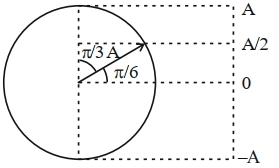
Let time from 0 to \(A / 2\) is \(t _1\)from \(A / 2\) to \(A\) is \(t _2\) then \(\omega t _1=\pi / 6\)
\(\omega t _2=\pi / 3\)
\(\frac{ t _1}{ t _2}=\frac{1}{2}\)
\(t _2=2 t _1=2 \times 2=4\,sec\)
-
- (A) \(9\)
- (B) \(7\)
- (C) \(6\)
- (D) \(8\)
જવાબ અને ઉકેલ જુઓ
સાચો જવાબ: (D)
\(x = A \sin (\omega t )\)\(U _{( x )}=\frac{1}{2} kx ^2\)
\(\frac{ dU }{ dt }=\frac{1}{2} k 2 x \frac{ dx }{ dt }\)
\(= kA ^2 \omega \sin \omega t\,\cos \omega t \times \frac{2}{2}\)
\(\left(\frac{ dU }{ dt }\right)_{\max }=\frac{ kA ^2 \omega}{2}(\sin 2 \omega t )_{\max }\)
\(2 \omega t =\frac{\pi}{2} \Rightarrow t =\frac{\pi}{4} \omega=\frac{ T }{8} \Rightarrow \beta=8\)
-
- (A) \(24\) કલાક
- (B) \(1\) કલાક \(24\) મિનીટ
- (C) \(1\) કલાક \(40\) મિનીટ
- (D) \(12\) કલાક
જવાબ અને ઉકેલ જુઓ
સાચો જવાબ: (B)
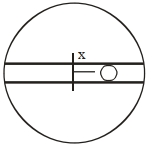
Let at some time particle is at a distance \(x\) from centre of Earth, then at that position field\(E=\frac{G M}{R^3} x\)
\(\therefore \text { Acceleration of particle }\)
\(\vec{a}=-\frac{ GM }{ R ^3} \overrightarrow{ x }\)
\(\Rightarrow \omega=\sqrt{\frac{ GM }{ R ^3}}=\sqrt{\frac{ g }{ R }}\)
\(\text { Now } T =\frac{2 \pi}{\omega}=2 \pi \sqrt{\frac{ R }{ g }}\)
\(\Rightarrow T =2 \times 3.14 \times \sqrt{\frac{6400 \times 10^3}{10}}\)
\(=2 \times 3.14 \times 800\,sec \approx 1 \text { hour } 24 \text { minutes }\)
-
- (A) \(20\)
- (B) \(21\)
- (C) \(19\)
- (D) \(26\)
જવાબ અને ઉકેલ જુઓ
સાચો જવાબ: (A)
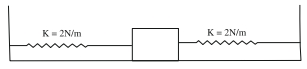
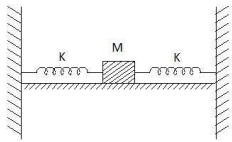
\(Keff = K + K\) as both springs are in use in parallel\(=2\,k\)
\(=2 \times 2=4\,N / m \quad m =490\,gm\)
\(=0.49\,kg\)
\(T =2 \pi \sqrt{\frac{ m }{ Keff }}=2 \pi \sqrt{\frac{0.49\,kg }{4}}\)
\(=2 \pi \sqrt{\frac{49}{400}}=2 \pi \frac{7}{20}=\frac{7 \pi}{10}\)
No. of oscillation in the \(14 \pi\) is
\(N =\frac{\text { time }}{ T }=\frac{14 \pi}{7 \pi / 10}=20\)
-
- (A) ફક્ત \((A), (B)\) અને \((C)\)
- (B) ફક્ત \((C)\) અને \((D)\)
- (C) ફકત \((A), (B)\) અને \((D)\)
- (D) ફકત \((A), (C)\) અને \((D)\)
જવાબ અને ઉકેલ જુઓ
સાચો જવાબ: (A)
\(F =- kx \text { A true }\)\(a=-\omega^2 x B \text { true }\)
\(\text { Velocity is maximum at mean position } C \text { true }\)
\(\text { Acceleration is maximum at extreme } D \text { false }\)
\(\text { points }\)
- 410. સ.આ.ગ. કરતાં કણનો કંપવિસ્તાર \(3\,cm\) છે. સ્થાનાંતર (\(cm\) માં) કે જ્યાં તેની ગતિઊર્જા સ્થિતિઉર્જા કરતાં \(25 \%\) વધુ હશે? 2023 મધ્યમ
- (A) \(4\)
- (B) \(2\)
- (C) \(5\)
- (D) \(3\)
જવાબ અને ઉકેલ જુઓ
સાચો જવાબ: (B)
\(K E=P E+\frac{P E}{4}\)\(K E=\frac{5}{4} P E\)
\(\frac{1}{2} m \omega^2\left(A^2-x^2\right)=\frac{5}{4} \times \frac{1}{2} m \omega^2 x^2\) \({\left[ v =\omega \sqrt{ A ^2- x ^2}\right]}\)
\(A^2-x^2=\frac{5}{4} x^2\)
\(\frac{9 x^2}{4}=A^2\)
\(x=\frac{2}{3} A\)
\(\therefore x=\frac{2}{3} \times 3\,cm\)
\(x=2\,cm\)
-
- (A) \(10\)
- (B) \(5\)
- (C) \(20\)
- (D) \(30\)
જવાબ અને ઉકેલ જુઓ
સાચો જવાબ: (C)
\(\therefore T =3.14=\pi\)\(T =\pi=\frac{2 \pi}{\omega} \Rightarrow \omega=2\)
\(F _{\max }= ma _{\max }\)
\(= m \left( A \omega^2\right)\)
\(= mA (2)^2\)
\(=5 \times 1 \times 4\)
\(=20\,N\)
-
- (A) \(37.5\)
- (B) \(9.75\)
- (C) \(18.75\)
- (D) \(12.5\)
જવાબ અને ઉકેલ જુઓ
સાચો જવાબ: (C)
\(u _{\max }=\frac{1}{2} m \omega^2 A ^2=25\,J\)\(KE \text { at } \frac{ A }{2}=\frac{1}{2} mv _1^2=\frac{1}{2} m \omega^2\left( A ^2-\frac{ A ^2}{4}\right)\)
\(KE =\frac{1}{2} m \omega^2 \frac{3 A ^2}{4}=\frac{3}{4}\left(\frac{1}{2} m \omega^2 A ^2\right)\)
\(KE =\frac{3}{4} \times 25=18.75\,J\)
-
- (A) \(80\)
- (B) \(81\)
- (C) \(88\)
- (D) \(82\)
જવાબ અને ઉકેલ જુઓ
સાચો જવાબ: (C)
\(4 v ^2=50- x ^2\)\(\Rightarrow \quad v =\frac{1}{2} \sqrt{50- x ^2}\)
\(\omega=\frac{1}{2}\)
\(T =\frac{2 \pi}{\omega}=4 \pi=\frac{88}{7}\)
\(x =88\)
- 414. \(Y=\sin \omega t+\cos \omega t\) સમીકરણ દ્વારા રજૂ થતી આવર્તી ગતિ માટે ગતિનો કંપવિસ્તાર \(............\) છે. 2023 સરળ
- (A) \(0.5\)
- (B) \(\sqrt{2}\)
- (C) \(9\)
- (D) \(6\)
જવાબ અને ઉકેલ જુઓ
સાચો જવાબ: (B)
\(y=\sin \omega t+\cos \omega t\)\(y=\sin \omega t+\sin \left(\omega t+\frac{\pi}{2}\right)\)
\(\Delta \phi=\frac{\pi}{2}\)
\(A _{\text {net }}=\sqrt{1^2+1^2+2 \times 1 \times 1 \times \cos (\Delta \phi)}\)
\(A _{\text {met }}=\sqrt{2}\)
-
- (A) \(32\)
- (B) \(28\)
- (C) \(24\)
- (D) \(27\)
જવાબ અને ઉકેલ જુઓ
સાચો જવાબ: (B)
\(\sqrt{\frac{3 RT }{ M }}=\sqrt{\frac{\alpha+5}{\alpha}} \sqrt{\frac{8}{\pi} \frac{ RT }{ M }}\)\(3=\frac{\alpha+5}{\alpha} \frac{8}{\pi}\)
\(\alpha=28\)
-
- (A) \(v _0\)
- (B) \(4 v_0\)
- (C) \(\frac{v_0}{4}\)
- (D) \(2 v _0\)
જવાબ અને ઉકેલ જુઓ
સાચો જવાબ: (D)
\(V _{ rms }=\sqrt{\frac{3 RT }{ M }}\)\(\Rightarrow V _{ rms } \alpha \sqrt{ T }\)
Increasing temperature \(4\) times, rms speed gets doubled.
-
- (A) \(-273\)
- (B) \(-100\)
- (C) \(-373\)
- (D) \(-40\)
જવાબ અને ઉકેલ જુઓ
સાચો જવાબ: (A)
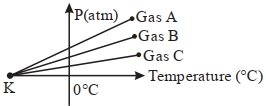
For isochoric process\(\frac{ P }{ T }= n \frac{ R }{ V }= constan t\)
\(P =\frac{ nR }{ V }( t +273)\)
If \(P =0 \Rightarrow t =-273^{\circ}\,C\)
-
- (A) \(\gamma \propto \frac{1}{\sqrt{ T }}\)
- (B) \(\gamma \propto T ^{\circ}\)
- (C) \(\gamma \propto \frac{1}{T}\)
- (D) \(\gamma \propto T\)
જવાબ અને ઉકેલ જુઓ
સાચો જવાબ: (B)
\(\gamma\) is independent of temperature -
- (A) \(1098\)
- (B) \(2049\)
- (C) \(750\)
- (D) \(1500\)
જવાબ અને ઉકેલ જુઓ
સાચો જવાબ: (B)
Mean free path\(\lambda=\frac{ RT }{\sqrt{2} \pi d ^2 N _{ A } P }\)
\(\lambda \propto T\)
\(\frac{1500 d }{\lambda}=\frac{273}{373}\)
\(\lambda=2049\,d\)
-
- (A) \(\frac{27}{35}\)
- (B) \(\frac{35}{27}\)
- (C) \(\frac{25}{21}\)
- (D) \(\frac{21}{25}\)
જવાબ અને ઉકેલ જુઓ
સાચો જવાબ: (C)
For monoatomic gas\(\gamma_1=\frac{5}{3}\)
For diatomic gas at low temperatures
\(\gamma _2=\frac{7}{5}\)
\(\therefore \frac{\gamma_1}{\gamma_2}=\frac{\frac{5}{3}}{\frac{7}{5}}=\frac{25}{21}\)
-
- (A) \(1\)
- (B) \(2\)
- (C) \(\frac{39.9}{2}\)
- (D) \(39.9\)
જવાબ અને ઉકેલ જુઓ
સાચો જવાબ: (A)
Average \(KE\) per molecule \(=\frac{3}{2} kT\)\(\frac{ K _{ AS }}{ K _{ H }}=\frac{1}{1}\)
-
- (A) \(2: 1\)
- (B) \(1: 1\)
- (C) \(1: 4\)
- (D) \(4: 1\)
જવાબ અને ઉકેલ જુઓ
સાચો જવાબ: (B)
\(K _{ av }=\frac{5}{2} kT\)Ratio \(=1: 1\)
-
- (A) \(1.25\)
- (B) \(0.25\)
- (C) \(0.75\)
- (D) \(0.50\)
જવાબ અને ઉકેલ જુઓ
સાચો જવાબ: (B)
Collision frequency,\(\mathrm{f}=\frac{\mathrm{V}}{\lambda}=\frac{\mathrm{V}}{\left(\frac{1}{\sqrt{2} \pi \mathrm{d}^2 \mathrm{n}_\psi}\right)}=\sqrt{2} \pi \mathrm{d}^2 \mathrm{vn}_v\)
\(\therefore \mathrm{f} \propto \mathrm{n}_{\mathrm{v}}, \mathrm{n}_{\mathrm{v}}\) is number density
\(\frac{\mathrm{f}_1}{\mathrm{f}_2}=\frac{\mathrm{n}_{\mathrm{r}_1}}{\mathrm{n}_{r_2}}=\frac{3 \times 10^{19}}{12 \times 10^{-19}}=0.25\)
-
- (A) \(\frac{9}{2} R\)
- (B) \(\frac{5}{2} R\)
- (C) \(\frac{3}{2} R\)
- (D) \(\frac{7}{2} R\)
જવાબ અને ઉકેલ જુઓ
સાચો જવાબ: (D)
Diatomic gas molecules have three translational degree of freedom, two rotational degree of freedom and it is given that it has one vibrational mode so there are two additional degree of freedom corresponding to one vibrational mode, so total degree of freedom \(=7\)\(C _{ V }=\frac{ fR }{2}=\frac{7 R }{2}\)
-
- (A) \(751.7\)
- (B) \(451.7\)
- (C) \(651.7\)
- (D) \(551.7\)
જવાબ અને ઉકેલ જુઓ
સાચો જવાબ: (C)
\(V _{ rms }=\sqrt{\frac{3 RT }{ M }} \quad \frac{ v _{ Ar }}{ v _{ Cl }}=\sqrt{\frac{ M _{ Cl }}{ M _{ Ar }}}\)\(\Rightarrow v _{ Ar }=1.33 \times 490=651.7\,m / s\)
-
- (A) \(28\)
- (B) \(27\)
- (C) \(8\)
- (D) \(4\)
જવાબ અને ઉકેલ જુઓ
સાચો જવાબ: (A)
\(\sqrt{\frac{3 RT }{ M }}=\left(1+\frac{5}{ x }\right)^{\frac{1}{2}} \sqrt{\frac{8 RT }{\pi M }}\)\(\Rightarrow \frac{3 \times 22}{7 \times 8}=1+\frac{5}{ x }\)
\(\Rightarrow x =28\)
-
- (A) \(523\)
- (B) \(1260\)
- (C) \(91\)
- (D) \(27.4\)
જવાબ અને ઉકેલ જુઓ
સાચો જવાબ: (A)
\(V _{ rms }=\sqrt{\frac{3 k _{ B } T }{ m }}=\sqrt{\frac{3 \times 1.4 \times 10^{-23} \times 300}{4.6 \times 10^{-26}}}=523\,m / s\) -
- (A) બંને કથન \(I\) અને કથન \(II\) સાચાં છે.
- (B) કથન \(I\) સાચું છે.પરંતુ કથન \(II\) ખોટું છે.
- (C) બંને કથન \(I\) અને અને કથન \(II\) ખોટા છે.
- (D) કથન \(I\) ખોટું છે.પરંતુ કથન \(II\) સાચું છે.
જવાબ અને ઉકેલ જુઓ
સાચો જવાબ: (B)
Statement\(-I\)\(T _1=-73^{\circ}\,C =200\,K\)
\(T _2=527^{\circ}\,C =800\,K\)
\(\frac{ V _1}{ V _2}=\frac{\sqrt{\frac{3 RT _1}{ M }}}{\sqrt{\frac{3 RT _2}{ M }}}=\sqrt{\frac{ T _1}{ T _2}}\)
\(=\sqrt{\frac{200}{800}}=\frac{1}{2}\)
\(V _2=2 V _1 \text { (True) }\)
Statement\(-II\)
\(PV = nRT\)
Translational \(KE =\frac{3}{2} nRT\) (False)
-
- (A) \((A) - (IV), (B) - (III), (C) - (II), (D) - (I)\)
- (B) \((A) - (IV), (B) - (II), (C) - (I), (D) - (III)\)
- (C) \((A) - (I), (B) - (III), (C) - (IV), (D) - (II)\)
- (D) \((A) - (I), (B) - (IV), (C) - (III), (D) - (II)\)
જવાબ અને ઉકેલ જુઓ
સાચો જવાબ: (C)
Factual -
- (A) \(v _{rms}(\) એક \()= v _{rms}(\) દ્રી \()= v _{rms}(\) બહુ \()\)
- (B) \(v _{rms}(\) એક \() > v _{rms}(\) દ્રી \() > v _{rms}\) (બહુ)
- (C) \(v _{rms}(\) દ્રી \() < v _{rms}(\) બહુ \() < v _{rms}(\) એક \()\)
- (D) \(v _{rms}\)( એક \() < v _{rms} \)( દ્રી \() < v _{rms}\) (બહુ \()\)
જવાબ અને ઉકેલ જુઓ
સાચો જવાબ: (B)
\(v _{ rms }(\text { mono })=\sqrt{\frac{3 RT }{4 \times 10^{-3}}}\)\(v _{ rms }(\text { dia })=\sqrt{\frac{3 RT }{71 \times 10^{-3}}}\)
\(v _{ rms }( ply )=\sqrt{\frac{3 RT }{146 \times 10^{-3}}}\)
So correct relation is
\(v _{ rms }(\text { mono }) > v _{ rms }(\text { dia }) > v _{ rms }(\text { poly })\)
-
- (A) \(8\)
- (B) \(16\)
- (C) \(4\)
- (D) \(11\)
જવાબ અને ઉકેલ જુઓ
સાચો જવાબ: (D)
\(\left( C _{ v }\right)_{\operatorname{mix}}=\frac{ n _1 Cv _1+ n _2 Cv _2}{ n _1+ n _2}\)\(\left( C _{ v }\right)_{\operatorname{mix}}=\frac{2 \times \frac{5}{2} R +4 \times \frac{3}{2} R }{2+4}=\frac{11 R }{6}\)
\(\Delta U = n \left( C _{ v }\right)_{\operatorname{mix}} RT =6 \frac{11 R }{6} \times RT =11 R\)
- 432. તાપમાને ઓકિસજનના અણુઓની ગતિ ઊર્જા તેના \(27^{\circ} C\) તાપમાનના મૂલ્ય કરતા બમણી થશે............. \(^{\circ}\,C\) 2023 સરળ
- (A) \(1227\)
- (B) \(927\)
- (C) \(327\)
- (D) \(627\)
જવાબ અને ઉકેલ જુઓ
સાચો જવાબ: (C)
Kinetic energy \(=\frac{f}{2} kT , T\) is absolute temperature.If \(K _1\) is kinetic energy at \(27^{\circ} C\).
\(K _2\) is kinetic energy at new temperature \(T\).
\(\frac{ K _1}{ K _2}=\frac{ T _1}{ T _2} \Rightarrow \frac{1}{2}=\frac{300}{ T }\)
\(T =600\,K\)
\(T =327^{\circ}\,C\)
-
- (A) તાપમાનના વર્ગ ( \(\left.T^2\right)\) ના સમપ્રમાણમાં
- (B) તાપમાનના વ્યસ્તના વર્ગમૂળના \(\left(\sqrt{\frac{1}{T}}\right)\) સમપ્રમાણમાં
- (C) તાપમાનના વર્ગમૂળ \((\sqrt{T})\) ના સમપ્રમાણમાં
- (D) તાપમાન \((T)\) ના સમપ્રમાણમાં
જવાબ અને ઉકેલ જુઓ
સાચો જવાબ: (C)
The rms speed of a gas molecule is\(V _{ RMS }=\sqrt{\frac{3 RT }{ M }}\)
\(V _{ RMS } \alpha \sqrt{ T }\)
-
- (A) નિરપેક્ષ તાપમાનના સમપ્રમાણમાં
- (B) કદના સમપ્રમાણમાં
- (C) દબાણના સમપ્રમાણમાં
- (D) વાયુની પ્રકૃતિ પર આધાર રાખે છે
જવાબ અને ઉકેલ જુઓ
સાચો જવાબ: (A)
Basic theoryTranslational \(K . E\) on average of a molecule is \(\frac{3}{2}\)
\(KT\) which is independent of nature, pressure and volume.
-
- (A) \(4320\)
- (B) \(432000\)
- (C) \(4800\)
- (D) \(4.32\)
જવાબ અને ઉકેલ જુઓ
સાચો જવાબ: (A)
Work done \(= P \Delta V\)\(=3 \times 10^5 \times 1600 \times 10^{-6}\)
\(=480\,J\)
Only \(10 \%\) of heat is used in work done.
Hence \(\Delta Q=4800\,J\)
The rest goes in internal energy, which is \(90\,\%\) of heat.
Change in internal energy \(=0.9 \times 4800=4320\,J\)
-
- (A) \(4\)
- (B) \(2\)
- (C) \(8\)
- (D) \(2.67\)
જવાબ અને ઉકેલ જુઓ
સાચો જવાબ: (C)
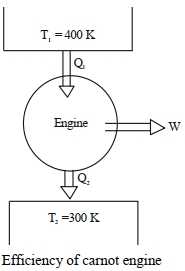
\(\eta=1-\frac{ T _2}{ T _1}=\frac{ W }{ Q _1}\)\(\Rightarrow \frac{ W }{ Q _1}=1-\frac{300}{400}=\frac{1}{4}\)
\(\Rightarrow \frac{2 kJ }{ Q _1}=\frac{1}{4}\)
\(\Rightarrow Q _1=8\,kJ\)
-
- (A) \(360\)
- (B) \(1000\)
- (C) \(900\)
- (D) \(300\)
જવાબ અને ઉકેલ જુઓ
સાચો જવાબ: (B)
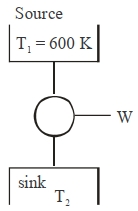
\(\text { Initially } \eta=\frac{1}{2}\)\(\eta=1-\frac{ T _2}{ T _1}\)
\(\therefore \frac{1}{2}=1-\frac{ T _2}{600} \quad \Rightarrow T _2=300\,K\)
\(\Rightarrow \frac{ T _2}{600}=\frac{1}{2} \quad\)
Now efficiency is increased to \(70 \%\) and \(T _2=300\) \(K\), Let temp of source \(T _1= T\)
\(\Rightarrow \frac{7}{10}=1-\frac{300}{T}\)
\(\Rightarrow \frac{300}{ T }=1-\frac{7}{10}\)
\(\Rightarrow \frac{300}{ T }=\frac{3}{10} \quad \therefore T =1000\,K\)
-
- (A) \(6\)
- (B) \(0\)
- (C) \(-4.5\)
- (D) \(4.5\)
જવાબ અને ઉકેલ જુઓ
સાચો જવાબ: (D)
\(\text { As } \Delta q =0\)\(\Delta u =- W\)
\(W =\int PdV\)
\(\Delta u =- W =30 \times 10^3 \times 150 \times 10^{-6}\)
\(=4500 \times 10^{-3}\)
\(=4.5\,J\)
-
- (A) \(16.5\)
- (B) \(33\)
- (C) \(66\)
- (D) \(62\)
જવાબ અને ઉકેલ જુઓ
સાચો જવાબ: (D)
\(T _{ H }=99^{\circ} C =99+273\)\(\qquad=372\,K\)
\(1-\frac{ T _{ C }}{ T _{ H }}=\frac{1}{3}\)
\(\frac{ T _{ C }}{ T _{ H }}=\frac{2}{3} \quad(1) \Rightarrow T _{ C }=\frac{2}{3} \times 372\)
\(1-\frac{ T _{ C }+ X }{ T _{ H }}=\frac{1}{6}\)
\(\frac{5}{6}=\frac{ T _{ C }+ X }{ T _{ H }}\)
\(\frac{5}{6}=\frac{248+ X }{372}\)
\(248+ X =5 \times 62\)
\(X =310-248=62\,K\)
-
- (A) \(P _0(4)^{\frac{1}{\gamma}}\)
- (B) \(P _0(4)^\gamma\)
- (C) \(P _0\)
- (D) \(4 P _0\)
જવાબ અને ઉકેલ જુઓ
સાચો જવાબ: (B)
As gas is suddenly compressed, the processes is adiabatic.Equation of gas for adiabatic process is
\(PV ^\gamma=\text { constant. }\)
\(\Rightarrow P _1 V _1^\gamma= P _2 V _2^\gamma\)
\(\Rightarrow P _0 V _0^\gamma= P _2\left(\frac{ V _0}{4}\right)^\gamma\)
\(\Rightarrow P _2= P _0(4)^\gamma\)
-
- (A) ફક્ત \(A\) અને \(E\)
- (B) ફક્ત \(B\) અને \(D\)
- (C) ફક્ત \(B\) અને \(D\)
- (D) ફક્ત \(C\) અને \(D\)
જવાબ અને ઉકેલ જુઓ
સાચો જવાબ: (D)
\(dQ = dU + dW \Rightarrow dU = nC _{ V } dT\)\(dU =0 \quad \text { (for isothermal) }\)
\(U =\text { constant }\)
\(Also dQ > 0 \quad \text { (supplied) }\)
Hence,\(dW > 0\)
-
- (A) \(270\)
- (B) \(262\)
- (C) \(278\)
- (D) \(360\)
જવાબ અને ઉકેલ જુઓ
સાચો જવાબ: (C)
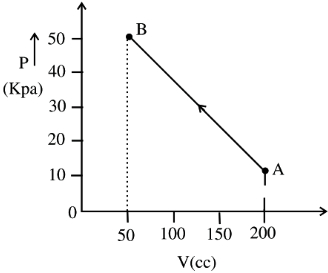
Taking volume constant:\(\frac{ P _1}{ T _1}=\frac{ P _2}{ T _2}\)\(\Rightarrow P _2=\frac{ P _1}{ T _1} \times T _2=\frac{270 \times(309)}{300}\)
\(=278\,kPa\)
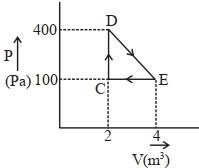
- 443. એક થર્મોડાયનેમિક તંત્ર ચક્રિય પ્રક્રિયા કરે છે. પ્રક્રિયામાં થતું કુલ કાર્ય \(...............\,J\) છે.
 2023 સરળ
- (A) \(100\)
- (B) \(300\)
- (C) \(0\)
- (D) \(200\)
જવાબ અને ઉકેલ જુઓ
સાચો જવાબ: (B)
\(\text { On } P - V \text { scale area of loop }=\text { work done }\)\(\Rightarrow W =+\frac{1}{2}(2) \times 300\)
\(W =300\,J\)
-
- (A) \(1200\)
- (B) \(600\)
- (C) \(500\)
- (D) \(800\)
જવાબ અને ઉકેલ જુઓ
સાચો જવાબ: (D)
\(dQ=dU+dw\)\(\frac{\mathrm{dU}}{\mathrm{dt}}=\frac{\mathrm{dQ}}{\mathrm{dt}}-\frac{\mathrm{dw}}{\mathrm{dt}}\)
\(\frac{\mathrm{dU}}{\mathrm{dt}}=1000-200=800 \mathrm{~W}\)
-
- (A) તંત્રને કોઈ ઉષ્મા આપવામાં આવતી નથી.
- (B) વાયુનું તાપમાન વધે છે.
- (C) આંતરિક ઉર્જામાં થતો ફેરફાર વાયુ પર થતા કાર્ય જેટલો છે.
- (D) આંતરિક ઉર્જામાં કોઈ ફેરફાર થતો નથી.
જવાબ અને ઉકેલ જુઓ
સાચો જવાબ: (D)
(1) \(\Delta Q=0\)(2) \(\Delta Q =\Delta U +\Delta W\)
\(\Rightarrow \Delta U =-\Delta W\)
adiabatic compression \(( V \downarrow)\)
\(\Delta W =- ve \Rightarrow \Delta U =+ ve\)
\(\Delta U \uparrow \Rightarrow T \uparrow\)
\(\Delta U \neq 0\)
-
- (A) \(A-II, B-I, C-III, D-IV\)
- (B) \(A-II, B-I, C-IV, D-III\)
- (C) \(A-I, B-II, C-IV, D-III\)
- (D) \(A-I, B-II, C-III, D-IV\)
જવાબ અને ઉકેલ જુઓ
સાચો જવાબ: (B)
\(\Delta U = nC _{ v } \Delta T\)For isothermal process \(T\) is constant
So \(\Delta U =0\)
\(A \longrightarrow II\)
Adiabatic process
\(\Delta Q =0\)
\(\Delta Q =\Delta U +\Delta W\)
\(\quad \Delta U =-\Delta W\)
Work done by gas is positive
So \(\Delta U\) is negative
\(B \longrightarrow I\)
For Isochoric process \(\Delta W =0\)
\(C \longrightarrow IV\)
For Isobaric process
\(\Delta W = P \Delta V \neq 0\)
\(\Delta U = nC _{ V } \Delta T \neq 0\)
Heat absorbed goes partly to increase internal energy and partly do work.
-
- (A) \(A\) સાચું છે પણ \(R\) ખોટું નથી.
- (B) \(A\) ખોટું છે પણ \(R\) સાચું નથી.
- (C) \(A\) અને \(R\) બંને સાચાં છે અને \(R\) એ \(A\) ની સાચી સમજૂતી આપે છે.
- (D) \(A\) અને \(R\) બંને સાચાં છે પરંતુ \(R\) એ \(A\) ની સાચી સમજૂતી આપતું નથી.
જવાબ અને ઉકેલ જુઓ
સાચો જવાબ: (C)
First law of thermodynamics is based on law of conservation of energy and it can be written as \(dQ = dU - dW\) where \(d\)W is work done on the system -
- (A) વિધાન \(I\) સાચું છે.પરંતુ વિધાન \(II\) ખોટું છે.
- (B) બંને વિધાન \(I\) અને વિધાન \(II\) સાચાં છે.
- (C) બંને વિધાન \(I\) અને વિધાન \(II\) ખોટા છે.
- (D) વિધાન \(I\) ખોટું છે. પરંતુ વિધાન \(II\) સાચું છે.
જવાબ અને ઉકેલ જુઓ
સાચો જવાબ: (D)
Statement \(I:\) \(\Delta Q > 0\)According to \(1^{\text {st }}\) law of thermodynamics
\(\Delta Q =\Delta U + W\)
If \(\Delta Q > 0, \Delta U < 0\) and \(W > 0\) is also possible.
Hence \(\Delta T < 0\), so \(T\) decreases.
Statement \(I\) is false
Statement \(II:\) W \( > 0\)
\(\therefore \int Pdv > 0\)
Therefore volume of system must increase during positive work done by the system.
Statement \(II\) is true
-
- (A) \(A\) સાચું છે પણ \(R\) ખોટું નથી.
- (B) \(A\) અને \(R\) બંને સાચાં છે પરંતુ \(R\) એ \(A\) ની સાચી સમજૂતી આપતું નથી.
- (C) \(A\) ખોટું છે પણ \(R\) સાચું છે.
- (D) \(A\) અને \(R\) બંને સાચાં છે અને \(R\) એ \(A\) ની સાચી સમજૂતી આપે છે.
જવાબ અને ઉકેલ જુઓ
સાચો જવાબ: (D)
Both \(A\) and \(R\) are true and \(R\) is the correct explanation of \(A\) -
- (A) ફકત \(2,3\) અને \(4\)
- (B) ફકત \(2\) અને \(3\)
- (C) ફકત \(2\) અને \(4\)
- (D) ફકત \(1\) અને \(2\)
જવાબ અને ઉકેલ જુઓ
સાચો જવાબ: (C)
\(\eta=\left(1-\frac{273}{373}\right) \times 100=26.8 \%\)
આ પેજ પર આ ફિલ્ટર મુજબ કોઈ પ્રશ્ન નથી.