


All JEE Mains 2023 Physics questions
32 chaptersShowing 401–450 of 644 questions
-
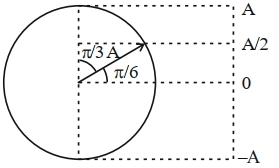
- (A) \(\frac{\pi}{6}\)
- (B) \(\frac{\pi}{3}\)
- (C) \(\frac{\pi}{4}\)
- (D) \(\frac{\pi}{2}\)
Show answer and solution
Correct Answer: (A)
\(X = A \sin (\omega t +\delta)\) \(V = A \omega \cos (\omega t +\delta)\)\(\frac{ A }{2}= A \sin (\omega t +\delta)\) \(\therefore V \text { is tve, } \delta \text { must be }\)
\(\text { At } t =0\) \(\text { in } 1^{\text {st }} \text { quadrant or } 4^{\text {th }}\)
\(\sin \delta=\frac{1}{2} \Rightarrow \delta=\frac{\pi}{6}, \frac{5 \pi}{6}\) \(\text { quadrant }\)
\(\therefore \text { Common solution is } \delta=\frac{\pi}{6}\)
- 402. A particle executes SHM of amplitude A. The distance from the mean position when its's kinetic energy becomes equal to its potential energy is on 2023 Medium
- (A) \(\sqrt{2\,A }\)
- (B) \(2\,A\)
- (C) \(\frac{1}{\sqrt{2}}\,A\)
- (D) \(\frac{1}{2}\,A\)
Show answer and solution
Correct Answer: (C)
\(KE = PE\)\(\frac{1}{2} M \omega^2\left( A ^2- x ^2\right)=\frac{1}{2} M \omega^2 x ^2\)
\(A ^2- x ^2= x ^2 \Rightarrow A ^2=2 \times 2\)
\(\Rightarrow x = \pm \frac{ A }{\sqrt{2}}\)
-
- (A) \(3\)
- (B) \(2\)
- (C) \(1.5\)
- (D) \(4\)
Show answer and solution
Correct Answer: (D)
Let time from 0 to \(A / 2\) is \(t _1\)from \(A / 2\) to \(A\) is \(t _2\) then \(\omega t _1=\pi / 6\)
\(\omega t _2=\pi / 3\)
\(\frac{ t _1}{ t _2}=\frac{1}{2}\)
\(t _2=2 t _1=2 \times 2=4\,sec\)
-
- (A) \(1: 1\)
- (B) \(2: 1\)
- (C) \(1: 4\)
- (D) \(1: 3\)
Show answer and solution
Correct Answer: (D)
\(x =\frac{ A }{2}, \quad \text { P.E. }=\frac{1}{2} kx ^2\)\(K . E .=\frac{1}{2} kA ^2-\frac{1}{2} kx ^2\)
\(\frac{ P . E }{ K . E }=\frac{ x ^2}{ A ^2- x ^2}=\frac{ A ^2}{4\left(\frac{3 A ^2}{4}\right)}=\frac{1}{3}\)
-
- (A) \(20\)
- (B) \(40\)
- (C) \(60\)
- (D) \(80\)
Show answer and solution
Correct Answer: (B)
\(\frac{1}{4} a =-25 x \quad ; \quad a =-100 x\)\(\omega^2=100 \quad \omega=10\)
\(\omega A =4\) \(\quad A=\frac{4}{10}=0.4\,m\)
\(A =40\,cm\)
-
- (A) \(10\)
- (B) \(5\)
- (C) \(20\)
- (D) \(30\)
Show answer and solution
Correct Answer: (C)
\(\therefore T =3.14=\pi\)\(T =\pi=\frac{2 \pi}{\omega} \Rightarrow \omega=2\)
\(F _{\max }= ma _{\max }\)
\(= m \left( A \omega^2\right)\)
\(= mA (2)^2\)
\(=5 \times 1 \times 4\)
\(=20\,N\)
-
- (A) \(98\)
- (B) \(97\)
- (C) \(99\)
- (D) \(100\)
Show answer and solution
Correct Answer: (C)
\(\sin \theta_0=\frac{A}{l}=\frac{10}{100}=\frac{1}{10}\)From conservation of energy
\(\frac{1}{2} m v^2=m g l(1-\cos \theta)\)
Maximum tension occurs at mean position.
\(\therefore T-m g=\frac{m v^2}{l}\)
\(\Rightarrow T=m g+\frac{m v^2}{l}\)
\(\therefore T=m g+2 m g(1-\cos \theta)\)
\(=m g\left[1+2\left(1-\sqrt{1-\sin ^2 \theta}\right)\right]\)
\(=m g\left[3-2 \sqrt{1-\frac{1}{100}}\right]\)
\(=\frac{250}{1000} \times 9.8\left[3-2\left(1-\frac{1}{200}\right)\right]=\frac{99}{40}\)
\(\therefore x=99\)
-
- (A) \(24\) hours
- (B) \(1\) hour \(24\) minutes
- (C) \(1\) hour \(40\) minutes
- (D) \(12\) hours
Show answer and solution
Correct Answer: (B)
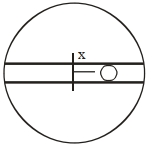
Let at some time particle is at a distance \(x\) from centre of Earth, then at that position field\(E=\frac{G M}{R^3} x\)
\(\therefore \text { Acceleration of particle }\)
\(\vec{a}=-\frac{ GM }{ R ^3} \overrightarrow{ x }\)
\(\Rightarrow \omega=\sqrt{\frac{ GM }{ R ^3}}=\sqrt{\frac{ g }{ R }}\)
\(\text { Now } T =\frac{2 \pi}{\omega}=2 \pi \sqrt{\frac{ R }{ g }}\)
\(\Rightarrow T =2 \times 3.14 \times \sqrt{\frac{6400 \times 10^3}{10}}\)
\(=2 \times 3.14 \times 800\,sec \approx 1 \text { hour } 24 \text { minutes }\)
-
- (A) \(3\)
- (B) \(2\)
- (C) \(4\)
- (D) \(1\)
Show answer and solution
Correct Answer: (C)
General equation for displacement is given by\(x=A \sin (\omega t+\phi)\)
\(\text { at given time }\)
\(\Rightarrow \omega t+\phi=30^{\circ}\)
\(\Rightarrow x=40 \times \frac{\sqrt{3}}{2} \Rightarrow 20 \sqrt{3}\,cm\)
\(\Rightarrow A=40\,cm\)
\(\Rightarrow K . E=\frac{1}{2} k\left(A^2-x^2\right)=200\)
\(200=\frac{1}{2} k\left(\frac{1600-1200}{100 \times 100}\right)\)
\(400 \times 100 \times 100=k \times 400\)
\(k=10^4\)
\(x=4\)
- 410. For a periodic motion represented by the equation \(Y=\sin \omega t+\cos \omega t\) The amplitude of the motion is 2023 Easy
- (A) \(0.5\)
- (B) \(\sqrt{2}\)
- (C) \(9\)
- (D) \(6\)
Show answer and solution
Correct Answer: (B)
\(y=\sin \omega t+\cos \omega t\)\(y=\sin \omega t+\sin \left(\omega t+\frac{\pi}{2}\right)\)
\(\Delta \phi=\frac{\pi}{2}\)
\(A _{\text {net }}=\sqrt{1^2+1^2+2 \times 1 \times 1 \times \cos (\Delta \phi)}\)
\(A _{\text {met }}=\sqrt{2}\)
-
- (A) \(\sqrt{2}\)
- (B) \(\frac{1}{\sqrt{2}}\)
- (C) \(2\)
- (D) \(\frac{1}{2}\)
Show answer and solution
Correct Answer: (B)
\(\omega=\sqrt{\frac{ k }{ m }}\)\(\frac{\omega_2}{\omega_1}=\sqrt{\frac{ m _1}{ m _2}}=\sqrt{\frac{1}{2}}\)
-
- (A) \((A), (B)\) and \((C)\) only
- (B) \((C)\) and \((D)\) only
- (C) \((A), (B)\) and \((D)\) only
- (D) \((A), (C)\) and \((D)\) only
Show answer and solution
Correct Answer: (A)
\(F =- kx \text { A true }\)\(a=-\omega^2 x B \text { true }\)
\(\text { Velocity is maximum at mean position } C \text { true }\)
\(\text { Acceleration is maximum at extreme } D \text { false }\)
\(\text { points }\)
-
- (A) \(20\)
- (B) \(21\)
- (C) \(19\)
- (D) \(26\)
Show answer and solution
Correct Answer: (A)
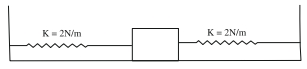
\(Keff = K + K\) as both springs are in use in parallel\(=2\,k\)
\(=2 \times 2=4\,N / m \quad m =490\,gm\)
\(=0.49\,kg\)
\(T =2 \pi \sqrt{\frac{ m }{ Keff }}=2 \pi \sqrt{\frac{0.49\,kg }{4}}\)
\(=2 \pi \sqrt{\frac{49}{400}}=2 \pi \frac{7}{20}=\frac{7 \pi}{10}\)
No. of oscillation in the \(14 \pi\) is
\(N =\frac{\text { time }}{ T }=\frac{14 \pi}{7 \pi / 10}=20\)
-
- (A) \(4\)
- (B) \(2\)
- (C) \(5\)
- (D) \(3\)
Show answer and solution
Correct Answer: (B)
\(K E=P E+\frac{P E}{4}\)\(K E=\frac{5}{4} P E\)
\(\frac{1}{2} m \omega^2\left(A^2-x^2\right)=\frac{5}{4} \times \frac{1}{2} m \omega^2 x^2\) \({\left[ v =\omega \sqrt{ A ^2- x ^2}\right]}\)
\(A^2-x^2=\frac{5}{4} x^2\)
\(\frac{9 x^2}{4}=A^2\)
\(x=\frac{2}{3} A\)
\(\therefore x=\frac{2}{3} \times 3\,cm\)
\(x=2\,cm\)
-
- (A) \(9\)
- (B) \(7\)
- (C) \(6\)
- (D) \(8\)
Show answer and solution
Correct Answer: (D)
\(x = A \sin (\omega t )\)\(U _{( x )}=\frac{1}{2} kx ^2\)
\(\frac{ dU }{ dt }=\frac{1}{2} k 2 x \frac{ dx }{ dt }\)
\(= kA ^2 \omega \sin \omega t\,\cos \omega t \times \frac{2}{2}\)
\(\left(\frac{ dU }{ dt }\right)_{\max }=\frac{ kA ^2 \omega}{2}(\sin 2 \omega t )_{\max }\)
\(2 \omega t =\frac{\pi}{2} \Rightarrow t =\frac{\pi}{4} \omega=\frac{ T }{8} \Rightarrow \beta=8\)
-
- (A) \(37.5\)
- (B) \(9.75\)
- (C) \(18.75\)
- (D) \(12.5\)
Show answer and solution
Correct Answer: (C)
\(u _{\max }=\frac{1}{2} m \omega^2 A ^2=25\,J\)\(KE \text { at } \frac{ A }{2}=\frac{1}{2} mv _1^2=\frac{1}{2} m \omega^2\left( A ^2-\frac{ A ^2}{4}\right)\)
\(KE =\frac{1}{2} m \omega^2 \frac{3 A ^2}{4}=\frac{3}{4}\left(\frac{1}{2} m \omega^2 A ^2\right)\)
\(KE =\frac{3}{4} \times 25=18.75\,J\)
-
- (A) \(80\)
- (B) \(81\)
- (C) \(88\)
- (D) \(82\)
Show answer and solution
Correct Answer: (C)
\(4 v ^2=50- x ^2\)\(\Rightarrow \quad v =\frac{1}{2} \sqrt{50- x ^2}\)
\(\omega=\frac{1}{2}\)
\(T =\frac{2 \pi}{\omega}=4 \pi=\frac{88}{7}\)
\(x =88\)
-
- (A) \(120\)
- (B) \(121\)
- (C) \(122\)
- (D) \(123\)
Show answer and solution
Correct Answer: (A)
\(2 A \cos \left(\frac{\Delta \phi}{2}\right)= A\)\(\cos \left(\frac{\Delta \phi}{2}\right)=\frac{1}{2}\)
\(\frac{\Delta \phi}{2}=60^{\circ}\)
-
- (A) \(1\)
- (B) \(2\)
- (C) \(\frac{39.9}{2}\)
- (D) \(39.9\)
Show answer and solution
Correct Answer: (A)
Average \(KE\) per molecule \(=\frac{3}{2} kT\)\(\frac{ K _{ AS }}{ K _{ H }}=\frac{1}{1}\)
-
- (A) \(2: 1\)
- (B) \(1: 1\)
- (C) \(1: 4\)
- (D) \(4: 1\)
Show answer and solution
Correct Answer: (B)
\(K _{ av }=\frac{5}{2} kT\)Ratio \(=1: 1\)
-
- (A) \(8\)
- (B) \(16\)
- (C) \(4\)
- (D) \(11\)
Show answer and solution
Correct Answer: (D)
\(\left( C _{ v }\right)_{\operatorname{mix}}=\frac{ n _1 Cv _1+ n _2 Cv _2}{ n _1+ n _2}\)\(\left( C _{ v }\right)_{\operatorname{mix}}=\frac{2 \times \frac{5}{2} R +4 \times \frac{3}{2} R }{2+4}=\frac{11 R }{6}\)
\(\Delta U = n \left( C _{ v }\right)_{\operatorname{mix}} RT =6 \frac{11 R }{6} \times RT =11 R\)
-
- (A) \(\frac{9}{2} R\)
- (B) \(\frac{5}{2} R\)
- (C) \(\frac{3}{2} R\)
- (D) \(\frac{7}{2} R\)
Show answer and solution
Correct Answer: (D)
Diatomic gas molecules have three translational degree of freedom, two rotational degree of freedom and it is given that it has one vibrational mode so there are two additional degree of freedom corresponding to one vibrational mode, so total degree of freedom \(=7\)\(C _{ V }=\frac{ fR }{2}=\frac{7 R }{2}\)
-
- (A) \(32\)
- (B) \(28\)
- (C) \(24\)
- (D) \(27\)
Show answer and solution
Correct Answer: (B)
\(\sqrt{\frac{3 RT }{ M }}=\sqrt{\frac{\alpha+5}{\alpha}} \sqrt{\frac{8}{\pi} \frac{ RT }{ M }}\)\(3=\frac{\alpha+5}{\alpha} \frac{8}{\pi}\)
\(\alpha=28\)
-
- (A) \(-273\)
- (B) \(-100\)
- (C) \(-373\)
- (D) \(-40\)
Show answer and solution
Correct Answer: (A)
For isochoric process\(\frac{ P }{ T }= n \frac{ R }{ V }= constan t\)
\(P =\frac{ nR }{ V }( t +273)\)
If \(P =0 \Rightarrow t =-273^{\circ}\,C\)
-
- (A) Both statement \(I\) and Statement \(II\) are true
- (B) Statement \(I\) is true but Statement \(II\) is false
- (C) Both Statement \(I\) and Statement \(II\) are false
- (D) Statement \(I\) is false but Statement \(II\) is true
Show answer and solution
Correct Answer: (B)
Statement\(-I\)\(T _1=-73^{\circ}\,C =200\,K\)
\(T _2=527^{\circ}\,C =800\,K\)
\(\frac{ V _1}{ V _2}=\frac{\sqrt{\frac{3 RT _1}{ M }}}{\sqrt{\frac{3 RT _2}{ M }}}=\sqrt{\frac{ T _1}{ T _2}}\)
\(=\sqrt{\frac{200}{800}}=\frac{1}{2}\)
\(V _2=2 V _1 \text { (True) }\)
Statement\(-II\)
\(PV = nRT\)
Translational \(KE =\frac{3}{2} nRT\) (False)
-
- (A) \(751.7\)
- (B) \(451.7\)
- (C) \(651.7\)
- (D) \(551.7\)
Show answer and solution
Correct Answer: (C)
\(V _{ rms }=\sqrt{\frac{3 RT }{ M }} \quad \frac{ v _{ Ar }}{ v _{ Cl }}=\sqrt{\frac{ M _{ Cl }}{ M _{ Ar }}}\)\(\Rightarrow v _{ Ar }=1.33 \times 490=651.7\,m / s\)
-
- (A) \(\frac{27}{35}\)
- (B) \(\frac{35}{27}\)
- (C) \(\frac{25}{21}\)
- (D) \(\frac{21}{25}\)
Show answer and solution
Correct Answer: (C)
For monoatomic gas\(\gamma_1=\frac{5}{3}\)
For diatomic gas at low temperatures
\(\gamma _2=\frac{7}{5}\)
\(\therefore \frac{\gamma_1}{\gamma_2}=\frac{\frac{5}{3}}{\frac{7}{5}}=\frac{25}{21}\)
-
- (A) \((A) - (IV), (B) - (III), (C) - (II), (D) - (I)\)
- (B) \((A) - (IV), (B) - (II), (C) - (I), (D) - (III)\)
- (C) \((A) - (I), (B) - (III), (C) - (IV), (D) - (II)\)
- (D) \((A) - (I), (B) - (IV), (C) - (III), (D) - (II)\)
Show answer and solution
Correct Answer: (C)
Factual -
- (A) proportional to absolute temperature
- (B) proportional to volume
- (C) proportional to pressure
- (D) dependent on the nature of the gas
Show answer and solution
Correct Answer: (A)
Basic theoryTranslational \(K . E\) on average of a molecule is \(\frac{3}{2}\)
\(KT\) which is independent of nature, pressure and volume.
- 430. The correct relation between \(\gamma=\frac{ C _p}{ c _v}\) and temperature \(T\) is : 2023 Medium
- (A) \(\gamma \propto \frac{1}{\sqrt{ T }}\)
- (B) \(\gamma \propto T ^{\circ}\)
- (C) \(\gamma \propto \frac{1}{T}\)
- (D) \(\gamma \propto T\)
Show answer and solution
Correct Answer: (B)
\(\gamma\) is independent of temperature -
- (A) \(1098\)
- (B) \(2049\)
- (C) \(750\)
- (D) \(1500\)
Show answer and solution
Correct Answer: (B)
Mean free path\(\lambda=\frac{ RT }{\sqrt{2} \pi d ^2 N _{ A } P }\)
\(\lambda \propto T\)
\(\frac{1500 d }{\lambda}=\frac{273}{373}\)
\(\lambda=2049\,d\)
-
- (A) \(1.25\)
- (B) \(0.25\)
- (C) \(0.75\)
- (D) \(0.50\)
Show answer and solution
Correct Answer: (B)
Collision frequency,\(\mathrm{f}=\frac{\mathrm{V}}{\lambda}=\frac{\mathrm{V}}{\left(\frac{1}{\sqrt{2} \pi \mathrm{d}^2 \mathrm{n}_\psi}\right)}=\sqrt{2} \pi \mathrm{d}^2 \mathrm{vn}_v\)
\(\therefore \mathrm{f} \propto \mathrm{n}_{\mathrm{v}}, \mathrm{n}_{\mathrm{v}}\) is number density
\(\frac{\mathrm{f}_1}{\mathrm{f}_2}=\frac{\mathrm{n}_{\mathrm{r}_1}}{\mathrm{n}_{r_2}}=\frac{3 \times 10^{19}}{12 \times 10^{-19}}=0.25\)
-
- (A) \(28\)
- (B) \(27\)
- (C) \(8\)
- (D) \(4\)
Show answer and solution
Correct Answer: (A)
\(\sqrt{\frac{3 RT }{ M }}=\left(1+\frac{5}{ x }\right)^{\frac{1}{2}} \sqrt{\frac{8 RT }{\pi M }}\)\(\Rightarrow \frac{3 \times 22}{7 \times 8}=1+\frac{5}{ x }\)
\(\Rightarrow x =28\)
-
- (A) \(523\)
- (B) \(1260\)
- (C) \(91\)
- (D) \(27.4\)
Show answer and solution
Correct Answer: (A)
\(V _{ rms }=\sqrt{\frac{3 k _{ B } T }{ m }}=\sqrt{\frac{3 \times 1.4 \times 10^{-23} \times 300}{4.6 \times 10^{-26}}}=523\,m / s\) -
- (A) Proportional to square of temperature \(\left( T ^2\right)\).
- (B) Inversely proportional to square root of temperature \(\sqrt{\frac{1}{ T }}\).
- (C) Proportional to square root of temperature \(\sqrt{T}\).
- (D) Proportional to temperature \((T)\).
Show answer and solution
Correct Answer: (C)
The rms speed of a gas molecule is\(V _{ RMS }=\sqrt{\frac{3 RT }{ M }}\)
\(V _{ RMS } \alpha \sqrt{ T }\)
-
- (A) \(1227\)
- (B) \(927\)
- (C) \(327\)
- (D) \(627\)
Show answer and solution
Correct Answer: (C)
Kinetic energy \(=\frac{f}{2} kT , T\) is absolute temperature.If \(K _1\) is kinetic energy at \(27^{\circ} C\).
\(K _2\) is kinetic energy at new temperature \(T\).
\(\frac{ K _1}{ K _2}=\frac{ T _1}{ T _2} \Rightarrow \frac{1}{2}=\frac{300}{ T }\)
\(T =600\,K\)
\(T =327^{\circ}\,C\)
-
- (A) \(v _0\)
- (B) \(4 v_0\)
- (C) \(\frac{v_0}{4}\)
- (D) \(2 v _0\)
Show answer and solution
Correct Answer: (D)
\(V _{ rms }=\sqrt{\frac{3 RT }{ M }}\)\(\Rightarrow V _{ rms } \alpha \sqrt{ T }\)
Increasing temperature \(4\) times, rms speed gets doubled.
-
- (A) \(v _{ rms }(\) mono \()= v _{ rms }(\) dia \()= v _{rms}(\) poly \()\)
- (B) \(v _{rms}(\) mono \() > v _{rms}(\) dia \() > v _{rms}\) (poly)
- (C) \(v _{rms}(\) dia \() < v _{rms}(\) poly \() < v _{rms}(\) mono \()\)
- (D) \(v _{ rms }( mono ) < v _{rms}( dia ) < v _{ rms }\) (poly \()\)
Show answer and solution
Correct Answer: (B)
\(v _{ rms }(\text { mono })=\sqrt{\frac{3 RT }{4 \times 10^{-3}}}\)\(v _{ rms }(\text { dia })=\sqrt{\frac{3 RT }{71 \times 10^{-3}}}\)
\(v _{ rms }( ply )=\sqrt{\frac{3 RT }{146 \times 10^{-3}}}\)
So correct relation is
\(v _{ rms }(\text { mono }) > v _{ rms }(\text { dia }) > v _{ rms }(\text { poly })\)
-
- (A) \(4320\)
- (B) \(432000\)
- (C) \(4800\)
- (D) \(4.32\)
Show answer and solution
Correct Answer: (A)
Work done \(= P \Delta V\)\(=3 \times 10^5 \times 1600 \times 10^{-6}\)
\(=480\,J\)
Only \(10 \%\) of heat is used in work done.
Hence \(\Delta Q=4800\,J\)
The rest goes in internal energy, which is \(90\,\%\) of heat.
Change in internal energy \(=0.9 \times 4800=4320\,J\)
-
- (A) \(270\)
- (B) \(262\)
- (C) \(278\)
- (D) \(360\)
Show answer and solution
Correct Answer: (C)
Taking volume constant:\(\frac{ P _1}{ T _1}=\frac{ P _2}{ T _2}\)\(\Rightarrow P _2=\frac{ P _1}{ T _1} \times T _2=\frac{270 \times(309)}{300}\)
\(=278\,kPa\)
-
- (A) \(16.5\)
- (B) \(33\)
- (C) \(66\)
- (D) \(62\)
Show answer and solution
Correct Answer: (D)
\(T _{ H }=99^{\circ} C =99+273\)\(\qquad=372\,K\)
\(1-\frac{ T _{ C }}{ T _{ H }}=\frac{1}{3}\)
\(\frac{ T _{ C }}{ T _{ H }}=\frac{2}{3} \quad(1) \Rightarrow T _{ C }=\frac{2}{3} \times 372\)
\(1-\frac{ T _{ C }+ X }{ T _{ H }}=\frac{1}{6}\)
\(\frac{5}{6}=\frac{ T _{ C }+ X }{ T _{ H }}\)
\(\frac{5}{6}=\frac{248+ X }{372}\)
\(248+ X =5 \times 62\)
\(X =310-248=62\,K\)
-
- (A) \(360\)
- (B) \(1000\)
- (C) \(900\)
- (D) \(300\)
Show answer and solution
Correct Answer: (B)
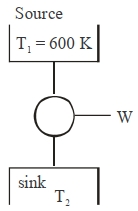
\(\text { Initially } \eta=\frac{1}{2}\)\(\eta=1-\frac{ T _2}{ T _1}\)
\(\therefore \frac{1}{2}=1-\frac{ T _2}{600} \quad \Rightarrow T _2=300\,K\)
\(\Rightarrow \frac{ T _2}{600}=\frac{1}{2} \quad\)
Now efficiency is increased to \(70 \%\) and \(T _2=300\) \(K\), Let temp of source \(T _1= T\)
\(\Rightarrow \frac{7}{10}=1-\frac{300}{T}\)
\(\Rightarrow \frac{300}{ T }=1-\frac{7}{10}\)
\(\Rightarrow \frac{300}{ T }=\frac{3}{10} \quad \therefore T =1000\,K\)
- 443. A gas is compressed adiabatically, which one of the following statement is NOT true. 2023 Medium
- (A) There is no heat supplied to the system
- (B) The temperature of the gas increases
- (C) The change in the internal energy is equal to the work done on the gas.
- (D) There is no change in the internal energy
Show answer and solution
Correct Answer: (D)
(1) \(\Delta Q=0\)(2) \(\Delta Q =\Delta U +\Delta W\)
\(\Rightarrow \Delta U =-\Delta W\)
adiabatic compression \(( V \downarrow)\)
\(\Delta W =- ve \Rightarrow \Delta U =+ ve\)
\(\Delta U \uparrow \Rightarrow T \uparrow\)
\(\Delta U \neq 0\)
-
- (A) \(W=T R[\sqrt{2}-2]\)
- (B) \(W=\frac{T}{R}[\sqrt{2}-2]\)
- (C) \(W=\frac{R}{T}[2-\sqrt{2}]\)
- (D) \(W=R T[2-\sqrt{2}]\)
Show answer and solution
Correct Answer: (D)
\(T_1 V_1^{\gamma-1}=T_2 V_2^{\gamma-1}\)\(T V^{1 / 2}=T_2(2 V)^{1 / 2}\)
\(T_2=\frac{T}{\sqrt{2}}\)
\(W=\frac{R\left(T_1-T_2\right)}{\gamma-1}=\frac{R\left(T-\frac{T}{\sqrt{2}}\right)}{\frac{1}{2}}=R T(2-\sqrt{2})\)
-
- (A) \(1200\)
- (B) \(600\)
- (C) \(500\)
- (D) \(800\)
Show answer and solution
Correct Answer: (D)
\(dQ=dU+dw\)\(\frac{\mathrm{dU}}{\mathrm{dt}}=\frac{\mathrm{dQ}}{\mathrm{dt}}-\frac{\mathrm{dw}}{\mathrm{dt}}\)
\(\frac{\mathrm{dU}}{\mathrm{dt}}=1000-200=800 \mathrm{~W}\)
- 446. A thermodynamic system is taken through cyclic process. The total work done in the process is \(.........\,J\)
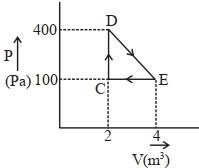 2023 Easy
- (A) \(100\)
- (B) \(300\)
- (C) \(0\)
- (D) \(200\)
Show answer and solution
Correct Answer: (B)
\(\text { On } P - V \text { scale area of loop }=\text { work done }\)\(\Rightarrow W =+\frac{1}{2}(2) \times 300\)
\(W =300\,J\)
-
- (A) \(2,3\) and \(4\) only
- (B) \(2\) and \(3\) only
- (C) \(2\) and \(4\) only
- (D) \(1\) and \(2\) only
Show answer and solution
Correct Answer: (C)
\(\eta=\left(1-\frac{273}{373}\right) \times 100=26.8 \%\) -
- (A) \(8\)
- (B) \(8^{\frac{3}{2}}\)
- (C) \(\frac{1}{8}\)
- (D) \(4\)
Show answer and solution
Correct Answer: (D)
Isothermal process, \(T =\) constant\(PV =n R T=\text { constant }\)
\(P _1 V_1= P _2 V_2\)
\(PV = P _{ A }( V / 8)\)
\(P _{ A }=8 P\)
Adiabatic process, PV \(\gamma=\) constant \(\gamma\) for monoatomic gas is \(\frac{5}{3}\).
\(P _1 V _1^\gamma= P _2 V _2^\gamma\)
\(\frac{ P _{ B }}{ P }=\left(\frac{ V _1}{ V _2}\right)^\gamma=\left(\frac{ V }{ V / 8}\right)^{\frac{5}{3}}\)
\(P _{ B }=32 P\)
\(\frac{ P _{ B }}{ P _{ A }}=\frac{32 P }{8 P }=4\)
-
- (A) \(A\) is true but \(R\) is false
- (B) Both \(A\) and \(R\) are true but \(R\) is NOT the correct explanation of \(A\)
- (C) \(A\) is false but \(R\) is true
- (D) Both \(A\) and \(R\) are true and \(R\) is the correct explanation of \(A\)
Show answer and solution
Correct Answer: (D)
Both \(A\) and \(R\) are true and \(R\) is the correct explanation of \(A\) -
- (A) \(A\) is correct but \(R\) is not correct
- (B) \(A\) is not correct but \(R\) is correct
- (C) Both \(A\) and \(R\) are correct and \(R\) is the correct explanation of \(A\)
- (D) Both \(A\) and \(R\) are correct but \(R\) is not the correct explanation of \(A\)
Show answer and solution
Correct Answer: (C)
First law of thermodynamics is based on law of conservation of energy and it can be written as \(dQ = dU - dW\) where \(d\)W is work done on the system
No questions on this page match these filters.