


JEE Mains 2024 Physics ના બધા પ્રશ્નો
31 પ્રકરણ593 માંથી 401–450 પ્રશ્નો
-
- (A) \(10\)
- (B) \(15\)
- (C) \(20\)
- (D) \(25\)
જવાબ અને ઉકેલ જુઓ
સાચો જવાબ: (A)
Given,\(\mathrm{T}=3.14=\frac{2 \pi}{\omega}\)
\(\omega=2 \mathrm{rad} / \mathrm{s}\)
\(\mathrm{x}=10 \sin \left(\omega \mathrm{t}+\frac{\pi}{3}\right)\)
\(\mathrm{v}=\frac{\mathrm{dx}}{\mathrm{dt}}=10 \omega \cos \left(\omega \mathrm{t}+\frac{\pi}{3}\right)\)
\(\text { at } \mathrm{t}=0\)
\(\mathrm{v}=10 \omega \cos \left(\frac{\pi}{3}\right)=10 \times 2 \times \frac{1}{2}[\text { using } \omega=2 \mathrm{rad} / \mathrm{s}]\)
\(\mathrm{v}=10 \mathrm{~m} / \mathrm{s}\)
-
- (A) \(500 \mathrm{~K}\)
- (B) \(200 \mathrm{~K}\)
- (C) \(100 \mathrm{~K}\)
- (D) \(300 \mathrm{~K}\)
જવાબ અને ઉકેલ જુઓ
સાચો જવાબ: (A)
\( \mathrm{PV}=\mathrm{nRT} \)\( \mathrm{PV}=\frac{\mathrm{N}}{\mathrm{N}_{\mathrm{A}}} \mathrm{RT}\)
\(\mathrm{N}=\) Total no. of molecules
\(\mathrm{P}=\frac{\mathrm{N}}{\mathrm{V}} \mathrm{kT}\)
\(1.38 \times 1.01 \times 10^5=2 \times 10^{25} \times 1.38 \times 10^{-23} \times \mathrm{T}\)
\(1.01 \times 10^5=2 \times 10^2 \times \mathrm{T}\)
\(\mathrm{T}=\frac{1.01 \times 10^3}{2} \approx 500 \mathrm{~K}\)
-
- (A) \(\frac{7}{2} \mathrm{RT}\)
- (B) \(70 \mathrm{~K}_{\mathrm{B}} \mathrm{T}\)
- (C) \(35 \mathrm{RT}\)
- (D) \(35 \mathrm{~K}_{\mathrm{B}} \mathrm{T}\)
જવાબ અને ઉકેલ જુઓ
સાચો જવાબ: (D)
સ્વતંત્રતાના અંશ \((f)=5+2(3 N-5)\)\( f=5+2(3 \times 2-1)=7\)
એક અણુની ઊર્જા \(=\frac{f}{2} K_B T\)
10 અણુઓની ઊર્જા
\(=10\left(\frac{\mathrm{f}}{2} \mathrm{~K}_{\mathrm{B}} \mathrm{T}\right)=10\left(\frac{7}{2} \mathrm{~K}_{\mathrm{B}} \mathrm{T}\right)=35 \mathrm{~K}_{\mathrm{B}} \mathrm{T}\)
-
- (A) \(6845.5 \mathrm{~J}\)
- (B) \(5942.0 \mathrm{~J}\)
- (C) \(6232.5 \mathrm{~J}\)
- (D) \(5670.5 \mathrm{~J}\)
જવાબ અને ઉકેલ જુઓ
સાચો જવાબ: (C)
\( \text { Kinetic energy }=\frac{f}{2} \mathrm{nRT} \)\( =\frac{5}{2} \times 1 \times 8.31 \times 300 \mathrm{~J} \)
\( =6232.5 \mathrm{~J}\)
-
- (A) \(C_B=\infty, C_A=0\)
- (B) \(C_A=0\) અને \(C_B=\infty\)
- (C) \(C_P>C_B>C_A>C_v\)
- (D) \(C_A>C_P>C_V\)
જવાબ અને ઉકેલ જુઓ
સાચો જવાબ: (C)
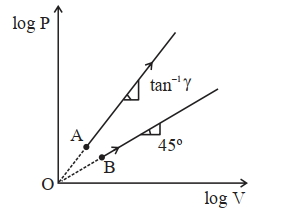
પ્રક્રિયા \(\mathrm{A}\) માટે
\( \log P=\gamma \log \mathrm{V} \Rightarrow \mathrm{P}=\mathrm{V}^\gamma,(\gamma>1) \)
\( P V^{-\gamma}=\text { Constant } \)
\( C_A=C_V+\frac{R}{1+\gamma} \ldots . \text { (i) }\)
Likewise for process \(\mathrm{B} \rightarrow P V^{-1}=\) \(Cons\) \(\tan t\)
\(C_B\) \( =C_v+\frac{R}{1+1} \)
\(C_B\) \( =C_v+\frac{R}{2} \) \(.............(ii)\)
\(C_P\) \(=C_v+R\) \(...........(iii)\)
By \((i)\), \((ii)\) & \((iii)\) \(C_P>C_B>C_A>C_v\) [No answer matching] -
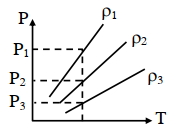
- (A) \(\rho_2<\rho_3\)
- (B) \(\rho_1>\rho_2\)
- (C) \(\rho_1<\rho_2\)
- (D) \(\rho_1=\rho_2=\rho_3\)
જવાબ અને ઉકેલ જુઓ
સાચો જવાબ: (B)
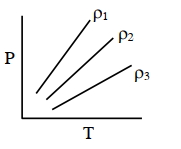
For ideal gas\(P V=n R T\)
\(P V=\frac{m}{M} R T\)
\(P=\left(\frac{M}{V}\right) \frac{R T}{M}\)
\(P=\frac{\rho R T}{M}\)
(Where \(\mathrm{m}\) is mass of gas and \(\mathrm{M}\) is molecular mass of gas)
for same temperature \(\mathrm{P}_1>\mathrm{P}_2>\mathrm{P}_3\)
So \(\rho_1>\rho_2>\rho_3\)
So correct answer is \((2)\)
-
- (A) ગતિ ઉર્જા
- (B) વેગમાન
- (C) દળ
- (D) ઝડપ
જવાબ અને ઉકેલ જુઓ
સાચો જવાબ: (A)
\(\mathrm{KE}=\frac{\mathrm{f}}{2} \mathrm{kT}\)Conceptual
- 408. \(\mathrm{CH}_4\) અણુ માટે રૅખીયગતિ માટે મુક્તતાનાં અંશો \(\left(f_t\right)\) અને યાકગતિ માટે મુક્તતાનાં અંશો \(\left(f_r\right)\) _______ છે. 2024 અઘરું
- (A) \(f=2\) અને \(f=2\)
- (B) \(f_t=3\) અને \(f=3\)
- (C) \(f=3\) અને \(f=2\)
- (D) \(f=2\) અને \(f=3\)
જવાબ અને ઉકેલ જુઓ
સાચો જવાબ: (B)
\(\text { Since } \mathrm{CH}_4 \text { is polyatomic Non-Linear }\)\(\text { D.O.F of } \mathrm{CH}_4\)
\(\text { T. DOF }=3\)
\(\text { R DOF }=3\)
- 409. એક દ્વિપરમાણ્વીય વાયુ \((\gamma=1.4)\) સમદાબી વિસ્તરણમાં \(100 \mathrm{~J}\) કાર્ય કરે છે. વાયુને આપેલી ઉષ્મા _______ છે. 2024 અઘરું
- (A) \(350 \mathrm{~J}\)
- (B) \(490 \mathrm{~J}\)
- (C) \(150 \mathrm{~J}\)
- (D) \(250 \mathrm{~J}\)
જવાબ અને ઉકેલ જુઓ
સાચો જવાબ: (A)
સમદાબી પ્રક્રિયા માટે\(\mathrm{w}=\mathrm{P} \Delta \mathrm{v}=\mathrm{nR} \Delta \mathrm{T}=100 \mathrm{~J}\)
\(\mathrm{Q}=\Delta \mathrm{u}+\mathrm{w}\)
\(\Delta \mathrm{Q}=\frac{\mathrm{F}}{2} \mathrm{nR} \Delta \mathrm{T}+\mathrm{nR} \Delta \mathrm{T}\)
\(\left(\frac{\mathrm{f}}{2}+1\right) \mathrm{nR} \Delta \mathrm{T}\)
\(\left(\frac{5}{2}+1\right) 100=350 \mathrm{~J}\)
-
- (A) \(\frac{7}{5}\)
- (B) \(\frac{3}{2}\)
- (C) \(\frac{3}{5}\)
- (D) \(\frac{5}{3}\)
જવાબ અને ઉકેલ જુઓ
સાચો જવાબ: (C)
\(\frac{\left(\mathrm{C}_{\mathrm{v}}\right)_{\text {mono }}}{\left(\mathrm{C}_{\mathrm{v}}\right)_{\text {dia }}}=\frac{\frac{3}{2} \mathrm{R}}{\frac{5}{2} \mathrm{R}}=\frac{3}{5}\) - 411. એક નમૂનો હિલિયમ અને ઓક્સિજન વાયુનું મિશ્રણ ધરાવે છે. નમૂનામાં હિલિયમ અને ઓક્સિજનની વર્ગ માધ્ય મૂળ ઝડપનો ગુણોત્તર _______ છે. 2024 અઘરું
- (A) \(\frac{1}{32}\)
- (B) \(\frac{2 \sqrt{2}}{1}\)
- (C) \(\frac{1}{4}\)
- (D) \(\frac{1}{2 \sqrt{2}}\)
જવાબ અને ઉકેલ જુઓ
સાચો જવાબ: (B)
\(\mathrm{V}_{\mathrm{rms}} =\sqrt{\frac{3 \mathrm{RT}}{\mathrm{M}_{\mathrm{w}}}}\)\(\Rightarrow \frac{\mathrm{V}_{\mathrm{O}_2}}{\mathrm{~V}_{\mathrm{He}}}\) \(=\sqrt{\frac{\mathrm{M}_{\mathrm{w}, \mathrm{He}}}{\mathrm{M}_{\mathrm{w}, \mathrm{O}_2}}}\)
\(=\sqrt{\frac{4}{32}}=\frac{1}{2 \sqrt{2}}\)
\(\frac{\mathrm{V}_{\mathrm{He}}}{\mathrm{V}_{\mathrm{O}_2}} =\frac{2 \sqrt{2}}{1}\)
-
- (A) \(3000 \mathrm{~K}\)
- (B) \(3200 \mathrm{~K}\)
- (C) \(1600 \mathrm{~K}\)
- (D) \(1500 \mathrm{~K}\)
જવાબ અને ઉકેલ જુઓ
સાચો જવાબ: (B)
For monoatomic molecule degree of freedom \(=3\).\( \therefore \mathrm{K}_{v-\mathrm{g}}=\frac{3}{2} \mathrm{~K}_{\mathrm{B}} \mathrm{T} \)
\( \mathrm{T}=\frac{0.414 \times 1.6 \times 10^{-19} \times 2}{3 \times 1.38 \times 10^{-23}} \)
\( =3200 \mathrm{~K}\)
- 413. એક પરમાણ્વિક વાયુના બે મોલને દ્વિપરમાણ્વિક વાયુના છ મોલ સાથે મિશ્રિત કરવામાં આવે છે. અચળ કદે મિશ્રણની મોલર વિશિષ્ટ ઉષ્મા _______ છે. 2024 અઘરું
- (A) \(\frac{9}{4} R\)
- (B) \(\frac{7}{4} R\)
- (C) \(\frac{3}{2} R\)
- (D) \(\frac{5}{2} R\)
જવાબ અને ઉકેલ જુઓ
સાચો જવાબ: (A)
\( \mathrm{C}_{\mathrm{V}} \)\( =\frac{\mathrm{n}_1 \mathrm{C}_{\mathrm{r}_1}+\mathrm{n}_2 \mathrm{C}_{\mathrm{r}_2}}{\mathrm{n}_1+\mathrm{n}_2} \)\( =\frac{2 \times \frac{3}{2} \mathrm{R}+6 \times \frac{5}{2} \mathrm{R}}{2+6} \)
\( =\frac{9}{4} \mathrm{R}\)
-
- (A) \(-39^{\circ} \mathrm{C}\)
- (B) \(117^{\circ} \mathrm{C}\)
- (C) \(127^{\circ} \mathrm{C}\)
- (D) \(-78^{\circ} \mathrm{C}\)
જવાબ અને ઉકેલ જુઓ
સાચો જવાબ: (B)
\(\mathrm{K} . \mathrm{E}=\frac{\mathrm{nf}_1 \mathrm{RT}}{2}\)\(\mathrm{~T}_{\mathrm{i}}=-78^{\circ} \mathrm{C} \rightarrow 273+\left[-78^{\circ} \mathrm{C}\right]=195 \mathrm{~K}\)
\(\mathrm{~K} . \mathrm{E} \alpha \mathrm{T}\)
\(K.E\) ઊર્જાને બમણું કરવા માટે તાપમાન પણ બમણું થાય છે
\(\mathrm{T}_{\mathrm{f}}=390 \mathrm{~K}\)
\(\mathrm{~T}_{\mathrm{f}}=117^{\circ} \mathrm{C}\)
-
- (A) \(36\ \mathrm{Nm}^{-2}\)
- (B) \(18\ \mathrm{Nm}^{-2}\)
- (C) \(6 \ \mathrm{Nm}^{-2}\)
- (D) \(2\ \mathrm{Nm}^{-2}\)
જવાબ અને ઉકેલ જુઓ
સાચો જવાબ: (C)
\( \text { Radiation pressure }=\frac{I}{V} \)\( =\frac{I \cdot \mu}{c} \)
\( =\frac{6 \times 10^8 \times 3}{3 \times 10^8} \)
\( =6 \mathrm{~N} / \mathrm{m}^2\)
-
- (A) \(2.0\)
- (B) \(0.5\)
- (C) \(1.5\)
- (D) \(1.0\)
જવાબ અને ઉકેલ જુઓ
સાચો જવાબ: (B)
\(V_{1 \mathrm{~ms}}=\sqrt{\frac{3 \mathrm{RT}}{\mathrm{M}}}\)\(\frac{\mathrm{V}_1}{\mathrm{~V}_2}=\sqrt{\frac{\mathrm{M}_2}{\mathrm{M}_1}} \Rightarrow \frac{2}{\mathrm{~V}_2}=\sqrt{\frac{32}{2}}\)
\(\mathrm{~V}_2=0.5 \mathrm{~km} / \mathrm{s}\)
-
- (A) \(\frac{\sqrt{3}}{2} \mathrm{Z}\)
- (B) \(\frac{4}{3} \mathrm{Z}\)
- (C) \(\frac{2}{\sqrt{3}} \mathrm{Z}\)
- (D) \(\frac{3}{4} Z\)
જવાબ અને ઉકેલ જુઓ
સાચો જવાબ: (C)
સરેરાશ મુક્ત પથ અચળ ધારીએ.\(\mathrm{f} \propto \mathrm{v} \propto \sqrt{\mathrm{T}}\)
\(\frac{\mathrm{f}_1}{\mathrm{f}_2}=\sqrt{\frac{\mathrm{T}_1}{\mathrm{~T}_2}}=\sqrt{\frac{300}{400}}\)
\(\mathrm{f}_2=\sqrt{\frac{4}{3}}=\mathrm{f}_1=\frac{2}{\sqrt{3}} \mathrm{Z}\)
-
- (A) \(\frac{1}{\sqrt{2 n \pi d^2}}\)
- (B) \(\sqrt{2} \mathrm{n} \pi \mathrm{d}^2\)
- (C) \(\frac{1}{\sqrt{2} \mathrm{n} \pi \mathrm{d}^2}\)
- (D) \(\frac{1}{\sqrt{2} n^2 \pi^2 d^2}\)
જવાબ અને ઉકેલ જુઓ
સાચો જવાબ: (C)
\(\mathrm{n}=\) પ્રતિ એકમ કદ દીઠ અણુઓની સંખ્યા\(\mathrm{d}=\) અણુનો વ્યાસ
\(\lambda=\frac{1}{\sqrt{2} \pi \mathrm{d}^2 \mathrm{n}}\) (સિદ્ધાંત મુજબ)
-
- (A) \(1.75\)
- (B) \(1.40\)
- (C) \(1.52\)
- (D) \(1.35\)
જવાબ અને ઉકેલ જુઓ
સાચો જવાબ: (C)
\(\mathrm{f}_1=3, \quad \mathrm{f}_2=5\)\(\mathrm{n}_1=3, \quad \mathrm{n}_2=2\)
\(\mathrm{f}_{\text {mixture }}=\frac{\mathrm{n}_1 \mathrm{f}_1+\mathrm{n}_2 \mathrm{f}_2}{\mathrm{n}_1+\mathrm{n}_2}=\frac{9+10}{\mathrm{f}}=\frac{19}{5}\)
\(\gamma_{\text {mixture }}=1+\frac{2 \times 5}{19}=\frac{29}{19}=1.52\)
- 420. ક્યા તાપમાને હાઈડ્રોજન અણુનો r.m.s. વેગ \(47^{\circ} \mathrm{C}\) તાપમાને રહેલા ઓક્સિજન અણુના r.m.s. વેગ જેટલો હશે? 2024 અઘરું
- (A) \(80 \mathrm{~K}\)
- (B) \(-73 \mathrm{~K}\)
- (C) \(4 \mathrm{~K}\)
- (D) \(20 \mathrm{~K}\)
જવાબ અને ઉકેલ જુઓ
સાચો જવાબ: (D)
\( \sqrt{\frac{3 R T}{2}}=\sqrt{\frac{3 R(320)}{32}} \)\( T=\frac{320}{16}=20 \mathrm{~K}\)
-
- (A) \(6\)
- (B) \(3\)
- (C) \(4\)
- (D) \(2\)
જવાબ અને ઉકેલ જુઓ
સાચો જવાબ: (C)
\(\mathrm{f}_{\mathrm{eq}}=\frac{\mathrm{n}_1 \mathrm{f}_1+\mathrm{n}_2 \mathrm{f}_2}{\mathrm{n}_1+\mathrm{n}_2}\)For diatomic gas \(\mathrm{f}_{\mathrm{eq}}=5\)
\( 5=\frac{(N)(6)+(2)(3)}{N+2} \)
\( 5 N+10=6 N+6 \)
\( N=4\)
-
- (A) વિધાન \(I\) ખોટું છે પરંતુ વિધાન \(II\) સાચું છે.
- (B) વિધાન \(I\) સાચું છે પરંતુ વિધાન \(II\) ખોટું છે.
- (C) વિધાન \(I\) અને વિધાન \(II\) બંને ખોટાં છે.
- (D) વિધાન \(I\) અને વિધાન \(II\) બંને સાચાં છે.
જવાબ અને ઉકેલ જુઓ
સાચો જવાબ: (D)
The mean free path \( \lambda \) of gas molecules is given by:
\( \lambda = \frac{1}{\sqrt{2}\,\pi d^2 n} \)where \( d \) is the molecular diameter and \( n \) is the number density. Hence,
\( \lambda \propto \frac{1}{d^2} \)Therefore, Statement (I) is true.
The average kinetic energy of a gas molecule is:
\( \langle E_k \rangle = \frac{3}{2}kT \)which shows that the average kinetic energy is directly proportional to the absolute temperature \( T \). Hence, Statement (II) is also true.
However, the mean free path depends on molecular diameter and number density, not directly on the average kinetic energy or temperature.
Both Statement (I) and Statement (II) are true, but Statement (II) is not the correct explanation of Statement (I).
-
- (A) \(16\)
- (B) \(8\)
- (C) \(4\)
- (D) \(32\)
જવાબ અને ઉકેલ જુઓ
સાચો જવાબ: (A)
\(\frac{\mathrm{P}_{\mathrm{A}} \mathrm{V}_{\mathrm{A}}}{\mathrm{P}_{\mathrm{B}} \mathrm{V}_{\mathrm{B}}}=\frac{\mathrm{n}_{\mathrm{A}} R \mathrm{RT}_{\mathrm{A}}}{\mathrm{n}_{\mathrm{B}} \mathrm{RT}_{\mathrm{B}}}\)Given \(V_A=V_B\)
And \(T_{\mathrm{A}}=T_{\mathrm{B}}\)
\(\frac{\mathrm{P}_{\mathrm{A}}}{\mathrm{P}_{\mathrm{B}}}=\frac{\mathrm{n}_{\mathrm{A}}}{\mathrm{n}_{\mathrm{B}}}\)
\(\frac{\mathrm{P}_{\mathrm{A}}}{\mathrm{P}_{\mathrm{B}}}=\frac{1 / 2}{1 / 32}=16\)
-
- (A) \(\frac{5}{3}\)
- (B) \(\frac{3}{2}\)
- (C) \(\frac{7}{5}\)
- (D) \(\frac{9}{7}\)
જવાબ અને ઉકેલ જુઓ
સાચો જવાબ: (B)
\( \mathrm{P} \propto \mathrm{T}^3 \Rightarrow \mathrm{PT}^{-3}=\text { constant } \)\( \mathrm{PV}^\gamma=\text { const } \)
\( \mathrm{P}\left(\frac{\mathrm{nRT}}{\mathrm{P}}\right)^\gamma=\text { const } \)
\( \mathrm{P}^{1-\gamma} \mathrm{T}^\gamma=\text { const }\)
\( \mathrm{PT}^{\frac{\gamma}{1-\gamma}}=\text { const } \)
\( \frac{\gamma}{1-\gamma}=-3 \)
\( \gamma=-3+3 \gamma \)
\( 3=2 \gamma \)
\( \gamma=\frac{3}{2}\)
-
- (A) \(318 \mathrm{~J}\)
- (B) \(298 \mathrm{~J}\)
- (C) \(284 \mathrm{~J}\)
- (D) \(142 \mathrm{~J}\)
જવાબ અને ઉકેલ જુઓ
સાચો જવાબ: (C)
\( \mathrm{Q}=\Delta \mathrm{U} \text { as work done is zero [constant volume] } \)\( \Delta \mathrm{U}=\mathrm{ms} \Delta \mathrm{T} \)
\( =0.08 \times(170 \times 4.18) \times 5 \)
\( \simeq 284 \mathrm{~J}\)
-
- (A) \(33800 \mathrm{~J}\)
- (B) \(2200 \mathrm{~J}\)
- (C) \(800 \mathrm{~J}\)
- (D) \(1200 \mathrm{~J}\)
જવાબ અને ઉકેલ જુઓ
સાચો જવાબ: (C)
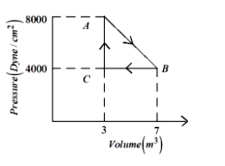
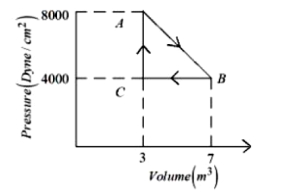
Work done \(\mathrm{AB}=\frac{1}{2}(8000+6000)\) Dyne \(/ \mathrm{cm}^2 \times\) \(4 \mathrm{~m}^3=\left(6000 \mathrm{Dyne} / \mathrm{cm}^2\right) \times 4 \mathrm{~m}^3\)Work done \(\mathrm{BC}=-\left(4000\right.\) Dyne \(\left./ \mathrm{cm}^2\right) \times 4 \mathrm{~m}^3\)
Total work done \(=2000\) Dyne \(/ \mathrm{cm}^2 \times 4 \mathrm{~m}^3\)
\(=2 \times 10^3 \) \(\times \frac{1}{10^5} \frac{\mathrm{N}}{\mathrm{cm}^2} \times 4 \mathrm{~m}^3 \)
\( =2 \times 10^{-2} \times \frac{\mathrm{N}}{10^{-4} \mathrm{~m}^2} \times 4 \mathrm{~m}^3 \)
\( =2 \times 10^2 \times 4 \mathrm{Nm}=800 \mathrm{~J}\)
-
- (A) પ્રક્રિયા \(B\) માટે \(\frac{P^{\gamma-1}}{T^\gamma} k\) અને પ્રક્રિયા \(A\) માટે \(T=k\).
- (B) પ્રક્રિયા \(B\) અને \(A\) માટે \(P V=k\).
- (C) પ્રક્રિયા B માટે \(\mathrm{PV}^\gamma=k\) અને પ્રક્રિયા \(A\) માટે \(P V=k\).
- (D) પ્રક્રિયા \(A\) માટે \(\frac{T^\gamma}{P^{\gamma-1}}=k\) અને પ્રક્રિયા \(B\) માટે \(P V=k\).
જવાબ અને ઉકેલ જુઓ
સાચો જવાબ: (A)
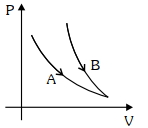
તીવ્ર વક્ર \((B)\) સમોષ્મ છે.સમોષ્મ \(\Rightarrow \mathrm{PV}^{\prime}=\) અચલ
Or \(\mathrm{P}\left(\frac{\mathrm{T}}{\mathrm{P}}\right)^{\mathrm{r}}=\) અચલ
\(\frac{\mathrm{T}^v}{\mathrm{P}^{v-1}}=\) અચલ
વક્ર \((A)\) સમતાપી છે.
\(\mathrm{T}=\) અચલ
\(\mathrm{PV}=\) અચલ
-
- (A) \(P_2 \geq P_1\)
- (B) \(P_2>P_1\)
- (C) \(P_1=P_2\)
- (D) \(P_1>P_2\)
જવાબ અને ઉકેલ જુઓ
સાચો જવાબ: (D)
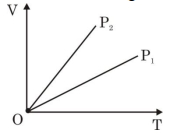
\(\mathrm{PV}=\mathrm{nRT}\)\(\mathrm{V}=\left(\frac{\mathrm{nR}}{\mathrm{P}}\right)_{\mathrm{T}}\)
\(\text { Slope }=\frac{\mathrm{nR}}{\mathrm{P}}\)
\(\text { Slope } \propto \frac{1}{\mathrm{P}}\)
\((\text { Slope })_2>(\text { Slope })_1\)
\(\mathrm{P}_2<\mathrm{P}_1\)
-
- (A) \(61.6 \mathrm{~J}\)
- (B) \(431.2 \mathrm{~J}\)
- (C) \(616 \mathrm{~J}\)
- (D) \(19.6 \mathrm{~J}\)
જવાબ અને ઉકેલ જુઓ
સાચો જવાબ: (A)
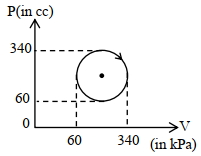
\(\Delta \mathrm{U}=0 \text { (Cyclic process) }\)\(\Delta \mathrm{Q}=\mathrm{W}=\text { area of } \mathrm{P}-\mathrm{V} \text { curve. }\)
\(=\pi \times\left(140 \times 10^3 \mathrm{~Pa}\right) \times\left(140 \times 10^{-6} \mathrm{~m}^3\right)\)
\(\Delta \mathrm{Q}=61.6 \mathrm{~J}\)
-
- (A) \(225 \mathrm{~J}\)
- (B) \(205 \mathrm{~J}\)
- (C) \(20 \mathrm{~J}\)
- (D) \(-20 \mathrm{~J}\)
જવાબ અને ઉકેલ જુઓ
સાચો જવાબ: (B)
\(\mathrm{W}_{\mathrm{AB}} =\int \mathrm{PdV}\) \(\quad\) (T ને અચળ ધારીએ)\(=\int \frac{\mathrm{RTdV}}{\mathrm{V}^3}\)
\(=\mathrm{RT} \int_2^4 \mathrm{~V}^{-3} \mathrm{dV}\)
\(=8 \times 300 \times\left(-\frac{1}{2}\left[\frac{1}{4^2}-\frac{1}{2^2}\right]\right)\)
\(=225 \mathrm{~J}\)
\(\mathrm{~W}_{\mathrm{BC}} =\mathrm{P} \int_4^2 \mathrm{dV}=10(2-4)=-20 \mathrm{~J}\)
\(\mathrm{~W}_{\mathrm{CA}} =0\)
\(\therefore \mathrm{W}_{\text {cyck }} =205 \mathrm{~J}\)
નોંધ: પ્રક્રિયા \(A B\) માં ડેટા અસંગત છે.
તેથી તેને પડકારવાની જરૂર છે.
-
- (A) \(\frac{5}{3}\)
- (B) \(\frac{9}{7}\)
- (C) \(\frac{3}{2}\)
- (D) \(\frac{7}{5}\)
જવાબ અને ઉકેલ જુઓ
સાચો જવાબ: (C)
\(\mathrm{P} \propto \mathrm{T}^3\)\(\mathrm{PT}^{-3}=\) અચળ
\(\because \frac{\mathrm{PV}}{\mathrm{T}}=\mathrm{nR}=\) આદર્શ વાયુ સમીકરણ મુજબ અચળ
\((\mathrm{P})(\mathrm{PV})^{-3}=\) અચળ
\(\mathrm{P}^{-2} \mathrm{~V}^{-3}=\) અચળ \(\quad . .(1)\)
\(\because\) એડિયાબેટિક પ્રક્રિયા માટેનું સમીકરણ છે
\(\mathrm{PV}^y=\) અચળ \(\quad . .(2)\)
સમીકરણ (1) અને (2) ની સરખામણી કરતા
\(\frac{\mathrm{C}_{\mathrm{p}}}{\mathrm{C}_{\mathrm{V}}}=\mathrm{y}=\frac{3}{2}\)
-
- (A) \(2\left(\mathrm{P}_1 \mathrm{~V}_1-\mathrm{P}_2 \mathrm{~V}_2\right)\)
- (B) \(2\left(\mathrm{P}_2 \mathrm{~V}_2-\mathrm{P}_1 \mathrm{~V}_1\right)\)
- (C) \(2\left(\sqrt{\mathrm{P}_1} V_1-\sqrt{\mathrm{P}_2} V_2\right)\)
- (D) \(2\left(\mathrm{P}_2 \sqrt{\mathrm{V}_2}-\mathrm{P}_1 \sqrt{\mathrm{V}_1}\right)\)
જવાબ અને ઉકેલ જુઓ
સાચો જવાબ: (A)
\(\mathrm{PV}^{\mathrm{x}}=\) અચળ માટેજો વાયુ દ્વારા થયેલ કાર્ય પૂછવામાં આવે તો
\({W}=\frac{\mathrm{nR} \Delta \mathrm{T}}{1-\mathrm{x}}\)
અહીં x \(=\frac{3}{2}\)
\( W =\frac{\mathrm{P}_2 \mathrm{~V}_2-\mathrm{P}_1 \mathrm{~V}_1}{-\frac{1}{2}}\)
\(=2\left(\mathrm{P}_1 \mathrm{~V}_1-\mathrm{P}_2 \mathrm{~V}_2\right) \ldots .\) વિકલ્પ (1) સાચો છે
જો બાહ્ય દ્વારા થયેલ કાર્ય પૂછવામાં આવે તો
\(\mathrm{W}=-2\left(\mathrm{P}_1 \mathrm{~V}_1-\mathrm{P}_2 \mathrm{~V}_2\right) \ldots \ldots\) વિકલ્પ \((2)\) સાચો છે.
- 433. એક આદર્શ વાયુનું કદ \((\gamma=1.5)\) સમોષ્મી રીતે \(5\) લિટરથી \(4\) લિટર કરવામાં આવે છે. પ્રારંભિક દબાણ અને અંતિમ દબાણનો ગુણોત્તર _______ છે. 2024 અઘરું
- (A) \(\frac{4}{5}\)
- (B) \(\frac{16}{25}\)
- (C) \(\frac{8}{5 \sqrt{5}}\)
- (D) \(\frac{2}{\sqrt{5}}\)
જવાબ અને ઉકેલ જુઓ
સાચો જવાબ: (C)
સમોષ્મી પ્રક્રિયા માટે\(P_i V_i=P_f V_f^\gamma\)
\(P_i(5)^{1.5}=P_f(4)^{1.5}\)
\(\frac{P_i}{P_f}=\left(\frac{4}{5}\right)^{\frac{3}{2}}=\frac{4}{5} \cdot\left(\frac{4}{5}\right)^{\frac{1}{2}} \Rightarrow \frac{8}{5 \sqrt{5}}\)
-
- (A) \(850 \mathrm{~J}\)
- (B) \(800 \mathrm{~J}\)
- (C) \(600 \mathrm{~J}\)
- (D) \(700 \mathrm{~J}\)
જવાબ અને ઉકેલ જુઓ
સાચો જવાબ: (D)
\(\gamma=1+\frac{2}{f}=1.4 \Rightarrow \frac{2}{f}=0.4\)\(\Rightarrow f=5\)
\(W=n R \Delta T=200 J\)
\(Q=\left(\frac{f+2}{2}\right) n R \Delta T\)
\(=\frac{7}{2} \times 200=700 J\)
-
- (A) \(72.9 \mathrm{~J}\)
- (B) \(24.9 \mathrm{~J}\)
- (C) \(48 \mathrm{~J}\)
- (D) \(23.1 \mathrm{~J}\)
જવાબ અને ઉકેલ જુઓ
સાચો જવાબ: (D)
થર્મોડાયનેમિક્સનો \(1^{\text {st }}\) નિયમ\(\Delta \mathrm{Q}=\Delta \mathrm{U}+\mathrm{W}\)
\(\Rightarrow+48=\mathrm{nC}_{\mathrm{v}} \Delta \mathrm{T}+\mathrm{W}\)
\(\Rightarrow 48=(1)\left(\frac{3 \mathrm{R}}{2}\right)(2)+\mathrm{W}\)
\(\Rightarrow \mathrm{W}=48-3 \times \mathrm{R}\)
\(\Rightarrow \mathrm{W}=48-3 \times(8.3)\)
\(\Rightarrow \mathrm{W}=23.1\) જૂલ
-
- (A) \(29 \mathrm{RT}\)
- (B) \(20 \mathrm{RT}\)
- (C) \(27 \mathrm{RT}\)
- (D) \(21 \mathrm{RT}\)
જવાબ અને ઉકેલ જુઓ
સાચો જવાબ: (C)
\(\mathrm{U}=\mathrm{nC}_{\mathrm{V}} \mathrm{T}\)\(\Rightarrow \mathrm{U}=\mathrm{n}_1 \mathrm{C}_{\mathrm{V}_1} \mathrm{~T}+\mathrm{n}_2 \mathrm{C}_{\mathrm{V}_2} \mathrm{~T}\)
\(\Rightarrow 8 \times \frac{3 \mathrm{R}}{2} \times \mathrm{T}+6 \times \frac{5 \mathrm{R}}{2} \times \mathrm{T}\)
\(=27 \mathrm{RT}\)
- 437. \(\mathrm{PV}^2=\mathrm{RT}\) સમીકરણનું પાલન કરતા વાસ્તવિક વાયુની અચળ દબાણે વિશિષ્ટ ઉષ્મા _______ છે. 2024 અઘરું
- (A) \(\mathrm{C}_{\mathrm{V}}+\mathrm{R}\)
- (B) \(\frac{\mathrm{R}}{3}+\mathrm{C}_{\mathrm{V}}\)
- (C) \(\mathrm{R}\)
- (D) \(C_V+\frac{R}{2 V}\)
જવાબ અને ઉકેલ જુઓ
સાચો જવાબ: (D)
\(\mathrm{dQ}=\mathrm{du}+\mathrm{dW}\)\(\mathrm{CdT}=\mathrm{C}_{\mathrm{V}} \mathrm{dT}+\mathrm{PdV}\) \(....(1)\)
\(\therefore \quad \mathrm{PV}^2=\mathrm{RT}\)
\(\quad \mathrm{P}=\text { constant }\)
\(\quad \mathrm{P}(2 \mathrm{VdV})=\mathrm{RdT}\)
\(\quad \mathrm{PdV}=\frac{\mathrm{RdT}}{2 \mathrm{~V}}\)
સમીકરણ \((1)\) માં મુકતા
\(\mathrm{C}=\mathrm{C}_{\mathrm{V}}+\frac{\mathrm{R}}{2 \mathrm{~V}}\)
-
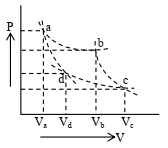
- (A) \(\frac{V_a}{V_d}=\left(\frac{V_b}{V_c}\right)^{-1}\)
- (B) \(\frac{V_a}{V_d} \neq \frac{V_b}{V_c}\)
- (C) \(\frac{V_a}{V_d}=\frac{V_b}{V_c}\)
- (D) \(\frac{V_a}{V_d}=\left(\frac{V_b}{V_c}\right)^2\)
જવાબ અને ઉકેલ જુઓ
સાચો જવાબ: (C)
સમોષ્મી પ્રક્રિયા માટે\(\mathrm{TV}^{\gamma-1}=\) અચળ
\(\mathrm{T}_{\mathrm{a}} \cdot \mathrm{V}_{\mathrm{a}}^{\gamma-1}=\mathrm{T}_{\mathrm{d}} \cdot \mathrm{V}_{\mathrm{d}}^{\gamma-1}\)
\(\left(\frac{\mathrm{V}_{\mathrm{a}}}{\mathrm{V}_{\mathrm{d}}}\right)^{\gamma-1}=\frac{\mathrm{T}_{\mathrm{d}}}{\mathrm{T}_{\mathrm{a}}}\)
\(\mathrm{T}_{\mathrm{b}} \cdot \mathrm{V}_{\mathrm{b}}^{\gamma-1}=\mathrm{T}_{\mathrm{c}} \cdot \mathrm{V}_{\mathrm{c}}^{\gamma-1}\)
\(\left(\frac{\mathrm{V}_{\mathrm{b}}}{\mathrm{V}_{\mathrm{c}}}\right)^{\gamma-1}=\frac{\mathrm{T}_{\mathrm{c}}}{\mathrm{T}_{\mathrm{b}}}\)
\(\mathrm{T}_{\mathrm{b}} \cdot \mathrm{V}_{\mathrm{b}}^{\gamma-1}=\mathrm{T}_{\mathrm{c}} \cdot \mathrm{V}_{\mathrm{c}}^{\gamma-1}\)
\(\left(\frac{\mathrm{V}_{\mathrm{b}}}{\mathrm{V}_{\mathrm{c}}}\right)^{\gamma-1}=\frac{\mathrm{T}_{\mathrm{c}}}{\mathrm{T}_{\mathrm{b}}}\)
\(\frac{\mathrm{V}_{\mathrm{a}}}{\mathrm{V}_{\mathrm{d}}}=\frac{\mathrm{V}_{\mathrm{b}}}{\mathrm{V}_{\mathrm{c}}} \quad\left(\begin{array}{r}\because \mathrm{T}_{\mathrm{d}}=\mathrm{T}_{\mathrm{c}} \\ \mathrm{T}_{\mathrm{a}}=\mathrm{T}_{\mathrm{b}}\end{array}\right)\)
-
- (A) \(\mathrm{RT}[\sqrt{2}-2]\)
- (B) \(\mathrm{RT}[1-2 \sqrt{2}]\)
- (C) \(\mathrm{RT}[2 \sqrt{2}-1]\)
- (D) \(\mathrm{RT}[2-\sqrt{2}]\)
જવાબ અને ઉકેલ જુઓ
સાચો જવાબ: (D)
\(\mathrm{W}=\frac{\mathrm{nR} \Delta \mathrm{T}}{1-\gamma}\)\(\mathrm{TV}^{\gamma-1}=\text { constant }=\mathrm{T}_{\mathrm{f}}(2 \mathrm{~V})^{\gamma-1}\)
\(\mathrm{~T}_{\mathrm{f}}=\mathrm{T}\left(\frac{1}{2}\right)^{1 / 2}=\frac{\mathrm{T}}{\sqrt{2}}\)
\(\mathrm{~W}=\frac{\mathrm{R}\left(\frac{\mathrm{T}}{\sqrt{2}}-\mathrm{T}\right)}{1-\frac{3}{2}}=2 \mathrm{RT} \frac{(\sqrt{2}-1)}{\sqrt{2}}\)
\(=\mathrm{RT}(2-\sqrt{2})\)
-
- (A) \(\mathrm{RT}[2-\sqrt{2}]\)
- (B) \(\frac{\mathrm{R}}{\mathrm{T}}[2-\sqrt{2}]\)
- (C) \(\mathrm{RT}[2+\sqrt{2}]\)
- (D) \(\frac{T}{R}[2+\sqrt{2}]\)
જવાબ અને ઉકેલ જુઓ
સાચો જવાબ: (A)
\(\mathrm{TV}^{\gamma-1}=\) અચળ\(\Rightarrow \mathrm{T}(\mathrm{V})^{\frac{3}{2}-1}=\mathrm{T}_{\mathrm{f}}(2 \mathrm{~V})^{\frac{3}{2}-1}\)
\(\Rightarrow \mathrm{TV}^{\frac{1}{2}}=\mathrm{T}_{\mathrm{f}}(2)^{\frac{1}{2}}(\mathrm{~V})^{\frac{1}{2}}\)
\(\Rightarrow \mathrm{T}_{\mathrm{f}}=\left(\frac{\mathrm{T}}{\sqrt{2}}\right)\)
હવે, કાર્ય \(=\frac{\mathrm{nR} \Delta \mathrm{T}}{1-\gamma}=\frac{1 \cdot \mathrm{R}\left[\frac{\mathrm{T}}{\sqrt{2}}-\mathrm{T}\right]}{1-\frac{3}{2}}\)
\(\Rightarrow\) કાર્ય \(=2 \mathrm{RT}\left[1-\frac{1}{\sqrt{2}}\right]\)
\(\Rightarrow\) કાર્ય \(=\mathrm{RT}[2-\sqrt{2}]\)
- 441. સેલ્સિયસ માપક્રમ પર શરીરનું તાપમાન \(40^{\circ} \mathrm{C}\) વધે છે. ફેરનહીટ માપક્રમ પર તાપમાનમાં થતો વધારો _______ છે. 2024 અઘરું
- (A) \(70^{\circ} \mathrm{F}\)
- (B) \(68^{\circ} \mathrm{F}\)
- (C) \(72^{\circ} \mathrm{F}\)
- (D) \(75^{\circ} \mathrm{F}\)
જવાબ અને ઉકેલ જુઓ
સાચો જવાબ: (C)
આપણે જાણીએ છીએ કે પ્રતિ \({ }^{\circ} \mathrm{C}\) ફેરફાર એ \({ }^{\circ} \mathrm{F}\) માં \(1.8^{\circ}\) ફેરફારને સમતુલ્ય છે.\(\therefore\) સેલ્સિયસ માપક્રમ પર \(40^{\circ}\) ફેરફાર એ ફેરનહીટ માપક્રમ પર \(72^{\circ}\) ફેરફારને અનુરૂપ હશે.
આથી વિકલ્પ \((3)\)
-
- (A) \(15\)
- (B) \(16\)
- (C) \(17\)
- (D) \(18\)
જવાબ અને ઉકેલ જુઓ
સાચો જવાબ: (D)
\(\beta=\frac{-\Delta \mathrm{P}}{\frac{\Delta \mathrm{V}}{\mathrm{V}}}\)\(\Delta \mathrm{P}=-\beta \frac{\Delta \mathrm{V}}{\mathrm{V}}\)
\(\rho \mathrm{gh}=-\beta \frac{\Delta \mathrm{V}}{\mathrm{V}}\)
\(10^3 \times 10 \times \mathrm{h}=-9 \times 10^8 \times\left(-\frac{0.02}{100}\right)\)
\(\Rightarrow \mathrm{h}=18 \mathrm{~m}\)
-
- (A) \(4\)
- (B) \(5\)
- (C) \(1\)
- (D) \(3\)
જવાબ અને ઉકેલ જુઓ
સાચો જવાબ: (C)
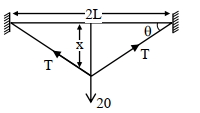
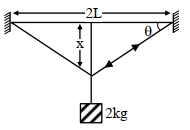
ઊર્ધ્વ દિશામાં \(2 \mathrm{~T} \sin \theta=20\)નાના ખૂણાના આસન્ન મૂલ્યનો ઉપયોગ કરીને \(\sin \theta=\theta\)
\(\theta=\frac{1}{100}\)
\(\therefore \quad \mathrm{T}=\frac{10}{\theta}\)
\(T=1000 \mathrm{~N}\)
લંબાઈમાં ફેરફાર \(\Delta \mathrm{L} =2 \sqrt{\mathrm{x}^2+\mathrm{L}^2}-2 \mathrm{~L}\)
\(=2 \mathrm{~L}\left[1+\frac{\mathrm{x}^2}{2 \mathrm{~L}^2}-1\right]\)
\(\Delta \mathrm{L} =\frac{\mathrm{x}^2}{\mathrm{~L}}\)
\(\therefore\) સ્થિતિસ્થાપકતા ગુણાંક \(=\frac{\text { stress }}{\text { strain }}\)
\(2 \times 10^{11}=\frac{10^3}{\mathrm{~A} \times \frac{\mathrm{x}^2}{\mathrm{~L}}} \times 2 \mathrm{~L}\)
\(\therefore \quad \mathrm{A}=1 \times 10^{-4} \mathrm{~m}^2\)
-
- (A) \(9\)
- (B) \(10\)
- (C) \(11\)
- (D) \(12\)
જવાબ અને ઉકેલ જુઓ
સાચો જવાબ: (D)
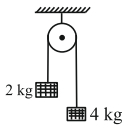
\(\mathrm{T}=\left(\frac{2 \mathrm{~m}_1 \mathrm{~m}_2}{\mathrm{~m}_1+\mathrm{m}_2}\right) \mathrm{g}=\frac{80}{3} \mathrm{~N}\)\(\mathrm{~A}=\pi \mathrm{r}^2=16 \pi \times 10^{-10} \mathrm{~m}^2\)
\(\text { Strain }=\frac{\Delta \ell}{\ell}=\frac{\mathrm{F}}{\mathrm{AY}}=\frac{\mathrm{T}}{\mathrm{AY}}\)
\(=\frac{80 / 3}{16 \pi \times 10^{-10} \times 2 \times 10^{11}}=\frac{1}{12 \pi}\)
\(\alpha=12\)
-
- (A) \(7\)
- (B) \(5\)
- (C) \(4\)
- (D) \(2\)
જવાબ અને ઉકેલ જુઓ
સાચો જવાબ: (D)
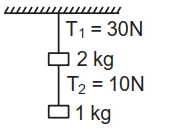
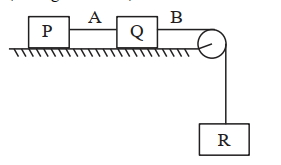
\( a=\frac{10}{3} \mathrm{~m} / \mathrm{s}^2 \)
\( 30-T_1=3 \times a \)
\( T_1=20 \mathrm{~N} \)
\( \text {strain }=\frac{\text { stress }}{Y} \)
\( =2 \times 10^{-4}\)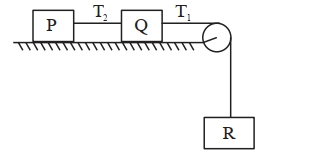
-
- (A) \(16\)
- (B) \(14\)
- (C) \(20\)
- (D) \(50\)
જવાબ અને ઉકેલ જુઓ
સાચો જવાબ: (A)
\( \mathrm{Y}=\frac{\text { Stress }}{\text { Strain }}=\frac{\mathrm{F} / \mathrm{A}}{\Delta \ell / \ell}=\frac{\mathrm{F} \ell}{\mathrm{A} \Delta \ell} \)\( \Delta \ell=\frac{\mathrm{F} \ell}{\mathrm{AY}} \)
\( \mathrm{V}=\mathrm{A} \ell \Rightarrow \ell=\frac{\mathrm{V}}{\mathrm{A}} \)
\( \Delta \ell=\frac{\mathrm{FV}}{\mathrm{A}^2 \mathrm{Y}}\)
\(Y\) & \(V\) is same for both the wires
\( \Delta \ell \propto \frac{\mathrm{F}}{\mathrm{A}^2} \)
\( \frac{\Delta \ell_1}{\Delta \ell_2}=\frac{\mathrm{F}_1}{\mathrm{~A}_1^2} \times \frac{\mathrm{A}_2^2}{\mathrm{~F}_2} \)
\( \Delta \ell_1=\Delta \ell_2 \)
\( \mathrm{~F}_1 \mathrm{~A}_2^2=\mathrm{F}_2 \mathrm{~A}_1^2 \)
\( \frac{\mathrm{F}_1}{\mathrm{~F}_2}=\frac{\mathrm{A}_1^2}{\mathrm{~A}_2^2}=\left(\frac{4}{1}\right)^2=16\)
-
- (A) \(17\)
- (B) \(18\)
- (C) \(20\)
- (D) \(21\)
જવાબ અને ઉકેલ જુઓ
સાચો જવાબ: (C)
\(\frac{\mathrm{F}}{\mathrm{A}}=\mathrm{Y} \frac{\Delta \ell}{\ell} \Rightarrow \Delta \ell=\frac{\mathrm{F} \ell}{\mathrm{AY}}\)\(\Delta \ell=\frac{200 \times 2}{2 \times 10^{-4} \times 10^{11}}=2 \times 10^{-5}=20 \mu\)

-
- (A) \(5\)
- (B) \(10\)
- (C) \(8\)
- (D) \(3\)
જવાબ અને ઉકેલ જુઓ
સાચો જવાબ: (D)
\(\Delta \mathrm{L}=\frac{\mathrm{FL}}{\mathrm{AY}}\)\(\frac{\Delta \mathrm{L}}{\mathrm{L}}=\frac{\mathrm{F}}{\mathrm{AY}}\)
\(\frac{\frac{\Delta \mathrm{L}_1}{\mathrm{~L}_1}}{\frac{\Delta \mathrm{L}_2}{\mathrm{~L}_2}}=\frac{\mathrm{F}_1}{\mathrm{~F}_2}=\frac{30}{10}=3\)
-
- (A) \(600\)
- (B) \(700\)
- (C) \(800\)
- (D) \(900\)
જવાબ અને ઉકેલ જુઓ
સાચો જવાબ: (A)
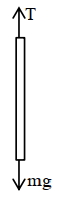
\(\mathrm{T}=\mathrm{mg}\)\(\sigma=\frac{\mathrm{T}}{\mathrm{A}}=\frac{\mathrm{mg}}{\mathrm{A}}\)
\(\frac{(\sigma \mathrm{A} \ell) \mathrm{g}}{\mathrm{A}}\)
\(\Rightarrow \ell=\frac{\sigma}{\rho \mathrm{g}}=\frac{1.2 \times 10^8 \times 3}{6 \times 10^4 \times 10}=600\)
-
- (A) \(1\)
- (B) \(2\)
- (C) \(4\)
- (D) \(7\)
જવાબ અને ઉકેલ જુઓ
સાચો જવાબ: (B)
\( \mathrm{B}=-\frac{\Delta \mathrm{P}}{\left(\frac{\Delta \mathrm{V}}{\mathrm{V}}\right)} \)\( -\left(\frac{\Delta \mathrm{V}}{\mathrm{V}}\right)=\frac{\rho \mathrm{gh}}{\mathrm{B}}=\frac{1000 \times 10 \times 4000}{2 \times 10^9} \)
\( =2 \times 10^{-2}[-\mathrm{ve} \text { sign represent compression }]\)
આ પેજ પર આ ફિલ્ટર મુજબ કોઈ પ્રશ્ન નથી.