


All JEE Mains 2024 Physics questions
31 chaptersShowing 401–450 of 593 questions
-
- (A) \(1\)
- (B) \(12\)
- (C) \(15\)
- (D) \(9\)
Show answer and solution
Correct Answer: (D)
\( \text { Let total energy }=\mathrm{E}=\frac{1}{2} \mathrm{KA}^2 \)\( \mathrm{U}=\frac{1}{2} \mathrm{~K}\left(\frac{\mathrm{A}}{3}\right)^2=\frac{\mathrm{KA}^2}{2 \times 9}=\frac{\mathrm{E}}{9} \)
\( \mathrm{KE}=\mathrm{E}-\frac{\mathrm{E}}{9}=\frac{8 \mathrm{E}}{9} \)
\( \text { Ratio } \frac{\text { Total }}{\mathrm{KE}}=\frac{\mathrm{E}}{\frac{8 \mathrm{E}}{9}}=\frac{9}{8} \)
\( \mathrm{x}=9\)
- 402. A diatomic gas \((\gamma=1.4)\) does \(100 \mathrm{~J}\) of work in an isobaric expansion. The heat given to the gas is _______. 2024 Hard
- (A) \(350 \mathrm{~J}\)
- (B) \(490 \mathrm{~J}\)
- (C) \(150 \mathrm{~J}\)
- (D) \(250 \mathrm{~J}\)
Show answer and solution
Correct Answer: (A)
For Isobaric process\(\mathrm{w}=\mathrm{P} \Delta \mathrm{v}=\mathrm{nR} \Delta \mathrm{T}=100 \mathrm{~J}\)
\(\mathrm{Q}=\Delta \mathrm{u}+\mathrm{w}\)
\(\Delta \mathrm{Q}=\frac{\mathrm{F}}{2} \mathrm{nR} \Delta \mathrm{T}+\mathrm{nR} \Delta \mathrm{T}\)
\(\left(\frac{\mathrm{f}}{2}+1\right) \mathrm{nR} \Delta \mathrm{T}\)
\(\left(\frac{5}{2}+1\right) 100=350 \mathrm{~J}\)
-
- (A) \(\frac{7}{5}\)
- (B) \(\frac{3}{2}\)
- (C) \(\frac{3}{5}\)
- (D) \(\frac{5}{3}\)
Show answer and solution
Correct Answer: (C)
\(\frac{\left(\mathrm{C}_{\mathrm{v}}\right)_{\text {mono }}}{\left(\mathrm{C}_{\mathrm{v}}\right)_{\text {dia }}}=\frac{\frac{3}{2} \mathrm{R}}{\frac{5}{2} \mathrm{R}}=\frac{3}{5}\) - 404. A sample contains mixture of helium and oxygen gas. The ratio of root mean square speed of helium and oxygen in the sample is _______. 2024 Hard
- (A) \(\frac{1}{32}\)
- (B) \(\frac{2 \sqrt{2}}{1}\)
- (C) \(\frac{1}{4}\)
- (D) \(\frac{1}{2 \sqrt{2}}\)
Show answer and solution
Correct Answer: (B)
\(\mathrm{V}_{\mathrm{rms}} =\sqrt{\frac{3 \mathrm{RT}}{\mathrm{M}_{\mathrm{w}}}}\)\(\Rightarrow \frac{\mathrm{V}_{\mathrm{O}_2}}{\mathrm{~V}_{\mathrm{He}}}\) \(=\sqrt{\frac{\mathrm{M}_{\mathrm{w}, \mathrm{He}}}{\mathrm{M}_{\mathrm{w}, \mathrm{O}_2}}}\)
\(=\sqrt{\frac{4}{32}}=\frac{1}{2 \sqrt{2}}\)
\(\frac{\mathrm{V}_{\mathrm{He}}}{\mathrm{V}_{\mathrm{O}_2}} =\frac{2 \sqrt{2}}{1}\)
-
- (A) \(36\ \mathrm{Nm}^{-2}\)
- (B) \(18\ \mathrm{Nm}^{-2}\)
- (C) \(6 \ \mathrm{Nm}^{-2}\)
- (D) \(2\ \mathrm{Nm}^{-2}\)
Show answer and solution
Correct Answer: (C)
\( \text { Radiation pressure }=\frac{I}{V} \)\( =\frac{I \cdot \mu}{c} \)
\( =\frac{6 \times 10^8 \times 3}{3 \times 10^8} \)
\( =6 \mathrm{~N} / \mathrm{m}^2\)
- 406. At which temperature the r.m.s. velocity of a hydrogen molecule equal to that of an oxygen molecule at \(47^{\circ} \mathrm{C}\) ? 2024 Hard
- (A) \(80 \mathrm{~K}\)
- (B) \(-73 \mathrm{~K}\)
- (C) \(4 \mathrm{~K}\)
- (D) \(20 \mathrm{~K}\)
Show answer and solution
Correct Answer: (D)
\( \sqrt{\frac{3 R T}{2}}=\sqrt{\frac{3 R(320)}{32}} \)\( T=\frac{320}{16}=20 \mathrm{~K}\)
-
- (A) \(\frac{5}{3}\)
- (B) \(\frac{3}{2}\)
- (C) \(\frac{7}{5}\)
- (D) \(\frac{9}{7}\)
Show answer and solution
Correct Answer: (B)
\( \mathrm{P} \propto \mathrm{T}^3 \Rightarrow \mathrm{PT}^{-3}=\text { constant } \)\( \mathrm{PV}^\gamma=\text { const } \)
\( \mathrm{P}\left(\frac{\mathrm{nRT}}{\mathrm{P}}\right)^\gamma=\text { const } \)
\( \mathrm{P}^{1-\gamma} \mathrm{T}^\gamma=\text { const }\)
\( \mathrm{PT}^{\frac{\gamma}{1-\gamma}}=\text { const } \)
\( \frac{\gamma}{1-\gamma}=-3 \)
\( \gamma=-3+3 \gamma \)
\( 3=2 \gamma \)
\( \gamma=\frac{3}{2}\)
- 408. Energy of \(10\) non rigid diatomic molecules at temperature \(\mathrm{T}\) is _______. 2024 Hard
- (A) \(\frac{7}{2} \mathrm{RT}\)
- (B) \(70 \mathrm{~K}_{\mathrm{B}} \mathrm{T}\)
- (C) \(35 \mathrm{RT}\)
- (D) \(35 \mathrm{~K}_{\mathrm{B}} \mathrm{T}\)
Show answer and solution
Correct Answer: (D)
\(\text { Degree of freedom }(f)=5+2(3 N-5)\)\( f=5+2(3 \times 2-1)=7\)
\(\text { energy of one molecule }=\frac{f}{2} K_B T\)
energy of 10 molecules
\(=10\left(\frac{\mathrm{f}}{2} \mathrm{~K}_{\mathrm{B}} \mathrm{T}\right)=10\left(\frac{7}{2} \mathrm{~K}_{\mathrm{B}} \mathrm{T}\right)=35 \mathrm{~K}_{\mathrm{B}} \mathrm{T}\)
-
- (A) Statement \(I\) is false but Statement \(II\) is true.
- (B) Statement \(I\) is true but Statement \(II\) is false.
- (C) Both Statement \(I\) and Statement \(II\) are false
- (D) Both Statement \(I\) and Statement \(II\) are true.
Show answer and solution
Correct Answer: (D)
The mean free path \( \lambda \) of gas molecules is given by:
\( \lambda = \frac{1}{\sqrt{2}\,\pi d^2 n} \)where \( d \) is the molecular diameter and \( n \) is the number density. Hence,
\( \lambda \propto \frac{1}{d^2} \)Therefore, Statement (I) is true.
The average kinetic energy of a gas molecule is:
\( \langle E_k \rangle = \frac{3}{2}kT \)which shows that the average kinetic energy is directly proportional to the absolute temperature \( T \). Hence, Statement (II) is also true.
However, the mean free path depends on molecular diameter and number density, not directly on the average kinetic energy or temperature.
Both Statement (I) and Statement (II) are true, but Statement (II) is not the correct explanation of Statement (I).
-
- (A) \(\frac{1}{\sqrt{2 n \pi d^2}}\)
- (B) \(\sqrt{2} \mathrm{n} \pi \mathrm{d}^2\)
- (C) \(\frac{1}{\sqrt{2} \mathrm{n} \pi \mathrm{d}^2}\)
- (D) \(\frac{1}{\sqrt{2} n^2 \pi^2 d^2}\)
Show answer and solution
Correct Answer: (C)
\(\mathrm{n}=\) number of molecule per unit volume\(\mathrm{d}=\) diameter of the molecule
\(\lambda=\frac{1}{\sqrt{2} \pi \mathrm{d}^2 \mathrm{n}}\) (By Theory)
-
- (A) \(\frac{\sqrt{3}}{2} \mathrm{Z}\)
- (B) \(\frac{4}{3} \mathrm{Z}\)
- (C) \(\frac{2}{\sqrt{3}} \mathrm{Z}\)
- (D) \(\frac{3}{4} Z\)
Show answer and solution
Correct Answer: (C)
Assuming mean free path constant.\(\mathrm{f} \propto \mathrm{v} \propto \sqrt{\mathrm{T}}\)
\(\frac{\mathrm{f}_1}{\mathrm{f}_2}=\sqrt{\frac{\mathrm{T}_1}{\mathrm{~T}_2}}=\sqrt{\frac{300}{400}}\)
\(\mathrm{f}_2=\sqrt{\frac{4}{3}}=\mathrm{f}_1=\frac{2}{\sqrt{3}} \mathrm{Z}\)
-
- (A) \(2.0\)
- (B) \(0.5\)
- (C) \(1.5\)
- (D) \(1.0\)
Show answer and solution
Correct Answer: (B)
\(V_{1 \mathrm{~ms}}=\sqrt{\frac{3 \mathrm{RT}}{\mathrm{M}}}\)\(\frac{\mathrm{V}_1}{\mathrm{~V}_2}=\sqrt{\frac{\mathrm{M}_2}{\mathrm{M}_1}} \Rightarrow \frac{2}{\mathrm{~V}_2}=\sqrt{\frac{32}{2}}\)
\(\mathrm{~V}_2=0.5 \mathrm{~km} / \mathrm{s}\)
-
- (A) \(1.75\)
- (B) \(1.40\)
- (C) \(1.52\)
- (D) \(1.35\)
Show answer and solution
Correct Answer: (C)
\(\mathrm{f}_1=3, \quad \mathrm{f}_2=5\)\(\mathrm{n}_1=3, \quad \mathrm{n}_2=2\)
\(\mathrm{f}_{\text {mixture }}=\frac{\mathrm{n}_1 \mathrm{f}_1+\mathrm{n}_2 \mathrm{f}_2}{\mathrm{n}_1+\mathrm{n}_2}=\frac{9+10}{\mathrm{f}}=\frac{19}{5}\)
\(\gamma_{\text {mixture }}=1+\frac{2 \times 5}{19}=\frac{29}{19}=1.52\)
-
- (A) \(6\)
- (B) \(3\)
- (C) \(4\)
- (D) \(2\)
Show answer and solution
Correct Answer: (C)
\(\mathrm{f}_{\mathrm{eq}}=\frac{\mathrm{n}_1 \mathrm{f}_1+\mathrm{n}_2 \mathrm{f}_2}{\mathrm{n}_1+\mathrm{n}_2}\)For diatomic gas \(\mathrm{f}_{\mathrm{eq}}=5\)
\( 5=\frac{(N)(6)+(2)(3)}{N+2} \)
\( 5 N+10=6 N+6 \)
\( N=4\)
-
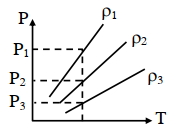
- (A) \(\rho_2<\rho_3\)
- (B) \(\rho_1>\rho_2\)
- (C) \(\rho_1<\rho_2\)
- (D) \(\rho_1=\rho_2=\rho_3\)
Show answer and solution
Correct Answer: (B)
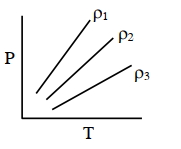
For ideal gas\(P V=n R T\)
\(P V=\frac{m}{M} R T\)
\(P=\left(\frac{M}{V}\right) \frac{R T}{M}\)
\(P=\frac{\rho R T}{M}\)
(Where \(\mathrm{m}\) is mass of gas and \(\mathrm{M}\) is molecular mass of gas)
for same temperature \(\mathrm{P}_1>\mathrm{P}_2>\mathrm{P}_3\)
So \(\rho_1>\rho_2>\rho_3\)
So correct answer is \((2)\)
-
- (A) \(3000 \mathrm{~K}\)
- (B) \(3200 \mathrm{~K}\)
- (C) \(1600 \mathrm{~K}\)
- (D) \(1500 \mathrm{~K}\)
Show answer and solution
Correct Answer: (B)
For monoatomic molecule degree of freedom \(=3\).\( \therefore \mathrm{K}_{v-\mathrm{g}}=\frac{3}{2} \mathrm{~K}_{\mathrm{B}} \mathrm{T} \)
\( \mathrm{T}=\frac{0.414 \times 1.6 \times 10^{-19} \times 2}{3 \times 1.38 \times 10^{-23}} \)
\( =3200 \mathrm{~K}\)
- 417. The parameter that remains the same for molecules of all gases at a given temperature is _______. 2024 Hard
- (A) kinetic energy
- (B) momentum
- (C) mass
- (D) speed
Show answer and solution
Correct Answer: (A)
\(\mathrm{KE}=\frac{\mathrm{f}}{2} \mathrm{kT}\)Conceptual
-
- (A) \(500 \mathrm{~K}\)
- (B) \(200 \mathrm{~K}\)
- (C) \(100 \mathrm{~K}\)
- (D) \(300 \mathrm{~K}\)
Show answer and solution
Correct Answer: (A)
\( \mathrm{PV}=\mathrm{nRT} \)\( \mathrm{PV}=\frac{\mathrm{N}}{\mathrm{N}_{\mathrm{A}}} \mathrm{RT}\)
\(\mathrm{N}=\) Total no. of molecules
\(\mathrm{P}=\frac{\mathrm{N}}{\mathrm{V}} \mathrm{kT}\)
\(1.38 \times 1.01 \times 10^5=2 \times 10^{25} \times 1.38 \times 10^{-23} \times \mathrm{T}\)
\(1.01 \times 10^5=2 \times 10^2 \times \mathrm{T}\)
\(\mathrm{T}=\frac{1.01 \times 10^3}{2} \approx 500 \mathrm{~K}\)
-
- (A) \(-39^{\circ} \mathrm{C}\)
- (B) \(117^{\circ} \mathrm{C}\)
- (C) \(127^{\circ} \mathrm{C}\)
- (D) \(-78^{\circ} \mathrm{C}\)
Show answer and solution
Correct Answer: (B)
\(\mathrm{K} . \mathrm{E}=\frac{\mathrm{nf}_1 \mathrm{RT}}{2}\)\(\mathrm{~T}_{\mathrm{i}}=-78^{\circ} \mathrm{C} \rightarrow 273+\left[-78^{\circ} \mathrm{C}\right]=195 \mathrm{~K}\)
\(\mathrm{~K} . \mathrm{E} \alpha \mathrm{T}\)
To double the \(K.E\) energy temp also become double
\(\mathrm{T}_{\mathrm{f}}=390 \mathrm{~K}\)
\(\mathrm{~T}_{\mathrm{f}}=117^{\circ} \mathrm{C}\)
-
- (A) \(6845.5 \mathrm{~J}\)
- (B) \(5942.0 \mathrm{~J}\)
- (C) \(6232.5 \mathrm{~J}\)
- (D) \(5670.5 \mathrm{~J}\)
Show answer and solution
Correct Answer: (C)
\( \text { Kinetic energy }=\frac{f}{2} \mathrm{nRT} \)\( =\frac{5}{2} \times 1 \times 8.31 \times 300 \mathrm{~J} \)
\( =6232.5 \mathrm{~J}\)
- 421. The translational degrees of freedom \((f)\) and rotational degrees of freedom \((f)\) of \(\mathrm{CH}_4\) molecule are _______. 2024 Hard
- (A) \(f=2\) and \(f=2\)
- (B) \(f_t=3\) and \(f=3\)
- (C) \(f=3\) and \(f=2\)
- (D) \(f=2\) and \(f=3\)
Show answer and solution
Correct Answer: (B)
\(\text { Since } \mathrm{CH}_4 \text { is polyatomic Non-Linear }\)\(\text { D.O.F of } \mathrm{CH}_4\)
\(\text { T. DOF }=3\)
\(\text { R DOF }=3\)
-
- (A) \(\frac{9}{4} R\)
- (B) \(\frac{7}{4} R\)
- (C) \(\frac{3}{2} R\)
- (D) \(\frac{5}{2} R\)
Show answer and solution
Correct Answer: (A)
\( \mathrm{C}_{\mathrm{V}} \)\( =\frac{\mathrm{n}_1 \mathrm{C}_{\mathrm{r}_1}+\mathrm{n}_2 \mathrm{C}_{\mathrm{r}_2}}{\mathrm{n}_1+\mathrm{n}_2} \)\( =\frac{2 \times \frac{3}{2} \mathrm{R}+6 \times \frac{5}{2} \mathrm{R}}{2+6} \)
\( =\frac{9}{4} \mathrm{R}\)
-
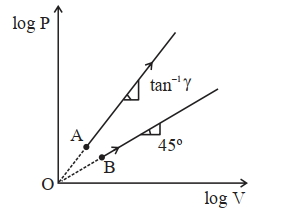
- (A) \(C_B=\infty, C_A=0\)
- (B) \(C_A=0\) and \(C_B=\infty\)
- (C) \(C_P>C_B>C_A>C_v\)
- (D) \(C_A>C_P>C_V\)
Show answer and solution
Correct Answer: (C)
For process \(\mathrm{A}\)
\( \log P=\gamma \log \mathrm{V} \Rightarrow \mathrm{P}=\mathrm{V}^\gamma,(\gamma>1) \)
\( P V^{-\gamma}=\text { Constant } \)
\( C_A=C_V+\frac{R}{1+\gamma} \ldots . \text { (i) }\)
Likewise for process \(\mathrm{B} \rightarrow P V^{-1}=\) \(Cons\) \(\tan t\)
\(C_B\) \( =C_v+\frac{R}{1+1} \)
\(C_B\) \( =C_v+\frac{R}{2} \) \(.............(ii)\)
\(C_P\) \(=C_v+R\) \(...........(iii)\)
By \((i)\), \((ii)\) & \((iii)\) \(C_P>C_B>C_A>C_v\) [No answer matching] -
- (A) \(16\)
- (B) \(8\)
- (C) \(4\)
- (D) \(32\)
Show answer and solution
Correct Answer: (A)
\(\frac{\mathrm{P}_{\mathrm{A}} \mathrm{V}_{\mathrm{A}}}{\mathrm{P}_{\mathrm{B}} \mathrm{V}_{\mathrm{B}}}=\frac{\mathrm{n}_{\mathrm{A}} R \mathrm{RT}_{\mathrm{A}}}{\mathrm{n}_{\mathrm{B}} \mathrm{RT}_{\mathrm{B}}}\)Given \(V_A=V_B\)
And \(T_{\mathrm{A}}=T_{\mathrm{B}}\)
\(\frac{\mathrm{P}_{\mathrm{A}}}{\mathrm{P}_{\mathrm{B}}}=\frac{\mathrm{n}_{\mathrm{A}}}{\mathrm{n}_{\mathrm{B}}}\)
\(\frac{\mathrm{P}_{\mathrm{A}}}{\mathrm{P}_{\mathrm{B}}}=\frac{1 / 2}{1 / 32}=16\)
-
- (A) \(318 \mathrm{~J}\)
- (B) \(298 \mathrm{~J}\)
- (C) \(284 \mathrm{~J}\)
- (D) \(142 \mathrm{~J}\)
Show answer and solution
Correct Answer: (C)
\( \mathrm{Q}=\Delta \mathrm{U} \text { as work done is zero [constant volume] } \)\( \Delta \mathrm{U}=\mathrm{ms} \Delta \mathrm{T} \)
\( =0.08 \times(170 \times 4.18) \times 5 \)
\( \simeq 284 \mathrm{~J}\)
-
- (A) \(850 \mathrm{~J}\)
- (B) \(800 \mathrm{~J}\)
- (C) \(600 \mathrm{~J}\)
- (D) \(700 \mathrm{~J}\)
Show answer and solution
Correct Answer: (D)
\(\gamma=1+\frac{2}{f}=1.4 \Rightarrow \frac{2}{f}=0.4\)\(\Rightarrow f=5\)
\(W=n R \Delta T=200 J\)
\(Q=\left(\frac{f+2}{2}\right) n R \Delta T\)
\(=\frac{7}{2} \times 200=700 J\)
-
- (A) \(29 \mathrm{RT}\)
- (B) \(20 \mathrm{RT}\)
- (C) \(27 \mathrm{RT}\)
- (D) \(21 \mathrm{RT}\)
Show answer and solution
Correct Answer: (C)
\(\mathrm{U}=\mathrm{nC}_{\mathrm{V}} \mathrm{T}\)\(\Rightarrow \mathrm{U}=\mathrm{n}_1 \mathrm{C}_{\mathrm{V}_1} \mathrm{~T}+\mathrm{n}_2 \mathrm{C}_{\mathrm{V}_2} \mathrm{~T}\)
\(\Rightarrow 8 \times \frac{3 \mathrm{R}}{2} \times \mathrm{T}+6 \times \frac{5 \mathrm{R}}{2} \times \mathrm{T}\)
\(=27 \mathrm{RT}\)
-
- (A) \(225 \mathrm{~J}\)
- (B) \(205 \mathrm{~J}\)
- (C) \(20 \mathrm{~J}\)
- (D) \(-20 \mathrm{~J}\)
Show answer and solution
Correct Answer: (B)
\(\mathrm{W}_{\mathrm{AB}} =\int \mathrm{PdV} \quad \text { (Assuming } \mathrm{T} \text { to be constant) }\)\(=\int \frac{\mathrm{RTdV}}{\mathrm{V}^3}\)
\(=\mathrm{RT} \int_2^4 \mathrm{~V}^{-3} \mathrm{dV}\)
\(=8 \times 300 \times\left(-\frac{1}{2}\left[\frac{1}{4^2}-\frac{1}{2^2}\right]\right)\)
\(=225 \mathrm{~J}\)
\(\mathrm{~W}_{\mathrm{BC}} =\mathrm{P} \int_4^2 \mathrm{dV}=10(2-4)=-20 \mathrm{~J}\)
\(\mathrm{~W}_{\mathrm{CA}} =0\)
\(\therefore \mathrm{W}_{\text {cyck }} =205 \mathrm{~J}\)
Note: Data is inconsistent in process \(A B\).
So needs to be challenged.
-
- (A) \(\mathrm{RT}[2-\sqrt{2}]\)
- (B) \(\frac{\mathrm{R}}{\mathrm{T}}[2-\sqrt{2}]\)
- (C) \(\mathrm{RT}[2+\sqrt{2}]\)
- (D) \(\frac{T}{R}[2+\sqrt{2}]\)
Show answer and solution
Correct Answer: (A)
\(\mathrm{TV}^{\gamma-1}=\text { constant }\)\(\Rightarrow \mathrm{T}(\mathrm{V})^{\frac{3}{2}-1}=\mathrm{T}_{\mathrm{f}}(2 \mathrm{~V})^{\frac{3}{2}-1}\)
\(\Rightarrow \mathrm{TV}^{\frac{1}{2}}=\mathrm{T}_{\mathrm{f}}(2)^{\frac{1}{2}}(\mathrm{~V})^{\frac{1}{2}}\)
\(\Rightarrow \mathrm{T}_{\mathrm{f}}=\left(\frac{\mathrm{T}}{\sqrt{2}}\right)\)
\(\text { Now, W.D. }=\frac{\mathrm{nR} \Delta \mathrm{T}}{1-\gamma}=\frac{1 \cdot \mathrm{R}\left[\frac{\mathrm{T}}{\sqrt{2}}-\mathrm{T}\right]}{1-\frac{3}{2}}\)
\(\Rightarrow \text { W.D. }=2 \mathrm{RT}\left[1-\frac{1}{\sqrt{2}}\right]\)
\(\Rightarrow \text { W.D. }=\mathrm{RT}[2-\sqrt{2}]\)
-
- (A) \(\mathrm{RT}[\sqrt{2}-2]\)
- (B) \(\mathrm{RT}[1-2 \sqrt{2}]\)
- (C) \(\mathrm{RT}[2 \sqrt{2}-1]\)
- (D) \(\mathrm{RT}[2-\sqrt{2}]\)
Show answer and solution
Correct Answer: (D)
\(\mathrm{W}=\frac{\mathrm{nR} \Delta \mathrm{T}}{1-\gamma}\)\(\mathrm{TV}^{\gamma-1}=\text { constant }=\mathrm{T}_{\mathrm{f}}(2 \mathrm{~V})^{\gamma-1}\)
\(\mathrm{~T}_{\mathrm{f}}=\mathrm{T}\left(\frac{1}{2}\right)^{1 / 2}=\frac{\mathrm{T}}{\sqrt{2}}\)
\(\mathrm{~W}=\frac{\mathrm{R}\left(\frac{\mathrm{T}}{\sqrt{2}}-\mathrm{T}\right)}{1-\frac{3}{2}}=2 \mathrm{RT} \frac{(\sqrt{2}-1)}{\sqrt{2}}\)
\(=\mathrm{RT}(2-\sqrt{2})\)
-
- (A) \(33800 \mathrm{~J}\)
- (B) \(2200 \mathrm{~J}\)
- (C) \(800 \mathrm{~J}\)
- (D) \(1200 \mathrm{~J}\)
Show answer and solution
Correct Answer: (C)
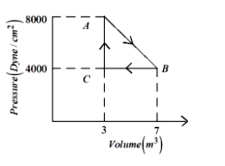
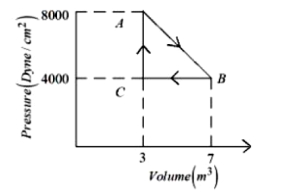
Work done \(\mathrm{AB}=\frac{1}{2}(8000+6000)\) Dyne \(/ \mathrm{cm}^2 \times\) \(4 \mathrm{~m}^3=\left(6000 \mathrm{Dyne} / \mathrm{cm}^2\right) \times 4 \mathrm{~m}^3\)Work done \(\mathrm{BC}=-\left(4000\right.\) Dyne \(\left./ \mathrm{cm}^2\right) \times 4 \mathrm{~m}^3\)
Total work done \(=2000\) Dyne \(/ \mathrm{cm}^2 \times 4 \mathrm{~m}^3\)
\(=2 \times 10^3 \) \(\times \frac{1}{10^5} \frac{\mathrm{N}}{\mathrm{cm}^2} \times 4 \mathrm{~m}^3 \)
\( =2 \times 10^{-2} \times \frac{\mathrm{N}}{10^{-4} \mathrm{~m}^2} \times 4 \mathrm{~m}^3 \)
\( =2 \times 10^2 \times 4 \mathrm{Nm}=800 \mathrm{~J}\)
-
- (A) \(72.9 \mathrm{~J}\)
- (B) \(24.9 \mathrm{~J}\)
- (C) \(48 \mathrm{~J}\)
- (D) \(23.1 \mathrm{~J}\)
Show answer and solution
Correct Answer: (D)
\(1^{\text {st }}\) law of thermodynamics\(\Delta \mathrm{Q}=\Delta \mathrm{U}+\mathrm{W}\)
\(\Rightarrow+48=\mathrm{nC}_{\mathrm{v}} \Delta \mathrm{T}+\mathrm{W}\)
\(\Rightarrow 48=(1)\left(\frac{3 \mathrm{R}}{2}\right)(2)+\mathrm{W}\)
\(\Rightarrow \mathrm{W}=48-3 \times \mathrm{R}\)
\(\Rightarrow \mathrm{W}=48-3 \times(8.3)\)
\(\Rightarrow \mathrm{W}=23.1 \text { Joule }\)
-
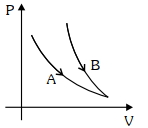
- (A) \(\mathrm{PV}^\gamma=\mathrm{k}\) for process \(\mathrm{B}\) and \(\mathrm{PV}=\mathrm{k}\) for process \(\mathrm{A}\).
- (B) \(\mathrm{PV}=\mathrm{k}\) for process \(\mathrm{B}\) and \(\mathrm{A}\).
- (C) \(\frac{P^{\gamma-1}}{T^\gamma}=k\) forprocess \(B\) and \(T=k\) for process \(A\)
- (D) \(\frac{T^\gamma}{P^{\gamma-1}}=k\) for process \(A\) and \(P V=k\) for process \(B\).
Show answer and solution
Correct Answer: (A)
Steeper curve \((B)\) is adiabaticAdiabatic \(\Rightarrow \mathrm{PV}^{\prime}=\) const.
Or \(\mathrm{P}\left(\frac{\mathrm{T}}{\mathrm{P}}\right)^{\mathrm{r}}=\) const.
\(\frac{\mathrm{T}^v}{\mathrm{P}^{v-1}}=\text { const. }\)
Curve \((A)\) is isothermal
\(\mathrm{T}=\) const.
\(\mathrm{PV}=\) const.
-
- (A) \(\frac{5}{3}\)
- (B) \(\frac{9}{7}\)
- (C) \(\frac{3}{2}\)
- (D) \(\frac{7}{5}\)
Show answer and solution
Correct Answer: (C)
\(\mathrm{P} \propto \mathrm{T}^3\)\(\mathrm{PT}^{-3}=\text { constant }\)
\(\because \frac{\mathrm{PV}}{\mathrm{T}}=\mathrm{nR}=\text { constant from ideal gas equation }\)
\((\mathrm{P})(\mathrm{PV})^{-3}=\text { constant }\)
\(\mathrm{P}^{-2} \mathrm{~V}^{-3}=\text { cosntant } \quad . .(1)\)
\(\because \text { Process equation for adiabatic process is }\)
\(\mathrm{PV}^y=\text { constant } \quad . .(2)\)
\(\text { Comparing equation (1) and (2) }\)
\(\frac{\mathrm{C}_{\mathrm{p}}}{\mathrm{C}_{\mathrm{V}}}=\mathrm{y}=\frac{3}{2}\)
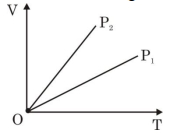
- 435. The given figure represents two isobaric processes for the same mass of an ideal gas, then ....
 2024 Hard
- (A) \(P_2 \geq P_1\)
- (B) \(P_2>P_1\)
- (C) \(P_1=P_2\)
- (D) \(P_1>P_2\)
Show answer and solution
Correct Answer: (D)
\(\mathrm{PV}=\mathrm{nRT}\)\(\mathrm{V}=\left(\frac{\mathrm{nR}}{\mathrm{P}}\right)_{\mathrm{T}}\)
\(\text { Slope }=\frac{\mathrm{nR}}{\mathrm{P}}\)
\(\text { Slope } \propto \frac{1}{\mathrm{P}}\)
\((\text { Slope })_2>(\text { Slope })_1\)
\(\mathrm{P}_2<\mathrm{P}_1\)
-
- (A) \(61.6 \mathrm{~J}\)
- (B) \(431.2 \mathrm{~J}\)
- (C) \(616 \mathrm{~J}\)
- (D) \(19.6 \mathrm{~J}\)
Show answer and solution
Correct Answer: (A)
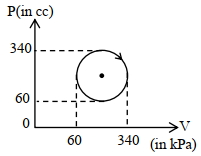
\(\Delta \mathrm{U}=0 \text { (Cyclic process) }\)\(\Delta \mathrm{Q}=\mathrm{W}=\text { area of } \mathrm{P}-\mathrm{V} \text { curve. }\)
\(=\pi \times\left(140 \times 10^3 \mathrm{~Pa}\right) \times\left(140 \times 10^{-6} \mathrm{~m}^3\right)\)
\(\Delta \mathrm{Q}=61.6 \mathrm{~J}\)
-
- (A) \(2\left(\mathrm{P}_1 \mathrm{~V}_1-\mathrm{P}_2 \mathrm{~V}_2\right)\)
- (B) \(2\left(\mathrm{P}_2 \mathrm{~V}_2-\mathrm{P}_1 \mathrm{~V}_1\right)\)
- (C) \(2\left(\sqrt{\mathrm{P}_1} V_1-\sqrt{\mathrm{P}_2} V_2\right)\)
- (D) \(2\left(\mathrm{P}_2 \sqrt{\mathrm{V}_2}-\mathrm{P}_1 \sqrt{\mathrm{V}_1}\right)\)
Show answer and solution
Correct Answer: (A)
For \(\mathrm{PV}^{\mathrm{x}}=\) constantIf work done by gas is asked then
\({W}=\frac{\mathrm{nR} \Delta \mathrm{T}}{1-\mathrm{x}}\)
Here x \(=\frac{3}{2}\)
\( W =\frac{\mathrm{P}_2 \mathrm{~V}_2-\mathrm{P}_1 \mathrm{~V}_1}{-\frac{1}{2}}\)
\(=2\left(\mathrm{P}_1 \mathrm{~V}_1-\mathrm{P}_2 \mathrm{~V}_2\right) \ldots . \text { Option (1) is correct }\)
If work done by external is asked then
\(\mathrm{W}=-2\left(\mathrm{P}_1 \mathrm{~V}_1-\mathrm{P}_2 \mathrm{~V}_2\right) \ldots \ldots\) Option \((2)\) is correct
- 438. The specific heat at constant pressure of a real gas obeying \(\mathrm{PV}^2=\mathrm{RT}\) equation is _______. 2024 Hard
- (A) \(\mathrm{C}_{\mathrm{V}}+\mathrm{R}\)
- (B) \(\frac{\mathrm{R}}{3}+\mathrm{C}_{\mathrm{V}}\)
- (C) \(\mathrm{R}\)
- (D) \(C_V+\frac{R}{2 V}\)
Show answer and solution
Correct Answer: (D)
\(\mathrm{dQ}=\mathrm{du}+\mathrm{dW}\)\(\mathrm{CdT}=\mathrm{C}_{\mathrm{V}} \mathrm{dT}+\mathrm{PdV}\) \(....(1)\)
\(\therefore \quad \mathrm{PV}^2=\mathrm{RT}\)
\(\quad \mathrm{P}=\text { constant }\)
\(\quad \mathrm{P}(2 \mathrm{VdV})=\mathrm{RdT}\)
\(\quad \mathrm{PdV}=\frac{\mathrm{RdT}}{2 \mathrm{~V}}\)
Put in equation \((1)\)
\(\mathrm{C}=\mathrm{C}_{\mathrm{V}}+\frac{\mathrm{R}}{2 \mathrm{~V}}\)
-
- (A) \(\frac{4}{5}\)
- (B) \(\frac{16}{25}\)
- (C) \(\frac{8}{5 \sqrt{5}}\)
- (D) \(\frac{2}{\sqrt{5}}\)
Show answer and solution
Correct Answer: (C)
For Adiabatic process\(P_i V_i=P_f V_f^\gamma\)
\(P_i(5)^{1.5}=P_f(4)^{1.5}\)
\(\frac{P_i}{P_f}=\left(\frac{4}{5}\right)^{\frac{3}{2}}=\frac{4}{5} \cdot\left(\frac{4}{5}\right)^{\frac{1}{2}} \Rightarrow \frac{8}{5 \sqrt{5}}\)
-
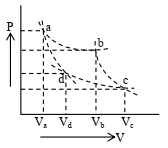
- (A) \(\frac{V_a}{V_d}=\left(\frac{V_b}{V_c}\right)^{-1}\)
- (B) \(\frac{V_a}{V_d} \neq \frac{V_b}{V_c}\)
- (C) \(\frac{V_a}{V_d}=\frac{V_b}{V_c}\)
- (D) \(\frac{V_a}{V_d}=\left(\frac{V_b}{V_c}\right)^2\)
Show answer and solution
Correct Answer: (C)
For adiabatic process\(\mathrm{TV}^{\gamma-1}=\text { constant }\)
\(\mathrm{T}_{\mathrm{a}} \cdot \mathrm{V}_{\mathrm{a}}^{\gamma-1}=\mathrm{T}_{\mathrm{d}} \cdot \mathrm{V}_{\mathrm{d}}^{\gamma-1}\)
\(\left(\frac{\mathrm{V}_{\mathrm{a}}}{\mathrm{V}_{\mathrm{d}}}\right)^{\gamma-1}=\frac{\mathrm{T}_{\mathrm{d}}}{\mathrm{T}_{\mathrm{a}}}\)
\(\mathrm{T}_{\mathrm{b}} \cdot \mathrm{V}_{\mathrm{b}}^{\gamma-1}=\mathrm{T}_{\mathrm{c}} \cdot \mathrm{V}_{\mathrm{c}}^{\gamma-1}\)
\(\left(\frac{\mathrm{V}_{\mathrm{b}}}{\mathrm{V}_{\mathrm{c}}}\right)^{\gamma-1}=\frac{\mathrm{T}_{\mathrm{c}}}{\mathrm{T}_{\mathrm{b}}}\)
\(\mathrm{T}_{\mathrm{b}} \cdot \mathrm{V}_{\mathrm{b}}^{\gamma-1}=\mathrm{T}_{\mathrm{c}} \cdot \mathrm{V}_{\mathrm{c}}^{\gamma-1}\)
\(\left(\frac{\mathrm{V}_{\mathrm{b}}}{\mathrm{V}_{\mathrm{c}}}\right)^{\gamma-1}=\frac{\mathrm{T}_{\mathrm{c}}}{\mathrm{T}_{\mathrm{b}}}\)
\(\frac{\mathrm{V}_{\mathrm{a}}}{\mathrm{V}_{\mathrm{d}}}=\frac{\mathrm{V}_{\mathrm{b}}}{\mathrm{V}_{\mathrm{c}}} \quad\left(\begin{array}{r}\because \mathrm{T}_{\mathrm{d}}=\mathrm{T}_{\mathrm{c}} \\ \mathrm{T}_{\mathrm{a}}=\mathrm{T}_{\mathrm{b}}\end{array}\right)\)
-
- (A) \(70^{\circ} \mathrm{F}\)
- (B) \(68^{\circ} \mathrm{F}\)
- (C) \(72^{\circ} \mathrm{F}\)
- (D) \(75^{\circ} \mathrm{F}\)
Show answer and solution
Correct Answer: (C)
We know that per \({ }^{\circ} \mathrm{C}\) change is equivalent to \(1.8^{\circ}\) change in \({ }^{\circ} \mathrm{F}\).\(\therefore 40^{\circ}\) change on celcius scale will corresponds to \(72^{\circ}\) change on Fahrenheit scale.
Hence option \((3)\)
-
- (A) \(0.6\)
- (B) \(0.4\)
- (C) \(0.2\)
- (D) \(0\)
Show answer and solution
Correct Answer: (D)
\(\frac{{dV}}{V} = (1 - 2\sigma )\frac{{dL}}{L}\)
\(\frac{{dV}}{V} =0\) -
- (A) \(4\)
- (B) \(5\)
- (C) \(1\)
- (D) \(3\)
Show answer and solution
Correct Answer: (C)
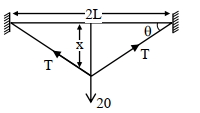
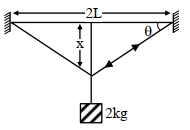
In vertical derection \(2 \mathrm{~T} \sin \theta=20\)using small angle approximation \(\sin \theta=\theta\)
\(\theta=\frac{1}{100}\)
\(\therefore \quad \mathrm{T}=\frac{10}{\theta}\)
\(T=1000 \mathrm{~N}\)
Change in length \(\Delta \mathrm{L} \quad=2 \sqrt{\mathrm{x}^2+\mathrm{L}^2}-2 \mathrm{~L}\)
\(=2 \mathrm{~L}\left[1+\frac{\mathrm{x}^2}{2 \mathrm{~L}^2}-1\right]\)
\(\Delta \mathrm{L} =\frac{\mathrm{x}^2}{\mathrm{~L}}\)
\(\therefore\) Modulus of elasticity \(=\frac{\text { stress }}{\text { strain }}\)
\(2 \times 10^{11}=\frac{10^3}{\mathrm{~A} \times \frac{\mathrm{x}^2}{\mathrm{~L}}} \times 2 \mathrm{~L}\)
\(\therefore \quad \mathrm{A}=1 \times 10^{-4} \mathrm{~m}^2\)
-
- (A) \(3\) times
- (B) \(3 / 2\) times
- (C) \(4\) times
- (D) \(2\) times
Show answer and solution
Correct Answer: (D)
\( \mathrm{Y}=\frac{\text { stress }}{\text { strain }} \)\( \mathrm{Y}=\frac{\frac{\mathrm{F}}{\mathrm{r}^2}}{\frac{\ell}{\mathrm{L}}} \)
\( \mathrm{F}=\mathrm{Y} \pi \mathrm{r}^2 \times \frac{\ell}{\mathrm{L}} \) \(...........(i)\)
\( \mathrm{Y}=\frac{\frac{\pi \mathrm{r}^2 / 4}{\Delta \ell}}{\mathrm{L}} \)
\( \mathrm{F}=\mathrm{Y} \frac{\Delta \ell}{\mathrm{L}} \times 2 \times \frac{\pi \mathrm{r}^2}{4} \)
\( \text { From }(\mathrm{i}) \)
\( \mathrm{Y} \pi \mathrm{r}^2 \frac{\ell}{\mathrm{L}}=\mathrm{Y} \frac{\Delta \ell}{\mathrm{L}} \frac{\pi \mathrm{r}^2}{2} \)
\( \Delta \ell=2 \ell\)
-
- (A) \(7\)
- (B) \(5\)
- (C) \(4\)
- (D) \(2\)
Show answer and solution
Correct Answer: (D)
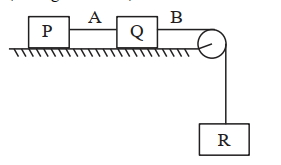
\( a=\frac{10}{3} \mathrm{~m} / \mathrm{s}^2 \)
\( 30-T_1=3 \times a \)
\( T_1=20 \mathrm{~N} \)
\( \text {strain }=\frac{\text { stress }}{Y} \)
\( =2 \times 10^{-4}\)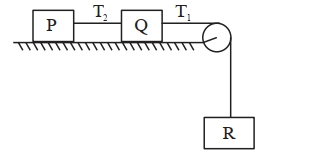
-
- (A) Both \((A)\) and \((R)\) are correct and \((R)\) is the correct explanation of \((A)\)
- (B) Both \((A)\) and \((R)\) are correct but \((R)\) is not the correct explanation of \((A)\)
- (C) \((A)\) is true but \((R)\) is false
- (D) \((A)\) is false but \((R)\) is true
Show answer and solution
Correct Answer: (B)
Assertion Reason both are correct Theory -
- (A) \(1\)
- (B) \(2\)
- (C) \(4\)
- (D) \(7\)
Show answer and solution
Correct Answer: (B)
\( \mathrm{B}=-\frac{\Delta \mathrm{P}}{\left(\frac{\Delta \mathrm{V}}{\mathrm{V}}\right)} \)\( -\left(\frac{\Delta \mathrm{V}}{\mathrm{V}}\right)=\frac{\rho \mathrm{gh}}{\mathrm{B}}=\frac{1000 \times 10 \times 4000}{2 \times 10^9} \)
\( =2 \times 10^{-2}[-\mathrm{ve} \text { sign represent compression }]\)
-
- (A) \(5\)
- (B) \(10\)
- (C) \(8\)
- (D) \(3\)
Show answer and solution
Correct Answer: (D)
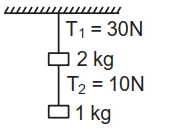
\(\Delta \mathrm{L}=\frac{\mathrm{FL}}{\mathrm{AY}}\)\(\frac{\Delta \mathrm{L}}{\mathrm{L}}=\frac{\mathrm{F}}{\mathrm{AY}}\)
\(\frac{\frac{\Delta \mathrm{L}_1}{\mathrm{~L}_1}}{\frac{\Delta \mathrm{L}_2}{\mathrm{~L}_2}}=\frac{\mathrm{F}_1}{\mathrm{~F}_2}=\frac{30}{10}=3\)
-
- (A) \(600\)
- (B) \(700\)
- (C) \(800\)
- (D) \(900\)
Show answer and solution
Correct Answer: (A)
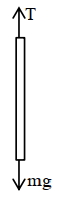
\(\mathrm{T}=\mathrm{mg}\)\(\sigma=\frac{\mathrm{T}}{\mathrm{A}}=\frac{\mathrm{mg}}{\mathrm{A}}\)
\(\frac{(\sigma \mathrm{A} \ell) \mathrm{g}}{\mathrm{A}}\)
\(\Rightarrow \ell=\frac{\sigma}{\rho \mathrm{g}}=\frac{1.2 \times 10^8 \times 3}{6 \times 10^4 \times 10}=600\)
-
- (A) \(15\)
- (B) \(16\)
- (C) \(17\)
- (D) \(18\)
Show answer and solution
Correct Answer: (D)
\(\beta=\frac{-\Delta \mathrm{P}}{\frac{\Delta \mathrm{V}}{\mathrm{V}}}\)\(\Delta \mathrm{P}=-\beta \frac{\Delta \mathrm{V}}{\mathrm{V}}\)
\(\rho \mathrm{gh}=-\beta \frac{\Delta \mathrm{V}}{\mathrm{V}}\)
\(10^3 \times 10 \times \mathrm{h}=-9 \times 10^8 \times\left(-\frac{0.02}{100}\right)\)
\(\Rightarrow \mathrm{h}=18 \mathrm{~m}\)
No questions on this page match these filters.