


All JEE Mains 2020 Physics questions
31 chaptersShowing 101–150 of 401 questions
-
- (A) \(\frac{\mathrm{h}}{\sqrt{2}}\)
- (B) \(\frac{3}{4} \mathrm{h} \sqrt{2}\)
- (C) \(\frac{\mathrm{h}}{2(\sqrt{2}+1)}\)
- (D) \(\frac{\mathrm{h}}{3 \sqrt{2}}\)
Show answer and solution
Correct Answer: (B)
For near normal incidence,\(\mathrm{h}_{\mathrm{app}}=\frac{\mathrm{h}_{\mathrm{actal}}}{\left(\frac{\mu_{\mathrm{in}}}{\mu_{\mathrm{rat}}}\right)}\)
\(\mathrm{h}_{\text {apparent }}=\frac{\frac{\mathrm{h}}{\left(\frac{2 \sqrt{2}}{\sqrt{2}}\right)}+\mathrm{h}}{\frac{\sqrt{2}}{1}}=\frac{3 \mathrm{h}}{2 \sqrt{2}}=\frac{3}{4} \mathrm{h} \sqrt{2}\)
-
- (A) \(22\)
- (B) \(12\)
- (C) \(33\)
- (D) \(2\)
Show answer and solution
Correct Answer: (A)
\(M =\frac{ v _{0}}{+ u _{0}}\left(1+\frac{ d }{ fe }\right)\)focal length of objective lens is small \(u_{0} \simeq f _{0}\). Alos as focal length of eye is small
\(v _{0} \simeq L\)
\( M =\frac{ L }{+ f _{0}}\left(1+\frac{ d }{ f _{ e }}\right) \)
\(\Rightarrow 375=\frac{150}{5}\left(1+\frac{250}{ f _{ e }}\right)\)
\(\Rightarrow \frac{375}{30}=\left(1+\frac{250}{f_{e}}\right)\)
\(\Rightarrow \frac{375}{30}-1=\frac{250}{f_{e}}\)
\(\Rightarrow \frac{345}{30}=\frac{250}{f_{e}}\)
\(\Rightarrow f _{e}=2.2 \;cm\)
\(F _{ e }=22\; mm\)
-
- (A) \(4.5\)
- (B) \(4\)
- (C) \(3.5\)
- (D) \(4.8\)
Show answer and solution
Correct Answer: (A)
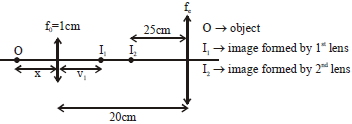
for first lens \(=\frac{1}{v_{1}}-\frac{1}{-x}=\frac{1}{1} \Rightarrow v_{1}=\frac{x}{x-1}\)also magnification \(\left| m _{1}\right|=\left|\frac{ v _{1}}{ u _{1}}\right|=\frac{1}{ x -1}\)
for \(2^{nd}\) lens this is acting as object
so \(u _{2}=-\left(20- v _{1}\right)=-\left(20-\frac{ x }{ x -1}\right)\)
and \(v _{2}=-25 cm\)
angular magnification \(\left| m _{ A }\right|=\left|\frac{ D }{ u _{2}}\right|=\frac{25}{\left| u _{2}\right|}\)
Total magnification \(m = m _{1} m _{ A }=100\)
\(\left(\frac{1}{x-1}\right)\left(\frac{25}{20-\frac{x}{x-1}}\right)=100\)
\(\frac{25}{20(x-1)-x}=100 \Rightarrow 1=80(x-1)-4 x\)
\(\Rightarrow 76 x=81 \Rightarrow x=\frac{81}{76}\)
\(\Rightarrow u _{2}=-\left(20-\frac{81 / 76}{81 / 76-1}\right)=\frac{-19}{5}\)
now by lens formula
\(\frac{1}{-25}-\frac{1}{-19 / 5}=\frac{1}{f_{e}} \Rightarrow f_{e}=\frac{25 \times 19}{106} \approx 4.48 cm\)
-
- (A) \(60\)
- (B) \(15\)
- (C) \(45\)
- (D) \(30\)
Show answer and solution
Correct Answer: (D)
\(\sin \theta_{\mathrm{C}}=\frac{1}{\mu}=\frac{1}{\sqrt{3 \times 4 / 3}}\)\(\theta_{\mathrm{C}}=30^{\circ}\)
-
- (A) \(445\)
- (B) \(495\)
- (C) \(486\)
- (D) \(476\)
Show answer and solution
Correct Answer: (D)
Using displacement method\(f =\frac{ D ^{2}- d ^{2}}{4 D }\)
Here, \(D=100 cm\)
\(d =40 cm\)
\(f =\frac{100^{2}-40^{2}}{4(100)}=21 cm\)
\(P =\frac{1}{ f }=\frac{100}{21} D \quad \frac{ N }{100}=\frac{100}{21} N =476\)
- 106. The magnifying power of a telescope with tube \(60\; \mathrm{cm}\) is \(5 .\) What is the focal length of its eye piece?......\(cm\) 2020 Medium
- (A) \(30\)
- (B) \(40\)
- (C) \(20\)
- (D) \(10\)
Show answer and solution
Correct Answer: (D)
\(\mathrm{L}=\mathrm{f}_{0}+\mathrm{f}_{\mathrm{e}}=60\; \mathrm{cm}\)\(\mathrm{M}=\frac{\mathrm{f}_{0}}{\mathrm{f}_{\mathrm{e}}}=5\)
\(\Rightarrow \mathrm{f}_{0}=5 \mathrm{f}_{\mathrm{e}}\)
\(\therefore \quad 6 \mathrm{f}_{\mathrm{e}}=60 \mathrm{cm}\)
\(\mathrm{f}_{\mathrm{e}}=10 \mathrm{cm}\)
-
- (A) \(17\)
- (B) \(21\)
- (C) \(34\)
- (D) \(50\)
Show answer and solution
Correct Answer: (A)
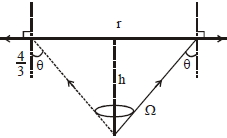
\(\frac{4}{3} \sin \theta=1 \sin 90^{\circ}\)\(\sin \theta=\frac{3}{4}\)
Area of sphere in which light spread \(=4 \pi \mathrm{R}^{2}\) \(\Omega=2 \pi(1-\cos \theta)\)
\(\Omega=2 \pi\left(1-\frac{\sqrt{7}}{4}\right)\)
\(\mathrm{P} \rightarrow 4 \pi\) steradians
\(\mathrm{P}^{\prime} \rightarrow \frac{\mathrm{P}}{4 \pi}(1-\cos \theta)\)
ratio \(=\frac{P'}{P}=\frac{2 \pi(1-\cos \theta)}{4 \pi}=\frac{(1-\cos \theta)}{2}=\frac{1-\frac{\sqrt{7}}{4}}{2}\)
\(=\frac{0.33}{2}=0.17\)
-
- (A) \(1\)
- (B) \(5\)
- (C) \(9\)
- (D) \(13\)
Show answer and solution
Correct Answer: (A)
\(\left(\frac{d v}{d t}\right)|=| \frac{v^{2}}{u^{2}}\left|\frac{d u}{d t}\right|\)\(=\left(\frac{10}{30}\right) 2 \times 9=1 m / s\)
-
- (A) \(418\)
- (B) \(245\)
- (C) \(348\)
- (D) \(365\)
Show answer and solution
Correct Answer: (C)
\(f =750 Hz , V _{ rms }=2 OV\)\(R =100 \Omega , L =0.1803 H\)
\(C =10_{\mu} F , S=2 J /{ }^{\circ} C\)
\(Z-\sqrt{R^{2}+\left(X_{L}-X_{C}\right)^{2}}-\sqrt{R^{2}+(\omega L-1 / \omega C)^{2}}\)
\(=\sqrt{ R ^{2}+\left(2 \pi fL -\frac{1}{2 \pi fC }\right)^{2}}\)
Putting values
\(|Z|=834 \Omega\)
In \(AC\) power \(P = V _{ rms } i _{ rms }\) \(cos\phi\)
\(\operatorname{Cos} \phi=\frac{ R }{| Z |} \quad i _{ rms }=\frac{ V _{ rms }}{| Z |}\)
\(=\frac{V_{\max }^{2} R}{(|Z|)^{2}}\)
\(=\left(\frac{20}{834}\right)^{2} \times 100=0.0575 J / s\)
\(H = Pt = S \cdot \Delta\theta\)
\(t =\frac{2(10)}{0.0575}=348 sec\)
- 110. An \(AC\) circuit has \(R =100 \Omega, C =2\, \mu F\) and \(L =80\, mH ,\) connected in series. The quality factor of the circuit is\(.......\) 2020 Medium
- (A) \(0.5\)
- (B) \(2\)
- (C) \(20\)
- (D) \(400\)
Show answer and solution
Correct Answer: (B)
\(Q =\frac{1}{ R } \sqrt{\frac{ L }{ C }}=\frac{1}{100} \sqrt{\frac{80 \times 10^{-3}}{2 \times 10^{-6}}}\)\(=\frac{1}{100} \sqrt{40 \times 10^{3}}\)
\(=\frac{200}{100}=2\)
-
- (A) \(1.1 \times 10^{-2}\; H\)
- (B) \(1.1 \times 10^{-1} \;H\)
- (C) \(5.5 \times 10^{-5} \;H\)
- (D) \(6.7 \times 10^{-7}\; H\)
Show answer and solution
Correct Answer: (A)
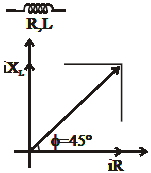
Reactance of inductance coil\(=\sqrt{{ R ^{2}+ x _{ L }^{2}}}=100\) \(...(i)\)
\(f =1000 Hz\) of applied \(AC\) signal
Voltage leads current bly \(45^{\circ}\)
\(\tan 45^{\circ}=\frac{ i X _{ L }}{ iR }=\frac{\omega L }{ R }\)
ie \(R = X _{ L }=\omega L\)
Putting in eqn \((i):\) \(\sqrt{ X _{ L }^{2}+ X _{ L }^{2}}=100\)
\(\sqrt{2} X _{ L }=100 \Rightarrow X _{ L }=50 \sqrt{2}\)
ie \(\omega L =50 \sqrt{2}\)
\(L =\frac{50 \sqrt{2}}{\omega}=\frac{50 \sqrt{2}}{2 \pi f }=\frac{25 \sqrt{2}}{\pi \times 1000} H\)
\(=1.125 \times 10^{-2} H\)
-
- (A) \(200\)
- (B) \(250\)
- (C) \(350\)
- (D) \(400\)
Show answer and solution
Correct Answer: (D)
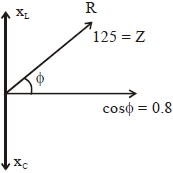
\(P =\frac{ E _{ rms }^{2}}{ Z } \cos \phi\)\(400=\frac{(250)^{2} \times 0.8}{ Z }\)
\(Z =25 \times 5=125\)
\(X _{ L }=125 \sin \phi=125 \times 0.6=75\)
-
- (A) \(0.52 \cos 314 t\)
- (B) \(0.52 \sin 314 t\)
- (C) \(10 \cos 314 t\)
- (D) \(5.2 \cos 314 t\)
Show answer and solution
Correct Answer: (A)
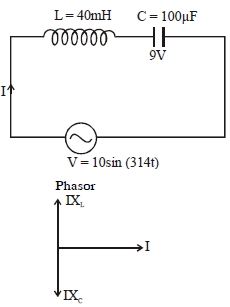
\(\mathrm{X}_{\mathrm{L}}=\omega \mathrm{L}=314 \times 40 \times 10^{-3}=12.56 \Omega\)\(\mathrm{X}_{\mathrm{C}}=\frac{1}{\omega \mathrm{C}}=\frac{1}{314 \times 100 \times 10^{-6}}\)
\(=\frac{10^{4}}{314}=31.84 \Omega\)
\(\mathrm{V}_{\mathrm{m}}=\mathrm{I}_{\mathrm{m}}\left(\mathrm{X}_{\mathrm{C}}-\mathrm{X}_{\mathrm{L}}\right)\)
\(10=\mathrm{I}_{\mathrm{m}}(31.84-12.56)\)
\(I_{m}=\frac{10}{19.28}=0.52 A\)
\(I=0.52 \sin \left(314 t+\frac{\pi}{2}\right)\)
-
- (A) \(\sqrt{\frac{2 gC }{ ab }}\)
- (B) \(2 \sqrt{2 g C}\)
- (C) \(\sqrt{\frac{2 g}{C}}\)
- (D) \(2 \sqrt{ gC }\)
Show answer and solution
Correct Answer: (B)
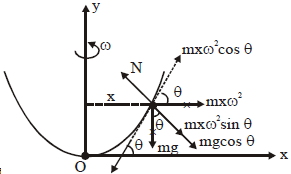
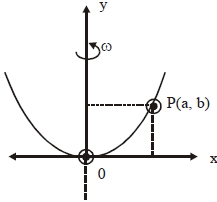
In rotating frame\(mx \omega^{2} \cos \theta= mg \sin \theta\)
\(x \omega^{2}= g \tan \theta\)
\(x \omega^{2}= g \cdot \frac{ dy }{ dx }\)
\(x \omega^{2}= g \cdot(8 cx )\)
\(\omega^{2}=8 gc\)
\(\omega=2 \sqrt{2 gc }\)
-
- (A) \(\sqrt{\frac{2 gC }{ ab }}\)
- (B) \(2 \sqrt{2 g C}\)
- (C) \(\sqrt{\frac{2 g}{C}}\)
- (D) \(2 \sqrt{ gC }\)
Show answer and solution
Correct Answer: (B)
In rotating frame\(mx \omega^{2} \cos \theta= mg \sin \theta\)
\(x \omega^{2}= g \tan \theta\)
\(x \omega^{2}= g \cdot \frac{ dy }{ dx }\)
\(x \omega^{2}= g \cdot(8 cx )\)
\(\omega^{2}=8 gc\)
\(\omega=2 \sqrt{2 gc }\)
-
- (A) \(69\)
- (B) \(63\)
- (C) \(55\)
- (D) \(49\)
Show answer and solution
Correct Answer: (B)
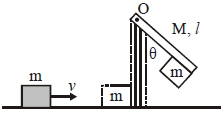
Angular momentum conservation\(mv l=\frac{ Ml ^{2}}{3} \omega+ m l^{2} \omega\)
\(\Rightarrow \omega=\frac{1 \times 6 \times 1}{\frac{2}{3}+1}=\frac{18}{5}\)
Now using energy consevation
\(\frac{1}{2}\left( M \frac{l^{2}}{3}\right) \omega^{2}+\frac{1}{2}\left( m l^{2}\right) \omega^{2}\)
\(=( m + M ) r _{ cm }(1-\cos \theta)\)
\(=( m + M )\left(\frac{ m l+\frac{ M l}{2}}{ m + M }\right) g (1-\cos \theta)\)
\(\frac{5}{6} \times\left(\frac{18}{5}\right)^{2}=20(1-\cos \theta)\)
\(\Rightarrow 1-\cos \theta=\frac{18}{5} \times \frac{3}{20}\)
\(\cos \theta=1-\frac{27}{50}\)
\(\cos \theta=\frac{23}{50} \Rightarrow \theta \simeq 63^{\circ}\)
-
- (A) \(25\)
- (B) \(27\)
- (C) \(20\)
- (D) \(15\)
Show answer and solution
Correct Answer: (C)
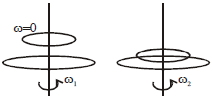
Let moment of inertia of bigger disc is \(I =\frac{ MR ^{2}}{2}\)\(\Rightarrow\) \(MOI\) of small disc \(I_{2}=\frac{M\left(\frac{R}{2}\right)^{2}}{2}=\frac{I}{4}\)
by angular momentum conservation
\(I \omega_{1}+\frac{ I }{4}( D )= I \omega_{2}+\frac{ I }{4} \omega_{2} \Rightarrow \omega_{2}=\frac{4 \omega_{1}}{5}\)
initial kinetic energy \(K _{1}=\frac{1}{2} I \omega_{1}^{2}\)
final kinetic energy \(K _{2}\)
\(=\frac{1}{2}\left( I +\frac{ I }{4}\right)\left(\frac{4 \omega_{1}}{5}\right)^{2}=\frac{1}{2} I \omega_{1}^{2}\left(\frac{4}{5}\right)\)
\(P \%=\frac{ K _{1}- K _{2}}{ K _{1}} \times 100 \%=\frac{1-4 / 5}{1} \times 100=20 \%\)
-
- (A) \(25\)
- (B) \(27\)
- (C) \(20\)
- (D) \(15\)
Show answer and solution
Correct Answer: (C)
Let moment of inertia of bigger disc is \(I =\frac{ MR ^{2}}{2}\)\(\Rightarrow\) \(MOI\) of small disc \(I_{2}=\frac{M\left(\frac{R}{2}\right)^{2}}{2}=\frac{I}{4}\)
by angular momentum conservation
\(I \omega_{1}+\frac{ I }{4}( D )= I \omega_{2}+\frac{ I }{4} \omega_{2} \Rightarrow \omega_{2}=\frac{4 \omega_{1}}{5}\)
initial kinetic energy \(K _{1}=\frac{1}{2} I \omega_{1}^{2}\)
final kinetic energy \(K _{2}\)
\(=\frac{1}{2}\left( I +\frac{ I }{4}\right)\left(\frac{4 \omega_{1}}{5}\right)^{2}=\frac{1}{2} I \omega_{1}^{2}\left(\frac{4}{5}\right)\)
\(P \%=\frac{ K _{1}- K _{2}}{ K _{1}} \times 100 \%=\frac{1-4 / 5}{1} \times 100=20 \%\)
-
- (A) \(10^{-3}\)
- (B) \(10^{-2}\)
- (C) \(10^{-4}\)
- (D) \(10^{-1}\)
Show answer and solution
Correct Answer: (A)
\(R=0.1 m\)\(\omega=\frac{2 \pi}{ T }=\frac{2 \pi}{60}=0.105 rad / sec\)
\(a =\omega^{2} R\)
\(=(0.105)^{2}(0.1)\)
\(=0.0011\)
\(=1.1 \times 10^{-3}\)
Average acceleration is of the order of \(10^{-3}\)
-
- (A) \(200\)
- (B) \(195\)
- (C) \(150\)
- (D) \(175\)
Show answer and solution
Correct Answer: (B)
\(\vec{\tau}=\left(\overrightarrow{ r}_{2}-\overrightarrow{ r }_{1}\right) \times \overrightarrow{ F }\)\(=[(4 \hat{ i }+3 \hat{ j }-\hat{ k })-(\hat{ i }+2 \hat{ j }+\hat{ k })] \times \overrightarrow{ F }\)
\(=(3 \hat{i}+\hat{j}-2 \hat{k}) \times(\hat{i}+2 \hat{j}+3 \hat{k})\)
\(\tau=\left|\begin{array}{ccc}\hat{i} & \hat{j} & \hat{k} \\ 3 & 1 & -2 \\ 1 & 2 & 3\end{array}\right|\)
\(=7 \hat{ i }-11 \hat{ j }+5 \hat{ k }\)
\(|\vec{\tau}|=\sqrt{195}\)
-
- (A) \(7\)
- (B) \(20\)
- (C) \(15\)
- (D) \(9\)
Show answer and solution
Correct Answer: (D)
\(L _{ i }= L _{ f }\)\(\left(80 R ^{2}+\frac{200 R ^{2}}{2}\right) \omega=\left(0+\frac{200 R ^{2}}{2}\right) \omega_{1}\)
\(180 \omega_{0}=100 \omega_{1}\)
\(\omega_{1}=1.8 \omega_{0}=1.8 \times 5\)
\(=9 rpm\)
-
- (A) \(\frac{4}{3}\left(\frac{a+b}{2 a+3 b}\right) L\)
- (B) \(\frac{3}{2}\left(\frac{a+b}{2 a+b}\right) L\)
- (C) \(\frac{3}{2}\left(\frac{2 a+b}{3 a+b}\right) L\)
- (D) \(\frac{3}{4}\left(\frac{2 a+b}{3 a+b}\right) L\)
Show answer and solution
Correct Answer: (D)
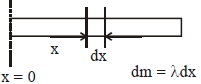
\(\mathrm{x}_{\mathrm{cm}}=\frac{\int \mathrm{xdm}}{\int \mathrm{dm}}=\frac{\int(\lambda \mathrm{dx}) \mathrm{x}}{\int \mathrm{dm}}\)\(=\frac{\int_{0}^{L}\left(a+\frac{b x^{2}}{L^{2}}\right) x d x}{\int_{0}^{L}\left(a+\frac{b x^{2}}{L^{2}}\right) d x}\)
\(=\frac{\frac{a L^{2}}{2}+\frac{b}{L^{2}} \cdot \frac{L^{4}}{4}}{a L+\frac{b}{L^{2}} \cdot \frac{L^{3}}{3}}\)
\(=\frac{\left(\frac{4 a+2 b}{8}\right) L}{\frac{(3 a+b)}{3}}=\frac{3}{4} \frac{(2 a+b) L}{(3 a+b)}\)
-
- (A) \(\frac{4}{3}\left(\frac{a+b}{2 a+3 b}\right) L\)
- (B) \(\frac{3}{2}\left(\frac{a+b}{2 a+b}\right) L\)
- (C) \(\frac{3}{2}\left(\frac{2 a+b}{3 a+b}\right) L\)
- (D) \(\frac{3}{4}\left(\frac{2 a+b}{3 a+b}\right) L\)
Show answer and solution
Correct Answer: (D)
\(\mathrm{x}_{\mathrm{cm}}=\frac{\int \mathrm{xdm}}{\int \mathrm{dm}}=\frac{\int(\lambda \mathrm{dx}) \mathrm{x}}{\int \mathrm{dm}}\)\(=\frac{\int_{0}^{L}\left(a+\frac{b x^{2}}{L^{2}}\right) x d x}{\int_{0}^{L}\left(a+\frac{b x^{2}}{L^{2}}\right) d x}\)
\(=\frac{\frac{a L^{2}}{2}+\frac{b}{L^{2}} \cdot \frac{L^{4}}{4}}{a L+\frac{b}{L^{2}} \cdot \frac{L^{3}}{3}}\)
\(=\frac{\left(\frac{4 a+2 b}{8}\right) L}{\frac{(3 a+b)}{3}}=\frac{3}{4} \frac{(2 a+b) L}{(3 a+b)}\)
-
- (A) \(15\)
- (B) \(45\)
- (C) \(30\)
- (D) \(23\)
Show answer and solution
Correct Answer: (D)
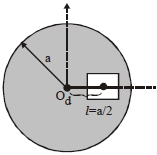
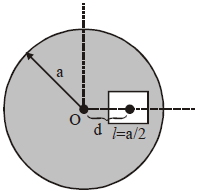
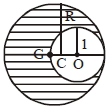
\(X _{ com }=\frac{ m _{1} x _{1}- m _{2} x _{2}}{ m _{1}- m _{2}}\)where :
\(m _{1}=\) mass of complete disc
\(m _{2}=\) removed mass
Let \(\sigma=\) surface mass density of disc material
wrt \({ }^{\prime} O ^{\prime}: X_{ com }=\frac{\sigma \pi a ^{2}( O )-\sigma \cdot \frac{ a ^{2}}{4} \cdot d }{\sigma \pi a ^{2}-\sigma \frac{ a ^{2}}{4}}=\frac{-\frac{ a ^{2}}{4} d }{\pi a ^{2}-\frac{ a ^{2}}{4}}\)
\(=\frac{-d}{4 \pi-1}=-\frac{a}{2(4 \pi-1)}\)
So, \(X=2(4 \pi-1)=(8 \pi-2)=23.12\)
So, nearest integer value of \(X=23\)
-
- (A) \(15\)
- (B) \(45\)
- (C) \(30\)
- (D) \(23\)
Show answer and solution
Correct Answer: (D)
\(X _{ com }=\frac{ m _{1} x _{1}- m _{2} x _{2}}{ m _{1}- m _{2}}\)where :
\(m _{1}=\) mass of complete disc
\(m _{2}=\) removed mass
Let \(\sigma=\) surface mass density of disc material
wrt \({ }^{\prime} O ^{\prime}: X_{ com }=\frac{\sigma \pi a ^{2}( O )-\sigma \cdot \frac{ a ^{2}}{4} \cdot d }{\sigma \pi a ^{2}-\sigma \frac{ a ^{2}}{4}}=\frac{-\frac{ a ^{2}}{4} d }{\pi a ^{2}-\frac{ a ^{2}}{4}}\)
\(=\frac{-d}{4 \pi-1}=-\frac{a}{2(4 \pi-1)}\)
So, \(X=2(4 \pi-1)=(8 \pi-2)=23.12\)
So, nearest integer value of \(X=23\)
-
- (A) \(30\)
- (B) \(28\)
- (C) \(20\)
- (D) \(25\)
Show answer and solution
Correct Answer: (C)
\(\overrightarrow{ L }_{ i }=\overrightarrow{ L }_{ f }\)\(mvL = I \omega\)
\(mvL =\left(\frac{ ML ^{2}}{3}+ mL ^{2}\right) \omega\)
\(0.1 \times 80 \times 1=\left(\frac{0.9 \times 1^{2}}{3}+0.1 \times 1^{2}\right)\)
\(8=\left(\frac{3}{10}+\frac{1}{10}\right) \omega\)
\(8=\frac{4}{10} \omega\)
\(\omega=20\, rad \frac{ rad }{ sec }\)
-
- (A) \(Mg \sqrt{1-\frac{ a ^{2}}{ R ^{2}}}\)
- (B) \(Mg \sqrt{\left(\frac{ R }{ R - a }\right)^{2}-1}\)
- (C) \(Mg \frac{ a }{ R }\)
- (D) \(M g \sqrt{1-\left(\frac{R-a}{R}\right)^{2}}\)
Show answer and solution
Correct Answer: (D)
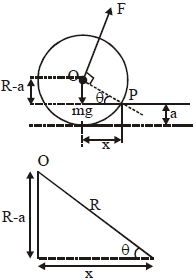
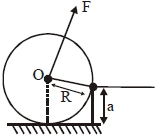
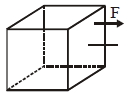
To Step up,\(F \times R \geq M g \times X\)
\(\Rightarrow F_{\min }=\frac{M g}{R} \times \sqrt{R^{2}-(R-a)^{2}}\)
\(\quad\quad\quad\,=M g \sqrt{1-\left(\frac{R-a}{R}\right)^{2}}\)
-
- (A) \(Mg \sqrt{1-\frac{ a ^{2}}{ R ^{2}}}\)
- (B) \(Mg \sqrt{\left(\frac{ R }{ R - a }\right)^{2}-1}\)
- (C) \(Mg \frac{ a }{ R }\)
- (D) \(M g \sqrt{1-\left(\frac{R-a}{R}\right)^{2}}\)
Show answer and solution
Correct Answer: (D)
To Step up,\(F \times R \geq M g \times X\)
\(\Rightarrow F_{\min }=\frac{M g}{R} \times \sqrt{R^{2}-(R-a)^{2}}\)
\(\quad\quad\quad\,=M g \sqrt{1-\left(\frac{R-a}{R}\right)^{2}}\)
-
- (A) \(\cos \theta=\frac{g}{2 \ell \omega^{2}}\)
- (B) \(\cos \theta=\frac{3 g}{2 \ell \omega^{2}}\)
- (C) \(\cos \theta=\frac{2 g}{3 \ell \omega^{2}}\)
- (D) \(\cos \theta=\frac{g}{\ell \omega^{2}}\)
Show answer and solution
Correct Answer: (B)
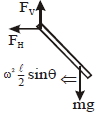
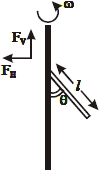
\(F_{V}=m g\)\(F_{H}=m \omega^{2} \frac{\ell}{2} \sin \theta\)
\(mg \frac{\ell}{2} \sin \theta- m \omega^{2} \frac{\ell}{2} \sin \theta \frac{\ell}{2} \cos \theta=\frac{ m \ell^{2}}{12} \omega^{2} \sin \theta \cos \theta\)
\(\cos \theta=\frac{3}{2} \frac{g}{\omega^{2} \ell}\) \(....(ii)\)
-
- (A) \(\cos \theta=\frac{g}{2 \ell \omega^{2}}\)
- (B) \(\cos \theta=\frac{3 g}{2 \ell \omega^{2}}\)
- (C) \(\cos \theta=\frac{2 g}{3 \ell \omega^{2}}\)
- (D) \(\cos \theta=\frac{g}{\ell \omega^{2}}\)
Show answer and solution
Correct Answer: (B)
\(F_{V}=m g\)\(F_{H}=m \omega^{2} \frac{\ell}{2} \sin \theta\)
\(mg \frac{\ell}{2} \sin \theta- m \omega^{2} \frac{\ell}{2} \sin \theta \frac{\ell}{2} \cos \theta=\frac{ m \ell^{2}}{12} \omega^{2} \sin \theta \cos \theta\)
\(\cos \theta=\frac{3}{2} \frac{g}{\omega^{2} \ell}\) \(....(ii)\)
-
- (A) \(8.75 \times 10^{-4} \;\mathrm{J}\)
- (B) \(8.75 \times 10^{-3} \;\mathrm{J}\)
- (C) \(6.25 \times 10^{-4} \;\mathrm{J}\)
- (D) \(1.13 \times 10^{-} \;\mathrm{J}\)
Show answer and solution
Correct Answer: (A)
\(\mathrm{m}=0.5 \mathrm{kg}, \mathrm{v}=5 \mathrm{cm} / \mathrm{s}\)\(\mathrm{KE}\) in rolling \(=\frac{1}{2} \mathrm{mv}^{2}+\frac{1}{2} \mathrm{I} \omega^{2}\)
\(=\frac{1}{2} \mathrm{mv}^{2}\left(1+\frac{\mathrm{K}^{2}}{\mathrm{R}^{2}}\right)\)
\(=8.75 \times 10^{-4} \mathrm{J}\)
-
- (A) \(\left[\frac{m_{1}+m_{2}}{\left(m_{1}+m_{2}\right) R^{2}+I}\right]^{\frac{1}{2}} g h\)
- (B) \(\left[\frac{2\left(\mathrm{m}_{1}-\mathrm{m}_{2}\right) \mathrm{gh}}{\left(\mathrm{m}_{1}+\mathrm{m}_{2}\right) \mathrm{R}^{2}+\mathrm{I}}\right]^{\frac{1}{2}}\)
- (C) \(\left[\frac{2\left(\mathrm{m}_{1}+\mathrm{m}_{2}\right) \mathrm{gh}}{\left(\mathrm{m}_{1}+\mathrm{m}_{2}\right) \mathrm{R}^{2}+\mathrm{I}}\right]^{\frac{1}{2}}\)
- (D) \(\left[\frac{\left(\mathrm{m}_{1}-\mathrm{m}_{2}\right)}{\left(\mathrm{m}_{1}+\mathrm{m}_{2}\right) \mathrm{R}^{2}+\mathrm{I}}\right]^{\frac{1}{2}} \mathrm{gh}\)
Show answer and solution
Correct Answer: (B)
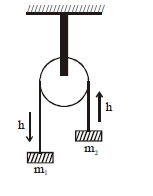
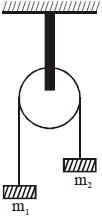
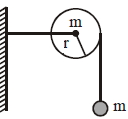
by using work energy theorem\(\mathrm{Wg}=\Delta \mathrm{KE}\)
\(\left(\mathrm{m}_{1}-\mathrm{m}_{2}\right) \mathrm{gh}=\frac{1}{2}\left(\mathrm{m}_{1}+\mathrm{m}_{2}\right) \mathrm{V}^{2}+\frac{1}{2} \mathrm{I} \omega^{2}\)
\(\left(\mathrm{m}_{1}-\mathrm{m}_{2}\right) \mathrm{gh}=\frac{1}{2}\left(\mathrm{m}_{1}+\mathrm{m}_{2}\right)(\omega \mathrm{R})^{2}+\frac{1}{2} \mathrm{I} \omega^{2}\)
\(\left(\mathrm{m}_{1}-\mathrm{m}_{2}\right) \mathrm{gh}=\frac{\omega^{2}}{2}\left[\left(\mathrm{m}_{1}+\mathrm{m}_{2}\right) \mathrm{R}^{2}+\mathrm{I}\right]\)
\(\omega=\sqrt{\frac{2\left(\mathrm{m}_{1}-\mathrm{m}_{2}\right) \mathrm{gh}}{\left(\mathrm{m}_{1}+\mathrm{m}_{2}\right) \mathrm{R}^{2}+\mathrm{I}}}\)
-
- (A) \(\left[\frac{m_{1}+m_{2}}{\left(m_{1}+m_{2}\right) R^{2}+I}\right]^{\frac{1}{2}} g h\)
- (B) \(\left[\frac{2\left(\mathrm{m}_{1}-\mathrm{m}_{2}\right) \mathrm{gh}}{\left(\mathrm{m}_{1}+\mathrm{m}_{2}\right) \mathrm{R}^{2}+\mathrm{I}}\right]^{\frac{1}{2}}\)
- (C) \(\left[\frac{2\left(\mathrm{m}_{1}+\mathrm{m}_{2}\right) \mathrm{gh}}{\left(\mathrm{m}_{1}+\mathrm{m}_{2}\right) \mathrm{R}^{2}+\mathrm{I}}\right]^{\frac{1}{2}}\)
- (D) \(\left[\frac{\left(\mathrm{m}_{1}-\mathrm{m}_{2}\right)}{\left(\mathrm{m}_{1}+\mathrm{m}_{2}\right) \mathrm{R}^{2}+\mathrm{I}}\right]^{\frac{1}{2}} \mathrm{gh}\)
Show answer and solution
Correct Answer: (B)
by using work energy theorem\(\mathrm{Wg}=\Delta \mathrm{KE}\)
\(\left(\mathrm{m}_{1}-\mathrm{m}_{2}\right) \mathrm{gh}=\frac{1}{2}\left(\mathrm{m}_{1}+\mathrm{m}_{2}\right) \mathrm{V}^{2}+\frac{1}{2} \mathrm{I} \omega^{2}\)
\(\left(\mathrm{m}_{1}-\mathrm{m}_{2}\right) \mathrm{gh}=\frac{1}{2}\left(\mathrm{m}_{1}+\mathrm{m}_{2}\right)(\omega \mathrm{R})^{2}+\frac{1}{2} \mathrm{I} \omega^{2}\)
\(\left(\mathrm{m}_{1}-\mathrm{m}_{2}\right) \mathrm{gh}=\frac{\omega^{2}}{2}\left[\left(\mathrm{m}_{1}+\mathrm{m}_{2}\right) \mathrm{R}^{2}+\mathrm{I}\right]\)
\(\omega=\sqrt{\frac{2\left(\mathrm{m}_{1}-\mathrm{m}_{2}\right) \mathrm{gh}}{\left(\mathrm{m}_{1}+\mathrm{m}_{2}\right) \mathrm{R}^{2}+\mathrm{I}}}\)
-
- (A) \(0\)
- (B) \(\frac{1}{4}\)
- (C) \(\frac{3}{4}\)
- (D) \(\frac{5}{6}\)
Show answer and solution
Correct Answer: (C)
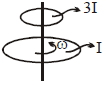
By anglar momentum conservation\(\omega I+3 I \times 0=4 I \omega^{\prime} \Rightarrow \omega^{\prime}=\frac{\omega}{4}\)
\(( KE )_{ i }=\frac{1}{2} I \omega^{2}\)
\(( KE )_{ f }=\frac{1}{2} \times(4 I ) \times\left(\frac{\omega}{4}\right)^{2}=\frac{ I \omega^{2}}{8}\)
\(\Delta KE =\frac{3}{8} I \omega^{2}\)
fractional loss \(=\frac{\Delta KE }{ KE _{1}}=\frac{\frac{3}{8} I \omega^{2}}{\frac{1}{2} I \omega^{2}}=\frac{3}{4}\)
-
- (A) \(0\)
- (B) \(\frac{1}{4}\)
- (C) \(\frac{3}{4}\)
- (D) \(\frac{5}{6}\)
Show answer and solution
Correct Answer: (C)
By anglar momentum conservation\(\omega I+3 I \times 0=4 I \omega^{\prime} \Rightarrow \omega^{\prime}=\frac{\omega}{4}\)
\(( KE )_{ i }=\frac{1}{2} I \omega^{2}\)
\(( KE )_{ f }=\frac{1}{2} \times(4 I ) \times\left(\frac{\omega}{4}\right)^{2}=\frac{ I \omega^{2}}{8}\)
\(\Delta KE =\frac{3}{8} I \omega^{2}\)
fractional loss \(=\frac{\Delta KE }{ KE _{1}}=\frac{\frac{3}{8} I \omega^{2}}{\frac{1}{2} I \omega^{2}}=\frac{3}{4}\)
-
- (A) \(15\)
- (B) \(11\)
- (C) \(18\)
- (D) \(20\)
Show answer and solution
Correct Answer: (B)
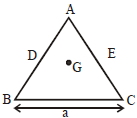
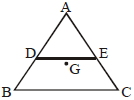
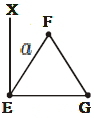
Let side of triangle is a and mass is \(m\)\(MOI\) of plate \(ABC\) about centroid
\(I_{0}=\frac{m}{3}\left(\left(\frac{a}{2 \sqrt{3}}\right)^{2} \times 3\right)=\frac{m a^{2}}{12}\)
triangle \(ADE\) is also an equilateral triangle of side \(a / 2\)
Let moment of inertia of triangular plate \(ADE\) about it's centroid \((G')\) is \(I _{1}\) and \(mass\) is \(m _{1}\)
\(m _{1}=\frac{ m }{\frac{\sqrt{3} a ^{2}}{4}} \times \frac{\sqrt{3}}{4}\left(\frac{ a }{2}\right)^{2}=\frac{ m }{4}\)
\(I _{1}=\frac{ m _{1}}{12}\left(\frac{ a }{2}\right)^{2}=\frac{ m }{4 \times 12} \frac{ a ^{2}}{4}=\frac{ ma ^{2}}{192}\)
distance \(G G^{\prime}=\frac{a}{\sqrt{3}}-\frac{a}{2 \sqrt{3}}=\frac{a}{2 \sqrt{3}}\)
so \(MOI\) of part \(ADE\) about centroid \(G\) is
\(I _{2}= I _{1}+ m _{1}\left(\frac{ a }{2 \sqrt{3}}\right)^{2}=\frac{ ma ^{2}}{192}+\frac{ m }{4} \cdot \frac{ a ^{2}}{12}\)
\(=\frac{5 ma ^{2}}{192}\)
now \(MOI\) of remaining part
\(=\frac{m a^{2}}{12}-\frac{5 m a^{2}}{192}=\frac{11 m a^{2}}{12 \times 16}=\frac{11 I_{0}}{16}\)
\(\Rightarrow \quad N=11\)
-
- (A) \(15\)
- (B) \(11\)
- (C) \(18\)
- (D) \(20\)
Show answer and solution
Correct Answer: (B)
Let side of triangle is a and mass is \(m\)\(MOI\) of plate \(ABC\) about centroid
\(I_{0}=\frac{m}{3}\left(\left(\frac{a}{2 \sqrt{3}}\right)^{2} \times 3\right)=\frac{m a^{2}}{12}\)
triangle \(ADE\) is also an equilateral triangle of side \(a / 2\)
Let moment of inertia of triangular plate \(ADE\) about it's centroid \((G')\) is \(I _{1}\) and \(mass\) is \(m _{1}\)
\(m _{1}=\frac{ m }{\frac{\sqrt{3} a ^{2}}{4}} \times \frac{\sqrt{3}}{4}\left(\frac{ a }{2}\right)^{2}=\frac{ m }{4}\)
\(I _{1}=\frac{ m _{1}}{12}\left(\frac{ a }{2}\right)^{2}=\frac{ m }{4 \times 12} \frac{ a ^{2}}{4}=\frac{ ma ^{2}}{192}\)
distance \(G G^{\prime}=\frac{a}{\sqrt{3}}-\frac{a}{2 \sqrt{3}}=\frac{a}{2 \sqrt{3}}\)
so \(MOI\) of part \(ADE\) about centroid \(G\) is
\(I _{2}= I _{1}+ m _{1}\left(\frac{ a }{2 \sqrt{3}}\right)^{2}=\frac{ ma ^{2}}{192}+\frac{ m }{4} \cdot \frac{ a ^{2}}{12}\)
\(=\frac{5 ma ^{2}}{192}\)
now \(MOI\) of remaining part
\(=\frac{m a^{2}}{12}-\frac{5 m a^{2}}{192}=\frac{11 m a^{2}}{12 \times 16}=\frac{11 I_{0}}{16}\)
\(\Rightarrow \quad N=11\)
-
- (A) \(25\)
- (B) \(33\)
- (C) \(30\)
- (D) \(39\)
Show answer and solution
Correct Answer: (A)
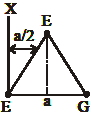
\(I =0+ m \left(\frac{ a }{2}\right)^{2}+ ma ^{2}\)\(=\frac{5}{4} ma ^{2}\)
-
- (A) \(25\)
- (B) \(33\)
- (C) \(30\)
- (D) \(39\)
Show answer and solution
Correct Answer: (A)
\(I =0+ m \left(\frac{ a }{2}\right)^{2}+ ma ^{2}\)\(=\frac{5}{4} ma ^{2}\)
-
- (A) \(\left(\mathrm{R}^{2}-\mathrm{R}+1\right)(2-\mathrm{R})=1\)
- (B) \(\left(\mathrm{R}^{2}+\mathrm{R}-1\right)(2-\mathrm{R})=1\)
- (C) \(\left(\mathrm{R}^{2}+\mathrm{R}+1\right)(2-\mathrm{R})=1\)
- (D) \(\left(\mathrm{R}^{2}-\mathrm{R}-1\right)(2-\mathrm{R})=1\)
Show answer and solution
Correct Answer: (C)
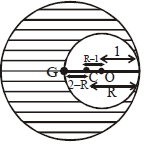
By concept of \(COM\)\(\mathrm{m}_{1} \mathrm{R}_{1}=\mathrm{m}_{2} \mathrm{R}_{2}\)
Remaining mass \(\times(2-\mathrm{R})=\) cavity mass \(\times(\mathrm{R}-1)\)
\(\left(\frac{4}{3} \pi \mathrm{R}^{3} \rho-\frac{4}{3} \pi l^{3} \rho\right)(2-\mathrm{R})=\frac{4}{3} \pi l^{3} \rho \times(\mathrm{R}-1)\)
\(\left(\mathrm{R}^{3}-1\right)(2-\mathrm{R})=\mathrm{R}-1\)
\(\left(\mathrm{R}^{2}+\mathrm{R}+1\right)(2-\mathrm{R})=1\)
-
- (A) \(\left(\mathrm{R}^{2}-\mathrm{R}+1\right)(2-\mathrm{R})=1\)
- (B) \(\left(\mathrm{R}^{2}+\mathrm{R}-1\right)(2-\mathrm{R})=1\)
- (C) \(\left(\mathrm{R}^{2}+\mathrm{R}+1\right)(2-\mathrm{R})=1\)
- (D) \(\left(\mathrm{R}^{2}-\mathrm{R}-1\right)(2-\mathrm{R})=1\)
Show answer and solution
Correct Answer: (C)
By concept of \(COM\)\(\mathrm{m}_{1} \mathrm{R}_{1}=\mathrm{m}_{2} \mathrm{R}_{2}\)
Remaining mass \(\times(2-\mathrm{R})=\) cavity mass \(\times(\mathrm{R}-1)\)
\(\left(\frac{4}{3} \pi \mathrm{R}^{3} \rho-\frac{4}{3} \pi l^{3} \rho\right)(2-\mathrm{R})=\frac{4}{3} \pi l^{3} \rho \times(\mathrm{R}-1)\)
\(\left(\mathrm{R}^{3}-1\right)(2-\mathrm{R})=\mathrm{R}-1\)
\(\left(\mathrm{R}^{2}+\mathrm{R}+1\right)(2-\mathrm{R})=1\)
-
- (A) \(\frac{1}{r} \sqrt{\frac{2 g h}{3}}\)
- (B) \( r \sqrt{\frac{3}{4 g h}}\)
- (C) \( \frac{1}{r} \sqrt{\frac{4 g h}{3}}\)
- (D) \({r} \sqrt{\frac{3}{2 g h}}\)
Show answer and solution
Correct Answer: (C)
\(\mathrm{mgh}=\frac{1}{2} \mathrm{mv}^{2}+\frac{1}{2} \times \frac{1}{2} \mathrm{mr}^{2} \times \frac{\mathrm{v}^{2}}{\mathrm{r}^{2}}=\frac{3}{4} \mathrm{mv}^{2}\)\(\mathrm{u}=\sqrt{\frac{4}{3} \mathrm{gh}}\)
\(\omega=\frac{V}{r}\)
\(\omega= \frac{1}{r} \sqrt{\frac{4 g h}{3}}\)
-
- (A) \(80\)
- (B) \(75\)
- (C) \(85\)
- (D) \(82\)
Show answer and solution
Correct Answer: (B)
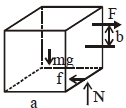
\(\mathrm{F}=\mu \mathrm{m} \mathrm{g}\dots (1)\)\(\mathrm{F}\left(\mathrm{b}+\frac{\mathrm{a}}{2}\right)=\mathrm{mg} \frac{\mathrm{a}}{2}\dots (2)\)
\(\mu m g\left(b+\frac{a}{2}\right)=m g \times \frac{a}{2}\)
\(\left(b+\frac{a}{2}\right) \mu=\frac{a}{2}\)
\(0.4=\mu=\frac{a}{2 b+a}\)
\(0.8 b+0.4 a=a\)
\(0.8 \mathrm{b}=0.6 \mathrm{a}\)
\(\frac{b}{a}=\frac{3}{4}\)

No questions on this page match these filters.