


પ્રશ્નો
નવા પહેલા95 માંથી 51–95 પ્રશ્નો
-
- (A) \(320\)
- (B) \(32\)
- (C) \(16\)
- (D) \(160\)
જવાબ અને ઉકેલ જુઓ
સાચો જવાબ: (C)
\(Sn ^{2+}+2 e ^{-} \rightarrow Sn \quad \Delta G _{1}^{0}=+2 \times 0.140 \times F\)\(Sn ^{+4}+4 e ^{-} \rightarrow Sn \quad \Delta G _{2}^{0}=-4 \times 0.01 \times F\)
____________________________________________
\(Sn ^{+4}+2 e ^{-} \rightarrow Sn ^{+2} \quad \Delta G _{3}^{0}=-2 \times E _{ Sn ^{+4} / Sn ^{+2}}^{0} \times F\)
\(\Delta G _{3}^{0}=\Delta G _{2}^{0}-\Delta G _{1}^{0}\)
\(-2 \times E ^{0} \times F =-(0.04+0.28) \times F\)
\(E ^{0}=0.16\) volt \(=16 \times 10^{-2} \,V\)
-
- (A) \(33\)
- (B) \(32\)
- (C) \(34\)
- (D) \(31\)
જવાબ અને ઉકેલ જુઓ
સાચો જવાબ: (C)
At anode\(Cu \rightarrow Cu ^{2+}+2 e ^{-}\)
At cathode
\(2 Ag ^{+}+2 e ^{-} \rightarrow 2 Ag\)
Cell reaction \(\rightarrow Cu +2 Ag ^{+} \rightarrow Cu ^{2+}+2 Ag\)
\(E _{\text {cell }}= E _{\text {cell }}^{0}-\frac{0.06}{2} \log \frac{\left[ Cu ^{2+}\right]}{\left[ Ag ^{+}\right]^{2}}\)
\(0.43= E _{\text {cell }}^{0}-\frac{0.06}{2} \log \frac{(0.001)}{(0.01)^{2}}\)
\(E _{\text {ceil }}^{0}=0.46\)
\(E _{\text {cell }}^{0}= E _{ Ag ^{+} / Ag }^{0}- E _{ Cu ^{2+} / Cu }^{0}\)
\(0.46=0.80- E _{ Cu ^{2+} / Cu }^{0}\)
\(E _{ Cu ^{2+} / Cu }^{0}=0.34\) volt
\(E _{ Cu ^{2+} / Cu }^{0}=34 \times 10^{-2}\)
-
- (A) \(95\)
- (B) \(202\)
- (C) \(23\)
- (D) \(4\)
જવાબ અને ઉકેલ જુઓ
સાચો જવાબ: (C)
સ્પષ્ટીકરણ:
આપમેળે થતી કુલ કોષ પ્રક્રિયા અને પ્રમાણિત કોષ પોટેન્શિયલ મેળવવાની સચોટ વૈજ્ઞાનિક રીત નીચે મુજબ છે:
1. રિડક્શન પોટેન્શિયલના આધારે કેથોડ અને એનોડ નક્કી કરવા:
કોઈપણ રાસાયણિક કોષ પ્રક્રિયા આપમેળે થવા માટે, તેનો કુલ પ્રમાણિત કોષ પોટેન્શિયલ (\( E^\circ_{\text{cell}} \)) હંમેશા ધન (+) હોવો જોઈએ. આ નિયમ મુજબ, જે અર્ધ-કોષનું પ્રમાણિત રિડક્શન પોટેન્શિયલ મૂલ્ય ઊંચું હોય તે કેથોડ (રિડક્શન) બને અને જેનું મૂલ્ય ઓછું હોય તે એનોડ (ઓક્સિડેશન) બને.
આયર્ન (Iron) ના પ્રણાલીનું રિડક્શન પોટેન્શિયલ: \( E^\circ_{\text{Fe}^{3+}/\text{Fe}^{2+}} = 0.77\text{ V} \) (ઊંચું મૂલ્ય \(\rightarrow\) કેથોડ)
આયોડિન (Iodine) ના પ્રણાલીનું રિડક્શન પોટેન્શિયલ: \( E^\circ_{\text{I}_2/2\text{I}^-} = 0.54\text{ V} \) (નીચું મૂલ્ય \(\rightarrow\) એનોડ)
2. સંતુલિત અર્ધ-કોષ પ્રક્રિયાઓ અને કુલ પ્રક્રિયા:
કેથોડ પર (રિડક્શન): \( 2\text{Fe}^{3+} + 2\text{e}^- \rightarrow 2\text{Fe}^{2+} \)
એનોડ પર (ઓક્સિડેશન): \( 2\text{I}^- \rightarrow \text{I}_2 + 2\text{e}^- \)
કુલ આપમેળે થતી કોષ પ્રક્રિયા: \( 2\text{Fe}^{3+} + 2\text{I}^- \rightarrow 2\text{Fe}^{2+} + \text{I}_2 \)
3. પ્રમાણિત કોષ પોટેન્શિયલ (\( E^\circ_{\text{cell}} \)) ની ગણતરી:
પ્રમાણિત કોષ પોટેન્શિયલના સૂત્રનો ઉપયોગ કરતા:
\( E^\circ_{\text{cell}} = E^\circ_{\text{cathode}} - E^\circ_{\text{anode}} \)
\( E^\circ_{\text{cell}} = E^\circ_{\text{Fe}^{3+}/\text{Fe}^{2+}} - E^\circ_{\text{I}_2/2\text{I}^-} \)
\( E^\circ_{\text{cell}} = 0.77\text{ V} - 0.54\text{ V} = 0.23\text{ V} \)
4. આપેલા સમીકરણ સાથે સરખામણી:
પ્રશ્ન મુજબ: \( E^\circ_{\text{cell}} = x \times 10^{-2}\text{ V} \)
આપણે જાણીએ છીએ કે \( 0.23\text{ V} = 23 \times 10^{-2}\text{ V} \) લખી શકાય.
બંને બાજુ સરખાવતા: \( x = 23 \) મળે છે.
આથી, સાચો ઉત્તર વિકલ્પ C છે. -
- (A) \(A\)
- (B) \(B\)
- (C) \(C\)
- (D) \(D\)
જવાબ અને ઉકેલ જુઓ
સાચો જવાબ: (C)
A cell with less variation in EMF with temperature is preferred as reference electrode because it can be used for wider range of temperature without much derivation from standard value so a cell with less \(\left(\frac{\partial E }{\partial T }\right)_{ P }\) is preferred. -
- (A) \(A > C > B > D > E\)
- (B) \(A > B > C > D > E\)
- (C) \(A > C > B > E > D\)
- (D) \(A > B > C > E > D\)
જવાબ અને ઉકેલ જુઓ
સાચો જવાબ: (A)
\(E _{ Cl _{2} / Cl ^{-}}^{\circ}=+1.36\, V\)\(E _{ I _{2} / I ^{-}}^{\circ}=+0.54\, V\)
\(E _{ Ag ^{+} / Ag }^{\circ}=+0.80\, V\)
\(E _{ Na ^{+} / Na }^{\circ}=-2.71 \,V\)
\(E _{ Li ^{+} / Li }^{\circ}=-3.05\, V\)
-
- (A) \(50\)
- (B) \(5\)
- (C) \(15\)
- (D) \(25\)
જવાબ અને ઉકેલ જુઓ
સાચો જવાબ: (B)
Anode \(: H _{2} \rightarrow 2 H ^{+}+2 e ^{-}\)Cathode: \(Cu ^{2+}+2 e ^{-} \rightarrow Cu\)
\(\overline{ Cu ^{2+}+ H _{2} \rightarrow 2 H ^{+}+ Cu }\)
\(E _{\text {cell }}= E _{\text {cell }}^{0}-\frac{0.06}{2} \log \frac{\left[ H ^{+}\right]^{2}}{\left[ Cu ^{2+}\right]}\)
\(0.576=0.34-\frac{0.06}{2} \log \left\{\frac{\left[ H ^{+}\right]^{2}}{(0.01)}\right\}\)
\(+3.93-\log \left( H ^{+}\right)+\log 0.1\)
\(\Rightarrow pH =4.93 \simeq 5\)
-
- (A) \(20\)
- (B) \(21\)
- (C) \(22\)
- (D) \(24\)
જવાબ અને ઉકેલ જુઓ
સાચો જવાબ: (D)
\({Zn} \longrightarrow {Zn}^{2+}+2 {e}^{-}\)\(2 {Fe}^{3+} \longrightarrow {e}^{-}+{e}^{2+}\)
___________________________________________________________
\({Zn}+2 {Fe}^{3+} \longrightarrow {Zn}^{2+}+2 {Fe}^{2+}\)
________________________________________________________
\({E}_{{cell}}^{0}=0.77-(0.76)\)
\(=1.53 {~V}\)
\(1.50=1.53-\frac{0.06}{2} \log \left(\frac{{Fe}^{2+}}{{Fe}^{3+}}\right)^{2}\)
\(\log \left(\frac{{Fe}^{2+}}{{Fe}^{3+}}\right)=\frac{0.03}{0.06}=\frac{1}{2}\)
\(\frac{\left[{Fe}^{2+}\right]}{\left[{Fe}^{3+}\right]}=10^{1 / 2}=\sqrt{10}\)
\(\frac{\left[{Fe}^{3+}\right]}{\left[{Fe}^{2+}\right]}=\frac{1}{\sqrt{10}}frac{\left[{Fe}^{3+}\right]}{\left[{Fe}^{2+}\right]+\left[{Fe}^{3+}\right]}\)
\(\frac{1}{1+\sqrt{10}}=\frac{1}{4.16}\)
\(=0.2402\)
\(=24 \times 10^{-2}\)
-
- (A) \(3776\)
- (B) \(3800\)
- (C) \(4276\)
- (D) \(1552\)
જવાબ અને ઉકેલ જુઓ
સાચો જવાબ: (A)
Eqn is-\(MnO _{4}^{-}+ H ^{\oplus}+5 e ^{-} \rightarrow Mn ^{+2}+4 H _{2} O\)
Nernst equation:
\(E _{\text {cell }}= E _{ Cell }^{0}-\frac{0.059}{5} \log \frac{\left[ Mn ^{+2}\right]}{\left[ MnO _{4}^{-}\right]}\left[\frac{1}{ H ^{+}}\right]^{8}\)
\((I)\) Given \(\left[ H ^{\oplus}\right]=1\, M\)
\(E _{1}= E ^{0}-\frac{0.059}{5} \log \frac{\left[ Mn ^{+2}\right]}{\left[ MnO _{4}^{-}\right]}\)
\((II)\) Now : \(\left[ H ^{\oplus}\right]=10^{-4}\, M\)
\(E _{2}= E ^{0}-\frac{0.059}{5} \log \frac{\left[ Mn ^{+2}\right]}{\left[ MnO _{4}^{-}\right]} \times \frac{1}{\left(10^{-4}\right)^{8}}\)
\(= E ^{0}-\frac{0.059}{5} \log \frac{ Mn ^{+2}}{\left[ MnO _{4}^{-}\right]}+\frac{0.059}{5} \log 10^{-32}\)
therefore : \(\left| E _{1}- E _{2}\right|=\frac{0.059}{5} \times 32\)
\(=0.3776\, V =3776 \times 10^{-4}\)
\(x =3776\)
-
- (A) \(147\)
- (B) \(157\)
- (C) \(188\)
- (D) \(288\)
જવાબ અને ઉકેલ જુઓ
સાચો જવાબ: (A)
\(Zn _{( s )} \rightarrow Zn _{( aq .)}^{2+}+2 e ^{-}\)\(2 Ag ^{+}_{( aq. )}+2 e ^{-} \rightarrow 2 Ag _{( s )}\)
__________________________________________________
\(Zn _{( s )}+2 Ag ^{+}_{( aq. )} \rightarrow Zn _{( aq .)}^{2+}+ 2 Ag _{( s )}\)
__________________________________________________________
\(E _{ cell }^{0}= E _{ Ag ^{+} / Ag }^{0}- E _{ zn ^{2+} / Zn }^{0}\)
\(=0.80-(-0.76)\)
\(=1.56 \,V\)
\(E _{\text {cell }}=1.56 \frac{-0.059}{2} \log \frac{\left[ Zn ^{2+}\right]}{\left[ Ag ^{+}\right]^{2}}\)
\(=1.56-\frac{0.059}{2} \log \frac{0.1}{(0.01)^{2}}\)
\(=1.56-\frac{0.059}{2} \times 3\)
\(=1.56-0.0885\)
\(=1.4715\)
\(=147.15 \times 10^{-2}\)
-
- (A) \(4\)
- (B) \(14\)
- (C) \(28\)
- (D) \(36\)
જવાબ અને ઉકેલ જુઓ
સાચો જવાબ: (C)
Cell reaction is:\({Cu}({s})+2 {Ag}^{+}({aq}) \rightarrow {Cu}^{2+}+2 {Ag}({s})\)
Now, \({E}_{\text {cell }}-\frac{0.059}{2} \log \frac{\left[{cu}^{+}+\right]}{\left[{Ag}^{+}\right]^{2}}...(1)\)
\(\therefore {E}_{1}=0.3095={E}_{\text {cell }}^{0}-\frac{0.059}{2} \cdot \log \frac{0.01}{(0.001)^{2}} \ldots(2)\)
From \((1)\) and \((2),\) \({E}_{2}=0.28\, {~V}=28 \times 10^{-2}\, {~V}\)
-
- (A) \(1090\)
- (B) \(109\)
- (C) \(10.9\)
- (D) \(1.09\)
જવાબ અને ઉકેલ જુઓ
સાચો જવાબ: (B)
Galvanic cell:\({Zn}_{({s})}+{Cu}_{\left({aq.}\right)}^{+2} \rightarrow {{Zn}^{+2}}+{Cu}({s})\)
\(\quad\quad\quad\quad0.02\,M\quad0.04\,M\)
\(\text { Nernst equation }={F}_{\text {cell }}={E}_{\text {cell }}^{\circ}-\frac{0.059}{2} \log \frac{\left[2 {n}^{+2}\right]}{\left[{Cu}^{+2}\right]}\)
\(\Rightarrow {E}_{\text {cell }}\left[{E}_{\text {cell }}^{\circ}-{E}_{{Zn}^{+2} / {Zn}}^{\circ}\right]-\frac{0.059}{2} \log \frac{0.04}{0.02}\)
\(\Rightarrow {E}_{\text {cell }}[0.34-(-0.76)]-\frac{0.059}{2} \log ^{2}\)
\(\Rightarrow {E}_{\text {cell }} 1-1-\frac{0.059}{2} \times 0.3010\)
\(\quad=1.0911=109.11 \times 10^{-2}\)
\(\quad=109\)
-
- (A) \(5\)
- (B) \(2\)
- (C) \(3\)
- (D) \(9\)
જવાબ અને ઉકેલ જુઓ
સાચો જવાબ: (C)
\({E}={E}^{\circ}-\frac{0.059}{2} \log \frac{\left[{Cu}^{+2}\right]}{\left[{Ag}^{+}\right]^{2}}\)\(=2.97-\frac{0.059}{2} \log \frac{0.25}{\left(10^{-3}\right)^{2}}=2.81\,{~V}\)
-
- (A) \(1\)
- (B) \(2\)
- (C) \(3\)
- (D) \(4\)
જવાબ અને ઉકેલ જુઓ
સાચો જવાબ: (D)
સ્પષ્ટીકરણ:
NCERT ધોરણ 12 રસાયણવિજ્ઞાન (વિદ્યુતરસાયણ વિજ્ઞાન પ્રકરણ) ના નિયમો અનુસાર નેર્ન્સ્ટ સમીકરણ (Nernst equation) નો ઉપયોગ કરીને \(2x\) ના મૂલ્યની સ્ટેપ-બાય-સ્ટેપ ગણતરી નીચે મુજબ છે:
સ્ટેપ 1: રિડક્શન અર્ધ-કોષ પ્રક્રિયાઓ લખવી
કેથોડ પર થતી બે સંભવિત રિડક્શન પ્રક્રિયાઓ નીચે મુજબ છે:
પ્રક્રિયા 1: \(\text{NO}_3^-\) નું \(\text{NO}\) માં રિડક્શન
\(\text{NO}_3^- + 4\text{H}^+ + 3\text{e}^- \rightarrow \text{NO} + 2\text{H}_2\text{O}\), \(E^\circ_1 = 0.96\text{ V}\)
પ્રક્રિયા 2: \(\text{NO}_3^-\) નું \(\text{NO}_2\) માં રિડક્શન
\(\text{NO}_3^- + 2\text{H}^+ + \text{e}^- \rightarrow \text{NO}_2 + \text{H}_2\text{O}\), \(E^\circ_2 = 0.79\text{ V}\)
સ્ટેપ 2: ઉષ્માગતિકીય પ્રવૃત્તિ અને રિડક્શન પોટેન્શિયલ વચ્ચેનો સંબંધ
કોપર દ્વારા રિડક્શન થવાની ઉષ્માગતિકીય પ્રવૃત્તિ ત્યારે જ સમાન થાય જ્યારે બંને પ્રક્રિયાઓ માટેના કોષ પોટેન્શિયલ (\(E_{\text{cell}}\)) સમાન હોય. અહીં ઓક્સિડેશન અર્ધ-કોષ (કોપર એનોડ) બંને માટે સમાન અને અચળ હોવાથી, કેથોડ પરના રિડક્શન પોટેન્શિયલ સમાન હોવા જોઈએ:
\(E_1 = E_2\)
સ્ટેપ 3: \(\text{HNO}_3\) માટે સાંદ્રતાના પદો દર્શાવવા
\(\text{HNO}_3\) એ પ્રબળ એસિડ હોવાથી દ્રાવણમાં તેનું સંપૂર્ણ આયનીકરણ થાય છે:
\(\text{HNO}_3 \rightarrow \text{H}^+ + \text{NO}_3^-\)
ધારો કે \(\text{HNO}_3\) ની મોલર સાંદ્રતા \(C\) છે. આથી:
\([\text{H}^+] = C\) અને \([\text{NO}_3^-] = C\)
સ્ટેપ 4: નેર્ન્સ્ટ સમીકરણ લાગુ પાડવું
\(298\text{ K}\) તાપમાને નેર્ન્સ્ટ સમીકરણ પરથી, જ્યાં \(\frac{2.303RT}{F} = 0.059\text{ V}\) અને \(P_{\text{NO}} = P_{\text{NO}_2} = 1\text{ bar}\) લેતા:
પ્રક્રિયા 1 માટે:
\(E_1 = E^\circ_1 + \frac{0.059}{3} \log \left([\text{NO}_3^-][\text{H}^+]^4\right)\)
\(E_1 = 0.96 + \frac{0.059}{3} \log (C \cdot C^4) = 0.96 + \frac{0.295}{3} \log C\)
પ્રક્રિયા 2 માટે:
\(E_2 = E^\circ_2 + \frac{0.059}{1} \log \left([\text{NO}_3^-][\text{H}^+]^2\right)\)
\(E_2 = 0.79 + \frac{0.059}{1} \log (C \cdot C^2) = 0.79 + 0.177 \log C\)
સ્ટેપ 5: \(E_1\) und \(E_2\) ને સરખાવીને \(x\) શોધવું
\(0.96 + \frac{0.295}{3} \log C = 0.79 + 0.177 \log C\)
\(0.96 - 0.79 = 0.177 \log C - 0.0983 \log C\)
\(0.17 = 0.0787 \log C\)
\(\log C = \frac{0.17}{0.0787} \approx 2.16\)
અહીં સાંદ્રતા \(10^x\text{ M}\) સ્વરૂપે આપેલી હોવાથી:
\(C = 10^{2.16} = 10^x \implies x = 2.16\)
તેથી, \(2x\) નું મૂલ્ય:
\(2x = 2 \times 2.16 = 4.32\)
નજીકના પૂર્ણાંકમાં રાઉન્ડ ઓફ કરતા સાચું મૂલ્ય 4 મળે છે.
આથી, સાચો ઉત્તર વિકલ્પ D છે. -
- (A) \(96500\)
- (B) \(96455\)
- (C) \(96530\)
- (D) \(96570\)
જવાબ અને ઉકેલ જુઓ
સાચો જવાબ: (A)
\(\Delta G =\Delta G ^{\circ}+ RT \ln \left[\frac{ Sn ^{+2}}{ Cu ^{+2}}\right]\)\(=-2 \times 96500[(-0.16)-0.34]+ RT \ln \left(\frac{1}{1}\right)\)
\(=96500 J\)
-
- (A) \(1.52\)
- (B) \(2.56\)
- (C) \(0.36\)
- (D) \(3.56\)
જવાબ અને ઉકેલ જુઓ
સાચો જવાબ: (A)
\(\mathrm{O}_{2}(\mathrm{g})+4 \mathrm{H}^{+}+4 \mathrm{e}^{-} \rightarrow 2 \mathrm{H}_{2} \mathrm{O}(l) ; \mathrm{E}_{\mathrm{red.}}^{0}=1.23 \mathrm{V}\)
From nernst equation
\(\mathrm{E}_{\text {cell }}=\mathrm{E}_{\text {cell }}^{0}-\frac{\mathrm{RT}}{\mathrm{nF}} \ln \mathrm{Q}\)
at \(1\; bar\) and \(298 \mathrm{K}\)
\(\frac{2.303 \mathrm{RT}}{\mathrm{F}}=0.059\)
\(\mathrm{pH}=5 \Rightarrow\left[\mathrm{H}^{+}\right]=10^{-5} \mathrm{M}\)
\(\mathrm{E}_{\text {cell }}=1.23-\frac{0.059}{4} \log \left[\mathrm{H}^{+}\right]^{4}\)
\(\mathrm{E}_{\text {cell }}=1.23-\frac{0.059}{4} \log \left(10^{-5}\right)^{4}\)
\(=1.23+0.295=1.525 \mathrm{V}\)
-
- (A) \(C _{1}=2 C _{2}\)
- (B) \(C_{2}=\frac{C 1} {\sqrt{2}}\)
- (C) \(C _{1}= C _{2}\)
- (D) \(C _{2}=\sqrt{2} C _{1}\)
જવાબ અને ઉકેલ જુઓ
સાચો જવાબ: (D)
\(\Delta G =- n F E _{\text {cell }}\)\(\Delta G\) is negative, if \(E _{\text {cell }}\) is positive
Anode : \(\quad Cu ( s ) \longrightarrow Cu ^{-2}\left( C _{1}\right)+2 e ^{-}: E ^{\circ}\)
\(\frac{\text { Cathode }: Cu ^{+2}\left( C _{2}\right)+2 e ^{-} \longrightarrow Cu ( S ):- E ^{\circ}}{\text { Cell reaction }: Cu ^{+2}\left( C _{2}\right) \longrightarrow Cu ^{+2}\left( C _{1}\right) E _{\text {cell }}^{\circ}=0}\)
\(E _{\text {cell }}= E _{\text {cell }}^{\circ}-\frac{2.303 RT }{ nF } \log Q\)
\(E _{\text {cell }}=0-\frac{2.303 RT }{ nF } \log \left(\frac{ C _{1}}{ C _{2}}\right)\)
\(E _{\text {cell }}>0:\) if \(\frac{ C _{1}}{ C _{2}}<1 \Rightarrow C _{1}< C _{2}\)
-
- (A) \(0.158\; \mathrm{V}\)
- (B) \(0.182\; \mathrm{V}\)
- (C) \(-0.182\; \mathrm{V}\)
- (D) \(-0.158\; \mathrm{V}\)
જવાબ અને ઉકેલ જુઓ
સાચો જવાબ: (A)
\(\quad \quad \quad \quad \quad \quad \quad \quad \quad \quad E^{o}\quad \quad \quad \Delta G^o\)\(\mathrm{Cu}^{2 \mathrm{+}}+2 \mathrm{e}^{-} \longrightarrow \mathrm{Cu} \quad 0.34 \quad=-2 \mathrm{F}(0.34)\)
\(\mathrm{Cu}^{+}+\mathrm{e}^{-} \longrightarrow \mathrm{Cu} \quad \quad 0.522 \quad=-\mathrm{F}(0.522)\)
\(\mathrm{Cu}^{2 \mathrm{+}}+\mathrm{e}^{-} \longrightarrow \mathrm{Cu}^{+}\)
\(\Delta \mathrm{G}^{0}=-2 \mathrm{F}(0.34)-(-\mathrm{F}(0.522))\)\(=-\mathrm{F}(0.68-0.522)=-F(0.158)\)
\(\mathrm{E}^{0}=\frac{-\mathrm{F}(0.158)}{-\mathrm{F}}=0.158 \mathrm{V}\)
-
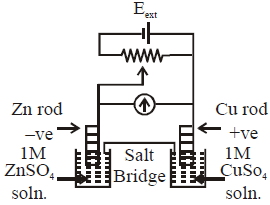
- (A) જો \(E _{ ext }>1.1\, V , Zn\) એ \(Zn\) વિદ્યુતધ્રુવ પર ઓગળી જાય છે અને \(Cu\) એ \(Cu\) વિદ્યુતધ્રુવ પર જમા થાય છે.
- (B) If \(E _{\text {ext }}>1.1\, V , e ^{-}\) \(Cu\) થી \(Zn\) તરફ વહે છે.
- (C) If \(E _{ ext }=1.1 \,V ,\) no flow of e \(^{-}\) અથવા પ્રવાહ વહેતું નથી
- (D) If \(E _{\text {ext }}<1.1\, V , Zn\) એ એનોડ પર ઓગળી જાય છે અને \(Cu\) કેથોડ પર જમા થાય છે.
જવાબ અને ઉકેલ જુઓ
સાચો જવાબ: (A)
\(E _{\text {cell }}^{\circ}=0.34-(-0.76)\)\(\quad=1.10\) volt
If \(E _{\text {ext }}>1.10\) volt
\(Cu \rightarrow\) Anode
\(Zn \rightarrow\) Cathode
If \(E _{\text {ext }}=1.10\, volt\)
\(Zn \rightarrow\) Anode
\(Cu \rightarrow\) Cathode
-
- (A) \(140\)
- (B) \(144\)
- (C) \(150\)
- (D) \(156\)
જવાબ અને ઉકેલ જુઓ
સાચો જવાબ: (B)
\(Cu ^{+} \longrightarrow Cu + e ^{-}\)\(Cu ^{+}+ e ^{-} \longrightarrow Cu ( s )\)
__________________________________
\(2 Cu ^{+} \longrightarrow Cu ^{2+}+ Cu\)
\(E_{c e l l}^{o}=E_{C u^{+} / C u}^{0}-E_{C u^{2+} / C u^{+}}^{0}\)
\(=0.52-0.16\)
\(=0.36 V\)
At equilibrium \(\rightarrow E _{\text {cell }}=0\)
\(E_{c e l l}^{o}=\frac{R T}{n F} l n K\)
\(\ln K =\frac{ E _{ eell }^{\circ} \times nF }{ RT }\)
\(\ln K =\frac{0.36 \times 1}{0.025}\)
\(=14.4=144 \times 10^{-1}\)
-
- (A) \(146\)
- (B) \(150\)
- (C) \(142\)
- (D) \(154\)
જવાબ અને ઉકેલ જુઓ
સાચો જવાબ: (C)
\(\frac{1}{2} H _{2} \rightarrow H ^{+}+ e ^{\ominus}\)\(e ^{\ominus}+ AgCl _{(s)} \rightarrow Ag _{(s)}+ Cl ^{\ominus}\)
_______________________________________________________
\(\frac{1}{2} H _{2}+ AgCl _{(s)} \rightarrow H _{( aq )}^{+}+ Ag _{(s)}+ Cl _{( aq )}^{\ominus}\)
\(E =\varepsilon^{0}-\frac{.06}{1} \log \frac{\left[ H ^{+}\right]\left[ Cl ^{\ominus}\right]}{ P _{ H _{2}}^{\frac{1}{2}}}\)
\(E =0.22-.06 \log \frac{\left(10^{-1}\right)\left(10^{-1}\right)}{1^{\frac{1}{2}}}\)
\(E =0.22+.12=34 volt\)
\(\Rightarrow\) total energy of photon will be (for Na)
\(=2.3+0.34=2.64\,eV\)
\(\Rightarrow\) stopping potential required for \(K\)
\(=2.64-2.25=0.39\) volt
\(E=\varepsilon^{0}-\frac{.06}{1} \log \frac{\left[ H ^{+}\right]\left[ Cl ^{-}\right]}{ P _{ H _{2}}^{\frac{1}{2}}}\)
as \(\left[ H ^{+}\right]=\left[ Cl ^{\ominus}\right]\) so
\(0.39=0.22-.06 \log \frac{\left[ H ^{+}\right]^{2}}{1^{\frac{1}{2}}}\)
\(0.17=+.12 pH\)
\(pH =1.4166 \Rightarrow 1.42\)
-
- (A) \(2.15\)
- (B) \(3.33\)
- (C) \(1.67\)
- (D) \(4.33\)
જવાબ અને ઉકેલ જુઓ
સાચો જવાબ: (A)
Cell reaction is\(\mathrm{Sn}(\mathrm{s})+\mathrm{Pb}^{+2}(\mathrm{aq}) \rightarrow \mathrm{Sn}^{+2}(\mathrm{aq})+\mathrm{Pb}(\mathrm{s})\dots (1)\)
Apply Nernst equation:
\(\mathrm{E}_{\text {cell}}=\mathrm{E}_{\text {cel }}^{0}-\frac{0.06}{2} \log \frac{\left[\mathrm{Sn}^{+2}\right]}{\left[\mathrm{Pb}^{+2}\right]}\)
\(\mathrm{E}_{\mathrm{cell}}^{0}=-0.13+0.14=0.01 \mathrm{V}\)
At equilibrium : \(E_{\text {cell}}=0\)
Substituting in \(( 1)\)
\(0=0.01-\frac{0.06}{2} \log \frac{\left[\mathrm{Sn}^{+2}\right]}{\left[\mathrm{Pb}^{+2}\right]}\)
\(\Rightarrow \quad \frac{1}{3}=\log \frac{\left[\mathrm{Sn}^{+2}\right]}{\left[\mathrm{Pb}^{+2}\right]}\)
\(\Rightarrow\; \frac{\left[\mathrm{Sn}^{+2}\right]}{\left\lceil\mathrm{Pb}^{+2}\right\rceil}=2.15\)
-
- (A) \(0.64,-5.71\) અને \(-14.29\)
- (B) \(28.4,-7.14\) અને \(-5.71\)
- (C) \(28.4,-5.71\) અને \(-14.29\)
- (D) \(0.64,-7.14\) અને \(-5.71\)
જવાબ અને ઉકેલ જુઓ
સાચો જવાબ: (C)
\(\operatorname{In}\left[\frac{ k _{2}}{ k _{1}}\right]=\frac{\Delta H ^{\circ}}{ R }\left\{\frac{1}{ T _{1}}-\frac{1}{ T _{2}}\right\}\)\(\ln (10)=\frac{\Delta H ^{\circ}}{ R }\left\{\frac{1}{298}-\frac{1}{373}\right\}\)
\(373 \times 298 \times R \times 2.303=\Delta H ^{\circ}=28.37 kJ mol ^{-1}\)
\(\Delta G _{ T _{1}}^{\circ}=- RT _{1} \ln \left( K _{1}\right)=-298 R \ln (10)=-5.71 k mol ^{-1}\)
\(\Delta G _{ T _{2}}^{\circ}=- RT _{2} \ln \left( K _{2}\right)=-373 R \ln (100)\)
\(=-14.283 kJ / mol\)
-
- (A) \(e^{-80}\)
- (B) \(e^{-160}\)
- (C) \(e^{320}\)
- (D) \(e^{160}\)
જવાબ અને ઉકેલ જુઓ
સાચો જવાબ: (D)
\(Zn\,(S)\, + \,C{u^{2 + }}(aq)\, \rightleftharpoons \,Z{n^{2 + }}\,(aq)\, + \,Cu(s)\)\( - nF{E_{cell}}\, = \, - \,RT\ln \,K\)
\(\ln \,K\, = \,\frac{{2\, \times \,96500\, \times \,2}}{{8\, \times \,300}}\, = \,160.83\)
\(K\, = \,{e^{160}}\)
-
- (A) \(0.04736\,mV\)
- (B) \(0.4736\,mV\)
- (C) \(0.4736\,V\)
- (D) \(0.04736\,V\)
જવાબ અને ઉકેલ જુઓ
સાચો જવાબ: (C)
\(\Delta {G^o}\, = \, - \,nFE_{cell}^o\,\) \( = \, - \,2.303\,RT\,\log \,{K_{eq}}\)\(2FE_{cell}^o\, = \,2.303\,RT\,\log \,{K_{eq}}\)
\(2E_{cell}^o\, = \,\frac{{2.303\,RT}}{F}\,\log \,10\, \times \,{10^{15}}\)
\(E_{cell}^o\, = \,\frac{{0.059}}{2}\,\, \times \,16\) \( = \,8\, \times \,0.059\, \Rightarrow \,0.472\)
-
- (A) \(-192\)
- (B) \(384\)
- (C) \(-384\)
- (D) \(192\)
જવાબ અને ઉકેલ જુઓ
સાચો જવાબ: (C)
\(\Delta G = - 2 \times 96000 \times 2\) \(\Delta G = - nF{E^o}\) \(\Delta G = - 2 \times 96000 \times 2\,J\) \(\Delta G = - 384\,kJ\,mol^{-1}\) -
- (A) \(Ag^+\,/\,Ag\)
- (B) \(Fe^{3+}\,/\,Fe^{2+}\)
- (C) \(Au^{3+}\,/\,Au\)
- (D) \(Fe^{2+}\,/\,Fe\)
જવાબ અને ઉકેલ જુઓ
સાચો જવાબ: (C)
\(E_{cell}^o{\kern 1pt} = E_{Cathode}^o\, - \,E_{Z{n^{2 + }}/Zn}^o\) Since \(Au^{3+} \to Au\) has maximum value. -
- (A) \(O_2\)
- (B) \({S_2}O_8^{2 - }\)
- (C) \(Au^{3+}\)
- (D) \(Br_2\)
જવાબ અને ઉકેલ જુઓ
સાચો જવાબ: (B)
For strongest oxidising agent, standard reduction potential should be highest. Peroxy oxygen \((-O -O-)\) is reduced to oxide \((O^{2-})\) in the change -
- (A) \(0.94\)
- (B) \(0.76\)
- (C) \(0.40\)
- (D) \(0.20\)
જવાબ અને ઉકેલ જુઓ
સાચો જવાબ: (D)
\(E\, = \,{E^o}\, - \,0.06\,\log \,\frac{{[{H^ + }]\,[C{l^ - }]}}{{{{[{H_2}]}^{1/2}}}}\)\(0.92\, = \,{E^o}\, - \,0.06\,\log \,\frac{{{{10}^{ - 6}}\,.\,{{10}^{ - 6}}}}{{{1^{1/2}}}}\)
\(0.92\, = \,{E^o}\, - \,0.06\,\log \,{10^{ - 12}}\)
\({E^o} + \,\,0.06\, \times \,12\)
\({E^o}\, = \,0.92\, - \,0.06\, \times \,12\)
\({E^o}\, = \,0.92\, - \,0.72\)
\(E_{Ag}^o\,/\,AgCl\, = \,0.20\)
-
- (A) \(x -z\)
- (B) \(x + y -z\)
- (C) \(x -y\)
- (D) \(x + 2y -3z\)
જવાબ અને ઉકેલ જુઓ
સાચો જવાબ: (D)
\(F{{e}^{2+}}(aq)\,+\,A{{g}^{+}}(aq)\,\to \,F{{e}^{3+}}\,(aq)\,+\,Ag\,(s)\)\(E_{cell}^o\, = \,3\)
Given :
\(E_{A{g^ + }/Ag}^o\, = \,x\) ....... \((1)\)
\(E_{F{e^{2 + }}/Fe}^o\, = \,y\) ....... \((2)\)
\(E_{F{e^{3 + }}/Fe}^o\, = \,Z\) ....... \((3)\)
Using equation:
\(\Delta {G^o}\, = \, - \,nF{E^o}\)
\(\Delta G_1^0\, = \, - \,Fx\)
\(\Delta G_2^0\, = \, - \,2Fy\)
\(\Delta G_3^0\, = \, - \,3Fz\)
\(F{e^{2 + }}\, + \,2{e^ - }\, \to \,Fe\, - \,2Fy\)
\(\mathop {F{e^{3 + }}}\limits_ - \, + \,\mathop {3{e^ - }}\limits_ - \, \to \,\mathop {Fe}\limits_ - \, - \,\mathop {3Fz}\limits_ + \)
\(\overline {F{e^{2 + }}\, \to \,F{e^{3 + }}\, + \,{e^ - }\,( - 2Fy\, + \,3Fz)} \)
\(\underline {A{g^ + }\, + \,{e^ - }\, \to \,Ag\, - \,Fx} \)
\(\Delta {G_{Total\,}}\, = \, - \,2\,Fy\, + \,3Fz\, - \,Fx\, = \, - \,FE_{cell}^o\)
\(E_{cell}^o\, = \,x\, + \,2y\, - \,3z\)
-
- (A) \(Ca < Zn < Mg < Ni\)
- (B) \(Ni < Zn < Mg < Ca\)
- (C) \(Zn < Mg < Ni < Ca\)
- (D) \(Ca < Mg < Zn < Ni\)
જવાબ અને ઉકેલ જુઓ
સાચો જવાબ: (B)
Lesser the \(SRP\) value higher the reducing power. -
- (A) \(Cr\)
- (B) \(Mn^{2+}\)
- (C) \(Cr^{+3}\)
- (D) \(Cl^-\)
જવાબ અને ઉકેલ જુઓ
સાચો જવાબ: (A)
Lower the reduction potential, greater is the tendency of the element to get oxidized, hence, greater is the reducing ability. Since, chromium system has lowest reduction potential; therefore, it is the strongest reducing agent. -
- (A) \(-0.057\)
- (B) \(+0.057\)
- (C) \(+0.30\)
- (D) \(-0.30\)
જવાબ અને ઉકેલ જુઓ
સાચો જવાબ: (A)
\(\Delta {G^o}\, = \, - nF{E^o}\)\((i)\,F{e^{2 + }}\, + \,2{e^ - }\, \to \,Fe;\) \({E^o}\, = \, - 0.47\,\,V;\)
\((ii)\,F{e^{3 + }}\, + \,{e^ - }\, \to \,F{e^{2 + }};\) \({E^o}\, = \, + 0.77\,\,V;\)
\((iii)\,F{e^{3 + }}\, + \,3{e^ - }\, \to Fe\)
\((i)\,\Delta {G^o}\, = \, - nF{E^o}\, = \, - \,2\,( - 0.47)F\, = \,0.94\,F\)
\((ii)\,\Delta {G^o}\, = \, - nF{E^o}\, = \, - \,1\,( + 0.77)F\, = \, - 0.77F\)
\((iii)\) on adding \(:\,\Delta {G^o}\, = \, + \,0.17\,F\)
\(\Delta {G^o}\, = \, - nF{E^o}\,{E^o}\) for
\((F{e^{3 + }} \to Fe)\, = \,\frac{{\Delta {G^o}}}{{ - nF}}\,\) \( = \,\frac{{0.17F}}{{ - 3F}}\, = \, - \,0.057\,V\)
-
- (A) \(Tl^+\) એ \(Al^{3+}\) કરતા વધુ થાય છે
- (B) \(Al^+\) એ \(Al^{3+}\) કરતા વધુ થાય છે
- (C) \(Tl^+\) એ \(Al^+\) કરતા વધુ થાય છે
- (D) \(Tl^{3+}\) એ \(Al^{3+}\) કરતા વધુ થાય છે
જવાબ અને ઉકેલ જુઓ
સાચો જવાબ: (C)
\((i)\,\mathop {A{l^{3 + }}}\limits_{Most\,\,stable} \,\xrightarrow{{{E^o}\, = \, - \,1.66}}Al\,\xleftarrow{{{E^o}\, = \, + \,0.55}}\mathop {A{l^ + }}\limits_{Less\,\,stable} \)\((ii)\mathop {T{l^{3 + }}}\limits_{Less\,\,stable} \,\xrightarrow{{{E^o}\, = \, - + 1.26}}Tl\,\xleftarrow{{{E^o}\, = \, - 0.34}}\mathop {T{l^ + }}\limits_{Most\,\,\,stable} \)
\(Tl^+\) has negative electrode potential \((E^o = - 0.34)\) means, it does not prefer to convert into \(Tl\) but reverse must be preferred that's why it is more stable than \(Tl^{3+}\) \((E^o\,=\,+\,1.26)\) In \(Al\), \(Al^{3+}\) is more stable \(E^o=\,-\,1.66\) than \(Al^+\) \((E^o\,=\,+0.55)\) and also from \(Tl^+\) due to more negative value of \(E^o\). Therefore, by comparison it confirms that \(Tl^+\) is more stable than \(Al^+\).
-
- (A) \(0.38\)
- (B) \(0.32\)
- (C) \(1.28\)
- (D) \(0.66\)
જવાબ અને ઉકેલ જુઓ
સાચો જવાબ: (B)
Cell reaction :\(M\, + \,3A{g^ + }(aq)\, \to \,{M^{3 + }}\, + \,3Ag(s)\)
\(E\, = \,{E^o}\, - \,\frac{{0.0591}}{n}\log \,\) \(\frac{{[\operatorname{Re} duction\,\,state]}}{{[Oxidised\,\,\,state]}}\)
\(0.421\, = \,{E^o}\, - \,\frac{{0.0591}}{3}\log \,\frac{{0.001}}{{{{(0.01)}^3}}}\)
\({E^o}\, = \,0.48\)
\({E^o}\, = \,E_{A{g^ + }/Ag}^o\, - \,E_{{M^{3 + }}/M}^o\)
\(E_{{M^{3 + }}/M}^o\, = \,0.8\,V\, - \,0.48\,V\, = \,0.32\,volt\)
-
- (A) \(Ti^{2+}\)
- (B) \(V^{2+}\)
- (C) \(Cr^{2+}\)
- (D) \(Mn^{2+}\)
જવાબ અને ઉકેલ જુઓ
સાચો જવાબ: (D)
ions \(E^o\,(V)\)\(Ti^{2+}\) \(-0.37\)
\(V^{2+}\) \(-0.26\)
\(Cr^{2+}\) \(-0.41\)
\(Mn^{2+}\) \(+1.57\)
Negative value of \(E^o\) means these metals librate hydrogen from dilute acid.
\(({M^{2 + }}\, + \,2{H^ + }\, - \,{e^ - }\, \to \,{M^{3 + }}\, + \,{H_2})\)
- 86. \(1\,M\,ZnSO_4\) નું દ્રાવણ ધરાવતા બીકરમાં જે કોપર ધાતુનો ચોસલો નાખવામાં આવે તો શું થશે ? 2016 અઘરું
- (A) ઓક્સિજન વાયુ ઉત્પન્ન થવાની સાથે કોપર ધાતુ દ્રાવ્ય થશે.
- (B) હાઇડ્રોજન વાયુ ઉત્પન્ન થવાની સાથે કોપર ધાતુ દ્રાવ્ય થશે.
- (C) પ્રક્રિયા થશે નહિ
- (D) કોપર ધાતુ દ્રાવ્ય થશે અને ઝિંક ધાતુ નિક્ષેપત પામશે
જવાબ અને ઉકેલ જુઓ
સાચો જવાબ: (C)
No reaction will occur as the \(Zn\) is placed above \(Cu\) in electrochemical series. Hence there will be no displacement reaction. -
- (A) બંને કિસ્સામાં એનોડથી કેથોડ તરફ
- (B) કેથોડથી એનોડ અને એનોડથી કેથોડ તરફ
- (C) એનોડથી કેથોડ અને કેથોડથી એનોડ તરફ
- (D) બંને કિસ્સામાં કેથોડથી એનોડ તરફ
જવાબ અને ઉકેલ જુઓ
સાચો જવાબ: (C)
\(EMF\) of galvanic cell \(= 1 .1\,volt\) If \(E_{ext} < EMF\) then electron flows steadily from anode to cathode while If \(E_{ext} > EMF\) there electron flows from cathode to anode as polarity is changed. -
- (A) \(Cl^-, Br^-\) અને \(I^-\)
- (B) \(Br^-\) અને \(I^-\)
- (C) \(Cl^-\) અને \(Br^-\)
- (D) માત્ર \(I^-\)
જવાબ અને ઉકેલ જુઓ
સાચો જવાબ: (B)
\(MnO_4^ - \, + \,8{H^ + }\, + \,5{e^ - }\, \to \,M{n^{2 + }}\, + \,4{H_2}O\)\(E\, = \,1.51 - \,\frac{{0.059}}{5}\log \frac{{[M{n^{2 + }}]}}{{[MnO_4^ - ]\,\,{{[{H^ + }]}^8}}}\)
Taking \(Mn^{2+}\) and \(MnO_4^-\) in standard state i.e.\(1\,M,\)
\(E\, = \,1.51 - \,\frac{{0.059}}{5}\, \times \,\,8\,\,\log \frac{1}{{\,[{H^ + }]}}\)\(\, = \,1.51 - \,\frac{{0.059}}{5}\, \times \,\,8\, \times \,3 = 1.2268\,\,V\)
Hence at this \(pH,\) \(MnO_4^-\) will oxidise only \(Br^-\) and \(I^-\) as \(SRP\) of \(Cl_2/Cl^-\) is \(1.36\,V\) which is greater than that for \(MnO_4^-\) \(/Mn^{2+}\).
-
- (A) \(A, C, B, D\)
- (B) \(B, D, C, A\)
- (C) \(C, B, D, A\)
- (D) \(D, A, B, C\)
જવાબ અને ઉકેલ જુઓ
સાચો જવાબ: (C)
As the value of reduction potential decreases the reducing power increases i.e. \(\mathop C\limits_{(0.85)} < \mathop B\limits_{(0.6)} < \mathop D\limits_{( - 0.76)} < \mathop A\limits_{( - 1.2)} \) -
- (A) \(Fe^{2+} < Al < Br^-\)
- (B) \(Br^- < Fe^{2+} < Al\)
- (C) \(Al < Br^- < Fe^{2+}\)
- (D) \(Al < Fe^{2+} < Br^-\)
જવાબ અને ઉકેલ જુઓ
સાચો જવાબ: (D)
A negative \(E^o\) means that the redox couple is a stronger reducing agent. Hence, we can say that Aluminium is strongest reducing agent.Reducing character decreases down the series. Hence the correct order is \(Al < Fe^{2+} < Br^-\)
-
- (A) \(-2.69\, V;\) પ્રક્રિયા થશે નહીં
- (B) \(-2.69\,V; \) પ્રક્રિયા થશે
- (C) \(-0.33\, V;\) પ્રક્રિયા થશે નહીં
- (D) \(-0.33 V;\) પ્રક્રિયા થશે
જવાબ અને ઉકેલ જુઓ
સાચો જવાબ: (A)
(a) \(\quad M n^{2+}+2 e^{-} \rightarrow M n ; \quad E^{\circ}=-1.18 V ; \ldots(i)\)(b) \(\quad M n^{3+}+e \rightarrow M n^{2+} ; \quad E^{\circ}=-1.51 V ; \ldots(i i)\)
Now multiplying equation \((i i)\) by two and subtracting from equation \((i)\)
\(3 M n^{2+} \rightarrow M n^{+}+2 M n^{3+}\)
\(E^{\circ}=E_{O_{X}}+E_{\mathrm{Red} .}=-1.18+(-1.51)=-2.69 \mathrm{V}\)
\([-\text { ve value of } E M F(\text { i.e., } \Delta G=+v e)\)\( \text { shows that the reaction is non-spontaneous }]\)
-
- (A) \(4.5\)
- (B) \(3\)
- (C) \(5\)
- (D) \(2.5\)
જવાબ અને ઉકેલ જુઓ
સાચો જવાબ: (B)
In the reaction\(\frac{2}{3}A{l_2}{O_3}\, \to \,\frac{4}{3}Al\, + \,{O_2}\)
For the oxidation half - reaction
\(A{l^{3 + }}\, + \,3{e^ - }\, \to \,Al\)
no. of electron transfered \((n)=3\)
\(\Delta G^o\,=\,-\,nFE^o\)
\(940=3\times 96500 \times E^o\)
\(E^o\,=\,\frac {940\times 10^3\,J}{3\times 96500}\)
\(=\,3.24\,\,\approx\,3\,V\)
-
- (A) \(Mn^{2+} < Cl^- < Cr^{3+} < Cr\)
- (B) \(Mn^{2+} < Cl^{3+} < Cl^- < Cr\)
- (C) \(Cr^{3+} < Cl^- < Mn^{2+} < Cr\)
- (D) \(Cr^{3+} < Cl^- < Cr < Mn^{2+}\)
જવાબ અને ઉકેલ જુઓ
સાચો જવાબ: (A)
Lower the value of reduction potential higher will be reducing power hence the correct order will be \(Mn^{2+} < Cl^- < Cr^{3+} < Cr\) -
- (A) \(Cl\)
- (B) \(Cr^{3+}\)
- (C) \(Mn^{2+}\)
- (D) \(MnO_4^-\)
જવાબ અને ઉકેલ જુઓ
સાચો જવાબ: (D)
Higher the value of standard reduction potential stronger will be the oxidising agent, hence \(M n O_{4}^-\) is the strongest oxidising agent. -
- (A) \(Cu^+\)
- (B) \(Fe^{3+}\)
- (C) \(Ag^+\)
- (D) \(I_2\)
જવાબ અને ઉકેલ જુઓ
સાચો જવાબ: (C)
Higher the value of reduction potential stronger will be the oxidising hence based on the given values \(Ag^+\) will be strongest oxidizing agent
આ પેજ પર આ ફિલ્ટર મુજબ કોઈ પ્રશ્ન નથી.