


Questions
Newest firstShowing 1–48 of 48 questions
-
- (A) 725
- (B) 726
- (C) 727
- (D) 728
Show answer and solution
Correct Answer: (C)
At the transition temperature and \(1\) atm pressure, the two states \(A\) and \(B\) are in equilibrium.
For a phase transition of a pure substance at \(1\) atm, both states are in their standard states, so the reaction quotient \(Q = 1\).
Using the relation \(\Delta G = \Delta G^0 + RT \ln Q\), we get \(\Delta G = \Delta G^0\).
At equilibrium, \(\Delta G = 0\), which implies \(\Delta G^0 = 0\).
Given \(\Delta G^0 = 105 - 35\log T\), we can equate it to zero:
\(105 - 35\log T = 0\)
\(35\log T = 105\)
\(\log T = 3\)
\(T = 10^3 = 1000\) K
Converting the temperature to Celsius:
\(T(^{\circ}\text{C}) = 1000 - 273 = 727^{\circ}\text{C}\)
Answer: \(727\) -
- (A) \(-21000\)
- (B) \(-10\)
- (C) \(-1000\)
- (D) \(-9.012\)
Show answer and solution
Correct Answer: (B)
The given reaction is \(X_2(g) + Y_2(g) \rightleftharpoons 2XY(g)\).
The standard enthalpy of reaction, \(\Delta_r H^\circ\), is calculated as:
\(\Delta_r H^\circ = \sum \Delta_f H^\circ(\text{products}) - \sum \Delta_f H^\circ(\text{reactants})\)
\(\Delta_r H^\circ = 2 \Delta_f H^\circ(XY) - [\Delta_f H^\circ(X_2) + \Delta_f H^\circ(Y_2)]\)
\(\Delta_r H^\circ = 2(42) - (8 + 80) = 84 - 88 = -4 \text{ kJ mol}^{-1}\)
The standard entropy of reaction, \(\Delta_r S^\circ\), is calculated as:
\(\Delta_r S^\circ = \sum S^\circ(\text{products}) - \sum S^\circ(\text{reactants})\)
\(\Delta_r S^\circ = 2 S^\circ(XY) - [S^\circ(X_2) + S^\circ(Y_2)]\)
\(\Delta_r S^\circ = 2(200) - (140 + 250) = 400 - 390 = 10 \text{ J K}^{-1} \text{ mol}^{-1}\)
Converting \(\Delta_r S^\circ\) to \(\text{kJ K}^{-1} \text{ mol}^{-1}\):
\(\Delta_r S^\circ = \dfrac{10}{1000} = 0.01 \text{ kJ K}^{-1} \text{ mol}^{-1}\)
Now, using the Gibbs free energy equation:
\(\Delta_r G^\circ = \Delta_r H^\circ - T \Delta_r S^\circ\)
\(\Delta_r G^\circ = -4 - 600 \times 0.01\)
\(\Delta_r G^\circ = -4 - 6 = -10 \text{ kJ mol}^{-1}\)
Answer: \(-10\) -
- (A) 30
- (B) 32
- (C) 34
- (D) 36
Show answer and solution
Correct Answer: (C)
The standard Gibbs free energy change is given by:
\(\Delta G^{\theta} = -RT \ln K = -2.3 RT \log K\)
First, calculate \(\log K\):
\(\log K = \log(1.8 \times 10^{-7}) = \log(18 \times 10^{-8})\)
\(\log K = \log 18 - 8 = \log(2 \times 3^2) - 8\)
\(\log K = \log 2 + 2 \log 3 - 8\)
Substituting the given values:
\(\log K = 0.30 + 2(0.48) - 8 = 0.30 + 0.96 - 8 = 1.26 - 8 = -6.74\)
Now, calculate \(\Delta G^{\theta}\):
\(\Delta G^{\theta} = -2.3 \times 8.3 \times 300 \times (-6.74) = 38599.98 \text{ J mol}^{-1}\)
Using the relation \(\Delta G^{\theta} = \Delta H^{\theta} - T \Delta S^{\theta}\):
\(38599.98 = 28400 - 300 \Delta S^{\theta}\)
\(300 \Delta S^{\theta} = 28400 - 38599.98 = -10199.98\)
\(\Delta S^{\theta} = -\dfrac{10199.98}{300} \approx -34 \text{ J K}^{-1} \text{ mol}^{-1}\)
The magnitude of \(\Delta S^{\theta}\) is \(34\).
Answer: \(34\) -
- (A) 30
- (B) 33
- (C) 35
- (D) 38
Show answer and solution
Correct Answer: (B)
\(-1.664 \times 10^3=-8.3 \times 300 \ln K_{ p }\)
\(\ln K _{ p }=0.693\)
\(K_{ p }=2\)
\(2=\frac{4 \alpha^2 P _0}{1-\alpha^2}\)
\(\alpha=\frac{1}{\sqrt{3}}\)
\(\alpha=\left(\frac{100}{3} \times 10^{-2}\right)^{1 / 2}\)
\(=\left(33.33 \times 10^{-2}\right)^{1 / 2}\) -
- (A) \( \Delta_{r}G^{\circ}(1) > 0; \Delta_{r}G^{\circ}(2) < 0 \)
- (B) \( \Delta_{r}G^{\circ}(1) < 0; \Delta_{r}G^{\circ}(2) < 0 \)
- (C) \( \Delta_{r}G^{\circ}(1) < 0; \Delta_{r}G^{\circ}(2) > 0 \)
- (D) \( \Delta_{r}G^{\circ}(1) > 0; \Delta_{r}G^{\circ}(2) > 0 \)
Show answer and solution
Correct Answer: (C)
\( PbO_{2} + Pb \rightarrow 2PbO \)
\( Pb^{2+} \) is more stable hence reaction will be spontaneous. So \( \Delta G^{\circ}_{r}(1) \) is negative.
\( SnO_{2} + Sn \rightarrow 2SnO \)
\( Sn^{2+} \) is less stable, so reaction will be non-spontaneous hence \( \Delta G^{\circ}_{r}(2) \) is positive. -
- (A) A-IV, B-I, C-III, D-II
- (B) A-IV, B-II, C-III, D-I
- (C) A-I, B-III, C-II, D-IV
- (D) A-II, B-I, C-III, D-IV
Show answer and solution
Correct Answer: (D)
(A) \(W _{ Rev .}=-\int P _{ gas } dV\)
\(W _{\text {Rev. Isot. Exp. }}=- nRT \ln \left[\frac{ V _{ f }}{ V _{ i }}\right]\)
(A) → (II)
(B) Free expansion
\(W _{ irrev. }=- P _{ ext } \Delta V\)
\(P _{ ext }=0\)
\(W =0\)
\(( B ) \rightarrow( I )\)
(C) Irreversible expansion
\(W _{\text {irrev: }}=- P _{\text {ext }} \Delta V\)
\(W_{\text {irrev: }}=-P_{\text {ext }}\left(V_f-V_i\right)\)
(C) → (III)
(D) Irreversible compression
\(W _{\text {irrer: }}=- P _{\text {ext }} \Delta V\)
\(W _{\text {irrer: }}=- P _{\text {ext }}\left( V _{ i }- V _{ f }\right)\) -
- (A) \(\mathrm{T}=\mathrm{Te}\)
- (B) \(\mathrm{Te} \gt \mathrm{T}\)
- (C) \(\mathrm{T} \gt \mathrm{Te}\)
- (D) \(\mathrm{Te}=5 \mathrm{~T}\)
Show answer and solution
Correct Answer: (C)
For reaction to be spontaneous according to \(2^{\text {nd }}\) law:
\(\begin{aligned}
& \Delta \mathrm{G} \lt 0 \\
& \Rightarrow \Delta \mathrm{H}-\mathrm{T} \Delta \mathrm{~S} \lt 0 \\
& \Rightarrow \mathrm{~T} \gt \left(\frac{\Delta \mathrm{H}}{\Delta \mathrm{~S}}\right)=\mathrm{T}_{\mathrm{e}} \\
& \Rightarrow \mathrm{~T} \gt \mathrm{T}_{\mathrm{e}}
\end{aligned}\) -
- (A) (B) and (C) only
- (B) (B) and (D) only
- (C) (A) and (D) only
- (D) (A) and (C) only
Show answer and solution
Correct Answer: (A)
\(\because \Delta \mathrm{G}=\Delta \mathrm{H}-\mathrm{T} \Delta \mathrm{~S}\)
For spontaneity of reaction: \(\Delta \mathrm{G}=-\mathrm{ve}\) -
- (A) 2850
- (B) 2750
- (C) 2950
- (D) 2650
Show answer and solution
Correct Answer: (A)
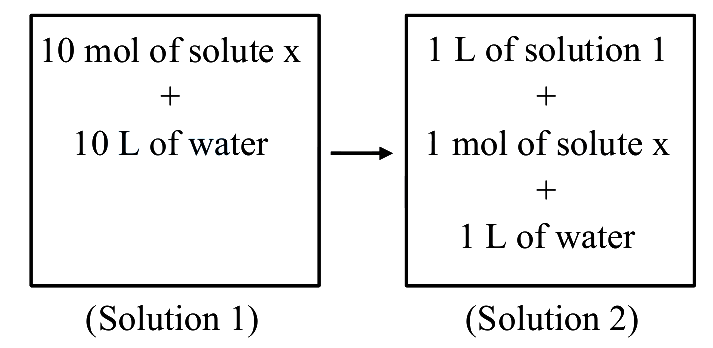
\(\begin{aligned} & \Delta \mathrm{H}_{\mathrm{rxn}}^{\mathrm{o}}=55 \mathrm{~kJ} / \mathrm{mol}, \quad \mathrm{T}=298 \mathrm{~K} \\ & \Delta \mathrm{~S}_{\mathrm{rxn}}^{\mathrm{o}}=175 \mathrm{~J} / \mathrm{mol} \\ & \Delta \mathrm{G}_{\mathrm{rxn}}^{\mathrm{o}}=\Delta \mathrm{H}_{\mathrm{rxn}}^{\mathrm{o}}-\mathrm{T} \Delta \mathrm{S}_{\mathrm{rxn}}^{\circ} \\ & \Rightarrow \Delta \mathrm{G}_{\mathrm{rxn}}^{\mathrm{o}}=55000 \mathrm{~J} / \mathrm{mol}-298 \times 175 \mathrm{~J} / \mathrm{mol} \\ & \Rightarrow \Delta \mathrm{G}_{\mathrm{rxn}}^{\mathrm{o}}=55000-52150 \\ & \Rightarrow \Delta \mathrm{G}_{\mathrm{rxn}}^{\mathrm{o}}=2850 \mathrm{~J} / \mathrm{mol}\end{aligned}\) - 10. Which of the following properties will change when system containing solution 1 will become solution 2?
2025 Easy- (A) Molar heat capacity
- (B) Density
- (C) Concentration
- (D) Gibbs free energy
Show answer and solution
Correct Answer: (D)
Both solutions are having same composition, which is 1 mole of ' \(x\) ' in 1 ' \(\ell\) ' water, so all the intensive properties will remain same, but as total amount is greater in solution ' 1 ' compared to solution ' 2 '. So extensive properties will be different hence Gibbs free energy will be different. -
- (A) \(37\)
- (B) \(38\)
- (C) \(39\)
- (D) \(40\)
Show answer and solution
Correct Answer: (A)
\( \Delta \mathrm{G}^{\circ}=\Delta \mathrm{H}^{\circ}-\mathrm{T} \Delta \mathrm{S}^{\circ} \)\( =77.2 \times 10^3-400 \times 122=28400 \mathrm{~J} \)
\( \Delta \mathrm{G}^{\circ}=-2.303 \mathrm{RT} \log \mathrm{K} \)
\( \Rightarrow 28400=-2.303 \times 8.314 \times 400 \log \mathrm{K} \)
\( \Rightarrow \log \mathrm{K}=-3.708=-37.08 \times 10^{-1}\)
-
- (A) \(\Delta \mathrm{G}\) is negative for a spontaneous reaction
- (B) \(\Delta \mathrm{G}\) is positive for a spontaneous reaction
- (C) \(\Delta \mathrm{G}\) is zero for a reversible reaction
- (D) \(\Delta \mathrm{G}\) is positive for a non-spontaneous reaction
Show answer and solution
Correct Answer: (B)
\((\Delta \mathrm{G})_{\mathrm{P}, \mathrm{T}}=(+) \text { ve for non-spontaneous process }\) -
- (A) \(1070\)
- (B) \(1060\)
- (C) \(1050\)
- (D) \(1040\)
Show answer and solution
Correct Answer: (A)
\(\Delta S =\frac{\Delta H }{ T _{ mp }}\)\(28.4=\frac{30.4 \times 1000}{ T _{ mp }}\)
\(T _{ mp }=1070.422\,K\)
-
- (A) \(6\)
- (B) \(3\)
- (C) \(12\)
- (D) \(9\)
Show answer and solution
Correct Answer: (A)
\(\because \Delta G ^{\circ}=- RT \ln K _{ eq }\)\(\text { and } K _{ eq }=\frac{ K _{ f }}{ K _{ b }}\)
\(\therefore K _{ eq }=\frac{10^3}{10^2}=10\)
\(\therefore \Delta G =- RT \ln 10\)
\(\Rightarrow-(8.3 \times 300 \times 2.3)=-5.7\,kJ\,mole ^{-1} \approx 6\,kJ\)
\(\text { mole }{ }^{-1}(\text { nearest integer) }\)
\(\text { Ans }=6\)
-
- (A) \(6\)
- (B) \(4\)
- (C) \(8\)
- (D) \(2\)
Show answer and solution
Correct Answer: (D)
For, Spontaneous process \(dG < 0\)For, Equilibrium \(dG =0\)
For, Nonspontaneous process \(dG > 0\)
\(\therefore\) \(A\) Wrong
\(B\) Correct
\(C\) Correct
\(D\) Wrong
-
- (A) \(1411\)
- (B) \(1412\)
- (C) \(1413\)
- (D) \(1414\)
Show answer and solution
Correct Answer: (A)
\(C _2 H _{4( g )}+3 O _{2( g )} \longrightarrow 2 CO _{2( g )}+2 H _2 O_{(l)}\)\(\Delta U =-1406\,KJ\,mol ^{-1}, T =300\,K\)
\(\Delta H =\Delta U +\Delta n _{ g } RT\)
\(\Delta H =-1406+(-2) \times 8.3 \times 300=-1406-4.98\)
\(=-1410.98\,KJ\,mol ^{-1} \approx-1411\)
\(\Delta H = T \Delta S =-1411\,KJ\,mol ^{-1}\)
-
- (A) \(4\)
- (B) \(6\)
- (C) \(2\)
- (D) \(8\)
Show answer and solution
Correct Answer: (C)
\(\Delta G =\Delta H - T \Delta S\)\(A : \Delta G \left( J\,mol ^{-1}\right)=-25 \times 10^3+80 \times 300:- ve\)
\(B : \Delta G \left( J\,mol ^{-1}\right)=-22 \times 10^3-40 \times 300:- ve\)
\(C : \Delta G \left( J\,mol ^{-1}\right)=25 \times 10^3+300 \times 50:+ ve\)
\(D : \Delta G \left( J\,mol ^{-1}\right)=22 \times 10^3-20 \times 300:+ ve\)
Processes \(C\) and \(D\) are non-spontaneous.
-
- (A) \(11\)
- (B) \(12\)
- (C) \(14\)
- (D) \(10\)
Show answer and solution
Correct Answer: (D)
\(\Delta G ^0=\Delta H ^0- T \Delta S\)\(\Rightarrow \Delta G ^0=(-54070-10 \times 298)\)
Also, \(\Delta G ^0=(-2.303 RT \log K )\)
\(\Rightarrow(-54070-10 \times 298)\)
\(=(-2.303 \times 8.134 \times 298 \log K )\)
\(\Rightarrow \log K =10 \text { Ans: } 10\)
-
- (A) \(C\) and \(D\) only
- (B) \(B\) and \(C\) only
- (C) \(A\) and \(B\) only
- (D) \(B\) and \(D\) only
Show answer and solution
Correct Answer: (B)
Only \((B)\) and \((C)\) are correct.\((B)\) \(G = H - TS\)
At constant \(T\)
\(\Delta G =\Delta H - T \Delta S\)
(A) First law is given by
\(\Delta U = Q + W\)
If we apply constant \(P\) and reversible work
\(\Delta U = Q - P \Delta V\)
(C)By definition of entropy change
\(dS =\frac{ dq _{ rer }}{ T }\)
At constant \(T\)
\(\Delta S=\frac{q_{\text {rev }}}{T}\)
(D) \(H = U + PV\)
For ideal gas
\(H = U + nRT\)
At constant \(T\)
\(\Delta H =\Delta U +\Delta nRT\)
-
- (A) \(5\)
- (B) \(96\)
- (C) \(51\)
- (D) \(57\)
Show answer and solution
Correct Answer: (C)
\(\frac{1}{2} H _{2}+ Ag ^{+} \rightarrow H ^{+}+ Ag\)\(\Delta G ^{\circ}=- nE ^{\circ} F\)
\(=-1 \times 0.5332 \times 96500 \,J\)
\(=-51.35 \,kJ\)
\(\left( n =2 \text { for } H _{2}+2 Ag ^{+} \rightarrow 2 H ^{+}+2 Ag \right)\)
-
- (A) \(( A )-( III ),( B )-( II ),( C )-( IV ),( D )-( I )\)
- (B) \(( A )-( II ),( B )-( III ),( C )-( IV ),( D )-( I )\)
- (C) \(( A )-( II ),( B )-( III ),( C )-( I ),( D )-( IV )\)
- (D) \(( A )-( II ),( B )-( I ),( C )-( III ),( D )-( IV )\)
Show answer and solution
Correct Answer: (B)
\((A)\) For a spontaneous process \(\Delta G _{ T , p }\, < \,0\)\((B)\;\Delta P =0 \rightarrow\) Isobaric process
\(\Delta T =0 \rightarrow\) Isothermal process
\((C)\;\Delta H _{\text {reaction }}=(\Sigma\) Bond energies of reactants \() - (\Sigma\) bond energies of products)
\((D)\;\Delta H\, < \,0\) is for exothermic reaction
-
- (A) \(30\)
- (B) \(300\)
- (C) \(210\)
- (D) \(670\)
Show answer and solution
Correct Answer: (B)
\(\Delta G =\Delta H - T \Delta S =0\) at equilibrium\(\Rightarrow-165 \times 10^{3}- T \times(-505)=0\)
\(\Rightarrow T =300\, K\)
-
- (A) \(\Delta H =\Delta U - P \Delta V\)
- (B) \(\Delta U = q + W\)
- (C) \(\Delta S _{ syz }+\Delta S _{ suxr } \geq 0\)
- (D) \(\Delta G =\Delta H - T \Delta S\)
Show answer and solution
Correct Answer: (A)
If \(U + P _{ V }\) (By definition)\(\Delta 14=\Delta U +\Delta( Pr )\) at constant pressure
\(\Delta H =\Delta U + P \Delta V\)
-
- (A) \(855\)
- (B) \(952\)
- (C) \(412\)
- (D) \(1054\)
Show answer and solution
Correct Answer: (A)
\(3 HC \equiv CH _{( g )} \rightarrow C _{6} H _{6}(\ell): \Delta G ^{0}=- RT \ln k\)\(\Delta G _{ f }^{0}-2.04 \times 10^{5} \,\frac{ J }{ mol }-1.24 \times 10^{5}\, \,J / mol\)
\(\Rightarrow \Delta G ^{0}=\sum\left(\Delta G _{ f }^{0}\right)_{ P }-\sum\left(\Delta G _{ f }^{0}\right)_{ R }\)
\(\Rightarrow- RT \,\ell nk =1 \times\left(-124 \times 10^{5}\right)-\left(-3 \times 2.04 \times 10^{5}\right)\)
\(\Rightarrow-2.303 \times R \times T \log\, k =4.88 \times 10^{5}\)
\(\Rightarrow \log k =-\frac{4.88 \times 10^{5}}{2.303 \times R \times T }=-\frac{488000}{5705.848}=-85.52\)
\(=855 \times 10^{-1}\)
\(\Rightarrow x =855\)
-
- (A) \(0.25\)
- (B) \(2.5\)
- (C) \(250\)
- (D) \(25\)
Show answer and solution
Correct Answer: (D)
\(\Delta \mathrm{G}^{\circ}=-\mathrm{nFE}^{\circ}=\Delta \mathrm{H}^{\circ}-\mathrm{T} \Delta \mathrm{S}^{\circ}\)\(=\frac{\Delta \mathrm{H}^{\circ}+\mathrm{nFE}^{\circ}}{\mathrm{T}}\)
\(=\frac{\left(-825.2 \times 10^{3}\right)+(2 \times 96487 \times 4.315)}{298}\)
\(=\frac{-825.2 \times 10^{3}+832.682 \times 10^{3}}{298}\)
\(=\frac{7.483 \times 10^{3}}{298}=25.11\, \mathrm{JK}^{-1}\, \mathrm{~mol}^{-1}\)
\(\therefore\) Nearest integer answer is \(25\)
-
- (A) \(964\)
- (B) \(864\)
- (C) \(96.4\)
- (D) \(9.64\)
Show answer and solution
Correct Answer: (A)
\(\mathrm{T}_{\min }=\left(\frac{\Delta^{0} \mathrm{H}}{\Delta^{0} \mathrm{~S}}\right)\)\(\Delta^{0} \mathrm{H}_{\mathrm{rxn}}=\left[\Delta_{\mathrm{f}}^{0} \mathrm{H}(\mathrm{Fe})+\Delta_{\mathrm{f}}^{0} \mathrm{H}(\mathrm{CO})\right]-\)
\(=\left[\Delta_{\mathrm{f}}^{0} \mathrm{H}(\mathrm{FeO})+\Delta_{\mathrm{f}}^{0} \mathrm{H}\left(\mathrm{C}_{(\text {graphite })}\right)\right]\)
\(=[0-110.5]-[-266.3+0]\)
\(=155.8 \, \mathrm{~kJ} / \mathrm{mol}\)
\(\Delta^{0} \mathrm{~S}_{\mathrm{rxn}}=\left[\Delta^{0} \mathrm{~S}(\mathrm{Fe})+\Delta^{0} \mathrm{~S}(\mathrm{CO})\right]-\)
\(\left[\Delta^{0} \mathrm{~S}(\mathrm{FeO})+\Delta^{0} \mathrm{~S}\left(\mathrm{C}_{(\mathrm{graphite})}\right)\right]\)
\(=[27.28+197.6]-[57.49+5.74]\)
\(=161.65 \,\mathrm{~J} / \mathrm{mol}-\mathrm{K}\)
\(\mathrm{T}_{\min }=\frac{155.8 \times 10^{3} \,\mathrm{~J} / \mathrm{mol}}{161.65\, \mathrm{~J} / \mathrm{mol}-\mathrm{K}}=963.8\, \mathrm{~K}\)
\(\simeq 964 \,\mathrm{k}\) (nearest integer)
-
- (A) \(50\)
- (B) \(250\)
- (C) \(200\)
- (D) \(150\)
Show answer and solution
Correct Answer: (C)
\(\Delta G ^{0}=\Delta H ^{0}- T \times \Delta S ^{0}\)\(\Delta G ^{0}=\Delta H ^{0}- T \times(2 T )\)
\(T =200\, K\)
-
- (A) \(360\)
- (B) \(390\)
- (C) \(460\)
- (D) \(551\)
Show answer and solution
Correct Answer: (A)
Given chemical reaction:\(\mathrm{A} \underset{\mathrm{T}\, 300\, \mathrm{~K}}{\longrightarrow} \mathrm{B}\)
\([\Delta \mathrm{G}]_{\mathrm{P}, \mathrm{T}}=-49.4\, \mathrm{~kJ} / \mathrm{mol}\)
\(\Delta \mathrm{H}_{\mathrm{rxn}}=51.4 \,\mathrm{~kJ} / \mathrm{mol}\)
\(\Delta \mathrm{S}_{\mathrm{rxn}}=?\)
\(\Rightarrow\) From the relation \([\Delta \mathrm{G}]_{\mathrm{P}, \mathrm{T}}=\Delta \mathrm{H}-\mathrm{T} \Delta \mathrm{S}\)
\(\Rightarrow \Delta S_{\text {rxn }} =\frac{\Delta H_{r x n}-[\Delta G]_{p, T}}{T}\)
\(=\frac{[51.4-(-49.4)] \times 100}{300} \,\frac{\mathrm{J}}{\mathrm{mol} \mathrm{K}}\)
\(\Rightarrow \Delta \mathrm{S}_{\mathrm{rxn}} =336\, \frac{\mathrm{J}}{\mathrm{mol} \mathrm{K}}\)
-
- (A) \(49\)
- (B) \(36\)
- (C) \(55\)
- (D) \(46\)
Show answer and solution
Correct Answer: (D)
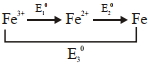
\(E _{1}^{0}+2 E _{2}^{0}=3 E _{3}^{0}\)\(E _{1}^{0}=3 E _{3}^{0}-2 E _{2}^{0}\)
\(=3(-0.036)-2(-0.44)\)
\(=+0.772 V\)
\(E _{\text {cell }}^{0}= E _{ Fe ^{3+} / Fe ^{2+}}^{0}+ E _{ I / I _{2}}^{0}=0.233\)
\(\Delta_{ r } G ^{0}=-2 \times 96.5 \times 0.233=-45 kJ\)
-
- (A) \(15\)
- (B) \(10\)
- (C) \(5\)
- (D) \(8\)
Show answer and solution
Correct Answer: (C)
\(\Delta \mathrm{G}=\Delta \mathrm{H}-\mathrm{T} \Delta \mathrm{S}\)\(\Delta \mathrm{G}=57.8-\frac{298(-176)}{1000}\)
\(\Delta \mathrm{G}=-5.352 \,\mathrm{~kJ} / \mathrm{mole}\)
\(\mid\) Nearest integer value \(\mid=5\)
-
- (A) \(25\)
- (B) \(30\)
- (C) \(20\)
- (D) \(35\)
Show answer and solution
Correct Answer: (C)
\(\Delta G ^{\circ}=- RT \ell n K _{ eq }\)Given \(\Delta G ^{\circ}=-9.478 KJ / mole\)
So \(-9.478 \times 10^{3}=-495 \times 8.314 \times \ell n K _{ eq }\)
\(\ell n K _{ eq }=2.303\)
\(=\ell n 10\)
So \(K _{ eq }=10\)
Now \(A ( g ) \rightleftharpoons B ( g )\)
\(\begin{array}{lll} t =0 & 22 0\end{array}\)
\(\begin{array}{lll}t=t 22-x x\end{array}\)
\(K _{ eq }=\frac{[ B ]}{[ C ]}=\frac{ x }{22- x }=10\)
or \(x=20\)
So millmoles of \(B =20\)
-
- (A) all the atoms of a given element have identical properties including identical mass. Atoms of different elements differ in mass
- (B) chemical reactions involve reorganisation of atoms. These are neither created nor destroyed in a chemical reaction.
- (C) when gases combine or reproduced in a chemical reaction they do so in a simple ratio by volume provided all gases are at the same \(T\) and \(P.\)
- (D) matter consists of indivisible atoms.
Show answer and solution
Correct Answer: (C)
according to Gaylussac's law of volume combination when gases combine or reproduced in a chemical reaction they do so in a simple ratio by volume provided all gases are at the same \(T\) and \(P.\) -
- (A) \(6\)
- (B) \(8\)
- (C) \(10\)
- (D) \(12\)
Show answer and solution
Correct Answer: (A)
\(\Delta G ^{\circ}=- AFE ^{\circ}=-3 \times 96500 \times E ^{\circ}\)\(\Rightarrow E ^{\circ}=-6 \times 10^{-2} V\)
-
- (A) \(13536.6\)
- (B) \(-13537.6\)
- (C) \(-13535.5\)
- (D) \(13530.2\)
Show answer and solution
Correct Answer: (B)
\(\Delta G^{\circ}=\Delta H^{\circ}-T \Delta S^{\circ}\)\(=\left(\Delta U^{\circ}+\Delta n_{g} R T\right)-T \Delta S^{\circ}\)
\(\left.=\left[\{-20+(-1)) \frac{8.314}{1000} \times 298\right\}-\frac{298}{1000} \times(-30)\right] k J\)
\(=-13.537572 kJ\)
\(=-13537.57\) Joule
-
- (A) \(-1.3\)
- (B) \(-2.7\)
- (C) \(-3.7\)
- (D) \(-4.2\)
Show answer and solution
Correct Answer: (B)
\(\mathrm{A}(\ell) \longrightarrow 2 \mathrm{B}(\mathrm{g})\)\(\Delta \mathrm{U}=2.1 \mathrm{Kcal}, \Delta \mathrm{S}=20 \mathrm{cal} \mathrm{K}^{-1}\) at \(300 \mathrm{K}\)
\(\Delta \mathrm{H}=\Delta \mathrm{U}+\Delta \mathrm{n}_{\mathrm{g}} \mathrm{RT}\)
\(\Delta \mathrm{G}=\Delta \mathrm{H}-\mathrm{T} \Delta \mathrm{S}\)
\(\Delta \mathrm{G}=\Delta \mathrm{U}+\Delta \mathrm{n}_{\mathrm{g}} \mathrm{RT}-\mathrm{T} \Delta \mathrm{S}\)
\(=2.1+\frac{2 \times 2 \times 300}{1000}-\frac{300 \times 20}{1000}\)
\(\left(\mathrm{R}=2 \mathrm{cal} \mathrm{K}^{-1} \mathrm{mol}^{-1}\right)\)
\(=2.1+1.2-6=-2.70 \mathrm{Kcal} / \mathrm{mol}\)
-
- (A) \(\Delta H < 0\) and \(\Delta S < 0\)
- (B) \(\Delta H < 0\) and \(\Delta S > 0\)
- (C) \(\Delta H > 0\) and \(\Delta S > 0\)
- (D) \(\Delta H > 0\) and \(\Delta S < 0\)
Show answer and solution
Correct Answer: (B)
At constant \(P\) and \(T\) and for the process to be spontaneous we should have \(\Delta G = -ve\) and we know that \(\Delta G = \Delta H - T\Delta S\)If \(\Delta H = -ve\) and \(\Delta S = +ve\) then at all the temperature the process will be spontaneous.
- 37. An ideal gas is allowed to expand from \(1\, L\) to \(10\, L\) against a constant external pressure of \(1\,bar\). The work done in \(kJ\) is 2019 Medium
- (A) \(-8\)
- (B) \(-9\)
- (C) \(-2\)
- (D) \(+10\)
Show answer and solution
Correct Answer: (B)
\(W = - {P_{ext}}\,\left( {{V_2} - {V_1}} \right)\) -
- (A) \(Y\) if \(T = 300\,K\)
- (B) \(Y\) if \(T = 280\,K\)
- (C) \(X\) if \(T = 350\,K\)
- (D) \(X\) if \(T = 315\,K\)
Show answer and solution
Correct Answer: (D)
\(\Delta {G^o} = (120 - \frac{3}{8}\,T) = 0\)Then \(T = 320\,K\)
Hence \(T > 320\,K\,Y\) formed
\(T < 320\,K\,X\) formed
-
- (A) The equilibrium constant is large suggestive of reaction going to completion and so no catalyst is required.
- (B) The equilibrium will shift in forward direction as the pressure increase.
- (C) The equilibrium constant decreases as the temperature increases.
- (D) The addition of inert gas at constant volume will not affect the equilibrium constant.
Show answer and solution
Correct Answer: (A)
In option \((B)\,-\,\Delta n_g\) is \(-ve\) therefore increase in pressure will bring reaction in forward direction. In option \((C)-\) as the reaction is exothermic therefore increase in temperature will decrease the equilibrium constant. In option \((D)-\) Equilibrium constant changes only with temperature. Hence, option \((B), (C)\) and \((D)\) are correct therefore option \((1)\) is incorrect choice. -
- (A) \(\Delta G^o < 0, K > 1\)
- (B) \(\Delta G^o < 0, K < 1\)
- (C) \(\Delta G^o = 0, K = 1\)
- (D) \(\Delta G^o > 0, K < 1\)
Show answer and solution
Correct Answer: (B)
\(\Delta G^o = -2.303\, RT\, log\, K_{eq}\) -
- (A) \(2040.5\)
- (B) \(1890\)
- (C) \(2480.3\)
- (D) \(2380.5\)
Show answer and solution
Correct Answer: (C)
In order to be spontaneous \(\Delta G^o\) should be \(-ve\)\(\Delta {G^o} = \Delta {H^o} - T\Delta {S^o}\)
\(0 = 491.1 \times {10^3} - T \times 198\)
\(T = \frac{{491100}}{{198}} = 2480\)
If temp is above \(2480\,K\), the reaction will be spontaneous.
-
- (A) \(-412.8\)
- (B) \(-384.0\)
- (C) \(1920\)
- (D) \(206.4\)
Show answer and solution
Correct Answer: (A)
\(\Delta G\, = \, - \,nFE_{cell}\, = \, - \,2\) \( \times \,96500\, \times \,2\,\, = \, - \,386\,\,kJ\)\(\Delta S=nF\left( \frac{dE}{dT} \right)=2\times 96500\,\,\times (-5\times {{10}^{-4}}J{{/}^{o}}C)=-96.5\,kJ\)
at \(298\,K\)
\(T\Delta S=298\times \,(-96.5\,\,J)\,=\,-\,28.8\,kJ\)
at constant \(T\,(=\,248\,K)\) and pressure
\(\Delta G\, = \,\,\Delta H\, - \,\,T\Delta S{\mkern 1mu} \)
\(\Delta H\, = \,\,\Delta G\, + \,\,T\Delta S{\mkern 1mu} \)
\(=-386-28.8=-412.8\,kJ\)
-
- (A) Endothermic if \(A > 0\)
- (B) Exothermic if \(A > 0\) and \(B < 0\)
- (C) Endothermic if \(A < 0\) and \(B > 0\)
- (D) Exothermic if \(B < 0\)
Show answer and solution
Correct Answer: (A)
\(\Delta {G^o} = \Delta {H^o} - T\Delta {S^o}\)\(\Delta {G^o} = A - BT\)
In endothermic reaction \(\Delta H = + ve\). Hence, \(A = +ve\)
-
- (A) \(100\)
- (B) \(1\)
- (C) \(10\)
- (D) \(0.1\)
Show answer and solution
Correct Answer: (C)
\(\Delta G_{rxn}^o = {\Delta _f}{G^o}(vapour) - {\Delta _f}{G^o}(liquid)\)\(\Delta G_{rxn}^o = 103 - 100.7 = 2.3\,kcal/mol\)
\( = 2300\,cal/mol\)
\(\Delta G_{rxn}^o = - RT\,\ln \,K\)
\(2300\,cal/mol = - 2\,cal\,mol\,K \times 500\,K \times \ln \,K\)
\(\ln \,K = 2.3\)
\(K = 10 \,atm = \)Vapour pressure of liquid \('S'\) Vapour pressure of liquid \('S'\) at \(500\,K\) is approximately equal to \(10\,atm.\)
-
- (A) \(-112.4\)
- (B) \(-56.2\)
- (C) \(-208\)
- (D) \(-168.2\)
Show answer and solution
Correct Answer: (B)
\((i)\,2F{e_2}{O_3}(s) \to 4Fe(s) + 3{O_2}(g);\)\({\Delta _r}{G^o} = + 1487.0\,kJ\,mo{l^{ - 1}}\)
\((ii)\,2CO(g) + {O_2}(g) \to 2C{O_2}(g);\)
\({\Delta _r}{G^o} = - 514.4\,kJ\,mo{l^{ - 1}}\)
Multiple reaction \((ii)\) with \(3\),we get
\((iii)\,6CO(g) + 3{O_2}(g) \to 6C{O_2}(g);\)
\({\Delta _r}{G^o} = 3 \times - 514.4 = - 1543.2\,kJ\,mo{l^{ - 1}}\)
When we add reaction \((i)\) and reaction \((iii)\), we get reaction \((iv)\)
\((iv)\,2F{e_2}{O_3}(s) + 6CO(g) \to 4Fe(s) + 6C{O_2}(g)\)
Free energy change, \({\Delta _r}{G^o}\) for the reaction will be
\(1487.0 - 1543.2 = - 56.2\,kJ\,mo{l^{ - 1}}\)
-
- (A) \(\Delta H\) is negative while \(\Delta S\) is positive
- (B) Both \(\Delta H\) and are \(\Delta S\) negative
- (C) \(\Delta H\) is positive while \(\Delta S\) is negative
- (D) Both \(\Delta H\) and \(\Delta S\) are positive
Show answer and solution
Correct Answer: (D)
\(\Delta G\, = \,\Delta H - T\Delta S\)For a spontaneous reaction \(\Delta G = -ve\) which is possible when both \(\Delta H\) and \(\Delta S\) are positive at high temperature and hence the reaction becomes spontaneous.
-
- (A) \(1.0 \times 10^{-10}\)
- (B) \(10\)
- (C) \(1\)
- (D) \(1.0 \times 10^{10}\)
Show answer and solution
Correct Answer: (C)
Given \(\Delta {H^o} = - 29.8\,kJ\,mo{l^{ - 1}}\)\(\Delta {S^o} = - 1.00\,kJ\,{K^{ - 1}}\)
From the equation
\(\Delta G = \Delta {H^o} - T\Delta {S^o} = - 29.8 - (298 \times - 0.100)\)
\( = - 29.8 + 29.8 = 0\)
Now, \(\Delta {G^o} = - 2.303\,RT\,\log \,{K_{eq}}\)
\(0 = - 2.303\,RT\,\log \,{K_{eq}}\)
\(\therefore {K_{eq}} = 1\)
-
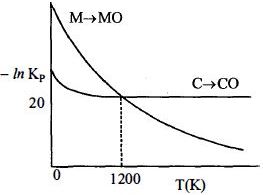
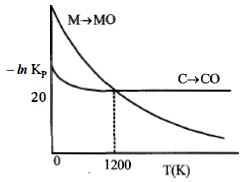
- (A) At \(T < 1200\,K,\) oxidation of carbon is unfavourable
- (B) Oxidation of carbon is favourable at all temperatures.
- (C) At \(T< 1200\,K,\) the reaction \(MO(s) +C(s) \to M(s) + CO(g)\) is spontaneous.
- (D) At \(T > 1200\,K,\) carbon will reduce \(MO(s)\) to \(M(s)\)
Show answer and solution
Correct Answer: (C)
At \(< 1200\,K\), carbon will reduce \(MO(s)\) to \(M(s)\) hence, chemical reaction\(MO(s) + C(s) \to M(s) + CO(g)\) is spontaneous
No questions on this page match these filters.
Other STD 11 - Thermodynamics and thermochemistry topics
Frequently asked
How many Free energy and Work function questions came in JEE Mains?
48 questions from 2016–2026, each with the correct answer and a full solution.
How difficult are Free energy and Work function questions?
15% are easy, 56% medium and 29% hard.