


Questions
Newest firstShowing 1–45 of 45 questions
-
- (A) 73%
- (B) 71%
- (C) 76%
- (D) 68%
Show answer and solution
Correct Answer: (A)
\(\begin{array}{l}\quad { C _{ x } H _{ z }}+ O _2 \rightarrow CO _2+ H _2 O \\ t =0 \quad 0.25 gm \\ t _{ eq }\quad-\quad 0.18 gm \quad 0.15 gm \end{array}\)
Mass of ' H ' \(=\frac{0.15}{18} \times 2=0.016 \simeq 0.017 gm\).
Mass of ' O ' \(=0.25-0.05-0.017=0.1833 gm\)
Mass \(\%\) of ' O ' \(=\frac{0.1833}{0.25} \times 100=73.32 \%\). -
- (A) 2%
- (B) 6%
- (C) 1%
- (D) 4%
Show answer and solution
Correct Answer: (D)
\(\begin{array}{cl} C _{ x } H _{ y } Br _{ z } & \rightarrow \quad CO _2 \\ 1 g & 1.32 g\end{array}\)
\(\% C=\frac{1.32 \times 12}{44 \times 1} \times 100=36 \%\)
\(\begin{array}{clc} C _{ x } H _{ y } Br _{ z } & \rightarrow & AgBr \\ 0.53 g & & 0.75 g\end{array}\)
\(\% Br =\frac{0.75 \times 80}{188 \times 0.53} \times 100=60.2 \%\)
\(\% H =100-(36+60.2)\)
\(\% H \simeq 4 \%\) -
- (A) 4
- (B) 5
- (C) 6
- (D) 7
Show answer and solution
Correct Answer: (B)
Mass of \(AgBr\) formed = \(3.36\) g
Molar mass of \(AgBr = 108 + 80 = 188\) g mol\(^{-1}\)
Moles of \(AgBr\) formed = \(\dfrac{3.36}{188} \approx 0.01787\) mol
Since \(1\) mole of \(AgBr\) contains \(1\) mole of \(Br\), moles of \(Br\) in the compound = \(0.01787\) mol.
Mass of \(Br = 0.01787 \times 80 = 1.43\) g
Percentage of \(Br\) in compound \((X) = \dfrac{1.43}{2.0} \times 100 = 71.5\%\)
Given percentage of \(C = 26.7\%\)
Percentage of \(H = 100\% - (71.5\% + 26.7\%) = 1.8\%\)
Now, we find the molar ratio of the elements in the compound:
Moles of \(C = \dfrac{26.7}{12} = 2.225\)
Moles of \(H = \dfrac{1.8}{1} = 1.8\)
Moles of \(Br = \dfrac{71.5}{80} = 0.893\)
Dividing by the smallest value (\(0.893\)) to get the simplest ratio:
\(C : H : Br = \dfrac{2.225}{0.893} : \dfrac{1.8}{0.893} : \dfrac{0.893}{0.893}\)
\(C : H : Br \approx 2.5 : 2 : 1\)
Multiplying by \(2\) to obtain whole numbers, we get the ratio \(5 : 4 : 2\).
The empirical formula of the compound is \(C_5H_4Br_2\).
The total number of carbon atoms in the empirical formula is \(5\).
Answer: \(5\) -
- (A) 42.10%
- (B) 63.15%
- (C) 21.05%
- (D) 48.24%
Show answer and solution
Correct Answer: (C)
\(\% S=\frac{32}{233} \times \frac{0.4813}{0.314} \times 100\)
\(=21.052 \%\) -
- (A) 50
- (B) 30
- (C) 20
- (D) 40
Show answer and solution
Correct Answer: (A)
% of \(P = \frac{n_{Mg_{2}P_{2}O_{7}} \times 2 \times 31}{w_{(unknown~compound)}} \times 100\)
\(= \frac{(\frac{1.79}{222} \times 2 \times 31)}{1} \times 100\)
\(= 49.99\% \approx 50\%\) -
- (A) \(273\)
- (B) \(27\)
- (C) \(2730\)
- (D) \(227\)
Show answer and solution
Correct Answer: (A)
Mass of carbon in the compound is calculated from the mass of \(CO_2\) produced:
Mass of C \(= \dfrac{12}{44} \times \text{mass of } CO_2 = \dfrac{12}{44} \times 0.25 = \dfrac{3}{44}\) g
Given that the percentage of carbon in the compound is \(25\%\):
\(\% \text{ of C} = \dfrac{\text{Mass of C}}{\text{Total mass } X} \times 100\)
\(25 = \dfrac{\dfrac{3}{44}}{X} \times 100\)
\(X = \dfrac{3}{44} \times \dfrac{100}{25} = \dfrac{3}{44} \times 4 = \dfrac{3}{11}\) g
\(X \approx 0.2727\) g
Verifying this using the percentage of hydrogen:
Mass of H \(= \dfrac{2}{18} \times \text{mass of } H_2O = \dfrac{2}{18} \times 0.12 = \dfrac{1}{75}\) g
\(\% \text{ of H} = \dfrac{\dfrac{1}{75}}{X} \times 100 = 4.89\)
\(X = \dfrac{100}{75 \times 4.89} \approx 0.2727\) g
Thus, \(X = 272.7 \times 10^{-3}\) g.
Rounding to the nearest integer, the required value is \(273\).
Answer: \(273\) -
- (A) 41
- (B) 42
- (C) 43
- (D) 44
Show answer and solution
Correct Answer: (A)
Mass of the organic compound, \(W = 0.2\) g
Mass of \(\text{BaSO}_4\) formed, \(m = 0.6\) g
Molar mass of \(\text{BaSO}_4 = 233 \text{ g mol}^{-1}\)
Molar mass of \(\text{S} = 32 \text{ g mol}^{-1}\)
The percentage of sulphur in the organic compound is given by the formula:
\(\% \text{S} = \dfrac{32}{233} \times \dfrac{m}{W} \times 100\)
Substituting the given values:
\(\% \text{S} = \dfrac{32}{233} \times \dfrac{0.6}{0.2} \times 100\)
\(\% \text{S} = \dfrac{32}{233} \times 3 \times 100\)
\(\% \text{S} = \dfrac{9600}{233} \approx 41.20\%\)
Rounding off to the nearest integer, the percentage of sulphur is \(41\).
Answer: \(41\) -
- (A) 53.58%
- (B) 87.65%
- (C) 37.57%
- (D) 34.79%
Show answer and solution
Correct Answer: (A)
Organic compound 0.2425 gm
AgCl obtained: 0.5253 gm
In carius method for estimation of halogen amount of AgCl obtained is 0.5253 gm from 0.2425 gm of organic compound.
Hence percentage of Cl .
Percentage of \( Cl = \frac{35.5}{143.5} \times \frac{0.5253}{0.2425} \times 100 = 53.58\% \) -
- (A) 4.55%
- (B) 10.30%
- (C) 21.97%
- (D) 16.48%
Show answer and solution
Correct Answer: (C)
\( \frac{n_{BaSO_{4}} \times 32}{W_{(unknown comp.)}} \times 100 \)
\( = \frac{1.2 \times 32}{233} \times \frac{100}{0.75} = 21.97\% \) -
- (A) 10
- (B) 15
- (C) 20
- (D) 25
Show answer and solution
Correct Answer: (B)
\(P_{ N _2}=(715-15) mm =\frac{700}{760} atm\)
\(V _{ N _2}=70 ml =\frac{70}{1000} l\)
\(n _{ N _2}=\frac{ PV }{ RT }=\frac{\left(\frac{700}{760}\right) \times\left(\frac{70}{1000}\right)}{0.0821 \times 300}\)
\(W _{ N _2}=\frac{700}{760} \times \frac{\frac{70}{1000}}{0.0821 \times 300} \times 28\)
\(\% N=\frac{ W _{ N _2}}{0.5} \times 100=\frac{700}{760} \times \frac{\frac{70 / 1000}{0.0821 \times 300} \times 28}{0.5} \times 100\)
\(=14.65 \% \approx 15\) -
- (A) 40
- (B) 43
- (C) 45
- (D) 48
Show answer and solution
Correct Answer: (B)
Iodine gives violet colour
\(\%\) of \(I =\frac{\text { Atomic weight of } I }{\text { Molecular weight of } AgI } \times \frac{ m }{ W } \times 100\)
\(=\frac{127}{235} \times \frac{0.12}{0.15} \times 100\)
\(\%\) of \(I =43.23 \% \approx 43 \%\) -
- (A) 21
- (B) 0.42
- (C) 42
- (D) 0.21
Show answer and solution
Correct Answer: (C)
eq. of \(H_{2}SO_{4}\) = eq. of Ammonia
\(\Rightarrow \frac{15 \times 1 \times 2}{1000}\) = moles of ammonia \(\times 1\)
\(\Rightarrow\) Moles of ammonia = moles of 'N'
\(\Rightarrow\) Weight of nitrogen = \(\frac{15 \times 1 \times 2}{1000} \times 14 = 0.42\)
% weight of 'N' = \(\frac{0.42}{1} \times 100 = 42\)% -
- (A) \(50\)
- (B) \(56\)
- (C) \(70\)
- (D) \(80\)
Show answer and solution
Correct Answer: (B)
\(\mathrm{H}_2 \mathrm{SO}_4+2 \mathrm{NH}_3 \rightarrow\left(\mathrm{NH}_4\right)_2 \mathrm{SO}_4\)Millimole of \(\mathrm{H}_2 \mathrm{SO}_4 \rightarrow 10 \times 2\)
So Millimole of \(\mathrm{NH}_3=20 \times 2=40\)
Organic \(\rightarrow\) \(\mathrm{NH}_3\)
Compound 40 Millimole
\(\therefore\) Mole of \(\mathrm{N}=\frac{40}{1000}\)
wt. of \(\mathrm{N}=\frac{40}{1000} \times 14\)
\(\%\) composition of \(\mathrm{N}\) in organic compound
\(=\frac{40 \times 14}{1000 \times 1} \times 100\)
\(=56 \%\)
-
- (A) Both Statement \(I\) and Statement \(II\) is false
- (B) Statement \(I\) is false but Statement \(II\) is true
- (C) Both Statement \(I\) and Statement \(II\) is true
- (D) Statement \(I\) is true but Statement \(II\) is false
Show answer and solution
Correct Answer: (A)
Nitrogen present in pyridine can not be estimated by Kjeldahl method as the nitrogen present in pyridine can not be easily converted into ammonium sulphate. -
- (A) Reducing agent
- (B) Catalytic agent
- (C) Hydrolysis agent
- (D) Oxidising agent
Show answer and solution
Correct Answer: (B)
Kjeldahl's method is used for estimation of \(\mathrm{N}_1\) trogen where \(\mathrm{CuSO}_4\) acts as a catalyst. -
- (A) \(20\)
- (B) \(30\)
- (C) \(50\)
- (D) \(40\)
Show answer and solution
Correct Answer: (D)
mole of \(AgBr =\frac{0.376}{188}\)mole of \(Br ^{-}=\)mole of \(AgBr =\frac{0.376}{188}\)
mass of \(Br ^{-}=\frac{0.376}{188} \times 80\)
\(\%\) of \(Br ^{-}=\frac{0.376 \times 80}{188 \times 0.4} \times 100=40 \%\)
- 17. \(0.5\,g\) of an organic compound \((X)\) with \(60 \%\) carbon will produce \(........\times 10^{-1}\, g\) of \(CO _2\) on complete combustion. 2023 Medium
- (A) \(10\)
- (B) \(11\)
- (C) \(12\)
- (D) \(13\)
Show answer and solution
Correct Answer: (B)
Percentage of Carbon\(=\frac{12}{44} \times \frac{\text { mass of } CO _2 \text { formed }}{\text { mass of compound taken }} \times 100\)
\(60=\frac{12}{44} \times \frac{\text { mass of } CO _2 \text { formed }}{0.5} \times 100\)
Mass of \(CO _2\) formed \(=\frac{60 \times 44 \times 0.5}{12 \times 100}\,g\)
\(=1.1 \text { gram }\)
\(=11 \times 10^{-1} \text { gram }\)
-
- (A) \(41\)
- (B) \(42\)
- (C) \(40\)
- (D) \(38\)
Show answer and solution
Correct Answer: (B)
\(\%\) sulphur \(=\frac{32}{233} \times \frac{\text { weight of } BaSO _4 \text { formed }}{\text { weight of organic compound }} \times 100\)\(=\frac{32}{233} \times \frac{1.4439}{0.471} \times 100\)
\(=42.10\)
Nearest integer \(42\)
-
- (A) \(42\)
- (B) \(43\)
- (C) \(48\)
- (D) \(44\)
Show answer and solution
Correct Answer: (D)
weight of \(C\) in \(0.792\,gm CO _2\)\(=\frac{12}{44} \times 0.792=0.216\)
\(\% \text { of } C \text { in compound }=\frac{0.216}{0.492} \times 100\)
\(=43.90 \%\)
Ans:\(44\)
-
- (A) \(14\)
- (B) \(21\)
- (C) \(18\)
- (D) \(56\)
Show answer and solution
Correct Answer: (A)
weight of organic compound \(=0.2\, g\)\(\text { mass of } N _{2}( g ) \text { evolved }=\frac{22.4 \times 10^{-3}}{22.4} \times 28\)
\(=28 \times 10^{-3} \,g\)
\(\% \text { of } N =\frac{28 \times 10^{-3}}{0.2} \times 100=14\)
-
- (A) \(40\)
- (B) \(140\)
- (C) \(80\)
- (D) \(143\)
Show answer and solution
Correct Answer: (A)
wt. of organic compound \(=0.25 \,g\)mass of \(Cl =\frac{35.5}{143.5} \times 0.4\, g\)
mass \(\%\) of \(Cl\) in the organic compound
\(=\frac{35.5 \times 0.4}{143.5 \times 0.25} \times 100\)
\(=39.58 \,\%\)
-
- (A) \(22\)
- (B) \(23\)
- (C) \(21\)
- (D) \(20\)
Show answer and solution
Correct Answer: (A)
\(V =22.78\,ml , T =280\,K\)\(P _{\text {total }}=759\,mmHg\)
\(P _{ N _{2}}=759-14.2=744.8\,mmHg\)
\(n _{ N _{2}}=\frac{744.8 \times 22.78}{760 \times 1000 \times 0.082 \times 280}=0.00097\)
\(W _{\text {Nitrogen }}=0.02716\)
\(\% N =\frac{0.02716}{0.125} \times 1000=21.728\)
-
- (A) \(34.04 \%\)
- (B) \(40.04 \%\)
- (C) \(36.03 \%\)
- (D) \(38.04 \%\)
Show answer and solution
Correct Answer: (A)
Mass of organic compound \(=0.45\,gm\)Mass of \(AgBr\) obtained \(=0.36\,gm\)
\(\therefore\) Moles of \(AgBr =\frac{0.36}{188}\)
\(\therefore\) Mass of Bromine \(=\frac{0.36}{188} \times 80=0.1532\,gm\)
\(\therefore \% Br\) in compound \(=\frac{0.1532}{0.45} \times 100=34.04 \%\)
-
- (A) \(340\)
- (B) \(90\)
- (C) \(188\)
- (D) \(34\)
Show answer and solution
Correct Answer: (D)
\(O . C \longrightarrow AgBr\)\(0.5\, g \quad 0.4\, g\)
\(mol\) of \(Br = mol\) of \(AgBr =\frac{0.4}{188}\)
\(\%\, Br =\%\, Br =\frac{\frac{0.4}{188} \times 80}{0.5} \times 100\)
\(=34.04\, \%\)
-
- (A) \(1\)
- (B) \(84\)
- (C) \(32\)
- (D) \(64\)
Show answer and solution
Correct Answer: (D)
Meq of \(H _{2} SO _{4}\) used by \(NH _{3}=12.5 \times 1 \times 2=25\)\(\%\) of \(N\) in the compound \(=\frac{25 \times 10^{-3} \times 14 \times 100}{0.55}=63.6\)
-
- (A) \(18\)
- (B) \(180\)
- (C) \(65\)
- (D) \(74\)
Show answer and solution
Correct Answer: (A)
\(C _{ x } HyOz +\left( x +\frac{ y }{4}-\frac{ z }{2}\right) O _{2} \rightarrow xCO _{2}+\frac{ y }{2} H _{2} O\)\(0.3g\quad\quad\quad\quad\quad\quad\quad\quad0.2g\quad\quad\quad0.1g\)
\(\frac{ n _{ CO _{2}}}{ n _{ H _{2} O }}=\frac{ x }{ y / 2}=\frac{0.2 / 44}{.1 / 18}\)
\(\frac{2 x }{ y }=\frac{36}{44}=\frac{9}{11}\)
\(x =\frac{9 y }{22}\)
\(\frac{ n _{ C _{ x } H _{ y } O_{ z } }}{ nCO _{ 2 } }=\frac{1}{ x }\)
\(\frac{0.3 }{12 x + y +16 z } \times \frac{44}{0.2}=\frac{1}{ x }\)
\(66 x =12 x + y +16 z\)
\(54 x = y +16 z\)
\(\frac{54 \times 9 y }{22}- y =16 z\)
\(\frac{464 y }{22}=16 z\)
\(z =\frac{29 y }{22}\)
\(C _{ x } H _{ y } O _{z}= C _{ x } H _{ y } O _{z}\)
\(C _{\frac{9 y}{22}} H _{ y } O _{\frac{29 y}{22}}^{22}\)
\(C _{9} H _{22} O _{29}\)
\(\,\%\) of \(C =\frac{12 \times 9}{(12 \times 9+22+29 \times 16)} \times 100=\frac{108}{594} \times 100\)
\(18.18 \,\%\)
-
- (A) \(46\)
- (B) \(44\)
- (C) \(43\)
- (D) \(42\)
Show answer and solution
Correct Answer: (A)
\(0.492\,g\) of \(C _{ x } H _{ y } O _{z}\)Gives \(0.7938\,g\,CO _{2}=0.018\) moles
\(0.4428\,g\,H _{2} O =0.0246\) moles
So moles of \(C =0.018 \Rightarrow 0.216\,g\)
Moles of \(H =0.049 \Rightarrow 0.049\,g\)
\(\therefore\) wt. of Oxygen \(=0.492-0.216-0.049\)
\(\%\) of Oxygen \(=\frac{0.227}{0.492} \times 10046\) (approx.)
-
- (A) \(64\)
- (B) \(92\)
- (C) \(50\)
- (D) \(46\)
Show answer and solution
Correct Answer: (D)
Mole of \(CO _{2}=\) Moles of \(C =\frac{0.793}{44}\)Weight of ' \(C\) ' \(=\frac{0.793}{44} \times 12=0.216 \,gm\)
Moles of ' \(H ^{\prime}=\frac{0.442}{18} \times 2\)
Weight of ' \(H ^{\prime}=\frac{0.442}{18} \times 2 \times 1=0.049 \,gm\)
\(\therefore\) Weight of ' \(O\) ' \(=0.492-0.216-0.049=0.227\, gm\) \(\,\%\) of ' \({ }^{\prime}{ }^{\prime}=\frac{0.227}{0.492} \times 100=46.13\, \%\)
-
- (A) \(55\)
- (B) \(56\)
- (C) \(54\)
- (D) \(53\)
Show answer and solution
Correct Answer: (B)
\(\% N =\frac{1.4\left( N _{1} V _{1}\right)}{\text { mass of organic compound }}\)\(\% N =\frac{1.4(2.5 \times 2 \times 2)}{0.25}=56\)
-
- (A) \(8\)
- (B) \(9\)
- (C) \(41\)
- (D) \(12\)
Show answer and solution
Correct Answer: (D)
Organic compound : \(0.8 \,\mathrm{gm}\)wt. of \(\mathrm{N}=\left(\frac{42}{100} \times 0.8\right)\, \mathrm{gm}\)
mole of \(N=\frac{42 \times 0.8}{100 \times 14}=\frac{2.4}{100}\, \mathrm{~mol}\)
moles of \(\mathrm{NH}_{3}=\frac{2.4}{100}\)
\(2 \mathrm{NH}_{3}+\mathrm{H}_{2} \mathrm{SO}_{4} \rightarrow\left(\mathrm{NH}_{4}\right)_{2} \mathrm{SO}_{4}\)
\(\quad\downarrow\quad\quad\quad\downarrow\)
\(\frac{2.4}{100}\) \(mole\) \(\quad\frac{1.2}{100}\) \(mole\)
For \(\mathrm{H}_{2} \mathrm{SO}_{4} \quad \frac{1.2}{100}=1 \times \mathrm{V}(\ell)\)
\(\Rightarrow \mathrm{V}_{\mathrm{H}_{2} \mathrm{SO}_{4}}=\frac{1.2}{100} \,\ell=12 \,\mathrm{~m} \ell\)
-
- (A) \(19\)
- (B) \(21\)
- (C) \(25\)
- (D) \(80\)
Show answer and solution
Correct Answer: (A)
\(\mathrm{n}_{\mathrm{cl}} \text { in compound }=\mathrm{n}_{\mathrm{AgCl}}=\frac{0.3849 \mathrm{~g}}{(107.87+35.5)}\, \mathrm{g} / \mathrm{mol}\)\(\Rightarrow \text { mass of chlorine }=\mathrm{n}_{\mathrm{Cl} } \times 35.5=0.0953\, \mathrm{gm}\)
\(\Rightarrow\, \% \text { wt of chlorine }=\frac{0.0953}{0.5} \times 100\)
\(\quad=19.06\, \%\)
-
- (A) \(1\)
- (B) \(6\)
- (C) \(3\)
- (D) \(8\)
Show answer and solution
Correct Answer: (C)
\(44 gm CO _{2}\), have \(12 gm\) carbonSo, \(420 gm CO _{2} \Rightarrow \frac{12}{44} \times 420\)
\(\Rightarrow \frac{1260}{11} gm\) carbon
\(\Rightarrow 114.545\) gram carbon
So, \(\%\) of carbon \(=\frac{114.545}{750} \times 100\)
\(=15.3 \%\)
\(18 gm H _{2} O \Rightarrow 2 gm H _{2}\)
\(210 gm \Rightarrow \frac{2}{18} \times 210\)
\(=23.33 gm H _{2}\)
\(So , \% H _{2} \Rightarrow \frac{23.33}{750} \times 100=3.11 \%\)
\(\approx 3 \%\)
-
- (A) \(4\)
- (B) \(400\)
- (C) \(40\)
- (D) \(0.40\)
Show answer and solution
Correct Answer: (C)
\(\mathrm{n}_{\mathrm{AgBr}}=\frac{0.188 \mathrm{~g}}{188 \mathrm{~g} / \mathrm{mol}}=10^{-3}\, \mathrm{~mol}\)\(\Rightarrow \mathrm{n}_{\mathrm{Br}}=\mathrm{n}_{\lambda_{\mathrm{kBt}}}=0.001\, \mathrm{~mol}\)
\(\Rightarrow \text { mass }_{\mathrm{Bz}}=(0.001 \times 80) \,\mathrm{gm}=0.08 \,\mathrm{gm}\)
\(\Rightarrow \text { mass } \%=\frac{0.08 \times 100}{0.2}=40 \,\%\)
-
- (A) \(25\)
- (B) \(19\)
- (C) \(32\)
- (D) \(16\)
Show answer and solution
Correct Answer: (B)
In Duma's method of estimation of Nitrogen.\(0.1840\, gm\) of organic compound gave \(30 \,mL\) of nitrogen which is collected at \(287\, K\) And \(758\,mm\) of \(Hg\).
Given ; Aqueous tension at \(287 \,K =14 \,mm\) of \(Hg\). Hence actual pressure \(=(758-14)\)
\(=744\, mm \text { of } Hg \text { . }\)
Volume of nitrogen at \(STP =\frac{273 \times 744 \times 30}{287 \times 760}\)
\(V =27.935 \,mL\)
\(\because 22400 mL\) of \(N _{2}\) at STP weighs \(=28\, gm .\)
\(\therefore 27.94 mL\) of \(N _{2}\) at STP weighs \(=\)
\(\left(\frac{28}{22400} \times 27.94\right)\, gm\)
\(=0.0349 \,gm\)
Hence \(=\left(\frac{0.0349}{0.1840} \times 100\right)\)
\(=18.97\, \%\)
Rond off. Answer \(=19 \,\%\)
-
- (A) \(142\)
- (B) \(42\)
- (C) \(471\)
- (D) \(233\)
Show answer and solution
Correct Answer: (B)
Molecular mass of \(\mathrm{BaSO}_{4}=233 \,\mathrm{~g}\)\(\because 233 \,g\,\mathrm{BaSO}_{4}\) contain \(\rightarrow 32\, \mathrm{~g}\) sulphur
\(\therefore 1.44\, \mathrm{~g} \,\mathrm{BaSO}_{4}\) contain \(\rightarrow \frac{32}{233} \times 1.44\, \mathrm{~g}\) sulphur
given : \(0.471\, \mathrm{~g}\) of organic compound
\(\%\) of \(\mathrm{S}=\frac{32 \times 1.44}{233 \times 0.471} \times 100=41.98 \,\% \approx 42\, \%\)
-
- (A) \(1963\)
- (B) \(8510\)
- (C) \(1125\)
- (D) \(7412\)
Show answer and solution
Correct Answer: (C)
Moles of \(\mathrm{N}\) in \(\mathrm{N}, \mathrm{N}\) - dimethylaminopentane\(=\left(\frac{57.5}{115}\right)=0.5\, \mathrm{~mol}\)
\(\Rightarrow \mathrm{C}_{7} \mathrm{H}_{17} \mathrm{~N}+\frac{45}{2} \mathrm{CuO} \rightarrow 7 \mathrm{CO}_{2}+\frac{17}{2} \mathrm{H}_{2} \mathrm{O}+\frac{1}{2} \mathrm{~N}_{2}+\frac{45}{2} \mathrm{Cu}\)
\(\frac{\mathrm{n}_{\mathrm{cuo}} \text { reacted }}{\left(\frac{45}{2}\right)}=\frac{\mathrm{n}_{\mathrm{C_7} \mathrm{H}_{17} \mathrm{N}} \text { reacted }}{1}\)
\(\Rightarrow \mathrm{n}_{\mathrm{C} \mathrm{u} O}\) reacted \(=\left(\frac{45}{2}\right) \times 0.5=11.25\)
-
- (A) \(2\)
- (B) \(7\)
- (C) \(1\)
- (D) \(15\)
Show answer and solution
Correct Answer: (B)
\(\mathrm{C}_{2} \mathrm{H}_{7} \mathrm{~N}+\left(2 \mathrm{x}+\frac{\mathrm{y}}{2}\right) \mathrm{CuO} \rightarrow \mathrm{x} \mathrm{CO}_{2}+\frac{\mathrm{y}}{2} \mathrm{H}_{2} \mathrm{O}+\frac{\mathrm{z}}{2} \mathrm{~N}_{2}+\left(2 \mathrm{x}+\frac{\mathrm{y}}{2}\right) \mathrm{Cu}\)On balancing
\(\mathrm{C}_{2} \mathrm{H}_{7} \mathrm{~N}+\frac{15}{2} \mathrm{CuO} \rightarrow 2 \mathrm{CO}_{2}+\frac{7}{2} \mathrm{H}_{2} \mathrm{O}+\frac{1}{2} \mathrm{~N}_{2}+\frac{15}{2} \mathrm{Cu}\)
On comparing
\(\mathrm{y}=7\)
-
- (A) \(96\)
- (B) \(12\)
- (C) \(85\)
- (D) \(68\)
Show answer and solution
Correct Answer: (D)
Moles of \(\mathrm{Br}=\) Moles of \(\mathrm{AgBr}\) obtained\(\Rightarrow \quad\) Mass of \(\mathrm{Br}=\frac{0.2397}{188} \times 80\, \mathrm{~g}\)
therefore \(\%\) Br in the organic compound
\(=\frac{W_{\text {Br }}}{W_{T}} \times 100\)
\(=\frac{0.2397 \times 80}{188 \times 0.15} \times 100=0.85 \times 80\)
\(=68\)
\(\Rightarrow\) Nearest integer is \('68^{\prime}\)
-
- (A) \(50\)
- (B) \(55\)
- (C) \(45\)
- (D) \(40\)
Show answer and solution
Correct Answer: (A)
Carius method\(\%\) of \(Br =\frac{\text { wt of } AgBr }{\text { wt. of organic compound }} \times 100 \times \frac{\text { molar mass of Br }}{\text { AgBr }}\)
\(=\frac{1.88}{1.6} \times \frac{80}{188} \times 100=\frac{15040}{300.8}=50 \%\)
-
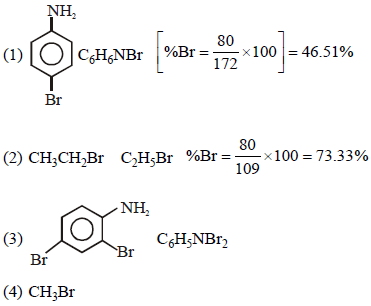
- (B) \(H _{3} C - CH _{2}- Br\)
- (D) \(H _{3} C - Br\)
Show answer and solution
Correct Answer: (A)
In Carius methodmass of organic compound \(=0.172 gm\) mass of Bromine \(=0.08 gm\)
Hence \(\%\) of Bromine \(=\frac{0.08}{0.172} \times 100\)
\(=46.51 \%\)
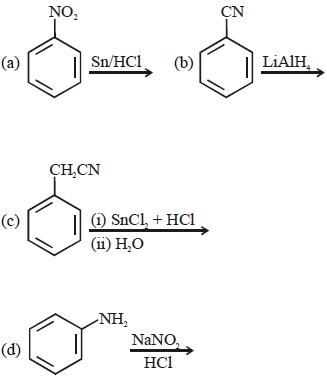
- 41. The Kjeldahl method of Nitrogen estimation fails for which of the following reaction products \(?\)
 2020 Medium
- (A) \(a\) and \(d\)
- (B) \(c\) and \(d\)
- (C) \(a, c\) and \(d\)
- (D) \(b\) and \(c\)
Show answer and solution
Correct Answer: (B)
Kjeldahl method is used for \(N\) estimation But not given by 'Diazo' compounds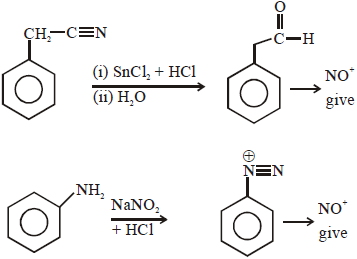
-
- (A) \(C_{12}H_8N\)
- (B) \(C_{12}H_8N_2\)
- (C) \(C_6H_8N_2\)
- (D) \(C_6H_8N\)
Show answer and solution
Correct Answer: (C)
\(CO_2 = 6\,mole,\,N_1 = 1\,mole\)\(C_{atom}= 6,\,N_{atom} = 2\)
Hence \(C_6H_8N_2\)
-
- (A) \(10\)
- (B) \(3\)
- (C) \(24\)
- (D) \(5\)
Show answer and solution
Correct Answer: (A)
Mili equivalents of \(H_2SO_4\)\( = 60 \times \frac{{M \times 2}}{{10}} = 12\)
Mili equivalents of \(NaOH = 20 \times \frac{M}{{10}} = 2\)
Mili equivalents of \(N{H_3} = 12 - 2 = 10\)
\(\% \,\) of nitrogen \( = \frac{{1.4 \times (N \times V)N{H_3}}}{{(Wt.\,of\,organic\,compound)}}\)
\(\frac{{1.4 \times 10}}{{1.4}} = 10\)
-
- (A) \(6\)
- (B) \(10\)
- (C) \(3\)
- (D) \(5\)
Show answer and solution
Correct Answer: (B)
\(\%\) of \(N=\frac{1.4 \times \text { meq.of acid }}{\text { mass of organic compound }}\)meq. of \(H_{2} S O_{4}=60 \times \frac{M}{10} \times 2=12\)
meq. of \(N a O H=20 \times \frac{M}{10}=2\)
meq. of acid consumed \(=12-2=10\)
\(\therefore \% \quad N=\frac{1.4 \times 10}{1.4}=10 \%\)
- 45. For which of the following compounds Kjeldahl method can be used to determine the percentage of Nitrogen ? 2013 Medium
- (A) Nitrobenzene
- (B) Pyridine
- (C) Alanine
- (D) Diazomethane
Show answer and solution
Correct Answer: (C)
Kjeldahl's method is not applicable for cpmpounds containing nitrogen in nitro and azo groups and nitrogen present in the ring. Because nitrogen of these compounds does not change to ammonium sulphate under these conditions.Hence only Alanine can be used to determine percentage of nitrogen.
\(\underset{Alanine}{\mathop{\begin{matrix}
{{H}_{2}}N-CH-COOH \\
|\,\,\,\,\,\,\,\,\, \\
\,\,\,\,\,\,\,\,\,CH{{(C{{H}_{3}})}_{2}} \\
\end{matrix}}}\,\)
No questions on this page match these filters.
Other STD 11 - Organic chemistry purification and characterization topics
Frequently asked
How many Quantitative Analysis questions came in JEE Mains?
45 questions from 2013–2026, each with the correct answer and a full solution.
How difficult are Quantitative Analysis questions?
13% are easy, 49% medium and 38% hard.