


JEE Mains 2022 Physics ના બધા પ્રશ્નો
31 પ્રકરણ577 માંથી 551–577 પ્રશ્નો
-
- (A) \(10\)
- (B) \(15\)
- (C) \(20\)
- (D) \(30\)
જવાબ અને ઉકેલ જુઓ
સાચો જવાબ: (D)
Let they meet at time \(t\).\(t =\sqrt{\frac{2 h }{ g }}=\sqrt{\frac{2 \times 80}{10}}\)
\(=4 \,sec\)
Time taken by ball \(B\) to meet \(A =2 \,sec\)
\(\text { using } S=u t+\frac{1}{2} \text { at }^{2}\)
\(-80=-u \times 2+\frac{1}{2}(-10)(2)^{2}\)
\(u=30\)
-
- (A) \(\frac{{a + f}}{{2\left( {1 + b} \right)}}\)
- (B) \(\;\frac{{f - a}}{{2\left( {1 + b} \right)}}\)
- (C) \(\;\frac{{a + f}}{{\left( {1 + b} \right)}}\)
- (D) \(\;\frac{{a + f}}{{2\left( {b - 1} \right)}}\)
જવાબ અને ઉકેલ જુઓ
સાચો જવાબ: (B)
\(\begin{array}{l}
\,\,\,Position\,of\,car\,P\,at\,any\,time\,t,\,is\\
\,\,{x_p}\left( t \right) = at + b{t^2}\\
\,\,{v_p}\left( t \right) = \frac{{d{x_p}\left( t \right)}}{{dt}} = a + 2bt\,\,\,\,\,\,\,\,\,\,\,\,\,\,\,\,\,\,\,\,\,\,\,\,\,\,\,...\left( i \right)\\
{\rm{Similarly}},\,for\,car\,Q,\\
\,\,\,\,\,\,\,\,\,\,\,\,\,{x_Q}\left( t \right) = ft - {t^2}\\
\,\,\,\,\,\,\,\,\,\,\,\,\,{v_Q}\left( t \right) = \frac{{d{x_q}\left( t \right)}}{{dt}} = f - 2t\,\,\,\,\,\,\,\,\,\,\,\,\,\,\,\,\,\,...\left( {ii} \right)\\
\,\,\,\,\,\,\,\,\,\,{v_p}\left( t \right) = {v_Q}\left( t \right)\,\,\,\,\,\,\,\,\,\,\,\,\,\,\,\,\,\,\,\,\,\,\,\,\,\,\,\,\,\,\,\,\,\,\,\,\left( {Given} \right)\\
\therefore \,\,\,\,\,\,\,\,\,\,\,a + 2bt = f - 2t\,or,\,2t\left( {b + 1} \right) = f - a\\
\therefore \,\,\,\,\,\,\,\,\,\,\,\,t = \frac{{f - a}}{{2\left( {1 + b} \right)}}\,
\end{array}\) -
- (A) \(393\)
- (B) \(390\)
- (C) \(392\)
- (D) \(391\)
જવાબ અને ઉકેલ જુઓ
સાચો જવાબ: (C)
\(t _{ a }=\frac{ u }{ g }=\frac{19.6}{9.8}=2 s\)\(t _{ d }=6-2 s =\sqrt{\frac{2 h _{\max }}{ g }}\)
\(\Rightarrow h _{\max }=\frac{16 \times 9.8}{2}=\frac{392}{5}\)
-
- (A) \(t _{1}=(\sqrt{2}) t _{2}\)
- (B) \(t _{1}=(\sqrt{2}-1) t _{2}\)
- (C) \(t _{2}=(\sqrt{2}+1) t _{1}\)
- (D) \(t _{2}=(\sqrt{2}-1) t _{1}\)
જવાબ અને ઉકેલ જુઓ
સાચો જવાબ: (D)
For first \(\frac{ h }{2}\)\(\frac{ h }{2}=\frac{1}{2} gt _{1}^{2}\)
For total height \(h\)
\(h =\frac{1}{2} g \left( t _{1}+ t _{2}\right)^{2}\)
\(\frac{1}{\sqrt{2}}=\frac{ t _{1}}{ t _{1}+ t _{2}}\)
\(1+\frac{ t _{2}}{ t _{1}}=\sqrt{2}\)
\(\frac{ t _{1}}{ t _{2}}=\frac{1}{\sqrt{2}-1}\)
\(t _{2}=(\sqrt{2}-1) t _{1}\)
-
- (A) \(6\)
- (B) \(5\)
- (C) \(4\)
- (D) \(3\)
જવાબ અને ઉકેલ જુઓ
સાચો જવાબ: (A)
Let they meet at \(t = t\)So first ball gets \(t \; sec\).
and \(2^{\text {nd }}\) gets \(( t -2) \; sec\) . and they will meet at same height
\(h _{1}=50 t -\frac{1}{2} gt ^{2}\)
\(h _{2}=50( t -2)-\frac{1}{2} g ( t -2)^{2}\)
\(h _{1}= h _{2}\)
\(50 t -\frac{1}{2} gt ^{2}=50( t -2)-\frac{1}{2} g ( t -2)^{2}\)
\(100=\frac{1}{2} g \left[ t ^{2}-( t -2)^{2}\right]\)
\(100=\frac{10}{2}[4 t -4]\)
\(5= t -1\)
\(t =6 \; sec\)
-
- (A) \(\frac{\sqrt{2}-1}{\sqrt{2}+1}\)
- (B) \(\frac{\sqrt{3}-\sqrt{2}}{\sqrt{3}+\sqrt{2}}\)
- (C) \(\frac{\sqrt{3}-1}{\sqrt{3}+1}\)
- (D) \(\frac{1}{3}\)
જવાબ અને ઉકેલ જુઓ
સાચો જવાબ: (B)
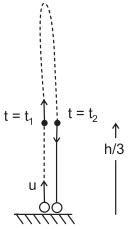
Max. Height \(= h =\frac{ u ^{2}}{2 g }\)\(\Rightarrow u =\sqrt{2 gh }\)
\(S =u t+\frac{1}{2} a t^{2}\)
\(\frac{ h }{3}=\sqrt{2 gh } t +\frac{1}{2}(- g ) t ^{2}\)
\(\frac{ gt ^{2}}{2}-\sqrt{2 ght }+\frac{ h }{3}=0 \quad\) (Roots are \(t _{1} \& t _{2}\) )
\(\frac{t_{2}}{t_{1}}=\frac{\sqrt{2 g h}+\sqrt{2 g h-4 \times \frac{g}{2} \times \frac{h}{3}}}{\sqrt{2 g h}-\sqrt{2 g h-4 \times \frac{g}{2} \times \frac{h}{3}}}=\frac{\sqrt{2 g h}+\sqrt{\frac{4 g h}{3}}}{\sqrt{2 g h}-\sqrt{\frac{4 g h}{3}}}=\frac{\sqrt{3}+\sqrt{2}}{\sqrt{3}-\sqrt{2}}\)
-
- (A) \(g / 2 n\)
- (B) \(g / n\)
- (C) \(2 g n\)
- (D) \(g / 2 n^{2}\)
જવાબ અને ઉકેલ જુઓ
સાચો જવાબ: (D)
Time taken by ball to reach highest point \(=\frac{ u }{ g }\)Frequency of throw \(=\frac{ g }{ u }= n\)
\(u =\frac{ g }{ n }\)
\(H _{\max }=\frac{ u ^{2}}{2 g }=\frac{\left(\frac{ g }{ n }\right)^{2}}{2 g }\)
\(\frac{g}{2 n^{2}}\)
-
- (A) \(2\)
- (B) \(1\)
- (C) \(4\)
- (D) \(3\)
જવાબ અને ઉકેલ જુઓ
સાચો જવાબ: (D)
Stopping distance \(=\frac{ v ^{2}}{2 a }= d\)If speed is made \(\frac{1}{3} rd\)
\(d^{\prime}=\frac{1}{9} d . \quad d^{\prime}=\frac{27}{9}=3 \text {. }\)
Braking acceleration remains same
-
- (A) \(17\)
- (B) \(16\)
- (C) \(20\)
- (D) \(18\)
જવાબ અને ઉકેલ જુઓ
સાચો જવાબ: (D)
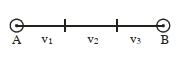
\(\langle\overrightarrow{ v }\rangle=\frac{\text { Displacement }}{\text { time }}\)(Let displacement be \(l\) )
\(=\frac{\ell}{\left(\frac{\ell}{ V _{3}}+\frac{\ell}{ V _{2}}+\frac{\ell}{ V _{1}}\right) \frac{1}{3}}\)
\(=\frac{3}{\frac{1}{ V _{1}}+\frac{1}{ V _{2}}+\frac{1}{ V _{3}}}=\frac{3}{\frac{1}{11}+\frac{1}{22}+\frac{1}{33}}\)
\(=18\,m / s\)
-
- (A) \(100\)
- (B) \(101\)
- (C) \(99\)
- (D) \(103\)
જવાબ અને ઉકેલ જુઓ
સાચો જવાબ: (A)
\(\frac{d v}{d s}=5\)\(a=v \frac{d v}{d s}=20 \times 5=100\,m / sec ^{2}\)
-
- (A) \(10\)
- (B) \(20\)
- (C) \(30\)
- (D) \(40\)
જવાબ અને ઉકેલ જુઓ
સાચો જવાબ: (C)
\(u =0, \quad\) Say acceleration is aFor \(ts\) \(\quad 10=\frac{1}{2} a t^{2}\)
For \(2 t s\)
\(10+ x =\frac{1}{2} a (2 t )^{2}\)
\(\frac{10+ x }{10}=\frac{4}{1}\)
\(x =30 \,m\)
-
- (A) \(19.6\)
- (B) \(29.4\)
- (C) \(39.2\)
- (D) \(73.5\)
જવાબ અને ઉકેલ જુઓ
સાચો જવાબ: (B)
\(v = \sqrt{2gh}\)
\(v = \sqrt{2 \times 9.8 \, m/s^2 \times 4.9 \, m}\)
\(v = 9.8 \, m/s\)
\(t_1 = \frac{v}{g}\)
\(t_1 = \frac{9.8 \, m/s}{9.8 \, m/s^2}\)
\(t_1 = 1.0 \, s\)
\(t_2 = T_{total} - t_1\)
\(t_2 = 4.0 \, s - 1.0 \, s\)
\(t_2 = 3.0 \, s\)
\(h_{lake} = v \times t_2\)
\(h_{lake} = 9.8 \, m/s \times 3.0 \, s\)
\(h_{lake} = 29.4 \, m\)
-
- (A) \(4\)
- (B) \(0\)
- (C) \(8\)
- (D) \(16\)
જવાબ અને ઉકેલ જુઓ
સાચો જવાબ: (B)
\(t =\sqrt{ x }+4\)\(\Rightarrow x =( t -4)^{2}= t ^{2}-8 t +16\)
\(\Rightarrow \frac{ dx }{ dt }=2 t -8\)
\(\left.\Rightarrow \frac{ dx }{ dt }\right|_{ t =4}=2 \times 4-8=0\)
-
- (A) \(2\)
- (B) \(1\)
- (C) \(0.5\)
- (D) \(1.5\)
જવાબ અને ઉકેલ જુઓ
સાચો જવાબ: (C)
\(\left(\frac{ V }{3}\right)^{2} = V ^{2}-2 a (4) \Rightarrow a =\frac{8 V ^{2}}{9(8)}=\frac{ V ^{2}}{9}\)\(0= V ^{2}-2 a (4+ x )\)
\(V ^{2} =2\left(\frac{ V ^{2}}{9}\right)(4+ x )\)
\(4.5 =4+ x\)
\(x =0.5\)
-
- (A) \(38\)
- (B) \(7\)
- (C) \(8\)
- (D) \(3\)
જવાબ અને ઉકેલ જુઓ
સાચો જવાબ: (D)
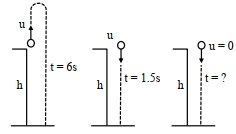
Let height of tower be \(h\) and speed of projection in first two cases be \(u\).For case-I : \(2^{\text {nd }}\) equation \(s=u t+\frac{1}{2}\) at \(^{2}\)
\(h =- u (6)+\frac{1}{2}\, g (6)^{2}\)
\(H =-6 u +18\,g \ldots\) \((i)\)
For case-II \(: h = u (1.5)+\frac{1}{2}\, g (1.5)^{2}\)
\(h =1.5 u +\frac{2.25 g }{2} \ldots\) \((ii)\)
Multiplying equation \((ii)\) by \(4\) we get
\(4 h =6 u +4.5\, g \ldots .\) \((iii)\)
equation \((i)\) \(+\) equation \((iii)\) we get \(5 h =22.5 g\)
\(h =4.5 g \ldots\) \((iv)\)
For case\(-III\)
\(h =0+\frac{1}{2} gt ^{2} \ldots\) \((v)\)
Using equation \((4)\)and equation \((5)\)
\(4.5 g=\frac{1}{2} g t^{2}\)
\(t ^{2}=9 \Rightarrow t =3 s\)
-
- (A) \(61 \times 10^{-1} kg\,s ^{-1}\)
- (B) \(61 \times 10^{-5} kg\,s ^{-1}\)
- (C) \(208\, kg\,s ^{-1}\)
- (D) \(30 \times 10^{-5} kg\,s ^{-1}\)
જવાબ અને ઉકેલ જુઓ
સાચો જવાબ: (B)
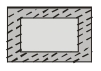
\(\frac{ dQ }{ dt }=\frac{ KA \Delta T }{\ell}\)\(A =2(0.6 \times 0.5+0.5 \times 0.2+0.2 \times 0.6)\)
\(=2(0.3+0.1+0.12)\)
\(=2(0.4+0.12)\)
\(=2(0.52)\)
\(=1.04\,m ^{2}\)
\(R _{ th }=\frac{\ell}{ KA } \Rightarrow \frac{1 \times 10^{-2}}{0.05 \times 1.04} \Rightarrow \frac{10^{-2}}{0.052}\)
\(\frac{ dQ }{ dt }=\frac{\Delta T }{ R _{ th }} \Rightarrow \frac{40 \times 0.052}{10^{-2}} \Rightarrow 2.08 \times 10^{2}\,J / s\)
\(2.08 \times 10^{2}= m \times 3.4 \times 10^{5}\)
\(m =\frac{2.08}{3.4 \times 10^{3}} \Rightarrow 0.61 \times 10^{-3}\,kg / s\)
\(=61 \times 10^{-5}\,Kg / s\)
-
- (A) \(20\)
- (B) \(21\)
- (C) \(23\)
- (D) \(22\)
જવાબ અને ઉકેલ જુઓ
સાચો જવાબ: (B)
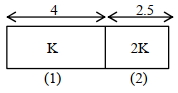
\(\frac{\Delta Q }{\Delta t }=\left(\frac{1}{ R }\right) \Delta T\)\(R\) : Thermal resistivity
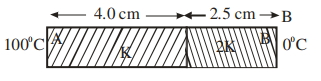
\(\therefore R _{1}=\frac{ L _{1}}{ K _{1} A }=\frac{ L _{1}}{ K (120)}\)
\(L _{1}=4 \,cm\)
\(A =120 \,cm ^{2}\)
\(R _{2}=\frac{2.5}{(2 K )(120)}\)
Now, \(R_{\text {eq }}\) of this series combination
\(R _{\text {eq }}= R _{1}+ R _{2}\)
where \(L _{ eq }=4+2.5=6.5\)
\(\frac{ L _{ eq }}{ K _{ eq }( A )}=\frac{4}{ K (120)}+\frac{5}{\frac{2}{2 K (120)}}\)
\(\frac{6.5}{ K _{ eq }(120)}=\frac{4}{ K (120)}+\frac{5}{4 K (120)}\)
\(\frac{6.5}{ K _{\text {eq }}}=\frac{21}{4 K }\)
\(K _{ eq }=\frac{26}{21} K =\left(1+\frac{5}{21}\right) K\)
\(\therefore a =21\)
-
- (A) \(18\)
- (B) \(14\)
- (C) \(45\)
- (D) \(150\)
જવાબ અને ઉકેલ જુઓ
સાચો જવાબ: (C)
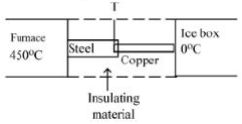
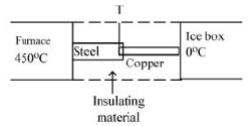
\(\frac{d \theta}{d t}=\frac{K_{1} A_{1}}{l_{1}}\left(T_{1}-T\right)=\frac{K_{2} A_{2}}{l_{2}}\left( T - T _{2}\right)\)\(\frac{450- T }{ T -0}=\frac{K_{2} A _{2} 1_{1}}{K_{1} A _{1} 1_{2}}=9 \times \frac{1}{2} \times 2\)
\(450- T =9 T \Rightarrow T =45^{\circ}\,C\)
-
- (A) \(86\)
- (B) \(16\)
- (C) \(19\)
- (D) \(11\)
જવાબ અને ઉકેલ જુઓ
સાચો જવાબ: (B)
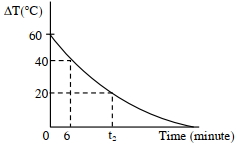
\(T - T _{0}=\left( T _{ i }- T _{0}\right) e ^{-\frac{ Bt }{ ms }}\)\(6 \lambda=\ln 1.5\)
\(40=60 \,e ^{-\lambda(6)} \Rightarrow 6 \lambda=\ln 1.5\)
\(20=60 \,e ^{-\lambda t _{2}} \Rightarrow t _{2} \lambda=\ln 3\)
\(\frac{ t _{2}}{6}=\frac{\ln 3}{\ln 1.5}\)
\(\therefore t _{2}=16.25 min\)
So \(\approx 16\)
-
- (A) ફક્ત \(A, B\) અને \(C\)
- (B) ફક્ત \(A\) અને \(B\)
- (C) ફક્ત \(A\) અને \(C\)
- (D) ફક્ત \(B, C\) અને \(D\)
જવાબ અને ઉકેલ જુઓ
સાચો જવાબ: (A)
Heat TransferA. by Newton's low of colling \(\frac{d \theta}{d t}=\propto \Delta T\)
B. \(H =\frac{d \theta}{d t}=\sigma e AT ^{4} \Rightarrow \frac{ H _{ P }}{ H _{Q}}=\left(\frac{ T _{ P }}{ T _{Q}}\right)^{4}=\left(\frac{283}{293}\right)^{4}\)
\(H _{ p }: H _{ Q }=1(1.03)^{4}=1:(1.03)^{4}=1: 1.15\) \(\Rightarrow B\) is correct
C. \(\eta=1-\frac{100}{400}=\frac{3}{4}=75 \%\)
D. is wrong as \(\frac{d \theta}{d t} \propto \Delta T\)
-
- (A) \(10\)
- (B) \(8\)
- (C) \(12.5\)
- (D) \(2\)
જવાબ અને ઉકેલ જુઓ
સાચો જવાબ: (B)
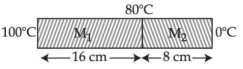
\(\Delta T \propto R \propto \frac{\ell}{ k }\),\(\frac{\Delta T _{1}}{\Delta T _{2}}=\frac{\ell_{1}}{ k _{1}} \times \frac{ k _{2}}{\ell_{2}}=\frac{16}{ k _{1}} \times \frac{ k }{8}\)
\(\frac{20}{80}=\frac{16}{ k _{1}} \times \frac{ k }{8} \rightarrow k _{1}=8 k\)
- 572. \(\vec{A}\) એવી સદિશ રાશિ છે કે \(|\vec{A}|=\) અશૂન્ય અચળાંક છે. નીચેનામાંથી ક્યું સમીકરણ \(\vec{A}\) માટે સાચું છે? 2022 સરળ
- (A) \(\overrightarrow{ A }\cdot \overrightarrow{ A }=0\)
- (B) \(\overrightarrow{ A } \times \overrightarrow{ A }<0\)
- (C) \(\overrightarrow{ A } \times \overrightarrow{ A }=0\)
- (D) \(\overrightarrow{ A } \times \overrightarrow{ A }>0\)
જવાબ અને ઉકેલ જુઓ
સાચો જવાબ: (C)
\(|\overrightarrow{ A }| \neq 0\)\(\overrightarrow{ A } \times \overrightarrow{ A }=|\overrightarrow{ A }||\overrightarrow{ A }| \sin 0^{\circ} \hat{ n }=0\)
-
- (A) \(\sin ^{-1}\left(\frac{3}{5}\right)\)
- (B) \(\sin ^{-1}\left(\frac{1}{3}\right)\)
- (C) \(\cos ^{-1}\left(\frac{3}{5}\right)\)
- (D) \(\cos ^{-1}\left(\frac{1}{3}\right)\)
જવાબ અને ઉકેલ જુઓ
સાચો જવાબ: (C)
\(\left(a^{2}+b^{2}+2 a b \cos \theta\right)=4\left(a^{2}+b^{2}-2 a b \cos \theta\right)\)put \(a\) = \(b\) we get
\(2 a^{2}+2 a^{2} \cos \theta=8 a^{2}-8 a^{2} \cos \theta\)
\(\cos \theta=\frac{3}{5}\)
-
- (A) \(42\)
- (B) \(47\)
- (C) \(19\)
- (D) \(4\)
જવાબ અને ઉકેલ જુઓ
સાચો જવાબ: (B)
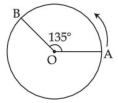
\(d = R \theta\)\(60= R \left(\frac{3 \pi}{4}\right)\)
\(R =\frac{60 \times 4}{3 \pi}=\frac{80}{\pi} m\)
Displacement \(=\sqrt{ R ^{2}+ R ^{2}-2 R ^{2} \cos 135}\)
\(\Rightarrow \sqrt{2 R ^{2}-2 R ^{2}(-0.7)}\)
\(\Rightarrow \sqrt{3.4 R ^{2}}=\sqrt{3.4\left(\frac{80}{\pi}\right)^{2}}\)
\(\approx 47\,m\)
- 575. એકબીજા સાથે \(\theta\) કોણ બનાવતા બે એકમ સદિશો \(\hat{A}\) અને \(\hat{B}\) માટે નીચેનામાંથી કયો સંબંધ સાચો છે \(?\) 2022 અઘરું
- (A) \(|\hat{ A }+\hat{ B }|=|\hat{ A }-\hat{ B }| \tan \frac{\theta}{2}\)
- (B) \(|\hat{ A }-\hat{ B }|=|\hat{ A }+\hat{ B }| \tan \frac{\theta}{2}\)
- (C) \(|\hat{ A }+\hat{ B }|=|\hat{ A }-\hat{ B }| \cos \frac{\theta}{2}\)
- (D) \(|\overrightarrow{ A }-\hat{ B }|=|\overrightarrow{ A }+\hat{ B }| \cos \frac{\theta}{2}\)
જવાબ અને ઉકેલ જુઓ
સાચો જવાબ: (B)
\(|\hat{ A }+\hat{ B }|=\sqrt{|\hat{ A }|^{2}+|\hat{ B }|^{2}+2|\hat{ A } \| \hat{ B }| \cos \theta}\)\(=\sqrt{1+1+2 \cos \theta}\)
\(=\sqrt{2(1+\cos \theta)}\)
\(=\sqrt{2 \times 2 \cos ^{2} \frac{\theta}{2}}\)
\(=2 \cos \frac{\theta}{2}\)
\(|\hat{ A }-\hat{ B }|=\sqrt{|\hat{ A }|^{2}+|\hat{ B }|^{2}-2|\hat{ A }||\hat{ B }| \cos \theta}\)
\(=\sqrt{2-2 \cos \theta}\)
\(=2 \sin \frac{\theta}{2}\)
\(\frac{|\hat{ A }+\hat{ B }|}{|\hat{ A }-\hat{ B }|}=\cot \frac{\theta}{2}\)
- 576. જો \(2 \hat{i}+4 \hat{j}-2 \hat{k}\) નો \(\hat{i}+2 \hat{j}+\alpha \hat{k}\) પરનો પ્રક્ષેપ શૂન્ય હોય, તો \(\alpha\) નું મૂલ્ય ........... હશે. 2022 અઘરું
- (A) \(2\)
- (B) \(3\)
- (C) \(5\)
- (D) \(4\)
જવાબ અને ઉકેલ જુઓ
સાચો જવાબ: (C)
\(\overrightarrow{ a } \cdot \overrightarrow{ b }=0\)\(\therefore \overrightarrow{ a } \cdot \overrightarrow{ b }=0\)
\(\therefore 2 \times 1+4 \times 2-2 \times \alpha=0\)
\(\therefore \alpha=5\)
-
- (A) \(2\)
- (B) \(1\)
- (C) \(3\)
- (D) \(4\)
જવાબ અને ઉકેલ જુઓ
સાચો જવાબ: (A)
\(\overrightarrow{ A }=(2 \hat{ i }+3 \hat{ j }-\hat{ k }) m \text { and } \overrightarrow{ B }=(\hat{ i }+2 \hat{ j }+2 \hat{ k }) m\)Component of \(\overrightarrow{ A }\) along \(\overrightarrow{ B }=\overrightarrow{ A } \cdot \hat{ B }\)
\(=\frac{\overrightarrow{ A } \overrightarrow{ B }}{|\overrightarrow{ B }|}\) \(=\frac{2+6-2}{\sqrt{1^{2}+2^{2}+2^{2}}}\)
\(=\frac{6}{3}=2\)
આ પેજ પર આ ફિલ્ટર મુજબ કોઈ પ્રશ્ન નથી.