


પ્રશ્નો
36 પ્રશ્નો36 માંથી 1–36 પ્રશ્નો
-
- (A) \(10\)
- (B) \(20\)
- (C) \(15\)
- (D) \(25\)
જવાબ અને ઉકેલ જુઓ
સાચો જવાબ: (B)
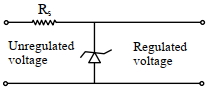
When unregulated voltage is \(14\, {V}\) voltage acrosszener diode must be \(10\, {V}\) So potential difference
across resistor \(\Delta {V}_{{Rs}}=4\, {V}\)
and \({P}_{\text {zener }}=2\, {W}\)
\({VI}=2\)
\({I}=\frac{2}{10}=0.2\, {A}\)
\(\Delta {V}_{{Rs}}={I} {R}_{{s}}\)
\(4 \times 0.2 {R}_{s} \Rightarrow {R}_{5}=\frac{40}{2}=20\, \Omega\)
-
- (A)
\(A\) \(B\) \(Y\) \(0\) \(0\) \(1\) \(0\) \(1\) \(0\) \(1\) \(0\) \(1\) \(1\) \(1\) \(0\) - (B)
\(A\) \(B\) \(Y\) \(0\) \(0\) \(0\) \(0\) \(1\) \(1\) \(1\) \(0\) \(1\) \(1\) \(1\) \(0\) - (C)
\(A\) \(B\) \(Y\) \(0\) \(0\) \(0\) \(0\) \(1\) \(1\) \(1\) \(0\) \(0\) \(1\) \(1\) \(1\) - (D)
\(A\) \(B\) \(Y\) \(0\) \(0\) \(1\) \(0\) \(1\) \(0\) \(1\) \(0\) \(0\) \(1\) \(1\) \(1\)
જવાબ અને ઉકેલ જુઓ
સાચો જવાબ: (D)
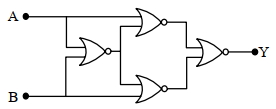
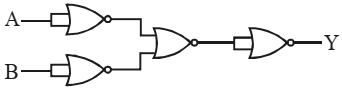
\(y=\overline{(A+\overline{A+B})+(\overline{B+\overline{A+B})}}\)\(y=(A+\overline{A+B}) \cdot(B+\overline{A+B})\)
\(A\) \(B\) \(Y\) \(0\) \(0\) \(1\) \(0\) \(1\) \(0\) \(1\) \(0\) \(0\) \(1\) \(1\) \(1\) 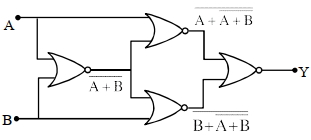
- (A)
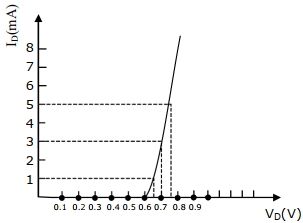
- 3. આકૃતિમાં ફોરવર્ડ બાયસની લાક્ષણિક્તા દર્શાવેલ છે, તો \({I}_{{D}}=3 \,{mA}\) પ્રવાહે અવરોધ (\(\Omega\) માં) કેટલો હશે?
 2021 મધ્યમ
- (A) \(25\)
- (B) \(30\)
- (C) \(35\)
- (D) \(40\)
જવાબ અને ઉકેલ જુઓ
સાચો જવાબ: (A)
\(R_{d}=\frac{d V}{d i}=\frac{1}{\frac{d i}{d v}}=\frac{1}{\frac{(5-1) \times 10^{-3}}{0.75-0.65}}\)\(\frac{100}{4}=25\, \Omega\)
-
- (A) \(3.75\)
- (B) \(2.35\)
- (C) \(2\)
- (D) \(2.73\)
જવાબ અને ઉકેલ જુઓ
સાચો જવાબ: (C)
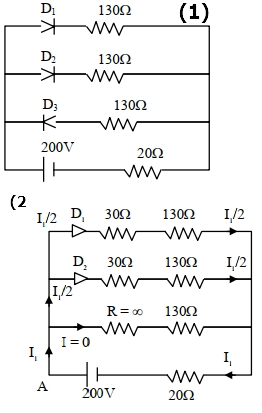
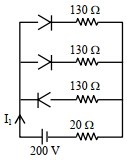
As per diagram,Diode \({D}_{1} \& {D}_{2}\) are in forward bias i.e. \({R}=30 \,\Omega\)
whereas diode \({D}_{3}\) is in reverse bias i.e. \({R}=\) infinite
\(\Rightarrow\) Equivalent circuit will be
Applying \(KVL\) starting from point \(A\)
\(-\left(\frac{{I}_{1}}{2}\right) \times 30-\left(\frac{{I}_{1}}{2}\right) \times 130-{I}_{1} \times 20+200=0\)
\(\Rightarrow-100 {I}_{1}+200=0\)
\({I}_{1}=2\)
-
- (A)
\(A\) \(B\) \(Y\) \(0\) \(0\) \(0\) \(0\) \(1\) \(1\) \(1\) \(0\) \(0\) \(1\) \(1\) \(1\) - (B)
\(A\) \(B\) \(Y\) \(0\) \(0\) \(1\) \(0\) \(1\) \(0\) \(1\) \(0\) \(1\) \(1\) \(1\) \(1\) - (C)
\(A\) \(B\) \(Y\) \(0\) \(0\) \(0\) \(0\) \(1\) \(0\) \(1\) \(0\) \(0\) \(1\) \(1\) \(1\) - (D)
\(A\) \(B\) \(Y\) \(0\) \(0\) \(0\) \(0\) \(1\) \(1\) \(1\) \(0\) \(1\) \(1\) \(1\) \(1\)
જવાબ અને ઉકેલ જુઓ
સાચો જવાબ: (B)
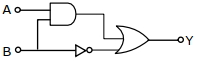
\(Y=A \cdot B+\bar{B}\)\(A\) \(B\) \(Y\) \(0\) \(0\) \(1\) \(0\) \(1\) \(0\) \(1\) \(0\) \(1\) \(1\) \(1\) \(1\) 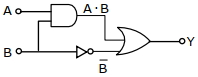
- (A)
-
- (A) \(5\)
- (B) \(2\)
- (C) \(4\)
- (D) \(1\)
જવાબ અને ઉકેલ જુઓ
સાચો જવાબ: (A)
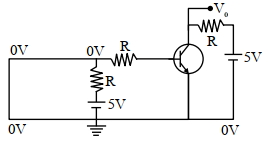
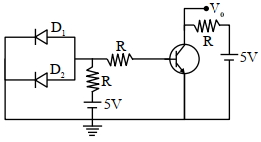
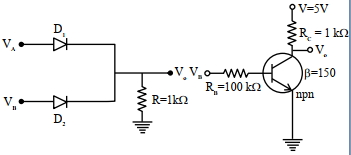
As diodes \({D}_{1}\) and \({D}_{2}\) are in forward bias, so they acted as neligible resistances\(\Rightarrow\) Input voltage become zero
\(\Rightarrow\) Input current is zero
\(\Rightarrow\) Output current is zero
\(\Rightarrow {V}_{0}=5 \text { volt }\)
-
- (A) \(XOR\) ગેટ
- (B) \(NAND\) ગેટ
- (C) \(AND\) ગેટ
- (D) \(NOR\) ગેટ
જવાબ અને ઉકેલ જુઓ
સાચો જવાબ: (B)
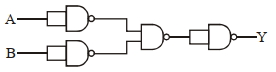
By De Morgan's theorem, we have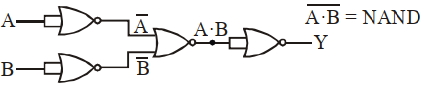
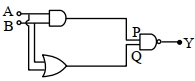
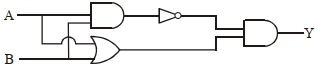
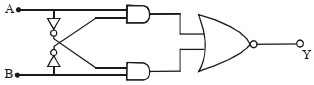
- 8. આપેલ લોઝિક પરિપથના \({A}, {B}\) ના ઈનપુટના મૂલ્યો \((0,0),(0,1),(1,0)\) અને \((1,1)\). તો આઉટપુટ \(Y\) નો ક્રમ કેવો હશે?
 2021 મધ્યમ
- (A) \(1,0,1,0\)
- (B) \(0,1,0,1\)
- (C) \(1,1,1,0\)
- (D) \(0,0,1,1\)
જવાબ અને ઉકેલ જુઓ
સાચો જવાબ: (C)
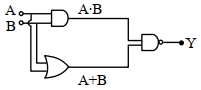
\({Y}=\overline{({A} \cdot {B}) \cdot({A}+{B})}\)\({Y}_{(0,0)}=1\)
\({Y}_{(0,1)}=1\)
\({Y}_{(1,0)}=1\)
\({Y}_{(1,1)}=0\)
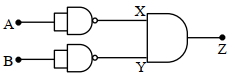
-
- (A) \(OR\)
- (B) \(AND\)
- (C) \(NOR\)
- (D) \(NAND\)
જવાબ અને ઉકેલ જુઓ
સાચો જવાબ: (C)
\(A\) \(B\) \(X\) \(Y\) \(Z\) \(1\) \(1\) \(0\) \(0\) \(0\) \(1\) \(0\) \(0\) \(1\) \(0\) \(0\) \(1\) \(1\) \(0\) \(0\) \(0\) \(0\) \(1\) \(1\) \(1\) -
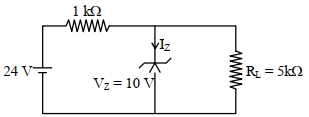
- (A) \(140\)
- (B) \(120\)
- (C) \(260\)
- (D) \(160\)
જવાબ અને ઉકેલ જુઓ
સાચો જવાબ: (B)
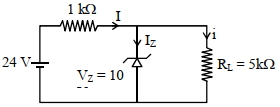
\({i}=\frac{10 {V}}{5 {k} \Omega}=2 \,{mA}\)\({I}=\frac{14 {V}}{1 {k} \Omega}=14 \,{mA}\)
\(\therefore {I}_{z}=12\, {mA}\)
\(\therefore {P}={I}_{z} {V}_{z}=120\, {mW}\)
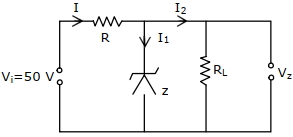
-
- (A) \(100\)
- (B) \(1000\)
- (C) \(500\)
- (D) \(50\)
જવાબ અને ઉકેલ જુઓ
સાચો જવાબ: (C)
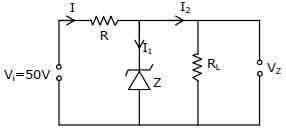
Voltage across \({R}_{{L}}=5\, {V}\)\(\Rightarrow {i}_{2}=\frac{5}{{R}_{{L}}}\)
Also voltage across \({R}=50-5=45\) \(volt\)
By \(v=i R \Rightarrow R=\frac{v}{i}=\frac{45}{i_{1}+i_{2}}\)
\({R}=\frac{45}{90 {m} {A}+\frac{5}{{R}_{{L}}}}\)
Current in zener diode is maximum when \({R}_{{L}} \rightarrow \infty\)
\(\left(i_{2} \rightarrow 0\right.\) and \(\left.i_{i}=i\right)\)
So \({R}=\frac{45}{90 {mA}}=500 \,\Omega\)
- 12. આપેલ પરિપથમાં રહેલા ઝેનર ડાયોડનો પાવર \(x \times 10^{-1}\;watt\) હોય તો \(x\)નું મૂલ્ય નજીકના પૂર્ણાંકમાં કેટલું હશે?
 2021 મધ્યમ
- (A) \(5\)
- (B) \(4\)
- (C) \(2\)
- (D) \(6\)
જવાબ અને ઉકેલ જુઓ
સાચો જવાબ: (A)
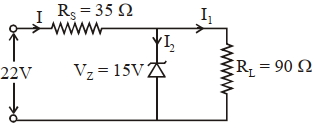
Voltage across \(R _{ S }=22-15=7 V\)Current through \(R _{ S }= I =\frac{7}{35}=\frac{1}{5} A\)
Current through \(90 \Omega= I _{2}=\frac{15}{90}=\frac{1}{6} A\)
Current through zener \(=\frac{1}{5}-\frac{1}{6}=\frac{1}{30} A\)
Power through zener diode
\(P = VI\)
\(P =15 \times \frac{1}{30}=0.5 watt\)
\(P =5 \times 10^{-1} watt\)
-
- (A) \(NOR\) ગેટ
- (B) \(NAND\) ગેટ
- (C) \(AND\) ગેટ
- (D) \(XOR\) ગેટ
જવાબ અને ઉકેલ જુઓ
સાચો જવાબ: (D)
Conceptual -
- (A) \(5\)
- (B) \(10\)
- (C) \(15\)
- (D) \(20\)
જવાબ અને ઉકેલ જુઓ
સાચો જવાબ: (A)
\(n _{ e } n _{ h }= n _{ i }^{2}\)\(n _{ e }=\frac{ n _{ i }^{2}}{ n _{ h }}=\frac{\left(1.5 \times 10^{16}\right)^{2}}{4.5 \times 10^{22}}\)
\(=\frac{1.5 \times 1.5 \times 10^{32}}{4.5 \times 10^{22}}\)
\(5 \times 10^{9} / m ^{3}\)
-
- (A) \(p\)-પ્રકારનાં અર્ધવાહકમાં ફર્મી સ્તર ઉપર ખસે છે અને \(n\)-પ્રકારનાં અર્ધવાહકમાં ફર્મી સ્તર નીચે ખસે છે.
- (B) \(p\)-પ્રકારનાં અર્ધવાહકમાં ફર્મી સ્તર નીચે ખસે છે અને \(n\)-પ્રકારનાં અર્ધવાહકમાં ફર્મી સ્તર ઉપર ખસે છે.
- (C) બંને \(p\)-પ્રકાર અને \(n\)-પ્રકારનાં અર્ધવાહક માટે જ્યારે \(T > T _{ F }\) \(K\) હશે ત્યારે ફર્મી સ્તર ઉપર ખસે છે અને \(T < T _{ F } K\) હશે ત્યારે ફર્મી સ્તર નીચે ખસે છે, જ્યાં \(T _{ F }\) એ ફર્મી તાપમાન દર્શાવે છે.
- (D) \(p\)- અને \(n\) પ્રકારનાં અર્ધવાહકમાં ફર્મી સ્તરને કોઈ અસર થતી નથી.
જવાબ અને ઉકેલ જુઓ
સાચો જવાબ: (B)
conceptual -
- (A) \(5\)
- (B) \(10\)
- (C) \(25\)
- (D) \(30\)
જવાબ અને ઉકેલ જુઓ
સાચો જવાબ: (C)
\(\beta=\frac{ I _{ C }}{ I _{ B }}=24\)\(R _{ C }=1000\)
\(\Delta V =0.6\)
\(I _{ C }=\frac{0.6}{1000}\)
\(I _{ C }=6 \times 10^{-4}\)
\(I _{ B }=\frac{ I _{ C }}{\beta}=\frac{6 \times 10^{-4}}{24}=25 \mu A\)
-
- (A) \(1\)
- (B) \(4\)
- (C) \(2\)
- (D) \(0.5\)
જવાબ અને ઉકેલ જુઓ
સાચો જવાબ: (C)
Band gap \(=\frac{h c}{\lambda_{0}}\)Where \(\lambda_{0}=\) threshold wavelength
Band gap \(=\frac{1242\, {ev}-\,{nm}}{621\, {nm}}=2\, {ev}\)
-
- (A) \(1046\, nm\) અને લાલ રંગ
- (B) \(654\, nm\) અને નારંગી રંગ
- (C) \(1046\, nm\) અને વાદળી રંગ
- (D) \(654\, nm\) અને લાલ રંગ
જવાબ અને ઉકેલ જુઓ
સાચો જવાબ: (D)
\(\lambda=\frac{ hc }{ E }=\frac{6.6 \times 10^{-34} \times 3 \times 10^{8}}{1.9 \times 1.6 \times 10^{-19}}=6.54 \times 10^{-7}\)\(=654 nm\)
Red color
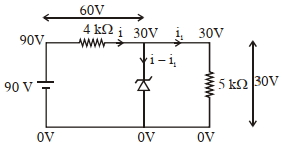
- 19. ઝેનર ડાયોડ માટે \(V _{ z }=30\, V\) છે. નીચે જણાવેલ પરિપથ માટે ડાયોડમાંથી પસાર થતો પ્રવાહ ....... \(mA\) છે.
 2021 અઘરું
- (A) \(3\)
- (B) \(9\)
- (C) \(12\)
- (D) \(18\)
જવાબ અને ઉકેલ જુઓ
સાચો જવાબ: (B)
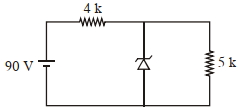
\(i =\frac{60}{4000} \,A\)\(i _{1}=\frac{30}{5000} \,A\)
\(i - i _{1}=\frac{60}{4000}-\frac{30}{5000}=\frac{9}{1000}\, A\)
current from zener diode
\(i _{z}= i - i _{1}=9\, m A\)
-
- (A) \(123\)
- (B) \(456\)
- (C) \(192\)
- (D) \(219\)
જવાબ અને ઉકેલ જુઓ
સાચો જવાબ: (C)
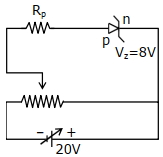
\(P=V i\)\(0.5=8 i\)
\(i=\frac{1}{16}\, A\)
\(E=20=8+i R_{p}\)
\(R_{P}=12 \times 16=192\, \Omega\)
- 21. જો એમીટર પ્રવાહ \(4\, mA\) જેટલો બદલવામાં આવે તો કલેકટર પ્રવાહ \(3.5\, mA\) જેટલો બદલાય છે. \(\beta\) નું મૂલ્ય ........... 2021 મધ્યમ
- (A) \(7\)
- (B) \(0.5\)
- (C) \(0.875\)
- (D) \(3.5\)
જવાબ અને ઉકેલ જુઓ
સાચો જવાબ: (A)
\(I _{\varepsilon}= I _{ C }+ I _{ B }\)\(\Rightarrow \Delta I _{\varepsilon}=\Delta I _{ C }+\Delta I _{ B }\)
\(4 mA =3.5 mA +\Delta I _{ B }\)
\(\Rightarrow \Delta I _{ B }=0.5 mA\)
\(\Rightarrow \beta=\frac{\Delta I _{ C }}{\Delta I _{ B }}\)
\(\beta=\frac{3.5}{0.5}\)
\(\Rightarrow \beta=7\)
-
- (A) \(AND\) and \(OR\) Gate
- (B) \(OR\) and \(NOT\) Gate
- (C) \(NAND\) and \(NOR\) Gate
- (D) \(AND\) and \(NOT\) Gate
જવાબ અને ઉકેલ જુઓ
સાચો જવાબ: (B)
\({V}_{{A}}=5 {V} \Rightarrow {A}=1\)\({V}_{{A}}=0 {V} \Rightarrow {A}=0\)
\({V}_{{B}}=5 {V} \Rightarrow {B}=1\)
\({V}_{{B}}=0 {V} \Rightarrow {B}=0\)
If \({A}={B}=0\), there is no potential anywhere here \({V}_{0}=0\)
If \({A}=1, {B}=0\), Diode \({D}_{1}\) is forward biased, here \({V}_{0}=5 {V}\)
If \({A}=0, {B}=1\), Diode \({D}_{2}\) is forward biased hence \({V}_{0}=5 {V}\)
If \({A}=1, {B}=1\), Both diodes are forward biased hence \({V}_{0}=5 {V}\)
Truth table for \({I}^{{st}}\)
\(A\) \(B\) Output \(0\) \(0\) \(0\) \(0\) \(1\) \(1\) \(1\) \(0\) \(1\) \(1\) \(1\) \(1\) \(\therefore\) Given circuit is \(OR\) gate
For \(\mathbb{I}^{{Id}}\) circuit
\({V}_{{B}}=5 {V}, {A}=1\)
\({V}_{{B}}=0 {V}, {A}=0\)
When \({A}=0, {E}-{B}\) junction is unbiased there is no current through it
\(\therefore {V}_{0}=1\)
When \({A}=1, {E}-{B}\) junction is forward biased
\({V}_{0}=0\)
\(\therefore\) Hence this circuit is not gate.
-
- (A) \(200\)
- (B) \(400\)
- (C) \(100\)
- (D) \(169\)
જવાબ અને ઉકેલ જુઓ
સાચો જવાબ: (A)
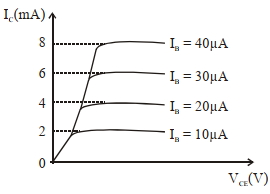
\(\beta=\frac{\Delta I _{ C }}{\Delta I _{ B }}=\frac{2 \times 10^{-3}}{10 \times 10^{-6}}\)\(\beta=\frac{1}{5} \times 10^{3}\)
\(\beta=2 \times 10^{2}\)
\(\beta=200\)
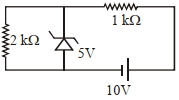
- 24. નીચે આપેલ જોડાણ માટે \(2\, k \Omega\) અવરોધમાં વહેતા પ્રવાહનું મૂલ્ય ............ \(\times 10^{-4} A\)
 2021 મધ્યમ
- (A) \(30\)
- (B) \(15\)
- (C) \(25\)
- (D) \(12\)
જવાબ અને ઉકેલ જુઓ
સાચો જવાબ: (C)
Current through \(2 k \Omega\) resistance\(I=\frac{5}{2 \times 10^{3}}=2.5 \times 10^{-3} A\)
\(I =25 \times 10^{-4} A\)
Ans. \(25\)
-
- (A) \(0.15\)
- (B) \(0.05\)
- (C) \(0.1\)
- (D) \(25\)
જવાબ અને ઉકેલ જુઓ
સાચો જવાબ: (D)
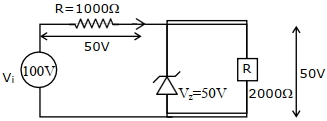
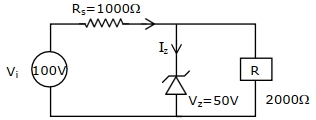
\(I=\frac{50}{1000}=50\, {mA}\)\({R}=1000 \,\Omega\)
\(I=\frac{50}{2000}=25\, m A\)
\(I_{z}=I_{1000}-I_{2000}\)
\(=50-25=25\, {mA}\)
-
- (A) વિધાન \(I\) ખોટું પણ વિધાન \(II\) સાચું છે.
- (B) બંને વિધાન \(I\) અને વિધાન \(II\) સાચાં છે.
- (C) બંને વિધાન \(I\) અને વિધાન \(II\) ખોટાં છે.
- (D) વિધાન \(I\) સાચું પણ વિધાન ખોટું છે.
જવાબ અને ઉકેલ જુઓ
સાચો જવાબ: (A)
Back to back diode will not the make a transistor\(\beta=\frac{ i _{c}}{ i _{ b }}\)
-
- (A) \(NOR\) ગેટ
- (B) \(OR\) ગેટ
- (C) \(AND\) ગેટ
- (D) \(NAND\) ગેટ
જવાબ અને ઉકેલ જુઓ
સાચો જવાબ: (A)
Truth table for the given logic gate :\(A\) \(B\) \(Y\) \(0\) \(0\) \(1\) \(0\) \(1\) \(1\) \(1\) \(0\) \(1\) \(1\) \(1\) \(0\) The truth table is similar to that of a NOR gate.
-
- (A)
\(A\) \(B\) \(Y\) \(0\) \(0\) \(0\) \(0\) \(1\) \(1\) \(1\) \(0\) \(1\) \(1\) \(1\) \(0\) - (B)
\(A\) \(B\) \(Y\) \(0\) \(0\) \(1\) \(0\) \(1\) \(0\) \(1\) \(0\) \(0\) \(1\) \(1\) \(1\) - (C)
\(A\) \(B\) \(Y\) \(0\) \(0\) \(1\) \(0\) \(1\) \(0\) \(1\) \(0\) \(1\) \(1\) \(1\) \(0\) - (D)
\(A\) \(B\) \(Y\) \(0\) \(0\) \(0\) \(0\) \(1\) \(1\) \(1\) \(0\) \(0\) \(1\) \(1\) \(1\)
જવાબ અને ઉકેલ જુઓ
સાચો જવાબ: (B)
\(y=\overline{(A \bar{B}+\bar{A} B)}\)\(y=\overline{A \bar{B}} \cdot \overline{\bar{A} B}\)
\(y=(\bar{A}+B) \cdot(A+\bar{B})\)
\(y=\bar{A} \cdot A+\bar{A} \bar{B}+A \cdot B+B \bar{B}\)
\(y=A B+\bar{A} \bar{B}\)
\(A\) \(B\) \(Y = AB +\overline{ A } \overline{ B }\) \(0\) \(0\) \(1\) \(0\) \(1\) \(0\) \(1\) \(0\) \(0\) \(1\) \(1\) \(1\) - (A)
-
- (A) \(400\)
- (B) \(100\)
- (C) \(121\)
- (D) \(169\)
જવાબ અને ઉકેલ જુઓ
સાચો જવાબ: (B)
\(10^{6}=\beta^{2} \times \frac{ R _{0}}{ R _{ i }}\)\(10^{6}=\beta^{2} \times \frac{10^{4}}{10^{2}}\)
\(\beta^{2}=10^{4} \Rightarrow \beta=100\)
- 30. \(p-n\) જંક્શન ડાયોડમાં ઝેનર બ્રેકડાઉન ત્યારે થાય છે જ્યારે \(p\) અને \(n\) બંને ....... . 2021 મધ્યમ
- (A) ખૂબ ઓછી અશુધ્ધિવાળા અને તેમને પહોળો ડિપ્લીશન સ્તર હોય છે.
- (B) ખૂબ વધારે અશુધ્ધિવાળા અને પાતળો ડિપ્લીશન સ્તર હોય છે.
- (C) ખૂબ ઓછી અશુધ્ધિવાળા હોય છે અને તેમને પાતળો ડિપ્લીશન લેયર હોય છે.
- (D) ખૂબ વધારે અશુધ્ધિવાળા અને પહોળો ડિપ્લીશન સ્તર હોય છે.
જવાબ અને ઉકેલ જુઓ
સાચો જવાબ: (B)
Zener diode is heavily doped and have narrow depletion layer. -
- (A) \(20\)
- (B) \(40\)
- (C) \(10\)
- (D) \(16\)
જવાબ અને ઉકેલ જુઓ
સાચો જવાબ: (A)
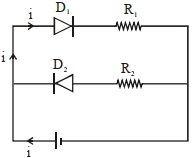
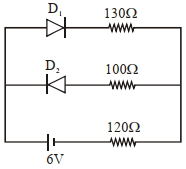
In this circuit \(D _{1}\) will be forward bias and \(D _{2}\) will be revers bias.\(\therefore\) There will be no current through \(D _{2}\) and \(R _{2}\)
Apply \(KVL\) in circuit we get \(+6-50 i -130 i -120 i =0\)
\(i =\frac{6}{300} A =\frac{6}{300} \times 1000 mA\)
\(\Rightarrow 20 mA\)
-
- (A) \((a)-(ii), (b)-(iv), (c)-(i), (d)-(iii)\)
- (B) \((a)-(iii), (b)-(iv), (c)-(i), (d)-(ii)\)
- (C) \((a)-(ii), (b)-(i), (c)-(iv), (d)-(iii)\)
- (D) \((a)-(ii), (b)-(i), (c)-(iii), (d)-(iv)\)
જવાબ અને ઉકેલ જુઓ
સાચો જવાબ: (A)
\((a)\) Rectifier \(\rightarrow AC\) to \(DC\)\((b)\) Stabilizer \(\rightarrow\) used for constant output voltage even when input voltage or current change.
\((c)\) Transformer \(\rightarrow\) Step - up or step - down ac voltage.
\((d)\) Filter \(\rightarrow\) used to remove any ripple in the rectified output voltage.
-
- (A) \(220\)
- (B) \(110\)
- (C) \(440\)
- (D) \(880\)
જવાબ અને ઉકેલ જુઓ
સાચો જવાબ: (C)
\(\frac{ N _{ P }}{ N _{ S }}=\frac{ V _{ P }}{ V _{ S }}\)\(\frac{ N _{ P }}{24}=\frac{220}{12}\)
\(N _{ P }=\frac{220 \times 24}{12}\)
\(N _{ P }=440\)
-
- (A) વિધાન \(-I\) સાચું છે પરંતુ વિધાન \(-II\) ખોટું છે
- (B) વિધાન \(-I\) ખોટું છે પરંતુ વિધાન \(-II\) સાચું છે
- (C) બંને વિધાન \(-I\) અને વિધાન \(-II\) ખોટા છે
- (D) બંને વિધાન \(-I\) અને વિધાન \(-II\) સાચાં છે.
જવાબ અને ઉકેલ જુઓ
સાચો જવાબ: (D)
To convert pulsating de into steady dc both of mentioned method are correct. -
- (A) વિધાન\(-I\) સાચું પરંતુ વિધાન\(-II\) ખોટું છે.
- (B) વિધાન\(-I\) ખોટું પરંતુ વિધાન\(-II\) સાચું છે.
- (C) વિધાન\(-I\) અને વિધાન\(-II\) બંને સાચા છે.
- (D) વિધાન\(-I\) અને વિધાન\(-II\) બંને ખોટા છે.
જવાબ અને ઉકેલ જુઓ
સાચો જવાબ: (A)
Pentavalent activities have excess free \({e}^{-}\)So \({e}^{-}\)density increases but overall semiconductor is neutral.
-
- (A) \(0.5\)
- (B) \(1.5\)
- (C) \(0.86\)
- (D) \(0.43\)
જવાબ અને ઉકેલ જુઓ
સાચો જવાબ: (D)
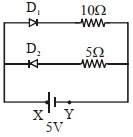
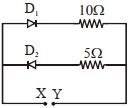
Here only \(D_{1}\) will work and we know for silicon diode, potential drop on \(D _{1}\) will be \(0.7 V\)\(I=\frac{5-0.7}{10}=0.43 A\)
આ પેજ પર આ ફિલ્ટર મુજબ કોઈ પ્રશ્ન નથી.