


પ્રશ્નો
16 પ્રશ્નો16 માંથી 1–16 પ્રશ્નો
-
- (A) \(13.3\)
- (B) \(12\)
- (C) \(10\)
- (D) \(13\)
જવાબ અને ઉકેલ જુઓ
સાચો જવાબ: (C)
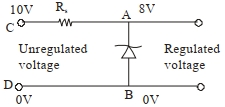
\(V_b=8 \text { volt }\)\(V_A-V_B=8 \text { volt }\)
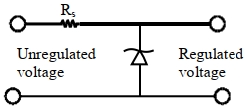
Current through zener diode,
\(i =\frac{ P }{ V }=\frac{1.6 W }{8 V }=0.2\,A\)
\(V _{ C }- V _{ A }=10-8 \text { volt }\)
\(\therefore R =\frac{ V _{ C }- V _{ A }}{ i }=\frac{2 V }{0.2 A }=10\,\Omega\)
[Note : A zener diode can regulate only if input voltage is \(\geq\) zener breakdown voltage the range of input voltage should be \(8\) to \(10\,V\) so that output voltage remains constant \(=8\,V\) ]
-
- (A) \(1.5\)
- (B) \(1\)
- (C) \(2.5\)
- (D) \(2\)
જવાબ અને ઉકેલ જુઓ
સાચો જવાબ: (A)
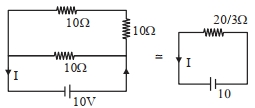
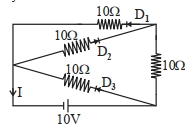
In the circuit \(D_1\) and \(D_3\) are forward biased and \(D_2\) is reverse biased.\(\therefore I =\frac{10}{20 / 3}=\frac{3}{2}\,A =1.5\,A\)
-
- (A) \(6\)
- (B) \(9\)
- (C) \(3\)
- (D) \(12\)
જવાબ અને ઉકેલ જુઓ
સાચો જવાબ: (C)
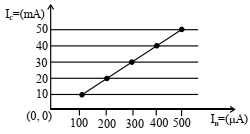
Power gain\(\Rightarrow A _{ V } \cdot A _1= B \frac{ R _{ C }}{ R _{ B }} \cdot B = B ^2 \frac{ R _{ C }}{ R _{ B }}\)
\(=\left(\frac{(20-10) \times 10^{-3}}{(200-100) \times 10^{-6}}\right) \times \frac{1 \times 10^3}{10 \times 10^3}=10^3\)
Hence \(x =3\)
-
- (A) \(OR\)
- (B) \(NAND\)
- (C) \(NOR\)
- (D) \(AND\)
જવાબ અને ઉકેલ જુઓ
સાચો જવાબ: (B)
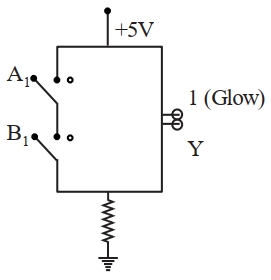
\(Y =\overline{ A _1 \odot B _1}\,\,\,\,NAND\)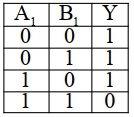
-
- (A) \(AND\)
- (B) \(NOR\)
- (C) \(OR\)
- (D) \(NAND\)
જવાબ અને ઉકેલ જુઓ
સાચો જવાબ: (A)
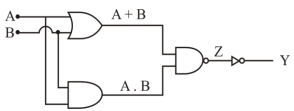
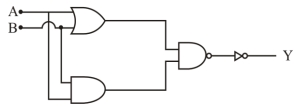
\(Z =\overline{(A+B) \cdot(A \cdot B)}\)\(Y =\bar{Z}=(A+B) \cdot(A \cdot B)\)
\(Y =A \cdot B\)
\(\therefore\) It is an \(AND\) Gate
-
- (A) \(OR\)
- (B) \(NOR\)
- (C) \(NAND\)
- (D) \(AND\)
જવાબ અને ઉકેલ જુઓ
સાચો જવાબ: (B)
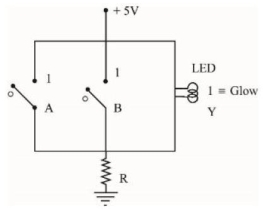
Circuit is closed when neither \(A\) nor \(B\) is closed \(\Rightarrow\) current flows for \(A=0 B=0\) when either or both of \(A\) and \(B\) is closed we get current bypass from switchHence it is "\(NOR\)" gate
- 7. અર્ધવાહકમાં, કન્ડકશન બેન્ડમાંના ઈલેકટ્રોન \(\left(n_e\right)\) અને તેના અવરોધ ઉપર તાપમાનના વધારાની અસર \(..............\) છે. 2023 મધ્યમ
- (A) \(n _{ e }\) અને અવરોધ બંને ધટશે.
- (B) \(n _e\) ધટશે, અવરોધ વધશે.
- (C) \(n _{ e }\) વધશે, અવરોધ ધટશે
- (D) \(n _{ e }\) ધટશે, અવરોધ વધશે.
જવાબ અને ઉકેલ જુઓ
સાચો જવાબ: (C)
As temperature increases, more electron excite to conduction band and hence conductivity increases, therefore resistance decreases. -
- (A) \(C\) અને \(D\)
- (B) \(A\)
- (C) \(C\)
- (D) \(B\)
જવાબ અને ઉકેલ જુઓ
સાચો જવાબ: (C)
\(LED\) works in forward biasing and light energy maybe slightly less or equal to band gap. -
- (A) \((A) \rightarrow I, (B) \rightarrow II, (C) \rightarrow III, (D) \rightarrow IV\)
- (B) \((A) \rightarrow II, (B) \rightarrow I, (C) \rightarrow III, (D) \rightarrow IV\)
- (C) \((A) \rightarrow II, (B) \rightarrow III, (C) \rightarrow I, (D) \rightarrow IV\)
- (D) \((A) \rightarrow III, (B) \rightarrow I, (C) \rightarrow II, (D) \rightarrow IV\)
જવાબ અને ઉકેલ જુઓ
સાચો જવાબ: (B)
Based on theory. -
- (A) \(110\)
- (B) \(0.9\)
- (C) \(210\)
- (D) \(9\)
જવાબ અને ઉકેલ જુઓ
સાચો જવાબ: (A)
Current gain in common emitter transistor\(\beta=\frac{\Delta I _{ C }}{\Delta I _{ B }}=\frac{16 mA -5 mA }{200 \mu A -100 \mu A }=\frac{11 mA }{100 \mu A }=110\)
-
- (A) \((A)\) અને \((R)\) બંને સાચાં છે અને \((R)\) એ \((A)\) ની સાચી સમજણ આપે છે.
- (B) \((A)\) અને \((R)\) બંને સાચાં છે અને \((R)\) એ \((A)\) ની સાચી સમજણ આપતું નથી.
- (C) \((A)\) સાયું છે પણ \((R)\) ખોટું છે.
- (D) \((A)\) ખોટું છે પણ \((R)\) સાચું છે.
જવાબ અને ઉકેલ જુઓ
સાચો જવાબ: (C)
In forward biased condition, diffusion of majority charge carriers takes place from \(p\)-side to \(n\)-side which constitute the diffusion current. -
- (A) \(A\) ખોટું છે પણ \(R\) સાચું છે.
- (B) બંને \(A\) અને \(R\) સાચાં છે, પણ \(R\) એ \(A\) ની સાયી સમજૂતી આપતું નથી
- (C) \(A\) સાચું છે પણ \(R\) ખોટું નથી.
- (D) બંને \(A\) અને \(R\) સાચાં છે \(R\) એ \(A\) ની સાચી સમજૂતી આપે છે.
જવાબ અને ઉકેલ જુઓ
સાચો જવાબ: (B)
Photodiodes are operated in reverse bias as fractional change in current due to light is more easy to detect in reverse bias. -
- (A) બંંને \(A\) અને \(R\) સાચા છે, \(R\) એ \(A\) ની સાચી સમજૂતી આપે છે.
- (B) બંને \(A\) અને \(R\) સાચા છે, પણ \(R\) એ \(A\) ની સાચી સમજૂતી આપતું નથી.
- (C) \(A\) ખોટું અને \(R\) સાચું છે.
- (D) \(A\) સાચું અને \(R\) ખોટું છે.
જવાબ અને ઉકેલ જુઓ
સાચો જવાબ: (C)
Theory based Photodiodes are operated in reverse bias condition. For \(P - N\) junction current in forward bias (for \(\left.V \geq V_0\right)\) is always greater than current in reverse bias \(\left(\right.\) for \(V \leq V _{ z }\) ) Hence Assertion if false but Reason is true -
- (A) બંંને કથન \(I\) અને કથન \(II\) ખોટા છે.
- (B) કથન \(I\) ખોટું છે. પણ કથન \(II\) સાચું છે.
- (C) બંંને કથન \(I\) અને કથન \(II\) સાચાં છે.
- (D) કથન \(I\) સાચું છે. પણ કથન \(II\) ખોટું છે.
જવાબ અને ઉકેલ જુઓ
સાચો જવાબ: (D)
Statement\(-I\) is correctWhen \(P-N\) junction is formed an electric field is generated form \(N\)-side to \(P\)-side due to which barrier potential arises \& majority charge carrier can not flow through the junction due to barrier potential so current is \(zero\) unless we apply forward bias voltage.
- 15. નીચેના પરિપથમાં પ્રત્યેક ડાયોડનો ફોરવર્ડ બાયસ અવરોધ \(25\,\Omega\) છે. નીચેના વિકલ્પોમાથી ક્યો વિકલ્પ સાચો છે?
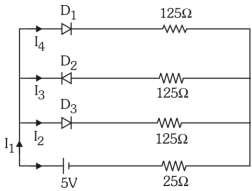 2023 મધ્યમ
- (A) \(\frac{ I _3}{ I _4}=1\)
- (B) \(\frac{ I _2}{ I _3}=1\)
- (C) \(\frac{I_1}{I_2}=1\)
- (D) \(\frac{I_1}{I_2}=2\)
જવાબ અને ઉકેલ જુઓ
સાચો જવાબ: (D)
\(R _{ eq }=\frac{150 \times 150}{300}+25=100 \Omega\)\(I _1=\frac{5}{10}=0.05\,A\)
\(I _2= I _4=\frac{0.05}{2}=0.025\,A\)
\(\frac{ I _1}{ I _2}=2\)
-
- (A) \(I _b=1.0\,\mu A\)
- (B) \(I _{ b }=0.10\,\mu A\)
- (C) \(I_b=100\,\mu A\)
- (D) \(I _{ b }=10\,\mu A\)
જવાબ અને ઉકેલ જુઓ
સાચો જવાબ: (D)
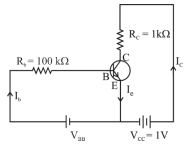
Considering the transistor in saturation mode\(V _{ CE }=0\)
Using KVL
\(-I_c R_c+V_{c c}=0\)
\(I_c=\frac{V_{ cC }}{R_c}=\frac{1}{1 \times 10^3}\)
\(I_c=10^{-3}\,A\)
\(\beta=\frac{I_c}{I_b}\)
\(I_b=\frac{10^{-3}}{100} \Rightarrow 10^{-5}\,A \Rightarrow I_b=10\,\mu A\)
આ પેજ પર આ ફિલ્ટર મુજબ કોઈ પ્રશ્ન નથી.