


All JEE Mains 2013 Physics questions
28 chaptersShowing 101–131 of 131 questions
-
- (A) Statement \(- 1\) is true, Statement \(-2\) is true and
Statement \(-2\) is the correct explanation of Statement \(-1\) - (B) Statement \(-1\) is true, Statement \(-2\) is false.
- (C) Statement \(-1\) is true, Statement \(-2\) is true but
Statement \(-2\) is not the correct explanation of Statement \(-1\) - (D) Statement \(-1\) is false, Statement \(-2\) is true
Show answer and solution
Correct Answer: (C)
Internal energy of a system is the energy possessed by the system due to molecular motion and molecular configuration.Internal energy \(u=u_{k}+u_{p}\)
For an ideal gas there is no molecular attraction \(u_{p}=0\)
\(\therefore\) Internal energy \(\mathrm{u}=\mathrm{u}_{\mathrm{k}}\)
\((i.e.,\, internal\, kinetic\, energy)\)
and \(u=u_{k}=\frac{3}{2} \mu R T\)
At constant pressure \((\Delta \mathrm{Q})_{\mathrm{P}}=\mu \mathrm{C}_{\mathrm{p}} \Delta \mathrm{T}\)
At constant volume \((\Delta \mathrm{Q})_{\mathrm{v}}=\mu \mathrm{C}_{\mathrm{v}} \Delta \mathrm{T}\)
\(\mathrm{AsC}_{\mathrm{P}}>\mathrm{C}_{\mathrm{V}} \quad \therefore \quad(\Delta \mathrm{T})_{\mathrm{P}}<(\Delta \mathrm{T})_{\mathrm{V}}\)
- (A) Statement \(- 1\) is true, Statement \(-2\) is true and
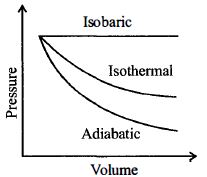
- 102. A sample of gas expands from \(V_1\) to \(V _2\). In which of the following, the work done will be greatest ?
 2013 Medium
- (A) Same in all processes
- (B) Isobaric process
- (C) Isothermal process
- (D) Adiabatic process
Show answer and solution
Correct Answer: (B)
Work done \(=\) Area bounded by \(PV\) graph and volume axis
Among the three process, bounded area by \(PV\) graph and volume axis is greatest for isobaric process, hence work done is greatest for isobaric process -
- (A) \(1.5\)
- (B) \(1.4\)
- (C) \(1.3\)
- (D) \(1.6\)
Show answer and solution
Correct Answer: (B)
Volume of the gas\(v=\frac{m}{d}\) and
using \(P V^{7}=\) constant
\(\frac{P^{\prime}}{P}=\frac{V}{V^{\prime}}=\left(\frac{d^{\prime}}{d}\right)^{\gamma}\)
\(\alpha 128=(32)^{\gamma}\)
\(\gamma=\frac{7}{5}=1.4\)
-
- (A) \(4P_0V_0\)
- (B) \(P_0V_0\)
- (C) \(\left( {\frac{{13}}{2}} \right)\) \( P_0V_0\)
- (D) \(\;\left( {\frac{{11}}{2}} \right)\) \( P_0V_0\)
Show answer and solution
Correct Answer: (C)
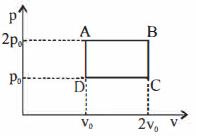
\(Heat\,given\,to\,system = {\left( {n{C_V}\Delta T} \right)_{A \to B}} + {\left( {n{C_P}\Delta T} \right)_{B \to C}}\)\( = {\left[ {\frac{3}{2}\left( {nR\Delta T} \right)} \right]_{A \to B}} + {\left[ {\frac{5}{2}\left( {nR\Delta T} \right)} \right]_{B \to C}}\)
\( = {\left[ {\frac{3}{2} \times {V_0}\Delta P} \right]_{A \to B}} + \left[ {\frac{5}{2} \times 2{P_0} \times {V_0}} \right]\)
\( = \frac{{13}}{2}{P_0}{V_0}\)
-
- (A) \(580\)
- (B) \(590\)
- (C) \(600\)
- (D) \(610\)
Show answer and solution
Correct Answer: (B)
As \(1\, g\) of steam at \(100\,^oC\) melts \(8\,g\) of ice at \(0\,^oC\). \(10\, g\) of steam will melt \(8\times10\, g\) of ice at \(0\,^oC\) Water in calorimeter \(\,= 500 + 80 + 10\,g\, = 590\,g\) -
- (A) \(2.0\)
- (B) \(7\)
- (C) \(3\)
- (D) \(0.5\)
Show answer and solution
Correct Answer: (D)
As the surrounding is identical, vessel is identical time taken to cool both water and liquid\(\left( {from\,{{30}^ \circ }C\,to\,{{25}^ \circ }C} \right)\) is same \(2\,minutes,\) therefore\({\left( {\frac{{dQ}}{{dt}}} \right)_{water}} = {\left( {\frac{{dQ}}{{dt}}} \right)_{liquid}}\)
\(or,\frac{{\left( {{m_w}{C_w} + W} \right)\Delta T}}{t} = \frac{{\left( {{m_\ell }{C_\ell } + W} \right)\Delta T}}{t}\)
\(\left( {W = water\,equivalent\,of\,the\,vessel} \right)\)
\(or,\,\,{m_w}{C_w} = {m_\ell }{C_\ell }\)
\(\therefore Specific\,heat\,of\,liquid,\,{C_\ell } = \frac{{{m_W}{C_W}}}{{{m_\ell }}}\)
\( = \frac{{50 \times 1}}{{100}} = 0.5\,kcal/kg\)
-
- (A) \(-73.7\)
- (B) \(-233.7\)
- (C) \(-86.3\)
- (D) \(-106.3\)
Show answer and solution
Correct Answer: (C)
\(Reading\,on\,any\,scale-LFP\)\(UFP-LFP\)
\(=constant\,for\,all\,scales\)
\(\frac{{340 - 273}}{{373\left| { - 273} \right.}} = \frac{{^ \circ y - \left( { - 160} \right)}}{{ - 50 - \left( { - 160} \right)}}\)
\( \Rightarrow \frac{{67}}{{100}} = \frac{{y + 160}}{{110}}\)
\(\therefore \,\,\,y = - {86.3^ \circ }\,y\)
-
- (A) \(2 : 5\)
- (B) \(1:4\)
- (C) \(1 : 64\)
- (D) \(1 : 8\)
Show answer and solution
Correct Answer: (B)
When there is no charge in liquid level in vessel then \(\gamma {'_{real}} = y{'_{vessel}}\)Change in volume in liquid relative to vessel
\(\Delta {V_{app}} = V\gamma {'_{app}}\Delta \theta = V\left( {\gamma {'_{real}} - \gamma {'_{vessel}}} \right)\)
-
- (A) \(1.75\)
- (B) \(2\)
- (C) \(1.50\)
- (D) \(1.25\)
Show answer and solution
Correct Answer: (D)
\({Y_c} \times \left( {\Delta {L_c}/{L_c}} \right) = {Y_s} \times \left( {\Delta {L_s}/{L_s}} \right)\)\( \Rightarrow 1 \times {10^{11}} \times \left( {\frac{{1 \times {{10}^{ - 3}}}}{1}} \right) = 2 \times {10^{11}} \times \left( {\frac{{\Delta {L_s}}}{{0.5}}} \right)\)
\(\therefore \Delta {L_s} = \frac{{0.5 \times {{10}^{ - 3}}}}{2} = 0.25\,mm\)
Therefore, total extension of the composite
\(wire = \Delta {L_c} + \Delta {L_s}\)
\( = 1\,mm + 0.25\,m = 1.25\,m\)
-
- (A) \(1.0\times 10^{-4}\)
- (B) \(1.5\times 10^{-4}\)
- (C) \(0.25\times 10^{-4}\)
- (D) \(5\times 10^{-4}\)
Show answer and solution
Correct Answer: (C)
\(Given,\,y = 2 \times {10^{11}}N{m^{ - 2}}\)\(Stress\left( {\frac{F}{A}} \right) = 5 \times {10^7}N{m^{ - 2}}\)
\(\Delta V = 0.02\% = 2 \times {10^{ - 4}}{m^3}\)
\(\frac{{\Delta r}}{r} = ?\)
\(\gamma = \frac{{stress}}{{strain}} \Rightarrow strain\left( {\frac{{\Delta \ell }}{{{\ell _0}}}} \right) = \frac{\gamma }{{stress}}\,\,...\left( i \right)\)
\(\Delta V = 2\pi {\ell _0}\Delta r - \pi {r^2}\Delta \ell \) \(...\left( {ii} \right)\)
From eqns \((i)\) and \((ii)\) putting the value of
\(\Delta \ell ,{\ell _0}\,and\,\Delta V\,and\,solving\,we\,get\)
\(\frac{{\Delta r}}{r} = 0.25 \times {10^{ - 4}}\)
-
- (A) \(\frac{{3c}}{{2a{b^2}}}\)
- (B) \(\frac{{2{a^2}c}}{b}\)
- (C) \(\frac{{3a}}{{2{b^2}c}}\)
- (D) \(\frac{{2ac}}{{{b^2}}}\)
Show answer and solution
Correct Answer: (C)
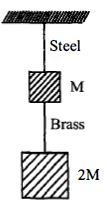
According to questions,\(\frac{{{\ell _s}}}{{{\ell _b}}} = a,\frac{{{r_s}}}{{{r_b}}} = b,\frac{{{y_s}}}{{{y_b}}} = c,\frac{{\Delta \ell s}}{{\Delta {\ell _b}}} = ?\)
\(As,y = \frac{{F\ell }}{{A\Delta \ell }} \Rightarrow \Delta \ell = \frac{{F\ell }}{{Ay}}\)
\(\Delta {\ell _s} = \frac{{3mg{\ell _s}}}{{\pi _s^2.{y_s}}}\left[ {{F_s} = \left( {M + 2M} \right)g} \right]\)
\(\Delta {\ell _b} = \frac{{2Mg{\ell _b}}}{{\pi r_b^2{y_b}}}\left[ {{F_b} = 2Mg} \right]\)
\(\therefore \frac{{\Delta {\ell _s}}}{{\Delta {\ell _b}}} = \frac{{\frac{{3Mg{\ell _s}}}{{\pi r_s^2.{y_s}}}}}{{\frac{{2Mg.{\ell _b}}}{{\pi {b^2}.{y_b}}}}} = \frac{{3a}}{{2{b^2}C}}\)
-
- (A) \(\frac{{2mg}}{{3A}}\)
- (B) \(\frac{{4mg}}{{3A}}\)
- (C) \(\frac{{mg}}{{A}}\)
- (D) \(\frac{{3mg}}{{4A}}\)
Show answer and solution
Correct Answer: (B)
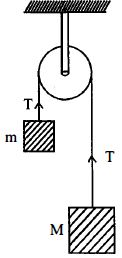
Tension in the wire, \(T = \left( {\frac{{2mM}}{{m + M}}} \right)g.\)\(Stress = \frac{{Force/Tension}}{{Area}} = \frac{{2mM}}{{A\left( {m + M} \right)}}g\)
\( = \frac{{2\left( {m \times 2m} \right)g}}{{A\left( {m + 2m} \right)}}\left( {M = 2m\,given} \right)\)
\( = \frac{{4{m^2}}}{{3mA}}g = \frac{{4mg}}{{3A}}\)
-
- (A) \(\frac{{2T}}{{\rho L}}\)
- (B) \(\;\frac{{\rho L}}{T}\)
- (C) \(\sqrt {\;\frac{T}{{\rho L}}} \)
- (D) \(\;\frac{T}{{\rho L}}\)
Show answer and solution
Correct Answer: (A)
When radius is decrease by \(\Delta R,\)\(4\pi {R^2}\Delta R\rho L = 4\pi T\left[ {{R^2} - {{\left( {R - \Delta R} \right)}^2}} \right]\)
\( \Rightarrow \rho {R^2}\Delta RL = T\left[ {{R^2} - {R^2} + 2R\Delta R - \Delta {R^2}} \right]\)
\( \Rightarrow \rho {R^2}\Delta RL = T2R\Delta R\,\,\left[ {\Delta R\,is\,very\,small} \right]\)
\( \Rightarrow R = \frac{{2T}}{{\rho L}}\)
-
- (A) Statement \(- 1\) is true, Statement \(-2\) is true; Statement \(-2\) is not the correct explanation for Statemer \(- 1\)
- (B) Statement \(-1\) is false, Statement \(-2\) is true
- (C) Statement \(- 1\) is true, Statement \(-2\) is false
- (D) Statement \(- 1\) is true, Statement \(-2\) is true; Statement \(-2\) is the correct explanation for Statement \(- 1\)
Show answer and solution
Correct Answer: (B)
Surface tension of a liquid decreases with the rise in temperture. At the boiling point of liquid, surface tension is zero.\(Capillary\,rise\,h = \frac{{2T\cos \theta }}{{rdg}}\)
As surface tension \(T\) decreases with rise in temperature hence capillary rise also decreases.
-
- (A) \(\theta \) increases and \(h\) also increases
- (B) \(\theta \) decreases and \(h\) also decreases
- (C) \(\theta \) increases and \(h\) decreases
- (D) \(\theta \) decreases and \(h\) increases
Show answer and solution
Correct Answer: (C)
Angle of contact \(\theta \)\(\cos \theta = \frac{{{T_{SA}} - {T_{SL}}}}{{{T_{LA}}}}\)
when water is on a waxy or oily surface
\({T_{SA}} < {T_{SL}}\cos \theta \,is\,negative\,i.e.,\)
\({90^ \circ } < \theta < {180^ \circ }\)
\(i.e.,\,angle\,of\,contact\,\theta \,increases\)
\(And\,for\,\theta > {90^ \circ }\,liquid\,level\,in\,capillary\,tube\)
\(fall.\,i.e.,\,h\,decreases\)
-
- (A) \(2.95\)
- (B) \(5.18\)
- (C) \(8.65\)
- (D) \(0.0\)
Show answer and solution
Correct Answer: (B)
Lengths of \(M\) and \(N\) are \((40-y)\) and \((40+y)\) respecively.\(P_1=\) Preessure of par \(M\)
\(P_2=\) Pressure of part \(N\)
As temperature is constant
Therefore, we can write \(PV =\) constant
For \(M : P_0(40 A)=P_1(40-y) A\)
\(\Rightarrow P_1=\frac{P_0(40)}{(40-y)} \ldots \ldots .(\text { i })\)
For \(N : P_0(40 A)=P_2(40+y) A\)
\(\Rightarrow P_2=\frac{P_0 40}{(40+y)}\)
Here \(A=\) area of cross section of tube
Pressure at lower face \(\left(P_1\right)=\) Pressure at upper face \(\left(P_2\right)+\) Pressure due to mercury column of height \(20 cm\).
\(P_1=P_2=20 pg\)
Use (i) and (ii) in (iii)
\(P_0 \frac{40}{(40-y)}=\frac{P_0 40}{(40+y)}+20 p g\)
\(\frac{40 P_0}{(40-y)}-\frac{40 P_0}{(40+y)}=20 p g\)
\(40 \times 76 p g\left[\frac{2 y}{1600-y^2}\right]=20 p g\)
\((52)(2 y)=1600-y^2\)
\(304 y=1600-y^2\)
\(y^2+304 y-1600=0\)
Solving for \(y\), we get \(y=5.18\; cm\)
-
- (A) \(\frac{{Mg}}{k}\)
- (B) \(\;\frac{{Mg}}{k}\left( {1 - \frac{{LA\sigma }}{M}} \right)\)
- (C) \(\;\frac{{Mg}}{k}\left( {1 - \frac{{LA\sigma }}{{2M}}} \right)\)
- (D) \(\;\frac{{Mg}}{k}\left( {1 + \frac{{LA\sigma }}{M}} \right)\)
Show answer and solution
Correct Answer: (C)
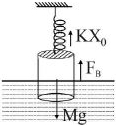
From figure, \(k{x_0} + {F_B} = Mg\)\(k{x_0} + \sigma \frac{L}{2}Ag = Mg\)
\(\left[ {mass = density \times volume} \right]\)
\( \Rightarrow k{x_0} = Mg - \sigma \frac{L}{2}Ag\)
\( \Rightarrow {x_0} = \frac{{Mg - \frac{{\sigma LAg}}{2}}}{k} = \frac{{Mg}}{k}\left( {1 - \frac{{LA\sigma }}{{2M}}} \right)\)
-
- (A) \(60\)
- (B) \(180\)
- (C) \(7500\)
- (D) \(12500\)
Show answer and solution
Correct Answer: (C)
Pressure difference\({P_2} - {P_1} = \frac{1}{2}\rho \left( {v_2^2 - v_1^2} \right)\)
\( = \frac{1}{2} \times 1.2\left( {{{\left( {150} \right)}^2} - {{\left( {100} \right)}^2}} \right)\)
\( = \frac{1}{2} \times 1.2\left( {22500 - 10000} \right)\)
\( = 7500\,N{m^{ - 2}}\)
-
- (A) \(5\)
- (B) \(0\)
- (C) \(10\)
- (D) \(20\)
Show answer and solution
Correct Answer: (C)
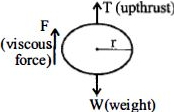
Weight of the body\(W = mg = \frac{4}{3}\pi {r^3}\rho g\)
\(T = \frac{4}{3}\pi {r^3}\sigma g\)
\(and\,F = 6\pi \eta vr\)
When the body attains terminal velocity net force acting on the body is zero \(i.e.,\)
\(W - T - F = 0\)
And terminal velocity \(v = \frac{2}{9}\frac{{{r^2}\left( {\rho - \sigma } \right)}}{\eta }g\)
As in case of upward motion upward force is twice its effective weight, therefore, it will move with same speed \(10cm/s\)
-
- (A) \(\frac{12}{5}\,W\)
- (B) \(\frac{5}{12}\,W\)
- (C) \(\frac{13}{5}\,W\)
- (D) \(\frac{13}{12}\,W\)
Show answer and solution
Correct Answer: (D)
\(\begin{array}{l}
PQ = \sqrt {O{P^2} + O{Q^2}} \\
= \sqrt {{{13}^2} + {5^2}} = 12\\
Tension\,in\,the\,string\,T,\,so,\,T\cos \theta = w\\
\Rightarrow T = \frac{w}{{\cos \theta }} = \frac{{13}}{{12}}W
\end{array}\)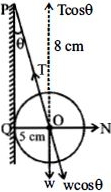
-
- (A) \(144\)
- (B) \(96\)
- (C) \(240\)
- (D) \(192\)
Show answer and solution
Correct Answer: (D)
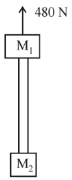
\(\begin{array}{l}
Acceleration\,produced\,in\,upward\,direction\\
a = \frac{F}{{{M_1} + {M_2} + Mass\,of\,metal\,rod}}\\
= \frac{{480}}{{20 + 12 + 8}} = 12\,m{s^{ - 2}}\\
Tension\,at\,the\,mid\,{\rm{point}}\,\\
T = \left( {{M_2} + \frac{{Mass\,of\,rod}}{2}} \right)a\\
\,\,\,\, = \left( {12 + 4} \right) \times 12 = 192N
\end{array}\) -
- (A) \(6.73\times 10^{-5}\,m/s^2\)
- (B) \(6.73\times 10^{-3}\,m/s^2\)
- (C) \(6.73\times 10^{-2}\,m/s^2\)
- (D) \(6.73\times 10^{-4}\,m/s^2\)
Show answer and solution
Correct Answer: (A)
During solar eclipse, the sun and moon will be on the same side of the earth and during lunar eclipse, the moon and the sun will be exactly on the earth’s opposite sides.So the gravitational force acting on earth due to sun will add up with the gravitational force acting on earth due to moon during solar eclipse and the gravitational forces will subtract with each other during lunar eclipse.
Let \(F_S\) be the gravitational force between earth and sun and \(F_L\) be the gravitational force between earth and moon.
Also, the acceleration of earth during solar and lunar eclipse can be derived from Newton’s second law,
\(F=ma\)........(1)
During solar eclipse, eqn (1) will be
\(m.{a_s} = {F_s} + {F_L} \to \left( 2 \right)\)
During lunar ecllpse, eqn \((1)\) will be
\(m.{a_L} = {F_s} - {F_L} \to \left( 3 \right)\)
Here, \(a_s\) and \(a_L\) are the acceleration of earth towards sun during solar and lunar ecllpse respectlvely and \(m\) is the mass of earth.
So the change in acceleration of earth toward sun from solar to lunar ecllpse perlod, can be found, can be found by subtracting eqn \((2)\) from eqn \((3)\)
\(m\left( {{a_s} - {a_L}} \right) = {F_s} + {F_L} - {F_s} + {F_L}\)
\(\therefore m\left( {{a_s} - {a_L}} \right) = 2{F_L} \to \left( 4 \right)\)
Here,
\({F_L} = G\frac{{m.{M_L}}}{{{D^2}}}\)
Where \(G\) is the gravltational constant, \(m\) is the mass of earth, \(ML\) is the mass of moon, and \(D\) is the distance between moon and earth.
\(D\) is equal to the orbital radlus of moon.
So the eqn \((4)\) becomes,
\(\left( {{a_s} - {a_L}} \right) = 2G\frac{{{M_L}}}{{{D^2}}} \to \left( 5 \right)\)
Now, substitute the glven values in eqn \((5)\),
\({M_L} = 7.36 \times {10^{22}}\,kg\)
\(D = 3.8 \times {10^8}\,m\)
Gravltational constant value, \(G = 6.67 \times {10^{ - 11}}N.{m^2}.k{g^{ - 2}}\)
\(\left( {{a_s} - {a_L}} \right) = 2 \times 6.67 \times {10^{ - 11}} \times \frac{{7.36 \times {{10}^{22}}}}{{{{\left( {3.8 \times {{10}^8}} \right)}^2}}}\)
\(\left( {{a_s} - {a_L}} \right) = 6.799 \times {10^{ = 11 + 22 - 16}}\)
\(\left( {{a_s} - {a_L}} \right) = 6.799 \times {10^{ - 5}}m/{s^2}\)
-
- (A) \(\frac{5}{6}\,\frac{{GM}}{{{x^2}}}\)
- (B) \(\frac{8}{9}\,\frac{{GM}}{{{x^2}}}\)
- (C) \(\frac{7}{8}\,\frac{{GM}}{{{x^2}}}\)
- (D) \(\frac{6}{7}\,\frac{{GM}}{{{x^2}}}\)
Show answer and solution
Correct Answer: (C)
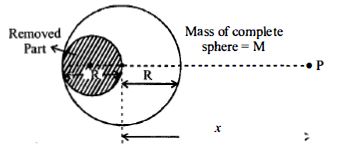
Let mass of smaller sphere (which has to be removed) is m\(Radius = \frac{R}{2}\left( {from\,figure} \right)\)
\(\frac{M}{{\frac{4}{3}\pi {R^3}}} = \frac{m}{{\frac{4}{3}\pi {{\left( {\frac{R}{2}} \right)}^3}}}\)
\( \Rightarrow m = \frac{M}{8}\)
Mass of the left over part of the sphere
\(M' = M - \frac{M}{8} = \frac{7}{8}M\)
Therefore gravitational filed due to the left over part of the sphere
\( = \frac{{GM'}}{{{x^2}}} = \frac{7}{8}\frac{{GM}}{{{x^2}}}\)
-
- (A) Zero
- (B) \(1\)
- (C) \(\frac{{144}}{{25}}\)
- (D) \(\frac{{25}}{{144}}\)
Show answer and solution
Correct Answer: (B)
From question,\({E_x} = 5\,N/kg\,and\,{E_y} = 12\,N/kg\)
Gravitational potential
\(=Gravitational\, field\times\,distance\)
\(\therefore {V_{\left( {12m,0} \right)}} = {E_x} \times 12\,J/kg\)
\(and\,{V_{\left( {0.5m} \right)}} = {E_y} \times 5\,\,J/kg\)
\(\left( {Give\,:\,potential\,at\,the\,origin\,is\,zero} \right)\)
\(\therefore \frac{{{V_{\left( {12\,m,0} \right)}}}}{{{V_{\left( {0,5m} \right)}}}} = \frac{{{E_x} \times 12}}{{{E_y} \times 5}} = \frac{{5 \times 12}}{{12 \times 5}} = 1\)
-
- (A) \(\frac{{GmM}}{{3R}}\;\;\;\;\;\;\;\;\;\;\;\;\;\;\;\;\;\;\;\;\;\;\;\;\)
- (B) \(\;\frac{{5GmM}}{{6R}}\)
- (C) \(\;\frac{{2GmM}}{{3R}}\)
- (D) \(\;\frac{{GmM}}{{2R}}\)
Show answer and solution
Correct Answer: (B)
Applying energy conservation\(k + \left( { - \frac{{GMm}}{R}} \right) = \frac{1}{2}mv_0^2 + \left( { - \frac{{GMm}}{{R + h}}} \right)\)
\(k - \frac{{GMm}}{R} = \frac{1}{2}m\left( {\frac{{Gm}}{{R + 2R}}} \right) - \frac{{GMm}}{{R + 2R}}\)
\(\therefore k = \frac{{5GMm}}{{6R}}\)
-
- (A) \(16\)
- (B) \(1\)
- (C) \(10\)
- (D) \(2\)
Show answer and solution
Correct Answer: (C)
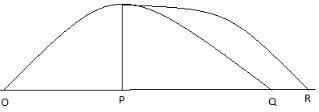
\(OQ=4\;km\)\(QR=x\;km\)
The centre of mass will hit the ground at point \(Q\). As the haviour mass comes to rest after bracking
\({x_{cm}} = \frac{{{m_1}{x_1} + {m_2}{x_2}}}{{{m_1} + {m_2}}}\)
\(\;Here\;{m_{1\;}} = \frac{{3M}}{4},{m_{2\;}} = \frac{M}{4},\;\)\(\;{x_{1\;}} = OP = 2,\;{x_{2\;}} = OR\; = \;4 + x\)
So,
\(4 = \frac{{\frac{{3M}}{4} \times 2 + \frac{M}{4} \times \left( {4 + x} \right)}}{M}\)
\(4M = \frac{{3M}}{2} + M\left( {1 + \frac{x}{4}} \right)1 + \frac{x}{4} \)\(= \frac{5}{2}\frac{x}{4} = \frac{3}{2}x = 6\;km\)
Hence horizontal range of lighter particle is
\(OR = OQ + QR = 4+6 = 10\; km\)
-
- (A) \(v^4\)
- (B) \(v^2\)
- (C) \(v\)
- (D) \(v^3\)
Show answer and solution
Correct Answer: (D)
10.Power \(=\mathrm{F} \bullet \mathrm{v}=\mathrm{Fv} F=v\left(\frac{d m}{d t}\right)=v\left\{\frac{d(\rho \times \text {volume})}{d t}\right\}\)\(=\rho v\left\{\frac{d(v o l u m e)}{d t}\right\}=\rho v(A v)=\rho A v^{2} \therefore\) 10.Power \(P=\rho A v^{3} \quad\) or \(P=v^{3}\)
-
- (A) Statement \(-1\) is true, Statement \(-2\) is true ; Statement \(-2\) is the correct explanation of Statement \(-1\)
- (B) Statement \(-1\) is true, Statement \(-2\) is true ; Statement \(-2\) is not the correct explanation of Statement \(-1\)
- (C) Statement \(-1\) is false, Statement \(-2\) is true
- (D) Statement \(-1\) is true, Statement \(-2\) is false
Show answer and solution
Correct Answer: (C)
Maximum energy loss \(=\frac{{{P^2}}}{{2m}} - \frac{{{P^2}}}{{2\left( {m + M} \right)}}\)\(\left[ {\because \,K.E. = \frac{{{P^2}}}{{2m}} = \frac{1}{2}m{v^2}} \right]\)
\( = \frac{{2{P^2}}}{{2m}}\left[ {\frac{M}{{\left( {m + M} \right)}}} \right] = \frac{1}{2}m{v^2}\left\{ {\frac{M}{{m + M}}} \right\}\)
Statement II is a case of 12.Perfectly Inelastic Collision.By comparing the equation given in statement I with abpve equation, we get
\(f = \left( {\frac{M}{{m + M}}} \right)\,instead\,of\,\left( {\frac{m}{{M + m}}} \right)\)
Hence statement \(I\) is wrong and statement \(II\) is correct.
-
- (A) \(4.4\)
- (B) \(2.4\)
- (C) \(3.6\)
- (D) \(1.6\)
Show answer and solution
Correct Answer: (B)
\(\begin{array}{l}
As\,ball\,is\,projected\,at\,an\,angle\,{45^{ \circ \,}}to\,the\\
horizontal\,therefore\,Rang = 4H\\
or\,\,\,\,10 = 4H \Rightarrow H\frac{{10}}{4} = 2.5m\\
\left( {Range\, = 4m\, + 6\,m = 10m} \right)\\
Maximum\,height,\,H = \frac{{{u^2}{{\sin }^2}\theta }}{{2g}}\\
\therefore \,{u^2} = \frac{{H \times 2g}}{{{{\sin }^2}\theta }} = \frac{{2.5 \times 2 \times 10}}{{{{\left( {\frac{1}{{\sqrt 2 }}} \right)}^2}}} = 100
\end{array}\)\(\begin{array}{l}
or,\,u = \sqrt {100} = 10\,m{s^{ - 1}}\\
Height\,of\,wall\,PA\\
= OA\,\tan \,\theta - \frac{{1\,g{{\left( {OA} \right)}^2}}}{{2\,{u^2}\,{{\cos }^2}\theta }}\\
= 4 = \frac{1}{2} \times \frac{{10 \times 16}}{{10 \times 10 \times \frac{1}{{\sqrt 2 }} \times \frac{1}{{\sqrt 2 }}}} = 2.4m
\end{array}\)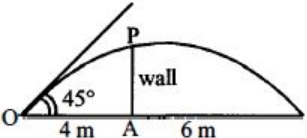
-
- (A) \(y= x- 5x^2\)
- (B) \(y= 2x- 5x^2\)
- (C) \(4y= 2x- 5x^2\)
- (D) \(4y= 2x- 25x^2\)
Show answer and solution
Correct Answer: (B)
\(\begin{array}{l}
\vec u = \hat i + 2\hat j = {u_x}\hat i + {u_y}\hat j \Rightarrow u\cos \theta = 1,\\
u\sin \theta = 2\\
y = x\tan \theta - \frac{1}{2}\frac{{g{x^2}}}{{u_x^2}}\\
\therefore \,y = 2x - \frac{1}{2}g{x^2} = 2x - 5{x^2}
\end{array}\) -
- (A) \(30\)
- (B) \(60\)
- (C) \(75\)
- (D) \(45\)
Show answer and solution
Correct Answer: (B)
\(\frac{u^{2}}{g}=100\)\(\Rightarrow u=20 \mathrm{m} / \mathrm{s}\)
\(t=\frac{2 u \sin \theta}{g}\)
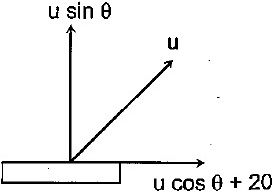
and \(R=(u \cos \theta+20)\left(\frac{2 u \sin \theta}{g}\right)\)
Put \(\frac{d R}{d \theta}=0\)
\(\Rightarrow \cos \theta=1 / 2\)
\(\Rightarrow \theta=60^{\circ}\)
No questions on this page match these filters.