


- JEE Mains 2013
- અઘરું
- MCQ
જ્યારે ચંદ્ર સૂર્ય ગ્રહણથી પૃથ્વી અને સૂર્ય ને જોડતી રેખામાં બીજી બાજુએ આવે ત્યારે પૃથ્વીના સૂર્ય તરફના પ્રવેગમાં કેટલો ફેરફાર થાય? (ચંદનું દળ \(= 7.36 \times 10^{22}\,kg,\) ચંદ્રની ત્રિજ્યા \(= 3 .8 \times 10^8\,m\) ).
જવાબ અને ઉકેલ
(A) \(6.73\times 10^{-5}\,m/s^2\)
પગલાવાર ઉકેલ
વિગતવાર સમજૂતી
So the gravitational force acting on earth due to sun will add up with the gravitational force acting on earth due to moon during solar eclipse and the gravitational forces will subtract with each other during lunar eclipse.
Let \(F_S\) be the gravitational force between earth and sun and \(F_L\) be the gravitational force between earth and moon.
Also, the acceleration of earth during solar and lunar eclipse can be derived from Newton’s second law,
\(F=ma\)........(1)
During solar eclipse, eqn (1) will be
\(m.{a_s} = {F_s} + {F_L} \to \left( 2 \right)\)
During lunar ecllpse, eqn \((1)\) will be
\(m.{a_L} = {F_s} - {F_L} \to \left( 3 \right)\)
Here, \(a_s\) and \(a_L\) are the acceleration of earth towards sun during solar and lunar ecllpse respectlvely and \(m\) is the mass of earth.
So the change in acceleration of earth toward sun from solar to lunar ecllpse perlod, can be found, can be found by subtracting eqn \((2)\) from eqn \((3)\)
\(m\left( {{a_s} - {a_L}} \right) = {F_s} + {F_L} - {F_s} + {F_L}\)
\(\therefore m\left( {{a_s} - {a_L}} \right) = 2{F_L} \to \left( 4 \right)\)
Here,
\({F_L} = G\frac{{m.{M_L}}}{{{D^2}}}\)
Where \(G\) is the gravltational constant, \(m\) is the mass of earth, \(ML\) is the mass of moon, and \(D\) is the distance between moon and earth.
\(D\) is equal to the orbital radlus of moon.
So the eqn \((4)\) becomes,
\(\left( {{a_s} - {a_L}} \right) = 2G\frac{{{M_L}}}{{{D^2}}} \to \left( 5 \right)\)
Now, substitute the glven values in eqn \((5)\),
\({M_L} = 7.36 \times {10^{22}}\,kg\)
\(D = 3.8 \times {10^8}\,m\)
Gravltational constant value, \(G = 6.67 \times {10^{ - 11}}N.{m^2}.k{g^{ - 2}}\)
\(\left( {{a_s} - {a_L}} \right) = 2 \times 6.67 \times {10^{ - 11}} \times \frac{{7.36 \times {{10}^{22}}}}{{{{\left( {3.8 \times {{10}^8}} \right)}^2}}}\)
\(\left( {{a_s} - {a_L}} \right) = 6.799 \times {10^{ = 11 + 22 - 16}}\)
\(\left( {{a_s} - {a_L}} \right) = 6.799 \times {10^{ - 5}}m/{s^2}\)
Physics ના વધુ પ્રશ્નો
- નીચે બે વિધાનો આપેલા છે. વિધન \(I:\) ચલિત ગૂંચળાવાળા ગેલ્વેનોમીટરમાં ગૂંચળાના આંટાની સંખ્યા બમણી કરતાં તેની પ્રવાહ સંવેદિતા બમણી થાય. વિધન \(II\) : ફક્ત ગૂંચળાના આંટાની સંખ્યા વધારીને ચલિત ગૂંયળાવાળા ગેલ્વેનીમીટર પ્રવાહ સંવેદિતા વધારતા તેની વોલ્ટેજ સંવેદિતા પણ તેટલા જ ગુણોત્તર પ્રમાણે વધશે. ઉપર્યુક્ત કથનોના સંદર્ભમાં, નીચે આપેલા વિકલ્પોમાંથી સાયો ઉત્તર પસંદ કરો.JEE Mains 2023 મધ્યમ
- શૂન્યાવકાશમાંથી પ્રસરતા વિદ્યુતચુંબકીય તરંગ માટે, \(\vec{k}\), \(\vec{E}\) અને \(\omega\) અનુક્રમે પ્રસરણ સદિશ, વિદ્યુત ક્ષેત્ર અને કોણીય આવૃત્તિ રજૂ કરે છે. આ તરંગ સાથે સંકળાયેલું ચુંબકીય ક્ષેત્ર શેના દ્વારા રજૂ થાય છે?JEE Mains 2026 મધ્યમ
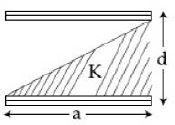
- \(a\) બાજુવાળી ચોરસ પ્લેટોને \(d\) અંતરે રાખી એક સમાંતર પ્લેટ કેપેસિટર બનાવવામાં આવે છે \((d < < a)\) અને આકૃતિમાં બતાવ્યા પ્રમાણે અવાહક એવી રીતે ભરવામાં આવે છે કે જેથી નીચેનો ત્રિકોણ \(K\) જેટલા પરાવૈદ્યુતાંક \((dialectric)\) ધરાવતા અવાહકથી ભરેલો છે. આ કેપેસિટરનું કેપેસિટન્સ __________ છે.
 JEE Mains 2019 અઘરું
- \(2\, kg\) દળનો કોઈ કણ લીસ્સા સમક્ષિતિજ ટેબલ પર છે અને તે \(0.6\, m\) ત્રિજ્યાના વર્તુળાકાર માર્ગ પર ગતિ કરે છે. જમીનથી ટેબલની ઊંચાઈ \(0.8\, m\) છે. જો કણની કોણીય ઝડપ \(12\, rad\, s^{-1}\) હોય તો વર્તુળના કેન્દ્રની એકદમ નીચે જમીન પર કોઈ બિંદુ ને અનુલક્ષીને તેના કોણીય વેગમાનની કિંમત ....... \(kg\, m^2\,s^{-1}\) થાય.JEE Mains 2015 મધ્યમ
- એક દૃઢ દ્રિપરમાણ્વીક આદર્શ વાયુ પૂરતા ઊંચા તાપમાને એક સમોષ્મી પ્રક્રિયામાંથી પસાર થાય છે. આ પ્રક્રિયા માટે તાપમાન અને કદનો સબંધ \(TV^x =\) અચળ છે, તો \(x\) કેટલો હશે?JEE Mains 2019 મધ્યમ
- એક દોરી \(0.40 \mathrm{kgm}^2\) જડત્વની ચાકમાત્રા અને \(10 \mathrm{~cm}\) ત્રિજ્યાવાળા એક પૈડાની ધાર પર વીંટાળેલી છે. પૈડું તેની ધરી ફરતે ભ્રમણ કરવા માટે મુક્ત છે. શરૂઆતમાં પૈડું સ્થિર છે. આ દોરીને હવે \(40 \mathrm{~N}\) ના બળથી ખેંચવામાં આવે છે. \(10\) \(\mathrm{s}\) પછી પૈડાનો કોણીય વેગ \(\mathrm{x} \mathrm{rad} / \mathrm{s}\) છે, જ્યાં \(\mathrm{x}\) _______ છે.JEE Mains 2024 અઘરું
JEE Mains ના વધુ PYQ
- સૂચિ-I ને સૂચિ-II સાથે જોડો
સૂચિ-I સૂચિ-II (A) બોલ્ટઝમેન અચળાંક I. \(\mathrm{ML}^2 \mathrm{~T}^{-1}\) (B) સ્નિગ્ધતા ગુણાંક II. \(\mathrm{MLT}^{-3} \mathrm{~K}^{-1}\) (C) પ્લાન્કનો અચળાંક III. \(\mathrm{ML}^2 \mathrm{~T}^{-2} \mathrm{~K}^{-1}\) (D) ઉષ્મા વાહકતા IV. \(\mathrm{ML}^{-1} \mathrm{~T}^{-1}\)
નીચે આપેલા વિકલ્પોમાંથી સાચો જવાબ પસંદ કરો :JEE Mains 2025 મધ્યમ - XPQY એ R કુલ અવરોધ ધરાવતો એક ઊભો, લીસો અને લાંબો લૂપ છે, જ્યાં PX એ QY ને સમાંતર છે અને તેમની વચ્ચેનું અંતર \(l\) છે. સમગ્ર અવકાશમાં લૂપના સમતલને લંબ એક નિયમિત ચુંબકીય ક્ષેત્ર B અસ્તિત્વ ધરાવે છે. L લંબાઈ (L > \(l\)) અને m દળ ધરાવતો CD સળિયો આકૃતિમાં દર્શાવ્યા મુજબ ગુરુત્વાકર્ષણ હેઠળ સ્થિર સ્થિતિમાંથી નીચે સરકે છે. સળિયા દ્વારા પ્રાપ્ત થતી અંતિમ ઝડપ __________ m/s છે.
(g = ગુરુત્વીય પ્રવેગ) JEE Mains 2026 સરળ
- દરેક \(2 \Omega\) ધરાવતા 12 તારોને જોડીને એક સમઘન બનાવવામાં આવેલ છે. \(a\) અને \(c\) બિંદુઓ વચ્ચે \(6 \mathrm{~V}\) જેટલું \(\mathrm{emf}\) ધરાવતી બેટરીને જોડવામાં આવે છે. \(\mathrm{e}\) અને \(\mathrm{f}\) થી વચ્ચે વોલ્ટેજનો તફ઼ાવત _______ \(\mathrm{V}\) હશે.
 JEE Mains 2024 અઘરું
- એક નદી પશ્ચિમથી પૂર્વ દિશામાં \(9 \mathrm{~km} \mathrm{~h}^{-1}\) ની ઝડપથી વહે છે. જો એક હોડી સ્થિર પાણીમાં મહત્તમ \(27 \mathrm{~km} \mathrm{~h}^{-1}\) ની ઝડપથી ગતિ કરી શકતી હોય, અને તે નદીના પ્રવાહની દિશા સાથે \(150^{\circ}\) ના ખૂણે મહત્તમ ઝડપથી ગતિ કરતી હોય ત્યારે નદીને અડધા મિનિટમાં પાર કરે છે, તો નદીની પહોળાઈ કેટલી હશે?JEE Mains 2025 સરળ
- ધાતુની સીમાંત (થ્રેશોલ્ડ) આવૃત્તિ \(f _0\) છે.જયારે \(2 f _0\) આવૃત્તિ ધરાવતો પ્રકાશ ધાતુની તકતી ઉપર આપાત થાય છે ત્યારે ઈલેક્ટ્રોનનો મહત્તમ વેગ \(v_1\) મળે છે.જયારે આપત વિકિરણની આવૃત્તિ વધારીને \(5f_0\) કરવામાં આવે છે ત્યારે ઉત્સર્જાતા ઈલેક્ટ્રોનનો વેગ \(v_2\) થાય છે.\(v_1\) અને \(v_2\)નો ગુણોતર \(..............\) થશે.JEE Mains 2023 મધ્યમ