


સંતુલન - ૨ ના બધા પ્રશ્નો
નવા પહેલા126 માંથી 101–126 પ્રશ્નો
-
- (A) \(1.9\, g, 0.28\, mol\, L^{-1}\)
- (B) \(13.6\, g, 0.28\, mol\, L^{-1}\)
- (C) \(1.9\, g, 0.14\, mol\, L^{-1}\)
- (D) \(13.6\, g, 0.14\, mol\, L^{-1}\)
જવાબ અને ઉકેલ જુઓ
સાચો જવાબ: (A)
\(\mathop {\mathop {Ca{{(OH)}_2}}\limits_{100\,m\,mol} }\limits_ - + \mathop {\mathop {N{a_2}S{O_4}}\limits_{14\,m\,mol} }\limits_ - \to \mathop {\mathop {CaS{O_4}}\limits_ - }\limits_{14\,m\,mol} + \mathop {\mathop {2NaOH}\limits_ - }\limits_{28\,m\,mol} \)\({w_{CaS{O_4}}} = 14 \times {10^{ - 3}} \times 136 = 1.9\,gm\)
\([O{H^ - }] = \frac{{28}}{{100}} = 0.28\,M\)
-
- (A) \(5.2\)
- (B) \(9\)
- (C) \(5\)
- (D) \(9.4\)
જવાબ અને ઉકેલ જુઓ
સાચો જવાબ: (B)
\(\mathop {\mathop {{H_2}S{O_4}}\limits_{2\,m.m} }\limits_ - + \mathop {\mathop {2N{H_4}OH}\limits_{6\,m.m} }\limits_{2\,m.m} \to \mathop {{{(N{H_4})}_2}S{O_4}}\limits_{2\,m.m} + 2{H_2}O\)\(pOH = 4.7 + \log \frac{4}{2} = 5\)
\(pH = 14 - 5 = 9\)
-
- (A) \(6.23\times10^{-11}\, M\)
- (B) \(1.84\times10^{-9}\, M\)
- (C) \(\frac{{2.49}}{{1.84}} \times {10^{ - 9}}\,M\)
- (D) \(2.49\times10^{-10}\, M\)
જવાબ અને ઉકેલ જુઓ
સાચો જવાબ: (D)
\({K_{sp}}\) of \(Cd{(OH)_2} = 4{s^3} = 4 \times {(1.84 \times {10^{ - 5}})^3}\)If \(pH = 12\)
\(pOH = 2\)
\([O{H^ - }] = {10^{ - 2}}\,M\)
\({K_{sp}} = [C{d^{2 + }}]{[O{H^ - }]^2}\)
\(4 \times {(1.84 \times {10^{ - 5}})^3} = [C{d^{2 + }}]{[O{H^ - }]^2}\)
\([C{d^{2 + }}] = \frac{{4 \times {{(1.84)}^3} \times {{10}^{ - 15}}}}{{{{10}^{ - 4}}}}\)
\(C{d^{2 + }} = 4 \times 6.22 \times {10^{ - 11}} = 2.49 \times {10^{ - 10}}\,M\)
-
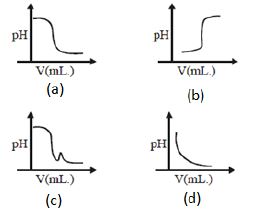
- (A) \((a)\)
- (B) \((c)\)
- (C) \((d)\)
- (D) \((b)\)
જવાબ અને ઉકેલ જુઓ
સાચો જવાબ: (A)
The nature of the curve is such that the \(pH\) change of the reaction becomes larger for very small change in volume of titrant. - 105. જે \(Ag_2CO_3\) નો \(K_{sp}=8 \times10^{-12}\) છે, તો \(0.1\, M\,AgNO_3\) માં \(Ag_2CO_3\) ની મોલર દ્રાવ્યતા કેટલી થાય? 2019 મધ્યમ
- (A) \(8\times 10^{-12}\,M\)
- (B) \(8\times 10^{-11}\,M\)
- (C) \(8\times 10^{-10}\,M\)
- (D) \(8\times 10^{-13}\,M\)
જવાબ અને ઉકેલ જુઓ
સાચો જવાબ: (C)
\(8 \times {10^{ - 12}} = {(2S' + 0.1)^2}S'\) Or \(S' = 8\times 10^{-10}\,M\) -
- (A) \(S = {\left( {\frac{{{K_{SP}}}}{{6912}}} \right)^{1/7}}\)
- (B) \(S = {\left( {\frac{{{K_{SP}}}}{{144}}} \right)^{1/6}}\)
- (C) \(S = {\left( {\frac{{{K_{SP}}}}{{929}}} \right)^{1/9}}\)
- (D) \(S = {\left( {\frac{{{K_{SP}}}}{{216}}} \right)^{1/7}}\)
જવાબ અને ઉકેલ જુઓ
સાચો જવાબ: (A)
\(Z{r_4}{(P{O_4})_4}(s) \rightleftharpoons \mathop {3Z{r^{4 + }}(aq.)}\limits_{3S\,M} + \mathop {4PO_4^{3 - }(aq.)}\limits_{4S\,M} \)\({K_{sp}} = {[Z{r^{4 + }}]^3}{[P{O_4}^{3 - }]^4} = {(3S)^3}.{(4S)^4} = 6912\,{S^7}\)
\(\therefore S = {\left( {\frac{{{K_{sp}}}}{{6912}}} \right)^{1/7}}\)
-
- (A) \((a)\) અને \((b)\)
- (B) \((a), (b)\) અને \((c)\)
- (C) \((b)\) અને \((c)\)
- (D) \((a), (b)\) અને \((d)\)
જવાબ અને ઉકેલ જુઓ
સાચો જવાબ: (B)
\((a)\,\mathop {\mathop {{H_2}S{O_4}}\limits_{400 \times 1 = 40} }\limits_{20} + \mathop {\mathop {2NaOH}\limits_{400 \times 1 = 40} }\limits_0 \to N{a_2}S{O_4} + 2{H_2}O\)\(\therefore [{H^ + }] = \frac{{20 \times 2}}{{800}} = \frac{1}{{20}} \Rightarrow pH = - log\left( {\frac{1}{{20}}} \right)\)
\(\therefore \,pH = 1.3\,\) so \((a)\) is correct
\((b)\,\log \,\left( {\frac{{{K_{{w_2}}}}}{{{K_{{w_1}}}}}} \right) = \frac{{\Delta H}}{{2.303\,R}}\left[ {\frac{1}{{{T_1}}} - \frac{1}{{{T_2}}}} \right]\)
so ionic product of water is temp. dependent hence \((b)\) is correct.
\((c)\,{K_a} = {10^{ - 5}},\,pH = 5 \Rightarrow [{H^ + }] = {10^{ - 5}}\)
\({K_a} = \frac{{c{\alpha ^2}}}{{(1 - \alpha )}} \Rightarrow {K_a} = \frac{{{{[H]}^ + }.\alpha }}{{(1 - \alpha )}}\)
\(\therefore \,{10^{ - 5}} = \frac{{{{10}^{ - 5}}.\alpha }}{{(1 - \alpha )}} \Rightarrow 1 - \alpha = \alpha = \frac{1}{2} = 50\% \)
so \((c)\) is correct
\((d)\) Le-chatelier's principle is applicable to cpmmon-Ion effect so option \((d)\) is wrong
-
- (A) \(a > c > b\)
- (B) \(c > a > b\)
- (C) \(c > b > a\)
- (D) \(a > b > c\)
જવાબ અને ઉકેલ જુઓ
સાચો જવાબ: (A)
Stronger the acidic strength greater will be its electrical conductivity. \(K_a\) value of formic acid \(>\) benzoic acid \(>\) acetic acid -
- (A) \(1.798\)
- (B) \(0.36\)
- (C) \(17.95\)
- (D) \(0.18\)
જવાબ અને ઉકેલ જુઓ
સાચો જવાબ: (D)
\({({K_{sp}})_{PbC{l_2}}} = 3.2 \times {10^{ - 8}} = 32 \times {10^{ - 9}}\)\(PbC{l_2} \leftrightarrow \mathop {P{b^{2 + }}}\limits_s + \mathop {2C{l^ - }}\limits_{2s} \)
\({K_{sp}} = [p{b^{2 + }}]{[C{l^ - }]^2}\)
\({K_{sp}} = 4{s^3} = 32 \times {10^{ - 9}}\)
\({s^3} = 8 \times {10^{ - 9}}\)
\(s = 2 \times {10^{ - 3}}\,M\)
\(\frac{w}{{M.W.}} \times \frac{1}{{{V_L}}} = 2 \times {10^{ - 3}}\)
\(\frac{{0.1}}{{278}} \times \frac{1}{{{V_L}}} = 2 \times {10^{ - 3}}\)
\({V_L} = \frac{{0.1 \times 1000}}{{278 \times 2}} = 0.18\,L\)
-
- (A) \(55\,mL\,\frac{M}{{10}}\,HCl + 45\,mL\,\frac{M}{{10}}\,NaOH\)
- (B) \(75\,mL\,\frac{M}{5}\,HCl + 25\,mL\,\frac{M}{5}\,NaOH\)
- (C) \(100\,mL\,\frac{M}{{10}}\,HCl + 100\,mL\,\frac{M}{{10}}\,NaOH\)
- (D) \(60\,mL\,\frac{M}{{10}}\,HCl + 40\,mL\,\frac{M}{{10}}\,NaOH\)
જવાબ અને ઉકેલ જુઓ
સાચો જવાબ: (B)
\(75\,mL\,\frac{M}{5}\,HCl + 25\,ml\,\frac{M}{5}\,NaOH\)\(25\,mL\,\frac{M}{5}\,NaOH\,\) will neutralise \(25\,mL\,\frac{M}{5}\,HCl\)
\(75 - 25 = 50\,mL\,\frac{M}{5}\,HCl\) will remain.
Total volume will be \(75 + 25 = 100\,mL\)
\(50\,mL\,\frac{M}{5}\,HCl\) is diluted to \(100\,mL\)
\([{H^ + }] = [HCl] = \frac{M}{5} \times \frac{{50}}{{100}} = \frac{M}{{10}}\)
\(pH = - {\log _{10}}[{H^ + }] = - {\log _{10}}\frac{M}{{10}} = 1\)
-
- (A) \(3.75\)
- (B) \(4.75\)
- (C) \(8.25\)
- (D) \(9. 25\)
જવાબ અને ઉકેલ જુઓ
સાચો જવાબ: (D)
\(N{H_3} + HCl \to N{H_4}Cl\)moles of \(HCl = 0.2\,M \times 25 \times {10^{ - 3}}\,L = 0.005\)
moles \(HCl\) (total consumed)
moles of \(N{H_3} = 0.2\,M \times 50 \times {10^{ - 3}}\,L = 0.01\)
moles \(HCl\)
excess \(N{H_3} = 0.01 - 0.005 = 0.005\) moles
\(1\) mole ammonia \(= 1 \) mole \(N{H_4}Cl\)
\(0.005\,N{H_3} = 0.005\,N{H_4}Cl\)
Total volume
\( = {V_{HCl}} + {V_{N{H_3}}} = 25 + 50\, = 75\,ml\)
\([N{H_3}] = [N{H_4}Cl] = \frac{{0.005\,mole}}{{75 \times {{10}^{ - 3}}\,L}} = 0.066\,M\)
\(pOH = p{K_b} + \log \frac{{[N{H_4}Cl]}}{{[N{H_3}]}}\)
\(pOH = 4.75 + \log \frac{{[0.066]}}{{[0.066]}}\)
\(pOH = 4.75\)
\(pH = 14 - pOH \Rightarrow pH = 9.25\)
-
- (A) \(320\)
- (B) \(325\)
- (C) \(316\)
- (D) \(330\)
જવાબ અને ઉકેલ જુઓ
સાચો જવાબ: (C)
\(\frac{{V \times 45}}{{100}} + \frac{{(800 - V) \times 20}}{{100}} = \frac{{800 \times 29.875}}{{100}}\)\( \Rightarrow \frac{{9V}}{{20}} + 160 - \frac{V}{5} = 239\)
\( \Rightarrow V = 136\)
-
- (A) \(7.2\)
- (B) \(6.9\)
- (C) \(7.0\)
- (D) \(1.0\)
જવાબ અને ઉકેલ જુઓ
સાચો જવાબ: (B)
For the salt of weak acid and weak base, we have\(\mathrm{pH} =7+\frac{1}{2} \mathrm{p} K_{\mathrm{a}}-\frac{1}{2} \mathrm{p} K_{\mathrm{b}} \)
\(=7+\frac{1}{2}(3.2)-\frac{1}{2}(3.4) \)
\(=6.9\)
-
- (A) બેઈઝ અને એસિડ
- (B) બેઈઝ અને બેઈઝ
- (C) એસિડ અને એસિડ
- (D) એસિડ અને બેઈઝ
જવાબ અને ઉકેલ જુઓ
સાચો જવાબ: (D)
Zinc oxide is an amphoteric oxide, as indicated by the following reactions:\( {\mathrm{ZnO}+\mathrm{Na}_{2} \mathrm{O} \rightarrow \mathrm{Na}_{2} \mathrm{ZnO}_{2}} \)
\({ { (Acid)\quad (Base) \quad (Salt)}} \)
\({\mathrm{ZnO}+\mathrm{CO}_{2} \rightarrow \mathrm{ZnCO}_{3}} \)
\({ { (Base) } \quad { (Acid) \quad (Salt)}}\)
-
- (A) \(4: 5\)
- (B) \(1 : 10\)
- (C) \(10 : 1\)
- (D) \(5 : 4\)
જવાબ અને ઉકેલ જુઓ
સાચો જવાબ: (C)
\(HA \leftrightarrow {H^ + } + {A^ - }\)(Unionized, weak acid and common ion effect)
\(HA + NaOH \to NaA + {H_2}O\)
\(NaA \to N{a^ + } + {A^ - }\) (ionized)
\({K_a} = \frac{{[{H^ + }][{A^ - }]}}{{[HA]}}\)
Given, \(pH = 6,\,[{H^ + }] = 1 \times {10^{ - 6}}\)
\([{H^ + }] = \frac{{{K_a}[Acid]}}{{[Salt]}}\)
\(\frac{{[Salt]}}{{[Acid]}} = \frac{{{K_a}}}{{[{H^ + }]}} = \frac{{{{10}^{ - 5}}}}{{{{10}^{ - 6}}}} = 10:1\)
-
- (A) \(N^{-3}\)
- (B) \(N_3^ - \)
- (C) \(N_2^ - \)
- (D) \(HN_3^ - \)
જવાબ અને ઉકેલ જુઓ
સાચો જવાબ: (B)
\(\mathop {{N_3}H}\limits_{{\text{Hydrazoic acid}}} \,\, \rightleftharpoons \,N_3^ - \, + \,{H^ + }\) \(i.e,\) conjugate base of hydrazoic acid is \(N_3^-\) -
- (A) \(S = \{ {K_{sp}}/{\left( {6912} \right)^{1/7}}\}\)
- (B) \(S = {\{ {K_{sp}}/144\} ^{1/7}}\)
- (C) \(S = {\{ {K_{sp}}/6912\} ^{1/7}}\)
- (D) \(S = {\{ {K_{sp}}/6912\} ^7}\)
જવાબ અને ઉકેલ જુઓ
સાચો જવાબ: (C)
\([Z{r_3}{(P{O_4})_4}] \rightleftharpoons \mathop {3Z{r^{4 + }}}\limits_{3S} + \mathop {4P{O_4}^{3 - }}\limits_{4S} \)\({K_{sp}} = {(3S)^3}{(4S)^4}\)
\( = 27{S^3} \times 256{S^4}\)
\( = 6912{S^7}\)
\(\therefore \,S = {\left( {\frac{{{K_{sp}}}}{{6912}}} \right)^{1/2}}\)
-
- (A) આદર્શ દ્રાવણો
- (B) કલિલમય દ્રાવણો
- (C) સાચા દ્રાવણો
- (D) બફર દ્રાવણો
જવાબ અને ઉકેલ જુઓ
સાચો જવાબ: (D)
Solutions which resist the change in the value of \(pH\) when small amount of acid or base is added to them are known as buffers . - 119. \(1\, litre\) \(HCl\) ના દ્રાવણની \(pH=1\) છે. આ જલીય દ્રાવણની \(pH=2\) કરવા માટે કેટલા લિટર પાણી ઉમેરવામાં જરૂર પડશે ? 2013 અઘરું
- (A) \(0.1\)
- (B) \(0.9\)
- (C) \(2\)
- (D) \(9\)
જવાબ અને ઉકેલ જુઓ
સાચો જવાબ: (D)
As \(p H=1 ; H^{+}=10^{-1}=0.1 \,M\)\(p H=2 ; H^{+}=10^{-2}=0.01\, M\)
\(\therefore M_{1}=0.1 ; V_{1}=1\)
\(M_{2}=0.01; V_{2}=?\)
From
\(M_{1} V_{1}=M_{2} V_{2} ; 0.1 \times 1=0.01 \times V_{2}\)
\(V_{2}=10\) litre
volume of water added \(=10-1=9\) litre.
- 120. \(330\,K\) તાપમાને \(K_w\), \(10^{-13.6}\) હોય, તો \(330\,K\) તાપમાને \(10^{-4}\, M\,OH^-\) ના દ્રાવણની \(pH\) ગણો 2013 મધ્યમ
- (A) \(4\)
- (B) \(9\)
- (C) \(10\)
- (D) \(9.6\)
જવાબ અને ઉકેલ જુઓ
સાચો જવાબ: (D)
Given at \(330\,K\)\({K_w} = {10^{ - 13.6}}\)
i.e. \(p{K_w} = pH + pOH\)
\(\because \,pOH = - \log [O{H^ - }]\)
\(13.6 = pH + pOH\)
\(pOH = - \log \,{10^{ - 4}}\)
\(13.6 = pH + 4\)
\(\therefore \,pH = 13.6 - 4\)
\( = 9.6\)
-
- (A) \(pH=4.70\)
- (B) \(pH < 4.70\)
- (C) દ્રાવણની \(pH\) એસિટિક એસિડની \(pH\) ને સમાન હશે
- (D) \(4.76 < pH < 5.0\)
જવાબ અને ઉકેલ જુઓ
સાચો જવાબ: (D)
\(pH = p{K_a} + \log \,\frac{{[salt]}}{{[acid]}}\)\( = 4.76 + \log \,\frac{{\frac{{7.5}}{{500}}}}{{\frac{5}{{500}}}} = 4.7 + \log \,1.5 = 4.87\)
Hence correct answer is \(4.76 < pH < 5.0\)
-
- (A) \(5.1 \times {10^{ - 5}}\,M\)
- (B) \(7.1 \times {10^{ - 8}}\,M\)
- (C) \(4.1 \times {10^{ - 5}}\,M\)
- (D) \(8.1 \times {10^{ - 7}}\,M\)
જવાબ અને ઉકેલ જુઓ
સાચો જવાબ: (A)
Given \(N{a_2}C{O_3} = 1.0 \times {10^{ - 4}}\,M\)\(\therefore \,[CO_3^ - ] = 1.0 \times {10^{ - 4}}\,M\)
\(i.e.\,\,\,s = 1.0 \times {10^{ - 4}}\,M\)
At equilibrium
\([B{a^{ + + }}][CO_3^ - ] = {K_{sp}}\,of\,BaC{O_3}\)
\([B{a^{ + + }}] = \frac{{{K_{sp}}}}{{[CO_3^ - ]}} = \frac{{5.1 \times {{10}^{ - 9}}}}{{1.0 \times {{10}^{ - 4}}}}\)
\( = 5.1 \times {10^{ - 5}}\,M\)
- 123. \(NaOH\) પ્રબળ બેઇઝ છે. \(5.0 \times 10^{-2}\,M\) \(NaOH\) ના દ્રાવણની \(pH\) જણાવો. \((log\,2 = 0.3)\) 2013 મધ્યમ
- (A) \(14\)
- (B) \(13.70\)
- (C) \(13\)
- (D) \(12.70\)
જવાબ અને ઉકેલ જુઓ
સાચો જવાબ: (D)
Given \([O{H^ - }] = 5 \times {10^{ - 2}}\)\(\therefore \,pOH = - \log \,5 \times {10^{ - 2}}\)
\( = - \log \,5 + 2\log \,10 = 1.30\)
\(\because \,pH + pOH = 14\)
\(\because \,pH = 14 - pOH\)
\( = 14 - 1.30 = 12.70\)
-
- (A) \({I^ - } < {F^ - } < H{S^ - } < N{H_2}^ - \)
- (B) \(H{S^ - } < N{H_2}^ - < {F^ - } < {I^ - }\)
- (C) \({F^ - } < {I^ - } < N{H_2}^ - < H{S^ - }\)
- (D) \(N{H_2}^ - < H{S^ - } < {I^ - } < {F^ - }\)
જવાબ અને ઉકેલ જુઓ
સાચો જવાબ: (A)
The species with the greatest proton affinity will be the strongest base, and its conjugate acid will be the weakest acid. The weakest acid will have the smallest value of \(K_a\). Since \(HI\) is a stronger acid than \(HF\) which is a stronger acid than \(H_2S\), a partial order of proton affinity is \({I^ - } < {F^ - } < H{S^ - }\) Since \(NH_3\) is a very weak acid, \(NH_2^ -\) must be a very strong base. Therefore the correct order of proton affinity is \(I^- < F^- < HS^- < NH_2^-\) - 125. નીચેના પૈકી કઈ ગોઠવણી,અલ્પદ્રાવ્ય ક્ષાર અનુક્રમે \(Hg_2Cl_2,\,\,Cr_2(SO_4 )_3,\,\,BaSO_4\) અને \(CrCl_3\), ની દ્રાવ્યતાનો સાચો ક્રમ રજૂ કરે છે? 2013 અઘરું
- (A) \(BaSO_4 > Hg_2Cl_2 > Cr_2(SO_4)_3 > CrCl_3\)
- (B) \(BaSO_4 > Hg_2Cl_2 > CrCl_3 > Cr_2 (SO_4)_3\)
- (C) \(BaSO_4 > CrCl_3 > Hg_2Cl_2 > Cr_2(SO_4)_3\)
- (D) \(Hg_2Cl_2 > BaSO_4 > CrCl_3 > Cr_2(SO_4)_3\)
જવાબ અને ઉકેલ જુઓ
સાચો જવાબ: (B)
\(C{r_2}{(S{O_4})_3} \rightleftharpoons \mathop {2C{r^{ + 3 }}}\limits_{2s} + \mathop {3S{O_4}^{ - - }}\limits_{3s} \)\({K_{sp}} = {(2s)^2}{(3s)^2} = 4{s^2} \times 27{s^3} = 108{s^5}\)
\(s = {\left( {\frac{{{K_{sp}}}}{{108}}} \right)^{1/5}}\)
\(H{g_2}C{l_2} \rightleftharpoons \mathop {2H{g^{2 + }}}\limits_{2s} + \mathop {2C{l^ - }}\limits_{2s} \)
\({K_{sp}} = {(2s)^2} \times {(2s)^2} = 16{x^4}\)
\(s = {\left( {\frac{{{K_{sp}}}}{{16}}} \right)^{1/4}}\)
\(BaS{O_4} \rightleftharpoons \mathop {B{a^{ + 2 }}}\limits_s + \mathop {S{O_4}^{ - - }}\limits_s \)
\({K_{sp}} = {s^2}\)
\(s = \sqrt {{K_{sp}}} \)
\(CrC{l_3} \rightleftharpoons \mathop {C{r^{3 + }}}\limits_s + \mathop {3C{l^ - }}\limits_{3s} \)
\({K_{sp}} = s \times {(3s)^3} = 27\,{s^4}\)
\(s = {\left( {\frac{{{K_{sp}}}}{{27}}} \right)^{1/4}}\)
Hence the correct order of solubilities of salts is
\(\sqrt {{K_{sp}}} > {\left( {\frac{{{K_{sp}}}}{{16}}} \right)^{1/4}} > {\left( {\frac{{{K_{sp}}}}{{27}}} \right)^{1/4}} > {\left( {\frac{{{K_{sp}}}}{{108}}} \right)^{1/5}}\)
-
- (A) \(F^- < CN^- < NO_2^-\)
- (B) \(NO_2^- < CN^- < F^-\)
- (C) \(F^- < NO_2^- < CN^-\)
- (D) \(NO_2^- < F^- < CN^-\)
જવાબ અને ઉકેલ જુઓ
સાચો જવાબ: (C)
Higher the value of \(K_a\) lower will be the value of \(pK_a\) \(i.e.\) higher will be the acidic nature. Further since \(CN^-, F^-\) and \(NO_2^-\) are conjugate base of the acids \(HCN, HF\) and \(HNO_2\) respectively hence the correct order of base strength will be \(F^- < NO_2^- < CN^-\) ( \(\because \) stronger the acid weaker will be its conjugate base)
આ પેજ પર આ ફિલ્ટર મુજબ કોઈ પ્રશ્ન નથી.